

Microengineered Multi‐Organoid System from hiPSCs to Recapitulate Human Liver‐Islet Axis in Normal and Type 2 Diabetes
Open accessThe DOI matches its Crossref record; 63 of the 65 references it cites were found in a registry or an index.
Abstract
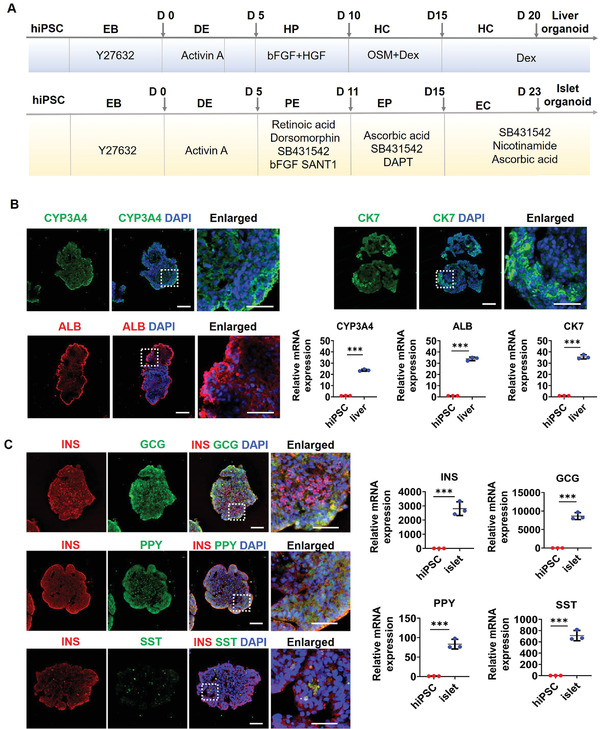
Type 2 diabetes mellitus (T2DM) is a systematic multi‐organ metabolic disease, which is characterized by the dynamic interplay among different organs. The increasing incidence of T2DM reflects an urgent need for the development of in vitro human‐relevant models for disease study and drug therapy. Here, a new microfluidic multi‐organoid system is developed that recapitulates the human liver‐pancreatic islet axis in normal and disease states. The system contains two compartmentalized regions connected by a microchannel network, enabling 3D co‐culture of human induced pluripotent stem cells (hiPSC)‐derived liver and islet organoids for up to 30 days under circulatory perfusion conditions. The co‐cultured liver and islet organoids exhibit favorable growth and improved tissue‐specific functions. Transcriptional analyses reveal the activation of metabolically relevant signaling pathways in the co‐cultured organoids. Notably, the co‐culture system facilitates sensitive glucose‐stimulated insulin secretion from islet organoids and increased glucose utilization in liver organoids by glucose tolerance tests. Both liver and islet organoids display mitochondrial dysfunction and decreased glucose transport capacity under high glucose conditions, which can be alleviated by metformin treatment. This novel multi‐organoid system can recapitulate human‐relevant liver‐islet axis under both physiological and pathological conditions, providing a unique platform for future T2DM research and drug development.
Overview
The claims and statistics of this paper haven’t been checked yet.
Free: it reads the open-access text and checks the first 5 claims that cite a source we can check. Create a free account to check every claim.
Integrity signals
Registry
Cites
Statistics
Figures



Verification
Claims the paper makes
The claims and statistics of this paper haven’t been checked yet.
Free: it reads the open-access text and checks the first 5 claims that cite a source we can check. Create a free account to check every claim.
Claims other papers make about this one
Each is checked against this paper’s own text: does it say what the citing paper says it does?
The cited source says what the claim attributes to it.
In the citing paper
“Tao et al. interfaced hiPSC-derived hepatic and pancreatic islet organoids within a unified microfluidic framework, faithfully reconstructing the human liver-islet axis under both euglycaemic and type-2-diabetic conditions.”
From Constructing biomimetic microenvironments for liver regeneration (2025) · doi:10.1186/s12951-025-03729-9 · cites this paper as [220]
In the citing paper
“This platform captures the synergistic regulation of glucose metabolism and pharmacological responses across organs, offering a powerful paradigm for interrogating multi-organ pathophysiology [220, 221].”
From Constructing biomimetic microenvironments for liver regeneration (2025) · doi:10.1186/s12951-025-03729-9 · cites this paper as [220]
Self-check
Percentages, sums and reported differences re-computed from the paper’s own numbers.
The self-check needs the paper’s full text.
Citations
Cites
Single-step method of RNA isolation by acid guanidinium thiocyanate-phenol-chloroform extraction
Chomczynski, P., & Sacchi, N. (1987) · Analytical Biochemistry · doi:10.1016/0003-2697(87)90021-2 · Cited by 46,426
Eckel, R. H., Alberti, K., Grundy, S. M., & Zimmet, P. Z. (2010) · The Lancet · doi:10.1016/s0140-6736(09)61794-3 · Cited by 6,295
Global aetiology and epidemiology of type 2 diabetes mellitus and its complications
Zheng, Y., Ley, S. H., & Hu, F. B. (2018) · Nature Reviews Endocrinology · doi:10.1038/nrendo.2017.151 · Cited by 5,697
Eckel, R. H., Grundy, S. M., & Zimmet, P. Z. (2005) · The Lancet · doi:10.1016/s0140-6736(05)66378-7 · Cited by 5,550
Type 2 diabetes: principles of pathogenesis and therapy
Stumvoll, M., Goldstein, B. J., & van Haeften, T. W. (2005) · The Lancet · doi:10.1016/s0140-6736(05)61032-x · Cited by 2,662
Serum retinol binding protein 4 contributes to insulin resistance in obesity and type 2 diabetes
Yang, Q., Graham, T. E., Mody, N., Preitner, F., Peroni, O. D., Zabolotny, J. M., Kotani, K., Quadro, L., & Kahn, B. B. (2005) · Nature · doi:10.1038/nature03711 · Cited by 2,086
Mitochondrial dysfunction and type 2 diabetes
Lowell, B. B., & Shulman, G. I. (2005) · Science · doi:10.1126/science.1104343 · Cited by 2,070
Generation of Functional Human Pancreatic β Cells In Vitro
Pagliuca, F. W., Millman, J. R., Gürtler, M., Segel, M., Van Dervort, A., Ryu, J. H., Peterson, Q. P., Greiner, D., & Melton, D. A. (2014) · Cell · doi:10.1016/j.cell.2014.09.040 · Cited by 2,025
Modeling physiological events in 2D vs. 3D cell culture
Duval, K., Grover, H., Han, L.-H., Mou, Y., Pegoraro, A. F., Fredberg, J., & Chen, Z. (2017) · Physiology · doi:10.1152/physiol.00036.2016 · Cited by 1,849
Metformin—mode of action and clinical implications for diabetes and cancer
Pernicova, I., & Korbonits, M. (2014) · Nature Reviews Endocrinology · doi:10.1038/nrendo.2013.256 · Cited by 1,349
Research works printed but not linked: 2
- 10.1038/s41574-018-0132-z · DOI
- Phillips P. J., 2012, Aust. Fam. Physician, 41, 391
Cited by
Items 101–177 of 177
Pancreatic Islet Cell Hormones: Secretion, Function, and Diabetes Therapy
Ma, J., Mao, L., Yang, L., Xie, Q., Fan, R., Lu, X., Huang, X., Tong, N., & Duan, Z. (2025) · MedComm · doi:10.1002/mco2.70359 · Cited by 20
“Research has developed a new microfluidic multiorganoid system to reveal the human liver–pancreatic islet axis in normal and disease states, and the combined culture of liver and islet organoids results in beneficial growth and improved functions specific to the tissues [163].”
Microbiota‐gut‐brain axis multi‐organ chip construction and applications in drug evaluation
Tang, Y., Chen, H., Zhao, Z., Kang, X., Wang, W., Dai, K., Guo, Y., Liang, A., Luo, A., & Hao, Z. (2025) · iMetaOmics. · doi:10.1002/imo2.70065 · Cited by 11
Self-citationLiver organoids: novel tools for discovering functional foods and food safety risk assessment
Zhong, H., Huang, Y., Hussain, M. M., Yang, M., & Guan, R. (2026) · Trends in Food Science & Technology · doi:10.1016/j.tifs.2026.105615 · Cited by 9
The application of organoids in toxicity test of environmental pollutants
Fang, Y., Akhtar, H., & Wang, J. (2024) · Cell organoid (Print) · doi:10.26599/co.2024.9410002 · Cited by 9
Yun, J., Jeon, T., & Kim, S. M. (2025) · Biomimetics · doi:10.3390/biomimetics10070443 · Cited by 10
Unraveling the Neural Circuits: Techniques, Opportunities and Challenges in Epilepsy Research
Xiao, W., Li, P., Kong, F., Kong, J., Pan, A., Long, L., Yan, X., Xiao, B., Gong, J., & Wan, L. (2024) · Cellular and Molecular Neurobiology · doi:10.1007/s10571-024-01458-5 · Cited by 9
Li, Y., Xu, M., Chen, J., Huang, J., Cao, J., Chen, H., Zhang, J., Luo, Y., Wang, Y., & Sun, J. (2024) · Stem Cell Research & Therapy · doi:10.1186/s13287-024-03780-7 · Cited by 10
“Constructing multi-organ interconnected organoid systems, such as gut-pancreas organoid systems [82], and integrated liver-gallbladder-pancreas organ chips to consolidate all organs related to diabetes metabolism [81], are viable strategies to overcome the limitations of single organ studies.”
BackgroundMethodSelf-citationUpdates on Organoid Model for the Study of Liver Cancer
El-Khobar, K. E., & Sukowati, C. H. C. (2023) · Technology in Cancer Research & Treatment · doi:10.1177/15330338231154090 · Cited by 9
“These co-cultures liver and islet organoids exhibited tissue-specific functions and metabolically relevant signaling pathways.(39) 4 Technology in Cancer Research & Treatment”
BackgroundThe role of endothelial cells in pancreatic islet development, transplantation and culture
Geng, A., Yuan, S., Yu, Q. C., & Zeng, Y. A. (2025) · Frontiers in Cell and Developmental Biology · doi:10.3389/fcell.2025.1558137 · Cited by 8
Recent Advances in Three-Dimensional In Vitro Models for Studies of Liver Fibrosis
Chi, K. Y., Kim, G., Son, J. S., Han, J., & Kim, J. (2025) · Tissue Engineering and Regenerative Medicine · doi:10.1007/s13770-025-00719-8 · Cited by 13
“Liver assembloids have emerged as a promising platform for addressing challenges in liver transplantation, particularly with regard to modeling liver fibrosis and exploring therapeutic interventions [52, 53].”
Engineering liver organoids-on-a-chip
Zhu, J., Dressman, A. S., Gall, K., & Park, S. E. (2026) · Frontiers in Lab on a Chip Technologies · doi:10.3389/frlct.2025.1719128 · Cited by 9
Kar, R., Mukhopadhyay, D., & Angom, R. S. (2024) · Hearts · doi:10.3390/hearts5040031 · Cited by 6
“There is also a limited life span for organoids, which many studies have tried to overcome by using microfluidic chips and bioreactors to increase their survival term [47].”
Zhang, T., Wang, N., Zhu, L., Chen, L., & Liu, H. (2023) · Biomedicines · doi:10.3390/biomedicines11030856 · Cited by 5
“in the successful establishment of a human liver– islet system [88], and further attempts in this field will help to address these unsolved questions.”
BackgroundInfluentialThe Values and Perspectives of Organoids in the Field of Metabolic Syndrome
Chen, T., Ding, M., & Zheng, Y. (2023) · International Journal of Molecular Sciences · doi:10.3390/ijms24098125 · Cited by 6
Advances in breast cancer organoid for individualized treatment
Li, X., & Zhu, D. (2023) · Organs-on-a-Chip · doi:10.1016/j.ooc.2023.100028 · Cited by 5
Bell, M., & Krasnodembskaya, A. D. (2025) · Stem Cells Translational Medicine · doi:10.1093/stcltm/szaf040 · Cited by 4
Li, R., Wu, Y., Zheng, Z., Zhou, F., Xu, K., & Su, J. (2026) · MedComm · doi:10.1002/mco2.70575 · Cited by 8
“[ 163 ] Liver organoids were generated from directly reprogrammed human hepatocyte-derived bipotent progenitor cells using a defined chemical cocktail.”
Microfluidic manipulation of the multicellular spheroids and organoids for modeling human diseases
Zhao, L., Xiong, S., Wang, D., & Wang, X. (2025) · Microchemical Journal · doi:10.1016/j.microc.2025.113718 · Cited by 5
Chen, Q., Li, C., Ding, W., & Kong, D. (2025) · Advanced Healthcare Materials · doi:10.1002/adhm.202503273 · Cited by 7
Engineering microfluidic human liver-islet crosstalk platform for recapitulating MASLD
Li, J., Wu, Z., Gan, J., Zhi, Y., Zhao, Y., & Li, L. (2025) · Chemical Engineering Journal · doi:10.1016/j.cej.2025.165209 · Cited by 6
The application of liver cancer organoids in tumour precision medicine: A comprehensive review
Mo, J., Gong, D., Zhai, M., Yang, J., Li, Z., Wu, M., Deng, X., & Dai, X. (2025) · iLiver · doi:10.1016/j.iliver.2025.100179 · Cited by 3
Ulanowicz, G., Galecka, V., Romanczuk, P., Kołodziejek, D., Jastrzębska, E., Brzózka, Z., & Żuchowska, A. (2025) · Advanced Materials Technologies · doi:10.1002/admt.202501748 · Cited by 5
“Due to their versatility, these microsystems have potential applications in toxicology testing [ 19 ], disease modeling [ 20 ], research into the process of cancer metastasis [ 21 ], and new drug development.”
Organs-on-chips: Advanced engineered living systems
Liu, Y., & Bian, L. (2024) · APL Bioengineering · doi:10.1063/5.0250720 · Cited by 3
Tumor organoid and tumor-on-a-chip equipped next generation precision medicine
Zhao, W., Zhang, Z., Xu, S., Sun, X., Wang, Y., Ye, J., Wang, X., Gu, Z., & Chen, Z. (2025) · Biofabrication · doi:10.1088/1758-5090/ae0bb3 · Cited by 4
Self-citationHan, M. H., Kim, D., & Yu, K. (2023) · Organoid · doi:10.51335/organoid.2023.3.e2 · Cited by 3
“In addition, cells differentiated into different lineages from iPSCs have enabled more advanced modeling of physiologically relevant organ microenvironments [12], such as the vascular system [13–15], immune system [16,17], and even connecting multiple organs [18,19].”
BackgroundTraditional and emerging strategies using hepatocytes for pancreatic regenerative medicine
Liu, S., Zhang, Y., Luo, Y., & Liu, J.-P. (2024) · Journal of Diabetes · doi:10.1111/1753-0407.13545 · Cited by 2
Abubakar, I. N., Essabbar, M., & Saikouk, H. (2024) · International Journal of Online and Biomedical Engineering (iJOE) · doi:10.3991/ijoe.v20i06.46929 · Cited by 7
Diseased human pancreas and liver microphysiological system for preclinical diabetes researchPreprint
Rigal, S., Casas, B., Kanebratt, K. P., Huldt, C. W., Magnusson, L. U., Müllers, E., Karlsson, F. H., Clausen, M., Hansson, S., Jansson‐Löfmark, R., et al. (2023) · bioRxiv (Cold Spring Harbor Laboratory) · doi:10.1101/2023.07.03.547412 · Cited by 3
An Easy-to-Use Arrayed Brain–Heart Chip
Peng, X., Wu, L., Li, Q., Ge, Y., Xu, T., & Zhao, J. (2024) · Biosensors · doi:10.3390/bios14110517 · Cited by 5
“Various tissues and organoids were cultured in designated culture chambers, which were interconnected through microfluidic channels [17].”
Developing biotechnologies in organoids for liver cancer
Hu, Y., Peng, Z., Qiu, M., Xue, L., Ren, H., Wu, X., Zhu, X., & Ding, Y. (2024) · Biomedical Technology · doi:10.1016/j.bmt.2024.100067 · Cited by 2
Xu, X., Zhang, Y., Geng, Y., Luo, Y., & Sun, X. (2025) · Frontiers in Pharmacology · doi:10.3389/fphar.2025.1650200 · Cited by 5
Zhao, M., Guo, H., Kuang, L., Dai, J., Cao, X., Yu, K., Wang, Y., Wang, Z., & Peng, C. Y. (2026) · International Journal of Surgery · doi:10.1097/js9.0000000000004634 · Cited by 2
“…liver islet-like organ chip mimics the human liver-islet axis and its glucose-stimulated response under physiological and pathological conditions [ 55 ] ; notably, the coculture system promotes robust glucose-stimulated pancreatic islet secretion in pancreatic islet-like organs and increases…”
Self-citationParini, F., Galla, R., Mulè, S., Musu, M., & Uberti, F. (2026) · International Journal of Molecular Sciences · doi:10.3390/ijms27052375 · Cited by 3
Wang, D., Huang, Y., Zhao, W., Chen, T., Bai, S., Guo, D., Wang, M., Zhao, Y., Zhao, L., Guo, G., et al. (2026) · Advanced Science · doi:10.1002/advs.202600040 · Cited by 4
Dai, H., & Zhang, Z. (2026) · Biomolecules · doi:10.3390/biom16040613 · Cited by 2
Wu, Y., Wang, Y., Zhang, W., Yuan, L.-L., & Chen, Y. (2026) · Stem Cell Research & Therapy · doi:10.1186/s13287-026-05080-8 · Cited by 2
“In parallel, a chip-based platform co-culturing iPSC-derived liver and islet organoids replicates key features of liver-pancreatic axis [158].”
Self-citationStandard: human breast cancer organoids derived from diverse clinical sample sources
Chen, Z., Xu, N., Chen, M., Hu, J., Yu, Z., Zhu, S., Zhang, Y., Zhang, R., Wang, K., Wang, S., et al. (2026) · Cell Regeneration · doi:10.1186/s13619-026-00291-z · Cited by 3
Experimental models in diabetes research
Dewalkar, L. P. (2026) · Laboratory Animal Research · doi:10.1186/s42826-026-00286-6 · Cited by 4
“…a human-derived system Used hiPSC derived islet and liver organoids in a linked platform to simulate metabolic interactions and test perturbations [151]. hPSC-derived islet organs via microfluidic device Combine differentiation and screening in-chip Built a multi-layer microfluidic device…”
Vascularized platforms for investigating cell communication via extracellular vesicles
Kim, J., Ro, J., & Cho, Y. (2024) · Biomicrofluidics · doi:10.1063/5.0220840 · Cited by 2
Liu, M., Li, X., Li, J., Zhong, Y., Lei, Y., & Liu, A. (2025) · Biotechnology Journal · doi:10.1002/biot.70076 · Cited by 2
Reconstructing community assembly using a numerical simulation model
Qiao, H., & Hu, J. (2022) · Biodiversity Science · doi:10.17520/biods.2022456 · Cited by 1
Engineering strategies of islet products for endocrine regeneration
Cheng, Y., & Zhao, G. (2023) · Engineered Regeneration · doi:10.1016/j.engreg.2023.01.003 · Cited by 4
Modelling human diabetes ex vivo: a glance at maturity onset diabetes of the young
Ka, M., Hawkins, E., Pouponnot, C., & Duvillié, B. (2024) · Frontiers in Endocrinology · doi:10.3389/fendo.2024.1427413 · Cited by 1
Avatar: The Way of Complex In Vitro Models in Cancer Nanomedicine
Mahadik, K., Dhurde, T., Sivakumar, M. B., & Rao, N. M. (2025) · Advanced Therapeutics · doi:10.1002/adtp.202500368 · Cited by 1
Liver Organoids: From Disease Modelling to Regenerative Medicine
Wang, T., Qu, X., Si, J., Meng, J., Zhang, T., & Niu, S. (2026) · Cell Proliferation · doi:10.1111/cpr.70268 · Cited by 1
Microengineered organoids: reconstituting organ-level functions in vitro
Park, S., Sharma, H., Kim, W., Gwon, Y., Kim, H., Choung, Y., & Kim, J. (2023) · Organoid · doi:10.51335/organoid.2023.3.e5 · Cited by 2
“Adapted from Tao et al. Adv Sci (Weinh) 2022;9:e2103495, with permission from Advanced Science [93].”
Background“Organ‐on‐a‐chip”の外科・代謝栄養学への応用の可能性
堀, 武., & Kaji, H. (2023) · The Japanese Journal of SURGICAL METABOLISM and NUTRITION · doi:10.11638/jssmn.57.4_85 · Cited by 1
Yaqing, W. A. N. G., Tao, T., & Qin, J. (2022) · Scientia Sinica Vitae · doi:10.1360/ssv-2022-0027 · Cited by 1
Self-citationChen, Y., & Zhao, L. (2023) · Scientia Sinica Vitae · doi:10.1360/ssv-2023-0004 · Cited by 1
Park, C. H., Noh, J. S., Jeon, J. P., & Yokozawa, T. (2023) · Drug Discoveries & Therapeutics · doi:10.5582/ddt.2022.01097
Establishment and Advancement of Pancreatic Organoids
Lee, D. H. (2024) · Gyemyeong uidae haksulji · doi:10.46308/kmj.2024.00052
Vascularization of organoids in microfluidic chips
Raji, R. G., Anjali, K., & Kumar, V. B. S. (2024) · Elsevier eBooks · doi:10.1016/b978-0-443-13782-2.00026-7
Advancements and prospects in human organoid phenomics: a comprehensive review
Zhang, W., XingYu, Y. I. N., HaiXia, G. U., HUANG, S., & Chen, C. (2024) · Scientia Sinica Vitae · doi:10.1360/ssv-2024-0113 · Cited by 1
Zhao, M., Kuang, L., Guo, H., Cao, X., Dai, J., Wang, Y., Wang, Z., & Peng, C. (2024) · bioRxiv (Cold Spring Harbor Laboratory) · doi:10.1101/2024.08.28.610094
Self-citationPeng, X., Li, L., Peng, Y., Zhou, G., & An, Z. (2024) · Annals of Medicine · doi:10.1080/07853890.2024.2322047 · Cited by 1
Application of Inorganic Bioactive Materials in Organoid Research
Ma, W., Yahui, H. A. N., Wu, C., & Lu, H. (2025) · Journal of Inorganic Materials · doi:10.15541/jim20250007
Fluidic Programmable Gravi-maze Array for High Throughput Multiorgan Drug TestingPreprint
Wong, H. C., Collins, C. J., Jose, J. A. J., Villegas, A. J., Bhakta, I. N., Collins, A. J., Katara, G., Kohana, J., Saluja, H. S., & Collins, J. P. (2025) · bioRxiv (Cold Spring Harbor Laboratory) · doi:10.1101/2025.06.18.660241
“These systems offer distinct advantages over conventional models, including the ability to simulate dynamic fluid flow, shear stress, and nutrient transport, all of which are critical for maintaining the viability and functionality of human tissues in vitro 17,18 .”
Research Progress on Pancreatic Islet Organoids
Tan, M., Li, G., Shen, N., Wang, X.-D., Du, X.-C., Zhang, L., & Zhang, H. (2025) · Current Stem Cell Research & Therapy · doi:10.2174/011574888x383245250617052324
Human iPSC-derived salivary gland organoids model diabetic salivary gland dysfunctionPreprint
Ehnes, D. D., Morishita, A., Phal, A., Jung, H. Y., Lim, Y. C., Foreman, Z., Cirulli, V., Mathieu, J., & Ruohola‐Baker, H. (2025) · bioRxiv (Cold Spring Harbor Laboratory) · doi:10.1101/2025.10.01.679897
Yang, H., Yang, S., He, J., Li, W., Zhang, A., Li, N., Zhou, G., & Sun, B. (2024) · Figshare · doi:10.6084/m9.figshare.26648253
Yang, H., Yang, S., He, J., Li, W., Zhang, A., Li, N., Zhou, G., & Sun, B. (2024) · Figshare · doi:10.6084/m9.figshare.26648259
Yang, H., Yang, S., He, J., Li, W., Zhang, A., Li, N., Zhou, G., & Sun, B. (2024) · Figshare · doi:10.6084/m9.figshare.26648256
Kim, H. J., Kim, G., Chi, K. Y., Kim, H., Jang, Y. J., Jo, S., Lee, J., Lee, Y., Woo, D.-H., Han, C., et al. (2023) · Figshare · doi:10.6084/m9.figshare.22610084
Yang, H., Yang, S., He, J., Li, W., Zhang, A., Li, N., Zhou, G., & Sun, B. (2024) · Figshare · doi:10.6084/m9.figshare.26648262
Yang, H., Yang, S., He, J., Li, W., Zhang, A., Li, N., Zhou, G., & Sun, B. (2024) · Figshare · doi:10.6084/m9.figshare.26648250
Three-dimensional models for type 2 diabetes study
Lu, Q.-Q., Zheng, Z. M., Wang, P., Hakim, M. S., & Yin, Y.-B. (2025) · Diabetology International · doi:10.1007/s13340-025-00862-6
The Use of Organoids in Dentistry: An Overview of New Research Approaches
Wadan, A. S., El‑Sadek, M. Z., Shaaban, A. H., Abdeldayem, K. N. E., Ahmed, A. H., Ahmed, M. A., Elsonpaty, H. S. A., Tawfik, A., Nabih, M. T., Elmesalamy, N., et al. (2026) · Regenerative Engineering and Translational Medicine · doi:10.1007/s40883-025-00541-7
Organoïdes hépatiques: De la promesse à la complexité fonctionnelle
Luce, E., & Duclos‐Vallée, J. (2026) · médecine/sciences · doi:10.1051/medsci/2026035
Multiscale Comparative Analyses of OVB-Organoids and Cerebral Organoids
Yang, J., Zhang, X., Li, S., & Gao, Z. (2026) · Cells · doi:10.3390/cells15080703
Self-citationWang, Y., Nozhat, Z., Duan, T., Chen, S., Ni, Y., Wang, Y., Shen, C., & You, M. (2026) · Cancer Biome and Targeted Therapy · doi:10.66505/cbtt.v1i2.37
Self-citationFrom Function to Single Cells: Analytical Innovations in Islet Biology and Diabetes Research
Roper, M. G., Edwards, J. L., & Wang, Y. J. (2026) · Annual Review of Analytical Chemistry · doi:10.1146/annurev-anchem-082024-121650
Self-citationMcGilvrey, M. I., Chew, S., Siddiqui, M. F., Bronson, R., Uslu, M., Ye, S., Ospina, O., Mcpherson, A., Diel, K., Dogsa, M., et al. (2026) · bioRxiv (Cold Spring Harbor Laboratory) · doi:10.64898/2026.05.22.726943
Pancreatic organoids and organoid-on-a-chip platforms: from disease modeling to precision therapy
Lin, M., Ma, W., Ma, T., He, Y., Shi, H., Ge, N., Guo, J., Xie, Y., Sun, S., & Yang, F. (2026) · Journal of Translational Medicine · doi:10.1186/s12967-026-08489-0
“Tao et al. [80] developed a hiPSC-derived liver-islet multi-organoid chip, where liver and islet organoids were cultured in separate chambers connected by parallel microchannels.”
Ma, H.-K., Li, X., Shen, L., & Ji, H.-F. (2026) · Foods · doi:10.3390/foods15152603
“Hence, it is clear that T2DM is not only a disease with glucose metabolism disturbance, but a complex, multifactorial disease with widespread organ dysfunction [11].”
Experimental Models for Drug Repurposing in Viral Hepatitis
Talukdar, A., & Devi, A. (2026) · Wiley eBooks · doi:10.1002/9781394466573.ch15
Kamei, K. (2026) · Communications Biology · doi:10.1038/s42003-026-10887-5
Network Biology: Current Status, Applications, Challenges, and Future Prospects
Li, X., Zhang, L., Ding, Y., Li, K., Chang, S., Pei, L., Li, Z., & Chen, Z. (2026) · MedComm · doi:10.1002/mco2.71065 · Cited by 2
“Liver-islet coculture illustrates functional coupling [ 126 ], whereas cerebral and kidney organoid studies highlight model-specific development, maturation, and standardization issues [ 127, 128 ].”
Metadata
- Authors
- Tao, T., Deng, P., Wang, Y., Zhang, X., Guo, Y., Chen, W., & Qin, J.
- Affiliations
- Dalian Institute of Chemical Physics (CN)
- Corresponding author
- Qin, Jianhua
- Venue
- Advanced Science
- Publisher
- Wiley
- Published
- 2021-12-23
- Volume
- 9
- Issue
- 5
- Pages
- e2103495-e2103495
- ISSN
- 2198-3844 (ISSN-L)
- PMC
- PMC8844474
- OpenAlex
- W4200627985
- Cited by
- 178
- References
- 65
- Citations by year
- 2026: 23 · 2025: 44 · 2024: 60 · 2023: 30 · 2022: 20 · 2021: 1
- FWCI
- 26.07
- Type
- journal article
- Language
- en
- Open access
- gold
- doi.org
- Licence
- Locations
- Advanced Science (publishedVersion, cc-by)
- PubMed Central (publishedVersion, cc-by)
- PubMed (publishedVersion)
- DOAJ (DOAJ: Directory of Open Access Journals) (submittedVersion, cc-by-sa)
- Funders
- Yunnan Key Research and Development Program (202003AD150009)
- Center for Advanced Study, University of Illinois at Urbana-Champaign (DICP I201934)
- Topics
- Health Sciences › Medicine › Endocrinology, Diabetes and Metabolism › Pancreatic function and diabetes
- Physical Sciences › Engineering › Biomedical Engineering › 3D Printing in Biomedical Research
- Health Sciences › Medicine › Surgery › Tissue Engineering and Regenerative Medicine
- Keywords
- type 2 diabetes, glucose-stimulated insulin secretion, glucose tolerance, mitochondrial dysfunction, glucose transport, metformin, in vitro disease model
- MeSH terms
- Diabetes Mellitus, Type 2, Humans, Islets of Langerhans, Liver, Organoids, Induced Pluripotent Stem Cells
About these checks
Registry, retraction, Cites and statistics results are computed, not judged, with one exception: a printed reference that no index lists is read once by a model before it counts as a citation error. Claims are extracted by a model and kept only when their quote appears verbatim in the text; each cited source is then checked, with a model’s help, for whether it says what the claim relies on. Those verdicts can be wrong — read the claim’s quote and the cited source before relying on one.
Statistics and arithmetic are recomputed, not judged.
Confidence bands are shown only for fields calibrated on our annotated test set. None is calibrated yet, so no band is shown.
What counts as a claim ›How we measure confidence ›How we check this ›
Are you an author, or do you see a problem with this page? Request a review
Data sources
Bibliographic data: Semantic Scholar, OpenAlex, Crossref.
Contains information from the Semantic Scholar Academic Graph Datasets, made available under the ODC Attribution License (ODC-BY 1.0).
Semantic Scholar’s data is described in: Kinney, R., et al. (2023). The Semantic Scholar Open Data Platform. arXiv:2301.10140.
