

The DOI matches its Crossref record; 55 of the 55 references it cites were found in a registry or an index; none of the 13 sources its claims cite is checked for support yet.
Dual Recycling of Depolymerization Catalyst and Biodegradable Polyester that Markedly Outperforms Polyolefins
Open accessAbstract
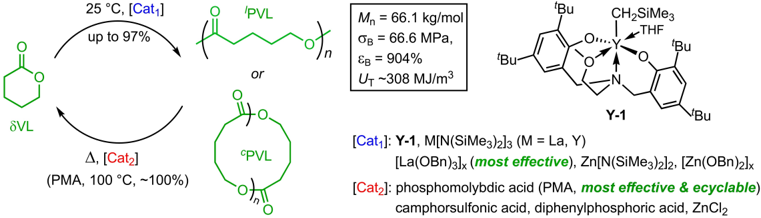
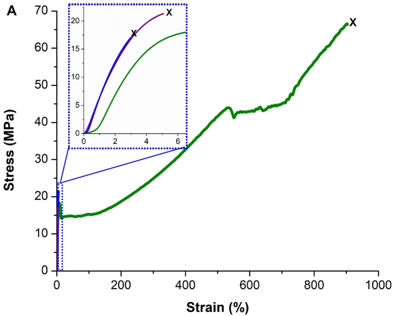
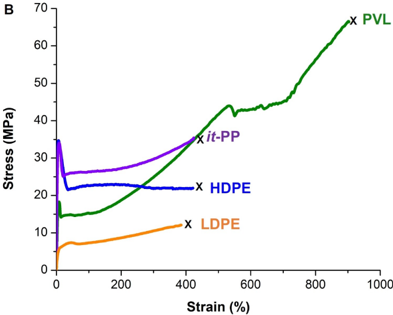
Chemically recyclable, circular polymers continue to attract increasing attention, but rendering both catalysts for depolymerization and high‐performance polymers recyclable is a more sustainable yet challenging goal. Here we introduce a dual catalyst/polymer recycling system in that recyclable inorganic phosphomolybdic acid catalyzes selective depolymerization of high‐ceiling‐temperature biodegradable poly(δ‐valerolactone) in bulk phase, which, upon reaching suitable molecular weight, exhibits outstanding mechanical performance with a high tensile strength of ≈66.6 MPa, fracture strain of ≈904 %, and toughness of ≈308 MJ m−3, and thus markedly outperforms commodity polyolefins, recovering its monomer in pure state and quantitative yield at only 100 °C. In sharp contrast, the uncatalyzed depolymerization not only requires a high temperature of >310 °C but is also low yielding and non‐selective. Importantly, the recovered monomer can be repolymerized as is to reproduce the same polymer, thereby closing the circular loop, and the recycled catalyst can be reused repeatedly for depolymerization runs without loss of its catalytic activity and efficiency.
Overview
Integrity signals
Registry
Cites
Statistics
Figures

Verification
Claims the paper makes
0 Valid · 3 Not valid · 11 Not checked · 57 Own results and interpretations
A result the paper states — it cites no source for it, so there is none to check. The quote shows it is in the paper.
In the paper
“To this end, we describe herein that identifying potent catalysts for the effective ROP of δVL leads to PVL materials with outstanding mechanical properties that largely outperform even robust polyolefins and for catalyzed, selective depolymerization of the resulting bulk PVL (solvent-free) with a recyclable catalyst to recover δVL in pure state and quantitative yield at desirably mild temperature”
§ Recyclable Polymers Hot Paper Dual Recycling of Depolymerization Catalyst and Biodegradable Polyester that Markedly Outperforms Polyolefins > Introduction
plainstates a cause- Asserted: passes — The authors put it forward as true.
- Checkable: passes — It can be checked against evidence.
- Load-bearing: passes — The paper’s conclusions depend on it.
- Based: passes — The paper gives a reason why it holds.
A result the paper reports from its own data — it cites no other source for it, so there is none to check. The quote shows it is in the paper.
In the paper
“Importantly, the recovered monomer can be repolymerized as is to reproduce the same polymer, thereby closing the circular loop”
§ Recyclable Polymers Hot Paper Dual Recycling of Depolymerization Catalyst and Biodegradable Polyester that Markedly Outperforms Polyolefins > Abstract
plainstates a cause- Asserted: passes — The authors put it forward as true.
- Checkable: passes — It can be checked against evidence.
- Load-bearing: passes — The paper’s conclusions depend on it.
- Based: passes — The paper gives a reason why it holds.
A result the paper reports from its own data — it cites no other source for it, so there is none to check. The quote shows it is in the paper.
In the paper
“To this end, we describe herein that identifying potent catalysts for the effective ROP of δVL leads to PVL materials with outstanding mechanical properties that largely outperform even robust polyolefins and for catalyzed, selective depolymerization of the resulting bulk PVL (solvent-free) with a recyclable catalyst to recover δVL in pure state and quantitative yield at desirably mild temperature”
- Also stated in: § Abstract · plain
“recovering its monomer in pure state and quantitative yield at only 100 °C”
§ Recyclable Polymers Hot Paper Dual Recycling of Depolymerization Catalyst and Biodegradable Polyester that Markedly Outperforms Polyolefins > Introduction
plainstates a cause- Asserted: passes — The authors put it forward as true.
- Checkable: passes — It can be checked against evidence.
- Load-bearing: passes — The paper’s conclusions depend on it.
- Based: passes — The paper gives a reason why it holds.
- Also stated in: § Abstract · plain
A result the paper reports from its own data — it cites no other source for it, so there is none to check. The quote shows it is in the paper.
In the paper
“Here we introduce a dual catalyst/polymer recycling system in that recyclable inorganic phosphomolybdic acid catalyzes selective depolymerization of high-ceiling-temperature biodegradable poly(δ-valerolactone) in bulk phase”
§ Recyclable Polymers Hot Paper Dual Recycling of Depolymerization Catalyst and Biodegradable Polyester that Markedly Outperforms Polyolefins > Abstract
plainstates a cause- Asserted: passes — The authors put it forward as true.
- Checkable: passes — It can be checked against evidence.
- Load-bearing: passes — The paper’s conclusions depend on it.
- Based: passes — The paper gives a reason why it holds.
A result the paper reports from its own data — it cites no other source for it, so there is none to check. The quote shows it is in the paper.
In the paper
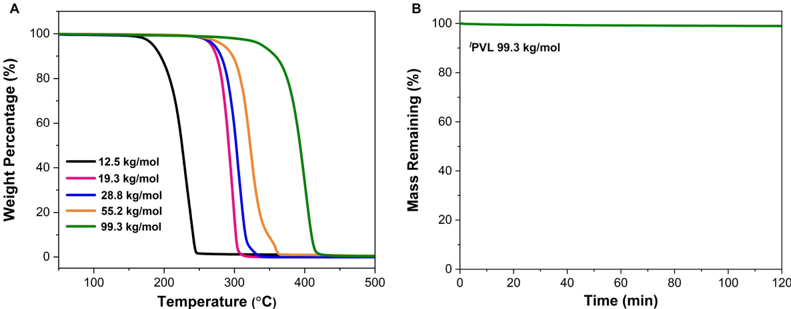
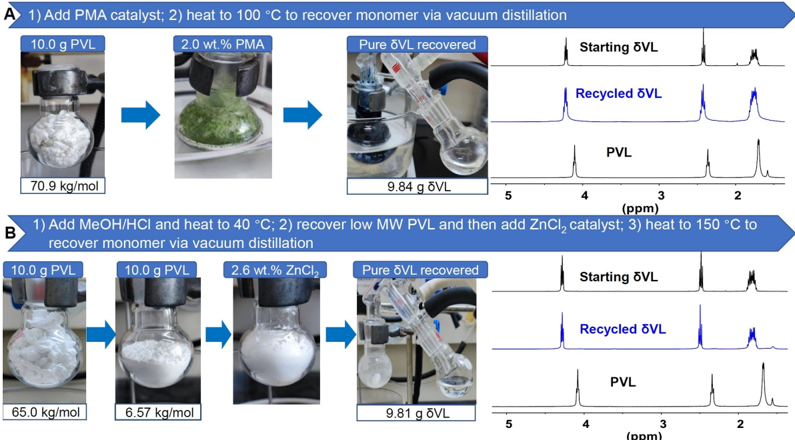
“When linear PVL with a low molecular weight (M n = 12.5 kg mol À 1 , Đ = 1.18) was mixed with 2.0 mol % ZnCl 2 at 150 °C under reduce pressure (0.07 Torr), δVL in near-quantitative purity and isolated yield (99 %) was recovered”
§ Recyclable Polymers Hot Paper Dual Recycling of Depolymerization Catalyst and Biodegradable Polyester that Markedly Outperforms Polyolefins > Chemical Recycling of PVL by Recyclable Catalyst
plainstates a causeSingle case- Asserted: passes — The authors put it forward as true.
- Checkable: passes — It can be checked against evidence.
- Load-bearing: passes — The paper’s conclusions depend on it.
- Based: passes — The paper gives a reason why it holds.
43 more claims
Create a free account to see all 71 claims and every source verdict.
- It may state two separate claims as one. 20
- The quote only partly states this claim. 1
- Probably not a substantial claim. 6
Citations
Cites
Williams, M. L., Landel, R. F., & Ferry, J. D. (1955) · Journal of the American Chemical Society · doi:10.1021/ja01619a008 · Cited by 8,083
Controlled Ring-Opening Polymerization of Lactide and Glycolide
Dechy-Cabaret, O., Martin-Vaca, B., & Bourissou, D. (2004) · Chemical Reviews · doi:10.1021/cr040002s · Cited by 2,257
Chemical recycling to monomer for an ideal, circular polymer economy
Coates, G. W., & Getzler, Y. D. Y. L. (2020) · Nature Reviews Materials · doi:10.1038/s41578-020-0190-4 · Cited by 1,644
Organocatalytic Ring-Opening Polymerization
Kamber, N. E., Jeong, W., Waymouth, R. M., Pratt, R. C., Lohmeijer, B. G. G., & Hedrick, J. L. (2007) · Chemical Reviews · doi:10.1021/cr068415b · Cited by 1,489
Critical advances and future opportunities in upcycling commodity polymers
Jehanno, C., Alty, J. W., Roosen, M., De Meester, S., Dove, A. P., Chen, E. Y.-X., Leibfarth, F. A., & Sardon, H. (2022) · Nature · doi:10.1038/s41586-021-04350-0 · Cited by 1,325
Self-citationChemically recyclable polymers: a circular economy approach to sustainability
Hong, M., & Chen, E. Y.-X. (2017) · Green Chemistry · doi:10.1039/c7gc01496a · Cited by 876
Self-citationThomas, C. M. (2010) · Chem. Soc. Rev. · doi:10.1039/b810065a · Cited by 853
Bio-based polymers with performance-advantaged properties
Cywar, R. M., Rorrer, N. A., Hoyt, C. B., Beckham, G. T., & Chen, E. Y.-X. (2021) · Nature Reviews Materials · doi:10.1038/s41578-021-00363-3 · Cited by 811
Self-citationA synthetic polymer system with repeatable chemical recyclability
Zhu, J.-B., Watson, E. M., Tang, J., & Chen, E. Y.-X. (2018) · Science · doi:10.1126/science.aar5498 · Cited by 709
Self-citationHong, M., & Chen, E. Y.-X. (2016) · Nature Chemistry · doi:10.1038/nchem.2391 · Cited by 677
Self-citation
Research works printed but not linked: 1
- Khalil M. I., 2015, Asian J. Biochem. Pharm. Res., 5, 137
Cited by
Recyclable and (Bio)degradable Polyesters in a Circular Plastics Economy
Shi, C., Quinn, E. C., Diment, W. T., & Chen, E. Y.-X. (2024) · Chemical Reviews · doi:10.1021/acs.chemrev.3c00848 · Cited by 402
Self-citationDepolymerization within a Circular Plastics System
Clark, R. A., & Shaver, M. P. (2024) · Chemical Reviews · doi:10.1021/acs.chemrev.3c00739 · Cited by 408
Ring-Opening Polymerization of Lactones to Prepare Closed-Loop Recyclable Polyesters
Li, Z., Shen, Y., & Li, Z. (2024) · Macromolecules · doi:10.1021/acs.macromol.3c01912 · Cited by 126
Yang, S., Du, S., Zhu, J., & Ma, S. (2024) · Chemical Society Reviews · doi:10.1039/d4cs00663a · Cited by 117
The thermodynamics and kinetics of depolymerization: what makes vinyl monomer regeneration feasible?
Lohmann, V., Jones, G. R., Truong, N. P., & Anastasaki, A. (2023) · Chemical Science · doi:10.1039/d3sc05143a · Cited by 106
Metadata
- Authors
- Li, X., Clarke, R. W., An, H., Gowda, R. R., Jiang, J., Xu, T., & Chen, E. Y. ‐.
- Affiliations
- State Key Laboratory of Fine Chemicals Department of Chemistry School of Chemical Engineering Dalian University of Technology Dalian 116024 China
- Colorado State University (US)
- Corresponding author
- Chen, Eugene Y.‐X.
- Venue
- Angewandte Chemie International Edition
- Publisher
- Wiley
- Published
- 2023-05-16
- Volume
- 62
- Issue
- 26
- Pages
- e202303791-e202303791
- ISSN
- 1433-7851 (ISSN-L)
- 1521-3773
- OpenAlex
- W4367174559
- Cited by
- 93
- References
- 55
- Citations by year
- 2026: 21 · 2025: 26 · 2024: 35 · 2023: 11
- FWCI
- 5.93
- Type
- journal article
- Language
- en
- Open access
- hybrid
- doi.org
- Locations
- Angewandte Chemie International Edition (publishedVersion, cc-by)
- PubMed (publishedVersion)
- OSTI OAI (U.S. Department of Energy Office of Scientific and Technical Information) (submittedVersion)
- Funders
- National Natural Science Foundation of China (21774017)
- Fundamental Research Funds for the Central Universities (DUT20LK35)
- Office of Science (DE-SC0022290)
- Topics
- Physical Sciences › Materials Science › Biomaterials › biodegradable polymer synthesis and properties
- Physical Sciences › Materials Science › Polymers and Plastics › Polymer crystallization and properties
- Physical Sciences › Materials Science › Polymers and Plastics › Polymer composites and self-healing
- Keywords
- poly(δ-valerolactone), chemical recycling, phosphomolybdic acid, catalyst recycling, biodegradable polyesters, monomer recovery, mechanical properties, repolymerization
- MeSH terms
- Catalysis, Polyenes, Polyesters, Polymers
About these checks
Registry, retraction, Cites and statistics results are computed, not judged, with one exception: a printed reference that no index lists is read once by a model before it counts as a citation error. Claims are extracted by a model and kept only when their quote appears verbatim in the text; each cited source is then checked, with a model’s help, for whether it says what the claim relies on. Those verdicts can be wrong — read the claim’s quote and the cited source before relying on one.
A language model drew the claims from the paper on 2026-10-01, under version 3 of the claim definition (model deepseek-v4.1-flash, prompt extract-v3).
A second model labelled each claim on 2026-10-01 (model jev-1.13-20260917, definition revision gold-guideline-v0.2).
Statistics and arithmetic are recomputed, not judged.
Confidence bands are shown only for fields calibrated on our annotated test set. None is calibrated yet, so no band is shown.
What counts as a claim ›How we measure confidence ›How we check this ›
Are you an author, or do you see a problem with this page? Request a review
How to cite
Cite CoChat for the checks on this page, and the paper for its own findings.
- This page
- CoChat. (2026). Citation check: Dual Recycling of Depolymerization Catalyst and Biodegradable Polyester that Markedly Outperforms Polyolefins. https://app.cochat.ai/papers/10.1002/anie.202303791
- The paper
- Li, X., Clarke, R. W., An, H., Gowda, R. R., Jiang, J., Xu, T., & Chen, E. Y. ‐. (2023). Dual Recycling of Depolymerization Catalyst and Biodegradable Polyester that Markedly Outperforms Polyolefins. Angewandte Chemie International Edition. https://doi.org/10.1002/anie.202303791
Data sources
Bibliographic data: Semantic Scholar, OpenAlex, Crossref.
Contains information from the Semantic Scholar Academic Graph Datasets, made available under the ODC Attribution License (ODC-BY 1.0).
Semantic Scholar’s data is described in: Kinney, R., et al. (2023). The Semantic Scholar Open Data Platform. arXiv:2301.10140.
