

The DOI matches its Crossref record; 2 of the 2 references it cites were found in a registry or an index.
Neural correlates of appreciating natural landscape and landscape garden: Evidence from an fMRI study
Open accessAbstract
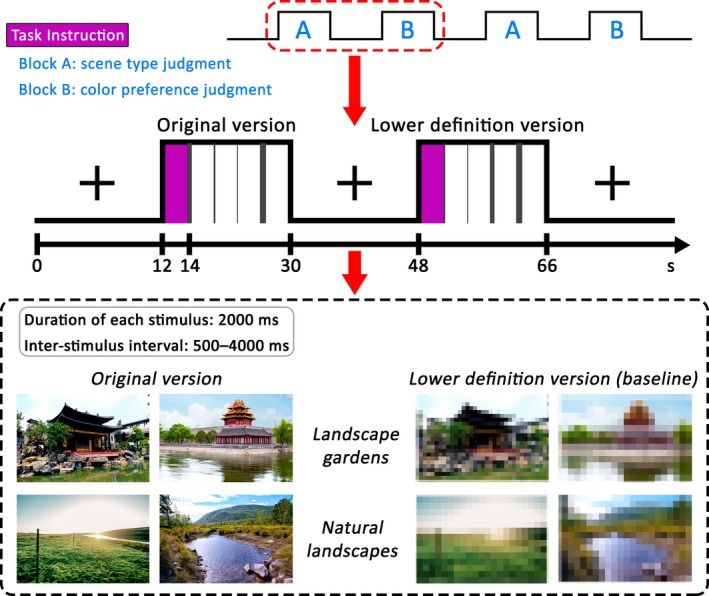
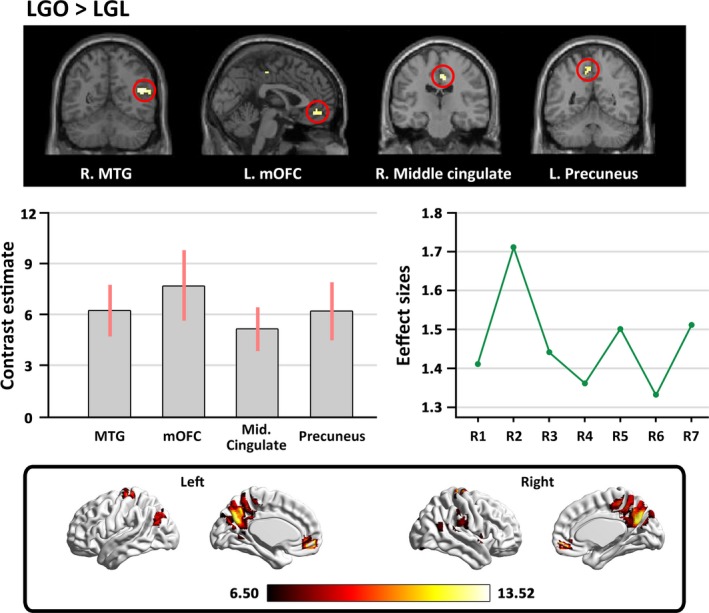
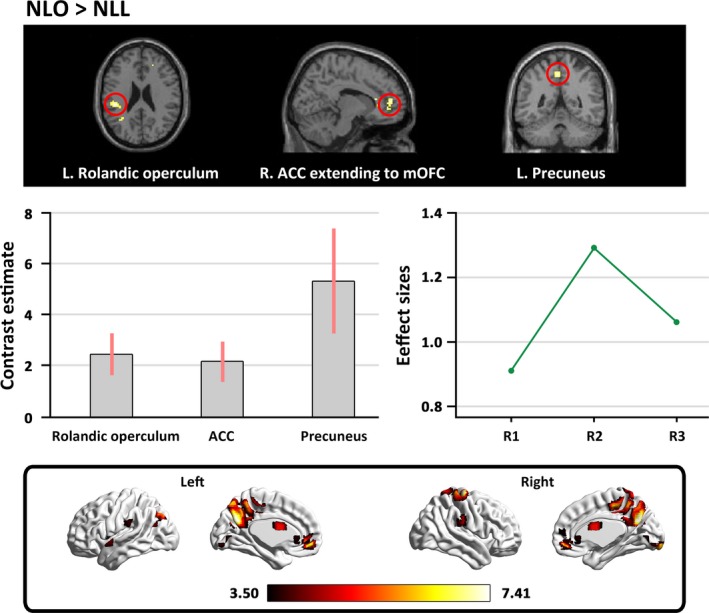
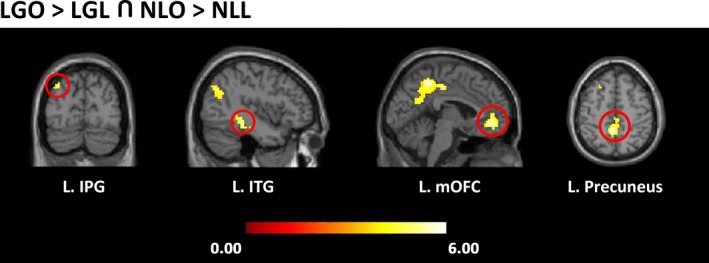
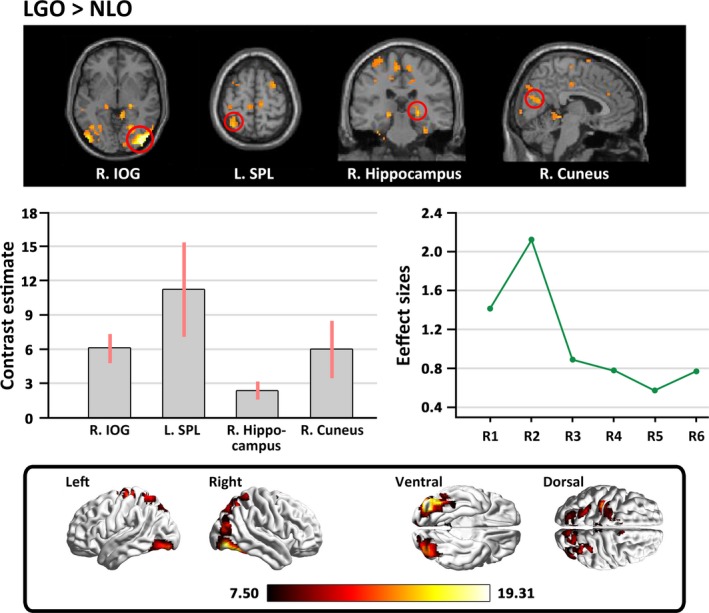
Introduction: Rambling natural landscapes or landscape gardens may invoke positive emotions. However, the manner in which people experience landscape gardens and the cortical differences in the appreciation of the naturalness and artificiality of landscapes remain unknown. Methods: This study scanned participants with functional magnetic resonance imaging while they viewed photographs of natural landscapes and landscape gardens and performed scene type judgment task. Results: As predicted, we identified brain regions that were associated with perceptual process, cognitive process, and rewarding experience when appreciating natural landscapes and landscape gardens without color preference. Meanwhile, the contrast between the appreciation of landscape gardens and natural landscapes was characterized by stronger activations of the inferior occipital lobe, the left superior parietal lobule (SPL), the right fusiform gyrus, the right cuneus, and the right hippocampus. Conclusions: Responses in these regions indicate that the appreciation of landscape gardens and natural landscapes relies on common cortical regions, and suggest the possibility that the inferior occipital lobe, the SPL, the fusiform gyrus, and the cuneus may be specifically associated with the appreciation of landscape gardens.
Overview
The claims and statistics of this paper haven’t been checked yet.
Run the check — free, no account needed. It reads the open-access text and checks the sources it cites.
Integrity signals
Registry
Cites
Statistics
Figures
Verification
Claims the paper makes
The claims and statistics of this paper haven’t been checked yet.
Run the check — free, no account needed. It reads the open-access text and checks the sources it cites.
Claims other papers make about this one
Each is checked against this paper’s own text: does it say what the citing paper says it does?
The source backs part of the claim, not all of it — or backs it for a different population, condition or comparison.
In the citing paper
“There are even studies using modern brain visualization techniques, such as fMRI, which demonstrate that experiencing natural environments really affects human brain function.”
From The Oxytocinergic System as a Mediator of Anti-stress and Instorative Effects Induced by Nature: The Calm and Connection Theory (2021) · cites this paper as Zhang et al., 2019
Experimental — accuracy not yet measured
Self-check
Percentages, sums and reported differences re-computed from the paper’s own numbers.
The self-check needs the paper’s full text.
Citations
Cites
Beauty in a smile: the role of medial orbitofrontal cortex in facial attractiveness
O’Doherty, J., Winston, J., Critchley, H., Perrett, D., Burt, D. M., & Dolan, R. J. (2003) · Neuropsychologia · doi:10.1016/s0028-3932(02)00145-8 · Cited by 898
Creativity in the Wild: Improving Creative Reasoning through Immersion in Natural Settings
Atchley, R. A., Strayer, D. L., & Atchley, P. (2012) · PLoS ONE · doi:10.1371/journal.pone.0051474 · Cited by 431
Research works printed but not linked: 42
- Berlyne D. E., 1971, Aesthetic and psychobiology
- 10.1111/j.1749-6632.2011.06400.x · DOI · Paper page
- 10.1162/jocn.2010.21457 · DOI
- 10.1093/acprof:oso/9780199811809.001.0001 · DOI
- 10.1016/j.tics.2014.03.003 · DOI
- 10.1038/srep40201 · DOI
- 10.1162/jocn_a_01146 · DOI
- 10.1177/1354067X02008002437 · DOI
- 10.1073/pnas.1620658114 · DOI
- 10.1016/j.conb.2009.09.001 · DOI
- 10.1371/journal.pone.0001201 · DOI
- 10.1016/j.neuroimage.2012.04.038 · DOI
- 10.1016/j.neuron.2009.06.001 · DOI
- 10.1006/jevp.1998.0089 · DOI · Paper page
- 10.1371/journal.pone.0021852 · DOI
- 10.1111/ejn.12135 · DOI
- 10.1002/hbm.23657 · DOI
- 10.1093/scan/nst147 · DOI
- 10.1037/1089-2680.11.4.305 · DOI
- 10.1007/s10539-013-9371-5 · DOI
- 10.1016/j.bandc.2008.08.004 · DOI · Paper page
- 10.1523/JNEUROSCI.2270-15.2015 · DOI
- 10.1523/JNEUROSCI.5202-13.2014 · DOI
- 10.3389/fnhum.2014.00478 · DOI
- 10.1016/j.neuroimage.2004.12.005 · DOI
- 10.1162/089892901750363244 · DOI
- 10.1016/j.jenvp.2009.10.009 · DOI
- 10.1093/aesthj/ayu073 · DOI
- Shimamura A., 2013, Experiencing art: In the brain of the beholder
- 10.1097/00001756-200404090-00032 · DOI
- 10.1037/a0031591 · DOI
- 10.1016/j.jenvp.2014.11.006 · DOI
- 10.1073/pnas.1301227110 · DOI
- 10.1093/scan/nsu123 · DOI
- 10.3389/fnhum.2014.01018 · DOI
- 10.1007/s12021-016-9299-4 · DOI
- 10.3389/fnhum.2014.00068 · DOI
- 10.1016/j.jenvp.2013.11.008 · DOI
- 10.1038/s41598-017-07608-8 · DOI
- 10.1016/j.bbr.2016.02.029 · DOI
- 10.1177/1474704917749742 · DOI
- 10.3389/fpsyg.2018.00071 · DOI
Cited by
Sorted by citations
Grahn, P., Ottosson, J., & Uvnäs-Moberg, K. (2021) · Frontiers in Psychology · doi:10.3389/fpsyg.2021.617814 · Cited by 46
Metadata
- Authors
- Zhang, W., He, X., Liu, S., Li, T., Li, J., Tang, X., & Lai, S.
- Affiliations
- South China Normal University (CN)
- State Key Laboratory of Subtropical Building Science (CN)
- Preschool Education Guidance Center of Tianhe District Public Kindergarten of Guangzhou Government Guangzhou P. R. China
- Corresponding author
- He, Xianyou
- Tang, Xiaoxiang
- Venue
- Brain and Behavior
- Publisher
- Wiley
- Published
- 2019-06
- Volume
- 9
- Issue
- 7
- Pages
- e01335-e01335
- ISSN
- 2157-9032 (ISSN-L)
- 2162-3279
- PMC
- PMC6625478
- OpenAlex
- W2947060376
- Cited by
- 32
- References
- 2
- Citations by year
- 2026: 2 · 2025: 8 · 2024: 3 · 2023: 6 · 2022: 3 · 2021: 7 · 2020: 2 · 2019: 1
- FWCI
- 1.89
- Type
- journal article
- Language
- en
- Open access
- gold
- doi.org
- Licence
- Locations
- Brain and Behavior (publishedVersion, cc-by)
- PubMed Central (publishedVersion, cc-by)
- PubMed (publishedVersion)
- DOAJ (DOAJ: Directory of Open Access Journals) (submittedVersion)
- Funders
- National Natural Science Foundation of China (31671132)
- Topics
- Life Sciences › Neuroscience › Cognitive Neuroscience › Aesthetic Perception and Analysis
- Social Sciences › Urban Studies › Urban Green Space and Health
- Physical Sciences › Engineering › Architecture › Landscape and Cultural Studies
- Keywords
- landscape appreciation, natural landscapes, landscape gardens, neural correlates, superior parietal lobule, fusiform gyrus, hippocampus, cuneus, landscape perception
- MeSH terms
- Gardens, Adolescent, Adult, Brain, Brain Mapping, Emotions, Female, Humans, Judgment, Magnetic Resonance Imaging, Male, Neural Pathways, Photography, Reward, Young Adult
About these checks
Registry, retraction, Cites and statistics results are computed, not judged, with one exception: a printed reference that no index lists is read once by a model before it counts as a citation error. Claims are extracted by a model and kept only when their quote appears verbatim in the text; each cited source is then checked, with a model’s help, for whether it says what the claim relies on. Those verdicts can be wrong — read the claim’s quote and the cited source before relying on one.
Statistics and arithmetic are recomputed, not judged.
Confidence bands are shown only for fields calibrated on our annotated test set. None is calibrated yet, so no band is shown.
What counts as a claim ›How we measure confidence ›How we check this ›
Are you an author, or do you see a problem with this page? Request a review
How to cite
Cite CoChat for the checks on this page, and the paper for its own findings.
- This page
- CoChat. (2026). Citation check: Neural correlates of appreciating natural landscape and landscape garden: Evidence from an fMRI study. https://app.cochat.ai/papers/10.1002/brb3.1335
- The paper
- Zhang, W., He, X., Liu, S., Li, T., Li, J., Tang, X., & Lai, S. (2019). Neural correlates of appreciating natural landscape and landscape garden: Evidence from an fMRI study. Brain and Behavior. https://doi.org/10.1002/brb3.1335
