

The DOI matches its Crossref record; 2 of the 2 references it cites were found in a registry or an index.
Value creation in circular economy business for sustainability: A stakeholder relationship perspective
Abstract
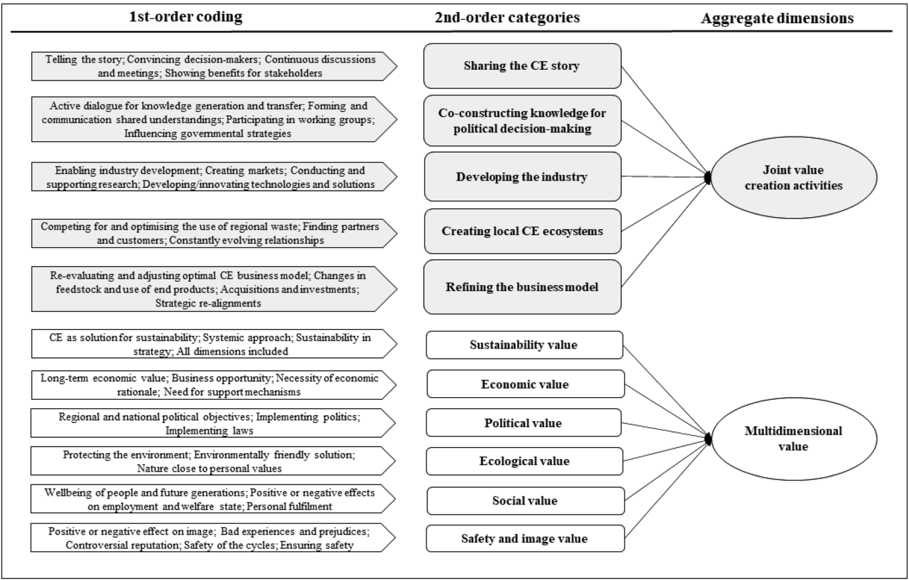
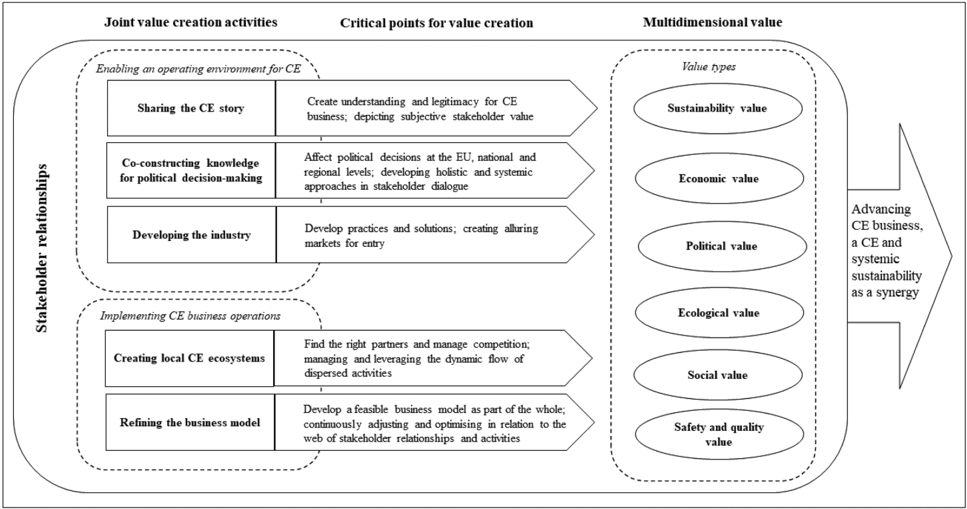
A circular economy (CE) requires companies to rethink their value creation and stakeholder relationships. While value creation in a CE business is typically understood from a company‐centric perspective, this article utilises stakeholder theory to conceptualise value creation as a relational, systemic activity involving multiple stakeholder relationships. We conduct a case study of the CE business development of a Finnish energy company and offer novel insights by identifying five joint value creation activities: sharing the CE story, co‐constructing knowledge for political decision‐making, developing the industry, creating local CE ecosystems and refining the business model. Additionally, we define the concept of multidimensional value, which acknowledges multifaceted, subjective stakeholder value expectations and enables the engagement of stakeholders in joint value creation activities. We conclude that the stakeholder relationship perspective on CE business value creation allows for the creation of the synergy necessary to advance CE business and sustainability.
Overview
The claims and statistics of this paper haven’t been checked yet.
Run the check — free, no account needed. It reads the open-access text and checks the sources it cites.
Integrity signals
Registry
Cites
Statistics
Figures

Verification
Claims the paper makes
The claims and statistics of this paper haven’t been checked yet.
Run the check — free, no account needed. It reads the open-access text and checks the sources it cites.
Claims other papers make about this one
Each is checked against this paper’s own text: does it say what the citing paper says it does?
In the citing paper
“In line with Tapaninaho and Heikkinen (2022) as well as Marjamaa et al. (2021), this paper acknowledges that this widely shared goal may be realized through extensive stakeholder collaborations guided by innovative governance.”
From Stakeholder governance to facilitate collaboration for a systemic circular economy transition: A qualitative study in the European chemicals and plastics industry (2024) · cites this paper as Tapaninaho and Heikkinen, 2022
In the citing paper
“Most relevant to the CE context, Tapaninaho and Heikkinen (2022, p. 2) argue that stakeholder relationships in a CE imply a mode of value creation that goes ' beyond the traditional and dominant focus on a single company and on firm profitability and competitiveness, '”
From Stakeholder governance to facilitate collaboration for a systemic circular economy transition: A qualitative study in the European chemicals and plastics industry (2024) · cites this paper as Tapaninaho and Heikkinen, 2022
Self-check
Percentages, sums and reported differences re-computed from the paper’s own numbers.
The self-check needs the paper’s full text.
Citations
Cites
Conceptualizing the circular economy: An analysis of 114 definitions
Kirchherr, J., Reike, D., & Hekkert, M. (2017) · Resources, Conservation and Recycling · doi:10.1016/j.resconrec.2017.09.005 · Cited by 8,550
Ghisellini, P., Cialani, C., & Ulgiati, S. (2016) · Journal of Cleaner Production · doi:10.1016/j.jclepro.2015.09.007 · Cited by 6,536
Research works printed but not linked: 42
- 10.1002/bse.2590 · DOI
- 10.1016/j.eist.2018.02.001 · DOI · Paper page
- 10.1016/j.jclepro.2012.07.007 · DOI · Paper page
- 10.1002/bse.2466 · DOI · Paper page
- Eikelenboom M. &deJong G.(2021).The impact of managers and network interactions on the integration of circularity in business strategy. Organization & Environment 1–29.https://doi.org/10.1177/1086026621994635 · DOI
- 10.1002/bse.2554 · DOI · Paper page
- Finnish Government, 2019, Inclusive and Competent Finland: A Socially, Economically and Ecologically Sustainable Society (Publications of the Finnish Government 2019: 33)
- 10.1057/palgrave.crr.1540226 · DOI
- 10.1017/CBO9780511815768 · DOI · Paper page
- 10.1177/0007650318773750 · DOI
- 10.1007/s10551-019-04112-z · DOI · Paper page
- 10.1177/0008125618811926 · DOI
- 10.1007/s10551-013-2001-y · DOI
- 10.1016/j.jclepro.2018.04.159 · DOI
- 10.1016/j.jclepro.2016.12.048 · DOI · Paper page
- 10.1177/1094428112452151 · DOI · Paper page
- 10.1023/B:BUSI.0000017968.21563.05 · DOI
- 10.1002/smj.801 · DOI
- 10.5840/beq20132314 · DOI
- 10.1177/1086026614535786 · DOI
- Jonker J., 2020, Collaborative business models for transition, TNO Report, 1
- Jonker J. &Faber N.(2018).Business models for multiple value creation: Exploring strategic changes in organisations enabling to address societal challenges. InA.Aagaard(Ed.) Sustainable business models: innovation implementation and success (pp.151–179). Springer Nature. · DOI
- Krippendorff K., 2004, Content Analysis. An Introductory to Its Methodology
- 10.1111/jiec.12763 · DOI · Paper page
- 10.1177/2277977921991914 · DOI · Paper page
- 10.1016/j.ecolecon.2018.12.012 · DOI
- 10.1007/s10551-015-2693-2 · DOI · Paper page
- 10.1007/s10551-011-0945-3 · DOI
- 10.1080/13645570701401305 · DOI
- 10.1002/bse.2602 · DOI
- Quarshie A. Salmi A. &Wu Z.(2021).From equivocality to reflexivity in biodiversity protection. Organization & Environment 34(4) 530–558.https://doi.org/10.1177/1086026619837122 · DOI
- 10.1016/j.jclepro.2018.08.072 · DOI
- 10.1002/(SICI)1099-0925(200003)7:1<29::AID-EMA119>3.0.CO;2-1 · DOI
- Stake R. E., 2005, Handbook of Qualitative Research, 443
- 10.1002/smj.2337 · DOI
- 10.1007/978-3-030-03562-4_1 · DOI
- Tsoukas H., 2009, Sage Handbook of Organizational Research Methods, 285
- 10.1016/j.jclepro.2017.09.047 · DOI
- 10.1016/j.spc.2021.02.018 · DOI · Paper page
- WCED, United Nations World Commission on Environment and Development, 1987, Our Common Future
- 10.1057/jibs.2010.55 · DOI
- 10.1016/j.jclepro.2016.07.102 · DOI
Cited by
Sorted by citations
Schultz, F. C., Valentinov, V., Kirchherr, J., Reinhardt, R. J., & Pies, I. (2024) · Business Strategy and the Environment · doi:10.1002/bse.3592 · Cited by 82
Rittershaus, P., Aryan, V., Sánchez, D., Renner, M., & Poeppelbuss, J. (2026) · Business Strategy and the Environment · doi:10.1002/bse.70271 · Cited by 3
Metadata
- Authors
- Tapaninaho, R., & Heikkinen, A.
- Affiliations
- Faculty of Management and Business Tampere University Tampere Finland
- Venue
- Business Strategy and the Environment
- Publisher
- Wiley
- Published
- 2022-01-27
- Volume
- 31
- Issue
- 6
- Pages
- 2728-2740
- ISSN
- 0964-4733
- 1099-0836
- Cited by
- 205
- References
- 2
- Language
- en
- Funders
- Strategic Research Council (320194, 320206)
About these checks
Registry, retraction, Cites and statistics results are computed, not judged, with one exception: a printed reference that no index lists is read once by a model before it counts as a citation error. Claims are extracted by a model and kept only when their quote appears verbatim in the text; each cited source is then checked, with a model’s help, for whether it says what the claim relies on. Those verdicts can be wrong — read the claim’s quote and the cited source before relying on one.
Statistics and arithmetic are recomputed, not judged.
Confidence bands are shown only for fields calibrated on our annotated test set. None is calibrated yet, so no band is shown.
What counts as a claim ›How we measure confidence ›How we check this ›
Are you an author, or do you see a problem with this page? Request a review
