

Molecular Evolution, Structure, and Function of Peroxidasins
Open accessThe DOI matches its Crossref record; 45 of the 46 references it cites were found in a registry or an index.
Abstract
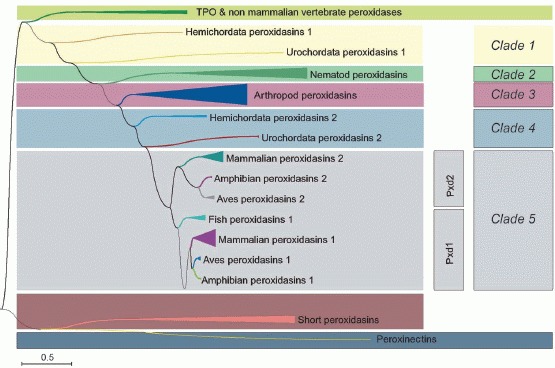
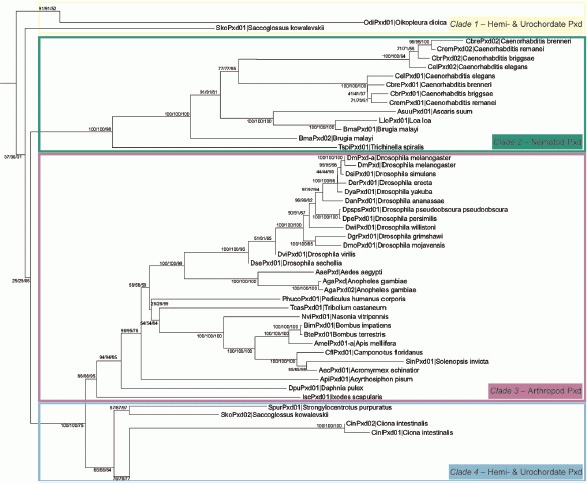
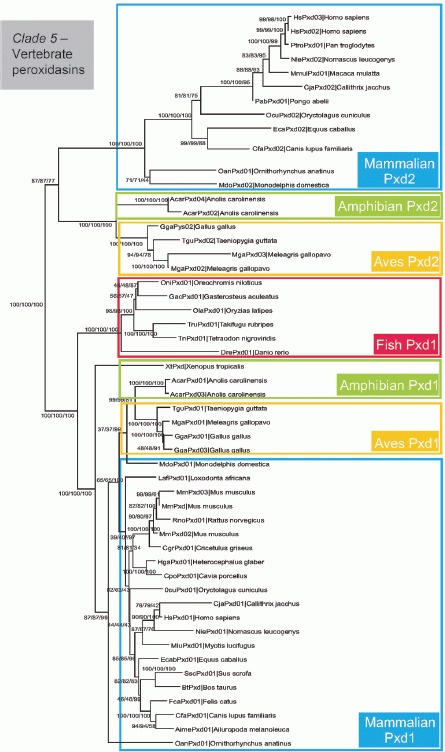
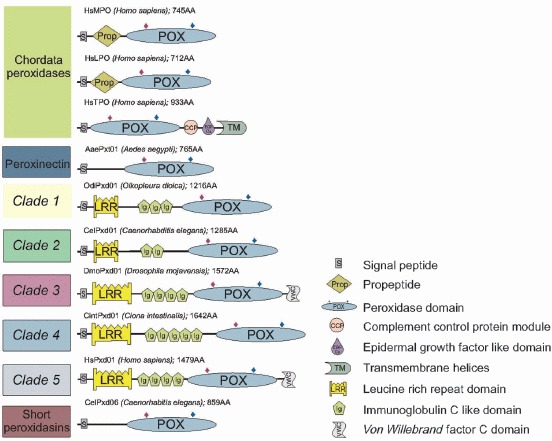
Peroxidasins represent the subfamily 2 of the peroxidase‐cyclooxygenase superfamily and are closely related to chordata peroxidases (subfamily 1) and peroxinectins (subfamily 3). They are multidomain proteins containing a heme peroxidase domain with high homology to human lactoperoxidase that mediates one‐ and two‐electron oxidation reactions. Additional domains of the secreted and glycosylated metalloproteins are type C‐like immunoglobulin domains, typical leucine‐rich repeats, as well as a von Willebrand factor C module. These are typical motifs of extracellular proteins that mediate protein–protein interactions. We have reconstructed the phylogeny of this new family of oxidoreductases and show the presence of four invertebrate clades as well as one vertebrate clade that includes also two different human representatives. The variability of domain assembly in the various clades was analyzed, as was the occurrence of relevant catalytic residues in the peroxidase domain based on the knowledge of catalysis of the mammalian homologues. Finally, the few reports on expression, localization, enzymatic activity, and physiological roles in the model organisms Drosophila melanogaster, Caenorhabditis elegans, and Homo sapiens are critically reviewed. Roles attributed to peroxidasins include antimicrobial defense, extracellular matrix formation, and consolidation at various developmental stages. Many research questions need to be solved in future, including detailed biochemical/physical studies and elucidation of the three dimensional structure of a model peroxidasin as well as the relation and interplay of the domains and the in vivo functions in various organisms including man.
Overview
The claims and statistics of this paper haven’t been checked yet.
Free: it reads the open-access text and checks the first 5 claims that cite a source we can check. Create a free account to check every claim.
Integrity signals
Registry
Cites
Statistics
Figures

Verification
Claims the paper makes
The claims and statistics of this paper haven’t been checked yet.
Free: it reads the open-access text and checks the first 5 claims that cite a source we can check. Create a free account to check every claim.
Claims other papers make about this one
Each is checked against this paper’s own text: does it say what the citing paper says it does?
In the citing paper
“However, the mechanisms behind peroxidasin-induced fibrosis regression does not require its crosslinking activity towards collagen IV (282); rather, peroxidasin deficiency produces a hypoxic environment that reduces the activation of HSCs and recruits pro-healing macrophages (281).”
From Found in translation—Fibrosis in metabolic dysfunction–associated steatohepatitis (MASH) (2023) · cites this paper as [282]
Self-check
Percentages, sums and reported differences re-computed from the paper’s own numbers.
The self-check needs the paper’s full text.
Citations
Cites
MEGA4: Molecular Evolutionary Genetics Analysis (MEGA) Software Version 4.0
Tamura, K., Dudley, J., Nei, M., & Kumar, S. (2007) · Molecular Biology and Evolution · doi:10.1093/molbev/msm092 · Cited by 28,730
Clustal W and Clustal X version 2.0
Larkin, M. A., Blackshields, G., Brown, N. P., Chenna, R., McGettigan, P. A., McWilliam, H., Valentin, F., Wallace, I. M., Wilm, A., Lopez, R., et al. (2007) · Bioinformatics · doi:10.1093/bioinformatics/btm404 · Cited by 28,358
The PSIPRED protein structure prediction server
McGuffin, L. J., Bryson, K., & Jones, D. T. (2000) · Bioinformatics · doi:10.1093/bioinformatics/16.4.404 · Cited by 3,838
Generation and initial analysis of more than 15,000 full-length human and mouse cDNA sequences
Mammalian Gene Collection (MGC) Program Team* (2002) · Proceedings of the National Academy of Sciences · doi:10.1073/pnas.242603899 · Cited by 1,749
The leucine-rich repeat as a protein recognition motif
Kobe, B. (2001) · Current Opinion in Structural Biology · doi:10.1016/s0959-440x(01)00266-4 · Cited by 1,679
ESyPred3D: Prediction of proteins 3D structures
Lambert, C., Léonard, N., De Bolle, X., & Depiereux, E. (2002) · Bioinformatics · doi:10.1093/bioinformatics/18.9.1250 · Cited by 611
Heinecke, J. W., Li, W., Daehnke, H. L., & Goldstein, J. A. (1993) · Journal of Biological Chemistry · doi:10.1016/s0021-9258(18)53581-x · Cited by 485
The leucine-rich repeat structure
Bella, J., Hindle, K. L., McEwan, P. A., & Lovell, S. C. (2008) · Cellular and Molecular Life Sciences · doi:10.1007/s00018-008-8019-0 · Cited by 466
Active site structure and catalytic mechanisms of human peroxidases
Furtmüller, P. G., Zederbauer, M., Jantschko, W., Helm, J., Bogner, M., Jakopitsch, C., & Obinger, C. (2006) · Archives of Biochemistry and Biophysics · doi:10.1016/j.abb.2005.09.017 · Cited by 358
Self-citationMembrane proteins with immunoglobulin-like domains—a master superfamily of interaction molecules
Barclay, A. N. (2003) · Seminars in Immunology · doi:10.1016/s1044-5323(03)00047-2 · Cited by 309
Research works printed but not linked: 1
- Mitchell M. S., 2000, Cancer Res., 60, 6448
Cited by
Independent evolution of four heme peroxidase superfamilies
Zámocký, M., Hofbauer, S., Schaffner, I., Gasselhuber, B., Nicolussi, A., Soudi, M., Pirker, K. F., Furtmüller, P. G., & Obinger, C. (2015) · Archives of Biochemistry and Biophysics · doi:10.1016/j.abb.2014.12.025 · Cited by 247
Self-citationA unique covalent bond in basement membrane is a primordial innovation for tissue evolution
Fidler, A. L., Vanacore, R. M., Chetyrkin, S. V., Pedchenko, V. K., Bhave, G., Yin, V. P., Stothers, C. L., Rose, K. L., McDonald, W. H., Clark, T. A., et al. (2014) · Proceedings of the National Academy of Sciences · doi:10.1073/pnas.1318499111 · Cited by 171
“Our study delineates peroxidasin and its domain structure from Protostoma (27) basally to Radiata and Placozoa.”
BackgroundInfluentialFound in translation—Fibrosis in metabolic dysfunction–associated steatohepatitis (MASH)
Wang, S., & Friedman, S. L. (2023) · Science Translational Medicine · doi:10.1126/scitranslmed.adi0759 · Cited by 158
“However, the mechanism behind peroxidasin-induced fibrosis regression does not require its cross-linking activity toward collagen IV ( 277 ); rather, peroxidasin deficiency produces a hypoxic environment that reduces the activation of HSCs and recruits proheal-ing macrophages ( 276 ).”
BackgroundDavies, M. J. (2021) · Pharmacology & Therapeutics · doi:10.1016/j.pharmthera.2020.107685 · Cited by 119
Genome-enabled insights into the biology of thrips as crop pests
Rotenberg, D., Baumann, A. A., Ben-Mahmoud, S. K., Christiaens, O., Dermauw, W., Ioannidis, P., Jacobs, C. G. C., Jentzsch, I. M. V., Oliver, J. E., Poelchau, M. F., et al. (2020) · BMC Biology · doi:10.1186/s12915-020-00862-9 · Cited by 106
The molecular genetic basis of herbivory between butterflies and their host plants
Nallu, S., Hill, J. A., Don, K., Sahagun, C., Zhang, W., Meslin, C., Snell‐Rood, E. C., Clark, N. L., Morehouse, N. I., Bergelson, J. M., et al. (2018) · Nature Ecology & Evolution · doi:10.1038/s41559-018-0629-9 · Cited by 85
Wang, C.-S., Ashton, N. N., Weiss, R. B., & Stewart, R. J. (2014) · Insect Biochemistry and Molecular Biology · doi:10.1016/j.ibmb.2014.08.009 · Cited by 61
“To illustrate, peroxidasins have a mosaic structure with Ig domains and leucine-rich repeats in the N-terminal half of the protein that mediate association with the extracellular matrix to localize their reactive products (Soudi et al., 2012).”
BackgroundHOCl and the Control of Oncogenesis
Bauer, G. (2018) · Journal of Inorganic Biochemistry · doi:10.1016/j.jinorgbio.2017.11.005 · Cited by 58
Structure and function of heme proteins regulated by diverse post-translational modifications
Lin, Y. (2018) · Archives of Biochemistry and Biophysics · doi:10.1016/j.abb.2018.01.009 · Cited by 63
Peroxidasins: novel players in tissue genesis
Péterfi, Z., & Geiszt, M. (2014) · Trends in Biochemical Sciences · doi:10.1016/j.tibs.2014.05.005 · Cited by 47
Lázár, E., Péterfi, Z., Sirokmány, G., Kovács, H. A., Klement, É., Medzihradszky, K. F., & Geiszt, M. (2015) · Free Radical Biology and Medicine · doi:10.1016/j.freeradbiomed.2015.02.015 · Cited by 56
Paumann-Page, M., Katz, R.-S., Bellei, M., Schwartz, I., Edenhofer, E., Sevcnikar, B., Soudi, M., Hofbauer, S., Battistuzzi, G., Furtmüller, P. G., et al. (2017) · Journal of Biological Chemistry · doi:10.1074/jbc.m117.775213 · Cited by 42
“This enzymatic property is closely related to the MPO-specific covalent heme-protein sulfonium ion linkage which does not exist in hsPxd01 (3, 4, 9).”
BackgroundSelf-citationOlive fly transcriptomics analysis implicates energy metabolism genes in spinosad resistance
Sagri, E., Reczko, M., Gregoriou, M., Tsoumani, K. T., Zygouridis, N. E., Salpea, K. D., Zalom, F. G., Ragoussis, J., & Mathiopoulos, K. D. (2014) · BMC Genomics · doi:10.1186/1471-2164-15-714 · Cited by 48
“While such proteins present protein-protein binding properties and are known to be involved in defense mechanisms (such as intracellular phagocytosis of apoptotic cells or foreign material) [78], the gene was not further evaluated.”
BackgroundHalogenation Activity of Mammalian Heme Peroxidases
Arnhold, J., & Malle, E. (2022) · Antioxidants · doi:10.3390/antiox11050890 · Cited by 40
“As the peroxidase domain in mammalian heme peroxidases is highly conserved and also contains, in TPO and PXDN, the corresponding amino acid residues for ester linkages to the heme, it has been thought that, in TPO and PXDN, the heme is covalently coupled to the apoprotein moiety, too [15,16].”
BackgroundRole of hypohalous acids in basement membrane homeostasis
Colon, S., Page-McCaw, P., & Bhave, G. (2017) · Antioxidants & Redox Signaling · doi:10.1089/ars.2017.7245 · Cited by 38
“As discussed later in this review, PXDN is the ancestral member of this family conserved to the basal phylum Cnidaria, which reflects its function in the BM assembly, a critical aspect of tissue genesis in animals (25, 27, 127).”
BackgroundPeroxidasin-like protein: a novel peroxidase homologue in the human heart
Péterfi, Z., Tóth, Z., Kovács, H. A., Lázár, E., Sum, A., Donkó, Á., Sirokmány, G., Shah, A. M., & Geiszt, M. (2013) · Cardiovascular Research · doi:10.1093/cvr/cvt256 · Cited by 38
“in the structure of peroxidasin (PXDN), a less-known member of the animal peroxidase family.(4,5) While PXDN contains a peroxidase domain”
BackgroundDSS-induced damage to basement membranes is repaired by matrix replacement and crosslinking
Howard, A., LaFever, K. S., Fenix, A. M., Scurrah, C. R., Lau, K. S., Burnette, D. T., Bhave, G. B., Ferrell, N. J., & Page, A. W. (2019) · Journal of Cell Science · doi:10.1242/jcs.226860 · Cited by 39
“Further, Drosophila offers an excellent system for genetic analysis of basement membrane, as it has the same four basic protein components as mammals (Collagen IV, Laminin, Perlecan, and Nidogen) but there are far fewer genes encoding them (Ramos-Lewis and Page-McCaw, 2018) and the enzymes that modify basement membran…”
BackgroundHuman peroxidasin 1 promotes angiogenesis through ERK1/2, Akt, and FAK pathways
Medfai, H., Khalil, A., Rousseau, A., Nuyens, V., Paumann-Page, M., Sevcnikar, B., Furtmüller, P. G., Obinger, C., Moguilevsky, N., Peulen, O., et al. (2018) · Cardiovascular Research · doi:10.1093/cvr/cvy179 · Cited by 35
Self-citationSojoodi, M., Erstad, D. J., Barrett, S. C., Salloum, S., Zhu, S., Qian, T., Colon, S., Gale, E. M., Jordan, V. C., Wang, Y., et al. (2022) · Cellular and Molecular Gastroenterology and Hepatology · doi:10.1016/j.jcmgh.2022.01.015 · Cited by 35
“Here, the elevation of ROS levels is associated with deficiency of PXDN, a highly conserved member of the heme-containing peroxidase family, which catalyzes the oxidation of various substrates in the presence of H2O2 and plays a vital role in the inhibition of ROS formation and oxidative stress.(17) Oxidative stress c…”
BackgroundBathish, B., Turner, R., Paumann-Page, M., Kettle, A. J., & Winterbourn, C. C. (2018) · Archives of Biochemistry and Biophysics · doi:10.1016/j.abb.2018.03.038 · Cited by 38
Peroxidasin mediates bromination of tyrosine residues in the extracellular matrix
Bathish, B., Paumann-Page, M., Paton, L. N., Kettle, A. J., & Winterbourn, C. C. (2020) · Journal of Biological Chemistry · doi:10.1074/jbc.ra120.014504 · Cited by 38
“Peroxidasin is a heme peroxidase that is widely distributed throughout the animal kingdom (1-3).”
BackgroundInhibitory Anti-Peroxidasin Antibodies in Pulmonary-Renal Syndromes
McCall, A. S., Bhave, G. B., Pedchenko, V. K., Hess, J. J., Free, M. E., Little, D. J., Baker, T. P., Pendergraft, W. F., Falk, R. J., Olson, S. W., et al. (2018) · Journal of the American Society of Nephrology · doi:10.1681/asn.2018050519 · Cited by 34
Jung, H., Lyons, R. E., Li, Y., Thành, N. M., Dinh, H., Hurwood, D. A., Salin, K. R., & Mather, P. B. (2013) · Marine Biotechnology · doi:10.1007/s10126-013-9555-7 · Cited by 34
“PXDN, closely related to chordate peroxidase and peroxinectin, has not been identified in crustaceans previously but has potential roles in antimicrobial defence, extracellular matrix formation and/or extracellular inhibitors of axonal regeneration, and consolidation at various developmental stages (Tindall et al. 200…”
BackgroundSingh, E., Gupta, A., Singh, P., Jain, M., Muthukumaran, J., Singh, R. P., & Singh, A. K. (2024) · Archives of Biochemistry and Biophysics · doi:10.1016/j.abb.2024.110155 · Cited by 34
Posttranslational modification of heme in peroxidases – Impact on structure and catalysis
Nicolussi, A., Auer, M., Sevcnikar, B., Paumann-Page, M., Pfanzagl, V., Zámocký, M., Hofbauer, S., Furtmüller, P. G., & Obinger, C. (2018) · Archives of Biochemistry and Biophysics · doi:10.1016/j.abb.2018.02.008 · Cited by 28
Self-citationSoudi, M., Paumann-Page, M., Delporte, C., Pirker, K. F., Bellei, M., Edenhofer, E., Stadlmayr, G., Battistuzzi, G., Boudjeltia, K. Z., Furtmüller, P. G., et al. (2015) · Journal of Biological Chemistry · doi:10.1074/jbc.m114.632273 · Cited by 28
“Together with the recently published phylogenetic studies (39), these findings TABLE 2”
BackgroundSelf-citationTiller, G. R., & Garsin, D. A. (2014) · Genetics · doi:10.1534/genetics.113.160606 · Cited by 26
“For this reason, SKPO-1 and other ShkTcontaining peroxidases may be most closely related to the peroxidasins, subfamily 2 of the peroxidase-cyclooxygenase superfamily, and in fact, SKPO-1 was placed in this family by phylogenetic analysis (Soudi et al. 2012).”
BackgroundInfluentialPaumann-Page, M., Kienzl, N. F., Motwani, J., Bathish, B., Paton, L. N., Magon, N. J., Sevcnikar, B., Furtmüller, P. G., Traxlmayr, M. W., Obinger, C., et al. (2021) · Redox Biology · doi:10.1016/j.redox.2021.102090 · Cited by 31
“PXDN, a member of the peroxidase-cyclooxygenase superfamily (11, 12), is a homotrimeric multidomain peroxidase which is secreted to the extracellular matrix (ECM).”
BackgroundSelf-citationAuer, M., Grünwald‐Gruber, C., Bellei, M., Pirker, K. F., Zámocký, M., Kroiss, D., Teufer, S. A., Hofbauer, S., Soudi, M., Battistuzzi, G., et al. (2013) · Journal of Biological Chemistry · doi:10.1074/jbc.m113.477067 · Cited by 22
“They are also reported to catalyze the oxidation of halides and to participate in innate immunity as well as in tissue biogenesis (7, 8).”
BackgroundSelf-citationSevcnikar, B., Schaffner, I., Chuang, C. Y., Gamon, L. F., Paumann-Page, M., Hofbauer, S., Davies, M. J., Furtmüller, P. G., & Obinger, C. (2020) · Archives of Biochemistry and Biophysics · doi:10.1016/j.abb.2020.108443 · Cited by 22
Self-citationPeroxidasin-mediated crosslinking of collagen IV is independent of NADPH oxidases
Sirokmány, G., Kovács, H. A., Lázár, E., Kónya, K., Donkó, Á., Enyedi, B., Grasberger, H., & Geiszt, M. (2018) · Redox Biology · doi:10.1016/j.redox.2018.03.009 · Cited by 22
Review of cancer cell volatile organic compounds: their metabolism and evolution
Furuhashi, T., Toda, K., & Weckwerth, W. (2025) · Frontiers in Molecular Biosciences · doi:10.3389/fmolb.2024.1499104 · Cited by 22
“10.3389/fmolb.2024.1499104 Regarding peroxidases, phylogenetic studies on animal peroxidase infer the presence of at least five clades and vertebrate peroxidasins in which the metalloprotein peroxidase-cyclooxygenase superfamily (related to prostaglandin synthesis) belongs (Soudi et al., 2012).”
InfluentialPeroxidasin is a novel target of the redox-sensitive transcription factor Nrf2
Hanmer, K. L., & Mavri‐Damelin, D. (2018) · Gene · doi:10.1016/j.gene.2018.06.076 · Cited by 22
Reaction of human peroxidasin 1 compound I and compound II with one-electron donors
Sevcnikar, B., Paumann-Page, M., Hofbauer, S., Pfanzagl, V., Furtmüller, P. G., & Obinger, C. (2020) · Archives of Biochemistry and Biophysics · doi:10.1016/j.abb.2020.108267 · Cited by 19
Self-citationManfredini, F., Romero, A. E., Pedroso, I., Paccanaro, A., Sumner, S., & Brown, M. J. F. (2017) · Genome Biology and Evolution · doi:10.1093/gbe/evx220 · Cited by 18
FlyXCDB—A Resource for Drosophila Cell Surface and Secreted Proteins and Their Extracellular Domains
Pei, J., Kinch, L. N., & Grishin, N. V. (2018) · Journal of Molecular Biology · doi:10.1016/j.jmb.2018.06.002 · Cited by 15
Soubhye, J., Furtmüller, P. G., Dufrasne, F., & Obinger, C. (2020) · Handbook of experimental pharmacology · doi:10.1007/164_2020_388 · Cited by 17
Self-citationPeebles, K. E., LaFever, K. S., Page-McCaw, P., Colon, S., Wang, D., Stricker, A. M., Ferrell, N. J., Bhave, G. B., & Page, A. W. (2023) · Matrix Biology · doi:10.1016/j.matbio.2023.11.005 · Cited by 16
A Role for Peroxidasin PXN-1 in Aspects of C. elegans Development
Lee, J., Bandyopadhyay, J., Lee, J. I., Cho, I., Park, D., & Cho, J. H. (2014) · Molecules and Cells · doi:10.14348/molcells.2015.2202 · Cited by 15
“The peroxidasins’ putative functions in host defense via antibacterial activity and in ECM formation have already been suggested and reviewed (Nelson et al., 1994; Soudi et al., 2012).”
Monomeric and homotrimeric solution structures of truncated human peroxidasin 1 variants
Paumann-Page, M., Tscheließnig, R., Sevcnikar, B., Katz, R.-S., Schwartz, I., Hofbauer, S., Pfanzagl, V., Furtmüller, P. G., & Obinger, C. (2019) · Biochimica et Biophysica Acta (BBA) - Proteins and Proteomics · doi:10.1016/j.bbapap.2019.07.002 · Cited by 15
Self-citationWestern Diet Induced Remodelling of the Tongue Proteome
Dutt, M., Ng, Y., Molendijk, J., Karimkhanloo, H., Liao, L., Blazev, R., Montgomery, M. K., Watt, M. J., & Parker, B. L. (2021) · Proteomes · doi:10.3390/proteomes9020022 · Cited by 10
“For example, peroxidasin homolog (PXDN) assists in extracellular matrix organisation and induces antimicrobial defence [55,56]; however, the association between PXDN and diet-induced obesity remains unknown.”
BackgroundMolecular identification, expression and function analysis of peroxidasin in Chilo suppressalis
Ma, C., Guo, Z., Zhang, F., & Su, J. (2019) · Insect Science · doi:10.1111/1744-7917.12743 · Cited by 8
“However, peroxidasin consists of the domains which are not found in any other peroxidases; the unusual domain structure of peroxidasin implies its unique biological function different from other peroxidases (Nelson et al., 1994; Soudi et al., 2012).”
BackgroundMethodInfluentialKakani, P., Gupta, L., & Kumar, S. (2020) · Frontiers in Physiology · doi:10.3389/fphys.2020.572340 · Cited by 7
Escobedo‐Fregoso, C., Ramírez-Salcedo, J., & Vázquez‐Juárez, R. (2017) · Journal of Shellfish Research · doi:10.2983/035.036.0321 · Cited by 7
“Peroxidasin stabilizes the cellular matrix and is composed of four Ig-like domains in arthropods and vertebrates (Soudi et al. 2012).”
BackgroundExpression pattern of immunoglobulin superfamily members in the silkworm, Bombyx mori
He, L., Cao, G., Huang, M., Xue, R., Hu, X., & Gong, C. (2014) · Gene · doi:10.1016/j.gene.2014.07.030 · Cited by 6
“Peroxidasins are in subfamily 2 of the peroxidase– cyclooxygenase superfamily and might function in antimicrobial defense (Soudi et al., 2012).”
BackgroundGislefoss, E., Gamil, A. A. A., Øvergård, A., & Evensen, Ø. (2023) · iScience · doi:10.1016/j.isci.2023.107991 · Cited by 5
“31,32 A Drosophila peroxinectin-like gene, curly suppressor, was identified as an important factor necessary for wing maturation, 33 and a crayfish peroxinectin was found to function as a cell adhesion ligand.”
BackgroundSmith-Díaz, C. C., Kumar, A., Das, A. B., Pace, P., Chitcholtan, K., Magon, N. J., Hossain, S. M., Eccles, M. R., Winterbourn, C. C., & Paumann-Page, M. (2025) · Free Radical Biology and Medicine · doi:10.1016/j.freeradbiomed.2025.01.007 · Cited by 7
Peroxidasin Inhibition by Phloroglucinol and Other Peroxidase Inhibitors
Paumann-Page, M., Obinger, C., Winterbourn, C. C., & Furtmüller, P. G. (2023) · Antioxidants · doi:10.3390/antiox13010023 · Cited by 6
“PXDN belongs to family 2 of the peroxidase–cyclooxygenase superfamily [36,37].”
BackgroundSelf-citationThe Adhesive Tape-Like Silk of Aquatic Caddisworms
Ashton, N. N., Wang, C.-S., & Stewart, R. J. (2016) · Springer eBooks · doi:10.1007/978-3-319-46082-6_5 · Cited by 4
Yao, Y., Liu, T., Zhang, S., Zhou, Y., Xu, X., Gai, Y., Lü, F., Cai, Y., Ye, X., & Liang, B. (2025) · Microchemical Journal · doi:10.1016/j.microc.2025.115281 · Cited by 1
Winterbourn, C. C., & Kettle, A. J. (2024) · Elsevier eBooks · doi:10.1016/b978-0-323-95488-4.00031-0 · Cited by 1
pxn-1 and pxn-2 May Interact Negatively during Neuronal Development and Aging in C. elegans
Cho, I., Hwang, G. J., & Cho, J. H. (2015) · Molecules and Cells · doi:10.14348/molcells.2015.0124 · Cited by 2
“, 1994); however, few studies have researched these roles in vivo (Gotenstein et al., 2010; Soudi et al., 2012).”
BackgroundMicroarray Analysis of Altered Gene Expression and the Role of ATF3 in HK-2 Cells Treated with Hemin
Wang, J., Wang, D., Li, Y., Gao, Y., Wang, S., Zuo, H., Xu, X., Wang, S., & Peng, R. (2013) · Renal Failure · doi:10.3109/0886022x.2013.780619
Gislefoss, E., Gamil, A. A. A., Øvergård, A., & Evensen, Ø. (2022) · Research Square · doi:10.21203/rs.3.rs-2152211/v1
Hu, Y., Zhang, C., Wu, Z., Wang, S., & Bao, Y. (2025) · Comparative Biochemistry and Physiology Part D Genomics and Proteomics · doi:10.1016/j.cbd.2025.101430
Molecular progression of various families and superfamilies of peroxidases
Bajpai, P. (2025) · Elsevier eBooks · doi:10.1016/b978-0-443-27463-3.00009-5
Ali, R., & Khan, M. F. (2026) · Endocrinology Diabetes & Metabolism · doi:10.1002/edm2.70284
“Still, previous studies confirm the presence of PXDN genes not only in renal tissue but also in the heart and vascular endothelium [2, 3].”
Potential Roles of Peroxidases in Caenorhabditis Elegans Innate Immunity
Tiller, G. R. (2014) · Digital Commons-TMC (Texas Medical Center)
Metadata
- Authors
- Soudi, M., Zamocky, M., Jakopitsch, C., Furtmüller, P. G., & Obinger, C.
- Affiliations
- BOKU University (AT)
- Corresponding author
- Obinger, Christian
- Venue
- Chemistry & Biodiversity
- Publisher
- Wiley
- Published
- 2012-09
- Volume
- 9
- Issue
- 9
- Pages
- 1776-1793
- ISSN
- 1612-1872 (ISSN-L)
- 1612-1880
- PMC
- PMC3533774
- OpenAlex
- W2036174322
- Cited by
- 58
- References
- 46
- Citations by year
- 2026: 1 · 2025: 5 · 2024: 2 · 2023: 4 · 2022: 3 · 2021: 2 · 2020: 7 · 2019: 3 · 2018: 9 · 2017: 5 · 2016: 1 · 2015: 4 · 2014: 7 · 2013: 5
- FWCI
- 2.23
- Type
- journal article
- Language
- en
- Open access
- green
- www.ncbi.nlm.nih.gov
- Locations
- Chemistry & Biodiversity (publishedVersion)
- PubMed Central (publishedVersion, cc-by)
- PubMed (publishedVersion)
- Topics
- Life Sciences › Immunology and Microbiology › Immunology › Neutrophil, Myeloperoxidase and Oxidative Mechanisms
- Life Sciences › Biochemistry, Genetics and Molecular Biology › Molecular Biology › Redox biology and oxidative stress
- Life Sciences › Immunology and Microbiology › Immunology › Invertebrate Immune Response Mechanisms
- Keywords
- peroxidasin, lactoperoxidase, leucine-rich repeats, protein domain architecture, phylogeny, catalytic residues, antimicrobial defense, extracellular matrix synthesis, Drosophila melanogaster, Caenorhabditis elegans, oxidative enzymes
- MeSH terms
- Peroxidasin, Amino Acid Sequence, Animals, Humans, Models, Molecular, Molecular Sequence Data, Peroxidase, Peroxidases, Phylogeny, Extracellular Matrix Proteins, Sequence Alignment, Evolution, Molecular, Chordata
About these checks
Registry, retraction, Cites and statistics results are computed, not judged, with one exception: a printed reference that no index lists is read once by a model before it counts as a citation error. Claims are extracted by a model and kept only when their quote appears verbatim in the text; each cited source is then checked, with a model’s help, for whether it says what the claim relies on. Those verdicts can be wrong — read the claim’s quote and the cited source before relying on one.
Statistics and arithmetic are recomputed, not judged.
Confidence bands are shown only for fields calibrated on our annotated test set. None is calibrated yet, so no band is shown.
What counts as a claim ›How we measure confidence ›How we check this ›
Are you an author, or do you see a problem with this page? Request a review
Data sources
Bibliographic data: Semantic Scholar, OpenAlex, Crossref.
Contains information from the Semantic Scholar Academic Graph Datasets, made available under the ODC Attribution License (ODC-BY 1.0).
Semantic Scholar’s data is described in: Kinney, R., et al. (2023). The Semantic Scholar Open Data Platform. arXiv:2301.10140.
