

The DOI matches its Crossref record.
Comparison of Skin Prick Test and Prick-to-Prick Test with Fruits and Vegetables in the Diagnosis of Food Allergy
Abstract
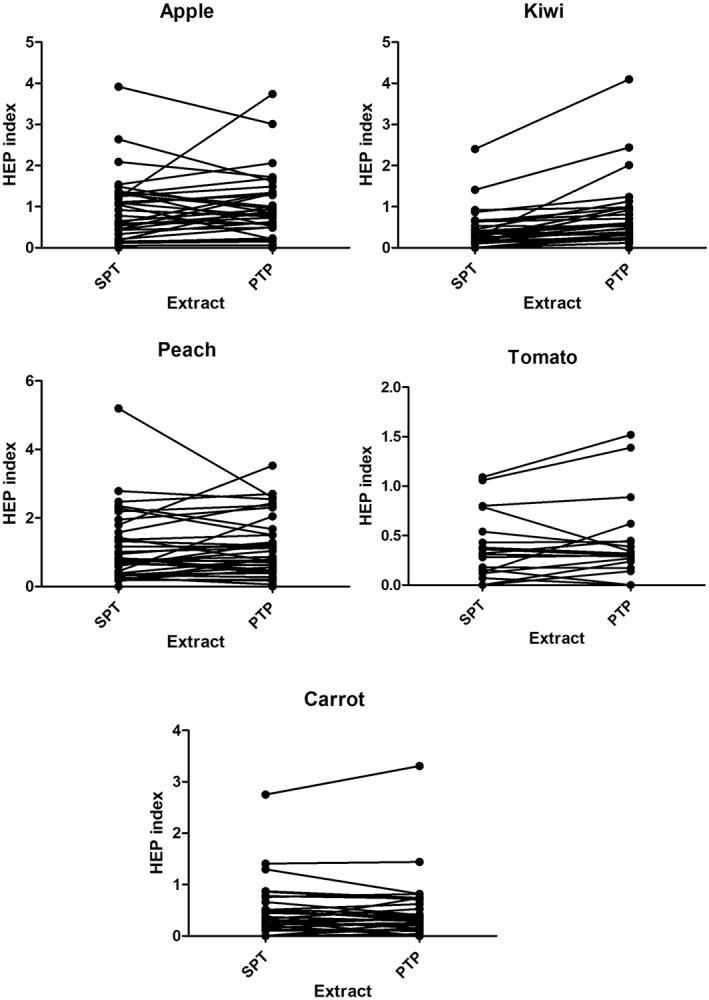
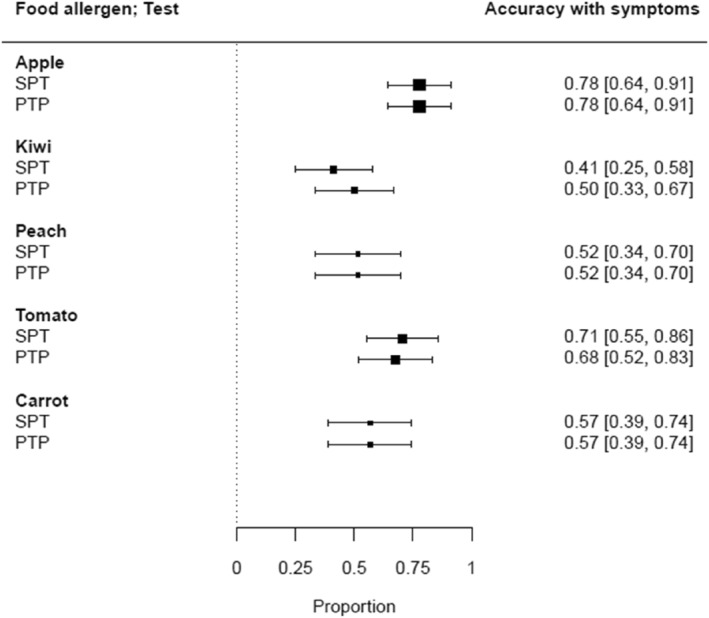
Introduction: Prick‐to‐prick (PTP) test with fresh food is accepted as a reliable tool for measuring sensitization to fruits and vegetables. Not all fruits and vegetables are available throughout the year. The objective of this study was to investigate whether skin prick test (SPT) performed with frozen juice of fruits and vegetables (FJFV) is a good alternative to PTP tests performed with fresh fruits and vegetables (FFV). Methods: Adult patients suspected of having a food allergy to fruits and/or vegetables were included. A questionnaire was used to score symptoms after consumption of apple, kiwi, peach, tomato, and carrot. SPTs with FJFV, and PTP tests with FFV were performed. Intra‐class correlation coefficients (ICC) between the SPT and PTP test results were calculated. The sensitivity and specificity of both diagnostic tests towards food allergen specific symptoms (FASS) were calculated. Results: Thirty‐six patients were included. FASS was positive in 75% for apple, 53% for kiwi, 44% for peach, 25% for tomato, and 22% for carrot. ICC between SPT and PTP test results were moderate for apple (0.72) and kiwi (0.71), strong for peach (0.75) and tomato (0.89), and very strong for carrot (0.94). Sensitivity was equal for the SPT and PTP tests for apple (0.93), peach (0.81), and carrot (1.00), and comparable for kiwi (0.50 resp. 0.70), and tomato (0.44 resp. 0.56). Specificity was equal for apple (0.33), peach (0.15), and carrot (0.41), and comparable for kiwi (0.29 resp. 0.21) and tomato (0.80 resp. 0.72). Conclusions: Results of SPT with FJFV and PTP test with FFV are comparable. SPT with FJFV is a good alternative in the daily practice of the allergists.
Overview
The claims and statistics of this paper haven’t been checked yet.
Run the check — free, no account needed. It reads the open-access text and checks the sources it cites.
Integrity signals
Registry
Cites
Statistics
Figures
Verification
Claims the paper makes
The claims and statistics of this paper haven’t been checked yet.
Run the check — free, no account needed. It reads the open-access text and checks the sources it cites.
Claims other papers make about this one
Each is checked against this paper’s own text: does it say what the citing paper says it does?
In the citing paper
“This method complements testing with commercial extracts and improves diagnostic accuracy, especially in cases where patients report symptoms but commercial extracts yield negative results [187].”
From Pollen–Food Allergy Syndrome: Allergens, Clinical Insights, Diagnostic and Therapeutic Challenges (2024) · cites this paper as [187]
In the citing paper
“However, in some cases, commercial food extracts may not contain the heat-labile proteins responsible for PFAS symptoms, necessitating testing with fresh food preparations (the “prick-to-prick” method) [187].”
From Pollen–Food Allergy Syndrome: Allergens, Clinical Insights, Diagnostic and Therapeutic Challenges (2024) · cites this paper as [187]
Self-check
Percentages, sums and reported differences re-computed from the paper’s own numbers.
The self-check needs the paper’s full text.
Citations
Cites
No references could be resolved yet.
Research works printed but not linked: 20
- Garriga T, 2010, Frozen fruit skin prick test for the diagnosis of fruit allergy, Asian Pac J Allergy Immunol, 28, 275
- 10.1002/mnfr.200600132 · DOI
- Hassan AK, 2015, An overview of fruit allergy and the causative allergens, Eur Ann Allergy Clin Immunol, 47, 180
- 10.1111/ddg.12731 · DOI
- 10.2174/1573396314666180423105842 · DOI
- 10.1186/s13601‐015‐0050‐2 · DOI
- 10.1186/2045‐7022‐3‐3 · DOI · Paper page
- 10.1111/all.14329 · DOI
- 10.1111/all.15902 · DOI · Paper page
- 10.1111/j.1398‐9995.1997.tb02427.x · DOI
- 10.1016/j.iac.2017.09.004 · DOI
- JongNWd.Reproducubility and Stability of 'in House Manufactured' Extracts Used in the Diagnosis of IgE Mediated Allergy;2004:45‐53. ISBN 90‐77595‐73‐2.
- 10.1067/mai.2000.106927 · DOI
- 10.1186/s13601‐016‐0092‐0 · DOI
- 10.3390/nu13041355 · DOI
- 10.3390/nu14030475 · DOI
- 10.1111/all.12201 · DOI
- Zivanovic M, 2017, Evaluation of food allergy in children by skin prick tests with commercial extracts and fresh foods, specific IgE and, open oral food challenge‐our five years experience in food allergy work‐up, Iran J Allergy, Asthma Immunol, 16, 127
- 10.1016/j.jaci.2012.10.017 · DOI
- 10.1111/all.12429 · DOI · Paper page
Cited by
Sorted by citations
Pollen–Food Allergy Syndrome: Allergens, Clinical Insights, Diagnostic and Therapeutic Challenges
Haidar, L., Bănărescu, C. F., Uța, C., Moldovan, S. I., Zimbru, E.-L., Zimbru, R.-I., Ciurariu, E., Georgescu, M., & Panaitescu, C. (2024) · Applied Sciences · doi:10.3390/app15010066 · Cited by 21
Metadata
- Authors
- Terlouw, S., van Boven, F. E., Borsboom‐van Zonneveld, M., de Graaf‐in ’t Veld, T., Gerth van Wijk, R., van Daele, P. L. A., van Maaren, M. S., Kuijpers, J. H. S. A. M., Veenbergen, S., & de Jong, N. W.
- Affiliations
- Department of Allergology Albert Schweitzer Hospital Zwijndrecht The Netherlands
- Internal Medicine Allergology & Clinical Immunology Erasmus MC University Medical Center Rotterdam Rotterdam The Netherlands
- Department of Immunology Laboratory Medical Immunology Erasmus MC University Medical Center Rotterdam Rotterdam The Netherlands
- Venue
- Clinical and Translational Allergy
- Publisher
- Wiley
- Published
- 2024-07
- Volume
- 14
- Issue
- 7
- ISSN
- 2045-7022
- PMC
- PMC11226404
- Cited by
- 9
- References
- 0
- Language
- en
About these checks
Registry, retraction, Cites and statistics results are computed, not judged, with one exception: a printed reference that no index lists is read once by a model before it counts as a citation error. Claims are extracted by a model and kept only when their quote appears verbatim in the text; each cited source is then checked, with a model’s help, for whether it says what the claim relies on. Those verdicts can be wrong — read the claim’s quote and the cited source before relying on one.
Statistics and arithmetic are recomputed, not judged.
Confidence bands are shown only for fields calibrated on our annotated test set. None is calibrated yet, so no band is shown.
What counts as a claim ›How we measure confidence ›How we check this ›
Are you an author, or do you see a problem with this page? Request a review
