

The DOI matches its Crossref record; 1 of the 1 references it cites were found in a registry or an index.
A High‐Throughput Investigation of the Binding Specificity of Carbohydrate‐Binding Modules for Synthetic and Natural Polymers
Open accessPublished version of a preprint
Abstract
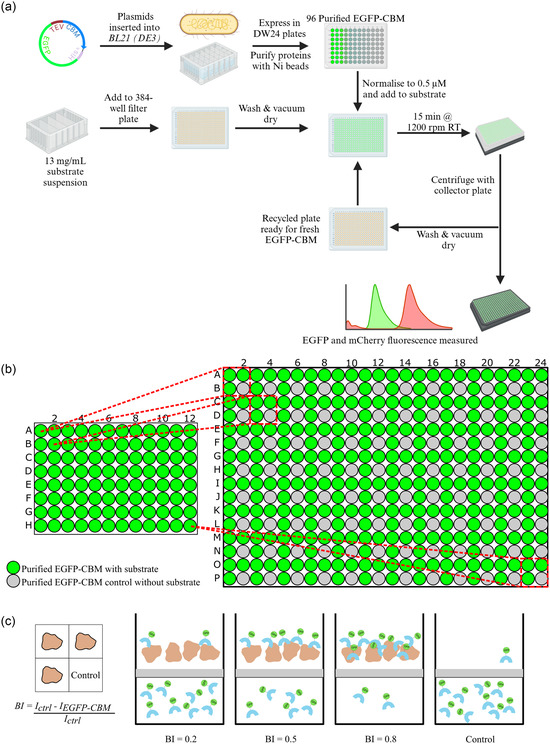
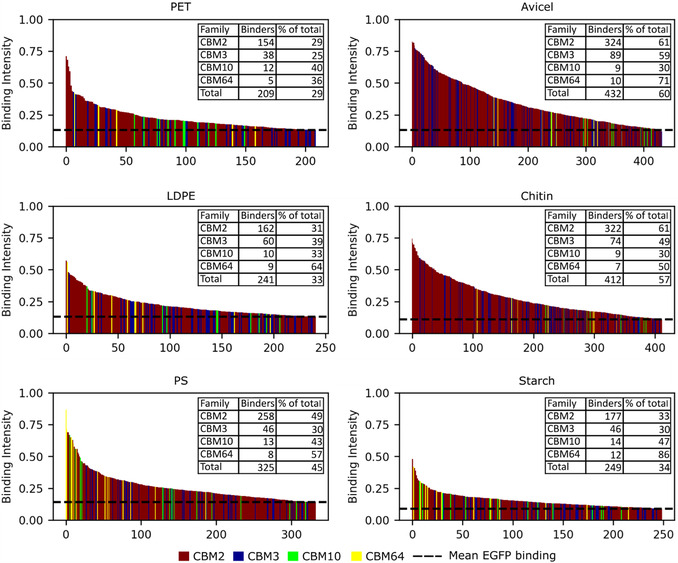
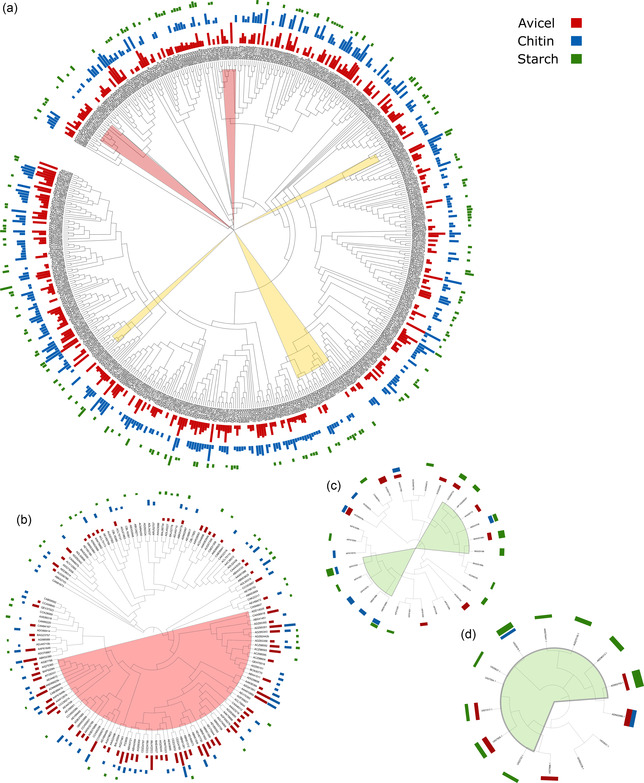
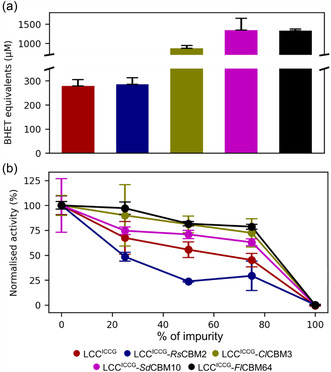
Carbohydrate‐binding modules (CBMs) are noncatalytic domains that enhance enzyme binding to substrates. Type A CBMs show potential for engineering plastic‐degrading enzymes due to their affinity for synthetic polymers. This study presents a high‐throughput screening pipeline for characterizing the affinity and specificity of type A CBMs towards the synthetic polymers polyethylene terephthalate (PET), polystyrene (PS), and polyethylene (PE), and the polysaccharides cellulose, chitin, and starch. ≈800 CBMs from the families CBM2, CBM3, CBM10, and CBM64 are expressed as green fluorescent protein (GFP)‐fusion proteins and tested for binding using a modified holdup assay, which produced up to 10 000 data points per day. The screening identifies ≈150 binders for PET and PE, around 250 for PS, and demonstrates family‐specific binding patterns for avicel, chitin, and starch. To demonstrate practical utility, four CBMs with high PET affinity are fused to the PET hydrolase LCC ICCG , enhancing activity on PET powder by around 5‐fold. These CBM‐enzyme fusions mitigate competitive binding to plastic impurities, improving performance in mixed plastic assays. This work significantly expands the repertoire of CBMs binding to synthetic polymers, advances our understanding of CBM‐substrate interactions, and provides knowledge for engineering enzymes to tackle plastic pollution, particularly where mixed plastics pose significant challenges.
Overview
The claims and statistics of this paper haven’t been checked yet.
Run the check — free, no account needed. It reads the open-access text and checks the sources it cites.
Integrity signals
Registry
Cites
Statistics
Figures
Verification
Claims the paper makes
The claims and statistics of this paper haven’t been checked yet.
Run the check — free, no account needed. It reads the open-access text and checks the sources it cites.
Self-check
Percentages, sums and reported differences re-computed from the paper’s own numbers.
The self-check needs the paper’s full text.
Citations
Cites
Highly accurate protein structure prediction with AlphaFold
Jumper, J., Evans, R., Pritzel, A., Green, T., Figurnov, M., Ronneberger, O., Tunyasuvunakool, K., Bates, R., Žídek, A., Potapenko, A., et al. (2021) · Nature · doi:10.1038/s41586-021-03819-2 · Cited by 43,764
Research works printed but not linked: 64
- 10.1038/s41598-019-44117-2 · DOI
- 10.1007/s11270-019-4220-z · DOI
- 10.1201/9780429469596-2 · DOI
- World Economic Forum, Ellen MacArthur Foundation and McKinsey & Company, 2016, Ellen MacArthur Found., 120
- 10.1016/j.compositesb.2016.09.013 · DOI
- 10.3389/fmicb.2020.580709 · DOI
- 10.1080/15583724.2022.2033765 · DOI
- 10.1002/pen.11467 · DOI
- 10.1016/j.joule.2021.06.015 · DOI
- 10.1021/acs.chemrev.2c00644 · DOI
- Yoshida S., 2016, Science 80‐., 351, 1196
- 10.1016/j.envpol.2017.09.043 · DOI
- 10.1007/s10532-008-9188-0 · DOI · Paper page
- 10.1007/s10311-022-01552-4 · DOI
- Nowak B., 2012, Scannning Electron Microscopy
- 10.1016/j.radphyschem.2016.04.003 · DOI
- 10.1073/pnas.1718804115 · DOI
- 10.1016/j.jhazmat.2021.125118 · DOI
- 10.1002/prot.26325 · DOI
- 10.1016/j.sbi.2013.05.005 · DOI
- 10.1016/j.scitotenv.2023.161948 · DOI
- 10.1007/s00253-019-09760-9 · DOI
- 10.1016/j.checat.2022.07.018 · DOI
- 10.1128/AEM.04111-14 · DOI
- 10.1016/j.jbiotec.2021.05.006 · DOI
- Zhang Y., 2022, Shengwu Gongcheng Xuebao/Chinese J. Biotechnol., 38, 217
- 10.1021/cbe.4c00125 · DOI
- 10.1186/s12896-023-00787-5 · DOI
- 10.1093/nar/gkab1045 · DOI · Paper page
- 10.1021/bm400140u · DOI
- 10.1016/j.seta.2020.100684 · DOI
- 10.1042/BJ20040892 · DOI
- 10.1074/jbc.M116.767541 · DOI
- 10.1016/j.jbc.2021.100638 · DOI
- 10.1073/pnas.1213200109 · DOI
- 10.1074/jbc.M006948200 · DOI
- 10.1002/star.201200172 · DOI
- 10.1016/j.foodhyd.2023.109162 · DOI
- 10.1038/nmeth.3438 · DOI
- 10.1038/s41467-022-33018-0 · DOI · Paper page
- 10.1016/j.ab.2011.02.009 · DOI
- Salmeán A. A., 2018, Sci. Reports, 8, 2500
- 10.1111/1751-7915.13895 · DOI
- 10.1016/S0021-9258(19)81530-2 · DOI
- 10.1016/j.jmb.2008.06.006 · DOI
- 10.1128/AEM.61.5.1980-1986.1995 · DOI
- 10.1021/bm500046f · DOI
- 10.1074/jbc.275.1.514 · DOI
- 10.1021/jacsau.2c00204 · DOI
- 10.1107/S139900471302926X · DOI
- 10.1128/JB.05227-11 · DOI
- 10.1038/nsb1096-842 · DOI
- 10.1038/s41586-020-2149-4 · DOI · Paper page
- 10.1016/j.enzmictec.2024.110479 · DOI
- 10.3390/ma14030503 · DOI
- 10.1007/978-1-62703-691-7_3 · DOI
- 10.1002/cssc.202101062 · DOI
- 10.1007/s00253-014-5672-0 · DOI
- 10.1002/pro.3280 · DOI
- 10.1016/0022-2836(82)90515-0 · DOI
- 10.1016/j.jmb.2010.09.028 · DOI · Paper page
- 10.1016/S1093-3263(02)00203-6 · DOI
- 10.1021/acs.jcim.1c01269 · DOI · Paper page
- 10.1128/AEM.06725-11 · DOI
Metadata
- Authors
- Rennison, A. P., Fernandez‐Macgregor, J., Melot, J., Durbesson, F., Tandrup, T., Westh, P., Vincentelli, R., & Møller, M. S.
- Affiliations
- Technical University of Denmark (DK)
- Laboratory Architecture et Fonction des Macromolecules Biologiques Aix‐Marseille University Luminy Campus 13288 Marseille France
- Aix-Marseille Université (FR)
- Corresponding author
- Møller, Marie Sofie
- ORCID
- Venue
- ChemSusChem
- Publisher
- Wiley
- Published
- 2025-07-14
- Volume
- 18
- Issue
- 16
- Pages
- e202500468-e202500468
- ISSN
- 1864-5631 (ISSN-L)
- 1864-564X
- PMC
- PMC12330340
- OpenAlex
- W4411454387
- Cited by
- 7
- References
- 1
- Citations by year
- 2026: 5 · 2025: 2
- FWCI
- 2.09
- Type
- journal article
- Language
- en
- Open access
- hybrid
- doi.org
- Licence
- Locations
- ChemSusChem (publishedVersion, cc-by-nc)
- bioRxiv (Cold Spring Harbor Laboratory) (acceptedVersion, cc-by-nc-nd)
- PubMed Central (publishedVersion, cc-by-nc)
- PubMed (publishedVersion)
- HAL (submittedVersion, cc-by-nc)
- Funders
- Agence Nationale de la Recherche (ANR‐16‐CONV‐0001)
- French Infrastructure for Integrated Structural Biology (ANR‐10‐INSB‐05‐01)
- Topics
- Life Sciences › Biochemistry, Genetics and Molecular Biology › Molecular Biology › Enzyme Catalysis and Immobilization
- Life Sciences › Biochemistry, Genetics and Molecular Biology › Biotechnology › Enzyme Production and Characterization
- Physical Sciences › Engineering › Biomedical Engineering › Biofuel production and bioconversion
- Keywords
- carbohydrate-binding module, synthetic polymers, polyethylene terephthalate, polystyrene, polyethylene, cellulose, chitin, starch, PET hydrolase, plastic-degrading enzymes, mixed plastic waste, plastic pollution
- MeSH terms
- Polyethylene Terephthalates, Polymers, Protein Binding, Substrate Specificity, High-Throughput Screening Assays
About these checks
Registry, retraction, Cites and statistics results are computed, not judged, with one exception: a printed reference that no index lists is read once by a model before it counts as a citation error. Claims are extracted by a model and kept only when their quote appears verbatim in the text; each cited source is then checked, with a model’s help, for whether it says what the claim relies on. Those verdicts can be wrong — read the claim’s quote and the cited source before relying on one.
Statistics and arithmetic are recomputed, not judged.
Confidence bands are shown only for fields calibrated on our annotated test set. None is calibrated yet, so no band is shown.
What counts as a claim ›How we measure confidence ›How we check this ›
Are you an author, or do you see a problem with this page? Request a review
How to cite
Cite CoChat for the checks on this page, and the paper for its own findings.
- This page
- CoChat. (2026). Citation check: A High‐Throughput Investigation of the Binding Specificity of Carbohydrate‐Binding Modules for Synthetic and Natural Polymers. https://app.cochat.ai/papers/10.1002/cssc.202500468
- The paper
- Rennison, A. P., Fernandez‐Macgregor, J., Melot, J., Durbesson, F., Tandrup, T., Westh, P., Vincentelli, R., & Møller, M. S. (2025). A High‐Throughput Investigation of the Binding Specificity of Carbohydrate‐Binding Modules for Synthetic and Natural Polymers. ChemSusChem. https://doi.org/10.1002/cssc.202500468
