

The DOI matches its Crossref record; 11 of the 11 references it cites were found in a registry or an index.
Multi‐family therapy for eating disorders: A systematic scoping review of the quantitative and qualitative findings
Abstract
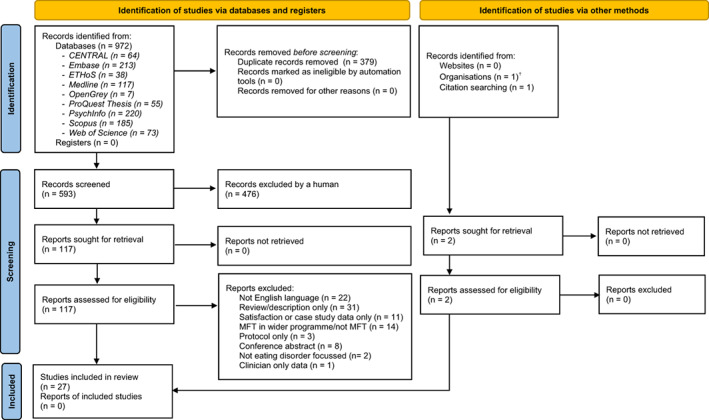
Objective: This study reviewed the quantitative and qualitative evidence‐base for multi‐family therapy (MFT) for eating disorders regarding change in physical and psychological symptoms, broader individual and family factors, and the experience of treatment. Method: A systematic scoping review was conducted. Four databases (PsycInfo, Medline, Embase, CENTRAL) and five grey literature databases were searched on 24th June 2021 for relevant peer‐reviewed journal articles, book chapters, and dissertations. No beginning time‐point was specified. Only papers that presented quantitative or qualitative data were included. No restrictions on age or diagnosis were imposed. Studies were first mapped by study design, participant age, and treatment setting, then narratively synthesized. Results: Outcomes for 714 people who received MFT across 27 studies (one mixed‐method, 17 quantitative and nine qualitative) were synthesized. MFT is associated with improvements in eating disorder symptomatology and weight gain for those who are underweight. It is also associated with improvements in other individual and family factors including comorbidities, self‐esteem, quality of life, and some aspects of the experience of caregiving, although these findings are more mixed. MFT is generally experienced as both helpful and challenging due to the content addressed and intensive group process. Discussion: MFT is associated with significant improvements in eating disorder symptoms across the lifespan and improvement in broader individual and family factors. The evidence base is small and studies are generally underpowered. Larger, higher‐quality studies are needed, as is research investigating the unique contribution of MFT on outcomes, given it is typically an adjunctive treatment.
Overview
The claims and statistics of this paper haven’t been checked yet.
Run the check — free, no account needed. It reads the open-access text and checks the sources it cites.
Integrity signals
Registry
Cites
Statistics
Figures
Verification
Claims the paper makes
The claims and statistics of this paper haven’t been checked yet.
Run the check — free, no account needed. It reads the open-access text and checks the sources it cites.
Claims other papers make about this one
Each is checked against this paper’s own text: does it say what the citing paper says it does?
The check wasn’t confident either way, so it gives no verdict — never disputed.
In the citing paper
“Externalisation as a technique in interventions for EDs is not limited to narrative therapy. For example, “externalisation of the illness” has been integrated as a therapeutic practice in Maudsley Family Therapy, FBT [18, 105] and CBT-AN [11].”
From Paper 1: a systematic synthesis of narrative therapy treatment components for the treatment of eating disorders (2022) · cites this paper as [105]
Experimental — accuracy not yet measured
Self-check
Percentages, sums and reported differences re-computed from the paper’s own numbers.
The self-check needs the paper’s full text.
Citations
Cites
Using thematic analysis in psychology
Braun, V., & Clarke, V. (2006) · Qualitative Research in Psychology · doi:10.1191/1478088706qp063oa · Cited by 194,414
PRISMA Extension for Scoping Reviews (PRISMA-ScR): Checklist and Explanation
Tricco, A. C., Lillie, E., Zarin, W., O'Brien, K. K., Colquhoun, H., Levac, D., Moher, D., Peters, M. D. J., Horsley, T., Weeks, L., et al. (2018) · Annals of Internal Medicine · doi:10.7326/m18-0850 · Cited by 43,565
Munn, Z., Peters, M. D. J., Stern, C., Tufanaru, C., McArthur, A., & Aromataris, E. (2018) · BMC Medical Research Methodology · doi:10.1186/s12874-018-0611-x · Cited by 11,385
Gratz, K. L., & Roemer, L. (2004) · Journal of Psychopathology and Behavioral Assessment · doi:10.1023/b:joba.0000007455.08539.94 · Cited by 8,942
Methley, A. M., Campbell, S., Chew-Graham, C., McNally, R., & Cheraghi-Sohi, S. (2014) · BMC Health Services Research · doi:10.1186/s12913-014-0579-0 · Cited by 2,706
(2020) · JBI Manual for Evidence Synthesis · doi:10.46658/jbimes-20-12 · Cited by 2,545
Resilience in the Face of Catastrophe: Optimism, Personality, and Coping in the Kosovo Crisis
Riolli, L., Savicki, V., & Cepani, A. (2002) · Journal of Applied Social Psychology · doi:10.1111/j.1559-1816.2002.tb02765.x · Cited by 2,166
Inventory of interpersonal problems: Psychometric properties and clinical applications.
Horowitz, L. M., Rosenberg, S. E., Baer, B. A., Ureño, G., & Villaseñor, V. S. (1988) · Journal of Consulting and Clinical Psychology · doi:10.1037/0022-006x.56.6.885 · Cited by 2,026
Noyes, J., Booth, A., Moore, G., Flemming, K., Tunçalp, Ö., & Shakibazadeh, E. (2019) · BMJ Global Health · doi:10.1136/bmjgh-2018-000893 · Cited by 497
Canadian practice guidelines for the treatment of children and adolescents with eating disorders
Couturier, J., Isserlin, L., Norris, M., Spettigue, W., Brouwers, M., Kimber, M., McVey, G., Webb, C., Findlay, S., Bhatnagar, N., et al. (2020) · Journal of Eating Disorders · doi:10.1186/s40337-020-0277-8 · Cited by 215 · cited 1×
“MFT-AN is now a recommended treatment for adolescents by several practice guidelines (Couturier et al., 2020; Heruc et al., 2020; NICE, 2017) and a specific version has recently been developed for adolescents with bulimia nervosa (MFT-BN; Stewart et al.”
Background
Research works printed but not linked: 85
- 10.1111/j.1545-5300.1986.00185.x · DOI
- 10.3389/fpsyg.2021.584565 · DOI
- 10.1111/j.1545-5300.1985.00398.x · DOI
- Beck A. T., 1996, Manual for the Beck depression inventory‐II
- 10.1037/h0037024 · DOI
- 10.1186/s40337-021-00412-w · DOI
- 10.1177/0969733017739780 · DOI
- 10.1016/S0005-7967(99)00130-8 · DOI · Paper page
- 10.1016/j.comppsych.2006.10.009 · DOI
- Cook‐Darzens S.(2007).Thérapies multifamiliales. Toulouse: Érès. Cairn.info.https://www.cairn.info/therapies-multifamiliales-9782749207094.htm · DOI
- Cutrona C. E., 1987, The provisions of social relationships and adaptation to stress, Advances in Personal Relationships, 1, 37
- 10.1002/(SICI)1099-0968(200002)8:1<4::AID-ERV330>3.0.CO;2-P · DOI
- 10.1002/anzf.1324 · DOI
- Dennhag I., 2019, Parental caregiver burden and recovery of adolescent anorexia nervosa after multi‐family therapy, Eating Disorders, 9315161, 1
- 10.1002/erv.2556 · DOI
- Derogatis L. R., 1992, The brief symptom inventory (BSI): Administration, scoring and procedures: Manual II
- 10.1002/erv.2359 · DOI
- 10.1007/s11136-005-1389-y · DOI
- Duarte A. E., 2012, The experiences of adolescents and their parents/carers with a multi‐family therapy Programme for bulimia nervosa
- 10.1111/j.1467-6427.2005.00303.x · DOI
- 10.1186/s12888-016-1129-6 · DOI
- 10.1080/10640266.2015.1034053 · DOI
- 10.1111/j.1752-0606.1983.tb01497.x · DOI
- 10.1002/eat.23441 · DOI
- Gabel K., 2014, The effect of multiple family therapy on weight gain in adolescents with anorexia nervosa: pilot data, Journal of the Canadian Academy of Child and Adolescent Psychiatry, 23, 196
- 10.1177/070674370004500208 · DOI
- 10.1111/1467-6427.12178 · DOI
- 10.1007/s40519-015-0207-y · DOI
- 10.1111/famp.12103 · DOI
- Goldberg D. P., 1998, A User's guide to the general health questionnaire, Windsor: nferNelson., 1, 1
- 10.1177/0004867414555814 · DOI · Paper page
- 10.1186/s40337-020-00341-0 · DOI
- 10.1097/YCO.0000000000000360 · DOI · Paper page
- 10.1111/1467-6427.12000 · DOI
- 10.1111/1467-6427.12231 · DOI
- 10.3109/00952997709007004 · DOI
- 10.1002/1097-4679(199005)46:3<306::AID-JCLP2270460310>3.0.CO;2-2 · DOI
- 10.1046/j.1467-6427.1984.00655.x · DOI
- 10.1046/j..1986.00731.x · DOI
- 10.1080/10640266.2015.1042318 · DOI
- Kovacs M., 1992, The Children's depression inventory (CDI)
- 10.1002/(SICI)1099-0879(199612)3:4<249::AID-CPP106>3.0.CO;2-S · DOI
- Laqueur H. P., 1964, Multiple family therapy, Current Psychiatric Therapies, 4, 150
- 10.1159/000201935 · DOI
- Lock J., 2012, Treatment manual for anorexia nervosa: A family‐based approach
- 10.1097/YCO.0000000000000451 · DOI
- 10.1002/erv.2353 · DOI
- McFarlane W. R., 2002, Multifamily groups in the treatment of severe psychiatric disorders
- 10.1111/j.1467-6427.2011.00579.x · DOI
- 10.1002/erv.2495 · DOI
- 10.1097/XEB.0000000000000050 · DOI · Paper page
- 10.1007/s40501-020-00205-z · DOI
- 10.1002/erv.1094 · DOI
- 10.1001/archpsyc.1987.01800240021004 · DOI
- 10.1111/1467-6427.12075 · DOI
- 10.1348/014466505X53902 · DOI
- 10.1111/j.1467-6427.2005.00304.x · DOI
- 10.1002/erv.364 · DOI
- 10.1186/1477-7525-6-28 · DOI
- 10.4324/9781003038764 · DOI
- Simic M., 2015, Family therapy for adolescent eating and weight disorders, 110
- 10.1186/s40337-020-0285-8 · DOI
- Slagerman M., 1989, Multiple family group treatment for eating disorders: A short term program, Psychiatric Medicine, 7, 269
- Spielberger C., 1970, STAI manual for the state trait anxiety inventory
- Stewart C. S., 2019, Multi‐family therapy for bulimia nervosa in adolescence: A pilot study in a community eating disorder service, Eating Disorders, 9315161, 1
- 10.1080/10640266.2015.1044348 · DOI
- 10.1176/appi.ps.52.12.1633 · DOI
- 10.1007/BF00785760 · DOI · Paper page
- 10.1080/21662630.2015.1048478 · DOI
- 10.1002/eat.23097 · DOI
- 10.4324/9780429460364 · DOI
- 10.1002/erv.2816 · DOI
- 10.1002/erv.1075 · DOI
- 10.1002/eat.22411 · DOI
- 10.1111/1467-6427.12067 · DOI
- Wallin U., 2007, Multi‐family therapy with anorexia nervosa. A treatment manual
- Wallin U., 2011, Multifamiljeterapi vid anorexia nervosa [multifamily therapy of anorexia nervosa]
- 10.1016/0191-8869(93)90090-P · DOI
- 10.1002/erv.1077 · DOI
- 10.1002/erv.1076 · DOI
- 10.1016/S0165-1781(02)00023-9 · DOI
- 10.1002/eat.22876 · DOI
- 10.1521/jsyt.2019.38.3.50 · DOI
- 10.1521/jsyt.2019.38.3.67 · DOI
- Wooley S. C., 1987, Eating Disorders: The family therapy collections, 20, (pp. 12
Cited by
Sorted by citations
Heywood, L., Conti, J., & Hay, P. (2022) · Journal of Eating Disorders · doi:10.1186/s40337-022-00635-5 · Cited by 24
Metadata
- Authors
- Baudinet, J., Eisler, I., Dawson, L., Simic, M., & Schmidt, U.
- Venue
- International Journal of Eating Disorders
- Publisher
- Wiley
- Published
- 2021-10-20
- Volume
- 54
- Issue
- 12
- Pages
- 2095-2120
- ISSN
- 0276-3478
- 1098-108X
- PMC
- PMC9298280
- Cited by
- 72
- References
- 11
- Language
- en
About these checks
Registry, retraction, Cites and statistics results are computed, not judged, with one exception: a printed reference that no index lists is read once by a model before it counts as a citation error. Claims are extracted by a model and kept only when their quote appears verbatim in the text; each cited source is then checked, with a model’s help, for whether it says what the claim relies on. Those verdicts can be wrong — read the claim’s quote and the cited source before relying on one.
Statistics and arithmetic are recomputed, not judged.
Confidence bands are shown only for fields calibrated on our annotated test set. None is calibrated yet, so no band is shown.
What counts as a claim ›How we measure confidence ›How we check this ›
Are you an author, or do you see a problem with this page? Request a review
