

The DOI matches its Crossref record; 5 of the 5 references it cites were found in a registry or an index.
CAQ Corner: Acute liver failure management and liver transplantation
Abstract
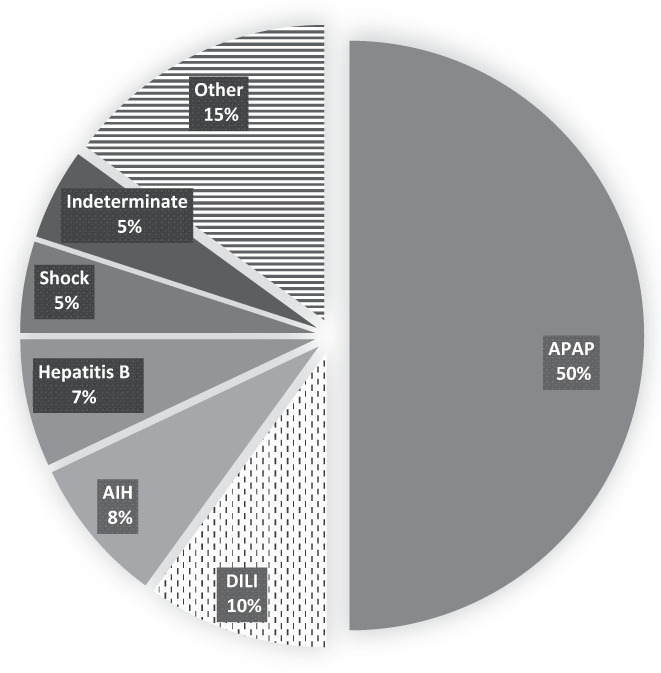
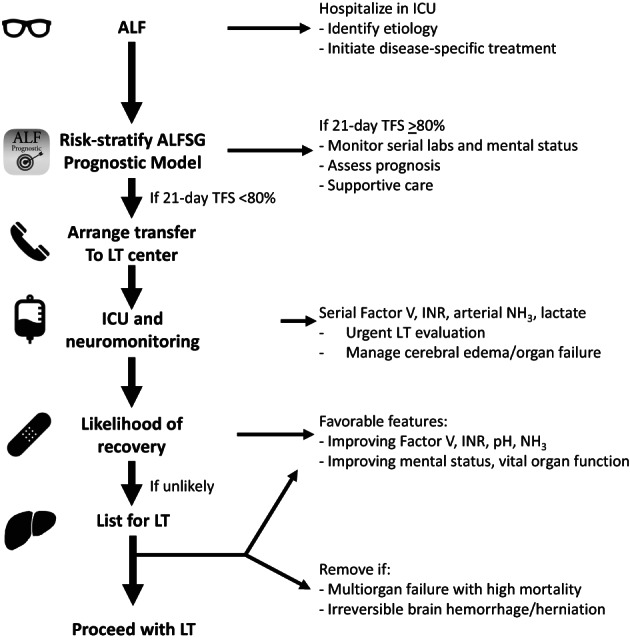
Robert J. Fontana, MD Jason J. Pan, MD Acute liver failure (ALF) or fulminant hepatic failure is a rare cause of liver disease due to a multitude of etiologies with an estimated annual incidence of only 2000–3000 cases in the United States.[1] ALF is defined as the sudden onset of encephalopathy and coagulopathy (i.e., an international normalized ratio [INR] of >1.5) in an individual without preexisting liver disease in the past 8–24 weeks. The encephalopathy in ALF arises due to rapid increases in ammonia and other neurotoxins that can disrupt the blood–brain barrier with resultant cerebral edema. The likelihood of spontaneous recovery or transplantation-free survival (TFS) is strongly related to the etiology of ALF and maximal degree of encephalopathy.[2, 3] Significant improvements in TFS over the past two decades among patients with ALF are largely attributed to improvements in critical care including greater use of N-acetylcysteine (NAC) and continuous renal replacement therapy (CRRT) and less frequent use of blood products and mechanical intubation.[2] Nonetheless, nearly one-quarter of patients with ALF listed for liver transplantation (LT) will die awaiting an organ. Although LT is done under emergency circumstances in patients with ALF, 1- and 5-year survival rates and neurological outcomes are now excellent and approaching those of patients with cirrhosis undergoing LT.[4-6] All patients with ALF should undergo a rapid and comprehensive diagnostic evaluation at presentation because the etiology of ALF has both therapeutic and prognostic implications (Table 1). IV or oral NAC up to 72 h Ipecac syrup and activated charcoal if single-time-point ingestion within 12 h Stop suspect agent Consider IV or oral NAC up to 72 h Consult LiverTox database Tenofovir, entecavir, or tenofovir alafenamide Consider IV or oral NAC for up to 72 h ANA, SmAb, quantitative IgG, IgM, and IgA levels Transjugular liver biopsy required for diagnosis If histologically confirmed, methylprednisolone 20 mg IV every 8 h Consider IV or oral NAC up to 72 h Differential: acute fatty liver disease of pregnancy, HELLP syndrome, preeclampsia/eclampsia Liver imaging, urinalysis, lactate, long-chain L-3 hydroxyacyl-CoA dehydrogenase deficiency testing of acute fatty liver of pregnancy suspected Consider APAP, HSV, HEV testing based on history Suspect if alkaline phosphatase-to-bilirubin ratio <4, aspartate transaminase-to-alanine transaminase ratio >2.2, Coombs-negative hemolytic anemia Ceruloplasmin, 24 h urine copper, slit lamp eye examination, genetic testing Transjugular liver biopsy with copper quantification Oral chelators: zinc, trientine Plasmapheresis Avoid penicillamine, due to risk of neurologic deterioration Anti-HAV IgM HEV IgM/PCR, CMV IgM/PCR, EBV IgM/PCR, HSV IgM/PCR as clinically indicated Liver ultrasound with Doppler magnetic resonance imaging or CT with contrast for confirmation Possible venography and transjugular biopsy for staging Thrombophilia evaluation Each year there are >60,000 instances of acetaminophen (APAP) overdose in the United States and nearly 500 individuals who progress to ALF despite NAC treatment. APAP overdose accounts for nearly 50% of all adult ALF cases and up to 20% of pediatric ALF cases (predominantly in teenagers; Figure 1).[7, 8] Some patients intentionally ingest a large single dose of APAP, typically >4–6 g, as a suicide gesture, while others may unintentionally overdose on APAP containing narcotic congeners or over-the-counter products in the setting of an acute illness or chronic pain over several days. Cofactors for inadvertent APAP hepatotoxicity are increased hepatic oxidative metabolism due to chronic alcohol use and poor nutrition as well as fasting that can deplete intrahepatic glutathione stores.[7] Initial serum APAP drug levels are useful for risk stratification with single-time-point ingestions (i.e., Rumack nomogram) but often are low or undetectable in individuals with unintentional overdose.[7] At presentation, most patients with APAP overdose have markedly elevated serum aminotransferases, a variably elevated INR, and normal or minimally elevated total bilirubin level. Lactic acidosis, acute kidney injury, hypoglycemia, and cerebral edema may develop over the first 72 h. Transplantation-free survival remains high at 60%–70% even in patients with grade 3–4 hepatic encephalopathy.[7, 9] In patients with a single-time-point ingestion, ipecac syrup or gastric lavage with administration of activated charcoal is recommended within the first 12 h. Whenever APAP overdose is suspected, NAC therapy should be rapidly instituted via an enteral or intravenous route (Table 2). Loading dose: 140 mg/kg Subsequent doses: 70 mg/kg every 4 h for up to 72 h Dose 1. Loading dose: 150 mg/kg NAC in 200 ml D5W over 1 h Dose 2. 50 mg/kg NAC in 500 ml D5W over 4 h Dose 3. 125 mg/kg NAC in 1000 ml D5W over 19 h Dose 4. 150 mg/kg NAC in 1000 ml D5W over 24 h Dose 5. 150 mg/kg NAC in 1000 ml D5W over
Overview
The claims and statistics of this paper haven’t been checked yet.
Run the check — free, no account needed. It reads the open-access text and checks the sources it cites.
Integrity signals
Registry
Cites
Statistics
Figures
Verification
Claims the paper makes
The claims and statistics of this paper haven’t been checked yet.
Run the check — free, no account needed. It reads the open-access text and checks the sources it cites.
Claims other papers make about this one
Each is checked against this paper’s own text: does it say what the citing paper says it does?
In the citing paper
“In the US, select patients with ALF are priority in the LT waitlist and given Status 1A priority if the life expectancy is <7 days without LT and no preexisting diagnosis liver disease is present.[35,36]”
From Drug-induced liver injury: Diagnosis, management and the role of liver transplantation (2025) · cites this paper as [36]
Self-check
Percentages, sums and reported differences re-computed from the paper’s own numbers.
The self-check needs the paper’s full text.
Citations
Cites
Simplified criteria for the diagnosis of autoimmune hepatitis
Hennes, E. M., Zeniya, M., Czaja, A. J., Parés, A., Dalekos, G. N., Krawitt, E. L., Bittencourt, P. L., Porta, G., Boberg, K. M., Hofer, H., et al. (2008) · Hepatology · doi:10.1002/hep.22322 · Cited by 1,901
Mack, C. L., Adams, D., Assis, D. N., Kerkar, N., Manns, M. P., Mayo, M. J., Vierling, J. M., Alsawas, M., Murad, M. H., & Czaja, A. J. (2020) · Hepatology · doi:10.1002/hep.31065 · Cited by 983
Drug-Induced Acute Liver Failure: Results of a U.S. Multicenter, Prospective Study
Reuben, A., Koch, D. G., & Lee, W. M. (2010) · Hepatology · doi:10.1002/hep.23937 · Cited by 772
A revised electronic version of RUCAM for the diagnosis of DILI
Hayashi, P. H., Lucena, M. I., Fontana, R. J., Bjornsson, E. S., Aithal, G. P., Barnhart, H., Gonzalez‐Jimenez, A., Yang, Q., Gu, J., Andrade, R. J., et al. (2022) · Hepatology · doi:10.1002/hep.32327 · Cited by 160
Self-citationAntimitochondrial antibodies in acute liver failure: implications for primary biliary cirrhosis
Leung, P. S. C., Rossaro, L., Davis, P. A., Park, O., Tanaka, A., Kikuchi, K., Miyakawa, H., Norman, G. L., Lee, W., & Gershwin, E. M. (2007) · Hepatology · doi:10.1002/hep.21828 · Cited by 121
Research works printed but not linked: 47
- Stravitz, 2019, Acute liver failure, Lancet, 394, 869, 10.1016/S0140-6736(19)31894-X · DOI · Paper page
- Reuben, 2016, Outcomes in adults with acute liver failure between 1998 and 2013, Ann Intern Med, 164, 724, 10.7326/M15-2211 · DOI · Paper page
- Koch, 2016, Development of a model to predict transplant free survival of patients with acute liver failure, Clin Gastroenterol Hepatol, 14, 1199, 10.1016/j.cgh.2016.03.046 · DOI · Paper page
- Nephew, 2019, Black adult patients with acute liver failure are sicker and more likely to undergo liver transplantation than white patients, Liver Transpl, 25, 1634, 10.1002/lt.25594 · DOI
- Fontana, 2015, Two‐year outcomes in initial survivors with acute liver failure: results from a prospective, multicentre study, Liver Int, 35, 370, 10.1111/liv.12632 · DOI
- Kwon, 2021, OPTN/SRTR 2019 annual data report: liver, Am J Transplant, 21, 208, 10.1111/ajt.16494 · DOI · Paper page
- Larson, 2005, Acetaminophen‐induced acute liver failure: results of a United States multicenter, prospective study, Hepatology, 42, 1364, 10.1002/hep.20948 · DOI · Paper page
- Squires, 2006, Acute liver failure in children: the first 348 patients in the pediatric acute liver failure study group, J Pediatr, 148, 652, 10.1016/j.jpeds.2005.12.051 · DOI · Paper page
- MacDonald, 2021, Clinical and neurologic outcomes in acetaminophen‐induced acute liver failure: a 21‐year multicenter cohort study, Clin Gastroenterol Hepatol, 19, 2615, 10.1016/j.cgh.2020.09.016 · DOI
- Ghabril, 2022, Eight‐fold increase in dietary supplement‐related liver failure leading to transplant Waitlisting over the last quarter century in the United States, Liver Transpl, 28, 169, 10.1002/lt.26246 · DOI · Paper page
- Kesar, 2022, Liver transplantation for acute liver injury in Asians is more likely due to herbal and dietary supplements, Liver Transpl, 28, 188, 10.1002/lt.26260 · DOI · Paper page
- Stravitz, 2011, Autoimmune acute liver failure: proposed clinical and histological criteria, Hepatology, 53, 517, 10.1002/hep.24080 · DOI · Paper page
- Wai, 2005, Clinical outcome and virological characteristics of hepatitis B‐related acute liver failure in the United States, J Viral Hepat, 12, 192, 10.1111/j.1365-2893.2005.00581.x · DOI
- Teo, 2001, Hepatitis B infection in patients with acute liver failure in the United States, Hepatology, 33, 972, 10.1053/jhep.2001.23065 · DOI
- Dao, 2012, Two distinct subtypes of hepatitis B virus‐related acute liver failure are separable by quantitative serum immunoglobulin M anti‐hepatitis B core antibody and hepatitis B virus DNA levels, Hepatology, 55, 676, 10.1002/hep.24732 · DOI
- Taylor, 2006, Fulminant hepatitis a virus infection in the United States: incidence, prognosis, and outcomes, Hepatology, 44, 1589, 10.1002/hep.21439 · DOI · Paper page
- Taylor, 2012, Short and long‐term outcomes in patients with acute liver failure due to ischemic hepatitis, Dig Dis Sci, 57, 777, 10.1007/s10620-011-1918-1 · DOI
- Fontana, 2016, The role of hepatitis E virus infection in adult Americans with acute liver failure, Hepatology, 64, 1870, 10.1002/hep.28649 · DOI
- Levitsky, 2008, Detection and diagnosis of herpes virus infection in adults with acute liver failure, Liver Transpl, 14, 1498, 10.1002/lt.21567 · DOI
- Casey, 2020, Acute liver failure (ALF) in pregnancy: how much is pregnancy related?, Hepatology, 72, 1366, 10.1002/hep.31144 · DOI
- Ganger, 2018, Acute liver failure of indeterminate etiology: a comprehensive systematic approach by an expert committee to establish causality, Am J Gastroenterol, 113, 1319, 10.1038/s41395-018-0160-2 · DOI
- Lee, 2009, Intravenous N‐acetylcysteine improves transplant‐free survival in early stage non‐acetaminophen acute liver failure, Gastroenterology, 137, 856, 10.1053/j.gastro.2009.06.006 · DOI · Paper page
- Squires, 2013, Intravenous N‐acetylcysteine in pediatric patients with non‐APAP acute liver failure: a placebo‐controlled clinical trial, Hepatology, 57, 1542, 10.1002/hep.26001 · DOI · Paper page
- C, 1995, Histopathological heterogeneity in fulminant hepatic failure, Hepatology, 21, 345
- Fontana, 2021, Prognostic value of the 13C‐ Methacetin breath test in adults with acute liver failure and non‐acetaminophen acute liver injury, Hepatology, 74, 961, 10.1002/hep.31783 · DOI
- Reddy, 2016, Determinants of outcome among patients with acute liver failure listed for liver transplantation in the United States, Liver Transpl, 22, 505, 10.1002/lt.24347 · DOI
- Karvellas, 2014, Outcomes and complications of intracranial pressure monitoring in acute liver failure: a retrospective cohort study, Crit Care Med, 42, 1157, 10.1097/CCM.0000000000000144 · DOI
- Jindasa, 2021, Hemorrhagic complications of invasive intracranial pressure monitor placement in acute liver failure: outcomes of a single‐center protocol and comprehensive literature review, Neurocrit Care, 25, 87, 10.1007/s12028-020-01143-7 · doi:10.1007/s12028-020-01143-7
- Karvellas, 2015, Therapeutic hypothermia in acute liver failure: a multicenter retrospective cohort analysis, Liver Transpl, 21, 4, 10.1002/lt.24021 · DOI
- Jalan, 2004, Moderate hypothermia in patients with acute liver failure and uncontrolled intracranial hypertension, Gastroenterology, 127, 1338, 10.1053/j.gastro.2004.08.005 · DOI · Paper page
- Cardoso, 2018, Continuous renal replacement therapy is associated with reduced serum ammonia levels and mortality in acute liver failure, Hepatology, 67, 711, 10.1002/hep.29488 · DOI · Paper page
- Lee, 2016, Extracorporeal liver support devices for listed patients, Liver Transpl, 22, 839, 10.1002/lt.24396 · DOI
- MacDonald, 2022, Use of the molecular adsorbent recirculating system in acute liver failure: results of a multi‐center propensity score‐matched study, Crit Care Med, 50, 286, 10.1097/CCM.0000000000005194 · DOI
- Larsen, 2016, High‐volume plasma exchange in patients with acute liver failure: an open randomised controlled trial, J Hepatol, 64, 69, 10.1016/j.jhep.2015.08.018 · DOI · Paper page
- Rajajee, 2018, Noninvasive intracranial pressure assessment in acute liver failure, Neurocrit Care, 29, 280, 10.1007/s12028-018-0540-x · DOI
- AlObaidi, 2019, Impact of increased intracranial pressure on pupillometry: a replication study., Crit Care Explor, 1, e0054, 10.1097/CCE.0000000000000054 · doi:10.1097/cce.0000000000000054
- Stravitz, 2018, Bleeding complications in acute liver failure, Hepatology, 67, 1931, 10.1002/hep.29694 · DOI
- Stravitz, 2021, Coagulopathy, bleeding events, and outcome according to rotational thromboelastometry in patients with acute liver injury/failure, Hepatology, 74, 937, 10.1002/hep.31767 · DOI · Paper page
- Rajajee, 2017, Protocol based invasive intracranial pressure monitoring in acute liver failure: feasibility, safety, and impact on management., Crit Care, 21, 178, 10.1186/s13054-017-1762-6 · doi:10.1186/s13054-017-1762-6
- Rolando, 1996, Bacterial and fungal infection in acute liver failure, Semin Liver Dis, 16, 389, 10.1055/s-2007-1007252 · DOI · Paper page
- Fontana, 2019, A decline in status 1 listings: the impact of etiology and medical management of acute liver failure, Liver Transpl, 25, 1605, 10.1002/lt.25638 · doi:10.1002/lt.25638
- Hartog, 2022, Primary nonfunction of the liver allograft, Transplantation, 106, 117, 10.1097/TP.0000000000003682 · DOI
- Feng, 2017, Living donor liver transplantation in high model for end‐stage liver disease score patients, Liver Transpl, 23, S9, 10.1002/lt.24819 · doi:10.1002/lt.24819
- Rela, 2016, Current status of auxiliary partial orthotopic liver transplantation for acute liver failure, Liver Transpl, 22, 1265, 10.1002/lt.24509 · DOI
- Nguyen, 2020, Clinical application of hepatocyte transplantation: current status, applicability, limitations, and future outlook, Expert Rev Gastroenterol Hepatol, 14, 185, 10.1080/17474124.2020.1733975 · DOI
- Stewart, 2009, ABO‐incompatible deceased donor liver transplantation in the United States: a National Registry Analysis, Liver Transpl, 15, 883, 10.1002/lt.21723 · DOI
- Anugwom, 2021, Comparison of clinical outcomes of induction regimens in patients undergoing liver transplantation for acute liver failure, Liver Transpl, 27, 27, 10.1002/lt.25832 · doi:10.1002/lt.25832
Cited by
Drug-induced liver injury: Diagnosis, management and the role of liver transplantation
Ozturk, N. B., Uskudar, E., Toruner, M. D., Simsek, C., & Gurakar, A. (2025) · Hepatology Forum · doi:10.14744/hf.2024.2024.0003 · Cited by 9
Metadata
- Authors
- Pan, J. J., & Fontana, R. J.
- Venue
- Liver Transplantation
- Published
- 2022-10
- Volume
- 28
- Issue
- 10
- Pages
- 1664-1673
- ISSN
- 1527-6465
- PMC
- PMC9796044
- Cited by
- 12
- References
- 5
- Language
- en
- Licence
- creativecommons.org/licenses/by-nc/4.0/ (vor)
- doi.wiley.com/10.1002/tdm_license_1.1 (tdm)
About these checks
Registry, retraction, Cites and statistics results are computed, not judged, with one exception: a printed reference that no index lists is read once by a model before it counts as a citation error. Claims are extracted by a model and kept only when their quote appears verbatim in the text; each cited source is then checked, with a model’s help, for whether it says what the claim relies on. Those verdicts can be wrong — read the claim’s quote and the cited source before relying on one.
Statistics and arithmetic are recomputed, not judged.
Confidence bands are shown only for fields calibrated on our annotated test set. None is calibrated yet, so no band is shown.
What counts as a claim ›How we measure confidence ›How we check this ›
Are you an author, or do you see a problem with this page? Request a review
How to cite
Cite CoChat for the checks on this page, and the paper for its own findings.
- This page
- CoChat. (2026). Citation check: CAQ Corner: Acute liver failure management and liver transplantation. https://app.cochat.ai/papers/10.1002/lt.26503
- The paper
- Pan, J. J., & Fontana, R. J. (2022). CAQ Corner: Acute liver failure management and liver transplantation. Liver Transplantation. https://doi.org/10.1002/lt.26503
Data sources
Bibliographic data: Semantic Scholar, OpenAlex, Crossref.
Contains information from the Semantic Scholar Academic Graph Datasets, made available under the ODC Attribution License (ODC-BY 1.0).
Semantic Scholar’s data is described in: Kinney, R., et al. (2023). The Semantic Scholar Open Data Platform. arXiv:2301.10140.
