

Reversibility of Spermatogonial Stem Cell Injury After Single Acute Scrotal Hyperthermia in Mouse and Rat Models: A Systematic Review
Open accessThe DOI matches its Crossref record; 71 of the 71 references it cites were found in a registry or an index; none of the 86 sources its claims cite is checked for support yet.
Abstract
Background: Acute scrotal hyperthermia is a recognized spermatogenesis stressor, but recovery of spermatogonial stem cells after a single mild heat exposure remains unclear, particularly over cycle‐relevant timeframes. This systematic review evaluates the in vivo local scrotal hyperthermia across at least one full spermatogenic cycle. Methods: A PICO‐driven search identified 18 mouse and rat studies using a single scrotal heating exposure. Outcomes were synthesized thematically across structural, cellular, endocrine/apoptotic, and sperm domains. Results: Injury patterns were graded and temperature‐ and species‐dependent, with more consistent abnormalities at 43°C and milder effects in rats than in mice. Structural endpoints often remained abnormal at the longest follow‐up, and architectural repair did not reliably achieve functional recovery. Mouse stereology at 43°C indicated long‐term SSC and germ‐cell depletion, with Leydig‐cell and partial Sertoli‐cell losses; rat stereology was sparse and absent at 42°C. Testosterone responses were heterogeneous, whereas tubular apoptosis was more consistently elevated in mice at 43°C. Sperm concentration/count declined where assessed, with more frequent impairments of motility and other quality indices, including DNA integrity, at 43°C. Conclusion: Recovery was often incomplete and endpoint‐specific, with impairment more consistently detected at 43°C, particularly in mice. Future studies require standardized thermal dosing, transparent bias‐mitigation, and SSC/niche‐resolved functional assays.
Overview
CoChat Summary
TL;DR
This systematic review of 18 mouse and rat studies found that a single acute local scrotal hyperthermia produces graded, temperature- and species-dependent spermatogonial/germ-cell injury, with more consistent and persistent impairment at 43°C and in mice than rats. Recovery was often incomplete and endpoint-specific, and structural repair did not reliably indicate functional recovery.
Key findings
- Across 18 studies, heating clustered at 43°C (14 studies) or 42°C (4 studies), with exposure durations of 12–30 min and recovery assessed from 6 h to 110 days; at the longest follow-up, only 4/12 histology comparisons showed near-normal architecture, while 8/12 still had persistent or partially recovered lesions.
- Mouse stereology at 43°C showed long-term depletion of SSCs, pachytene spermatocytes, round spermatids, and Leydig cells (each ↓ 3/3), while Sertoli-cell counts were more variable (unchanged in 3/5 studies and decreased in 2/5).
- Testosterone fell in 3/5 mouse studies but showed no change in the single rat study; apoptotic tubules increased in 5/6 mouse experiments at 43°C but remained unchanged in the lone rat experiment.
- Sperm count/concentration declined in all four mouse studies measuring it; at 43°C, motility ↓ 4/5, viability ↓ 3/4, morphology ↓ 2/3, and apoptotic sperm ↑ 2/2, whereas none of these parameters declined at 42°C.
Methods
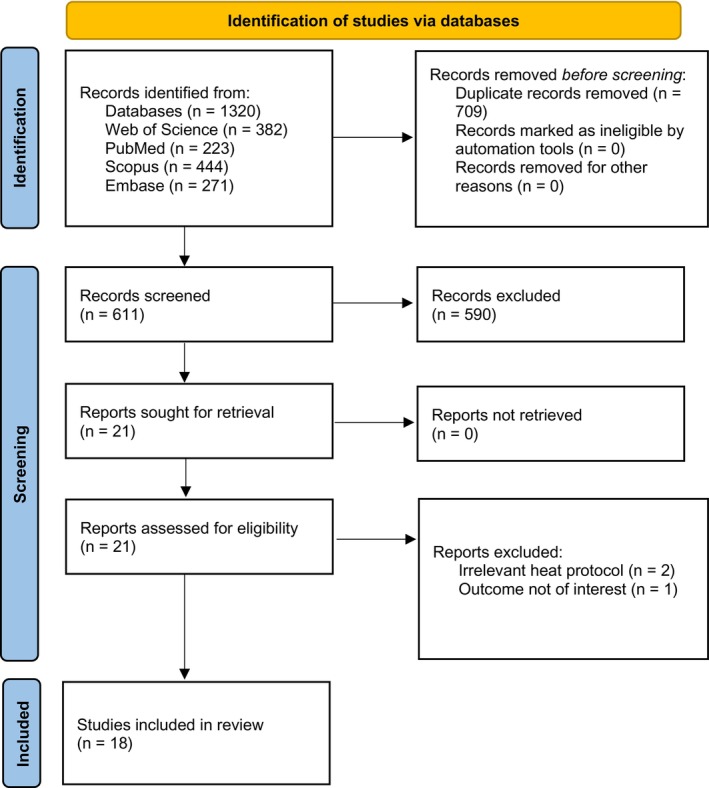
- PICO-driven systematic review reported per PRISMA 2020; searches in PubMed, Scopus, Web of Science, and Embase (May 6–13, 2025) retrieved 1320 records, 709 duplicates were removed, 611 titles/abstracts were screened, 21 full texts were assessed, and 18 studies were included.
- Eligible studies were peer-reviewed original full-text in vivo rat or mouse studies of acute, single, localized testicular/scrotal heat exposure with an analyzable comparator and ≥ 1 prespecified outcome relevant to reversibility of SSC damage or downstream spermatogenesis recovery; outcomes were grouped into structural integrity, stereology, endocrine/apoptosis, and sperm parameters.
- Data were synthesized narratively using SWiM guidance without meta-analysis; the longest follow-up at or beyond one full spermatogenic cycle (35 days in mice, 49 days in rats) was used for primary direction classification, and risk of bias was assessed with SYRCLE domains.
Limitations
- The paper states that heat exposure protocols and follow-up windows varied substantially, thermal dosing was often insufficiently standardized or reported, outcomes frequently relied on semi-quantitative histology, quantitative cellular data were sparse and largely confined to mouse studies at 43°C, SSC-resolved functional assays were uncommon, and substantial risk of bias and incomplete reporting preclude strong causal claims about reversibility.
- The paper also states that the review was conducted by a single reviewer with delayed blinded second-pass verification rather than independent second-reviewer verification, the protocol was not prospectively registered, and no meta-analysis or statistical publication-bias analysis was undertaken because of heterogeneity.
- Evident from the text: many subgroup strata contained fewer than three contributing studies, so no comparative conclusions were drawn for those cells; no study achieved Low overall risk of bias (7/18 High, 11/18 Unclear), and several studies had selective outcome reporting, unit-of-analysis errors, or genotype/co-intervention confounders.
Model-written summary. Check it against the paper before relying on it.
Integrity signals
Registry
Cites
Statistics
Figures
Verification
Claims the paper makes
0 Valid · 0 Not valid · 41 Not checked · 144 Own results and interpretations
A result the paper reports from its own data — it cites no other source for it, so there is none to check. The quote shows it is in the paper.
In the paper
“A PICO‐driven search identified 18 mouse and rat studies using a single scrotal heating exposure.”
- Also stated in: § Study Selection · plain
“After all exclusions, 18 studies met the inclusion criteria and were incorporated into the qualitative synthesis.”
§ Reversibility of Spermatogonial Stem Cell Injury After Single Acute Scrotal Hyperthermia in Mouse and Rat Models: A Systematic Review > Abstract > Methods
plain- Asserted: passes — The authors put it forward as true.
- Checkable: passes — It can be checked against evidence.
- Load-bearing: passes — The paper’s conclusions depend on it.
- Based: passes — The paper gives a reason why it holds.
- Rests on an assumption not shown here.
- Also stated in: § Study Selection · plain
A result the paper reports from its own data — it cites no other source for it, so there is none to check. The quote shows it is in the paper.
In the paper
“Mouse stereology at 43°C indicated long‐term SSC and germ‐cell depletion, with Leydig‐cell and partial Sertoli‐cell losses; rat stereology was sparse and absent at 42°C.”
§ Reversibility of Spermatogonial Stem Cell Injury After Single Acute Scrotal Hyperthermia in Mouse and Rat Models: A Systematic Review > Abstract > Results
hedgedstates a cause- Asserted: passes — The authors put it forward as true.
- Checkable: passes — It can be checked against evidence.
- Load-bearing: passes — The paper’s conclusions depend on it.
- Based: passes — The paper gives a reason why it holds.
- Rests on an assumption not shown here.
A result the paper reports from its own data — it cites no other source for it, so there is none to check. The quote shows it is in the paper.
In the paper
“Mouse stereology at 43°C indicated long‐term SSC and germ‐cell depletion, with Leydig‐cell and partial Sertoli‐cell losses; rat stereology was sparse and absent at 42°C.”
§ Reversibility of Spermatogonial Stem Cell Injury After Single Acute Scrotal Hyperthermia in Mouse and Rat Models: A Systematic Review > Abstract > Results
hedgedstates a cause- Asserted: passes — The authors put it forward as true.
- Checkable: passes — It can be checked against evidence.
- Load-bearing: unclear — It is unclear whether the paper’s conclusions depend on it.
- Based: passes — The paper gives a reason why it holds.
- Rests on an assumption not shown here.
A result the paper reports from its own data — it cites no other source for it, so there is none to check. The quote shows it is in the paper.
In the paper
“Injury patterns were graded and temperature‐ and species‐dependent, with more consistent abnormalities at 43°C and milder effects in rats than in mice.”
§ Reversibility of Spermatogonial Stem Cell Injury After Single Acute Scrotal Hyperthermia in Mouse and Rat Models: A Systematic Review > Abstract > Results
plainstates an association- Asserted: passes — The authors put it forward as true.
- Checkable: passes — It can be checked against evidence.
- Load-bearing: unclear — It is unclear whether the paper’s conclusions depend on it.
- Based: passes — The paper gives a reason why it holds.
- Rests on an assumption not shown here.
82 more claims
Create a free account to see all 185 claims and to verify the 86 references still open.
- It may state two separate claims as one. 75
- Probably not a substantial claim. 35
Self-check
Percentages, sums and reported differences re-computed from the paper’s own numbers.
Each contradiction between two passages listed here was confirmed by an independent check.
Rated major: it would touch a result — a value a result rests on, reported and recomputed p-values on opposite sides of the significance level, two passages that conflict with no sign which is right, or a cited work retracted before this paper was published.
In the paper
§ Reversibility of Spermatogonial Stem Cell Injury After Single Acute Scrotal Hyperthermia in Mouse and Rat Models: A Systematic Review > Results > Results by Outcome Theme
“Five studies quantified testicular cell populations in mice, whereas no stereological outcomes were reported in rats (Table 3).”
§ Reversibility of Spermatogonial Stem Cell Injury After Single Acute Scrotal Hyperthermia in Mouse and Rat Models: A Systematic Review > Methods > Data Collection
“| Queiroz et al. 2013 | Brazil | Rat/Wistar | 43°C × 15 min | 3, 7, 15, 30, 60 | Histological integrity, GCs nuclear fragmentation, serum T, testis weight (statistically insginifcant likely d/t low sample size), ST volume, daily sperm production per testis or gram of testis, SC index and rST per ST cross section, SC population | 3 | High |”
Rated major: it would touch a result — a value a result rests on, reported and recomputed p-values on opposite sides of the significance level, two passages that conflict with no sign which is right, or a cited work retracted before this paper was published.
In the paper
§ Reversibility of Spermatogonial Stem Cell Injury After Single Acute Scrotal Hyperthermia in Mouse and Rat Models: A Systematic Review > Discussion > Structural Integrity and Recovery Interpretation
“while structural endpoints often suggest partial restoration, this evidence is frequently incomplete and is more consistently observed in mice than in rats.”
§ Reversibility of Spermatogonial Stem Cell Injury After Single Acute Scrotal Hyperthermia in Mouse and Rat Models: A Systematic Review > Results > Results by Outcome Theme
“all four rat studies demonstrating substantial structural recovery by at least 49 days, whereas mouse studies were heterogeneous, with 2/8 reaching near normal morphology, 4/8 retaining severe germinal epithelium degeneration, and 2/8 showing relative recovery with minor or major lesions.”
Rated minor: it would not touch a result — a value no result rests on, a p-value that stays on the same side of the significance level, or a conflict that is clerical, resolved elsewhere in the paper, or outside its own findings.
In the paper
§ Reversibility of Spermatogonial Stem Cell Injury After Single Acute Scrotal Hyperthermia in Mouse and Rat Models: A Systematic Review > Results > Results by Outcome Theme
“At approximately 35 days, sperm count/concentration had declined in all four studies that measured it”
§ Reversibility of Spermatogonial Stem Cell Injury After Single Acute Scrotal Hyperthermia in Mouse and Rat Models: A Systematic Review > Methods > Data Collection
“| Hasani et al. 2020 | Iran | Mouse/NMRI | 43°C × 30 min | 70 | Sperm count, motility, morphology & vaibility”
Rated minor: it would not touch a result — a value no result rests on, a p-value that stays on the same side of the significance level, or a conflict that is clerical, resolved elsewhere in the paper, or outside its own findings.
In the paper
§ Reversibility of Spermatogonial Stem Cell Injury After Single Acute Scrotal Hyperthermia in Mouse and Rat Models: A Systematic Review > Results > Subgroup Patterns (Species and Temperature)
“at 43°C, motility declined in 4/5 studies”
§ Reversibility of Spermatogonial Stem Cell Injury After Single Acute Scrotal Hyperthermia in Mouse and Rat Models: A Systematic Review > Results > Subgroup Patterns (Species and Temperature)
“| Motility (total & progressive) | 4/5 | NR | 4/4 | 0/1 |”
Rated minor: it would not touch a result — a value no result rests on, a p-value that stays on the same side of the significance level, or a conflict that is clerical, resolved elsewhere in the paper, or outside its own findings.
In the paper
§ Reversibility of Spermatogonial Stem Cell Injury After Single Acute Scrotal Hyperthermia in Mouse and Rat Models: A Systematic Review > Results > Subgroup Patterns (Species and Temperature)
“Every mouse study that measured ST diameter (3/3) or testis weight (6/6) found reductions”
§ Reversibility of Spermatogonial Stem Cell Injury After Single Acute Scrotal Hyperthermia in Mouse and Rat Models: A Systematic Review > Results > Subgroup Patterns (Species and Temperature)
“| Testis weight | 5/5 | 1/1 | 6/6 | NR |”
3 more findings
Create a free account to see every finding of this check.
Citations
Cites
The PRISMA 2020 statement: An updated guideline for reporting systematic reviews
Page, M. J., McKenzie, J. E., Bossuyt, P. M., Boutron, I., Hoffmann, T. C., Mulrow, C. D., Shamseer, L., Tetzlaff, J. M., Akl, E. A., Brennan, S. E., et al. (2021) · BMJ · doi:10.1136/bmj.n71 · Cited by 108,283
The ARRIVE guidelines 2.0: Updated guidelines for reporting animal research
Percie du Sert, N., Hurst, V., Ahluwalia, A., Alam, S., Avey, M. T., Baker, M., Browne, W. J., Clark, A., Cuthill, I. C., Dirnagl, U., et al. (2020) · PLOS Biology · doi:10.1371/journal.pbio.3000410 · Cited by 7,238
Synthesis without meta-analysis (SWiM) in systematic reviews: reporting guideline
Campbell, M., McKenzie, J. E., Sowden, A., Katikireddi, S. V., Brennan, S. E., Ellis, S., Hartmann-Boyce, J., Ryan, R., Shepperd, S., Thomas, J., et al. (2020) · BMJ · doi:10.1136/bmj.l6890 · Cited by 4,628
SYRCLE’s risk of bias tool for animal studies
Hooijmans, C. R., Rovers, M. M., de Vries, R. B., Leenaars, M., Ritskes-Hoitinga, M., & Langendam, M. W. (2014) · BMC Medical Research Methodology · doi:10.1186/1471-2288-14-43 · Cited by 4,415
A call for transparent reporting to optimize the predictive value of preclinical research
Landis, S. C., Amara, S. G., Asadullah, K., Austin, C. P., Blumenstein, R., Bradley, E. W., Crystal, R. G., Darnell, R. B., Ferrante, R. J., Fillit, H., et al. (2012) · Nature · doi:10.1038/nature11556 · Cited by 1,196
Spermatogenesis: The Commitment to Meiosis
Griswold, M. D. (2016) · Physiological Reviews · doi:10.1152/physrev.00013.2015 · Cited by 825
Single data extraction generated more errors than double data extraction in systematic reviews
Buscemi, N., Hartling, L., Vandermeer, B., Tjosvold, L., & Klassen, T. P. (2006) · Journal of Clinical Epidemiology · doi:10.1016/j.jclinepi.2005.11.010 · Cited by 464
Causes, effects and molecular mechanisms of testicular heat stress
Durairajanayagam, D., Agarwal, A., & Ong, C. (2015) · Reproductive BioMedicine Online · doi:10.1016/j.rbmo.2014.09.018 · Cited by 431
Risk of bias in reports of in vivo research: a focus for improvement
Macleod, M. R., Lawson McLean, A., Kyriakopoulou, A., Serghiou, S., de Wilde, A., Sherratt, N., Hirst, T., Hemblade, R., Bahor, Z., Nunes-Fonseca, C., et al. (2015) · PLOS Biology · doi:10.1371/journal.pbio.1002273 · Cited by 358 · cited 2×
“…outcome assessment, pre-specified primary endpoints, sample-size justification and transparent handling of exclusions and missing data because the pervasive absence or non-reporting of these safeguards undermines confidence in causal inference regarding in vivo “reversibility” [48, 53, 54, 58].”
Paul, C., Teng, S., & Saunders, P. T. K. (2009) · Biology of Reproduction · doi:10.1095/biolreprod.108.071779 · Cited by 355
The nature and dynamics of spermatogonial stem cells
de Rooij, D. G. (2017) · Development · doi:10.1242/dev.146571 · Cited by 313
Pérez‐Crespo, M., Pintado, B., & Gutiérrez‐Adán, A. (2008) · Molecular Reproduction and Development · doi:10.1002/mrd.20759 · Cited by 311
The need for randomization in animal trials: an overview of systematic reviews
Hirst, J. A., Howick, J., Aronson, J. K., Roberts, N., Perera, R., Koshiaris, C., & Heneghan, C. (2014) · PLoS ONE · doi:10.1371/journal.pone.0098856 · Cited by 294 · cited 1×
“This matters because animal studies that do not utilize randomization and blinding are more likely to report between-group differences, particularly where outcomes are susceptible to observer influence [55, 56].”
Emergency medicine animal research: does use of randomization and blinding affect the results?
Bebarta, V., Luyten, D., & Heard, K. (2003) · Academic Emergency Medicine · doi:10.1111/j.1553-2712.2003.tb00056.x · Cited by 244
Kubota, H., & Brinster, R. L. (2018) · Biology of Reproduction · doi:10.1093/biolre/ioy077 · Cited by 234
Autophagy and Apoptosis Act as Partners to Induce Germ Cell Death after Heat Stress in Mice
Zhang, M., Jiang, M., Bi, Y., Zhu, H., Zhou, Z., & Sha, J. (2012) · PLoS ONE · doi:10.1371/journal.pone.0041412 · Cited by 196
High risk of temporary alteration of semen parameters after recent acute febrile illness
Sergerie, M., Mieusset, R., Croute, F., Daudin, M., & Bujan, L. (2007) · Fertility and Sterility · doi:10.1016/j.fertnstert.2006.12.045 · Cited by 173
EARLY CHANGES IN THE GERMINAL EPITHELIUM OF RAT TESTES FOLLOWING EXPOSURE TO HEAT
CHOWDHURY, A. K., & STEINBERGER, E. (1970) · Reproduction · doi:10.1530/jrf.0.0220205 · Cited by 164
Seminal and molecular evidence that sauna exposure affects human spermatogenesis
Garolla, A., Torino, M., Sartini, B., Cosci, I., Patassini, C., Carraro, U., & Foresta, C. (2013) · Human Reproduction · doi:10.1093/humrep/det020 · Cited by 163
Nußbaumer-Streit, B., Sommer, I., Hamel, C., Devane, D., Noel-Storr, A. H., Puljak, L., Trivella, M., & Gartlehner, G. (2023) · BMJ Evidence-Based Medicine · doi:10.1136/bmjebm-2022-112185 · Cited by 134
A quantitative study of the effect of heat on germinal epithelium of rat testes
Chowdhury, A. K., & Steinberger, E. (1964) · American Journal of Anatomy · doi:10.1002/aja.1001150307 · Cited by 121
Counter-current transfer in reproductive biology
Einer-Jensen, N., & Hunter, R. (2005) · Reproduction · doi:10.1530/rep.1.00278 · Cited by 109
Heat Shock Transcription Factor 1 Is Involved in Quality-Control Mechanisms in Male Germ Cells1
Izu, H., Inouye, S., Fujimoto, M., Shiraishi, K., Naito, K., & Nakai, A. (2004) · Biology of Reproduction · doi:10.1095/biolreprod.103.020065 · Cited by 104
Heat stress response of somatic cells in the testis
Aldahhan, R. A., & Stanton, P. G. (2021) · Molecular and Cellular Endocrinology · doi:10.1016/j.mce.2021.111216 · Cited by 91
Self-citationMcLean, D. J., Russell, L. D., & Griswold, M. D. (2002) · Biology of Reproduction · doi:10.1095/biolreprod66.5.1374 · Cited by 89
Melatonin protects the mouse testis against heat-induced damage
Zhang, P., Zheng, Y., Lv, Y., Li, F., Su, L., Qin, Y., & Zeng, W. (2020) · Molecular Human Reproduction · doi:10.1093/molehr/gaaa002 · Cited by 85
Dong, Y.-S., Hou, W.-G., Li, Y., Liu, D.-B., Hao, G.-Z., Zhang, H.-F., Li, J.-C., Zhao, J., Zhang, S., Liang, G.-B., et al. (2016) · Cell Death & Differentiation · doi:10.1038/cdd.2015.139 · Cited by 77
Lee, A. K., Klein, J., Fon Tacer, K., Lord, T., Oatley, M. J., Oatley, J. M., Porter, S. N., Pruett-Miller, S. M., Tikhonova, E. B., Karamyshev, A. L., et al. (2020) · Molecular Cell · doi:10.1016/j.molcel.2020.06.037 · Cited by 76
Effect of varicoceles on spermatogenesis
Kang, C. L., Punjani, N., Lee, R. K., Li, P. S., & Goldstein, M. (2021) · Seminars in Cell and Developmental Biology · doi:10.1016/j.semcdb.2021.04.005 · Cited by 67
Robinson, B. R., Netherton, J. K., Ogle, R. A., & Baker, M. A. (2023) · Biological Reviews · doi:10.1111/brv.12921 · Cited by 54
Beilby, K. H., Kneebone, E., Roseboom, T. J., van Marrewijk, I. M., Thompson, J. G., Norman, R. J., Robker, R. L., Mol, B. W. J., & Wang, R. (2023) · Human Reproduction Update · doi:10.1093/humupd/dmac043 · Cited by 51
Wet heat exposure: A potentially reversible cause of low semen quality in infertile men
Shefi, S., Tarapore, P. E., Walsh, T. J., Croughan, M., & Turek, P. J. (2007) · International braz j urol · doi:10.1590/s1677-55382007000100008 · Cited by 50
Abdelhamid, M. H. M., Walschaerts, M., Ahmad, G., Mieusset, R., Bujan, L., & Hamdi, S. (2019) · Translational Andrology and Urology · doi:10.21037/tau.2019.11.18 · Cited by 46
Ghrelin attenuates heat-induced degenerative effects in the rat testis
Kheradmand, A., Dezfoulian, O., & Tarrahi, M. J. (2011) · Regulatory Peptides · doi:10.1016/j.regpep.2010.12.002 · Cited by 46
Ilkhani, S., Moradi, A., Aliaghaei, A., Norouzian, M., Abdi, S., Rojhani, E., Ebadinejad, A., Sajadi, E., & Abdollahifar, M. (2020) · Andrologia · doi:10.1111/and.13664 · Cited by 38
Photobiomodulation restores spermatogenesis in the transient scrotal hyperthermia-induced mice
Hasani, A., Khosravi, A., Rahimi, K., Afshar, A., Fadaei-Fathabadi, F., Raoofi, A., Raee, P., Aghajanpour, F., Aliaghaei, A., Abdi, S., et al. (2020) · Life Sciences · doi:10.1016/j.lfs.2020.117767 · Cited by 36
Salem, A. M. (2021) · International Journal of Women's Health · doi:10.2147/ijwh.s309299 · Cited by 34
Temperature Sensitivity of Human Spermatogonia and Spermatocytes in Vitro
Nakamura, M., Namiki, M., Okuyama, A., Matsui, T., Doi, Y., Takeyama, M., Fujioka, H., Nishimune, Y., Matsumoto, K., & Sonoda, T. (1987) · Archives of Andrology · doi:10.3109/01485018708986808 · Cited by 34
Setchell, B. P., Ploen, L., & Ritzen, E. M. (2001) · Reproduction · doi:10.1530/rep.0.1220255 · Cited by 31
Rao, M., Zeng, Z., Tang, L., Cheng, G., Xia, W., & Zhu, C. (2017) · Oncotarget · doi:10.18632/oncotarget.22900 · Cited by 28
Ghrelin regulates Bax and PCNA but not Bcl-2 expressions following scrotal hyperthermia in the rat
Kheradmand, A., Dezfoulian, O., & Alirezaei, M. (2012) · Tissue and Cell · doi:10.1016/j.tice.2012.04.009 · Cited by 28
High temperature suppressed SSC self-renewal through S phase cell cycle arrest but not apoptosis
Wang, J., Gao, W.-J., Deng, S.-L., Liu, X., Jia, H., & Ma, W.-Z. (2019) · Stem Cell Research & Therapy · doi:10.1186/s13287-019-1335-5 · Cited by 27
Methods for applying blinding and randomisation in animal experiments
Verhave, P., van Eenige, R., & Tiebosch, I. A. (2024) · Laboratory Animals · doi:10.1177/00236772241272991 · Cited by 26
Aldahhan, R. A., Stanton, P. G., Ludlow, H., de Kretser, D. M., & Hedger, M. P. (2019) · Molecular and Cellular Endocrinology · doi:10.1016/j.mce.2019.110546 · Cited by 25
Self-citationZou, L., Cheng, G., Xu, C., Liu, H., Wang, Y., Li, N., Zhu, C., & Xia, W. (2021) · Andrology · doi:10.1111/andr.12923 · Cited by 23
Setchell, B. P., Ploen, L., & Ritzen, E. M. (2002) · Reproduction · doi:10.1530/rep.0.1240133 · Cited by 23
Abdelhamid, M. H. M., Esquerre-Lamare, C., Walschaerts, M., Ahmad, G., Mieusset, R., Hamdi, S., & Bujan, L. (2019) · Reproductive Biology · doi:10.1016/j.repbio.2019.06.001 · Cited by 22
Liu, M., Qi, L., Zeng, Y., Yang, Y., Bi, Y., Shi, X., Zhu, H., Zhou, Z., & Sha, J. (2012) · PLoS ONE · doi:10.1371/journal.pone.0045694 · Cited by 20
Attenuation of Spermatogonial Stem Cell Activity in Cryptorchid Testes
Kamisawa, H., Kojima, Y., Mizuno, K., Imura, M., Hayashi, Y., & Kohri, K. (2012) · Journal of Urology · doi:10.1016/j.juro.2011.10.170 · Cited by 19
Khosravi, A., Hasani, A., Rahimi, K., Aliaghaei, A., Pirani, M., Azad, N., Ramezani, F., Tamimi, A., Behnam, P., Raoofi, A., et al. (2020) · Acta Histochemica · doi:10.1016/j.acthis.2020.151632 · Cited by 18
Griswold (2008) · StemBook · doi:10.3824/stembook.1.7.1 · Cited by 18
Reuveni, N., Carlson, C. A., Schwartz, S., Meter, D., Barrett, T. S., & Freeman, S. M. (2022) · Translational Psychiatry · doi:10.1038/s41398-022-01967-1 · Cited by 17
Tenorio, B. M., Ferreira Filho, M. B. A., Jimenez, G. C., Morais, R. N. D., Peixoto, C. A., Nogueira, R. D. A., & Silva Junior, V. A. D. (2014) · Electromagnetic Biology and Medicine · doi:10.3109/15368378.2013.795156 · Cited by 16
Yoshimura, S., Shimada, R., Kikuchi, K., Kawagoe, S., Abe, H., Iisaka, S., Fujimura, S., Yasunaga, K.-I., Usuki, S., Tani, N., et al. (2024) · Nature Communications · doi:10.1038/s41467-024-47601-0 · Cited by 15
The Fate of Spermatogonial Stem Cells in the Cryptorchid Testes of RXFP2 Deficient Mice
Ferguson, L., How, J. J., & Agoulnik, A. I. (2013) · PLoS ONE · doi:10.1371/journal.pone.0077351 · Cited by 15
Cheng, G., Ke, D., Rao, M., Hu, S., Wang, Y., Zhou, F., Liu, H., Zhu, C., & Xia, W. (2019) · Reproduction, Fertility and Development · doi:10.1071/rd18469 · Cited by 12
Gao, W.-J., Li, H.-X., Feng, J., Lu, X.-R., Yin, P.-L., Jia, H., & Ma, W.-Z. (2023) · Reproductive Sciences · doi:10.1007/s43032-022-01133-4 · Cited by 11
Munro, B. A., Bergen, P., & Pang, D. S. (2022) · Veterinary Anaesthesia and Analgesia · doi:10.1016/j.vaa.2021.09.004 · Cited by 10
Functional Importance of Mini-Puberty in Spermatogenic Stem Cell Formation
Shima, Y. (2022) · Frontiers in Cell and Developmental Biology · doi:10.3389/fcell.2022.907989 · Cited by 10
Zhuo, L., Zhou, Y., Tian, J., Li, Y., Xie, Z., Pei, C., Yan, B., & Ma, L. (2023) · Theriogenology · doi:10.1016/j.theriogenology.2023.07.008 · Cited by 9
The Onset of Heat-Induced Testicular Calcification in Mice
Chihara, M., Nakamura, T., Sakakibara, N., Otsuka, S., Ichii, O., & Kon, Y. (2014) · American Journal Of Pathology · doi:10.1016/j.ajpath.2014.06.004 · Cited by 8
Chihara, M., Nakamura, T., Otsuka-Kanazawa, S., Ichii, O., Elewa, Y. H. A., & Kon, Y. (2015) · Andrology · doi:10.1111/andr.12082 · Cited by 8
Melo, I. O., Angelo Mendes Tenorio, F. D. C., da Silva Gomes, J. A., da Silva Junior, V. A., de Albuquerque Nogueira, R., & Tenorio, B. M. (2022) · Acta Histochemica · doi:10.1016/j.acthis.2022.151949 · Cited by 8
Department of Anatomy, C. O. M., Tarmookh, S. A., El-Sheikh, A. A., Department of Anatomy, C. O. M., Motawei, K. H., Department of Anatomy, C. O. M., Al-Khater, K. M., Department of Anatomy, C. O. M., Banglore, S., Department of Anatomy, C. O. M., et al. (2024) · Malaysian Journal of Medical Sciences · doi:10.21315/mjms2024.31.4.3 · Cited by 6
Self-citationEffects of Nigella sativa on heat-induced testis damage in mouse
Mohajeri, D., & Kaffashi Elahi, R. (2015) · Bratislava Medical Journal · doi:10.4149/bll_2015_051 · Cited by 6
Majdi, A., Mostafavi, H., Moharrami, A., Yaraghi, S., Tabrizi, A. G., Dojahani, M., Alirezapour, E., & Mansori, K. (2024) · Stroke and Vascular Neurology · doi:10.1136/svn-2024-003235 · Cited by 4
Majdi, A., Yaraghi, S., Moharrami, A., Tabrizi, A. G., Dojahani, M., Alirezapour, E., Mansori, K., Eskandari, M., & Mostafavi, H. (2025) · Stroke and Vascular Neurology · doi:10.1136/svn-2025-004159 · Cited by 4
Abnormal H3K27me3 underlies degenerative spermatogonial stem cells in cryptorchid testis
Kuroha, K., Dočkal, I., Radović, U., Nakajima, K., Hoshi, I., Matsuda, S., Kojitani, N., Ohbo, K., & Tomizawa, S.-I. (2025) · Development · doi:10.1242/dev.204239 · Cited by 4
Aldahhan, R. A. (2025) · Elsevier eBooks · doi:10.1016/b978-0-443-21477-6.00419-3 · Cited by 1
Self-citationMoradpour, H., Neshat, M., & Safavi, E. (2018) · Journal of Pharmaceutical Research International · doi:10.9734/jpri/2018/42177 · Cited by 1
(2013) · Animal Reproduction
Research works printed but not linked: 1
- L. D. Russell, R. Ettlin, A. Sinha Hikim, and E. Clegg, Histological and Histopathological Evaluation of the Testis (Cache River Press, 1990).
Metadata
- Authors
- Aldahhan, R. A.
- Affiliations
- Imam Abdulrahman Bin Faisal University (SA)
- Corresponding author
- Aldahhan, Rashid A.
- ORCID
- Aldahhan, Rashid A.
- Venue
- Reproductive Medicine and Biology
- Publisher
- Wiley
- Published
- 2026-01
- Volume
- 25
- Issue
- 1
- Pages
- e70055-e70055
- ISSN
- 1445-5781 (ISSN-L)
- 1447-0578
- PMC
- PMC13160925
- OpenAlex
- W7160909455
- Cited by
- 0
- References
- 70
- FWCI
- 0.00
- Type
- journal article
- Language
- en
- Open access
- gold
- doi.org
- Licence
- cc-by
- creativecommons.org/licenses/by/4.0/ (vor, 130 d)
- doi.wiley.com/10.1002/tdm_license_1.1 (tdm)
- Locations
- Reproductive Medicine and Biology (publishedVersion, cc-by)
- PubMed Central (publishedVersion, cc-by)
- PubMed (publishedVersion)
- Topics
- Health Sciences › Medicine › Reproductive Medicine › Sperm and Testicular Function
- Health Sciences › Medicine › Reproductive Medicine › Reproductive Biology and Fertility
- Health Sciences › Medicine › Urology › Male Reproductive Health Studies
- Keywords
- spermatogonial stem cells, scrotal hyperthermia, acute heat stress, spermatogenesis, germ cell depletion, testosterone, tubular apoptosis, semen quality, sperm DNA integrity, spermatogenic cycle, injury recovery
About these checks
Registry, retraction, Cites and statistics results are computed, not judged, with one exception: a printed reference that no index lists is read once by a model before it counts as a citation error. Claims are extracted by a model and kept only when their quote appears verbatim in the text; each cited source is then checked, with a model’s help, for whether it says what the claim relies on. Those verdicts can be wrong — read the claim’s quote and the cited source before relying on one.
A language model drew the claims from the paper on 2026-11-27, under version 3 of the claim definition (model deepseek-v4.1-flash, prompt extract-v3).
A second model labelled each claim on 2026-11-27 (model jev-1.13-20260917, definition revision gold-guideline-v0.2).
Statistics and arithmetic are recomputed, not judged.
Confidence bands are shown only for fields calibrated on our annotated test set. None is calibrated yet, so no band is shown.
What counts as a claim ›How we measure confidence ›How we check this ›
Are you an author, or do you see a problem with this page? Request a review
Data sources
Bibliographic data: Semantic Scholar, OpenAlex, Crossref.
Contains information from the Semantic Scholar Academic Graph Datasets, made available under the ODC Attribution License (ODC-BY 1.0).
Semantic Scholar’s data is described in: Kinney, R., et al. (2023). The Semantic Scholar Open Data Platform. arXiv:2301.10140.
