

The DOI matches its Crossref record; 7 of the 7 references it cites were found in a registry or an index.
The Science of Reading Progresses: Communicating Advances Beyond the Simple View of Reading
Abstract
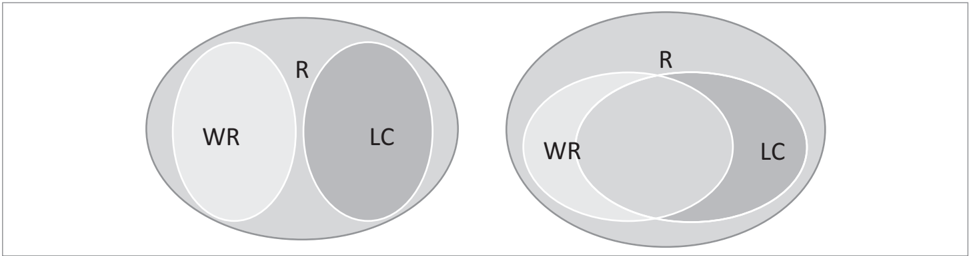
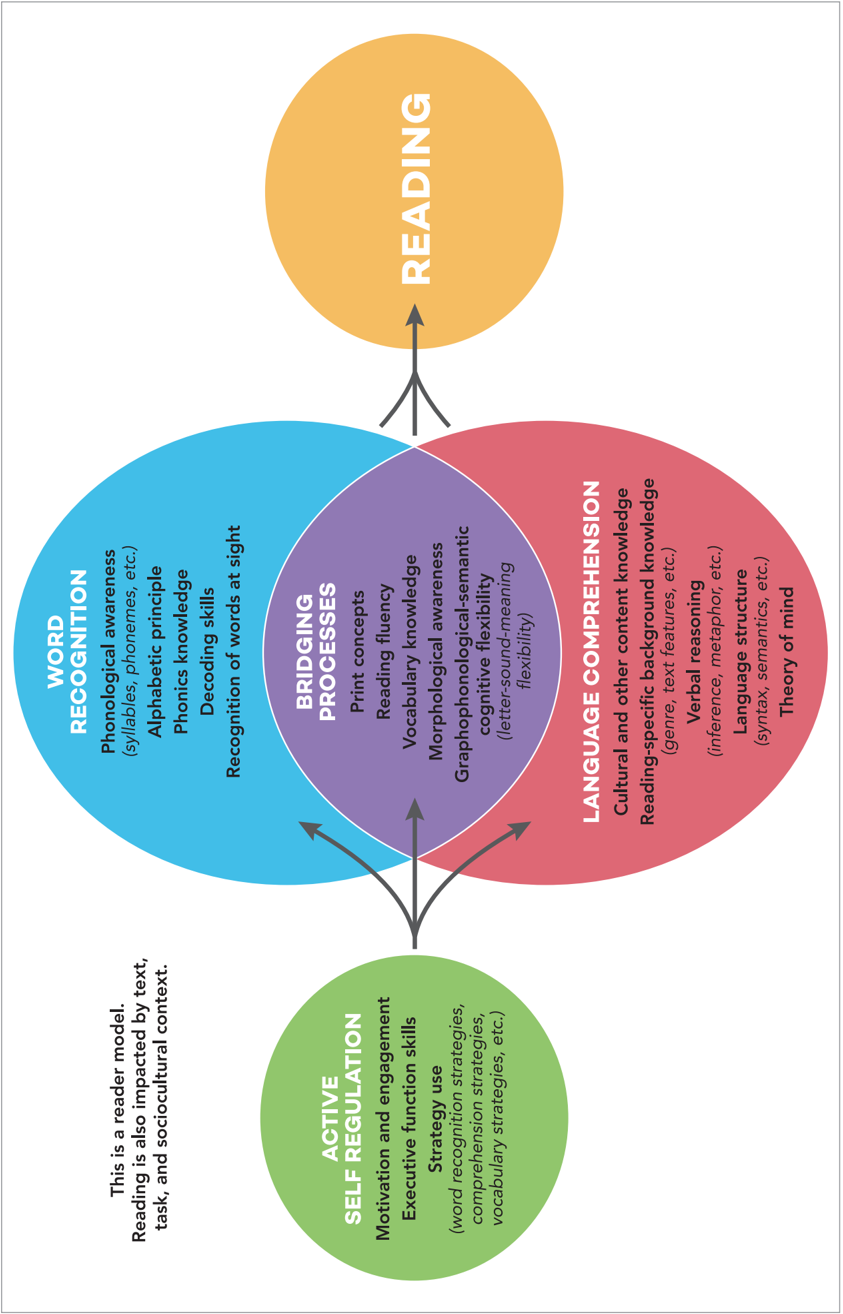
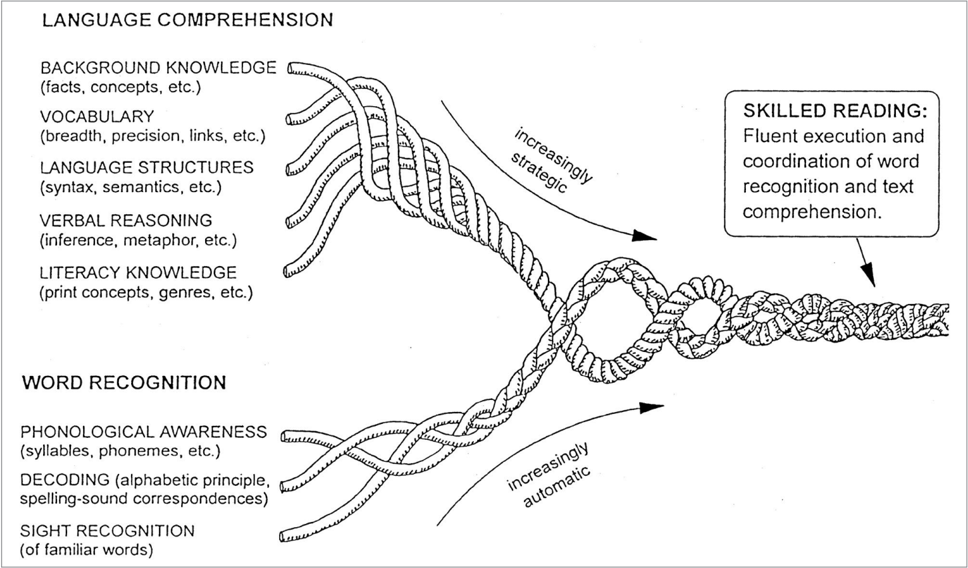
The simple view of reading is commonly presented to educators in professional development about the science of reading. The simple view is a useful tool for conveying the undeniable importance—in fact, the necessity—of both decoding and linguistic comprehension for reading. Research in the 35 years since the theory was proposed has revealed additional understandings about reading. In this article, we synthesize research documenting three of these advances: (1) Reading difficulties have a number of causes, not all of which fall under decoding and/or listening comprehension as posited in the simple view; (2) rather than influencing reading solely independently, as conceived in the simple view, decoding and listening comprehension (or in terms more commonly used in reference to the simple view today, word recognition and language comprehension) overlap in important ways; and (3) there are many contributors to reading not named in the simple view, such as active, self‐regulatory processes, that play a substantial role in reading. We point to research showing that instruction aligned with these advances can improve students’ reading. We present a theory, which we call the active view of reading, that is an expansion of the simple view and can be used to convey these important advances to current and future educators. We discuss the need to lift up updated theories and models to guide practitioners’ work in supporting students’ reading development in classrooms and interventions.
Overview
The claims and statistics of this paper haven’t been checked yet.
Run the check — free, no account needed. It reads the open-access text and checks the sources it cites.
Integrity signals
Registry
Cites
Statistics
Figures


Verification
Claims the paper makes
The claims and statistics of this paper haven’t been checked yet.
Run the check — free, no account needed. It reads the open-access text and checks the sources it cites.
Claims other papers make about this one
Each is checked against this paper’s own text: does it say what the citing paper says it does?
The cited source says what the claim attributes to it.
In the citing paper
“However, in light of the Declarative/Procedural Model (Ullman, 2016) and the Active View of Reading (Duke & Cartwright, 2021), reading authentic storybooks may ultimately prove more effective.”
From Harnessing Dual Memory Systems: A Balanced Approach to Explicit and Implicit Reading Instruction for Young EFL Learners (2026) · cites this paper as Duke & Cartwright, 2021
The cited source says what the claim attributes to it.
In the citing paper
“Given that motivation and engagement are critical factors affecting the reading experience as a key category of active self-regulation (Duke & Cartwright, 2021; see Figure 3), these differences may considerably influence the degree of implicit language acquisition.”
From Harnessing Dual Memory Systems: A Balanced Approach to Explicit and Implicit Reading Instruction for Young EFL Learners (2026) · cites this paper as Duke & Cartwright, 2021
Self-check
Percentages, sums and reported differences re-computed from the paper’s own numbers.
The self-check needs the paper’s full text.
Citations
Cites
Diamond, A. (2013) · Annual Review of Psychology · doi:10.1146/annurev-psych-113011-143750 · Cited by 13,268
Decoding, reading, and reading disability.
Gough, P. B., & Tunmer, W. E. (1986) · Remedial and Special Education · doi:10.1177/074193258600700104 · Cited by 3,972
Hoover, W. A., & Gough, P. B. (1990) · Reading and Writing · doi:10.1007/bf00401799 · Cited by 2,956
Is working memory training effective? A meta-analytic review
Melby-Lervåg, M., & Hulme, C. (2013) · Developmental Psychology · doi:10.1037/a0028228 · Cited by 1,782
Working memory training improves reading processes in typically developing children.
Loosli, S. V., Buschkuehl, M., Perrig, W. J., & Jaeggi, S. M. (2012) · Child Neuropsychology · doi:10.1080/09297049.2011.575772 · Cited by 365
Effects of working memory training on reading in children with special needs
Dahlin, K. I. E. (2011) · Reading and Writing · doi:10.1007/s11145-010-9238-y · Cited by 263
Connor, C. M., Dombek, J., Crowe, E. C., Spencer, M., Tighe, E. L., Coffinger, S., Zargar, E., Wood, T., & Petscher, Y. (2017) · Journal of Educational Psychology · doi:10.1037/edu0000128 · Cited by 63
Research works printed but not linked: 132
- 10.1177/002221949903200203 · DOI
- 10.1177/0022219407310838 · DOI · Paper page
- 10.1111/desc.12422 · DOI
- 10.1016/j.cortex.2018.01.009 · DOI
- 10.1007/s11145-006-9024-z · DOI
- 10.1598/RT.61.5.1 · DOI
- 10.1016/j.cedpsych.2016.02.002 · DOI
- 10.1177/00957984980244004 · DOI
- 10.1177/0741932509355988 · DOI
- 10.1007/s11145-015-9608-6 · DOI
- 10.1007/s10648-017-9422-6 · DOI
- 10.1037/0022-0663.87.3.488 · DOI
- 10.1002/rrq.338 · DOI
- 10.1037/0022-0663.94.1.56 · DOI
- Cartwright K.B., 2015, Executive skills and reading comprehension: A guide for educators
- 10.1016/j.cogdev.2020.100932 · DOI
- 10.1016/j.cedpsych.2016.01.003 · DOI
- 10.1002/trtr.1818 · DOI
- 10.1002/rrq.273 · DOI
- 10.1177/0741932518767563 · DOI
- 10.4324/9781410612052 · DOI
- 10.1177/002221940303600208 · DOI
- 10.1002/rrq.343 · DOI
- 10.1023/A:1011114724881 · DOI
- 10.1007/s11145-008-9126-x · DOI
- 10.1207/s15326950dp3902&3_9 · DOI
- 10.1037/0022-0663.99.2.311 · DOI
- 10.1037/a0019452 · DOI
- 10.1016/0022-0965(90)90079-N · DOI
- Cutting L.E., 2015, Advances in reading intervention: Research to practice to research, 73
- 10.1207/s1532799xssr1003_5 · DOI
- Cutting L.E., 2012, Reaching an understanding: Innovations in how we view reading assessment, 101
- Dawson P., 2018, Executive skills in children and adolescents
- 10.1007/s10648-018-9443-9 · DOI · Paper page
- 10.1080/14739879.2018.1450096 · DOI
- 10.1002/trtr.1819 · DOI
- 10.1016/j.jcomdis.2016.07.002 · DOI
- 10.1080/10888438.2013.819356 · DOI
- 10.1598/RRQ.36.3.2 · DOI
- 10.1037/edu0000180 · DOI
- 10.1080/00461520.2017.1309295 · DOI
- Foorman B.R., 2018, Decomposing the variance in reading comprehension to reveal the unique and common effects of language and decoding, JoVE Journal, 140
- 10.1080/19345747.2016.1237597 · DOI
- 10.1007/s11145-020-10043-3 · DOI
- 10.1177/0741932518772904 · DOI
- 10.3102/0034654313499616 · DOI
- 10.1111/1467-9817.12091 · DOI
- 10.1177/0022219408326210 · DOI
- 10.1111/mbe.12125 · DOI
- 10.1007/s11881-010-0041-x · DOI
- 10.1080/10888438.2012.689791 · DOI · Paper page
- 10.1007/s11145-017-9736-2 · DOI
- Gough P.B., 1996, Reading comprehension difficulties: Processes and intervention, 1
- 10.1016/j.jecp.2015.11.004 · DOI
- 10.1002/rrq.81 · DOI
- 10.1037/edu0000082 · DOI
- 10.1016/j.edurev.2020.100323 · DOI
- 10.1111/1467-9817.12246 · DOI
- 10.2307/25474660 · DOI
- Hoffman J.H., 2009, Handbook of research on reading comprehension, 54
- 10.3109/17549507.2014.904441 · DOI
- 10.1177/0741932518773154 · DOI
- 10.1007/978-3-030-44195-1 · DOI
- Houck B.D., 2012, Dismantling the myth of learning to read and reading to learn, ASCD Express, 7
- Huey E.B., 1908, The psychology and pedagogy of reading
- 10.1086/709857 · DOI
- International Dyslexia Association, 2018, Scarborough’s reading rope: A groundbreaking infographic, The Examiner, 7
- 10.1111/desc.12866 · DOI
- 10.1007/978-3-030-26550-2_1 · DOI
- 10.1080/02702710050084428 · DOI
- 10.1037/edu0000316 · DOI
- 10.1348/978185408X369020 · DOI
- 10.1007/s11145-010-9278-3 · DOI
- 10.1002/rrq.54 · DOI
- 10.1080/10888438.2017.1291643 · DOI · Paper page
- 10.1007/s11145-010-9276-5 · DOI
- 10.1111/1467-9817.12251 · DOI
- 10.1598/RRQ.45.2.4 · DOI
- 10.1207/s15548430jlr3804_1 · DOI
- 10.1002/rrq.99 · DOI
- 10.1007/s11145-018-9840-y · DOI
- 10.1037/edu0000459 · DOI
- 10.1177/0741932518764833 · DOI
- 10.1037/0022-0663.92.2.263 · DOI
- Lysaker J.T., 2011, Reading and social imagination: What relationally oriented reading instruction can do for children, Reading Psychology, 32, 520
- 10.1016/j.sbspro.2012.05.205 · DOI
- 10.1177/0022219413504996 · DOI
- 10.1007/s10648-020-09584-4 · DOI
- 10.1007/s11881-013-0080-1 · DOI
- Moats L., 2018, Develop your teachers into literacy experts
- 10.1080/10573569.2016.1203272 · DOI
- 10.1080/10888438.2017.1278763 · DOI
- 10.1111/j.1473-4192.2007.00132.x · DOI
- 10.1080/19404158.2019.1609272 · DOI · Paper page
- 10.1111/j.1467-9817.2004.00238.x · DOI · Paper page
- 10.1111/bjep.12355 · DOI
- Nusca V., 1999, The role of domain‐specific knowledge in the reading comprehension of adult readers
- 10.1007/s10648-018-9445-7 · DOI
- 10.1007/s11145-008-9159-1 · DOI
- 10.1080/10888438.2013.827687 · DOI · Paper page
- 10.1111/j.1467-8624.2012.01754.x · DOI
- 10.1598/RT.58.6.2 · DOI
- 10.1177/0022219415613080 · DOI
- Pressley M., 1995, Verbal protocols of reading: The nature of constructively responsive reading
- 10.2307/747692 · DOI
- 10.3102/01623737024003219 · DOI
- Rose J., 2006, Independent review of the teaching of early reading: Final report
- Rose J., 2017, Teaching reading—it’s simple but not simplistic, Teacher
- 10.1111/j.1467-9450.2005.00441.x · DOI
- Scarborough H.S., 2001, Handbook of early literacy research, 97
- 10.1007/s11145-016-9667-3 · DOI
- 10.1002/rrq.341 · DOI
- 10.1080/09297040802220029 · DOI
- Shanahan T., 2010, Improving reading comprehension in kindergarten through 3rd grade: A practice guide
- 10.3102/00028312025003441 · DOI
- 10.1080/10888438.2011.618153 · DOI
- 10.1177/0741932518770288 · DOI
- 10.1080/10888438.2016.1178267 · DOI
- 10.1177/0022219416638028 · DOI
- 10.1002/rrq.385 · DOI
- 10.1016/j.cedpsych.2020.101848 · DOI
- 10.1007/s11145-020-10034-4 · DOI
- 10.1080/10888438.2018.1450410 · DOI
- 10.1111/j.1467-9817.2009.01401.x · DOI
- 10.1037/a0023495 · DOI
- 10.1177/0022219411432685 · DOI
- 10.1002/acp.1414 · DOI
- 10.2307/747435 · DOI
- 10.1016/j.dr.2020.100945 · DOI
- 10.1002/rrq.163 · DOI
- 10.1016/j.neuropsychologia.2018.10.027 · DOI
- 10.1002/rrq.287 · DOI
Cited by
Sorted by citations
Building a Stronger Case for Independent Reading at School
Bus, A. G., Shang, Y., & Roskos, K. (2024) · AERA Open · doi:10.1177/23328584241267843 · Cited by 7
Kim, J. M. (2026) · Reading Psychology · doi:10.1080/02702711.2026.2735234
Metadata
- Authors
- Duke, N. K., & Cartwright, K. B.
- Venue
- Reading Research Quarterly
- Publisher
- Wiley
- Published
- 2021-05
- Volume
- 56
- Issue
- S1
- ISSN
- 0034-0553
- 1936-2722
- Cited by
- 510
- References
- 7
- Language
- en
About these checks
Registry, retraction, Cites and statistics results are computed, not judged, with one exception: a printed reference that no index lists is read once by a model before it counts as a citation error. Claims are extracted by a model and kept only when their quote appears verbatim in the text; each cited source is then checked, with a model’s help, for whether it says what the claim relies on. Those verdicts can be wrong — read the claim’s quote and the cited source before relying on one.
Statistics and arithmetic are recomputed, not judged.
Confidence bands are shown only for fields calibrated on our annotated test set. None is calibrated yet, so no band is shown.
What counts as a claim ›How we measure confidence ›How we check this ›
Are you an author, or do you see a problem with this page? Request a review
