

Effect of long‐term treatment with memantine on mortality in patients with major cognitive disorders: A systematic review and meta‐analysis
Open accessThe DOI matches its Crossref record; 42 of the 42 references it cites were found in a registry or an index; none of the 30 sources its claims cite is checked for support yet.
Abstract
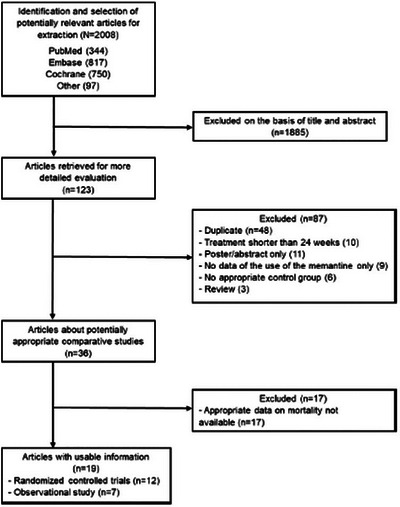
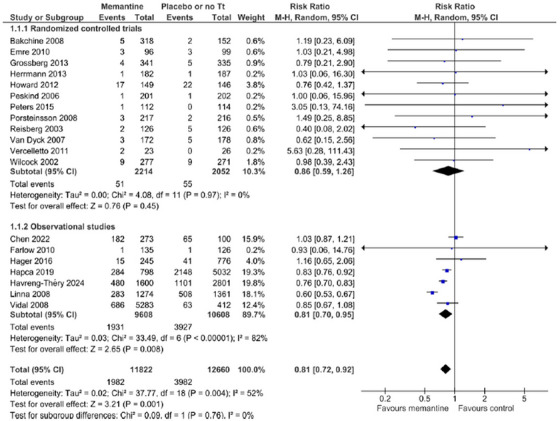
BACKGROUND: Dementia is responsible for a reduction in life expectancy, and the effect of memantine on mortality is still poorly understood. Our aim was to evaluate the effect of long‐term treatment with memantine on all‐cause mortality. METHODS: In this systematic review and meta‐analysis, we searched five databases from their creation to June 2024. RESULTS: We found 12 randomized trials ( n = 4266) and 7 observational studies ( n = 20,216). Treatment with memantine was associated with a reduction in all‐cause mortality (risk ratios [RRs] 0.81, 95% CI: 0.72–0.92, p = 0.001). In the sensitivity analysis, the pooled RR was similar for randomized controlled trials (RCT) (RR 0.86) and non‐randomized studies (RR 0.81) but pooled results from RCTs did not reach statistical significance (95% confidence interval [CI]: 0.59–1.26, p = 0.45), while they did for observational studies (95% CI: 0.70–0.95, p = 0.008), so we consider the overall evidence as of low certainty. CONCLUSION: Our results suggest that the use of memantine in patients with dementia may be associated with a reduction in all‐cause mortality. Highlights: Dementia reduces patients’ survival and the effect of long‐term use of memantine on all‐cause mortality is not well known. This systematic review and metanalysis included 19 studies including more than 24000 patients. We found that memantine in patients with dementia may be associated with a reduction in all‐cause mortality.
Overview
CoChat Summary
TL;DR
This systematic review and meta-analysis found that long-term memantine in patients with dementia may be associated with reduced all-cause mortality, with pooled RR 0.81 (95% CI 0.72–0.92, p = 0.001) across 19 studies. The evidence was considered low certainty because the significant result was driven mainly by observational studies, while RCTs alone showed a similar but non-significant reduction.
Key findings
- Across 12 RCTs (n = 4266) and 7 observational studies (n = 20,216), memantine was associated with lower all-cause mortality: RR 0.81, 95% CI 0.72–0.92, p = 0.001.
- Pooled RRs were similar for RCTs (RR 0.86) and observational studies (RR 0.81), but only observational studies reached significance (95% CI 0.70–0.95, p = 0.008; RCT 95% CI 0.59–1.26, p = 0.45).
- Four observational studies with multivariate adjustment showed reduced mortality with memantine: HR 0.78, 95% CI 0.67–0.90, p = 0.001.
- Heterogeneity was absent among RCTs (I² = 0%) but substantial among observational studies (I² = 82%, p < 0.001); excluding Linna et al. reduced observational heterogeneity to I² = 55% (p = 0.05) without changing results (observational RR 0.86, 95% CI 0.77–0.96; all studies RR 0.83, 95% CI 0.78–0.88).
Methods
- Systematic review and meta-analysis following PRISMA; searched PubMed, Embase, CENTRAL, ClinicalTrials.gov, and WHO ICTRP from database creation to June 30, 2024, including English-language randomized and non-randomized parallel controlled studies of memantine vs placebo/no exposure in any dementia, with ≥6 months follow-up and all-cause mortality.
- Included 19 studies (12 RCTs, 7 observational); data extracted on design, participants, deaths, dementia type, treatment/comparator, and MMSE; risk of bias assessed with Cochrane RoB2 and ROBINS-I, and certainty with GRADE.
- Mortality data pooled as risk ratios using Mantel–Haenszel random-effects models; multivariate-adjusted hazard ratios pooled separately by inverse variance; sensitivity analyses restricted to studies with >500 patients or low risk of bias in all domains.
Limitations
- Stated: the main limitation is that non-randomized studies were a major contributor to overall results, with possible unknown selection bias; significant heterogeneity remained among observational studies due to variable designs, follow-up (6–32 months), and settings, and persisted after removing the most influential study; multivariate-adjusted HRs could only be combined from four studies; two included studies combined galantamine/ChEIs with memantine, complicating interpretation.
- Stated: overall evidence was rated low certainty because the main contributors were observational studies.
- Evident from the text: mortality was not a primary outcome in any RCT and RCT follow-up averaged 7.8 months, so RCTs may have been underpowered for mortality; observational studies included two at serious risk of bias and two at moderate risk by ROBINS-I; only English-language publications were included.
Model-written summary. Check it against the paper before relying on it.
Integrity signals
Registry
Cites
Statistics
Figures

Verification
Claims the paper makes
0 Valid · 0 Not valid · 15 Not checked · 45 Own results and interpretations
A result the paper reports from its own data — it cites no other source for it, so there is none to check. The quote shows it is in the paper.
In the paper
“Treatment with memantine was associated with a reduction in all‐cause mortality (risk ratios [RRs] 0.81, 95% CI: 0.72–0.92, p = 0.001).”
- Also stated in: § CONCLUSION · hedged
“Our results suggest that the use of memantine in patients with dementia may be associated with a reduction in all‐cause mortality.”
- Also stated in: § RESEARCH IN CONTEXT · plain
“Among the 24,482 MND patients, those treated by memantine had significantly lower mortality than untreated patients.”
§ Effect of long‐term treatment with memantine on mortality in patients with major cognitive disorders: A systematic review and meta‐analysis > Abstract > RESULTS
plainstates an associationn = 24,482 ·- Asserted: passes — The authors put it forward as true.
- Checkable: passes — It can be checked against evidence.
- Load-bearing: passes — The paper’s conclusions depend on it.
- Based: passes — The paper gives a reason why it holds.
- Also stated in: § CONCLUSION · hedged
A result the paper states — it cites no source for it, so there is none to check. The quote shows it is in the paper.
In the paper
“Among the 24,482 MND patients, those treated by memantine had significantly lower mortality than untreated patients.”
§ Effect of long‐term treatment with memantine on mortality in patients with major cognitive disorders: A systematic review and meta‐analysis > INTRODUCTION > RESEARCH IN CONTEXT
plainn = 24,482- Asserted: passes — The authors put it forward as true.
- Checkable: passes — It can be checked against evidence.
- Load-bearing: unclear — It is unclear whether the paper’s conclusions depend on it.
- Based: passes — The paper gives a reason why it holds.
A result the paper reports from its own data — it cites no other source for it, so there is none to check. The quote shows it is in the paper.
In the paper
“Overall, all studies combined, long‐term treatment with memantine was associated with lower all‐cause mortality (RR 0.81, 95% CI: 0.72–0.92, p = 0.001) (Figure 2).”
- Also stated in: § DISCUSSION · boosted
“This meta‐analysis highlights that the long‐term use of memantine is associated with a significant reduction in all‐cause mortality of patients with dementia.”
- Also stated in: § Strengths and limitations · hedged
“In conclusion, our systematic review suggests that long‐term treatment with memantine is probably associated with reduced all‐cause mortality in patients with dementia.”
§ Effect of long‐term treatment with memantine on mortality in patients with major cognitive disorders: A systematic review and meta‐analysis > RESULTS > Mortality
boostedstates an association- Asserted: passes — The authors put it forward as true.
- Checkable: passes — It can be checked against evidence.
- Load-bearing: passes — The paper’s conclusions depend on it.
- Based: passes — The paper gives a reason why it holds.
- Also stated in: § DISCUSSION · boosted
A result the paper reports from its own data — it cites no other source for it, so there is none to check. The quote shows it is in the paper.
In the paper
“There was no significant difference neither on the effect in all‐cause mortality between studies including patients with more severe dementia and those with mild or moderate dementia (test for subgroup differences: p = 0.69, Figure S7).”
§ Effect of long‐term treatment with memantine on mortality in patients with major cognitive disorders: A systematic review and meta‐analysis > RESULTS > Mortality
plain- Asserted: passes — The authors put it forward as true.
- Checkable: passes — It can be checked against evidence.
- Load-bearing: unclear — It is unclear whether the paper’s conclusions depend on it.
- Based: passes — The paper gives a reason why it holds.
A result the paper reports from its own data — it cites no other source for it, so there is none to check. The quote shows it is in the paper.
In the paper
“Pooled RR were very similar both for randomized studies (RR 0.86) and for observational studies (RR 0.81).”
- Also stated in: § DISCUSSION · plain
“Nevertheless, in randomized studies, the pooled RR was similar to that in observational studies (RR 0.86 and 0.81, respectively) but did not reach the level of statistical significance.”
§ Effect of long‐term treatment with memantine on mortality in patients with major cognitive disorders: A systematic review and meta‐analysis > RESULTS > Mortality
plain- Asserted: passes — The authors put it forward as true.
- Checkable: passes — It can be checked against evidence.
- Load-bearing: passes — The paper’s conclusions depend on it.
- Based: passes — The paper gives a reason why it holds.
- Also stated in: § DISCUSSION · plain
23 more claims
Create a free account to see all 60 claims and to verify the 30 references still open.
- It may state two separate claims as one. 23
- The quote only partly states this claim. 1
- Probably not a substantial claim. 17
Self-check
Percentages, sums and reported differences re-computed from the paper’s own numbers.
Each contradiction between two passages listed here was confirmed by an independent check.
Rated minor: it would not touch a result — a value no result rests on, a p-value that stays on the same side of the significance level, or a conflict that is clerical, resolved elsewhere in the paper, or outside its own findings.
In the paper
§ Effect of long‐term treatment with memantine on mortality in patients with major cognitive disorders: A systematic review and meta‐analysis > Abstract > RESULTS
“they did for observational studies (95% CI: 0.70–0.95, p = 0.008)”
§ Effect of long‐term treatment with memantine on mortality in patients with major cognitive disorders: A systematic review and meta‐analysis > RESULTS > Mortality
“they were significant for observational studies (95% CI: 0.70–0.95, p < 0.001)”
Citations
Cites
The PRISMA 2020 statement: An updated guideline for reporting systematic reviews
Page, M. J., McKenzie, J. E., Bossuyt, P. M., Boutron, I., Hoffmann, T. C., Mulrow, C. D., Shamseer, L., Tetzlaff, J. M., Akl, E. A., Brennan, S. E., et al. (2021) · BMJ · doi:10.1136/bmj.n71 · Cited by 108,283
Quantifying heterogeneity in a meta‐analysis
Higgins, J. P. T., & Thompson, S. G. (2002) · Statistics in Medicine · doi:10.1002/sim.1186 · Cited by 36,763
GRADE guidelines: 3. Rating the quality of evidence
Balshem, H., Helfand, M., Schünemann, H. J., Oxman, A. D., Kunz, R., Brozek, J., Vist, G. E., Falck-Ytter, Y., Meerpohl, J., & Norris, S. (2011) · Journal of Clinical Epidemiology · doi:10.1016/j.jclinepi.2010.07.015 · Cited by 8,285
Lecanemab in early Alzheimer's disease
van Dyck, C. H., Swanson, C. J., Aisen, P., Bateman, R. J., Chen, C., Gee, M., Kanekiyo, M., Li, D., Reyderman, L., Cohen, S., et al. (2023) · New England Journal of Medicine · doi:10.1056/nejmoa2212948 · Cited by 5,678
2019 Alzheimer’s disease facts and figures.
Alzheimer's Association (2019) · Alzheimer's & Dementia · doi:10.1016/j.jalz.2019.01.010 · Cited by 2,461
(2015) · HAL · Cited by 2,238
Memantine in Moderate-to-Severe Alzheimer's Disease
Reisberg, B., Doody, R., Stöffler, A., Schmitt, F., Ferris, S., & Möbius, H. J. (2003) · New England Journal of Medicine · doi:10.1056/nejmoa013128 · Cited by 2,043
McShane, R., Areosa Sastre, A., & Minakaran, N. (2006) · Cochrane Database of Systematic Reviews · doi:10.1002/14651858.cd003154.pub5 · Cited by 1,155
Donepezil and memantine for moderate-to-severe Alzheimer's disease
Howard, R., McShane, R., Lindesay, J., Ritchie, C., Baldwin, A., Barber, R., Burns, A., Dening, T., Findlay, D., Holmes, C., et al. (2012) · New England Journal of Medicine · doi:10.1056/nejmoa1106668 · Cited by 782
Salloway, S., Chalkias, S., Barkhof, F., Burkett, P., Barakos, J., Purcell, D., Suhy, J., Forrestal, F., Tian, Y., Umans, K., et al. (2022) · JAMA Neurology · doi:10.1001/jamaneurol.2021.4161 · Cited by 619
Research works printed but not linked: 1
- Deeks JJ, Higgins JPT, Altman DG, et al. Chapter 10: Analysing data and undertaking meta‐analyses [last updated November 2024]. In: Higgins JPT, Thomas J, Chandler J, Cumpston M, Li T, Page MJ, Welch VA, eds. Cochrane Handbook for Systematic Reviews of Interventions version 6.5. Cochrane. 2024. Accessed February 3, 2025.
Cited by
Kim, M., Kwon, H., Sohn, S., Lee, W. J., Cho, K., & Kim, G. W. (2025) · Journal of Alzheimer s Disease · doi:10.1177/13872877251391820 · Cited by 13
“58 However, the speci fi c mechanism and long-term effects are still to be investigated.”
Neurotransmitter Systems in Alzheimer’s Disease
Ramírez-Expósito, M. J., Cueto‐Ureña, C., & Martínez-Martos, J. M. (2026) · Current Issues in Molecular Biology · doi:10.3390/cimb48030334 · Cited by 11
Zuliani, G., Brombo, G., Romagnoli, T., Polastri, M., Dario, F. D. P., & Zuin, M. (2025) · GeroScience · doi:10.1007/s11357-025-02052-3 · Cited by 4
“Our findings are consistent with RCT data showing ME efficacy in moderate-to-severe, but not mild, AD [16, 17, 29], as well as with the recent meta-analysis by Zolnowski-Kolp et al. [30], reporting a 19% mortality reduction associated with ME treatment.”
Ahuja, S., Kanwar, D., Silakari, P., Sahu, S. K., & Kaur, P. (2026) · Therapeutic Innovation & Regulatory Science · doi:10.1007/s43441-026-01013-y · Cited by 2
Virtual reality-based cognitive training in mild cognitive impairment: a systematic review
Scaramuzzi, G. F., Manippa, V., Pawlik, K. H., Gkanatsa, M., Cornacchia, E., Gasparre, D., Bonvino, A., Lancioni, G., & Taurisano, P. (2026) · Frontiers in Aging Neuroscience · doi:10.3389/fnagi.2026.1784911 · Cited by 1
Metadata
- Authors
- Zolnowski‐Kolp, V., Oquendo, B., Havreng‐Théry, C., Lafuente‐Lafuente, C., & Belmin, J.
- Affiliations
- Assistance Publique – Hôpitaux de Paris (FR)
- Sorbonne Université (FR)
- Inserm (FR)
- Corresponding author
- Belmin, Joël
- ORCID
- Venue
- Alzheimer's & Dementia: Translational Research & Clinical Interventions
- Publisher
- Wiley
- Published
- 2025-04
- Volume
- 11
- Issue
- 2
- Pages
- e70071-e70071
- ISSN
- 2352-8737 (ISSN-L)
- PMC
- PMC12009441
- OpenAlex
- W4409616422
- Semantic Scholar
- dae1622009a0a71302412419403969cf70f0299f
- Cited by
- 9
- References
- 41
- Citations by year
- 2026: 6 · 2025: 3
- FWCI
- 0.93
- Type
- journal article
- Language
- en
- Open access
- gold
- doi.org
- Licence
- Locations
- Alzheimer s & Dementia Translational Research & Clinical Interventions (publishedVersion, cc-by-nc-nd)
- PubMed Central (publishedVersion, cc-by-nc-nd)
- PubMed (publishedVersion)
- HAL (submittedVersion, other-oa)
- DOAJ (DOAJ: Directory of Open Access Journals) (submittedVersion)
- Topics
- Health Sciences › Medicine › Psychiatry and Mental health › Dementia and Cognitive Impairment Research
- Life Sciences › Neuroscience › Cellular and Molecular Neuroscience › Alzheimer's disease research and treatments
- Health Sciences › Medicine › Geriatrics and Gerontology › Pharmaceutical Practices and Patient Outcomes
- Keywords
- memantine, all-cause mortality, dementia, long-term treatment, survival, NMDA receptor antagonists, Alzheimer's disease
About these checks
Registry, retraction, Cites and statistics results are computed, not judged, with one exception: a printed reference that no index lists is read once by a model before it counts as a citation error. Claims are extracted by a model and kept only when their quote appears verbatim in the text; each cited source is then checked, with a model’s help, for whether it says what the claim relies on. Those verdicts can be wrong — read the claim’s quote and the cited source before relying on one.
A language model drew the claims from the paper on 2026-11-27, under version 3 of the claim definition (model deepseek-v4.1-flash, prompt extract-v3).
A second model labelled each claim on 2026-11-27 (model jev-1.13-20260917, definition revision gold-guideline-v0.2).
Statistics and arithmetic are recomputed, not judged.
Confidence bands are shown only for fields calibrated on our annotated test set. None is calibrated yet, so no band is shown.
What counts as a claim ›How we measure confidence ›How we check this ›
Are you an author, or do you see a problem with this page? Request a review
How to cite
Cite CoChat for the checks on this page, and the paper for its own findings.
- This page
- CoChat. (2026). Citation check: Effect of long‐term treatment with memantine on mortality in patients with major cognitive disorders: A systematic review and meta‐analysis. https://app.cochat.ai/papers/10.1002/trc2.70071
- The paper
- Zolnowski‐Kolp, V., Oquendo, B., Havreng‐Théry, C., Lafuente‐Lafuente, C., & Belmin, J. (2025). Effect of long‐term treatment with memantine on mortality in patients with major cognitive disorders: A systematic review and meta‐analysis. Alzheimer's & Dementia: Translational Research & Clinical Interventions. https://doi.org/10.1002/trc2.70071
Data sources
Bibliographic data: Semantic Scholar, OpenAlex, Crossref.
Contains information from the Semantic Scholar Academic Graph Datasets, made available under the ODC Attribution License (ODC-BY 1.0).
Semantic Scholar’s data is described in: Kinney, R., et al. (2023). The Semantic Scholar Open Data Platform. arXiv:2301.10140.
