

The DOI matches its Crossref record; 21 of the 21 references it cites were found in a registry or an index; none of the 38 sources its claims cite is checked for support yet.
Long‐Term Outcomes After Slowly Resorbable P4HB Mesh Implantation: A Multicenter Analysis From European Registry
Open accessAbstract
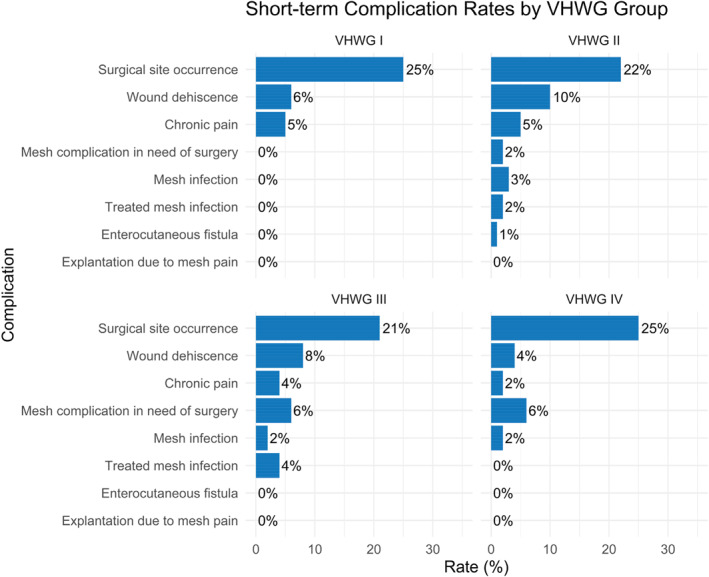
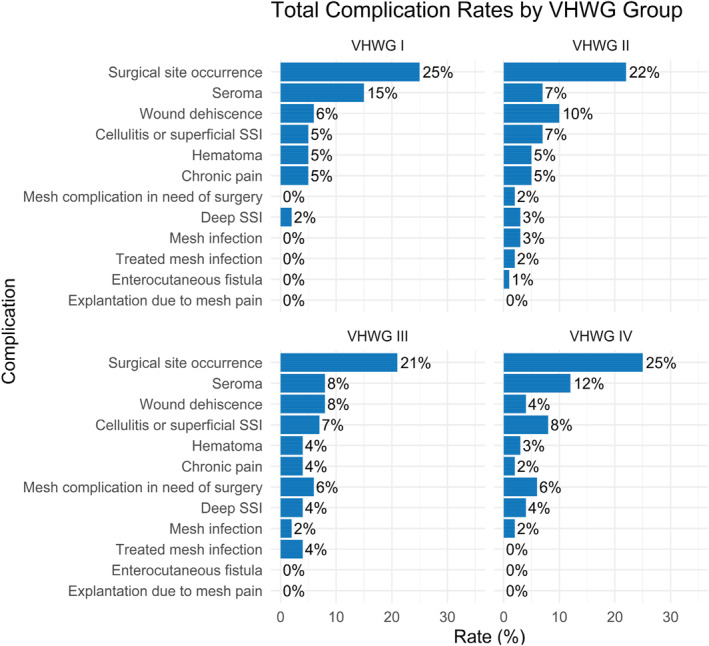
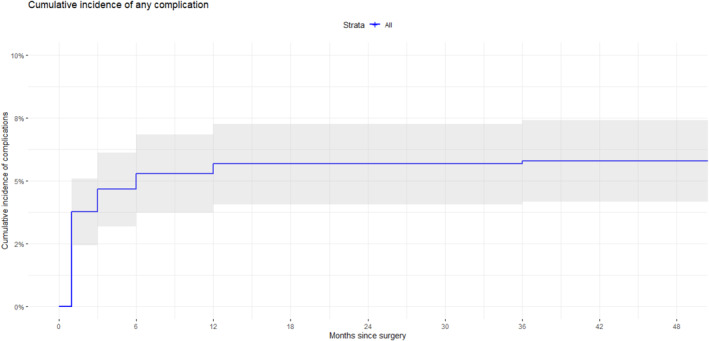
Background: Fully resorbable biosynthetic mesh composed of poly‐4‐hydroxybutyrate (P4HB), have been designed for incisional hernia (IH) repair, including in contaminated surgical fields. While existing studies have demonstrated its safety and efficacy in the short term, comprehensive long‐term data, particularly after complete mesh resorption, remain scarce. Methods: This multicenter European registry analysis investigates the incidence of short‐ and long‐term complications following IH repair with Phasix (P4HB) or Phasix ST (P4HB with hydrogel barrier; BD, Warwick, RI, USA) mesh. Adult patients from registries in France, Greece, Germany, and Spain were included and stratified using the Ventral Hernia Working Group (VHWG) classification. The primary endpoint was the incidence of long‐term mesh‐related complications one to five years post‐implantation, after mesh resorption. Secondary endpoints included short‐term complications and hernia recurrence. Results: A total of 790 patients underwent incisional hernia repair with P4HB mesh, with a median follow‐up of 38 months (IQR 36–48). Long‐term follow‐up beyond 24 months was available in 57% of patients. The majority of complications occur during the first 6 months. Long‐term mesh‐related morbidity remained low, with mesh infection occurring in 2% of patients and chronic pain in 3%–5%, even after complete mesh resorption. Rates of enterocutaneous fistula and mesh explantation were rare. Long‐term complication profiles varied by hernia complexity, comorbidity burden, and mesh position, with higher ASA class associated with increased risk of mesh infection and chronic pain. The overall hernia recurrence rate was 22%, with recurrence increasing after the expected resorption period and stabilizing thereafter. Higher recurrence risk was independently associated with VHWG grade III–IV (HR of 2.55 and 2.49), obesity (HR 1.41), and intraperitoneal mesh placement (HR 2.72). Conclusion: P4HB mesh demonstrated a favorable long‐term safety profile after complete resorption, with low rates of mesh‐related complications, even in high‐risk patients. Hernia recurrence remains an important secondary outcome and is strongly influenced by patient risk factors and surgical technique. These findings support a tailored, risk‐stratified approach to the use of biosynthetic meshes in IH repair.
Overview
CoChat Summary
TL;DR
In a multicenter European registry of 790 adults undergoing incisional hernia repair with slowly resorbable P4HB mesh, long-term mesh-related complications after expected resorption were low, but hernia recurrence remained common at about 22%. Recurrence risk was independently higher with VHWG grade III–IV, obesity, and intraperitoneal mesh placement.
Key findings
- Among 790 patients with median follow-up of 38 months (IQR 36–48), long-term follow-up beyond 24 months was available in 57% (448 patients). Long-term mesh infection occurred in 2% and chronic pain in 3%–5%, even after complete mesh resorption.
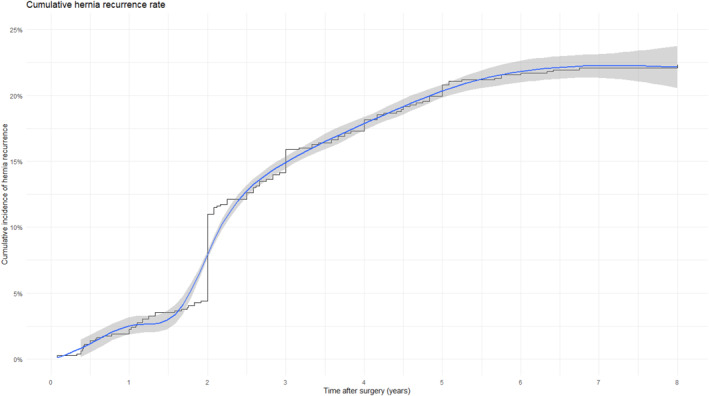
- Overall hernia recurrence was 22.3% (abstract reports 22%; discussion reports 22.6%). Recurrence increased after the expected resorption period and then stabilized.
- Independent recurrence risk factors included VHWG grade III (HR 2.55; 95% CI 1.32–5.01), VHWG grade IV (HR 2.49; 95% CI 1.23–5.09), obesity/BMI >30 (HR 1.41; 95% CI 1.02–1.94), and intraperitoneal mesh placement (HR 2.72; 95% CI 1.29–5.74).
- Higher ASA class was associated with increased risk of mesh infection and chronic pain; ASA IV/V had OR 10.68 (95% CI 1.43–79.71) for chronic pain, and ASA III/IV–V had increased odds of mesh infection.
Methods
- Observational study using prospective data from European abdominal wall surgery registries; adult patients (≥18 years) with documented incisional hernia repaired with Phasix (P4HB) or Phasix ST (P4HB with hydrogel barrier) were included.
- Patients were stratified by Ventral Hernia Working Group (VHWG) classification. The primary endpoint was long-term mesh-related complications two to five years postoperatively, after expected mesh resorption; secondary endpoints included short-term complications and hernia recurrence.
- Analyses included descriptive statistics, Kaplan–Meier survival analysis for time to recurrence, Cox proportional hazards modeling for recurrence risk factors, and multiple imputation using chained equations for missing data.
Limitations
- The paper states that retrospective registry data from multiple countries carry inherent reporting bias, with variability in documentation practices across centers.
- Recurrence was diagnosed by different modalities (CT, ultrasound, physical examination), introducing diagnostic heterogeneity; mesh selection and surgical technique were not randomized.
- Only 57% of patients had follow-up beyond 24 months, and follow-up duration was influenced by censoring after recurrence or reoperation; no controlled comparisons with synthetic resorbable or non-resorbable meshes were possible.
- The paper also states that no quality-of-life assessment using abdominal wall questionnaires was conducted, and functional outcomes/patient-reported quality-of-life metrics were not comprehensively captured.
Model-written summary. Check it against the paper before relying on it.
Integrity signals
Registry
Cites
Statistics
Figures
Verification
Claims the paper makes
0 Valid · 0 Not valid · 22 Not checked · 69 Own results and interpretations
A result the paper reports from its own data — it cites no other source for it, so there is none to check. The quote shows it is in the paper.
In the paper
“Long‐term mesh‐related morbidity remained low, with mesh infection occurring in 2% of patients and chronic pain in 3%–5%, even after complete mesh resorption.”
§ Long‐Term Outcomes After Slowly Resorbable P4HB Mesh Implantation: A Multicenter Analysis From European Registry > Abstract > Results
plainn = 790- Asserted: passes — The authors put it forward as true.
- Checkable: passes — It can be checked against evidence.
- Load-bearing: passes — The paper’s conclusions depend on it.
- Based: passes — The paper gives a reason why it holds.
A result the paper reports from its own data — it cites no other source for it, so there is none to check. The quote shows it is in the paper.
In the paper
“Long‐term follow‐up beyond 24 months was available in 57% of patients.”
- Also stated in: § Demographics · plain
“Long‐term follow‐up, defined as longer than 24 months, was available for 448 patients (56.7%).”
§ Long‐Term Outcomes After Slowly Resorbable P4HB Mesh Implantation: A Multicenter Analysis From European Registry > Abstract > Results
plainn = 448- Asserted: passes — The authors put it forward as true.
- Checkable: passes — It can be checked against evidence.
- Load-bearing: unclear — It is unclear whether the paper’s conclusions depend on it.
- Based: passes — The paper gives a reason why it holds.
- Also stated in: § Demographics · plain
A result the paper reports from its own data — it cites no other source for it, so there is none to check. The quote shows it is in the paper.
In the paper
“Patients who underwent an intraperitoneal onlay mesh (IPOM) repair had a significantly higher recurrence risk compared to the onlay mesh group (HR = 2.72; 95% CI: 1.29–5.74; p = 0.008).”
§ Long‐Term Outcomes After Slowly Resorbable P4HB Mesh Implantation: A Multicenter Analysis From European Registry > Results > Hernia Recurrence
plainstates an association- Asserted: passes — The authors put it forward as true.
- Checkable: passes — It can be checked against evidence.
- Load-bearing: passes — The paper’s conclusions depend on it.
- Based: passes — The paper gives a reason why it holds.
A result the paper reports from its own data — it cites no other source for it, so there is none to check. The quote shows it is in the paper.
In the paper
“Finally, the use of a Phasix ST mesh was at the limit of significance in terms of recurrence compared to standard Phasix mesh (HR = 1.51; 95% CI: 1.00–2.29; p = 0.05).”
§ Long‐Term Outcomes After Slowly Resorbable P4HB Mesh Implantation: A Multicenter Analysis From European Registry > Results > Hernia Recurrence
plainstates an association- Asserted: passes — The authors put it forward as true.
- Checkable: passes — It can be checked against evidence.
- Load-bearing: unclear — It is unclear whether the paper’s conclusions depend on it.
- Based: passes — The paper gives a reason why it holds.
A result the paper reports from its own data — it cites no other source for it, so there is none to check. The quote shows it is in the paper.
In the paper
“Compared to patients classified as VHWG I, those in VHWG III had a significantly increased hazard of recurrence (HR = 2.55; 95% CI: 1.32–5.01; p = 0.007), as did patients in VHWG IV (HR = 2.49; 95% CI: 1.23–5.09; p = 0.014).”
§ Long‐Term Outcomes After Slowly Resorbable P4HB Mesh Implantation: A Multicenter Analysis From European Registry > Results > Hernia Recurrence
plainstates an association- Asserted: passes — The authors put it forward as true.
- Checkable: passes — It can be checked against evidence.
- Load-bearing: passes — The paper’s conclusions depend on it.
- Based: passes — The paper gives a reason why it holds.
54 more claims
Create a free account to see all 91 claims and to verify the 35 references still open.
- The quote only partly states this claim. 3
- It may state two separate claims as one. 20
- Probably not a substantial claim. 13
Self-check
Percentages, sums and reported differences re-computed from the paper’s own numbers.
Each contradiction between two passages listed here was confirmed by an independent check.
Rated major: it would touch a result — a value a result rests on, reported and recomputed p-values on opposite sides of the significance level, two passages that conflict with no sign which is right, or a cited work retracted before this paper was published.
In the paper
§ Long‐Term Outcomes After Slowly Resorbable P4HB Mesh Implantation: A Multicenter Analysis From European Registry > Results > Demographics
“A total of 790 patients were included across 7 European registries, with a median follow‐up of 38 months (IQR 36–48).”
§ Long‐Term Outcomes After Slowly Resorbable P4HB Mesh Implantation: A Multicenter Analysis From European Registry > Results > Demographics
“| Characteristic | Overall follow‐up N = 790 a | Follow‐up < 1 year N = 342 a | Follow‐up > 1 year N = 448 a |”
Rated major: it would touch a result — a value a result rests on, reported and recomputed p-values on opposite sides of the significance level, two passages that conflict with no sign which is right, or a cited work retracted before this paper was published.
In the paper
§ Long‐Term Outcomes After Slowly Resorbable P4HB Mesh Implantation: A Multicenter Analysis From European Registry > Results > Hernia Recurrence
“The overall recurrence rate of incisional hernias in the cohort was 22.3% (Figure 3).”
§ Long‐Term Outcomes After Slowly Resorbable P4HB Mesh Implantation: A Multicenter Analysis From European Registry > Discussion
“An overall hernia recurrence rate of 22.6% was observed, which aligns with previous reports on resorbable meshes [3].”
Rated minor: it would not touch a result — a value no result rests on, a p-value that stays on the same side of the significance level, or a conflict that is clerical, resolved elsewhere in the paper, or outside its own findings.
In the paper
“| Yes | 312 (39%) | 109 (32%) | 203 (45%) | 289 (45%) | 0 (0%) | 69 (32%) | 73 (26%) | 34 (31%) |”
§ Long‐Term Outcomes After Slowly Resorbable P4HB Mesh Implantation: A Multicenter Analysis From European Registry > Results > Demographics
Reported 289 · recomputed 176
Rated minor: it would not touch a result — a value no result rests on, a p-value that stays on the same side of the significance level, or a conflict that is clerical, resolved elsewhere in the paper, or outside its own findings.
In the paper
“| Yes | 232 (29%) | 63 (18%) | 169 (38%) | 214 (33%) | 0 (0%) | 35 (16%) | 48 (17%) | 17 (16%) |”
§ Long‐Term Outcomes After Slowly Resorbable P4HB Mesh Implantation: A Multicenter Analysis From European Registry > Results > Demographics
Reported 214 · recomputed 100
Rated minor: it would not touch a result — a value no result rests on, a p-value that stays on the same side of the significance level, or a conflict that is clerical, resolved elsewhere in the paper, or outside its own findings.
In the paper
“| Never smoked | 471 (60%) | 218 (64%) | 253 (56%) | 360 (56%) | 32 (94%) | 147 (68%) | 225 (79%) | 79 (72%) |”
§ Long‐Term Outcomes After Slowly Resorbable P4HB Mesh Implantation: A Multicenter Analysis From European Registry > Results > Demographics
Reported 360 · recomputed 483
8 more findings
Create a free account to see every finding of this check.
Citations
Cites
The Clavien-Dindo Classification of Surgical Complications: Five-Year Experience
Clavien, P. A., Barkun, J., de Oliveira, M. L., Vauthey, J. N., Dindo, D., Schulick, R. D., de Santibañes, E., Pekolj, J., Slankamenac, K., Bassi, C., et al. (2009) · Annals of Surgery · doi:10.1097/sla.0b013e3181b13ca2 · Cited by 11,482
Breuing, K. H., Butler, C. E., Ferzoco, S. J., Franz, M., Hultman, C. S., Kilbridge, J. F., Rosen, M. J., Silverman, R. P., & Vargo, D. J. (2010) · Surgery · doi:10.1016/j.surg.2010.01.008 · Cited by 1,037
Mesh location in open ventral hernia repair: a systematic review and network meta-analysis
Holihan, J. L., Nguyen, D. H., Nguyen, M. T., Mo, J., Kao, L. S., & Liang, M. K. (2016) · World Journal of Surgery · doi:10.1007/s00268-015-3252-9 · Cited by 314
Krpata, D. M., Schmotzer, B. J., Flocke, S., Jin, J., Blatnik, J. A., Ermlich, B., Novitsky, Y. W., & Rosen, M. J. (2012) · Journal of the American College of Surgeons · doi:10.1016/j.jamcollsurg.2012.06.412 · Cited by 297
The Development and Validation of the Body‐Image Ideals Questionnaire
Cash, T. F., & Szymanski, M. L. (1995) · Journal of Personality Assessment · doi:10.1207/s15327752jpa6403_6 · Cited by 268
Rosen, M. J., Bauer, J. J., Harmaty, M., Carbonell, A. M., Cobb, W. S., Matthews, B., Goldblatt, M. I., Selzer, D. J., Poulose, B. K., Hansson, B. M. E., et al. (2017) · Annals of Surgery · doi:10.1097/sla.0000000000001601 · Cited by 259
A systematic review of the surgical treatment of large incisional hernia
Deerenberg, E. B., Timmermans, L., Hogerzeil, D. P., Slieker, J. C., Eilers, P. H. C., Jeekel, J., & Lange, J. F. (2015) · Hernia · doi:10.1007/s10029-014-1321-x · Cited by 137
Wilson, R. B., & Farooque, Y. (2022) · Journal of Gastrointestinal Surgery · doi:10.1007/s11605-022-05248-6 · Cited by 126
SSI, SSO, SSE, SSOPI: the elusive language of complications in hernia surgery
DeBord, J. R., Novitsky, Y. W., Fitzgibbons, R., Miserez, M., & Montgomery, A. K. (2018) · Hernia · doi:10.1007/s10029-018-1813-1 · Cited by 117
Deeken, C. R., Abdo, M. S., Frisella, M. M., & Matthews, B. D. (2011) · Surgical Endoscopy · doi:10.1007/s00464-010-1432-0 · Cited by 52
Cited by
Editorial: Biosynthetic resorbable meshes: a New frontier in abdominal wall hernia repair
Bueno‐Lledó, J., Berrevoet, F. C., Fischer, J. P., & Roth, J. S. (2026) · Frontiers in Surgery · doi:10.3389/fsurg.2026.1961336
Self-citation
Metadata
- Authors
- van den Berg, R., Wieser, M., López‐Cano, M., Bueno‐Lledó, J., Köckerling, F., Chatzimavroudis, G., Gonella‐Pacchiotti, C., Stabilini, C., Ortega‐Deballon, P., Romain, B., & PRS Group (Phasix Research Study Group)
- Affiliations
- Department of Surgery Erasmus University Medical Centre Rotterdam the Netherlands
- Hôpital d'Hautepierre (FR)
- Abdominal Wall Surgery Unit, Department of General Surgery Hospital Universitari Vall d'Hebron, Unviversitat Autònoma de Barcelona Barcelona Spain
- Hospital Universitari i Politècnic La Fe (ES)
- Charité – Universitätsmedizin Berlin (DE)
- Complex Hernia & Abdominal Wall Reconstruction Center European Interbalkan Medical Center Thessaloniki Greece
- University of Ferrara (IT)
- Ospedale Policlinico San Martino (IT)
- CHU Dijon Bourgogne (FR)
- Corresponding author
- Romain, Benoit
- ORCID
- Venue
- World Journal of Surgery
- Publisher
- Wiley
- Published
- 2026-03-20
- Volume
- 50
- Issue
- 5
- Pages
- 1195-1205
- ISSN
- 0364-2313 (ISSN-L)
- 1432-2323
- PMC
- PMC13206534
- OpenAlex
- W7139979103
- Cited by
- 1
- References
- 21
- Citations by year
- 2026: 1
- FWCI
- 4.36
- Type
- journal article
- Language
- en
- Open access
- hybrid
- doi.org
- Locations
- World Journal of Surgery (publishedVersion, cc-by)
- PubMed (publishedVersion)
- PubMed Central (publishedVersion, cc-by)
- EUR Research Repository (Erasmus University Rotterdam) (submittedVersion, cc-by)
- Topics
- Health Sciences › Medicine › Surgery › Hernia repair and management
- Health Sciences › Medicine › Surgery › Surgical Sutures and Adhesives
- Health Sciences › Medicine › Surgery › Abdominal Surgery and Complications
- Keywords
- incisional hernia repair, hernia recurrence, mesh infection, chronic pain, obesity, ASA class, late complications, contaminated surgical fields
- MeSH terms
- Incisional Hernia, Aged, Europe, Female, Follow-Up Studies, Hernia, Ventral, Humans, Hydroxybutyrates, Male, Middle Aged, Polyesters, Postoperative Complications, Recurrence, Registries, Surgical Mesh, Treatment Outcome, Absorbable Implants, Herniorrhaphy
About these checks
Registry, retraction, Cites and statistics results are computed, not judged, with one exception: a printed reference that no index lists is read once by a model before it counts as a citation error. Claims are extracted by a model and kept only when their quote appears verbatim in the text; each cited source is then checked, with a model’s help, for whether it says what the claim relies on. Those verdicts can be wrong — read the claim’s quote and the cited source before relying on one.
A language model drew the claims from the paper on 2026-11-13, under version 3 of the claim definition (model deepseek-v4.1-flash, prompt extract-v3).
A second model labelled each claim on 2026-11-13 (model jev-1.13-20260917, definition revision gold-guideline-v0.2).
Statistics and arithmetic are recomputed, not judged.
Confidence bands are shown only for fields calibrated on our annotated test set. None is calibrated yet, so no band is shown.
What counts as a claim ›How we measure confidence ›How we check this ›
Are you an author, or do you see a problem with this page? Request a review
Data sources
Bibliographic data: Semantic Scholar, OpenAlex, Crossref.
Contains information from the Semantic Scholar Academic Graph Datasets, made available under the ODC Attribution License (ODC-BY 1.0).
Semantic Scholar’s data is described in: Kinney, R., et al. (2023). The Semantic Scholar Open Data Platform. arXiv:2301.10140.
