

Exploring Genetic Resources to Increase Adaptation of Wheat to Climate Change
Open accessThe DOI matches its Crossref record; 27 of the 27 references it cites were found in a registry or an index.
Abstract
The combined problems of climate change, population growth, and increased demands on a declining natural resource base force scientists to push crop performance to its limits. A powerful strategy is to explore genetic resources to identify promising material that can be used directly in breeding, for gene discovery, and to further understand the mechanisms of adaptation. Initially traits must be defined for stress targets using conceptual models, examples being better root systems to access subsoil deep water and the ability to store and remobilize water soluble carbohydrates from storage tissue. New sources of diversity for such traits can be found in collections such as the World Wheat Collection housed at CIMMYT; for example, Mexican landraces provide good sources of both of these traits. Being a polyploid, wheat has a useful secondary gene pool that can be used to re-synthesize hexaploid wheat, while transgenic approaches remove all taxonomic limits to plant improvement. To efficiently explore genetic resources, for crop improvement and to identify genetic and mechanistic bases, requires high throughput phenotyping approaches. For example, an airborne remote sensing platforms is used to determine spectral indices associated with temperature, water content, and pigment composition of leaves via thermal and multispectral imagery. Using the above approaches, best lines are used directly in pre-breeding to combine favorable combinations of traits and their alleles. These approaches have already delivered a new generation of drought adapted lines where cumulative gene action on yield is observed through strategic combination of stress adaptive traits many coming from landraces or products of wide crossing with wheat wild relatives.
Overview
The claims and statistics of this paper haven’t been checked yet.
Free: it reads the open-access text and checks the first 5 claims that cite a source we can check. Create a free account to check every claim.
Integrity signals
Registry
Cites
Statistics
Figures
Verification
Claims the paper makes
The claims and statistics of this paper haven’t been checked yet.
Free: it reads the open-access text and checks the first 5 claims that cite a source we can check. Create a free account to check every claim.
Claims other papers make about this one
Each is checked against this paper’s own text: does it say what the citing paper says it does?
The cited source says what the claim attributes to it.
In the citing paper
“Identification of stress-responsive TFs are powerful findings to develop stress-resistant crop cultivars.”
From Impact of Climate Change on Crops Adaptation and Strategies to Tackle Its Outcome: A Review (2019) · cites this paper as [164]
Self-check
Percentages, sums and reported differences re-computed from the paper’s own numbers.
The self-check needs the paper’s full text.
Citations
Cites
Berni, J., Zarco-Tejada, P. J., Suarez, L., & Fereres, E. (2009) · IEEE Transactions on Geoscience and Remote Sensing · doi:10.1109/tgrs.2008.2010457 · Cited by 1,308 · cited 1×
“Rapid advances in remote sensing technologies, data processing and availability of instruments has made it easier to implement remote sensing techniques to research numerous plant properties (e.g., Leinonen and Jones 2004 ; Jones et al. 2007 ; Berni et al. 2009 ).”
BackgroundTranscriptional Regulatory Networks in Response to Abiotic Stresses in Arabidopsis and Grasses
Nakashima, K., Ito, Y., & Yamaguchi-Shinozaki, K. (2009) · Plant Physiology · doi:10.1104/pp.108.129791 · Cited by 1,250 · cited 1×
“…factors, for example, has been identifi ed as an attractive tool for improving stress tolerance, since transcription factors can regulate the expression of a large number of relevant downstream genes associated to abiotic stress responses in genetically modifi ed plants (Nakashima et al. 2009 ).”
BackgroundSelf-citationThe use of wild relatives in crop improvement: a survey of developments over the last 20 years
Hajjar, R., & Hodgkin, T. (2007) · Euphytica · doi:10.1007/s10681-007-9363-0 · Cited by 1,104 · cited 1×
“Although the gene pools used in conventional breeding are relatively restricted (Hajjar and Hodgkin 2007 ), a vast pool of genetic resources is available for breeding.”
BackgroundReynolds, M., Balota, M., Delgado, M., Amani, I., & Fischer, R. (1994) · Australian Journal of Plant Physiology · doi:10.1071/pp9940717 · Cited by 536 · cited 1×
“These ground-based measurements have already been proven to be linked with yield and biomass (e.g., Reynolds et al. 1994 ; Aparicio et al. 2000 ).”
BackgroundSelf-citationAchievements and Challenges in Understanding Plant Abiotic Stress Responses and Tolerance
Qin, F., Shinozaki, K., & Yamaguchi-Shinozaki, K. (2011) · Plant and Cell Physiology · doi:10.1093/pcp/pcr106 · Cited by 500 · cited 1×
“The manipulation of genes through biotechnology has provided the opportunity of genetic engineering plant responses to abiotic stresses such as heat, drought, and salinity (Qin et al. 2011 ).”
BackgroundSelf-citationMulti-location testing as a tool to identify plant response to global climate change.
Braun, H. J., Atlin, G., & Payne, T. (2010) · Climate change and crop production · doi:10.1079/9781845936334.0115 · Cited by 492 · cited 4×
“…breeders worldwide to provide new genotypes (~1,000 annually) to national programs as international public goods, through the following mechanisms (Braun et al. 2010 ): • Free exchange of germplasm with all national public and private breeding programs worldwide, including accessions from genetic…”
BackgroundInfluentialDrought-adaptive traits derived from wheat wild relatives and landraces
Reynolds, M., Dreccer, F., & Trethowan, R. (2006) · Journal of Experimental Botany · doi:10.1093/jxb/erl250 · Cited by 458 · cited 5×
“…shown signifi - cant contributions to drought adaptation (Lopes and Reynolds 2011 ), and it appears that the introduction of alleles from the wild D genome have increased the capacity of roots to partition resources to lower soil profi les when experiencing water stress (Reynolds et al. 2007b ).”
BackgroundMethodInfluentialSelf-citationSpectral Vegetation Indices as Nondestructive Tools for Determining Durum Wheat Yield
Aparicio, N., Villegas, D., Casadesus, J., Araus, J. L., & Royo, C. (2000) · Agronomy Journal · doi:10.2134/agronj2000.92183x · Cited by 423 · cited 1×
“These ground-based measurements have already been proven to be linked with yield and biomass (e.g., Reynolds et al. 1994 ; Aparicio et al. 2000 ).”
BackgroundPhysiological traits used in the breeding of new cultivars for water-scarce environments
Richards, R. A. (2006) · Agricultural Water Management · doi:10.1016/j.agwat.2005.07.013 · Cited by 403 · cited 4×
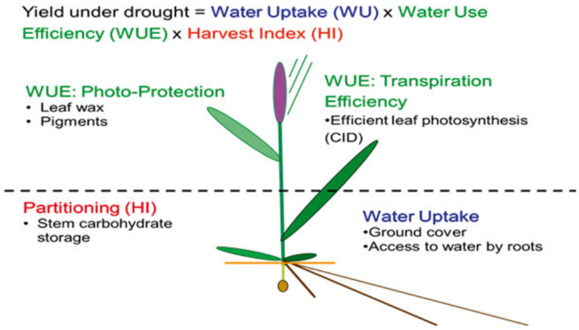
“Under water-limited situations, traits that improve water 41 Exploring Genetic Resources to Increase Adaptation of Wheat to Climate Change 364 uptake, water use effi ciency and partitioning to yield, respectively, are likely to work synergistically to maximize productivity (Richards 2006 ).”
BackgroundInfluentialCombining thermal and visible imagery for estimating canopy temperature and identifying plant stress
Leinonen, I., & Jones, H. G. (2004) · Journal of Experimental Botany · doi:10.1093/jxb/erh146 · Cited by 351 · cited 1×
“Rapid advances in remote sensing technologies, data processing and availability of instruments has made it easier to implement remote sensing techniques to research numerous plant properties (e.g., Leinonen and Jones 2004 ; Jones et al. 2007 ; Berni et al. 2009 ).”
Background
Research works printed but not linked: 2
- Rosegrant MW, Agcaoili M (2010) Global food demand, supply, and price prospects to 2010. International Food Policy Research Institute, Washington, DC
- Tattaris M, Reynolds M, Pietragalla J et al (2013) Airborne remote sensing for high throughput phenotyping of wheat. In: Proceedings of the workshop UAV-based remote sensing methods for monitoring vegetation, Cologne
Cited by
Impact of Climate Change on Crops Adaptation and Strategies to Tackle Its Outcome: A Review
Raza, A., Razzaq, A., Mehmood, S. S., Zou, X., Zhang, X., Lv, Y., & Xu, J. (2019) · Plants · doi:10.3390/plants8020034 · Cited by 1,762
“These TFs can control the phenotypes of genes in genetic engineered crops associated with various stresses [164].”
BackgroundReynolds, M., & Langridge, P. (2016) · Current Opinion in Plant Biology · doi:10.1016/j.pbi.2016.04.005 · Cited by 335
Self-citationHigh-throughput phenotyping for crop improvement in the genomics era
Mir, R. R., Reynolds, M., Pinto, F., Khan, M. A., & Bhat, M. A. (2019) · Plant Science · doi:10.1016/j.plantsci.2019.01.007 · Cited by 309
Self-citationReynolds, M., Chapman, S., Crespo-Herrera, L., Molero, G., Mondal, S., Pequeno, D. N. L., Pinto, F., Pinera-Chavez, F. J., Poland, J., Rivera-Amado, C., et al. (2020) · Plant Science · doi:10.1016/j.plantsci.2019.110396 · Cited by 247
Self-citationBreeding for drought and heat tolerance in wheat
Langridge, P., & Reynolds, M. (2021) · Theoretical and Applied Genetics · doi:10.1007/s00122-021-03795-1 · Cited by 181
“8 million wheat genetic resources available in collections worldwide, there is ample opportunity to tap new sources of abiotic stress tolerance (Reynolds et al. 2015; Dempewolf et al. 2014).”
BackgroundSelf-citation
Metadata
- Authors
- Reynolds, M., Tattaris, M., Cossani, C. M., Ellis, M., Yamaguchi-Shinozaki, K., & Pierre, C. S.
- Affiliations
- Centro Internacional de Mejoramiento de Maíz Y Trigo (MX)
- Corresponding author
- Reynolds, Matthew
- Venue
- Advances in Wheat Genetics: From Genome to Field
- Publisher
- Springer Japan
- Published
- 2015
- Pages
- 355-368
- OpenAlex
- W2469333057
- Cited by
- 62
- References
- 27
- Citations by year
- 2026: 5 · 2025: 4 · 2024: 7 · 2023: 6 · 2022: 2 · 2021: 8 · 2020: 6 · 2019: 14 · 2018: 2 · 2017: 4 · 2016: 4
- FWCI
- 7.90
- Type
- book chapter
- Language
- en
- Open access
- hybrid
- doi.org
- Licence
- cc-by-nc
- Locations
- Springer eBooks (publishedVersion, cc-by-nc)
- Topics
- Life Sciences › Agricultural and Biological Sciences › Plant Science › Wheat and Barley Genetics and Pathology
- Life Sciences › Agricultural and Biological Sciences › Plant Science › Genetics and Plant Breeding
- Life Sciences › Agricultural and Biological Sciences › Plant Science › Genetic and Environmental Crop Studies
- Keywords
- wheat, climate change adaptation, genetic resources, drought tolerance, landraces, wild wheat relative, pre-breeding, high-throughput phenotyping, airborne remote sensing, thermal imagery, multispectral imagery, hexaploid wheat, transgenic wheat, root water uptake, gene discovery
About these checks
Registry, retraction, Cites and statistics results are computed, not judged, with one exception: a printed reference that no index lists is read once by a model before it counts as a citation error. Claims are extracted by a model and kept only when their quote appears verbatim in the text; each cited source is then checked, with a model’s help, for whether it says what the claim relies on. Those verdicts can be wrong — read the claim’s quote and the cited source before relying on one.
Statistics and arithmetic are recomputed, not judged.
Confidence bands are shown only for fields calibrated on our annotated test set. None is calibrated yet, so no band is shown.
What counts as a claim ›How we measure confidence ›How we check this ›
Are you an author, or do you see a problem with this page? Request a review
How to cite
Cite CoChat for the checks on this page, and the paper for its own findings.
- This page
- CoChat. (2026). Citation check: Exploring Genetic Resources to Increase Adaptation of Wheat to Climate Change. https://app.cochat.ai/papers/10.1007/978-4-431-55675-6_41
- The paper
- Reynolds, M., Tattaris, M., Cossani, C. M., Ellis, M., Yamaguchi-Shinozaki, K., & Pierre, C. S. (2015). Exploring Genetic Resources to Increase Adaptation of Wheat to Climate Change. Advances in Wheat Genetics: From Genome to Field. https://doi.org/10.1007/978-4-431-55675-6_41
Data sources
Bibliographic data: Semantic Scholar, OpenAlex, Crossref.
Contains information from the Semantic Scholar Academic Graph Datasets, made available under the ODC Attribution License (ODC-BY 1.0).
Semantic Scholar’s data is described in: Kinney, R., et al. (2023). The Semantic Scholar Open Data Platform. arXiv:2301.10140.
