

The DOI matches its Crossref record; 97 of the 98 references it cites were found in a registry or an index; none of the 35 sources its claims cite is checked for support yet.
Casimir energy and modularity in higher-dimensional conformal field theories
Open accessAbstract
A bstract: An important problem in Quantum Field Theory (QFT) is to understand the structures of observables on spacetime manifolds of nontrivial topology. Such observables arise naturally when studying physical systems at finite temperature and/or finite volume and encode subtle properties of the underlying microscopic theory that are often obscure on the flat spacetime. Locality of the QFT implies that these observables can be constructed from more basic building blocks by cutting-and-gluing along a spatial slice, where a crucial ingredient is the Hilbert space on the spatial manifold. In Conformal Field Theory (CFT), thanks to the operator-state correspondence, we have a non-perturbative understanding of the Hilbert space on a spatial sphere. However it remains a challenge to consider more general spatial manifolds. Here we study CFTs in spacetime dimensions d > 2 on the spatial manifold T 2 × ℝ d− 3 which is one of the simplest manifolds beyond the spherical topology. We focus on the ground state in this Hilbert space and analyze universal properties of the ground state energy, also commonly known as the Casimir energy, which is a nontrivial function of the complex structure moduli τ of the torus. The Casimir energy is subject to constraints from modular invariance on the torus which we spell out using PSL(2 , ℤ) spectral theory. Moreover we derive a simple universal formula for the Casimir energy in the thin torus limit using the effective field theory (EFT) from Kaluza-Klein reduction of the CFT, with exponentially small corrections from worldline instantons. We illustrate our formula with explicit examples from well-known CFTs including the critical O ( N ) model in d = 3 and holographic CFTs in d ≥ 3.
Overview
CoChat Summary
TL;DR
The paper studies the Casimir energy density \(E(\tau)\) for \(d>2\) CFTs on \(T^2\times \mathbb R^{d-3}\), showing it is a modular-invariant function of the torus complex-structure modulus \(\tau\). It derives a universal thin-torus expansion controlled by two perturbative coefficients related to thermal stress-tensor one-point functions, plus exponentially small worldline-instanton corrections, and illustrates the result in free scalar, large-\(N\) \(O(N)\), and holographic CFTs.
Key findings
- In the thin-torus limit \(\tau\to i\infty\), the Casimir energy density has the universal form \(E(\tau)=c_1 \tau_2^{d/2}+c_2 \tau_2^{1-d/2}+O(\tau_2^\alpha e^{-2\pi M n\tau_2}e^{2\pi i n Q\tau_1})\), with \(c_1=-b_T/d\) and \(c_2=-b_T/(d-1)\) tied to thermal one-point functions.
- Modular invariance under \(PSL(2,\mathbb Z)\) constrains \(E(\tau)\); using \(PSL(2,\mathbb Z)\) spectral theory, the paper gives a spectral decomposition and argues that higher KK-charge instanton sectors are determined by the \(Q=0\) and \(Q=\pm1\) sectors.
- For a free real scalar, \(E(\tau)=E^*_{d/2}(\tau)\), with \(c_1=\Lambda(d/2)\) and \(c_2=\Lambda((d-1)/2)\).
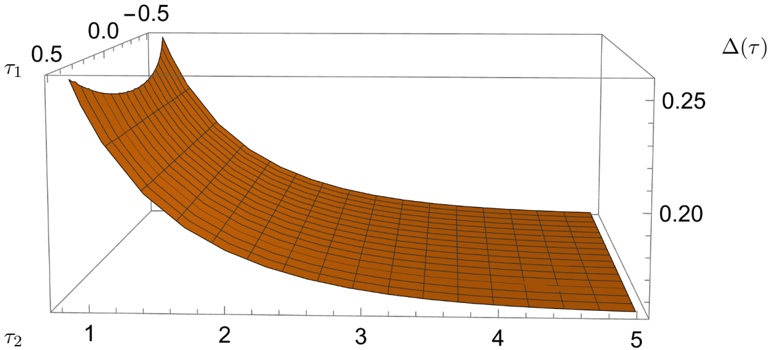
- For the large-\(N\) critical \(O(N)\) model in \(d=3\), \(c_1^{O(N)}=2N\zeta(3)/(5\pi)\), \(c_2^{O(N)}=0\), and \(\Delta_0=\frac1\pi\log\frac{1+\sqrt5}{2}\); for holographic CFTs with Einstein gravity duals, \(E(\tau)=\frac{(4\pi)^{d-1}\ell^{d-1}}{4d^d G_N}\frac{A^{d/2}}{\mathrm{sys}(T^2)^d}\), with \(c_1=\frac{(4\pi)^{d-1}\ell^{d-1}}{4d^d G_N}\) and \(c_2=0\).
Methods
- The paper uses effective field theory from Kaluza-Klein reduction on the small torus cycle to derive the universal thin-torus expansion, including perturbative terms and worldline-instanton corrections.
- It applies \(PSL(2,\mathbb Z)\) spectral theory to decompose the modular-invariant Casimir energy density into Eisenstein series and Maass cusp forms, extracting constraints on the spectral overlaps.
- It tests the general structure in analytic and numerical examples: free scalar CFT, the large-\(N\) critical \(O(N)\) model via the gap equation and generalized Eisenstein series, and holographic CFTs via AdS soliton solutions.
Limitations
- The paper states that non-degeneracy of Maass cusp forms is widely believed but not proven, and that a more detailed study of the spectral decomposition is left for the future.
- It assumes the thermal mass squared for KK zero modes is non-negative, noting recent counterexamples to this statement in the literature.
- Evident from the text: the positivity conjecture and the conjecture that \(E(\tau)\) has a global minimum at \(\tau=e^{2\pi i/3}\) are proposed but not proven; many explicit results rely on large-\(N\), free, or holographic limits.
Model-written summary. Check it against the paper before relying on it.
Integrity signals
Registry
Cites
Statistics
Figures
Verification
Claims the paper makes
60 Own interpretation · 57 Own result · 19 Not checked yet · 2 No full text of the sources · 1 Sources not found · 1 Own method · 1 No basis given
A result the paper states — it cites no source for it, so there is none to check. The quote shows it is in the paper.
In the paper
“So far we have focused on the overlap coefficient function h(s) in (3.33) that is necessary and sufficient to reconstruct the zero Fourier mode of E(τ ).”
§ Casimir energy and modularity in higher-dimensional conformal field theories > JHEP07(2023)028
plainstates a cause- Asserted: passes — The authors put it forward as true.
- Checkable: passes — It can be checked against evidence.
- Load-bearing: passes — The paper’s conclusions depend on it.
- Based: passes — The paper gives a reason why it holds.
A result the paper states — it cites no source for it, so there is none to check. The quote shows it is in the paper.
In the paper
“In the thin torus limit τ 2 → ∞, we derived a simple universal formula (2.15) for E(τ ) which shows that the toroidal Casimir energy is controlled by two perturbative terms in τ 2 up to non-perturbative corrections.”
§ Casimir energy and modularity in higher-dimensional conformal field theories > 6 Discussions
plainstates a cause- Asserted: passes — The authors put it forward as true.
- Checkable: passes — It can be checked against evidence.
- Load-bearing: passes — The paper’s conclusions depend on it.
- Based: passes — The paper gives a reason why it holds.
A result the paper reports from its own data — it cites no other source for it, so there is none to check. The quote shows it is in the paper.
In the paper
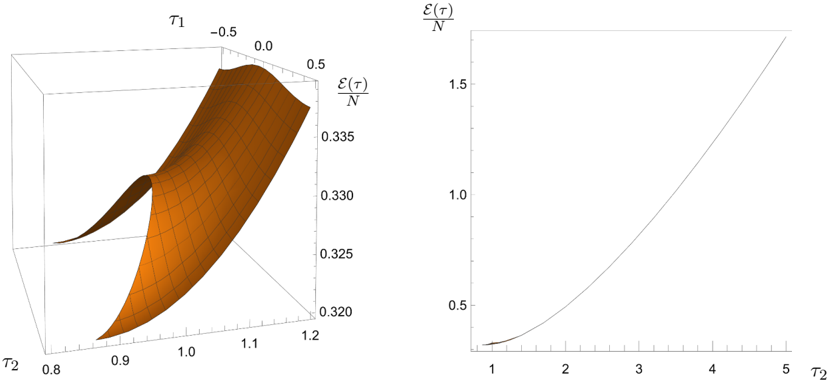
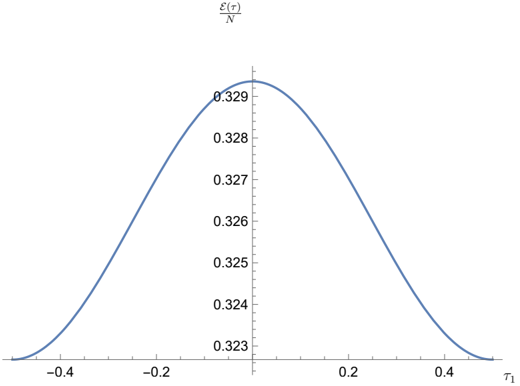
“The τ 1 dependence is negligible in this domain, except for minor dependence near the boundary at |τ | = 1, which is mostly contributed by the lowest nonzero KK mode.”
§ Casimir energy and modularity in higher-dimensional conformal field theories > JHEP07(2023)028
plain- Asserted: passes — The authors put it forward as true.
- Checkable: passes — It can be checked against evidence.
- Load-bearing: unclear — It is unclear whether the paper’s conclusions depend on it.
- Based: passes — The paper gives a reason why it holds.
A result the paper states — it cites no source for it, so there is none to check. The quote shows it is in the paper.
In the paper
“and integrate over ω to obtain, 0 = m,n∈Z 1 |mτ + n| 2 + τ 2 2 ∆ 2 (5.10)”
§ Casimir energy and modularity in higher-dimensional conformal field theories > 5.1.1 Casimir energy from gap equation
plainstates a cause- Asserted: passes — The authors put it forward as true.
- Checkable: passes — It can be checked against evidence.
- Load-bearing: passes — The paper’s conclusions depend on it.
- Based: passes — The paper gives a reason why it holds.
A result the paper states — it cites no source for it, so there is none to check. The quote shows it is in the paper.
In the paper
“The ground state and the corresponding Casimir energy E ρ (τ ) depend on ρ in addition to the complex moduli τ .”
§ Casimir energy and modularity in higher-dimensional conformal field theories > 6 Discussions
plainstates an association- Asserted: passes — The authors put it forward as true.
- Checkable: passes — It can be checked against evidence.
- Load-bearing: passes — The paper’s conclusions depend on it.
- Based: passes — The paper gives a reason why it holds.
- Rests on 2 assumptions not shown here.
86 more claims
Create a free account to see all 141 claims and to verify the 24 references still open.
- It may state two separate claims as one. 41
- Probably not a substantial claim. 11
- The quote only partly states this claim. 2
Self-check
Percentages, sums and reported differences re-computed from the paper’s own numbers.
Each contradiction between two passages listed here was confirmed by an independent check.
Rated minor: it would not touch a result — a value no result rests on, a p-value that stays on the same side of the significance level, or a conflict that is clerical, resolved elsewhere in the paper, or outside its own findings.
In the paper
§ Casimir energy and modularity in higher-dimensional conformal field theories > JHEP07(2023)028
“the eigenspectrum for ∆ is bounded below by 1 4 .”
§ Casimir energy and modularity in higher-dimensional conformal field theories > 3.1 Review of PSL(2, Z) spectral theory
“The special case is the constant function usually normalized as, ν 0 ≡ 3 π . (3.18)”
Citations
Cites
The large $N$ limit of superconformal field theories and supergravity
Maldacena, J. (1998) · Advances in Theoretical and Mathematical Physics · doi:10.4310/atmp.1998.v2.n2.a1 · Cited by 14,524
Anti de Sitter space and holography
Witten, E. (1998) · Advances in Theoretical and Mathematical Physics · doi:10.4310/atmp.1998.v2.n2.a2 · Cited by 13,070
Gauge theory correlators from non-critical string theory
Gubser, S. S., Klebanov, I. R., & Polyakov, A. M. (1998) · Physics Letters B · doi:10.1016/s0370-2693(98)00377-3 · Cited by 9,307
The Large-N Limit of Superconformal Field Theories and Supergravity
Maldacena, J. (1999) · International Journal of Theoretical Physics · doi:10.1023/a:1026654312961 · Cited by 6,704
Quantum field theory and the Jones polynomial
Witten, E. (1989) · Communications in Mathematical Physics · doi:10.1007/bf01217730 · Cited by 4,758
Anti-de Sitter space, thermal phase transition, and confinement in gauge theories
Witten, E. (1998) · Advances in Theoretical and Mathematical Physics · doi:10.4310/atmp.1998.v2.n3.a3 · Cited by 3,915
𝒩 = 6 superconformal Chern-Simons-matter theories, M2-branes and their gravity duals
Ofer Aharony, A., Bergman, O., Jafferis, D. L., & MALDACENA, J. M. (2008) · Journal of High Energy Physics · doi:10.1088/1126-6708/2008/10/091 · Cited by 2,463
Davide Gaiotto, A., Kapustin, A., Nathan Seiberg, B., & Willett, B. (2015) · Journal of High Energy Physics · doi:10.1007/jhep02(2015)172 · Cited by 2,115
Operator content of two-dimensional conformally invariant theories
Cardy, J. L. (1986) · Nuclear Physics B · doi:10.1016/0550-3213(86)90552-3 · Cited by 1,955
AdS dual of the critical O(N) vector model
Klebanov, I. R., & Polyakov, A. M. (2002) · Physics Letters B · doi:10.1016/s0370-2693(02)02980-5 · Cited by 1,062
Research works printed but not linked: 6
- G. Segal, The definition of conformal field theory, in the proceedings of the Symposium on Topology, Geometry and Quantum Field Theory (Segalfest), (2002), p. 421–575 [INSPIRE].
- S. Coleman, Aspects of Symmetry: Selected Erice Lectures, Cambridge Books Online, Cambridge University Press (1988).
- R.A. Rankin, A minimum problem for the epstein zeta-function, Glasgow Mathematical Journal 1 (1953) 149.
- J.W. Cassels, On a problem of rankin about the epstein zeta-function, Glasgow Mathematical Journal 4 (1959) 73.
- V. Ennola, A lemma about the epstein zeta-function, Glasgow Mathematical Journal 6 (1964) 198.
- P. Diananda, Notes on two lemmas concerning the epstein zeta-function, Glasgow Mathematical Journal 6 (1964) 202.
Cited by
Bootstrapping noninvertible symmetries
Lin, Y.-H., & Shao, S.-H. (2023) · Physical review. D/Physical review. D. · doi:10.1103/physrevd.107.125025 · Cited by 86
Universal asymptotics for high energy CFT data
Benjamin, N., Lee, J., Ooguri, H., & Simmons–Duffin, D. (2024) · Journal of High Energy Physics · doi:10.1007/jhep03(2024)115 · Cited by 84
Ising BCFT from Fuzzy HemispherePreprint
Dedushenko, M. (2024) · arXiv (Cornell University) · doi:10.48550/arxiv.2407.15948 · Cited by 49
Exact large charge in $$ \mathcal{N} $$ = 4 SYM and semiclassical string theory
Paul, H., Perlmutter, E., & Raj, H. (2023) · Journal of High Energy Physics · doi:10.1007/jhep08(2023)078 · Cited by 38
Brown, A., Wen, C., & Xie, H. (2023) · Journal of High Energy Physics · doi:10.1007/jhep07(2023)129 · Cited by 32
Metadata
- Authors
- Luo, C., & Wang, Y.
- Affiliations
- New York University (US)
- Corresponding author
- Luo, Conghuan
- Venue
- Journal of High Energy Physics
- Published
- 2023-07-04
- Volume
- 2023
- Issue
- 7
- ISSN
- 1029-8479 (ISSN-L)
- OpenAlex
- W4383369103
- Semantic Scholar
- 0bd2d0eb13b8afb393d2eb1144ee64047f89ed14
- Cited by
- 27
- References
- 98
- Citations by year
- 2026: 7 · 2025: 5 · 2024: 8 · 2023: 7
- FWCI
- 1.67
- Type
- journal article
- Language
- en
- Open access
- diamond
- doi.org
- Locations
- Journal of High Energy Physics (publishedVersion, cc-by)
- arXiv (Cornell University) (submittedVersion, cc-by)
- DOAJ (DOAJ: Directory of Open Access Journals) (submittedVersion, cc-by-sa)
- arXiv (Cornell University) (cc-by)
- Funders
- National Science Foundation (2210420)
- Topics
- Physical Sciences › Physics and Astronomy › Nuclear and High Energy Physics › Black Holes and Theoretical Physics
- Physical Sciences › Physics and Astronomy › Atomic and Molecular Physics, and Optics › Quantum Electrodynamics and Casimir Effect
- Physical Sciences › Mathematics › Geometry and Topology › Algebraic structures and combinatorial models
- Keywords
- Casimir energy, modular invariance, higher-dimensional conformal field theory, complex structure moduli, Kaluza-Klein reduction, worldline instantons, effective field theory, holographic CFT, ground state energy
About these checks
Registry, retraction, Cites and statistics results are computed, not judged, with one exception: a printed reference that no index lists is read once by a model before it counts as a citation error. Claims are extracted by a model and kept only when their quote appears verbatim in the text; each cited source is then checked, with a model’s help, for whether it says what the claim relies on. Those verdicts can be wrong — read the claim’s quote and the cited source before relying on one.
A language model drew the claims from the paper on 2026-11-12, under version 3 of the claim definition (model deepseek-v4.1-flash, prompt extract-v3).
A second model labelled each claim on 2026-11-12 (model jev-1.13-20260917, definition revision gold-guideline-v0.2).
Statistics and arithmetic are recomputed, not judged.
Confidence bands are shown only for fields calibrated on our annotated test set. None is calibrated yet, so no band is shown.
What counts as a claim ›How we measure confidence ›How we check this ›
Are you an author, or do you see a problem with this page? Request a review
How to cite
Cite CoChat for the checks on this page, and the paper for its own findings.
- This page
- CoChat. (2026). Citation check: Casimir energy and modularity in higher-dimensional conformal field theories. https://app.cochat.ai/papers/10.1007/jhep07(2023)028
- The paper
- Luo, C., & Wang, Y. (2023). Casimir energy and modularity in higher-dimensional conformal field theories. Journal of High Energy Physics. https://doi.org/10.1007/jhep07(2023)028
Data sources
Bibliographic data: Semantic Scholar, OpenAlex, Crossref.
Contains information from the Semantic Scholar Academic Graph Datasets, made available under the ODC Attribution License (ODC-BY 1.0).
Semantic Scholar’s data is described in: Kinney, R., et al. (2023). The Semantic Scholar Open Data Platform. arXiv:2301.10140.
