

The DOI matches its Crossref record; 4 of the 4 references it cites were found in a registry or an index.
The conformal bootstrap at finite temperature
Abstract
A bstract: We initiate an approach to constraining conformal field theory (CFT) data at finite temperature using methods inspired by the conformal bootstrap for vacuum correlation functions. We focus on thermal one- and two-point functions of local operators on the plane. The KMS condition for thermal two-point functions is cast as a crossing equation. By studying the analyticity properties of thermal two-point functions, we derive a “thermal inversion formula” whose output is the set of thermal one-point functions for all operators appearing in a given OPE. This involves identifying a kinematic regime which is the analog of the Regge regime for four-point functions. We demonstrate the effectiveness of the inversion formula by recovering the spectrum and thermal one-point functions in mean field theory, and computing thermal one-point functions for all higher-spin currents in the critical O ( N ) model at leading order in 1 /N . Furthermore, we develop a systematic perturbation theory for thermal data in the large spin, low-twist spectrum of any CFT. We explain how the inversion formula and KMS condition may be combined to algorithmically constrain CFTs at finite temperature. Throughout, we draw analogies to the bootstrap for vacuum four-point functions. Finally, we discuss future directions for the thermal conformal bootstrap program, emphasizing applications to various types of CFTs, including those with holographic duals.
Overview
The claims and statistics of this paper haven’t been checked yet.
Run the check — free, no account needed. It reads the open-access text and checks the sources it cites.
Integrity signals
Registry
Cites
Statistics
Figures
Verification
Claims the paper makes
The claims and statistics of this paper haven’t been checked yet.
Run the check — free, no account needed. It reads the open-access text and checks the sources it cites.
Claims other papers make about this one
Each is checked against this paper’s own text: does it say what the citing paper says it does?
In the citing paper
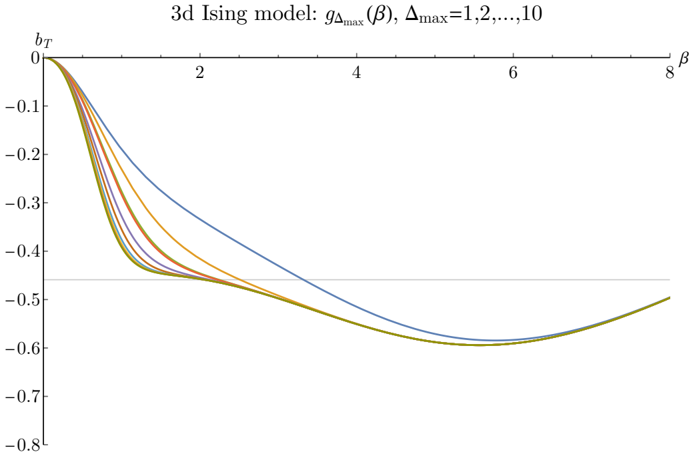
“c 1 is determined by the thermal one-point function of the CFT stress energy tensor, 7 c 1 = - b T d . (1.12)”
From Casimir energy and modularity in higher-dimensional conformal field theories (2023) · cites this paper as [20]
In the citing paper
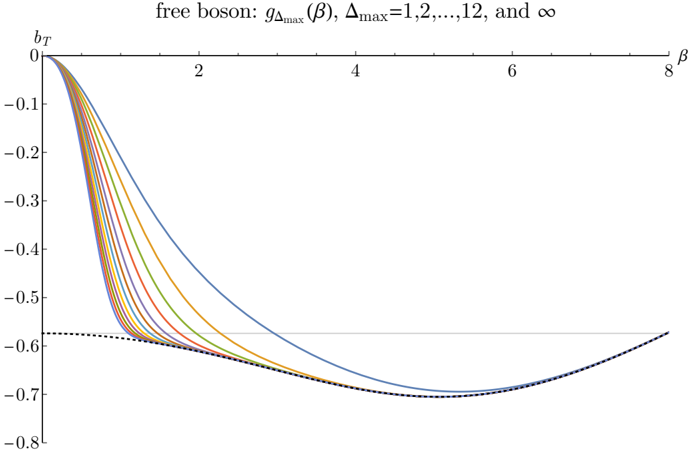
“Indeed, the thermal one-point function of stress tensor of a free real scalar (see for example [20]) takes the form (1.7) with b T = - 2ζ(d) dvol(S d-1 ) = - 1 d Λ d 2 , (4.8)”
From Casimir energy and modularity in higher-dimensional conformal field theories (2023) · cites this paper as [20]
Self-check
Percentages, sums and reported differences re-computed from the paper’s own numbers.
The self-check needs the paper’s full text.
Citations
Cites
Anti de Sitter space and holography
Witten, E. (1998) · Advances in Theoretical and Mathematical Physics · doi:10.4310/atmp.1998.v2.n2.a2 · Cited by 13,070
Gauge theory correlators from non-critical string theory
Gubser, S. S., Klebanov, I. R., & Polyakov, A. M. (1998) · Physics Letters B · doi:10.1016/s0370-2693(98)00377-3 · Cited by 9,307
Gauge Theory Correlators from Non-Critical String Theory
Gubser, S. S., Klebanov, I. R., & Polyakov, A. M. (1998) · arXiv · doi:10.48550/arxiv.hep-th/9802109 · Cited by 9,307
The Large-N Limit of Superconformal Field Theories and Supergravity
Maldacena, J. (1999) · International Journal of Theoretical Physics · doi:10.1023/a:1026654312961 · Cited by 6,704
Research works printed but not linked: 111
- M.-C. Cha, M.P.A. Fisher, S.M. Girvin, M. Wallin and A.P. Young, Universal conductivity of two-dimensional films at the superconductor-insulator transition, Phys. Rev. B 44 (1991) 6883. · DOI
- J. Smakov and E. Sorensen, Universal scaling of the conductivity at the superfluid-insulator phase transition, Phys. Rev. Lett. 95 (2005) 180603 [INSPIRE]. · DOI
- E. Katz, S. Sachdev, E.S. Sorensen and W. Witczak-Krempa, Conformal field theories at nonzero temperature: operator product expansions, Monte Carlo and holography, Phys. Rev. B 90 (2014) 245109 [arXiv:1409.3841] [INSPIRE]. · DOI
- F. Kos, D. Poland, D. Simmons-Duffin and A. Vichi, Bootstrapping the O(N) archipelago, JHEP 11 (2015) 106 [arXiv:1504.07997] [INSPIRE]. · DOI
- Y. Nakayama, Bootstrapping critical Ising model on three-dimensional real projective space, Phys. Rev. Lett. 116 (2016) 141602 [arXiv:1601.06851] [INSPIRE]. · DOI
- C. Hasegawa and Yu. Nakayama, ϵ-expansion in critical ϕ 3 -theory on real projective space from conformal field theory, Mod. Phys. Lett. A 32 (2017) 1750045 [arXiv:1611.06373] [INSPIRE]. · arXiv
- C. Hasegawa and Y. Nakayama, Three ways to solve critical ϕ 4 theory on 4 − ϵ dimensional real projective space: perturbation, bootstrap and Schwinger-Dyson equation, Int. J. Mod. Phys. A 33 (2018) 1850049 [arXiv:1801.09107] [INSPIRE]. · DOI
- S. El-Showk and K. Papadodimas, Emergent spacetime and holographic CFTs, JHEP 10 (2012) 106 [arXiv:1101.4163] [INSPIRE]. · DOI
- R. Rattazzi, V.S. Rychkov, E. Tonni and A. Vichi, Bounding scalar operator dimensions in 4D CFT, JHEP 12 (2008) 031 [arXiv:0807.0004] [INSPIRE]. · DOI
- D. Poland, D. Simmons-Duffin and A. Vichi, Carving out the space of 4D CFTs, JHEP 05 (2012) 110 [arXiv:1109.5176] [INSPIRE]. · DOI
- S. El-Showk, M.F. Paulos, D. Poland, S. Rychkov, D. Simmons-Duffin and A. Vichi, Solving the 3d Ising model with the conformal bootstrap II. c-minimization and precise critical exponents, J. Stat. Phys. 157 (2014) 869 [arXiv:1403.4545] [INSPIRE]. · arXiv
- M.F. Paulos, JuliBootS: a hands-on guide to the conformal bootstrap, arXiv:1412.4127 [INSPIRE]. · arXiv
- D. Simmons-Duffin, A semidefinite program solver for the conformal bootstrap, JHEP 06 (2015) 174 [arXiv:1502.02033] [INSPIRE]. · DOI
- P. Liendo, L. Rastelli and B.C. van Rees, The bootstrap program for boundary CFT d, JHEP 07 (2013) 113 [arXiv:1210.4258] [INSPIRE]. · DOI
- F. Gliozzi, P. Liendo, M. Meineri and A. Rago, Boundary and interface CFTs from the conformal bootstrap, JHEP 05 (2015) 036 [arXiv:1502.07217] [INSPIRE]. · DOI
- L. Rastelli and X. Zhou, The Mellin formalism for boundary CFT d, JHEP 10 (2017) 146 [arXiv:1705.05362] [INSPIRE]. · DOI
- M. Billò, V. Gonçalves, E. Lauria and M. Meineri, Defects in conformal field theory, JHEP 04 (2016) 091 [arXiv:1601.02883] [INSPIRE]. · arXiv
- A. Gadde, Conformal constraints on defects, arXiv:1602.06354 [INSPIRE]. · arXiv
- P. Liendo and C. Meneghelli, Bootstrap equations for N = 4 SYM with defects, JHEP 01 (2017) 122 [arXiv:1608.05126] [INSPIRE]. · DOI
- E. Lauria, M. Meineri and E. Trevisani, Radial coordinates for defect CFTs, arXiv:1712.07668 [INSPIRE]. · arXiv
- M. Lemos, P. Liendo, M. Meineri and S. Sarkar, Universality at large transverse spin in defect CFT, arXiv:1712.08185 [INSPIRE]. · arXiv
- F. Gliozzi and A. Rago, Critical exponents of the 3d Ising and related models from conformal bootstrap, JHEP 10 (2014) 042 [arXiv:1403.6003] [INSPIRE]. · DOI
- S. Hikami, Conformal bootstrap analysis for the Yang-Lee edge singularity, PTEP 2018 (2018) 053I01 [arXiv:1707.04813] [INSPIRE]. · arXiv
- S. El-Showk, M.F. Paulos, D. Poland, S. Rychkov, D. Simmons-Duffin and A. Vichi, Solving the 3D Ising model with the conformal bootstrap, Phys. Rev. D 86 (2012) 025022 [arXiv:1203.6064] [INSPIRE]. · arXiv
- F. Kos, D. Poland and D. Simmons-Duffin, Bootstrapping mixed correlators in the 3D Ising model, JHEP 11 (2014) 109 [arXiv:1406.4858] [INSPIRE]. · DOI
- F. Kos, D. Poland, D. Simmons-Duffin and A. Vichi, Precision islands in the Ising and O(N) models, JHEP 08 (2016) 036 [arXiv:1603.04436] [INSPIRE]. · DOI
- D. Simmons-Duffin, The lightcone bootstrap and the spectrum of the 3D Ising CFT, JHEP 03 (2017) 086 [arXiv:1612.08471] [INSPIRE]. · DOI
- A.L. Fitzpatrick, J. Kaplan, D. Poland and D. Simmons-Duffin, The analytic bootstrap and AdS superhorizon locality, JHEP 12 (2013) 004 [arXiv:1212.3616] [INSPIRE]. · DOI
- Z. Komargodski and A. Zhiboedov, Convexity and liberation at large spin, JHEP 11 (2013) 140 [arXiv:1212.4103] [INSPIRE]. · DOI
- L.F. Alday, A. Bissi and T. Lukowski, Large spin systematics in CFT, JHEP 11 (2015) 101 [arXiv:1502.07707] [INSPIRE]. · arXiv
- L.F. Alday and A. Zhiboedov, Conformal bootstrap with slightly broken higher spin symmetry, JHEP 06 (2016) 091 [arXiv:1506.04659] [INSPIRE]. · DOI
- L.F. Alday and A. Zhiboedov, An algebraic approach to the analytic bootstrap, JHEP 04 (2017) 157 [arXiv:1510.08091] [INSPIRE]. · DOI
- L.F. Alday, Large spin perturbation theory for conformal field theories, Phys. Rev. Lett. 119 (2017) 111601 [arXiv:1611.01500] [INSPIRE]. · DOI
- S. Caron-Huot, Analyticity in spin in conformal theories, JHEP 09 (2017) 078 [arXiv:1703.00278] [INSPIRE]. · DOI
- M. Froissart, Asymptotic behavior and subtractions in the Mandelstam representation, Phys. Rev. 123 (1961) 1053 [INSPIRE]. · DOI
- L.F. Alday, A. Bissi and E. Perlmutter, Holographic reconstruction of AdS exchanges from crossing symmetry, JHEP 08 (2017) 147 [arXiv:1705.02318] [INSPIRE]. · DOI
- P. Dey, K. Ghosh and A. Sinha, Simplifying large spin bootstrap in Mellin space, JHEP 01 (2018) 152 [arXiv:1709.06110] [INSPIRE]. · DOI
- J. Henriksson and T. Lukowski, Perturbative four-point functions from the analytic conformal bootstrap, JHEP 02 (2018) 123 [arXiv:1710.06242] [INSPIRE]. · DOI
- L.F. Alday, J. Henriksson and M. van Loon, Taming the ϵ-expansion with large spin perturbation theory, JHEP 07 (2018) 131 [arXiv:1712.02314] [INSPIRE]. · DOI
- L.F. Alday and S. Caron-Huot, Gravitational S-matrix from CFT dispersion relations, arXiv:1711.02031 [INSPIRE]. · arXiv
- M. van Loon, The analytic bootstrap in fermionic CFTs, JHEP 01 (2018) 104 [arXiv:1711.02099] [INSPIRE]. · DOI
- J. Henriksson and M. Van Loon, Critical O(N) model to order ϵ 4 from analytic bootstrap, arXiv:1801.03512 [INSPIRE]. · arXiv
- G.J. Turiaci and A. Zhiboedov, Veneziano amplitude of Vasiliev theory, arXiv:1802.04390 [INSPIRE]. · arXiv
- S. Sachdev, Polylogarithm identities in a conformal field theory in three-dimensions, Phys. Lett. B 309 (1993) 285 [hep-th/9305131] [INSPIRE]. · DOI
- M.A. Vasiliev, Higher spin gauge theories: star product and AdS space, hep-th/9910096 [INSPIRE]. · arXiv
- I.R. Klebanov and A.M. Polyakov, AdS dual of the critical O(N) vector model, Phys. Lett. B 550 (2002) 213 [hep-th/0210114] [INSPIRE]. · DOI
- S. Giombi and X. Yin, The higher spin/vector model duality, J. Phys. A 46 (2013) 214003 [arXiv:1208.4036] [INSPIRE]. · arXiv
- L.F. Alday and J.M. Maldacena, Comments on operators with large spin, JHEP 11 (2007) 019 [arXiv:0708.0672] [INSPIRE]. · DOI
- W. Witczak-Krempa, Constraining quantum critical dynamics: (2 + 1)D Ising model and beyond, Phys. Rev. Lett. 114 (2015) 177201 [arXiv:1501.03495] [INSPIRE]. · DOI
- P. Kravchuk, Casimir recursion relations for general conformal blocks, JHEP 02 (2018) 011 [arXiv:1709.05347] [INSPIRE]. · DOI
- D. Simmons-Duffin, The conformal bootstrap, in Proceedings, Theoretical Advanced Study Institute in Elementary Particle Physics: new frontiers in fields and strings (TASI 2015), Boulder, CO, U.S.A., 1–26 June 2015, World Scientific, Singapore, (2017), pg. 1 [arXiv:1602.07982] [INSPIRE]. · arXiv
- H. Osborn and A.C. Petkou, Implications of conformal invariance in field theories for general dimensions, Annals Phys. 231 (1994) 311 [hep-th/9307010] [INSPIRE]. · DOI · Paper page
- A.V. Chubukov, S. Sachdev and J. Ye, Theory of two-dimensional quantum Heisenberg antiferromagnets with a nearly critical ground state, Phys. Rev. B 49 (1994) 11919 [INSPIRE]. · DOI
- M. Krech and D.P. Landau, Casimir effect in critical systems: a Monte Carlo simulation, Phys. Rev. E 53 (1996) 4414.
- M. Krech, Casimir forces in binary liquid mixtures, Phys. Rev. E 56 (1997) 1642.
- P. Di Francesco, P. Mathieu and D. Sénéchal, Conformal field theory, Graduate Texts in Contemporary Physics, Springer, New York, U.S.A., (1997) [INSPIRE]. · DOI
- M. Gaberdiel, A general transformation formula for conformal fields, Phys. Lett. B 325 (1994) 366 [hep-th/9401166] [INSPIRE]. · DOI
- B. Chen, J. Long and J.-J. Zhang, Holographic Rényi entropy for CFT with W symmetry, JHEP 04 (2014) 041 [arXiv:1312.5510] [INSPIRE]. · DOI
- F.M. Haehl, R. Loganayagam, P. Narayan, A.A. Nizami and M. Rangamani, Thermal out-of-time-order correlators, KMS relations and spectral functions, JHEP 12 (2017) 154 [arXiv:1706.08956] [INSPIRE]. · DOI
- V.K. Dobrev, G. Mack, V.B. Petkova, S.G. Petrova and I.T. Todorov, Harmonic analysis on the n-dimensional Lorentz group and its application to conformal quantum field theory, Lect. Notes Phys. 63 (1977) 1 [INSPIRE]. · DOI
- D. Simmons-Duffin, D. Stanford and E. Witten, A spacetime derivation of the Lorentzian OPE inversion formula, JHEP 07 (2018) 085 [arXiv:1711.03816] [INSPIRE]. · DOI
- M.F. Paulos, J. Penedones, J. Toledo, B.C. van Rees and P. Vieira, The S-matrix bootstrap III: higher dimensional amplitudes, arXiv:1708.06765 [INSPIRE]. · arXiv
- J. Maldacena, S.H. Shenker and D. Stanford, A bound on chaos, JHEP 08 (2016) 106 [arXiv:1503.01409] [INSPIRE]. · DOI
- O. Aharony, L.F. Alday, A. Bissi and E. Perlmutter, Loops in AdS from conformal field theory, JHEP 07 (2017) 036 [arXiv:1612.03891] [INSPIRE]. · DOI
- D. Stanford, Many-body chaos at weak coupling, JHEP 10 (2016) 009 [arXiv:1512.07687] [INSPIRE]. · DOI
- A.L. Fitzpatrick and J. Kaplan, Unitarity and the holographic S-matrix, JHEP 10 (2012) 032 [arXiv:1112.4845] [INSPIRE]. · DOI
- A.V. Chubukov, S. Sachdev and J. Ye, Theory of two-dimensional quantum Heisenberg antiferromagnets with a nearly critical ground state, Phys. Rev. B 49 (1994) 11919 [INSPIRE]. · DOI
- J. Zinn-Justin, Quantum field theory and critical phenomena, Clarendon Pr., Oxford, U.K., (2002) [Int. Ser. Monogr. Phys. 113 (2002) 1] [INSPIRE].
- S. Sachdev and J. Ye, Universal quantum critical dynamics of two-dimensional antiferromagnets, Phys. Rev. Lett. 69 (1992) 2411 [cond-mat/9204001] [INSPIRE]. · arXiv
- A.C. Petkou and N.D. Vlachos, Finite size effects and operator product expansions in a CFT for d > 2, Phys. Lett. B 446 (1999) 306 [hep-th/9803149] [INSPIRE]. · DOI
- A.C. Petkou and N.D. Vlachos, Finite size and finite temperature effects in the conformally invariant O(N) vector model for 2 < d < 4, in 5th International Workshop on Thermal Field Theories and Their Applications, Regensburg, Germany, 10–14 August 1998 [hep-th/9809096] [INSPIRE]. · arXiv
- E.D. Skvortsov, On (un)broken higher-spin symmetry in vector models, in Proceedings, International Workshop on Higher Spin Gauge Theories, Singapore, 4–6 November 2015, World Scientific, Singapore, (2017), pg. 103 [arXiv:1512.05994] [INSPIRE]. · DOI
- V.E. Didenko and M.A. Vasiliev, Static BPS black hole in 4d higher-spin gauge theory, Phys. Lett. B 682 (2009) 305 [Erratum ibid. B 722 (2013) 389] [arXiv:0906.3898] [INSPIRE]. · arXiv
- V.E. Didenko and E.D. Skvortsov, Exact higher-spin symmetry in CFT: all correlators in unbroken Vasiliev theory, JHEP 04 (2013) 158 [arXiv:1210.7963] [INSPIRE]. · DOI
- M.A. Vasiliev, Invariant functionals in higher-spin theory, Nucl. Phys. B 916 (2017) 219 [arXiv:1504.07289] [INSPIRE]. · DOI
- V.E. Didenko, N.G. Misuna and M.A. Vasiliev, Charges in nonlinear higher-spin theory, JHEP 03 (2017) 164 [arXiv:1512.07626] [INSPIRE]. · DOI
- C. Iazeolla, E. Sezgin and P. Sundell, On exact solutions and perturbative schemes in higher spin theory, Universe 4 (2018) 5 [arXiv:1711.03550] [INSPIRE]. · DOI
- X.O. Camanho, J.D. Edelstein, J. Maldacena and A. Zhiboedov, Causality constraints on corrections to the graviton three-point coupling, JHEP 02 (2016) 020 [arXiv:1407.5597] [INSPIRE]. · DOI
- N. Afkhami-Jeddi, T. Hartman, S. Kundu and A. Tajdini, Einstein gravity 3-point functions from conformal field theory, JHEP 12 (2017) 049 [arXiv:1610.09378] [INSPIRE]. · DOI
- M.S. Costa, T. Hansen and J. Penedones, Bounds for OPE coefficients on the Regge trajectory, JHEP 10 (2017) 197 [arXiv:1707.07689] [INSPIRE]. · DOI
- D. Meltzer and E. Perlmutter, Beyond a = c: gravitational couplings to matter and the stress tensor OPE, JHEP 07 (2018) 157 [arXiv:1712.04861] [INSPIRE]. · DOI
- R.C. Myers, T. Sierens and W. Witczak-Krempa, A holographic model for quantum critical responses, JHEP 05 (2016) 073 [Addendum ibid. 09 (2016) 066] [arXiv:1602.05599] [INSPIRE]. · arXiv
- C. Cordova, J. Maldacena and G.J. Turiaci, Bounds on OPE coefficients from interference effects in the conformal collider, JHEP 11 (2017) 032 [arXiv:1710.03199] [INSPIRE]. · DOI
- K.A. Intriligator, Bonus symmetries of N = 4 super Yang-Mills correlation functions via AdS duality, Nucl. Phys. B 551 (1999) 575 [hep-th/9811047] [INSPIRE]. · DOI
- S.S. Gubser, I.R. Klebanov and A.W. Peet, Entropy and temperature of black 3-branes, Phys. Rev. D 54 (1996) 3915 [hep-th/9602135] [INSPIRE]. · arXiv
- V. Gonçalves, Four point function of N = 4 stress-tensor multiplet at strong coupling, JHEP 04 (2015) 150 [arXiv:1411.1675] [INSPIRE]. · DOI
- A. Belin, J. de Boer, J. Kruthoff, B. Michel, E. Shaghoulian and M. Shyani, Universality of sparse d > 2 conformal field theory at large N, JHEP 03 (2017) 067 [arXiv:1610.06186] [INSPIRE]. · DOI · Paper page
- A. Belin, J. De Boer and J. Kruthoff, Comments on a state-operator correspondence for the torus, arXiv:1802.00006 [INSPIRE]. · arXiv
- S. Giombi, S. Minwalla, S. Prakash, S.P. Trivedi, S.R. Wadia and X. Yin, Chern-Simons theory with vector fermion matter, Eur. Phys. J. C 72 (2012) 2112 [arXiv:1110.4386] [INSPIRE]. · DOI
- O. Aharony, G. Gur-Ari and R. Yacoby, d = 3 bosonic vector models coupled to Chern-Simons gauge theories, JHEP 03 (2012) 037 [arXiv:1110.4382] [INSPIRE]. · arXiv
- S. Jain, S.P. Trivedi, S.R. Wadia and S. Yokoyama, Supersymmetric Chern-Simons theories with vector matter, JHEP 10 (2012) 194 [arXiv:1207.4750] [INSPIRE]. · DOI
- O. Aharony, S. Giombi, G. Gur-Ari, J. Maldacena and R. Yacoby, The thermal free energy in large N Chern-Simons-matter theories, JHEP 03 (2013) 121 [arXiv:1211.4843] [INSPIRE]. · DOI
- G. Gur-Ari, S.A. Hartnoll and R. Mahajan, Transport in Chern-Simons-matter theories, JHEP 07 (2016) 090 [arXiv:1605.01122] [INSPIRE]. · DOI
- J. Maldacena and A. Zhiboedov, Constraining conformal field theories with a higher spin symmetry, J. Phys. A 46 (2013) 214011 [arXiv:1112.1016] [INSPIRE]. · arXiv
- J. Maldacena and A. Zhiboedov, Constraining conformal field theories with a slightly broken higher spin symmetry, Class. Quant. Grav. 30 (2013) 104003 [arXiv:1204.3882] [INSPIRE]. · DOI
- E. Hijano, P. Kraus, E. Perlmutter and R. Snively, Semiclassical Virasoro blocks from AdS 3 gravity, JHEP 12 (2015) 077 [arXiv:1508.04987] [INSPIRE]. · arXiv
- E. Hijano, P. Kraus, E. Perlmutter and R. Snively, Witten diagrams revisited: the AdS geometry of conformal blocks, JHEP 01 (2016) 146 [arXiv:1508.00501] [INSPIRE]. · DOI
- A.L. Fitzpatrick, J. Kaplan, M.T. Walters and J. Wang, Eikonalization of conformal blocks, JHEP 09 (2015) 019 [arXiv:1504.01737] [INSPIRE]. · DOI
- N. Lashkari, A. Dymarsky and H. Liu, Eigenstate thermalization hypothesis in conformal field theory, J. Stat. Mech. 1803 (2018) 033101 [arXiv:1610.00302] [INSPIRE]. · DOI
- D. Jafferis, B. Mukhametzhanov and A. Zhiboedov, Conformal bootstrap at large charge, JHEP 05 (2018) 043 [arXiv:1710.11161] [INSPIRE]. · DOI
- A.L. Fitzpatrick, J. Kaplan, D. Li and J. Wang, On information loss in AdS 3 /CFT 2, JHEP 05 (2016) 109 [arXiv:1603.08925] [INSPIRE]. · DOI · Paper page
- R. Kubo, Statistical-mechanical theory of irreversible processes. I. General theory and simple applications to magnetic and conduction problems, J. Phys. Soc. Jpn. 12 (1957) 570. · DOI · Paper page
- R. Kubo, M. Yokota and S. Nakajima, Statistical-mechanical theory of irreversible processes. II. Response to thermal disturbance, J. Phys. Soc. Jpn. 12 (1957) 1203. · DOI
- R. Kubo, The fluctuation-dissipation theorem, Rep. Prog. Phys. 29 (1966) 255. · DOI
- S.A. Hartnoll, A. Lucas and S. Sachdev, Holographic quantum matter, arXiv:1612.07324 [INSPIRE]. · arXiv
- L.P. Kadanoff and P.C. Martin, Hydrodynamic equations and correlation functions, Ann. Phys. 24 (1963) 419. · DOI
- B. Assel, D. Cassani, L. Di Pietro, Z. Komargodski, J. Lorenzen and D. Martelli, The Casimir energy in curved space and its supersymmetric counterpart, JHEP 07 (2015) 043 [arXiv:1503.05537] [INSPIRE]. · DOI
- Z. Komargodski and D. Simmons-Duffin, The Random-Bond Ising model in 2.01 and 3 dimensions, J. Phys. A 50 (2017) 154001 [arXiv:1603.04444] [INSPIRE]. · arXiv
- S. Meneses, S. Rychkov, J.M. V.P. Lopes and P. Yvernay, A structural test for the conformal invariance of the critical 3d Ising model, arXiv:1802.02319 [INSPIRE]. · arXiv
- L. Hadasz, Z. Jaskolski and P. Suchanek, Recursive representation of the torus 1-point conformal block, JHEP 01 (2010) 063 [arXiv:0911.2353] [INSPIRE]. · DOI
- P. Kraus, A. Maloney, H. Maxfield, G.S. Ng and J.-Q. Wu, Witten diagrams for torus conformal blocks, JHEP 09 (2017) 149 [arXiv:1706.00047] [INSPIRE]. · DOI
Cited by
Casimir energy and modularity in higher-dimensional conformal field theories
Luo, C., & Wang, Y. (2023) · Journal of High Energy Physics · doi:10.1007/jhep07(2023)028 · Cited by 27
Metadata
- Authors
- Iliesiu, L., Koloğlu, M., Mahajan, R., Perlmutter, E., & Simmons-Duffin, D.
- Venue
- Journal of High Energy Physics
- Published
- 2018-10
- Volume
- 2018
- Issue
- 10
- ISSN
- 1029-8479
- Cited by
- 133
- References
- 4
- Language
- en
About these checks
Registry, retraction, Cites and statistics results are computed, not judged, with one exception: a printed reference that no index lists is read once by a model before it counts as a citation error. Claims are extracted by a model and kept only when their quote appears verbatim in the text; each cited source is then checked, with a model’s help, for whether it says what the claim relies on. Those verdicts can be wrong — read the claim’s quote and the cited source before relying on one.
Statistics and arithmetic are recomputed, not judged.
Confidence bands are shown only for fields calibrated on our annotated test set. None is calibrated yet, so no band is shown.
What counts as a claim ›How we measure confidence ›How we check this ›
Are you an author, or do you see a problem with this page? Request a review
Data sources
Bibliographic data: Semantic Scholar, OpenAlex, Crossref.
Contains information from the Semantic Scholar Academic Graph Datasets, made available under the ODC Attribution License (ODC-BY 1.0).
Semantic Scholar’s data is described in: Kinney, R., et al. (2023). The Semantic Scholar Open Data Platform. arXiv:2301.10140.
