

The DOI matches its Crossref record; 5 of the 5 references it cites were found in a registry or an index.
Multiboundary wormholes and OPE statistics
Abstract
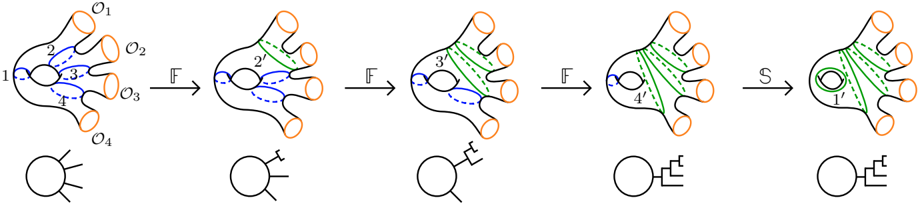
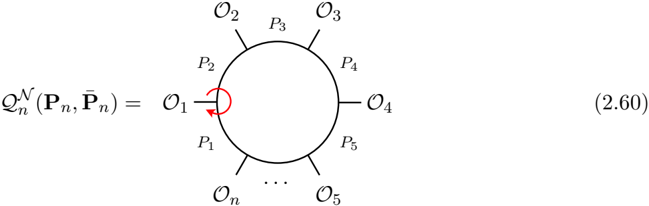
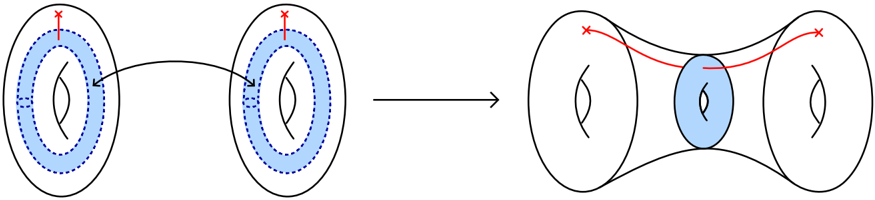
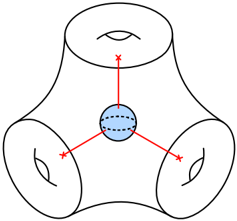
A bstract: We derive higher moments in the statistical distribution of OPE coefficients in holographic 2D CFTs, and show that such moments correspond to multiboundary Euclidean wormholes in pure 3D gravity. The n th cyclic non-Gaussian contraction of heavy-heavy-light OPE coefficients follows from crossing symmetry of the thermal n -point function. We derive universal expressions for the cubic and quartic moments and demonstrate that their scaling with the microcanonical entropy agrees with a generalization of the Eigenstate Thermalization Hypothesis. Motivated by this result, we conjecture that the full statistical ensemble of OPE data is fixed by three premises: typicality, crossing symmetry and modular invariance. Together, these properties give predictions for non-factorizing observables, such as the generalized spectral form factor. Using the Virasoro TQFT, we match these connected averages to new on-shell wormhole topologies with multiple boundary components. Lastly, we study and clarify examples where the statistics of heavy operators are not universal and depend on the light operator spectrum. We give a gravitational interpretation to these corrections in terms of Wilson loops winding around non-trivial cycles in the bulk.
Overview
The claims and statistics of this paper haven’t been checked yet.
Run the check — free, no account needed. It reads the open-access text and checks the sources it cites.
Integrity signals
Registry
Cites
Statistics
Figures











Verification
Claims the paper makes
The claims and statistics of this paper haven’t been checked yet.
Run the check — free, no account needed. It reads the open-access text and checks the sources it cites.
Claims other papers make about this one
Each is checked against this paper’s own text: does it say what the citing paper says it does?
In the citing paper
“This kind of contribution is essential to reproduce higher-point correlators[123] (see e.g.[124,125] for such corrections in the CFT data of two-dimensional CFTs reproduced by gravity).”
From The baby universe is fine and the CFT knows it: on holography for closed universes (2025) · cites this paper as [124]
Self-check
Percentages, sums and reported differences re-computed from the paper’s own numbers.
The self-check needs the paper’s full text.
Citations
Cites
Quantum statistical mechanics in a closed system
Deutsch, J. M. (1991) · Physical Review A · doi:10.1103/physreva.43.2046 · Cited by 2,860
Brown, J. D., & Henneaux, M. (1986) · Communications in Mathematical Physics · doi:10.1007/bf01211590 · Cited by 2,605
2 + 1 dimensional gravity as an exactly soluble system
Witten, E. (1988) · Nuclear Physics B · doi:10.1016/0550-3213(88)90143-5 · Cited by 2,562
Operator content of two-dimensional conformally invariant theories
Cardy, J. L. (1986) · Nuclear Physics B · doi:10.1016/0550-3213(86)90552-3 · Cited by 1,955
Solving the Schwarzian via the conformal bootstrap
Mertens, T. G., Turiaci, G. J., & Verlinde, H. L. (2017) · Journal of High Energy Physics · doi:10.1007/jhep08(2017)136 · Cited by 357
Research works printed but not linked: 87
- P. Saad, S.H. Shenker and D. Stanford, JT gravity as a matrix integral, arXiv:1903.11115 [INSPIRE]. · arXiv
- J.M. Maldacena and L. Maoz, Wormholes in AdS, JHEP 02 (2004) 053 [hep-th/0401024] [INSPIRE]. · DOI · Paper page
- D. Stanford and E. Witten, JT gravity and the ensembles of random matrix theory, Adv. Theor. Math. Phys. 24 (2020) 1475 [arXiv:1907.03363] [INSPIRE]. · DOI · Paper page
- G.J. Turiaci and E. Witten, N = 2 JT supergravity and matrix models, JHEP 12 (2023) 003 [arXiv:2305.19438] [INSPIRE]. · DOI · Paper page
- E. Witten, Matrix models and deformations of JT gravity, Proc. Roy. Soc. Lond. A 476 (2020) 20200582 [arXiv:2006.13414] [INSPIRE]. · arXiv
- A. Altland and J. Sonner, Late time physics of holographic quantum chaos, SciPost Phys. 11 (2021) 034 [arXiv:2008.02271] [INSPIRE]. · DOI
- A. Altland et al., Quantum chaos in 2D gravity, SciPost Phys. 15 (2023) 064 [arXiv:2204.07583] [INSPIRE]. · DOI · Paper page
- S. Collier, L. Eberhardt, B. Muehlmann and V.A. Rodriguez, The Virasoro minimal string, SciPost Phys. 16 (2024) 057 [arXiv:2309.10846] [INSPIRE]. · DOI
- A. Altland et al., From operator statistics to wormholes, Phys. Rev. Res. 3 (2021) 033259 [arXiv:2105.12129] [INSPIRE]. · DOI
- A. Belin and J. de Boer, Random statistics of OPE coefficients and Euclidean wormholes, Class. Quant. Grav. 38 (2021) 164001 [arXiv:2006.05499] [INSPIRE]. · DOI · Paper page
- J. Chandra, S. Collier, T. Hartman and A. Maloney, Semiclassical 3D gravity as an average of large-c CFTs, JHEP 12 (2022) 069 [arXiv:2203.06511] [INSPIRE]. · DOI
- S. Collier, L. Eberhardt and M. Zhang, Solving 3d gravity with Virasoro TQFT, SciPost Phys. 15 (2023) 151 [arXiv:2304.13650] [INSPIRE]. · DOI
- S. Collier, L. Eberhardt and M. Zhang, 3d gravity from Virasoro TQFT: holography, wormholes and knots, arXiv:2401.13900 [INSPIRE]. · arXiv
- M. Sasieta, Wormholes from heavy operator statistics in AdS/CFT, JHEP 03 (2023) 158 [arXiv:2211.11794] [INSPIRE]. · DOI · Paper page
- V. Balasubramanian, A. Lawrence, J.M. Magan and M. Sasieta, Microscopic origin of the entropy of astrophysical black holes, Phys. Rev. Lett. 132 (2024) 141501 [arXiv:2212.08623] [INSPIRE]. · DOI
- B. Freivogel, D. Nikolakopoulou and A.F. Rotundo, Wormholes from averaging over states, SciPost Phys. 14 (2023) 026 [arXiv:2105.12771] [INSPIRE]. · DOI
- J. Chandra and T. Hartman, Coarse graining pure states in AdS/CFT, JHEP 10 (2023) 030 [arXiv:2206.03414] [INSPIRE]. · DOI
- J. Chandra, Euclidean wormholes for individual 2d CFTs, JHEP 04 (2024) 051 [arXiv:2305.07183] [INSPIRE]. · DOI
- J. Chandra and T. Hartman, Toward random tensor networks and holographic codes in CFT, JHEP 05 (2023) 109 [arXiv:2302.02446] [INSPIRE]. · DOI
- A. Belin et al., Approximate CFTs and random tensor models, JHEP 09 (2024) 163 [arXiv:2308.03829] [INSPIRE]. · DOI
- D.L. Jafferis, D.K. Kolchmeyer, B. Mukhametzhanov and J. Sonner, Jackiw-Teitelboim gravity with matter, generalized eigenstate thermalization hypothesis, and random matrices, Phys. Rev. D 108 (2023) 066015 [arXiv:2209.02131] [INSPIRE]. · DOI
- D.L. Jafferis, D.K. Kolchmeyer, B. Mukhametzhanov and J. Sonner, Matrix models for eigenstate thermalization, Phys. Rev. X 13 (2023) 031033 [arXiv:2209.02130] [INSPIRE]. · arXiv
- J. de Boer, D. Liska, B. Post and M. Sasieta, A principle of maximum ignorance for semiclassical gravity, JHEP 02 (2024) 003 [arXiv:2311.08132] [INSPIRE]. · DOI
- J. Maldacena, S.H. Shenker and D. Stanford, A bound on chaos, JHEP 08 (2016) 106 [arXiv:1503.01409] [INSPIRE]. · DOI
- M. Srednicki, Chaos and quantum thermalization, Phys. Rev. E 50 (1994) 888 [cond-mat/9403051] [INSPIRE]. · DOI · Paper page
- M. Rigol, V. Dunjko and M. Olshanii, Thermalization and its mechanism for generic isolated quantum systems, Nature 452 (2008) 854 [arXiv:0708.1324] [INSPIRE]. · DOI
- L. Foini and J. Kurchan, Eigenstate thermalization hypothesis and out of time order correlators, Phys. Rev. E 99 (2019) 042139 [arXiv:1803.10658] [INSPIRE]. · DOI
- C. Murthy and M. Srednicki, Bounds on chaos from the eigenstate thermalization hypothesis, Phys. Rev. Lett. 123 (2019) 230606 [arXiv:1906.10808] [INSPIRE]. · DOI
- S. Jackson, L. McGough and H. Verlinde, Conformal bootstrap, universality and gravitational scattering, Nucl. Phys. B 901 (2015) 382 [arXiv:1412.5205] [INSPIRE]. · DOI
- J. Cardy, A. Maloney and H. Maxfield, A new handle on three-point coefficients: OPE asymptotics from genus two modular invariance, JHEP 10 (2017) 136 [arXiv:1705.05855] [INSPIRE]. · DOI
- S. Collier, A. Maloney, H. Maxfield and I. Tsiares, Universal dynamics of heavy operators in CFT2, JHEP 07 (2020) 074 [arXiv:1912.00222] [INSPIRE]. · DOI · Paper page
- A. Belin, J. de Boer and D. Liska, Non-Gaussianities in the statistical distribution of heavy OPE coefficients and wormholes, JHEP 06 (2022) 116 [arXiv:2110.14649] [INSPIRE]. · DOI · Paper page
- T. Anous, A. Belin, J. de Boer and D. Liska, OPE statistics from higher-point crossing, JHEP 06 (2022) 102 [arXiv:2112.09143] [INSPIRE]. · DOI
- N. Lashkari, A. Dymarsky and H. Liu, Eigenstate thermalization hypothesis in conformal field theory, J. Stat. Mech. 1803 (2018) 033101 [arXiv:1610.00302] [INSPIRE]. · DOI
- G. Turiaci and H. Verlinde, On CFT and quantum chaos, JHEP 12 (2016) 110 [arXiv:1603.03020] [INSPIRE]. · DOI
- Y. Hikida, Y. Kusuki and T. Takayanagi, Eigenstate thermalization hypothesis and modular invariance of two-dimensional conformal field theories, Phys. Rev. D 98 (2018) 026003 [arXiv:1804.09658] [INSPIRE]. · DOI
- P. Basu, D. Das, S. Datta and S. Pal, Thermality of eigenstates in conformal field theories, Phys. Rev. E 96 (2017) 022149 [arXiv:1705.03001] [INSPIRE]. · DOI
- P. Kraus and A. Maloney, A Cardy formula for three-point coefficients or how the black hole got its spots, JHEP 05 (2017) 160 [arXiv:1608.03284] [INSPIRE]. · DOI
- B. Ponsot and J. Teschner, Liouville bootstrap via harmonic analysis on a noncompact quantum group, hep-th/9911110 [INSPIRE]. · arXiv
- B. Ponsot and J. Teschner, Clebsch-Gordan and Racah-Wigner coefficients for a continuous series of representations of Uq(sl(2, R)), Commun. Math. Phys. 224 (2001) 613 [math/0007097] [INSPIRE]. · DOI
- L. Eberhardt, Notes on crossing transformations of Virasoro conformal blocks, arXiv:2309.11540 [INSPIRE]. · arXiv
- J. Wang et al., Emergence of unitary symmetry of microcanonically truncated operators in chaotic quantum systems, Phys. Rev. E 110 (2024) L032203 [arXiv:2310.20264] [INSPIRE]. · DOI
- S. Pappalardi, L. Foini and J. Kurchan, Eigenstate thermalization hypothesis and free probability, Phys. Rev. Lett. 129 (2022) 170603 [arXiv:2204.11679] [INSPIRE]. · DOI
- A. Maloney and E. Witten, Quantum gravity partition functions in three dimensions, JHEP 02 (2010) 029 [arXiv:0712.0155] [INSPIRE]. · DOI
- C.A. Keller and A. Maloney, Poincaré series, 3D gravity and CFT spectroscopy, JHEP 02 (2015) 080 [arXiv:1407.6008] [INSPIRE]. · DOI
- N. Benjamin, S. Collier and A. Maloney, Pure gravity and conical defects, JHEP 09 (2020) 034 [arXiv:2004.14428] [INSPIRE]. · DOI
- H. Maxfield and G.J. Turiaci, The path integral of 3D gravity near extremality; or, JT gravity with defects as a matrix integral, JHEP 01 (2021) 118 [arXiv:2006.11317] [INSPIRE]. · DOI · Paper page
- G. Di Ubaldo and E. Perlmutter, AdS3 pure gravity and stringy unitarity, Phys. Rev. Lett. 132 (2024) 041602 [arXiv:2308.01787] [INSPIRE]. · DOI
- T. Hartman, C.A. Keller and B. Stoica, Universal spectrum of 2d conformal field theory in the large c limit, JHEP 09 (2014) 118 [arXiv:1405.5137] [INSPIRE]. · DOI
- F.M. Haehl, C. Marteau, W. Reeves and M. Rozali, Symmetries and spectral statistics in chaotic conformal field theories, JHEP 07 (2023) 196 [arXiv:2302.14482] [INSPIRE]. · DOI
- C. Yan, More on torus wormholes in 3d gravity, JHEP 11 (2023) 039 [arXiv:2305.10494] [INSPIRE]. · DOI
- G.W. Moore and N. Seiberg, Classical and quantum conformal field theory, Commun. Math. Phys. 123 (1989) 177 [INSPIRE]. · DOI · Paper page
- J. Sonner and M. Vielma, Eigenstate thermalization in the Sachdev-Ye-Kitaev model, JHEP 11 (2017) 149 [arXiv:1707.08013] [INSPIRE]. · DOI
- S. Collier, Y. Gobeil, H. Maxfield and E. Perlmutter, Quantum Regge trajectories and the Virasoro analytic bootstrap, JHEP 05 (2019) 212 [arXiv:1811.05710] [INSPIRE]. · DOI
- B. Mukhametzhanov and A. Zhiboedov, Modular invariance, tauberian theorems and microcanonical entropy, JHEP 10 (2019) 261 [arXiv:1904.06359] [INSPIRE]. · DOI
- D. Das, S. Datta and S. Pal, Charged structure constants from modularity, JHEP 11 (2017) 183 [arXiv:1706.04612] [INSPIRE]. · DOI
- S. Pal and Z. Sun, Tauberian-Cardy formula with spin, JHEP 01 (2020) 135 [arXiv:1910.07727] [INSPIRE]. · DOI
- D. Das, Y. Kusuki and S. Pal, Universality in asymptotic bounds and its saturation in 2D CFT, JHEP 04 (2021) 288 [arXiv:2011.02482] [INSPIRE]. · DOI
- S. Pal, Bound on asymptotics of magnitude of three point coefficients in 2D CFT, JHEP 01 (2020) 023 [arXiv:1906.11223] [INSPIRE]. · DOI
- J. Qiao and S. Rychkov, A tauberian theorem for the conformal bootstrap, JHEP 12 (2017) 119 [arXiv:1709.00008] [INSPIRE]. · DOI
- C. Scarinci and K. Krasnov, The universal phase space of AdS3 gravity, Commun. Math. Phys. 322 (2013) 167 [arXiv:1111.6507] [INSPIRE]. · DOI
- K. Krasnov and J.-M. Schlenker, Minimal surfaces and particles in 3-manifolds, Geom. Dedicata 126 (2007) 187 [math/0511441] [INSPIRE]. · DOI
- E. Witten, Quantum field theory and the Jones polynomial, Commun. Math. Phys. 121 (1989) 351 [INSPIRE]. · DOI · Paper page
- H.L. Verlinde, Conformal field theory, 2D quantum gravity and quantization of Teichmüller space, Nucl. Phys. B 337 (1990) 652 [INSPIRE]. · DOI
- J. Ellegaard Andersen and R. Kashaev, A TQFT from quantum Teichmüller theory, Commun. Math. Phys. 330 (2014) 887 [arXiv:1109.6295] [INSPIRE]. · DOI
- J. Ellegaard Andersen and R. Kashaev, A new formulation of the Teichmüller TQFT, arXiv:1305.4291 [INSPIRE]. · arXiv
- J.E. Andersen and R. Kashaev, The Teichmüller TQFT, in the proceedings of the International congress of mathematicians, World Scientific, Singapore (2018), p. 2541 [https://doi.org/10.1142/9789813272880_0149] [arXiv:1811.06853] [INSPIRE]. · DOI
- K. Hikami, Hyperbolic structure arising from a knot invariant, Int. J. Mod. Phys. A 16 (2001) 3309. · DOI
- K. Hikami, Generalized volume conjecture and the A-polynomials: the Neumann-Zagier potential function as a classical limit of quantum invariant, J. Geom. Phys. 57 (2007) 1895 [math/0604094] [INSPIRE]. · DOI
- J. Cotler and K. Jensen, AdS3 gravity and random CFT, JHEP 04 (2021) 033 [arXiv:2006.08648] [INSPIRE]. · DOI
- J.-M. Schlenker and E. Witten, No ensemble averaging below the black hole threshold, JHEP 07 (2022) 143 [arXiv:2202.01372] [INSPIRE]. · DOI
- C.-M. Chang and Y.-H. Lin, Bootstrap, universality and horizons, JHEP 10 (2016) 068 [arXiv:1604.01774] [INSPIRE]. · DOI
- D. Berenstein, D. Grabovsky and Z. Li, Aspects of holography in conical AdS3, JHEP 04 (2023) 029 [arXiv:2205.02256] [INSPIRE]. · DOI
- J.-M. Schlenker and E. Witten, No ensemble averaging below the black hole threshold, JHEP 07 (2022) 143 [arXiv:2202.01372] [INSPIRE]. · DOI
- A. Belin, J. de Boer, P. Nayak and J. Sonner, Generalized spectral form factors and the statistics of heavy operators, JHEP 11 (2022) 145 [arXiv:2111.06373] [INSPIRE]. · DOI
- J.E. Andersen et al., On the Kontsevich geometry of the combinatorial Teichmüller space, arXiv:2010.11806 [INSPIRE]. · arXiv
- H. Maxfield, S. Ross and B. Way, Holographic partition functions and phases for higher genus Riemann surfaces, Class. Quant. Grav. 33 (2016) 125018 [arXiv:1601.00980] [INSPIRE]. · DOI
- D. Rolfsen, Knots and links, AMS Chelsea Publishing Series (2003). · DOI
- H. Murakami, An introduction to the volume conjecture, in Interactions between hyperbolic geometry, quantum topology and number theory 541, (2011), p. 1. · DOI
- E. Witten, Analytic continuation of Chern-Simons theory, AMS/IP Stud. Adv. Math. 50 (2011) 347 [arXiv:1001.2933] [INSPIRE]. · DOI
- D. Gabai, G.R. Meyerhoff and N. Thurston, Homotopy hyperbolic 3-manifolds are hyperbolic, Ann. Math. 157 (2003) 335 [math/9609207]. · DOI
- A. Castro, I. Coman, J.R. Fliss and C. Zukowski, Coupling fields to 3D quantum gravity via Chern-Simons theory, Phys. Rev. Lett. 131 (2023) 171602 [arXiv:2304.02668] [INSPIRE]. · DOI
- D.L. Jafferis, L. Rozenberg and G. Wong, 3d gravity as a random ensemble, arXiv:2407.02649 [INSPIRE]. · arXiv
- J. Cotler and K. Jensen, Wormholes and black hole microstates in AdS/CFT, JHEP 09 (2021) 001 [arXiv:2104.00601] [INSPIRE]. · DOI
- J. Cotler and K. Jensen, A precision test of averaging in AdS/CFT, JHEP 11 (2022) 070 [arXiv:2205.12968] [INSPIRE]. · DOI · Paper page
- G. Di Ubaldo and E. Perlmutter, AdS3/RMT2 duality, JHEP 12 (2023) 179 [arXiv:2307.03707] [INSPIRE]. · DOI
- N. Nemkov, On modular transformations of toric conformal blocks, JHEP 10 (2015) 039 [arXiv:1504.04360] [INSPIRE]. · DOI
Cited by
Sorted by citations
The baby universe is fine and the CFT knows it: on holography for closed universes
Antonini, S., Rath, P., Sasieta, M., Swingle, B., & Vilar López, A. (2025) · Journal of High Energy Physics · doi:10.1007/jhep12(2025)159 · Cited by 35
Metadata
- Authors
- de Boer, J., Liška, D., & Post, B.
- Venue
- Journal of High Energy Physics
- Published
- 2024-10-29
- Volume
- 2024
- Issue
- 10
- ISSN
- 1029-8479
- Cited by
- 27
- References
- 5
- Language
- en
About these checks
Registry, retraction, Cites and statistics results are computed, not judged, with one exception: a printed reference that no index lists is read once by a model before it counts as a citation error. Claims are extracted by a model and kept only when their quote appears verbatim in the text; each cited source is then checked, with a model’s help, for whether it says what the claim relies on. Those verdicts can be wrong — read the claim’s quote and the cited source before relying on one.
Statistics and arithmetic are recomputed, not judged.
Confidence bands are shown only for fields calibrated on our annotated test set. None is calibrated yet, so no band is shown.
What counts as a claim ›How we measure confidence ›How we check this ›
Are you an author, or do you see a problem with this page? Request a review
