

Photoaging: UV radiation-induced inflammation and immunosuppression accelerate the aging process in the skin
Open accessThe DOI matches its Crossref record; 192 of the 192 references it cites were found in a registry or an index.
Abstract
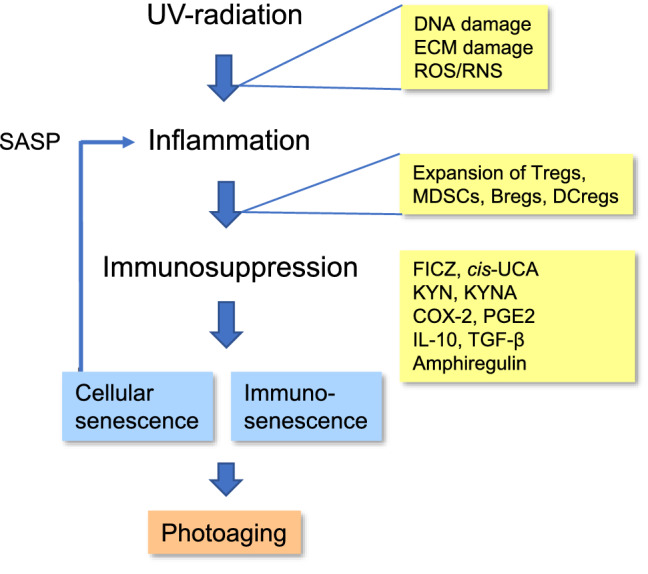
Background: Excessive exposure of the skin to UV radiation (UVR) triggers a remodeling of the immune system and leads to the photoaging state which is reminiscent of chronological aging. Over 30 years ago, it was observed that UVR induced an immunosuppressive state which inhibited skin contact hypersensitivity. Methods: Original and review articles encompassing inflammation and immunosuppression in the photoaging and chronological aging processes were examined from major databases including PubMed, Scopus, and Google Scholar. Results: Currently it is known that UVR treatment can trigger a cellular senescence and inflammatory state in the skin. Chronic low-grade inflammation stimulates a counteracting immunosuppression involving an expansion of immunosuppressive cells, e.g., regulatory T cells (Treg), myeloid-derived suppressor cells (MDSC), and regulatory dendritic cells (DCreg). This increased immunosuppressive activity not only suppresses the function of effector immune cells, a state called immunosenescence, but it also induces bystander degeneration of neighboring cells. Interestingly, the chronological aging process also involves an accumulation of pro-inflammatory senescent cells and signs of chronic low-grade inflammation, called inflammaging. There is also clear evidence that inflammaging is associated with an increase in anti-inflammatory and immunosuppressive activities which promote immunosenescence. Conclusion: It seems that photoaging and normal aging evoke similar processes driven by the remodeling of the immune system. However, it is likely that there are different molecular mechanisms inducing inflammation and immunosuppression in the accelerated photoaging and the chronological aging processes.
Overview
The claims and statistics of this paper haven’t been checked yet.
Free: it reads the open-access text and checks the first 5 claims that cite a source we can check. Create a free account to check every claim.
Integrity signals
Registry
Cites
Statistics
Figures
Verification
Claims the paper makes
The claims and statistics of this paper haven’t been checked yet.
Free: it reads the open-access text and checks the first 5 claims that cite a source we can check. Create a free account to check every claim.
Claims other papers make about this one
Each is checked against this paper’s own text: does it say what the citing paper says it does?
The source backs part of the claim, not all of it — or backs it for a different population, condition or comparison.
In the citing paper
“suggesting a subsequent reduction in inflammatory activity (Salminen et al, 2022;Terui et al, 1998).”
From Effect of Repeated Low-Dose UVR Exposure on Skin Inflammation Threshold, Skin Biomarkers, and Vitamin D in Healthy Adults (2025) · cites this paper as Salminen et al, 2022
Experimental — accuracy not yet measuredThe source backs part of the claim, not all of it — or backs it for a different population, condition or comparison.
In the citing paper
“UVA penetrates deep into the dermis, promoting collagen degradation, whereas UVB causes DNA mutations, increasing the risk of cancer.”
From A Comprehensive Review of the Role of UV Radiation in Photoaging Processes Between Different Types of Skin (2025) · cites this paper as [4]
Experimental — accuracy not yet measuredThe cited source says what the claim attributes to it.
In the citing paper
“UVA penetrates deeply into the dermis, causing oxidative stress and collagen breakdown, while UVB primarily affects the epidermis, inducing DNA damage and inflammation [3,4].”
From A Comprehensive Review of the Role of UV Radiation in Photoaging Processes Between Different Types of Skin (2025) · cites this paper as [4]
The cited source says what the claim attributes to it.
In the citing paper
“UVA penetrates deep into the dermis, promoting collagen degradation, whereas UVB causes DNA mutations, increasing the risk of cancer.”
From A Comprehensive Review of the Role of UV Radiation in Photoaging Processes Between Different Types of Skin (2025) · cites this paper as [4]
1 more claim about this paper
Create a free account to see every claim other papers make about this one.
Self-check
Percentages, sums and reported differences re-computed from the paper’s own numbers.
The self-check needs the paper’s full text.
Citations
Cites
1 retracted
RETRACTED: Characterisation of the Kynurenine Pathway in Skin‐Derived Fibroblasts and Keratinocytes
Sheipouri, D., Grant, R., Bustamante, S., Lovejoy, D. B., Guillemin, G. J., & Braidy, N. (2015) · Journal of Cellular Biochemistry · doi:10.1002/jcb.25019 · Cited by 22 · cited 1×
“UVB exposure also stimulated the kynurenine (KYN) pathway in human fibroblasts and keratinocytes [128].”
BackgroundRetractedLópez-Otín, C., Blasco, M. A., Partridge, L., Serrano, M., & Kroemer, G. (2013) · Cell · doi:10.1016/j.cell.2013.05.039 · Cited by 14,982
Oxidants, oxidative stress and the biology of ageing
Finkel, T., & Holbrook, N. J. (2000) · Nature · doi:10.1038/35041687 · Cited by 9,413
Aging: a theory based on free radical and radiation chemistry
Harman, D. (1956) · Journal of Gerontology · doi:10.1093/geronj/11.3.298 · Cited by 8,567 · cited 1×
“Oxidative stress induced by free radicals with aging, a phenomenon also present in UVR-induced photoaging, is one of the oldest aging theories [174].”
BackgroundInflamm‐aging: An Evolutionary Perspective on Immunosenescence
FRANCESCHI, C., BONAFÈ, M., VALENSIN, S., OLIVIERI, F., DE LUCA, M., OTTAVIANI, E., & DE BENEDICTIS, G. (2000) · Annals of the New York Academy of Sciences · doi:10.1111/j.1749-6632.2000.tb06651.x · Cited by 5,358 · cited 1×
“This state has been called inflammaging [10].”
The senescence-associated secretory phenotype: the dark side of tumor suppression
Coppé, J.-P., Desprez, P.-Y., Krtolica, A., & Campisi, J. (2010) · Annual Review of Pathology: Mechanisms of Disease · doi:10.1146/annurev-pathol-121808-102144 · Cited by 5,206 · cited 5×
“Subsequently, the SASP phenotype of senescent cells, i.e., the increased secretion of inflammatory mediators, enhanced the inflammatory state and the maintenance of an immunosuppressive condition in the skin (Fig.”
BackgroundInfluentialChronic inflammation in the etiology of disease across the life span
Furman, D., Campisi, J., Verdin, E., Carrera-Bastos, P., Targ, S., Franceschi, C., Ferrucci, L., Gilroy, D. W., Fasano, A., Miller, G. W., et al. (2019) · Nature Medicine · doi:10.1038/s41591-019-0675-0 · Cited by 4,915
TGF-β: the master regulator of fibrosis
Meng, X.-M., Nikolic-Paterson, D. J., & Lan, H. Y. (2016) · Nature Reviews Nephrology · doi:10.1038/nrneph.2016.48 · Cited by 3,528 · cited 1×
“Briefly, an increased exposure to TGF-β, as induced by UVR, inhibited cell proliferation [150], enhanced tissue fibrosis [151], stimulated the expression and secretion of ECM remodeling enzymes, such as matrix metalloproteinases and collagenases [152], and even promoted the inflammation-associated myelopoiesis in the…”
BackgroundVignali, D. A. A., Collison, L. W., & Workman, C. J. (2008) · Nature Reviews Immunology · doi:10.1038/nri2343 · Cited by 3,463
Mechanisms of photoaging and chronological skin aging
Fisher, G. J., Kang, S., Varani, J., Bata-Csorgo, Z., Wan, Y., Datta, S., & Voorhees, J. J. (2002) · Archives of Dermatology · doi:10.1001/archderm.138.11.1462 · Cited by 1,849 · cited 1×
“Several review articles have compared the pathophysiological properties of chronological aging and photoaging [3, 31] “Conclusions”.”
Background
Research works printed but not linked: 1
- Genome Res. 2019;29:697-709. https:// doi. org/ 10. 1101/ gr. 240093. 118. · DOI · Paper page
Cited by
Items 101–200 of 520
Yoon, K.-N., & Chung, J. H. (2025) · Journal of Dermatological Science · doi:10.1016/j.jdermsci.2025.06.001 · Cited by 16
Choi, E., Joo, H., Kim, M., Kim, D.-U., Chung, H., & Kim, J. G. (2025) · International Journal of Molecular Sciences · doi:10.3390/ijms26136427 · Cited by 14
“…our results demonstrate that LMWCPs inhibit UVB-induced inflammation by reducing the expression of inflammation-related cytokines (including Il-1 α , Il-6 , Il-10 , and Tnf-α ) and modulating neuro-immune-endocrine pathways through the suppression of MAPKs/c-Jun/c-Fos phosphorylation [9,29].”
Applications of Intravital Imaging in Cancer Immunotherapy
Deng, D., Hao, T., Lu, L., Yang, M., Zeng, Z., Lovell, J. F., Liu, Y., & Jin, H. (2024) · Bioengineering · doi:10.3390/bioengineering11030264 · Cited by 13
“Immunomodula-tory therapies target both innate and adaptive immune cells by activating NK cells [111], macrophages [112], and effector T cells [22] and inhibiting MDSCs and Tregs [113,114].”
Nazar, M., Hasan, M., Maghfira, M., Mustiqillah, S., Nada, C. E., Syahrial, S., Puspita, K., Rusman, R., Bakar, N. H. H. A., & Althubaiti, W. S. (2025) · Results in Engineering · doi:10.1016/j.rineng.2025.105848 · Cited by 13
Extremophilic Solutions: The Role of Deinoxanthin in Counteracting UV-Induced Skin Harm
Kuzucu, M. (2023) · Current Issues in Molecular Biology · doi:10.3390/cimb45100528 · Cited by 13
“Naturally occurring UV radiation is one of the most detrimental environmental agents for the skin, leading to photocarcinogenesis [10], photosensitivity disorders [15], and photoaging [16].”
BackgroundPark, J.-Y., Lee, J. Y., Kim, Y., & Kang, C.-H. (2023) · Nutrients · doi:10.3390/nu15030726 · Cited by 13
“Exposure to UVB causes DNA damage and destruction of the protein structure in the skin cells, resulting in wrinkle formation, inflammation, and cancer in the skin [4].”
BackgroundOh, J. H., Karadeniz, F., Seo, Y., & Kong, C. (2024) · Food Science and Biotechnology · doi:10.1007/s10068-024-01611-2 · Cited by 12
“UVA irradiation has been shown to directly damage HDFs, leading to aging symptoms in which the skin loses its elasticity and strength in addition to much-needed moisture (Salminen et al., 2022).”
Photoprotective Effects of Yeast Pulcherrimin
Kręgiel, D., Krajewska, A., Kowalska-Baron, A., Czarnecka, K. H., & Nowak, A. (2024) · Molecules · doi:10.3390/molecules29204873 · Cited by 12
“In turn, visible radiation can reach the subcutaneous adipose tissue [3].”
BackgroundLiu, J., Liu, Y., Wang, F., Yuan, Y., Ma, H., & Qu, L. (2025) · Frontiers in Pharmacology · doi:10.3389/fphar.2025.1520392 · Cited by 12
Zhang, J., Li, Z., Song, X., Cai, P., & Liu, Q. (2025) · Scientific Reports · doi:10.1038/s41598-025-99304-1 · Cited by 12
“UVA can directly cause photoaging of skin dermis, resulting in damage of fibroblasts, decreased collagen synthesis ability, and destruction of tissue structure 23,24 .”
Epidermal and dermal cell-composed organospheres to assess microplastic-induced skin toxicity
Yunxia, H., Nicolas, G. M., Cai, Y., Dai, X., & Ma, S. (2025) · Biomaterials · doi:10.1016/j.biomaterials.2025.123513 · Cited by 13
Wroński, A., Jarocka-Karpowicz, I., Surażyński, A., Gęgotek, A., Žarković, N., & Skrzydlewska, E. (2024) · Cells · doi:10.3390/cells13110965 · Cited by 12
“…of ROS, which favours the modification of the redox balance and the intensification of inflammatory processes, as previously demonstrated [66,67]. consequence of the increased activation of G-protein-coupled receptors (mainly CB1 and CB2) by the This leads to an increased risk of oxidative…”
BackgroundAin, N. U., Akhlaq, M. H., Zhu, K., Wen, J., Lin, Y., Li, D., & Zhang, Z. (2025) · International Journal of Biological Macromolecules · doi:10.1016/j.ijbiomac.2025.140649 · Cited by 12
Uses of Polypodium leucotomos Extract in Oncodermatology
Calzari, P., Vaienti, S., & Nazzaro, G. (2023) · Journal of Clinical Medicine · doi:10.3390/jcm12020673 · Cited by 12
“Additionally, UVR is able to act on Langerhans cells and mastocytes [7,8].”
BackgroundXie, Y., Yang, A.-Q., Li, N., Zheng, H., Zhong, Y., Jin, Y., Li, J., Ye, R., Du, L., & Hu, F. (2024) · Phytomedicine · doi:10.1016/j.phymed.2024.155679 · Cited by 11
Bioactivity of the Genus Turnera: A Review of the Last 10 Years
Parra-Naranjo, A., Delgado-Montemayor, C., Salazar‐Aranda, R., & de Torres, N. H. W. (2023) · Pharmaceuticals · doi:10.3390/ph16111573 · Cited by 11
“This process can increase oxidative stress levels, as well as induce cell damage at the level of DNA and the extracellular matrix and generate a state of immunosuppression [82].”
BackgroundJarocka-Karpowicz, I., Stasiewicz, A., Olchowik‐Grabarek, E., Sękowski, S., Kacprowska, A., & Skrzydlewska, E. (2025) · Free Radical Biology and Medicine · doi:10.1016/j.freeradbiomed.2025.01.008 · Cited by 11
Duan, G., Ren, Z., Du, B., Shao, W., Dong, H., & Du, A. (2022) · Journal of Cosmetic Dermatology · doi:10.1111/jocd.15559 · Cited by 11
Penilumamide, a novel SIRT1 activator, protects UVB-induced photodamages in HaCaT cells
Park, J. W., Park, J. H., Lee, H., Wang, C., Cao, S., & Kim, H.-S. (2024) · Journal of Toxicology and Environmental Health · doi:10.1080/15287394.2024.2387041 · Cited by 10
“…cytokines such as tumor necrosis factor-α (TNF-α), interleukin (IL)-6, IL-8, and IL-10 (Driessler et al. 2004; Indirapriyadarshini et al. 2023; S. J. Lee et al. 2017; Zhu et al. 2017), and induces inflammation (Cavinato et al. 2017; B. H. Kim et al. 2014; Salminen, Kaarniranta, and Kauppinen 2022).”
Gao, F., Sun, Y., & Gan, H. (2024) · Archives of Dermatological Research · doi:10.1007/s00403-024-03657-y · Cited by 10
“Photoaging refers to premature skin aging due to repeated exposure to UV radiation [40].”
Bioactive components and anti-photoaging activity of Aspergillus oryzae fermented rice bran extract
Wang, M., Yang, W., Chen, M., Zhou, X., & Zhou, Y. (2025) · Food Bioscience · doi:10.1016/j.fbio.2025.106354 · Cited by 10
Xu, R., Lü, Y., Cai, L., & Zhang, L. (2025) · ACS Biomaterials Science & Engineering · doi:10.1021/acsbiomaterials.4c02346 · Cited by 11
Detachable Microneedles With Crosslinked Hyaluronic Acid as Superficial Skin Filler
Toprangkobsin, P., Teepakakorn, A., Ampawa, S., Efendi, A., Limcharoen, B., Banlunara, W., Asawanonda, P., & Wanichwecharungruang, S. P. (2025) · Journal of Biomedical Materials Research Part A · doi:10.1002/jbm.a.37933 · Cited by 10
High‐Efficacy Double‐Effect Sunscreen: Phellodendron Sunscreen Liposome and ZIF‐8/OMC Composite
Chen, J., Nie, Y., Yang, S., Cheng, F., Nezamzadeh‐Ejhieh, A., Lai, X., Muddassir, M., & Liu, J. (2025) · Applied Organometallic Chemistry · doi:10.1002/aoc.70222 · Cited by 10
Elwan, A. H., El-Masry, S. M., Habib, D. A., & Zewail, M. (2025) · International Journal of Pharmaceutics · doi:10.1016/j.ijpharm.2025.125988 · Cited by 10
Sun, W., He, J., Zhang, Y., He, R., & Zhang, X. (2023) · Bioscience Biotechnology and Biochemistry · doi:10.1093/bbb/zbad054 · Cited by 10
Recent progress in the efficacy of algal saccharides on skin repair
Liu, Y., Zhu, Y. N., Zheng, Q., Lu, H., Huafa, H., Zhang, J., Fang, Z., Lin, L., & Ma, P. (2024) · Algal Research · doi:10.1016/j.algal.2024.103403 · Cited by 10
Budluang, P., Kim, J. E., Park, E. S., Seol, A., Jang, H. J., Kang, M. S., Kim, Y. H., Choi, J., Kim, S., Kim, S., et al. (2025) · Scientific Reports · doi:10.1038/s41598-025-88634-9 · Cited by 10
“These results underscore the close relationship between UV irradiation and inflammation, consistent with findings from other studies in the literatures 34–36 .”
Transdermal Delivery of Phloretin by Gallic Acid Microparticles
Cassano, R., Curcio, F., Sole, R., & Trombino, S. (2023) · Gels · doi:10.3390/gels9030226 · Cited by 10
Wang, Q., Zhong, Y., Li, N., Du, L., Ye, R., Xie, Y., & Hu, F. (2023) · Skin Research and Technology · doi:10.1111/srt.13539 · Cited by 10
Rosa, G. P., Peixoto, A. F., Barreto, M. D. C., Seca, A. M. L., & Pinto, D. C. G. A. (2022) · Marine Drugs · doi:10.3390/md21010035 · Cited by 10
Li, D., An, T., Wang, N., Ma, F., Tuo, L., He, N., Song, H., & Liu, Q. (2025) · Extracellular Vesicle · doi:10.1016/j.vesic.2025.100088 · Cited by 9
A novel polypeptide inhibitor of MMP-1 attenuates the UVA-mediated skin aging
Tang, P., Li, J., Guo, C., Xia, Z., Zheng, X.-Y., Zhu, S.-Y., Zheng, C., Kang, S.-N., Xu, W., & Li, X.-H. (2025) · Biochemical and Biophysical Research Communications · doi:10.1016/j.bbrc.2025.152681 · Cited by 9
Kim, S. J., Lee, S., Choi, Y. J., Kang, M., Lee, J., Hwang, G. S., Roh, S., Jin, M. H., Park, S., Park, M., et al. (2025) · Antioxidants · doi:10.3390/antiox14121424 · Cited by 9
“…premature skin aging caused by chronic exposure to ultraviolet (UV) radiation, is characterized by wrinkle formation, loss of skin elasticity, decreased hydration, epidermal thickening, and degradation of dermal extracellular matrix (ECM) components, such as collagen and hyaluronic acid (HA) [1–3].”
Effect of plant-derived exosome-like nanoparticles in ultraviolet-induced skin photoaging
Dong, H., Deng, Y., Li, J., Lin, W., Luo, Y., & Jiang, Y. (2025) · Frontiers in Pharmacology · doi:10.3389/fphar.2025.1721879 · Cited by 9
Yi, Y., Wang, Y.-C., Wu, Y., & Liu, Y. (2023) · Laboratory Investigation · doi:10.1016/j.labinv.2023.100268 · Cited by 10
Skin Aging and the Upcoming Role of Ferroptosis in Geroscience
Rezzani, R., Favero, G., Cominelli, G., Pinto, D., & Rinaldi, F. (2024) · International Journal of Molecular Sciences · doi:10.3390/ijms25158238 · Cited by 9
“The subcutaneous Recent research has identi fi ed that age-related decline in the functions of various skin immune cells is associated with in fl ammation, which is related to the removal of aging cells [106–112].”
BackgroundTanaka, Y., Parker, R., & Aganahi, A. (2023) · Clinical Cosmetic and Investigational Dermatology · doi:10.2147/ccid.s428170 · Cited by 9
“Photoimmunosuppression is increasingly cited as a major cause of photoageing and solar induced skin diseases, including skin cancer.(14) Up-regulation of ICAM1 may enhance prevention of photoimmunosuppression.”
BackgroundWang, Y., Zhang, Q., Liao, H., Lu, X., Cong, J., Liu, Z., Liu, Q., Deng, C., Cheng, Y., Shu, P., et al. (2025) · Heliyon · doi:10.1016/j.heliyon.2025.e42730 · Cited by 9
“Unlike collagen, rhFNP, a modified recombinant human FN, mediates cell adhesion and migration, promotes cell proliferation and differentiation, maintains the stability of the ECM skeleton, and heals wounds [26].”
Thungmungmee, S., & Wisidsri, N. (2025) · Scientific Reports · doi:10.1038/s41598-025-13679-9 · Cited by 8
“UVB exposure has also been shown to upregulate the expression of key pro-inflammatory cytokines, particularly TNF-α, IL-1β, and IL-6, which are key mediators in the photoaging processes 41 .”
Zheng, Y., Lei, J., Zhang, A., Cao, C., Xu, A., Zhou, M., & Lin, F. (2025) · Experimental Gerontology · doi:10.1016/j.exger.2025.112900 · Cited by 8
Hallmarks of the Aging Skin Microenvironment: Components and Mechanisms
He, R., Sun, M., Liu, T., Geng, L., Xing, C., Xu, P., Peng, Y., & Fang, Y. (2025) · Journal of Cellular Physiology · doi:10.1002/jcp.70111 · Cited by 8
“Furthermore, UV exacerbates inflammation through activation of Toll ‐ like receptors and NF ‐ κ B signaling while paradoxically suppressing immune surveillance via Treg induction, thereby accelerating photoaging (Salminen et al. 2022; Ansary et al. 2021).”
Choo, J. H., Lee, S. Y., Min, K., & Kang, N. G. (2025) · Current Issues in Molecular Biology · doi:10.3390/cimb47121065 · Cited by 8
“Additionally, ROS generated following-UV exposure amplify inflammatory signaling, further accelerating skin aging [7].”
Influential9-Hydroxyoctadecadienoic acid plays a crucial role in human skin photoaging
Tsuchida, K., & Sakiyama, N. (2023) · Biochemical and Biophysical Research Communications · doi:10.1016/j.bbrc.2023.08.044 · Cited by 8
Nutlin-3 Loaded Ethosomes and Transethosomes to Prevent UV-Associated Skin Damage
Esposito, E., Ferrara, F., Drechsler, M., Bortolini, O., Ragno, D., Toldo, S., Bondi, A., Pecorelli, A., Voltan, R., Secchiero, P., et al. (2024) · Life · doi:10.3390/life14010155 · Cited by 8
Peng, G., Li, Y., Zeng, Y., Sun, B., Zhang, L., & Liu, Q. (2024) · Journal of Cosmetic Dermatology · doi:10.1111/jocd.16259 · Cited by 8
Kang, W., Ha, Y., Jung, Y., Lee, H., & Park, T. (2024) · Life Sciences · doi:10.1016/j.lfs.2024.123034 · Cited by 8
Hartinger, R., Singh, K., Leverett, J. C., & Djabali, K. (2024) · Biomolecules · doi:10.3390/biom14101310 · Cited by 8
“Chronic inflammation, an important hallmark of aging, negatively affects the skin by damaging cells, altering cellular functions, and inducing cellular senescence [55,78,79].”
BackgroundHuang, Z., Gu, Z., Zeng, Y., & Zhang, D. (2025) · Naunyn-Schmiedeberg s Archives of Pharmacology · doi:10.1007/s00210-025-03800-0 · Cited by 8
Wang, T., Khan, A., Gong, L., Kim, H., Qi, L., & Cui, H. (2025) · Aesthetic Plastic Surgery · doi:10.1007/s00266-025-04764-5 · Cited by 8
“Skin damage caused by UV rays is primarily mediated directly or indirectly by inflammation and oxidative stress [14–16].”
Substantial Effects of Carotenoids on Skin Health: A Mechanistic Perspective
Varghese, R., Emerson, A., Vannier, B., Doss, C. G. P., Priyadarshini, R., Efferth, T., & Ramamoorthy, S. (2025) · Phytotherapy Research · doi:10.1002/ptr.8480 · Cited by 8
Keršmanc, P., Pogačnik, T., Žmitek, J., Hristov, H., Točkova, O., & Žmitek, K. (2025) · Nutrients · doi:10.3390/nu17071240 · Cited by 8
Jusuf, H., Hadjarati, H., Mustapa, M. A., Abdulkadir, W. S., Suryadi, A. M. A., Taupik, M., & Paneo, M. A. (2025) · Tropical Journal of Natural Product Research · doi:10.26538/tjnpr/v9i7.8 · Cited by 8
Martinović, M., Nešić, I., Žugić, A., & Tadić, V. (2025) · Plants · doi:10.3390/plants14152374 · Cited by 8
“UV rays may also cause local inflammation and activation of pro-inflammatory cytokines [11].”
Gallego-Rentero, M., Morala, J. N., Alonso-Juarranz, M., Carrasco, E., Portillo-Esnaola, M., Rodríguez-Luna, A., & González, S. (2022) · Antioxidants · doi:10.3390/antiox11112185 · Cited by 8
Human collagen III mRNA therapy for effective skin rejuvenation
Zhang, J., Chen, S., Yang, J., Song, L., Chen, L., Feng, W., Ju, R., & Xie, Z. (2025) · Journal of Translational Medicine · doi:10.1186/s12967-025-07351-z · Cited by 7
Recent advances on Hippo-YAP pathway in skin diseases
Cai, X., Chen, K., Li, X., Zhang, K., Gu, J., Shen, C., Yu, B., & Huang, C. (2026) · Frontiers in Immunology · doi:10.3389/fimmu.2025.1728064 · Cited by 7
Gargano, P., Picciotto, S., Paterna, A., Raccosta, S., Rao, E., Romancino, D. P., Smeraldi, G., Manno, M., Salamone, M., Zarovni, N., et al. (2026) · Biomedicine & Pharmacotherapy · doi:10.1016/j.biopha.2025.118961 · Cited by 7
Cuproptosis and Aging: Molecular Mechanisms and Therapeutic Implications
Hong, J., Liu, Y., Peng, Q., Mei, Z., & Wang, G. (2026) · Aging and Disease · doi:10.14336/ad.2025.1305 · Cited by 7
Wang, S., Liu, K., Zhang, M., Wang, S., Li, Z., & Zhuang, W. (2026) · Photochemical & Photobiological Sciences · doi:10.1007/s43630-026-00869-1 · Cited by 7
Uncovering the impact of UV radiation on mitochondria in dermal cells: a STED nanoscopy study
Kim, H. J., Jin, S., Kang, J., Bae, S. H., Son, J. B., Oh, J., Youn, H., Kim, S. K., Kang, K. W., & Chung, J. H. (2024) · Scientific Reports · doi:10.1038/s41598-024-55778-z · Cited by 7
“Photoaging is a process that accelerates natural aging through repeated ultraviolet (UV) exposure 13,14 .”
BackgroundA human skin microbiome reference catalog and the skin microbial landscape of plateau adults
Liu, Y., Li, Z., Zhang, C., Li, B., Jiang, W., Li, H., Zhang, L., Zhen, H., Bao, S., Li, X., et al. (2025) · iMetaOmics. · doi:10.1002/imo2.70000 · Cited by 7
Colla Corii Asini regulate collagen regeneration in UV exposure-induced skin photoaging in mice
Ma, Y., Huang, J., Gong, J., Li, L., Zhao, Y., Jin, Y., Gu, J., Liu, H., Wang, Y., & Sun, Y. (2025) · Chinese Medicine · doi:10.1186/s13020-025-01175-1 · Cited by 8
“UV irradiation induces oxidative stress and inflammatory responses in the epidermis and dermis, with oxidative stress further exacerbating inflammation [26].”
Xiao, X., Feng, H., Liao, Y., Tang, H., Li, L., Li, K., & Hu, F. (2023) · Biochemical Genetics · doi:10.1007/s10528-023-10334-8 · Cited by 7
Potential Role of Dietary Salmon Nasal Cartilage Proteoglycan on UVB-Induced Photoaged Skin
Lee, H. R., Hong, S., Cho, K., Kim, S. H., Ko, E., Lee, E., Kim, H. J., Jeon, S. Y., Do, S. G., & Kim, S. Y. (2024) · Biomolecules & Therapeutics · doi:10.4062/biomolther.2024.010 · Cited by 7
“…rays, ultraviolet B (UVB) exposure induces increased epidermal thickness because keratinocytes continue to divide on a molecular basis, and the skin tissue structure changes after exposure to UV rays, leading to dry skin, hyperpigmentation, desquamation, and hyperkeratosis (Salminen et al ., 2022).”
BackgroundCho, E.-C., Ahn, S., Shin, K.-O., Lee, J. B., Hwang, H., & Choi, Y. J. (2024) · Current Issues in Molecular Biology · doi:10.3390/cimb46060338 · Cited by 7
“Previous studies have highlighted a significant gap in data concerning how these molecular and biochemical processes linked to UV exposure contribute to the broader context of skin function and aging [19].”
BackgroundHuman skin rejuvenation via mRNA
Li, L., Tang, Z., Portillo, X., Arora, R., Yang, M., Mintzer, E., Zhang, Z., Sol, S., Boncimino, F., Han, P., et al. (2026) · Journal of Investigative Dermatology · doi:10.1016/j.jid.2026.06.952 · Cited by 7
Hsieh, C., Lin, H., Huang, H.-C., Khumsupan, D., Shen, S., Lin, S., Hsieh, C., Tsai, T., Jantama, S. S., Kuo, H., et al. (2025) · LWT · doi:10.1016/j.lwt.2025.117641 · Cited by 7
Jiang, J., Li, S., Fu, J., Jia, Z., Zhang, Y., Chen, X., Wang, B., & Wang, L. (2025) · International Journal of Biological Macromolecules · doi:10.1016/j.ijbiomac.2025.142909 · Cited by 7
Cao, H. (2024) · American Journal of Translational Research · doi:10.62347/xlgt5405 · Cited by 6
“The mechanism of RD involves high-energy radiation causing direct damage to the DNA of human epidermal cells, either in single or double strands, resulting in cell mutations and a series of skin reactions and injuries [6, 7].”
BackgroundSeo, J., Jeong, C., Choi, W. J., Park, J. H. Y., Lee, C. H., & Lee, K. W. (2024) · Journal of Food Science · doi:10.1111/1750-3841.17246 · Cited by 6
Zhou, F., Sun, Y., Chen, X., Hou, W., Shen, J., Lai, W., Han, K., & Zheng, Y. (2024) · Frontiers in Medicine · doi:10.3389/fmed.2024.1453940 · Cited by 6
“This activation is linked to senescence-related chronic low-level inflammation, known as inflammaging, which is closely connected to immunosenescence (36).”
Chen, Y., Xu, H.-W., Liu, Y.-H., Fu, Q., Zhang, P.-L., Zhou, J., Dong, H., & Yan, X.-D. (2024) · Polymers · doi:10.3390/polym16233317 · Cited by 4
“…continuous destruction of the ozone layer has led to a series of problems, such as accelerated melanin synthesis, collagen degradation, and increased skin sensitivity [1–5], which has motivated consumers to increase their awareness of sun protection and development of the sunscreen market [6–11].”
Improvement of Skin Condition Through RXR Alpha-Activating Materials
Ye, S., Lee, S., Kang, S., Jun, S., & Kang, N. (2025) · Biomolecules · doi:10.3390/biom15020296 · Cited by 6
“Therefore, we first analyzed IL-6 gene expression levels using HaCaT after UV irradiation, which is known to induce aging and increase skin inflammation [58].”
Han, S. H., Suh, H. J., Lee, S. J., & Chang, Y. B. (2025) · Journal of Photochemistry and Photobiology B Biology · doi:10.1016/j.jphotobiol.2025.113171 · Cited by 6
Han, B., Wang, S., Zeng, Y., Wang, Y., Zeng, X., Yang, Z., Huang, X., Huang, S., Wang, H., Gao, R., et al. (2025) · Journal of Functional Foods · doi:10.1016/j.jff.2025.106909 · Cited by 6
Kim, J.-H., Park, K.-W., Jeong, B.-G., Park, J.-K., Jang, H.-Y., Oh, Y.-S., Choi, J.-Y., & Kang, K.-Y. (2025) · Plants · doi:10.3390/plants14111712 · Cited by 6
“…inflammatory responses by upregulating cytokines like tumor necrosis factor-α (TNF-α ), interleukin (IL)-1 β and IL-6, and contributes to extracellular matrix (ECM) degradation, which constitutes the structure of skin tissues through increased expression of matrix metalloproteinases (MMPs) [3,4].”
Uno, E., Kim, F., Yoshino, M., Sato, Y., Hashimoto, M., Watanabe, K., Mizukami, Y., & Muto, J. (2025) · Frontiers in Immunology · doi:10.3389/fimmu.2025.1592751 · Cited by 6
Wei, D., Zhang, H., Xu, W., Zhang, B., Zhang, L., Lan, L., Li, Y., Shi, Y., & Song, X. (2025) · Journal of Photochemistry and Photobiology B Biology · doi:10.1016/j.jphotobiol.2025.113200 · Cited by 6
Yan, Y., Chang, Q., Wu, Y., Zhao, Y., Yan, G., Cao, Z., Zhang, H., Wang, X., Zeng, Q., & Wang, P. (2025) · Aging Cell · doi:10.1111/acel.70328 · Cited by 7
Huang, Q., Zhang, X., Zuo, Y., Wang, L., Sun, H., Xu, H., Yu, M., & Liu, C. (2026) · International Journal of Pharmaceutics X · doi:10.1016/j.ijpx.2026.100491 · Cited by 6
IRE1α regulates ROS and immune responses after UVB irradiation
Son, J., Bailey, J. T., Worrell, S. D., & Glick, A. B. (2024) · Redox Experimental Medicine · doi:10.1530/rem-23-0030 · Cited by 7
Wongkarn, S., Chewonarin, T., Ruangsuriya, J., Taya, S., Dejkriengkraikul, P., & Yodkeeree, S. (2025) · International Journal of Molecular Sciences · doi:10.3390/ijms26073418 · Cited by 6
“Massive apoptosis of skin cells from excessive UVB exposure can disrupt the skin barrier and accelerate photoaging [37,38].”
Park, H. R., Kim, J. K., Lee, J. K., Choi, B. R., Ku, S., & Jegal, K. H. (2023) · Applied Sciences · doi:10.3390/app13084788 · Cited by 6
Vitamin A: It's role in cosmeceuticals for antiaging
Farris, P. K. (2023) · Dermatological Reviews · doi:10.1002/der2.218 · Cited by 6
“7,13 AP ‐ 1 is responsible for the production of matrix metalloproteinases (MMPs) that break down collagen.”
BackgroundLiu, H., Zheng, H., Zhou, S., & Lin, Q. (2024) · Journal of Cosmetic Dermatology · doi:10.1111/jocd.16515 · Cited by 5
Hu, X., Du, S., Chen, M., Yang, H., He, J., Zhang, L., Tan, B., Wu, T., & Duan, X. (2024) · Journal of Inflammation Research · doi:10.2147/jir.s496328 · Cited by 5
The Impact of Ultraviolet Radiation on Human Health
Talaie, A., & Mousavi, S. M. (2024) · Journal of Environmental Treatment Techniques · doi:10.18502/jett.v12i4.17971 · Cited by 5
NGR-modified nanovesicles target ALKBH5 to inhibit ovarian cancer growth and metastasis
Du, C., Wang, D., Zhang, B., Zhao, Y., & He, Z. (2025) · Theranostics · doi:10.7150/thno.107766 · Cited by 6
“Conversely, the increase of immune inhibitory cells like Tregs and MDSCs suppresses anti-tumor immune responses, promoting tumor growth and metastasis [47, 42, 48].”
Hou, W., Lin, Z., Chen, X., Sun, Y., Lin, Y., Peng, M., Zhou, F., Jiang, H., Li, Y., & Zheng, Y. (2025) · Materials Today Bio · doi:10.1016/j.mtbio.2025.102150 · Cited by 5
Wang, D., Li, Y., Lu, J., Zhou, Y., Chang, X., Liu, J., Zhang, S., & Yan, W. (2025) · Ageing Research Reviews · doi:10.1016/j.arr.2025.102966 · Cited by 6
Li, C., Jiang, X., Yuan, Y., Chen, X., Pu, S., Lian, K., Li, L., & Wang, Q. (2026) · Frontiers in Immunology · doi:10.3389/fimmu.2026.1694842 · Cited by 5
iPRF: Uma opção de tratamento estético na harmonização orofacial
Assad, A. L., Suguihara, R. T., & Muknicka, D. P. (2023) · Research Society and Development · doi:10.33448/rsd-v12i12.44082 · Cited by 5
Lee, M., Kim, D., Park, M.-R., Kim, S., Kim, J., Kim, O., & Lee, J. (2024) · Nutrition Research and Practice · doi:10.4162/nrp.2024.18.5.587 · Cited by 5
Food hydroxycinnamic acids alleviate ageing in dermal cells
Kanlayavattanakul, M., Khongkow, M., Iempridee, T., & Lourith, N. (2024) · Food Production Processing and Nutrition · doi:10.1186/s43014-024-00262-4 · Cited by 5
“However, anti-inflammatory assessment of hydroxycinnamic acids relating with ageing and pho-toaging of skin (Chung et al., 2006; Salminen et al., 2022) is sparely available as well as their proficiency against senescent ageing.”
BackgroundInfluentialKim, K. M., Im, A., Shim, K., Lee, A. Y., Kim, T. S., Choi, S., Nam, K., Lee, S., Hyun, J. W., & Chae, S. (2024) · Photodermatology Photoimmunology & Photomedicine · doi:10.1111/phpp.13011 · Cited by 5
Michelini, S., Greco, M. E., Vespasiani, G., Trovato, F., Chello, C., Musolff, N., Cantisani, C., & Pellacani, G. (2025) · Skin Research and Technology · doi:10.1111/srt.70171 · Cited by 5
“Arachidonic acid is converted into prostaglandins by cyclooxygenase enzymes (COX), which increases the recruitment of inflammatory cells and the production of reactive oxygen species (ROS), interleukin-6 (IL-6), and other pro-inflammatory cytokines [48–50].”
Kumazawa, Y., Mizuno, K., & Taga, Y. (2025) · Photochemistry and Photobiology · doi:10.1111/php.70026 · Cited by 5
“However, the in�ammatory response and collagen breakdown are induced when ROS production exceeds the antioxidant capacity of cells following exposure to UV rays, resulting in skin photoaging 1,2 .”
Therapeutic Potential of Adipose Tissue Derivatives in Skin Photoaging
Liu, M., Lu, F., & Feng, J. (2023) · Regenerative Medicine · doi:10.2217/rme-2023-0098 · Cited by 5
Collagen Synthesis as a Prominent Process During the Interval between Two Laser Sessions
Mansouri, V., Arjmand, B., Moghadam, M. H., Rezaei–Tavirani, M., Razzaghi, Z., Ahmadzadeh, A., Rezaei, M. S., & ROBATI, R. M. (2023) · Journal of lasers in medical sciences · doi:10.34172/jlms.2023.50 · Cited by 5
Metadata
- Authors
- Salminen, A., Kaarniranta, K., & Kauppinen, A.
- Affiliations
- University of Eastern Finland (FI)
- Corresponding author
- Salminen, Antero
- Venue
- Inflammation Research
- Published
- 2022-06-24
- Volume
- 71
- Issue
- 7-8
- Pages
- 817-831
- ISSN
- 1023-3830 (ISSN-L)
- 1420-908X
- PMC
- PMC9307547
- OpenAlex
- W4283456943
- Cited by
- 432
- References
- 192
- Citations by year
- 2026: 128 · 2025: 146 · 2024: 91 · 2023: 56 · 2022: 10
- FWCI
- 13.48
- Type
- journal article
- Language
- en
- Open access
- hybrid
- doi.org
- Licence
- cc-by
- creativecommons.org/licenses/by/4.0 (tdm)
- creativecommons.org/licenses/by/4.0 (vor)
- Locations
- Inflammation Research (publishedVersion, cc-by)
- PubMed Central (publishedVersion, cc-by)
- PubMed (publishedVersion)
- Funders
- Academy of Finland (AK297267, AK328443, KK296840, KK333302)
- Kuopion Yliopistollinen Sairaala (KK5503743)
- University of Eastern Finland (UEF) including Kuopio University Hospital
- Topics
- Health Sciences › Medicine › Dermatology › Skin Protection and Aging
- Life Sciences › Biochemistry, Genetics and Molecular Biology › Aging › Genetics, Aging, and Longevity in Model Organisms
- Life Sciences › Biochemistry, Genetics and Molecular Biology › Cell Biology › Telomeres, Telomerase, and Senescence
- Keywords
- photoaging, ultraviolet radiation, skin aging, immunosenescence, inflammaging, low-grade inflammation, immunosuppression, regulatory T cells, myeloid-derived suppressor cells, regulatory dendritic cells, cellular senescence, contact hypersensitivity, skin immune system
- MeSH terms
- Aging, Humans, Immunosuppression Therapy, Inflammation, Skin, Ultraviolet Rays, Skin Aging
About these checks
Registry, retraction, Cites and statistics results are computed, not judged, with one exception: a printed reference that no index lists is read once by a model before it counts as a citation error. Claims are extracted by a model and kept only when their quote appears verbatim in the text; each cited source is then checked, with a model’s help, for whether it says what the claim relies on. Those verdicts can be wrong — read the claim’s quote and the cited source before relying on one.
Statistics and arithmetic are recomputed, not judged.
Confidence bands are shown only for fields calibrated on our annotated test set. None is calibrated yet, so no band is shown.
What counts as a claim ›How we measure confidence ›How we check this ›
Are you an author, or do you see a problem with this page? Request a review
Data sources
Bibliographic data: Semantic Scholar, OpenAlex, Crossref.
Contains information from the Semantic Scholar Academic Graph Datasets, made available under the ODC Attribution License (ODC-BY 1.0).
Semantic Scholar’s data is described in: Kinney, R., et al. (2023). The Semantic Scholar Open Data Platform. arXiv:2301.10140.
