

Photoaging: UV radiation-induced inflammation and immunosuppression accelerate the aging process in the skin
Open accessThe DOI matches its Crossref record; 192 of the 192 references it cites were found in a registry or an index.
Abstract
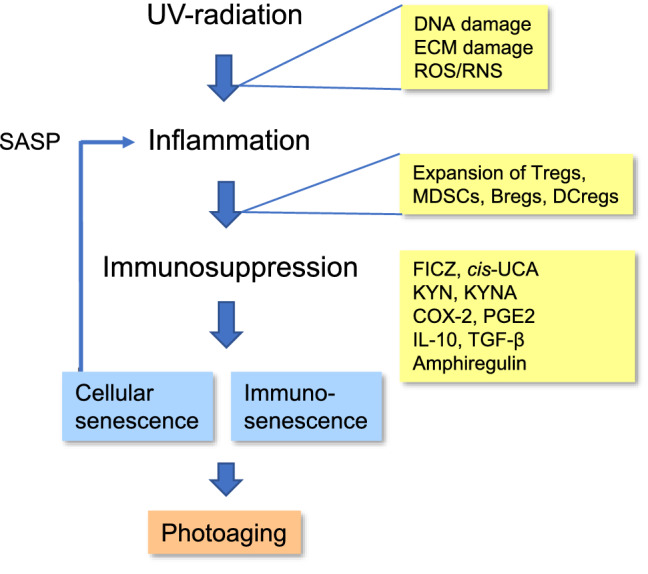
Background: Excessive exposure of the skin to UV radiation (UVR) triggers a remodeling of the immune system and leads to the photoaging state which is reminiscent of chronological aging. Over 30 years ago, it was observed that UVR induced an immunosuppressive state which inhibited skin contact hypersensitivity. Methods: Original and review articles encompassing inflammation and immunosuppression in the photoaging and chronological aging processes were examined from major databases including PubMed, Scopus, and Google Scholar. Results: Currently it is known that UVR treatment can trigger a cellular senescence and inflammatory state in the skin. Chronic low-grade inflammation stimulates a counteracting immunosuppression involving an expansion of immunosuppressive cells, e.g., regulatory T cells (Treg), myeloid-derived suppressor cells (MDSC), and regulatory dendritic cells (DCreg). This increased immunosuppressive activity not only suppresses the function of effector immune cells, a state called immunosenescence, but it also induces bystander degeneration of neighboring cells. Interestingly, the chronological aging process also involves an accumulation of pro-inflammatory senescent cells and signs of chronic low-grade inflammation, called inflammaging. There is also clear evidence that inflammaging is associated with an increase in anti-inflammatory and immunosuppressive activities which promote immunosenescence. Conclusion: It seems that photoaging and normal aging evoke similar processes driven by the remodeling of the immune system. However, it is likely that there are different molecular mechanisms inducing inflammation and immunosuppression in the accelerated photoaging and the chronological aging processes.
Overview
The claims and statistics of this paper haven’t been checked yet.
Free: it reads the open-access text and checks the first 5 claims that cite a source we can check. Create a free account to check every claim.
Integrity signals
Registry
Cites
Statistics
Figures
Verification
Claims the paper makes
The claims and statistics of this paper haven’t been checked yet.
Free: it reads the open-access text and checks the first 5 claims that cite a source we can check. Create a free account to check every claim.
Claims other papers make about this one
Each is checked against this paper’s own text: does it say what the citing paper says it does?
The source backs part of the claim, not all of it — or backs it for a different population, condition or comparison.
In the citing paper
“suggesting a subsequent reduction in inflammatory activity (Salminen et al, 2022;Terui et al, 1998).”
From Effect of Repeated Low-Dose UVR Exposure on Skin Inflammation Threshold, Skin Biomarkers, and Vitamin D in Healthy Adults (2025) · cites this paper as Salminen et al, 2022
Experimental — accuracy not yet measuredThe source backs part of the claim, not all of it — or backs it for a different population, condition or comparison.
In the citing paper
“UVA penetrates deep into the dermis, promoting collagen degradation, whereas UVB causes DNA mutations, increasing the risk of cancer.”
From A Comprehensive Review of the Role of UV Radiation in Photoaging Processes Between Different Types of Skin (2025) · cites this paper as [4]
Experimental — accuracy not yet measuredThe cited source says what the claim attributes to it.
In the citing paper
“UVA penetrates deeply into the dermis, causing oxidative stress and collagen breakdown, while UVB primarily affects the epidermis, inducing DNA damage and inflammation [3,4].”
From A Comprehensive Review of the Role of UV Radiation in Photoaging Processes Between Different Types of Skin (2025) · cites this paper as [4]
The cited source says what the claim attributes to it.
In the citing paper
“UVA penetrates deep into the dermis, promoting collagen degradation, whereas UVB causes DNA mutations, increasing the risk of cancer.”
From A Comprehensive Review of the Role of UV Radiation in Photoaging Processes Between Different Types of Skin (2025) · cites this paper as [4]
1 more claim about this paper
Create a free account to see every claim other papers make about this one.
Self-check
Percentages, sums and reported differences re-computed from the paper’s own numbers.
The self-check needs the paper’s full text.
Citations
Cites
1 retracted
RETRACTED: Characterisation of the Kynurenine Pathway in Skin‐Derived Fibroblasts and Keratinocytes
Sheipouri, D., Grant, R., Bustamante, S., Lovejoy, D. B., Guillemin, G. J., & Braidy, N. (2015) · Journal of Cellular Biochemistry · doi:10.1002/jcb.25019 · Cited by 22 · cited 1×
“UVB exposure also stimulated the kynurenine (KYN) pathway in human fibroblasts and keratinocytes [128].”
BackgroundRetractedLópez-Otín, C., Blasco, M. A., Partridge, L., Serrano, M., & Kroemer, G. (2013) · Cell · doi:10.1016/j.cell.2013.05.039 · Cited by 14,982
Oxidants, oxidative stress and the biology of ageing
Finkel, T., & Holbrook, N. J. (2000) · Nature · doi:10.1038/35041687 · Cited by 9,413
Aging: a theory based on free radical and radiation chemistry
Harman, D. (1956) · Journal of Gerontology · doi:10.1093/geronj/11.3.298 · Cited by 8,567 · cited 1×
“Oxidative stress induced by free radicals with aging, a phenomenon also present in UVR-induced photoaging, is one of the oldest aging theories [174].”
BackgroundInflamm‐aging: An Evolutionary Perspective on Immunosenescence
FRANCESCHI, C., BONAFÈ, M., VALENSIN, S., OLIVIERI, F., DE LUCA, M., OTTAVIANI, E., & DE BENEDICTIS, G. (2000) · Annals of the New York Academy of Sciences · doi:10.1111/j.1749-6632.2000.tb06651.x · Cited by 5,358 · cited 1×
“This state has been called inflammaging [10].”
The senescence-associated secretory phenotype: the dark side of tumor suppression
Coppé, J.-P., Desprez, P.-Y., Krtolica, A., & Campisi, J. (2010) · Annual Review of Pathology: Mechanisms of Disease · doi:10.1146/annurev-pathol-121808-102144 · Cited by 5,206 · cited 5×
“Subsequently, the SASP phenotype of senescent cells, i.e., the increased secretion of inflammatory mediators, enhanced the inflammatory state and the maintenance of an immunosuppressive condition in the skin (Fig.”
BackgroundInfluentialChronic inflammation in the etiology of disease across the life span
Furman, D., Campisi, J., Verdin, E., Carrera-Bastos, P., Targ, S., Franceschi, C., Ferrucci, L., Gilroy, D. W., Fasano, A., Miller, G. W., et al. (2019) · Nature Medicine · doi:10.1038/s41591-019-0675-0 · Cited by 4,915
TGF-β: the master regulator of fibrosis
Meng, X.-M., Nikolic-Paterson, D. J., & Lan, H. Y. (2016) · Nature Reviews Nephrology · doi:10.1038/nrneph.2016.48 · Cited by 3,528 · cited 1×
“Briefly, an increased exposure to TGF-β, as induced by UVR, inhibited cell proliferation [150], enhanced tissue fibrosis [151], stimulated the expression and secretion of ECM remodeling enzymes, such as matrix metalloproteinases and collagenases [152], and even promoted the inflammation-associated myelopoiesis in the…”
BackgroundVignali, D. A. A., Collison, L. W., & Workman, C. J. (2008) · Nature Reviews Immunology · doi:10.1038/nri2343 · Cited by 3,463
Mechanisms of photoaging and chronological skin aging
Fisher, G. J., Kang, S., Varani, J., Bata-Csorgo, Z., Wan, Y., Datta, S., & Voorhees, J. J. (2002) · Archives of Dermatology · doi:10.1001/archderm.138.11.1462 · Cited by 1,849 · cited 1×
“Several review articles have compared the pathophysiological properties of chronological aging and photoaging [3, 31] “Conclusions”.”
Background
Research works printed but not linked: 1
- Genome Res. 2019;29:697-709. https:// doi. org/ 10. 1101/ gr. 240093. 118. · DOI · Paper page
Cited by
Aging Biomarker Consortium, Bao, H., Cao, J., Chen, M., Chen, M., Chen, W., Chen, X., Chen, Y., Chen, Y., Chen, Y., et al. (2023) · Science China Life Sciences · doi:10.1007/s11427-023-2305-0 · Cited by 376
Tang, X., Yang, T., Yu, D., Xiong, H., & Zhang, S. (2024) · Environment International · doi:10.1016/j.envint.2024.108535 · Cited by 371
The role of cellular senescence in skin aging and age-related skin pathologies
Chin, T., Lee, X. E., Ng, P. Y., Lee, Y., & Dreesen, O. (2023) · Frontiers in Physiology · doi:10.3389/fphys.2023.1297637 · Cited by 138
Research Progress on Skin Aging and Active Ingredients
He, X., Wan, F., Su, W., & Xie, W. (2023) · Molecules · doi:10.3390/molecules28145556 · Cited by 149
Choi, W., Cho, J. H., Park, S. H., Kim, D. S., Lee, H. P., Kim, D.-H., Kim, H. S., Kim, J. H., & Cho, J. Y. (2024) · Journal of Ginseng Research · doi:10.1016/j.jgr.2024.01.001 · Cited by 112
“Inflammation is a defense response that protects the body from external stimuli, but an excessive inflammatory response can cause skin damage and accelerate skin aging [25].”
BackgroundUltraviolet (UV) radiation: a double-edged sword in cancer development and therapy
Yu, Z.-W., Zheng, M. H., Fan, H., Liang, X., & Tang, Y. (2024) · Molecular Biomedicine · doi:10.1186/s43556-024-00209-8 · Cited by 97
Inflammaging and Immunosenescence as Part of Skin Aging—A Narrative Review
Pająk, J., Nowicka, D., & Szepietowski, J. C. (2023) · International Journal of Molecular Sciences · doi:10.3390/ijms24097784 · Cited by 92
“UV radiation, especially UV B, causes both inflammation and immunosuppression (locally in the skin and also systemic) but in a different mechanism than during chronological aging [33].”
BackgroundXia, Y., Zhang, H., Wu, X., Xu, Y., & Tan, Q. (2024) · Biogerontology · doi:10.1007/s10522-024-10099-6 · Cited by 83
“The outcomes demonstrated that while resveratrol therapy decreased MMP1 expression, UVA irradiation significantly increased MMP1 expression (Fig.”
BackgroundInfluentialSun, Z., Zheng, Y., Wang, T., Zhang, J., Li, J., Wu, Z., Zhang, F., Gao, T., Li, Y. X., Xu, X., et al. (2025) · International Journal of Nanomedicine · doi:10.2147/ijn.s510352 · Cited by 73
“UV radiation-induced inflammatory damage accelerates skin photoaging, 33 and we further investigated the function of gADNPs and rADNPs in UVA-induced photoaging of DFs.”
Skin senescence—from basic research to clinical practice
Dorf, N., & Maciejczyk, M. (2024) · Frontiers in Medicine · doi:10.3389/fmed.2024.1484345 · Cited by 73
“On the other hand, ozone causes alterations in the stratum corneum, reduces the amount of natural antioxidants and generates stress, which leads finally to wrinkle formation (32).”
BackgroundSkin Barrier Dysfunction in Acne Vulgaris: Pathogenesis and Therapeutic Approaches
Deng, Y., Wang, F., & He, L. (2024) · Medical Science Monitor · doi:10.12659/msm.945336 · Cited by 70
“For example, sustained activation of the NF-k B and p38 MAPK pathways leads to the secretion of IL-1 b , IL-1 a , IL-6, and TNF-a , as well as to the development of the senescence-associated secretory phenotype [41], all of which contribute to ongoing damage to the skin barrier [42,43].”
Liu, Y., Qu, L., Wan, S., Li, Y., & Fan, D. (2022) · Journal of Agricultural and Food Chemistry · doi:10.1021/acs.jafc.2c06377 · Cited by 61
Ultraviolet Light Protection: Is It Really Enough?
Farris, P. K., & Valacchi, G. (2022) · Antioxidants · doi:10.3390/antiox11081484 · Cited by 60
“In addition, NF-kβ activation leads to premature senescence of keratinocytes, fibroblasts, melanocytes and preadipocytes [19].”
BackgroundResearch Progress in Skin Aging and Immunity
He, X., Gao, X., & Xie, W. (2024) · International Journal of Molecular Sciences · doi:10.3390/ijms25074101 · Cited by 59
“The molecular mechanism of the response suggests that inflammation is related to the increased anti-inflammatory and immunosuppressive activities that promote immune aging [49].”
BackgroundUltraviolet Light Causes Skin Cell Senescence: From Mechanism to Prevention Principle
Song, S., Li, F., Zhao, B., Zhou, M., & Wang, X. (2024) · Advanced Biology · doi:10.1002/adbi.202400090 · Cited by 56
Aging, ROS, and cellular senescence: a trilogy in the progression of liver fibrosis
Almalki, W. H., & Almujri, S. S. (2024) · Biogerontology · doi:10.1007/s10522-024-10153-3 · Cited by 56
“It plays a crucial role in tissue development and maintenance by regulating cell adhesion, migration, and signaling (Salminen et al. 2022).”
Salminen, A., Kaarniranta, K., & Kauppinen, A. (2024) · Ageing Research Reviews · doi:10.1016/j.arr.2024.102296 · Cited by 53
Self-citationDiscovery of matrix metalloproteinase inhibitors as anti-skin photoaging agents
Li, F., Zhi, J., Zhao, R., Sun, Y., Wen, H., Cai, H., Chen, W., Jiang, X., & Bai, R. (2024) · European Journal of Medicinal Chemistry · doi:10.1016/j.ejmech.2024.116152 · Cited by 51
Aryl hydrocarbon receptor (AhR) impairs circadian regulation: Impact on the aging process
Salminen, A. (2023) · Ageing Research Reviews · doi:10.1016/j.arr.2023.101928 · Cited by 46
“FICZ stimulates AhR signaling which promotes the generation of photoaging in the skin (Salminen et al., 2022).”
InfluentialSelf-citationWadhwa, A., Moreno‐Villanueva, M., Crucian, B. E., & Wu, H. (2024) · Immunity & Ageing · doi:10.1186/s12979-024-00449-w · Cited by 45
Nègre‐Salvayre, A., & Salvayre, R. (2022) · Antioxidants · doi:10.3390/antiox11112281 · Cited by 43
The role and safety of UVA and UVB in UV-induced skin erythema
Yang, J., Fan, G., Tan, F., Kong, H.-M., Liu, Q., Zou, Y., & Tan, Y.-M. (2023) · Frontiers in Medicine · doi:10.3389/fmed.2023.1163697 · Cited by 43
Alves, L. D. F., Moore, J. B., & Kell, D. B. (2024) · International Journal of Molecular Sciences · doi:10.3390/ijms25169082 · Cited by 43
Zhang, Z., Tan, R., Xiong, Z., Feng, Y., & Chen, L. (2025) · Frontiers in Pharmacology · doi:10.3389/fphar.2025.1562845 · Cited by 43
“Chronic low-grade in fl ammation, often termed in fl ammaging, is a hallmark of both chronological aging and photoaging (Salminen, 2022; Salminen et al., 2022).”
Role of Mitochondrial Dysfunction in UV ‐Induced Photoaging and Skin Cancers
Yuan, X., Li, H., Lee, J. S., & Lee, D. H. (2025) · Experimental Dermatology · doi:10.1111/exd.70114 · Cited by 41
“…causing mtDNA damage and the activation of the NF-κB signalling pathway, which further induces the synthesis and release of various inflammatory factors like interleukin-1 (IL-1), IL-6 and tumour necrosis factor-α (TNF-α), resulting in cellular apoptosis and inflammatory responses [71, 72].”
Sharma, P., Dhiman, T., Negi, R. S., Anshad, O. C., Gupta, K., Bhatti, J. S., & Thareja, S. (2024) · South African Journal of Botany · doi:10.1016/j.sajb.2024.01.035 · Cited by 39
Galvanic Cell Bipolar Microneedle Patches for Reversing Photoaging Wrinkles
Lin, X., Jia, Q., Lin, X., Shi, J., Gong, W., Shen, K., Liu, B., Sun, L., & Fan, Z. (2025) · Advanced Materials · doi:10.1002/adma.202500552 · Cited by 41
The Tumor Stroma of Squamous Cell Carcinoma: A Complex Environment That Fuels Cancer Progression
Buruiană, A., Gheban, B., Gheban-Roşca, I. A., Georgiu, C., Crișan, D., & Crişan, M. (2024) · Cancers · doi:10.3390/cancers16091727 · Cited by 37
“…polymorphisms affecting innate and adaptive immune responses [256], environmental exposures (such as UV radiation) with immunomodulatory effects [257], intratumoral heterogeneity that influences signaling pathways [258], the specific anatomical location of the tumor, and the patient’s overall…”
BackgroundTailoring biomaterials for skin anti-aging
Dan, X., Li, S., Chen, H., Xue, P., Liu, B., Ju, Y., Lei, L., Li, Y., & Fan, X. (2024) · Materials Today Bio · doi:10.1016/j.mtbio.2024.101210 · Cited by 39
“For instance, IL-6 is not only involved in the inflammatory response but is also associated with the aging of skin fibroblasts, wherein it promotes degradation of the ECM, leading to loss of skin elasticity and firmness [43].”
BackgroundBeneficial Effects of Epigallocatechin Gallate in Preventing Skin Photoaging: A Review
Sun, J., Jiang, Y., Fu, J., He, L., Guo, X., Ye, H., Yin, C., Li, H., & Jiang, H. (2024) · Molecules · doi:10.3390/molecules29225226 · Cited by 37
Skin Aging and Carotenoids: A Systematic Review of Their Multifaceted Protective Mechanisms
Stanescu, C. M., Chiscop, I., Mihalache, D., Popa, F., Tamaş, C., & Stoleriu, G. (2025) · Nutrients · doi:10.3390/nu17162596 · Cited by 37
“Carotenoids suppress these pathways, thereby preserving the dermal structural integrity [35,36,95].”
Chittasupho, C., Ditsri, S., Singh, S. K., Kanlayavattanakul, M., Duangnin, N., Ruksiriwanich, W., & Athikomkulchai, S. (2022) · Gels · doi:10.3390/gels8100639 · Cited by 37
“The long-term existence of an inflammatory microenvironment increases the risk of skin cancer and metastasis [5].”
BackgroundGao, W., Zhang, Y., Yuan, L., Huang, F., & Wang, Y. (2023) · Photochemistry and Photobiology · doi:10.1111/php.13801 · Cited by 37
“Chronic exposure to UV radiation, especially UVB, leads to histologic alterations in the skin characterized by epidermal thickness, wrinkle formulation, slackness, dryness and even DNA damage-induced skin tumor (1,2).”
BackgroundRutin Protects Fibroblasts from UVA Radiation through Stimulation of Nrf2 Pathway
Tabolacci, E., Tringali, G., Nobile, V., Duca, S., Pizzoferrato, M., Bottoni, P., & Clementi, M. E. (2023) · Antioxidants · doi:10.3390/antiox12040820 · Cited by 38
Namjoo, A. R., Abrbekoh, F. N., Saghati, S., Amini, H., Saadatlou, M. A. E., & Rahbarghazi, R. (2023) · Stem Cell Research & Therapy · doi:10.1186/s13287-023-03310-x · Cited by 37
“These features are less effective in consolidated tissues such as bone, and cartilage compared to the soft tissues [178, 179].”
BackgroundSkin Cancer Microenvironment: What We Can Learn from Skin Aging?
D’Arino, A., Caputo, S., Eibenschutz, L., Piemonte, P., Buccini, P., Frascione, P., & Bellei, B. (2023) · International Journal of Molecular Sciences · doi:10.3390/ijms241814043 · Cited by 36
“CXCL1, CXCL5, CXCL8, CXCL10) that cooperate to establish a pro-inflammatory environment and to recruit immune cells into the senescent tissue to remove damaged and transformed cells [147,149,155].”
BackgroundGréta, F., Haimhoffer, Á., Enikő, C., Bodnár, K., Vasvári, G., Nemes, D., Lekli, I., Gyöngyösi, A., Bácskay, I., Fehér, P. S., et al. (2023) · Pharmaceutics · doi:10.3390/pharmaceutics15082054 · Cited by 36
Impact of Vitamin D on Skin Aging, and Age-Related Dermatological Conditions
Ambagaspitiya, S. S., Appuhamillage, G. A., & Wimalawansa, S. J. (2025) · Frontiers in Bioscience-Landmark · doi:10.31083/fbl25463 · Cited by 35
“Cells undergoing senescence arrest their proliferation and secrete both anti-and pro-inflammatory mediators [104].”
Sotto, A. D., Gullì, M., Percaccio, E., Vitalone, A., Mazzanti, G., & Giacomo, S. D. (2022) · Nutrients · doi:10.3390/nu14153149 · Cited by 35
“Moreover, activation of photoaging triggers cellular senescence and inflammation, a condition known as inflammaging, and progressively suppresses the skin immune system, increasing susceptibility to infection, degenerative processes, and cancer [42,43].”
BackgroundSiquier-Dameto, G., Boadas‐Vaello, P., & Verdú, E. (2024) · Antioxidants · doi:10.3390/antiox13070770 · Cited by 34
“Ultraviolet radiation (UVA, UVB) on the skin, which causes inflammation [81], triggers a decrease in skin viscoelasticity [82].”
BackgroundSalminen, A. (2025) · Ageing Research Reviews · doi:10.1016/j.arr.2025.102694 · Cited by 34
“Immunosuppressive cells also express an elevated level of ARG1 and IDO1 which deplete the levels of L-arginine and L-tryptophan, respectively, thus disturbing protein synthesis within aging tissues (Tavernarakis, 2008; Murray, 2016; Salminen, 2022).”
Self-citationSkin optical properties from 200 to 300 nm support far UV-C skin-safety in vivo
Díaz, D. F. Z., Klein, A. L., Guttmann, M., Zwicker, P., Busch, L., Kröger, M., Klose, H., Rohn, S., Schleusener, J., & Meinke, M. C. (2023) · Journal of Photochemistry and Photobiology B Biology · doi:10.1016/j.jphotobiol.2023.112784 · Cited by 33
The Influence of Circadian Rhythms on DNA Damage Repair in Skin Photoaging
Su, Z. G., Hu, Q., Li, X., Wang, Z., & Xie, Y. (2024) · International Journal of Molecular Sciences · doi:10.3390/ijms252010926 · Cited by 32
“Skin photoaging not only impacts cosmetic appearance but also substantially elevates the risk of skin cancer [8].”
BackgroundLin, C.-H., Lin, M., Chung, Y.-K., Alalaiwe, A. S., Hung, C., & Fang, J. (2023) · Chemosphere · doi:10.1016/j.chemosphere.2023.140702 · Cited by 33
He, X., Wang, C., Zhang, Q., Yang, T., Guo, Q., Wang, Y., Guo, J., Wang, P., Zhang, J., Tang, H., et al. (2024) · Aging Cell · doi:10.1111/acel.14433 · Cited by 29
“In recent years, the important roles of senescent cells during skin photoaging process have been revealed, providing a novel insight to understand photoaging (Salminen et al., 2022 ).”
Multifunctional protocatechuic acid–polyacrylic acid hydrogel adhesives for wound dressings
Dong, Y., Su, J., Guo, X., Zhang, Q., Zhu, S., Zhang, K., & Zhu, H. (2024) · Journal of Materials Chemistry B · doi:10.1039/d4tb00425f · Cited by 29
Gui, Q., Ding, N., Yao, Z., Wu, M., Fu, R., Wang, Y., Zhao, Y., & Zhu, L. (2024) · Precision Clinical Medicine · doi:10.1093/pcmedi/pbae004 · Cited by 31
“Recent evidence suggests that both inflammaging and immunosenes-cence play significant roles in skin aging [ 74–76 ].”
BackgroundPhloretin Transfersomes for Transdermal Delivery: Design, Optimization, and In Vivo Evaluation
Wang, J., Zhao, Y., Zhai, B., Cheng, J., Sun, J., Zhang, X., & Guo, D. (2023) · Molecules · doi:10.3390/molecules28196790 · Cited by 27
“Photoaging is characterized by a rough, dry appearance as well as creases and sagging [4].”
BackgroundAnti-Aging Properties of Chitosan-Based Hydrogels Rich in Bilberry Fruit Extract
Studzińska-Sroka, E., Paczkowska‐Walendowska, M., Erdem, C., Paluszczak, J., Kleszcz, R., Hoszman-Kulisz, M., & Cielecka‐Piontek, J. (2024) · Antioxidants · doi:10.3390/antiox13010105 · Cited by 27
“Repeated excessive exposures to UV solar radiation and other harmful environmental factors induce skin cell alterations similar to those observed during the aging process [1].”
BackgroundUnraveling Melasma: From Epidermal Pigmentation to Microenvironmental Dysregulation
Fang, M., Wan, J., Zhou, Y., & Shi, Y. (2025) · Biology · doi:10.3390/biology14101402 · Cited by 26
“However, under conditions of chronic stress, particularly UVR, these cells fall into a state of senescence, an irreversible cell cycle arrest accompanied by a unique secretory phenotype known as the senescence-associated secretory phenotype (SASP) [12,48–50].”
Wang, T., Qin, Y., Qiao, J., Liu, Y., Wang, L., & Zhang, X. (2023) · Journal of Photochemistry and Photobiology B Biology · doi:10.1016/j.jphotobiol.2023.112801 · Cited by 26
Modeling of solar UV-induced photodamage on the hair follicles in human skin organoids
Kim, M.-J., Ahn, H.-J., Kong, D., Lee, S., Kim, D.-H., & Kang, K.-S. (2024) · Journal of Tissue Engineering · doi:10.1177/20417314241248753 · Cited by 25
Yu, Y., Huang, H., Su, T., Huang, W., Wu, X., Chen, X., Ye, S., Zhong, J., Li, C., & Li, Y. (2025) · International Journal of Molecular Sciences · doi:10.3390/ijms26051809 · Cited by 25
“Similar to naturally aging skin, photoaged skin exhibits a decrease in collagen and elastin, leading to wrinkle formation, loss of elasticity, hyperpigmentation, and dryness of the skin [10].”
Chen, Q., Lin, W., Tang, Y., He, F., Liang, B., Chen, J., Li, H., & Zhu, H. (2025) · Frontiers in Immunology · doi:10.3389/fimmu.2025.1566287 · Cited by 27
“Natural extracts with unique biological activities and low toxicity are considered promising therapeutic candidates (20 – 23).”
Salminen, A., Kaarniranta, K., & Kauppinen, A. (2025) · Biogerontology · doi:10.1007/s10522-025-10268-1 · Cited by 25
“…of the immune system, i.e., the development of acute and chronic inflammatory responses and the counteracting immunosuppression are characteristic pathological alterations encountered in both the accelerated and normal aging process (Schwarz et al. 2008; Bernard et al. 2019; Salminen et al. 2022).”
Self-citationSiquier-Dameto, G., Boisnic, S., Boadas‐Vaello, P., & Verdú, E. (2023) · Polymers · doi:10.3390/polym15112438 · Cited by 25
Xiao, X., Feng, H., Liao, Y., Tang, H., Li, L., Li, K., & Hu, F. (2023) · Aging · doi:10.18632/aging.205155 · Cited by 25
“Ultraviolet radiation is one of the major environmental factors causing skin damage and aging [5].”
Biomarkers of UVB radiation-related senescent fibroblasts
Qiang, M., & Dai, Z. (2024) · Scientific Reports · doi:10.1038/s41598-023-51058-4 · Cited by 25
“The observed associations underscore the relevance of these pathways in elucidating the molecular mechanisms underlying the impact of UVB radiation on skin aging 29 .”
BackgroundFrontiers in Topical Photoprotection
Sullivan, M., Obezo, C. G., Lipsky, Z. W., Panchal, A., & Jensen, J. (2025) · Cosmetics · doi:10.3390/cosmetics12030096 · Cited by 25
“When these cells reach the site of inflammation, they can release anti-inflammatory cytokines such as IL-10 and TGF-β ; release ROS compounds, reactive nitrogen species, and Prostaglandin E2 (PGE2); and change the expression of amino acid metabolizing enzymes [188].”
InfluentialLiu, J., Zheng, R., Zhang, Y., Jia, S., He, Y., & Liu, J. (2023) · Cancers · doi:10.3390/cancers15092640 · Cited by 24
Jastrząb, A., Conde, T., Gęgotek, A., Domingues, M. R., Domingues, P. M., & Skrzydlewska, E. (2023) · International Journal of Molecular Sciences · doi:10.3390/ijms241411302 · Cited by 24
“The results from this study and data from the literature suggest that UVB radiation modifies the metabolism of epidermal cells by activating oxidative and inflammatory processes, which could lead to accelerated skin ageing and the onset of disease processes [42].”
ResultJanjetović, Z., & Slominski, A. T. (2024) · Cosmetics · doi:10.3390/cosmetics11020037 · Cited by 25
“Photo-aging, especially caused by UVA and UVB, accelerates the process of ECM degradation, which is the main culprit in UV-induced changes in the skin dermis [85,140].”
The impact of the senescent microenvironment on tumorigenesis: Insights for cancer therapy
Zhang, W., Zhang, K., Shi, J., Qiu, H., Kan, C., Ma, Y., Hou, N., Han, F., & Sun, X. (2024) · Aging Cell · doi:10.1111/acel.14182 · Cited by 24
“These effects can increase the risk of skin cancer (Salminen et al., 2022).”
BackgroundDeciphering the Effects of Different Types of Sunlight Radiation on Skin Function: A Review
Letsiou, S., Koldiri, E., Beloukas, A. I., Rallis, E. A., & Kefala, V. (2024) · Cosmetics · doi:10.3390/cosmetics11030080 · Cited by 24
“Solar radiation, and especially ultraviolet radiation (UV), is thought to be the primary factor causing photoaging [4,5].”
BackgroundEpigenetics in Skin Homeostasis and Ageing
Dermitzakis, I., Kyriakoudi, S. A., Chatzianagnosti, S., Chatzi, D., Vakirlis, E., Meditskou, S., Μanthou, M. E., & Theotokis, P. (2025) · Epigenomes · doi:10.3390/epigenomes9010003 · Cited by 24
Yu, Y. H., Yan, G., Cao, Z. W., Wang, B., Zeng, Q., Shi, L., Chang, Q., Chen, C., Zhang, L., Liao, C., et al. (2023) · Frontiers in Immunology · doi:10.3389/fimmu.2023.1183709 · Cited by 23
Brar, G., Dhaliwal, A., Brar, A. S., Sreedevi, M., Ahmadi, Y., Irfan, M., Golbari, R., Zumárraga, D., Yateem, D., Lysak, Y., et al. (2025) · Cureus · doi:10.7759/cureus.81109 · Cited by 22
Anti-aging of phenolic-rich Acanthus ebracteatus Vahl. extracts
Kanlayavattanakul, M., Chaikul, P., Kongkow, M., Iempridee, T., & Lourith, N. (2023) · Chemical and Biological Technologies in Agriculture · doi:10.1186/s40538-023-00403-w · Cited by 21
Zhang, H., Dong, X., Liu, Y., Duan, P., Liu, C., Liu, K., Yu, Y., Liang, X., Dai, H., & Yu, A. (2025) · Acta Biomaterialia · doi:10.1016/j.actbio.2025.02.048 · Cited by 21
Kandil, S. M., Diab, H. M., Mahfoz, A. M., Elhawatky, A. F., & Abdou, E. M. (2024) · Pharmaceutical Research · doi:10.1007/s11095-024-03733-y · Cited by 21
“It has reported that, many of UV-induced skin harmful impacts are resulted from induction of many proinflammatory cytokines such as NF-κB [53].”
BackgroundPanax ginseng extract prevents UVB-induced skin photodamage by modulating VMP1-mediated ER stress
Chen, J., Tai, M., Chen, J., Ni, J., Yi, H., Chen, L., Wang, D., Wen, C., Li, J., Shen, X., et al. (2024) · Phytomedicine · doi:10.1016/j.phymed.2024.156010 · Cited by 20
Moskwa, J., Bronikowska, M., Socha, K., & Markiewicz‐Żukowska, R. (2023) · Nutrients · doi:10.3390/nu15163594 · Cited by 20
“This process can generate mutagenesis or even lead to cell death [20,21].”
BackgroundLiu, X., Chen, B., Liu, X., Zhang, X., & Wu, J. (2025) · Frontiers in Cell and Developmental Biology · doi:10.3389/fcell.2025.1625357 · Cited by 19
Identification of Loliolide with Anti-Aging Properties from Scenedesmus deserticola JD052
Cho, D., Yun, J., Heo, J., Lee, I., Lee, Y., Bae, S., Yun, B., & Kim, H.-S. (2023) · Journal of Microbiology and Biotechnology · doi:10.4014/jmb.2304.04044 · Cited by 19
“…identifying an effective UV protection agent has been a priority of researchers and practitioners in the field of cosmetic science with a focus on identifying new functional ingredients that could either directly protect against UV irradiation or mitigate UV-damage associated aging mechanisms [6].”
BackgroundOverview of Skin Cancer and Risk Factors
Abubakar, M. S. (2024) · International journal of general practice nursing. · doi:10.26689/ijgpn.v2i3.8114 · Cited by 19
“All these findings highlight sharply the clear relationship between UV radiation and immunosuppression [55–56] .”
Jwo, J., Chang, Y., & Huang, Y. (2023) · Photodermatology Photoimmunology & Photomedicine · doi:10.1111/phpp.12861 · Cited by 20
Role of Autophagy in Skin Photoaging: A Narrative Review
Zhong, X., Deng, Y., Yang, H., Du, X., Liu, P., & Du, Y. (2024) · Medicine · doi:10.1097/md.0000000000037178 · Cited by 18
“Presence of nodules, cysts, and acne No similar changes [5,24] Tumors +++ + [25–28] Incidence Atrophy at all levels of the skin Abnormal, ineffective proliferative response mediated by chronic inflammation [16,29] Histological characteristics 1.”
BackgroundNatural Compounds with Beneficial Effects on Skin Collagen Type I and Mechanisms of Their Action
Żynda, W., Ruczaj, A., & Galicka, A. (2025) · Antioxidants · doi:10.3390/antiox14040389 · Cited by 18
“UVB radiation can penetrate the epidermis and reach the upper dermis, which leads to increased oxidative stress and causes erythema (sunburn), while UVA radiation can penetrate the dermis and reach the fibroblasts that synthesize collagen [120–122].”
Wei, Q., He, F., Rao, J., Xiang, X., Li, L., & Qi, H. (2024) · Free Radical Biology and Medicine · doi:10.1016/j.freeradbiomed.2024.08.004 · Cited by 18
Mechanically regulated microcarriers with stem cell loading for skin photoaging therapy
Lin, X., Filppula, A. M., Zhao, Y., Shang, L., & Zhang, H. (2025) · Bioactive Materials · doi:10.1016/j.bioactmat.2024.12.024 · Cited by 18
Vicenin-2 reduces inflammation and apoptosis to relieve skin photoaging via suppressing GSK3β
Hu, X., Chen, M., Tan, B., Yang, H., Li, S., Li, R., Zhang, X., Long, F., Huang, Y., & Duan, X. (2025) · Journal of Photochemistry and Photobiology B Biology · doi:10.1016/j.jphotobiol.2025.113117 · Cited by 18
Targets Involved in Skin Aging and Photoaging and their Possible Inhibitors: A Mini-review
de Moura, J. P., Fernandes, É., Rodrigues, T. C. M. L., Monteiro, A., de Sousa, N. F., dos Santos, A. M. F., Scotti, M. T., & Scotti, L. (2023) · Current Drug Targets · doi:10.2174/1389450124666230719105849 · Cited by 17
Shu, P., Jiang, L., Li, M., Li, Y., Yuan, Z., Lin, L., Ju, W., Aisa, H. A., & Du, Z. (2023) · Photochemistry and Photobiology · doi:10.1111/php.13872 · Cited by 17
“15,16 A range of anti-photoaging skin care products, such as sunscreen, topical retinoids, 5-fluorouracil cream, topical or oral antioxidants, and facial rejuvenation therapies, have been widely and successfully used in the prevention and treatment of photoaging.”
BackgroundKrill oil: nutraceutical potential in skin health and disease
Duo, L., Yang, J., Wang, X., Zhang, G., Zhao, J., Zou, H., Wang, Z., & Li, Y. (2024) · Frontiers in Nutrition · doi:10.3389/fnut.2024.1388155 · Cited by 17
“UV radiation can cause cell damage by generating ROS and inflammatory mediators, which directly attack the DNA of skin cells (102).”
BackgroundOleuropein-Rich Gellan Gum/Alginate Films as Innovative Treatments against Photo-Induced Skin Aging
Busto, F., Licini, C., Luccarini, A., Damiani, E., Mattioli‐Belmonte, M., Cometa, S., & Giglio, E. D. (2023) · Molecules · doi:10.3390/molecules28114352 · Cited by 18
“Following UV exposure, immune and non-immune cells in the skin start to produce TNF-α and IL-6 cytokines, as consequence of inflammation triggering.”
BackgroundInfluentialKim, J., Chun, Y., Lee, S.-H., Lee, S., & Ku, S. (2023) · Marine Drugs · doi:10.3390/md21090479 · Cited by 17
Grafanaki, K., Maniatis, A., Sotiropoulou, V., Pasmatzi, E., & Τzouvelekis, Α. (2025) · International Journal of Molecular Sciences · doi:10.3390/ijms26178394 · Cited by 16
“Air pollution, ultraviolet (UV) radiation, and occupational hazards are well-established drivers of oxidative stress, epithelial injury, chronic inflammation, and premature aging, all of which are key mechanisms underlying fibrogenesis [175–177].”
Proanthocyanidins as Therapeutic Agents in Inflammation-Related Skin Disorders
Prokop, A., Magiera, A., & Olszewska, M. A. (2025) · International Journal of Molecular Sciences · doi:10.3390/ijms262010116 · Cited by 16
“These processes contribute to skin impairment and constitute one of the crucial risk factors in photoaging, skin carcinogenesis, the development of wrinkles, and epidermal pigmentation [106,107].”
Yu, F., Zhou, J., Chen, M., Liu, Y., Qiu, J. Y., Chen, J., Teng, Y., Gou, K., Tang, Y., Xu, Y., et al. (2026) · International Journal of Nanomedicine · doi:10.2147/ijn.s600909 · Cited by 16
“74 For example, in the epidermis, environmentally relevant doses of UVA drive proteomic remodeling in primary keratinocytes, upregulate senescence markers, and enhance both pro-inflammatory and antioxidant responses.”
Zhang, C., Liu, S., & Chen, G. (2024) · Aging and Disease · doi:10.14336/ad.2024.0478 · Cited by 16
“Prolonged exposure to UV radiation has been linked to DNA damage in skin cells, resulting in photoaging and a higher incidence of skin cancers [19, 20].”
Decellularized Adipose Matrix Rejuvenates Photoaged Skin through Immune Microenvironment Modulation
Zhou, J., Jiang, S., Wang, L., Lin, K., Wu, J., Gui, H., & Gao, Z. (2025) · BME Frontiers · doi:10.34133/bmef.0166 · Cited by 16
“The pathogenesis of photoaging is multifaceted, involving not only the loss of structural components but also the establishment of a chronic inflammatory microenvironment [ 6 , 7 ].”
Guo, Y., Zhang, Y., Wang, Y., Ma, L., Liu, H., & Gao, W. (2023) · Photodermatology Photoimmunology & Photomedicine · doi:10.1111/phpp.12879 · Cited by 16
Michel, P., Żbikowska, H. M., Rudnicka, K., Gonciarz, W., Krupa, A., Gajewski, A., Machała, P., & Olszewska, M. A. (2023) · Journal of Ethnopharmacology · doi:10.1016/j.jep.2023.117219 · Cited by 17
Li, T., Yan, Y., Han, L., Li, M., Liu, S., Zhou, X., Lee, J., Li, X., & Zhao, Y. (2024) · Industrial Crops and Products · doi:10.1016/j.indcrop.2024.118716 · Cited by 16
Impact of vitamin D on ultraviolet-induced photoaging and skin diseases
Ambagaspitiya, S. S., Appuhamillage, G. A., & Dassanayake, R. S. (2024) · Exploration of Medicine · doi:10.37349/emed.2024.00225 · Cited by 15
Preventive effects of dietary fucoxanthin on ultraviolet A induced photoaging in hairless mice
Liu, S., Mohri, S., Tsukamoto, M., Yanai, Y., Manabe, Y., & Sugawara, T. (2024) · Journal of the Science of Food and Agriculture · doi:10.1002/jsfa.13842 · Cited by 15
The Therapeutic Potential of Andrographolide and Its Derivatives in Inflammatory Diseases
Shan, X., Li, S., Liu, J., Wang, C., Wei, Y., Shi, J., Zhang, X., & Gu, L. (2025) · Pharmacology Research & Perspectives · doi:10.1002/prp2.70161 · Cited by 15
“It also reduces the skin's self-repairing ability, which makes the skin more susceptible to external environmental aggressions [123].”
Di, F., Zhang, J., Cheng, W., Li, L., Li, M., & Wang, C. (2023) · Food and Agricultural Immunology · doi:10.1080/09540105.2023.2243059 · Cited by 15
“There are lots of factors, such as physical damage, metabolic disorders, infection-related factors, oxidative stress, and chemical substances, can cause in fl ammation (Salminen et al., 2022; Tilg et al., 2020).”
BackgroundLu, B., Wang, Z., Xu, Y., Liu, Y., Ruan, B., Zhang, J., Zhang, J., Zhang, J., & Zhang, T. (2025) · Supramolecular Materials · doi:10.1016/j.supmat.2025.100093 · Cited by 14
Li, Z., Liang, J., Feng, J., Xing, H., Wang, R., Li, P., Su, J., & Yang, X. (2025) · Food Research International · doi:10.1016/j.foodres.2025.116548 · Cited by 14
Metadata
- Authors
- Salminen, A., Kaarniranta, K., & Kauppinen, A.
- Affiliations
- University of Eastern Finland (FI)
- Corresponding author
- Salminen, Antero
- Venue
- Inflammation Research
- Published
- 2022-06-24
- Volume
- 71
- Issue
- 7-8
- Pages
- 817-831
- ISSN
- 1023-3830 (ISSN-L)
- 1420-908X
- PMC
- PMC9307547
- OpenAlex
- W4283456943
- Cited by
- 432
- References
- 192
- Citations by year
- 2026: 128 · 2025: 146 · 2024: 91 · 2023: 56 · 2022: 10
- FWCI
- 13.48
- Type
- journal article
- Language
- en
- Open access
- hybrid
- doi.org
- Licence
- cc-by
- creativecommons.org/licenses/by/4.0 (tdm)
- creativecommons.org/licenses/by/4.0 (vor)
- Locations
- Inflammation Research (publishedVersion, cc-by)
- PubMed Central (publishedVersion, cc-by)
- PubMed (publishedVersion)
- Funders
- Academy of Finland (AK297267, AK328443, KK296840, KK333302)
- Kuopion Yliopistollinen Sairaala (KK5503743)
- University of Eastern Finland (UEF) including Kuopio University Hospital
- Topics
- Health Sciences › Medicine › Dermatology › Skin Protection and Aging
- Life Sciences › Biochemistry, Genetics and Molecular Biology › Aging › Genetics, Aging, and Longevity in Model Organisms
- Life Sciences › Biochemistry, Genetics and Molecular Biology › Cell Biology › Telomeres, Telomerase, and Senescence
- Keywords
- photoaging, ultraviolet radiation, skin aging, immunosenescence, inflammaging, low-grade inflammation, immunosuppression, regulatory T cells, myeloid-derived suppressor cells, regulatory dendritic cells, cellular senescence, contact hypersensitivity, skin immune system
- MeSH terms
- Aging, Humans, Immunosuppression Therapy, Inflammation, Skin, Ultraviolet Rays, Skin Aging
About these checks
Registry, retraction, Cites and statistics results are computed, not judged, with one exception: a printed reference that no index lists is read once by a model before it counts as a citation error. Claims are extracted by a model and kept only when their quote appears verbatim in the text; each cited source is then checked, with a model’s help, for whether it says what the claim relies on. Those verdicts can be wrong — read the claim’s quote and the cited source before relying on one.
Statistics and arithmetic are recomputed, not judged.
Confidence bands are shown only for fields calibrated on our annotated test set. None is calibrated yet, so no band is shown.
What counts as a claim ›How we measure confidence ›How we check this ›
Are you an author, or do you see a problem with this page? Request a review
Data sources
Bibliographic data: Semantic Scholar, OpenAlex, Crossref.
Contains information from the Semantic Scholar Academic Graph Datasets, made available under the ODC Attribution License (ODC-BY 1.0).
Semantic Scholar’s data is described in: Kinney, R., et al. (2023). The Semantic Scholar Open Data Platform. arXiv:2301.10140.
