

Stress, glucocorticoid receptors, and adult neurogenesis: a balance between excitation and inhibition?
Open accessThe DOI matches its Crossref record; 206 of the 206 references it cites were found in a registry or an index.
Abstract
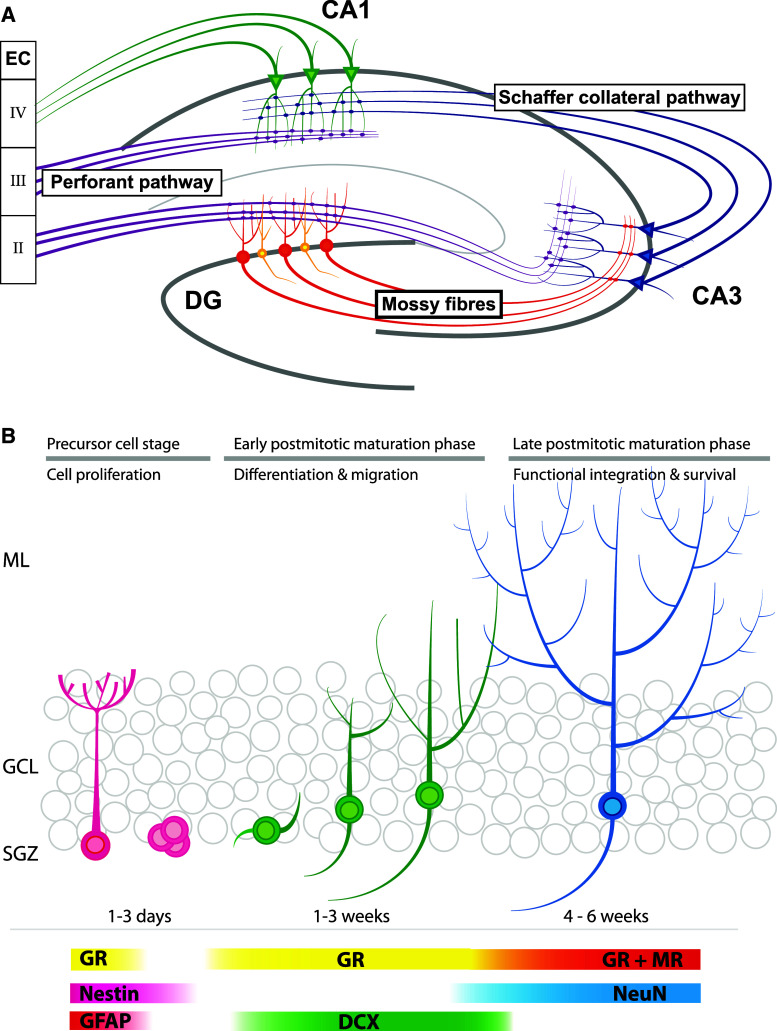
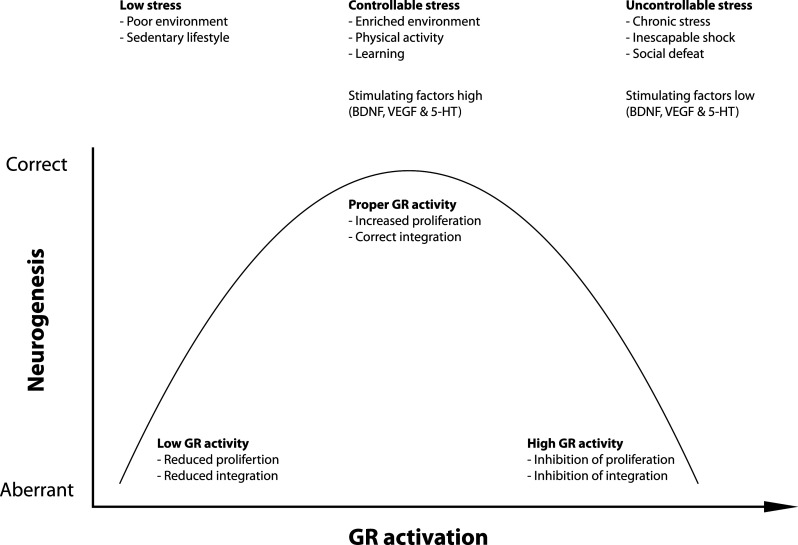
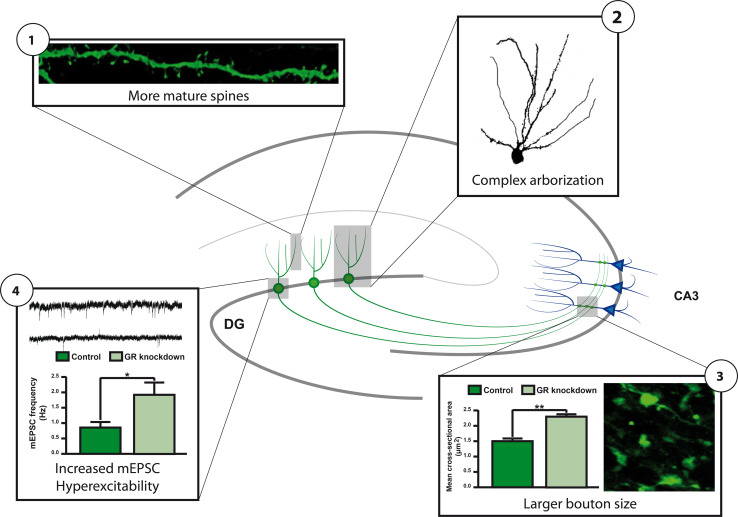
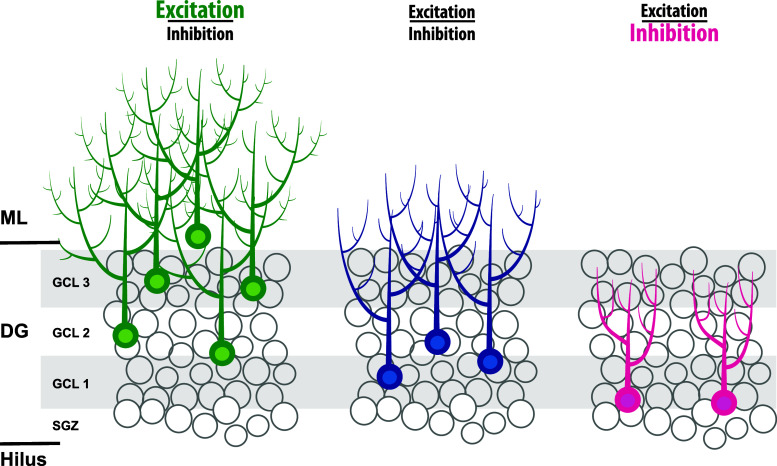
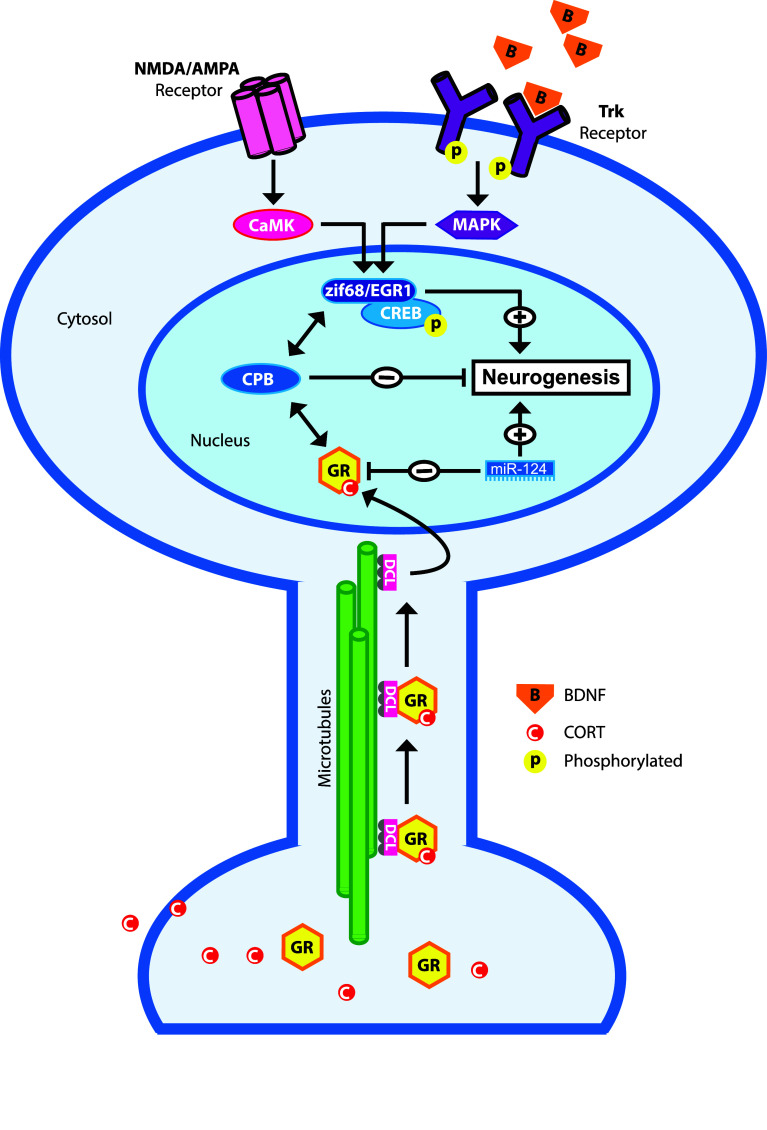
Adult neurogenesis, the birth of new neurons in the mature brain, has attracted considerable attention in the last decade. One of the earliest identified and most profound factors that affect adult neurogenesis both positively and negatively is stress. Here, we review the complex interplay between stress and adult neurogenesis. In particular, we review the role of the glucocorticoid receptor, the main mediator of the stress response in the proliferation, differentiation, migration, and functional integration of newborn neurons in the hippocampus. We review a multitude of mechanisms regulating glucocorticoid receptor activity in relationship to adult neurogenesis. We postulate a novel concept in which the level of glucocorticoid receptor expression directly regulates the excitation-inhibition balance, which is key for proper neurogenesis. We furthermore argue that an excitation-inhibition dis-balance may underlie aberrant functional integration of newborn neurons that is associated with psychiatric and paroxysmal brain disorders.
Overview
The claims and statistics of this paper haven’t been checked yet.
Free: it reads the open-access text and checks the first 5 claims that cite a source we can check. Create a free account to check every claim.
Integrity signals
Registry
Cites
Statistics
Figures
Verification
Claims the paper makes
The claims and statistics of this paper haven’t been checked yet.
Free: it reads the open-access text and checks the first 5 claims that cite a source we can check. Create a free account to check every claim.
Claims other papers make about this one
Each is checked against this paper’s own text: does it say what the citing paper says it does?
In the citing paper
“Animal models have established that prolonged stress can lead to HPA axis hyperreactivity and depressive behaviors along with hippocampal and mPFC abnormalities (68,69).”
From The Impact of Stress and Major Depressive Disorder on Hippocampal and Medial Prefrontal Cortex Morphology (2019) · cites this paper as [69]
In the citing paper
“excessively high as well as blunted glucocorticoid receptor expression has been linked to reduced neurogenesis within the dentate gyrus (69).”
From The Impact of Stress and Major Depressive Disorder on Hippocampal and Medial Prefrontal Cortex Morphology (2019) · cites this paper as [69]
Self-check
Percentages, sums and reported differences re-computed from the paper’s own numbers.
The self-check needs the paper’s full text.
Citations
Cites
Items 201–206 of 206
Liu, J., Steiner, M., Dunlop, J. A., Keupp, H., Shu, D., Ou, Q., Han, J. W., Zhang, Z., & Zhang, X. (2011) · Nature · doi:10.1038/nature10268 · Cited by 25
Persistent hippocampal neurogenesis and epilepsy
Parent, J. M. (2008) · Epilepsia · doi:10.1111/j.1528-1167.2008.01631.x · Cited by 19
Glucocorticoid Hedgehog Agonists in Neurogenesis
Wang, J., Barak, L. S., Mook, R. A., & Chen, W. (2011) · Vitamins and hormones · doi:10.1016/b978-0-12-386015-6.00030-5 · Cited by 19
Bi-Parental Care Contributes to Sexually Dimorphic Neural Cell Genesis in the Adult Mammalian Brain
Mak, G. K., Antle, M. C., Dyck, R. H., & Weiss, S. (2013) · PLoS ONE · doi:10.1371/journal.pone.0062701 · Cited by 12
9 Neurogenesis in the Adult HippocampusPreprint
Kempermann, G., Song, H., & Gage, F. H. (2008) · Cold Spring Harbor Monograph Archive · doi:10.1101/087969784.52.159 · Cited by 10
TrkB Regulates Hippocampal Neurogenesis and Governs Sensitivity to Antidepressive Treatment
Li, Y., Luikart, B. W., Birnbaum, S. G., Chen, J., Kwon, C., Kernie, S. G., Bassel‐Duby, R., & Parada, L. F. (2008) · Neuron · doi:10.1016/j.neuron.2008.10.021 · Cited by 8
Cited by
Belleau, E. L., Treadway, M. T., & Pizzagalli, D. A. (2019) · Biological Psychiatry · doi:10.1016/j.biopsych.2018.09.031 · Cited by 550
“Specifically, excessively high, as well as blunted, glucocorticoid receptor expression has been linked to reduced neurogenesis within the dentate gyrus (69).”
Anxiety and hippocampal neuronal activity: Relationship and potential mechanisms
Ghasemi, M., Navidhamidi, M., Rezaei, F., Azizikia, A., & Mehranfard, N. (2021) · Cognitive Affective & Behavioral Neuroscience · doi:10.3758/s13415-021-00973-y · Cited by 193
“Stress hormone receptors are absent in neuronal progenitor cells (Saaltink & Vreugdenhil, 2014), but both mineralocorticoid receptor (MR) and glucocorticoid receptor (GR) are present on new neurons (Wong & Herbert, 2005) and may act in concert to indirectly mediate effects of stress on the…”
BackgroundInfluentialmiR-17-92 Cluster Regulates Adult Hippocampal Neurogenesis, Anxiety, and Depression
Jin, J., Kim, S.-N., Liu, X., Zhang, H., Zhang, C., Seo, J.-S., Kim, Y., & Sun, T. (2016) · Cell Reports · doi:10.1016/j.celrep.2016.06.101 · Cited by 114
Liu, R. T. (2015) · Journal of Abnormal Psychology · doi:10.1037/abn0000043 · Cited by 113
Proteomic Profiling Reveals Microbiota-Driven Sensing Mechanisms of Gut-Brain Axis in Depression
Liu, Y., Luo, Y., Zeng, B., Gui, S., Zheng, P., Zheng, P., Pu, J., Wang, H., Wu, Y., Zhou, C., et al. (2018) · Translational Psychiatry · doi:10.1038/s41398-021-01689-w · Cited by 120
“Many studies have reported that depression is highly correlated with the activity of inflammatory signals [3, 4], alterations in neurotrophic signals [5], deficits in brain reward processing [6, 7], abnormal activity of the hypothalamic–pituitary–adrenal axis [8], changes in DNA methylation [9], and DNA damage [10].”
Background
Metadata
- Authors
- Saaltink, D.-J., & Vreugdenhil, E.
- Affiliations
- Leiden University Medical Center (NL)
- Corresponding author
- Vreugdenhil, Erno
- ORCID
- Vreugdenhil, Erno
- Venue
- Cellular and Molecular Life Sciences
- Published
- 2014-02-13
- Volume
- 71
- Issue
- 13
- Pages
- 2499-2515
- ISSN
- 1420-682X (ISSN-L)
- 1420-9071
- PMC
- PMC4055840
- OpenAlex
- W1973722262
- Cited by
- 127
- References
- 205
- Citations by year
- 2026: 2 · 2025: 9 · 2024: 12 · 2023: 14 · 2022: 9 · 2021: 12 · 2020: 12 · 2019: 10 · 2018: 4 · 2017: 12 · 2016: 16 · 2015: 10 · 2014: 5
- FWCI
- 1.49
- Type
- journal article
- Language
- en
- Open access
- hybrid
- doi.org
- Locations
- Cellular and Molecular Life Sciences (publishedVersion, cc-by)
- PubMed Central (publishedVersion, cc-by)
- PubMed (publishedVersion)
- Data Archiving and Networked Services (DANS) (submittedVersion)
- Leiden Repository (Leiden University) (submittedVersion)
- Funders
- Ministerie van Economische Zaken
- Topics
- Life Sciences › Neuroscience › Developmental Neuroscience › Neurogenesis and neuroplasticity mechanisms
- Life Sciences › Neuroscience › Behavioral Neuroscience › Stress Responses and Cortisol
- Life Sciences › Neuroscience › Cellular and Molecular Neuroscience › Neuroscience and Neuropharmacology Research
- Keywords
- adult neurogenesis, stress, glucocorticoid receptor, excitation-inhibition balance, hippocampus, neuronal migration, stress response, mental illness
- MeSH terms
- Mental Disorders, Cell Differentiation, Glucocorticoids, Hippocampus, Neurons, Stress, Physiological, Signal Transduction, Neurogenesis
About these checks
Registry, retraction, Cites and statistics results are computed, not judged, with one exception: a printed reference that no index lists is read once by a model before it counts as a citation error. Claims are extracted by a model and kept only when their quote appears verbatim in the text; each cited source is then checked, with a model’s help, for whether it says what the claim relies on. Those verdicts can be wrong — read the claim’s quote and the cited source before relying on one.
Statistics and arithmetic are recomputed, not judged.
Confidence bands are shown only for fields calibrated on our annotated test set. None is calibrated yet, so no band is shown.
What counts as a claim ›How we measure confidence ›How we check this ›
Are you an author, or do you see a problem with this page? Request a review
Data sources
Bibliographic data: Semantic Scholar, OpenAlex, Crossref.
Contains information from the Semantic Scholar Academic Graph Datasets, made available under the ODC Attribution License (ODC-BY 1.0).
Semantic Scholar’s data is described in: Kinney, R., et al. (2023). The Semantic Scholar Open Data Platform. arXiv:2301.10140.
