

The DOI matches its Crossref record; 60 of the 60 references it cites were found in a registry or an index.
Emergence and evolution of the renin-angiotensin-aldosterone system
Open accessAbstract
The renin-angiotensin-aldosterone system (RAAS) is not the sole, but perhaps the most important volume regulator in vertebrates. To gain insights into the function and evolution of its components, we conducted a phylogenetic analysis of its main related genes. We found that important parts of the system began to appear with primitive chordates and tunicates and that all major components were present at the divergence of bony fish, with the exception of the Mas receptor. The Mas receptor first appears after the bony-fish/tetrapod divergence. This phase of evolutionary innovation happened about 400 million years ago. We found solid evidence that angiotensinogen made its appearance in cartilage fish. The presence of several RAAS genes in organisms that lack all the components shows that these genes have had other ancestral functions outside of their current role. Our analysis underscores the utility of sequence comparisons in the study of evolution. Such analyses may provide new hypotheses as to how and why in today's population an increased activity of the RAAS frequently leads to faulty salt and volume regulation, hypertension, and cardiovascular diseases, opening up new and clinically important research areas for evolutionary medicine.
Overview
The claims and statistics of this paper haven’t been checked yet.
Run the check — free, no account needed. It reads the open-access text and checks the sources it cites.
Integrity signals
Registry
Cites
Statistics
Figures
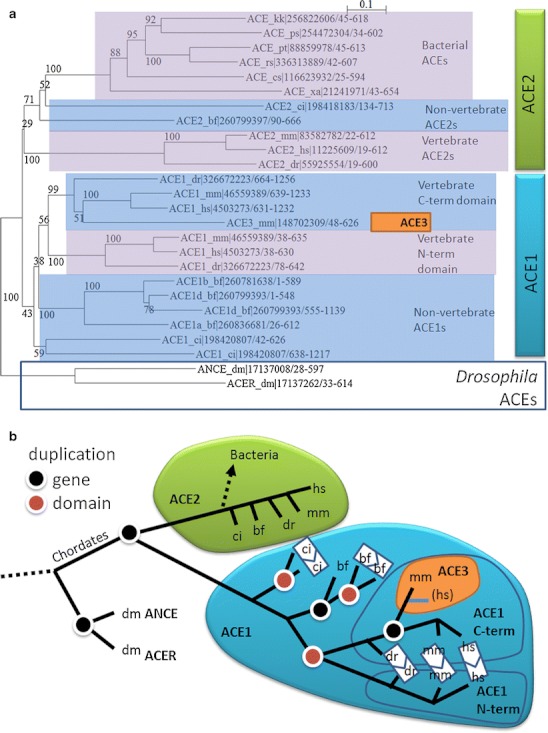
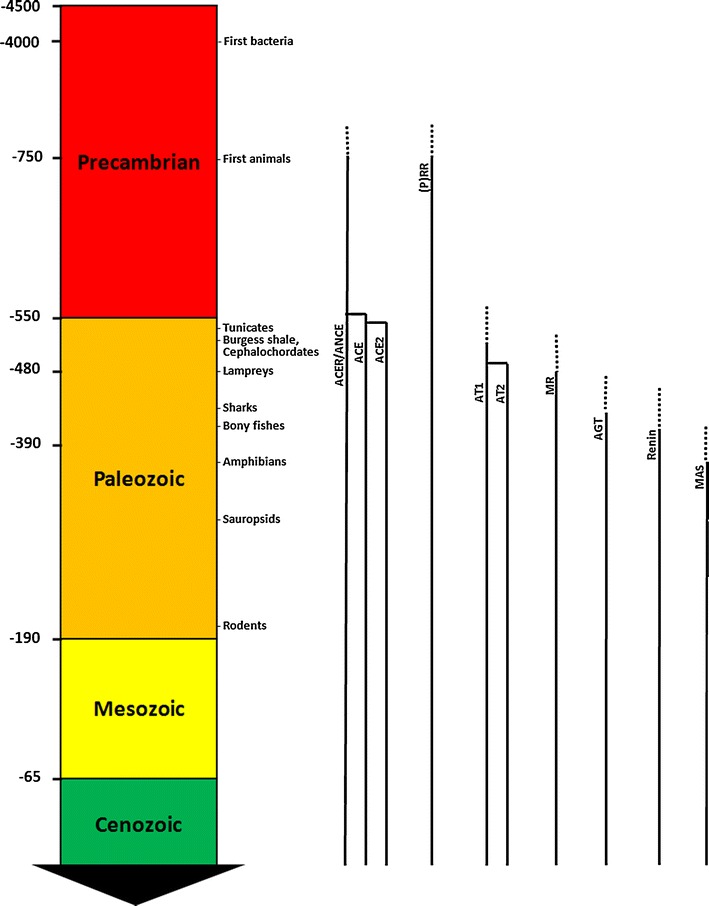
Verification
Claims the paper makes
The claims and statistics of this paper haven’t been checked yet.
Run the check — free, no account needed. It reads the open-access text and checks the sources it cites.
Claims other papers make about this one
Each is checked against this paper’s own text: does it say what the citing paper says it does?
In the citing paper
“Because BIO101 does not interfere with AT1R like TRV-027, our positive results in COVID-19 perhaps suggest a particular importance of MasR activation in the regulation of respiratory function.28”
In the citing paper
“Our results, and those of other clinical studies, suggests that the role of the RAS in COVID-19 pathophysiology may be more complex than previously thought.9,28”
In the citing paper
“These contrasting results between the effect of BIO101 and of these other compounds may be explained by the complexity of the RAS composed of many proteases, receptors and peptidic ligands with often opposing effects.28”
Self-check
Percentages, sums and reported differences re-computed from the paper’s own numbers.
The self-check needs the paper’s full text.
Citations
Cites
Gapped BLAST and PSI-BLAST: a new generation of protein database search programs
Altschul, S. (1997) · Nucleic Acids Research · doi:10.1093/nar/25.17.3389 · Cited by 73,302
MUSCLE: multiple sequence alignment with high accuracy and high throughput
Edgar, R. C. (2004) · Nucleic Acids Research · doi:10.1093/nar/gkh340 · Cited by 44,662
Clustal W and Clustal X version 2.0
Larkin, M., Blackshields, G., Brown, N. P., Chenna, R., McGettigan, P., McWilliam, H., Valentin, F., Wallace, I. M., Wilm, A., López, R., et al. (2007) · Bioinformatics · doi:10.1093/bioinformatics/btm404 · Cited by 28,598
Global burden of hypertension: analysis of worldwide data
Kearney, P. M., Whelton, M., Reynolds, K., Muntner, P., Whelton, P. K., & He, J. (2005) · The Lancet · doi:10.1016/s0140-6736(05)17741-1 · Cited by 8,698
Handbook of Proteolytic Enzymes
(2004) · Elsevier eBooks · doi:10.1016/c2009-0-03628-9 · Cited by 2,623
Stratigraphic placement and age of modern humans from Kibish, Ethiopia
McDougall, I., Brown, F. H., & Fleagle, J. G. (2005) · Nature · doi:10.1038/nature03258 · Cited by 1,023
Fulminant hypertension in transgenic rats harbouring the mouse Ren-2 gene
Mullins, J. J., Peters, J., & Ganten, D. (1990) · Nature · doi:10.1038/344541a0 · Cited by 919
Self-citationThe serpin superfamily of proteinase inhibitors: structure, function, and regulation.
Potempa, J., Korzus, E., & Travis, J. W. (1994) · Journal of Biological Chemistry · doi:10.1016/s0021-9258(17)33954-6 · Cited by 881
The Dawn of Darwinian Medicine
Williams, G. C., & Nesse, R. M. (1991) · The Quarterly Review of Biology · doi:10.1086/417048 · Cited by 739
NCBI Reference Sequences: current status, policy and new initiatives
Pruitt, K. D., Tatusova, T., Klimke, W., & Maglott, D. R. (2009) · Nucleic Acids Research · doi:10.1093/nar/gkn721 · Cited by 736 · cited 1×
“To complement the available physiological evidence on the evolution of the RAAS, we used the information available from the gene and protein sequences in public databases [20].”
Method
Cited by
Sorted by citations
Items 101–165 of 165
Class A Orphans in GtoPdb v.2023.1
Alexander, S. P. H., Battey, J., Benson, H. E., Benya, R. V., Bonner, T. I., Davenport, A. P., Singh, K. D., Eguchi, S., Harmar, A. J., Holliday, N. D., et al. (2023) · IUPHAR/BPS Guide to Pharmacology CITE · doi:10.2218/gtopdb/f16/2023.1 · Cited by 6
Why is chronic kidney disease progressive? Evolutionary adaptations and maladaptations
Chevalier, R. L. (2023) · American Journal of Physiology-Renal Physiology · doi:10.1152/ajprenal.00134.2023 · Cited by 7
General lysosomal hydrolysis can process prorenin accurately
Xa, L. K., Lacombe, M., Mercure, C., Lazure, C., & Reudelhuber, T. L. (2014) · American Journal of Physiology-Regulatory, Integrative and Comparative Physiology · doi:10.1152/ajpregu.00467.2013 · Cited by 6
Luft, F. C. (2014) · Journal of Molecular Medicine · doi:10.1007/s00109-014-1172-z · Cited by 6
Self-citationVecchie’, D., Wolter, J. M., Perry, J., Jumbo-Lucioni, P., & Luca, M. D. (2024) · International Journal of Molecular Sciences · doi:10.3390/ijms251810103 · Cited by 5
Zima, V., Šebková, K., Šimečková, K., Dvořák, T., Saudek, V., & Kostrouchová, M. (2015) · Folia Biologica · doi:10.14712/fb2015061050168 · Cited by 5
Ontogeny of renin gene expression in the chicken, Gallus gallus
Hoy, J., Nishimura, H., Mehalic, T. C., Yaoita, E., Gómez, R. A., Paxton, R. L., & Sequeira-Lόpez, M. L. S. (2020) · General and Comparative Endocrinology · doi:10.1016/j.ygcen.2020.113533 · Cited by 5
Immunohistochemical localization of renin-containing cells in two elasmobranch species
Lacy, E. R., Reale, E., & Luciano, L. (2016) · Fish Physiology and Biochemistry · doi:10.1007/s10695-015-0191-1 · Cited by 4
Duressa, T. F., Boonen, K., & Huybrechts, R. (2016) · General and Comparative Endocrinology · doi:10.1016/j.ygcen.2016.06.024 · Cited by 4
mRNA Metabolism and Hypertension
Zappa, M., Verdecchia, P., Spanevello, A., Golino, M., & Angeli, F. (2023) · Biomedicines · doi:10.3390/biomedicines11010118 · Cited by 5
Volpe, M., Battistoni, A., & Mancia, G. (2016) · Circulation Research · doi:10.1161/circresaha.116.309855 · Cited by 4
Postlethwait, J. H., Farnsworth, D. R., & Miller, A. C. (2020) · bioRxiv (Cold Spring Harbor Laboratory) · doi:10.1101/2020.09.01.278366 · Cited by 4
The Influence of Celery (Apium graveolens) Juice on Hypertension
Illes, J. D., & Rodrigues, J. (2023) · Reference series in phytochemistry · doi:10.1007/978-3-031-04195-2_72-1 · Cited by 3
Wong, M. K. (2021) · Elsevier eBooks · doi:10.1016/b978-0-12-820649-2.00124-8 · Cited by 3
Amorim, M. J. B., Gomes, S. I. L., Bicho, R. C., & Scott-Fordsmand, J. J. (2022) · Journal of Hazardous Materials · doi:10.1016/j.jhazmat.2022.129173 · Cited by 3
Welcome, M. O. (2018) · Springer eBooks · doi:10.1007/978-3-319-91056-7_11 · Cited by 3
Outside and inside angiotensin
Luft, F. C. (2013) · Journal of the American Society of Hypertension · doi:10.1016/j.jash.2013.02.004 · Cited by 3
Self-citationRobey, R. B., & Crane‐Godreau, M. A. (2013) · American Journal of Physiology-Cell Physiology · doi:10.1152/ajpcell.00090.2013 · Cited by 3
Cordero, A., Rodríguez‐Mañero, M., Alegría, E., & Brugada, P. (2013) · International Journal of Cardiology · doi:10.1016/j.ijcard.2013.04.203 · Cited by 2
EVIDENCE OF A FUNCTIONAL RENIN-ANGIOTENSIN SYSTEM IN THE CHANNEL CATFISH (ICTALURUS PUNCTATUS)
Hunt, J. C., Davis, K. A., & Sanderford, M. G. (2018) · Texas Journal of Science · doi:10.32011/txjsci_70_1_article2 · Cited by 2
The vasopressor action of angiotensin II (ANG II) in ball pythons (Python regius)
Hansen, L. M. B., & Wang, T. (2020) · Comparative Biochemistry and Physiology Part A Molecular & Integrative Physiology · doi:10.1016/j.cbpa.2020.110839 · Cited by 2
Cocciolillo, S., Sebastiani, G., Blostein, M. D., & Pantopoulos, K. (2019) · Elsevier eBooks · doi:10.1016/b978-0-12-813814-4.00018-3 · Cited by 2
Predictive Models of within- and between-Species SARS-CoV-2 Transmissibility
Soares, R., Vieira, C. P., & Vieira, J. (2022) · Viruses · doi:10.3390/v14071565 · Cited by 2
Proteomic Analysis of Human Macrophages Overexpressing Angiotensin-Converting Enzyme
Oosthuizen, D., Ganief, T. A., Bernstein, K. E., & Sturrock, E. D. (2024) · International Journal of Molecular Sciences · doi:10.3390/ijms25137055 · Cited by 2
Control of fluid intake in dehydrated rats and evolution of sodium appetite
Junior, L. A. D. L., Laurin, M., & Menani, J. V. (2024) · Physiology & Behavior · doi:10.1016/j.physbeh.2024.114642 · Cited by 2
Innis, C. J., Graham, K. M., Perrault, J. R., Harms, C. A., Christiansen, E. F., Dodge, K. L., & Burgess, E. A. (2024) · Conservation Physiology · doi:10.1093/conphys/coae083 · Cited by 2
Class A Orphans in GtoPdb v.2021.3
Alexander, S. P. H., Battey, J., Benson, H. E., Benya, R. V., Bonner, T. I., Davenport, A. P., Singh, K. D., Eguchi, S., Harmar, A. J., Holliday, N. D., et al. (2021) · IUPHAR/BPS Guide to Pharmacology CITE · doi:10.2218/gtopdb/f16/2021.3 · Cited by 2
A New Intelligent Biologically-Inspired Model for Fault Tolerance in Distributed Embedded Systems
Mehalaine, R., & Boutekkouk, F. (2020) · International Journal of Embedded and Real-Time Communication Systems · doi:10.4018/ijertcs.2020070102 · Cited by 2
Gregory, A. T., Pepe, S., & Denniss, A. R. (2020) · Heart Lung and Circulation · doi:10.1016/j.hlc.2020.10.008 · Cited by 2
Epithelial Sodium Channels (ENaC)
Song, C. E., Ma, H., & Eaton, D. C. (2020) · Physiology in health and disease · doi:10.1007/978-3-030-55454-5_18 · Cited by 2
Cardiac interoception impacts behavior and brain-wide neuronal dynamicsPreprint
Herrera, K. J., Zarghani-Shiraz, A., Ahrens, M. B., Engert, F., & Fishman, M. C. (2025) · bioRxiv (Cold Spring Harbor Laboratory) · doi:10.1101/2025.04.25.650721 · Cited by 2
Innis, C. J., Graham, K. M., Mott, C. R., Hart, K. M., Roche, D., Cherkiss, M. S., & Burgess, E. A. (2025) · Animals · doi:10.3390/ani15040600 · Cited by 1
Maamor, N. H., Cengnata, A., Pan, Y., Ismail, J. R., Malek, K. A., Williams, G. H., Yusoff, K., & Hoh, B. (2026) · PLoS ONE · doi:10.1371/journal.pone.0346614 · Cited by 1
A unique juxtaglomerular apparatus in the river ray, Potamotrygon humerosa, a freshwater stingray
Lacy, E. R., & Reale, E. (2017) · Zoomorphology · doi:10.1007/s00435-017-0372-9 · Cited by 1
Stanley, J. C. (2022) · Journal of Vascular Surgery · doi:10.1016/j.jvs.2022.02.033 · Cited by 1
Class A Orphans in GtoPdb v.2022.3
Alexander, S. P. H., Battey, J., Benson, H. E., Benya, R. V., Bonner, T. I., Davenport, A. P., Singh, K. D., Eguchi, S., Harmar, A. J., Holliday, N. D., et al. (2022) · IUPHAR/BPS Guide to Pharmacology CITE · doi:10.2218/gtopdb/f16/2022.3 · Cited by 1
Understanding Heart Failure: Evolution of Concepts and Treatments
Šmalcelj, A. (2024) · Cardiologia Croatica · doi:10.15836/ccar2024.251 · Cited by 1
The Influence of Celery (Apium graveolens) Juice on Hypertension
Illes, J. D., & Rodrigues, J. (2024) · Reference series in phytochemistry · doi:10.1007/978-3-031-38663-3_72 · Cited by 1
Nagy, V. (2020) · Cardiologia Hungarica · doi:10.26430/chungarica.2020.50.2.93 · Cited by 1
Class A Orphans (version 2019.4) in the IUPHAR/BPS Guide to Pharmacology Database
Alexander, S. P. H., Battey, J., Benson, H. E., Benya, R. V., Bonner, T. I., Davenport, A. P., Eguchi, S., Harmar, A. J., Holliday, N. D., Jensen, R. T., et al. (2019) · IUPHAR/BPS Guide to Pharmacology CITE · doi:10.2218/gtopdb/f16/2019.4 · Cited by 1
The effect of starting a meal with salt and date palm on taste impairment caused by COVID-19
Altun, Y., & Bülbüloğlu, S. (2022) · Ideggyógyászati Szemle · doi:10.18071/isz.75.0007 · Cited by 1
Aldosterone and Cardiovascular Diseases
Tomaschitz, A., & Pilz, S. (2014) · Springer eBooks · doi:10.1007/978-1-4939-0509-6_12
Nitric Oxide Can Directly Mediate Renin Cell Recruitment
Persson, P. B. (2013) · Hypertension · doi:10.1161/hypertensionaha.111.00483
Upregulation of Renin Angiotensin Aldosterone System (RAAS) by Methylglyoxal: Role in Hypertension
Dhar, I. (2013) · University Library - University of Saskatchewan (University of Saskatchewan)
Epithelial Sodium Channels (ENaCs)
Tai, T. L., Ma, H., & Eaton, D. C. (2015) · Springer eBooks · doi:10.1007/978-1-4939-3366-2_18
Villela, D. C. (2015) · Elsevier eBooks · doi:10.1016/b978-0-12-801364-9.00024-9
Metabolic Abnormalities in Heart Failure Patients Treated with Ultrafiltration Versus Diuretics
Koratala, A. (2018) · European Journal of Heart Failure · doi:10.1002/ejhf.1207
Rateesh, S., Pender, P., & Otton, J. M. (2021) · Springer eBooks · doi:10.1007/978-3-030-54779-0_25
Widatama, D. A., & Retnoaji, B. (2021) · IOP Conference Series Earth and Environmental Science · doi:10.1088/1755-1315/755/1/012012
Hunter, J., Bura, P., King, R., & Thomson, G. (2022) · Medical Principles and Practice · doi:10.1159/000525550
Transgenic animal models for the functional analysis of ACE2
Alenina, N. V., & Bäder, M. (2023) · Elsevier eBooks · doi:10.1016/b978-0-323-99618-1.00023-4
Cardiovascular Response to Exercise in Vertebrates: A ReviewPreprint
López-Román, A., Jiménez-Herranz, E., Calderón‐Montero, F. J., Ramos-Álvarez, J. J., & Lucas, R. G. (2023) · Preprints.org · doi:10.20944/preprints202307.0500.v1
Ghalayini, J., Lee, S. H., Gluscencova, O. B., Iliadi, K. G., & Boulianne, G. L. (2023) · bioRxiv (Cold Spring Harbor Laboratory) · doi:10.1101/2023.12.21.572837
Cardiovascular Response to Exercise in Vertebrates: UpdatePreprint
López-Román, A., Lucas, R. G., Jiménez-Herranz, E., Calderón‐Montero, F. J., & Ramos-Álvarez, J. J. (2024) · Preprints.org · doi:10.20944/preprints202307.0500.v2
The Importance of Plasma Renin Concentration in Intensive Care Patients with Circulatory ShockPreprint
Turan, Y. B., & Karakurt, S. (2024) · Research Square · doi:10.21203/rs.3.rs-3962245/v1
Angiotensinogen: in-silico insight to mutations, protein-protein interactions and evolution
Hussain, M., & Nishat, S. (2023) · ROMANIAN BIOTECHNOLOGICAL LETTERS · doi:10.25083/rbl/28.3/3990.3997
Duarte, D. Â. (2018) · Digital Library of Theses and Dissertations (Universidade de São Paulo) · doi:10.11606/t.17.2018.tde-04072024-141449
Role of ACE Inhibitors in Transforming Renin–Angiotensin System
Nandave, M. (2024) · Springer eBooks · doi:10.1007/978-981-97-7380-0_4
Davis, K. A., & Sanderford, M. G. (2025) · Journal of Fish Biology · doi:10.1111/jfb.70229
Évolution des récepteurs AT1 et AT2 de l’angiotensine II : Spécificité des récepteurs d’amniotes
Tiss, A. (2021) · theses.fr (ABES) · doi:10.70675/ca815b7ezb399z4a3dz96d6z08fc448533df
The Importance of Plasma Renin Concentrations in Intensive Care Patients with Circulatory Shock
Turan, Y. B., & Karakurt, S. (2026) · Journal of Clinical Medicine · doi:10.3390/jcm15093184
Cirillo, M., Zoccali, C., Garofalo, C., Borrelli, S., Ruotolo, C., Marzano, F., Minutolo, R., Nicola, L. D., & Conte, G. (2026) · Clinical Kidney Journal · doi:10.1093/ckj/sfag151
Kawagishi, H., Nakajima, T., Kashihara, T., Matsuoka, D., Matsushita, K., Nakada, T., Numaga‐Tomita, T., Morimoto, S., Kanda, Y., Minamino, N., et al. (2026) · Biomedicine & Pharmacotherapy · doi:10.1016/j.biopha.2026.119561
Urotensin II: A Key Role in Hormonal and Inflammatory Cytokine Regulation in COVID‐19 Patients
Maulud, S. Q. (2026) · International Journal of Microbiology · doi:10.1155/ijm/6760898
Metadata
- Authors
- Fournier, D., Luft, F. C., Bader, M., Ganten, D., & Andrade-Navarro, M. A.
- Affiliations
- Max Delbrück Center (DE)
- Charité – Universitätsmedizin Berlin (DE)
- Corresponding author
- Andrade-Navarro, Miguel A.
- Venue
- Journal of Molecular Medicine
- Published
- 2012-04-14
- Volume
- 90
- Issue
- 5
- Pages
- 495-508
- ISSN
- 0946-2716 (ISSN-L)
- 1432-1440
- PMC
- PMC3354321
- OpenAlex
- W2086052108
- Cited by
- 165
- References
- 60
- Citations by year
- 2026: 6 · 2025: 3 · 2024: 12 · 2023: 11 · 2022: 15 · 2021: 18 · 2020: 23 · 2019: 12 · 2018: 15 · 2017: 4 · 2016: 11 · 2015: 9 · 2014: 12 · 2013: 12 · 2012: 2
- FWCI
- 1.89
- Type
- journal article
- Language
- en
- Open access
- hybrid
- doi.org
- Licence
- cc-by
- Locations
- Journal of Molecular Medicine (publishedVersion, cc-by)
- PubMed Central (publishedVersion, cc-by)
- PubMed (publishedVersion)
- MDC Repository (Max-Delbrueck-Center for Molecular Medicine) (acceptedVersion)
- Topics
- Health Sciences › Medicine › Cardiology and Cardiovascular Medicine › Renin-Angiotensin System Studies
- Health Sciences › Medicine › Endocrinology, Diabetes and Metabolism › Hormonal Regulation and Hypertension
- Life Sciences › Biochemistry, Genetics and Molecular Biology › Molecular Biology › Genomics and Phylogenetic Studies
- Keywords
- renin-angiotensin-aldosterone system, phylogenetic analysis, angiotensinogen, Mas receptor, angiotensin II receptor, volume regulation, water-salt balance, Chordata, tunicates, Chondrichthyes, bony fishes, tetrapods, evolutionary innovation, hypertension, cardiovascular disease, evolutionary medicine
- MeSH terms
- Animals, Humans, Phylogeny, Renin-Angiotensin System, Time Factors, Sequence Homology, Amino Acid, Sequence Analysis, DNA, Evolution, Molecular
About these checks
Registry, retraction, Cites and statistics results are computed, not judged, with one exception: a printed reference that no index lists is read once by a model before it counts as a citation error. Claims are extracted by a model and kept only when their quote appears verbatim in the text; each cited source is then checked, with a model’s help, for whether it says what the claim relies on. Those verdicts can be wrong — read the claim’s quote and the cited source before relying on one.
Statistics and arithmetic are recomputed, not judged.
Confidence bands are shown only for fields calibrated on our annotated test set. None is calibrated yet, so no band is shown.
What counts as a claim ›How we measure confidence ›How we check this ›
Are you an author, or do you see a problem with this page? Request a review
