

A reaction norm model for genomic selection using high-dimensional genomic and environmental data
Open accessThe DOI matches its Crossref record; 52 of the 53 references it cites were found in a registry or an index.
Abstract
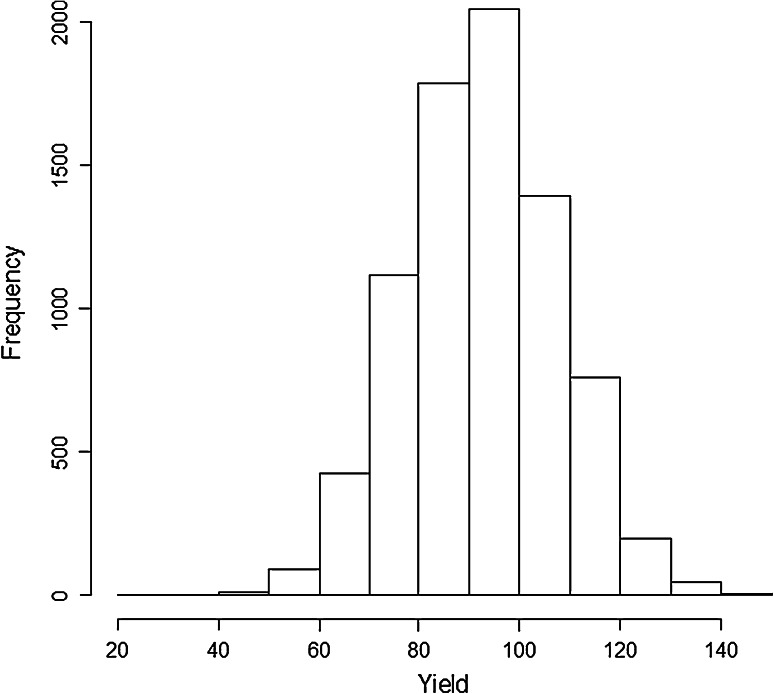
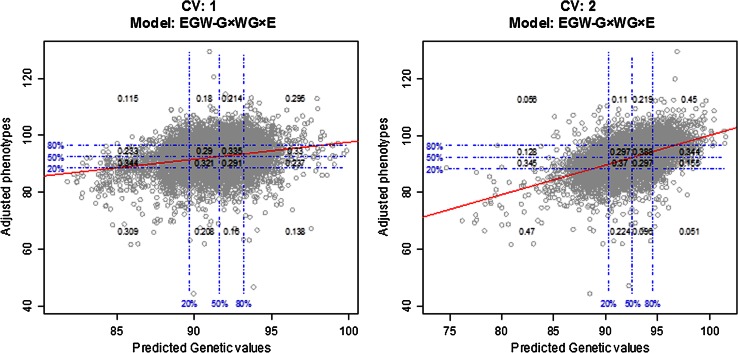
New methods that incorporate the main and interaction effects of high-dimensional markers and of high-dimensional environmental covariates gave increased prediction accuracy of grain yield in wheat across and within environments. In most agricultural crops the effects of genes on traits are modulated by environmental conditions, leading to genetic by environmental interaction (G × E). Modern genotyping technologies allow characterizing genomes in great detail and modern information systems can generate large volumes of environmental data. In principle, G × E can be accounted for using interactions between markers and environmental covariates (ECs). However, when genotypic and environmental information is high dimensional, modeling all possible interactions explicitly becomes infeasible. In this article we show how to model interactions between high-dimensional sets of markers and ECs using covariance functions. The model presented here consists of (random) reaction norm where the genetic and environmental gradients are described as linear functions of markers and of ECs, respectively. We assessed the proposed method using data from Arvalis, consisting of 139 wheat lines genotyped with 2,395 SNPs and evaluated for grain yield over 8 years and various locations within northern France. A total of 68 ECs, defined based on five phases of the phenology of the crop, were used in the analysis. Interaction terms accounted for a sizable proportion (16 %) of the within-environment yield variance, and the prediction accuracy of models including interaction terms was substantially higher (17-34 %) than that of models based on main effects only. Breeding for target environmental conditions has become a central priority of most breeding programs. Methods, like the one presented here, that can capitalize upon the wealth of genomic and environmental information available, will become increasingly important.
Overview
The claims and statistics of this paper haven’t been checked yet.
Free: it reads the open-access text and checks the first 5 claims that cite a source we can check. Create a free account to check every claim.
Integrity signals
Registry
Cites
Statistics
Figures
Verification
Claims the paper makes
The claims and statistics of this paper haven’t been checked yet.
Free: it reads the open-access text and checks the first 5 claims that cite a source we can check. Create a free account to check every claim.
Claims other papers make about this one
Each is checked against this paper’s own text: does it say what the citing paper says it does?
The source backs part of the claim, not all of it — or backs it for a different population, condition or comparison.
In the citing paper
“A further limitation of the approach proposed in Jarquín et al. (2014) is that it does not allow for the modelling of complex variance structures including heterogeneous residual variation, spatial field trend and blocking terms, unless a two-stage approach is implemented.”
From Incorporating environmental covariates to explore genotype × environment × management (G × E × M) interactions: A one-stage predictive model (2023) · cites this paper as Jarquín et al., 2014
Experimental — accuracy not yet measuredThe source backs part of the claim, not all of it — or backs it for a different population, condition or comparison.
In the citing paper
“This study on hybrid wheat showed that hybrid prediction accuracy increases when environmental covariables are incorporated, and when additive × environmental covariables and dominance × environmental covariables are included in the GBLUP reaction-norm model (Jarquin et al. 2014).”
From Nonlinear kernels, dominance, and envirotyping data increase the accuracy of genome-based prediction in multi-environment trials (2021) · cites this paper as Jarquin et al. 2014
Experimental — accuracy not yet measuredThe source backs part of the claim, not all of it — or backs it for a different population, condition or comparison.
In the citing paper
“Since the first report of a genomic-enabled prediction considering the reaction norm, as proposed by Jarquín et al. (2014), the environmental relationship kernel (KW) was modeled by the benchmark GBLUP approach.”
From Nonlinear kernels, dominance, and envirotyping data increase the accuracy of genome-based prediction in multi-environment trials (2021) · cites this paper as Jarquín et al. (2014)
Experimental — accuracy not yet measuredThe cited source says what the claim attributes to it.
In the citing paper
“The most recently developed methods that incorporate ECs to explain G × E interactions (see for example Boer et al., 2007;Jarquín et al., 2014;Hadasch et al., 2020) all assume a linear or quadratic trait response to an EC.”
From Incorporating environmental covariates to explore genotype × environment × management (G × E × M) interactions: A one-stage predictive model (2023) · cites this paper as Jarquín et al., 2014
The cited source says what the claim attributes to it.
In the citing paper
“Cuevas et al. (2016, 2018) and Souza et al. (2017) showed that using the GK within the multi-environment genomic GE model of Jarquín et al. (2014) led to higher prediction accuracy than the same method with the linear kernel GB.”
From Nonlinear kernels, dominance, and envirotyping data increase the accuracy of genome-based prediction in multi-environment trials (2021) · cites this paper as Jarquín et al. 2014
3 more claims about this paper
Create a free account to see every claim other papers make about this one.
Self-check
Percentages, sums and reported differences re-computed from the paper’s own numbers.
The self-check needs the paper’s full text.
Citations
Cites
R: A Language and Environment for Statistical Computing
R Core Team (2025) · doi:10.32614/r.manuals · Cited by 352,181
Introduction to Quantitative Genetics.
Edwards, A. W. F., & Falconer, D. S. (1982) · Biometrics · doi:10.2307/2529912 · Cited by 21,447
Prediction of Total Genetic Value Using Genome-Wide Dense Marker Maps
Meuwissen, T. H. E., Hayes, B. J., & Goddard, M. E. (2001) · Genetics · doi:10.1093/genetics/157.4.1819 · Cited by 7,917
Efficient Methods to Compute Genomic Predictions
VanRaden, P. M. (2008) · Journal of Dairy Science · doi:10.3168/jds.2007-0980 · Cited by 6,050 · cited 1×
“Following the standard assumptions of the Ridge-Regression-BLUP model (Habier et al. 2007; VanRaden 2008), we regarded marker effects as IID draws from normal distributions of the form bm IID∼ N ( 0, σ 2b ), m = 1,…,p.”
MethodIntroduction to quantitative genetics. 1. ed.
Falconer, D. (1984) · Cited by 1,454
Introduction to quantitative genetics (4th edn)
Frankham, R. (1996) · Trends in Genetics · doi:10.1016/0168-9525(96)81458-2 · Cited by 1,449
The Impact of Genetic Relationship Information on Genome-Assisted Breeding Values
Habier, D., Fernando, R. L., & Dekkers, J. C. M. (2007) · Genetics · doi:10.1534/genetics.107.081190 · Cited by 1,320 · cited 1×
“Following the standard assumptions of the Ridge-Regression-BLUP model (Habier et al. 2007; VanRaden 2008), we regarded marker effects as IID draws from normal distributions of the form bm IID∼ N ( 0, σ 2b ), m = 1,…,p.”
MethodThe analysis of groups of experiments
Yates, F., & Cochran, W. G. (1938) · The Journal of Agricultural Science · doi:10.1017/s0021859600050978 · Cited by 900 · cited 1×
“Yates and Cochran (1938) proposed using a multiplicative operator consisting of a simple regression of a line’s performance on the environmental mean (jointregression analysis).”
BackgroundBreeding for Quantitative Traits in Plants
Udall, J. A. (2003) · Crop Science · doi:10.2135/cropsci2003.1578 · Cited by 884 · cited 1×
“However, with variable selection procedures important volumes of information can be lost in the process of selecting markers (Bernardo 2010; Crossa 2012) or ECs, with the undesirable result that large proportions of genetic or environmental signals may be unaccounted for.”
BackgroundModel Selection and Validation for Yield Trials with Interaction
Gauch, H. G. (1988) · Biometrics · doi:10.2307/2531585 · Cited by 882 · cited 1×
“Years later, other multiplicative operators based on singular value decomposition were proposed and used by Gollob (1968), Mandel (1969), Gauch (1988), Cornelius et al. (1996) and Crossa and Cornelius (1997).”
Method
Cited by
Items 601–700 of 772
Morales, L., & Swarts, K. (2022) · Forests · doi:10.3390/f13050809
Genome wide selection optimization in maize breeding
Bernardeli, A. (2023) · doi:10.47328/ufvbbt.2023.173
Liu, X., Wang, M., Qin, J., Liu, Y., Zhong, J., & Wang, J. (2023) · bioRxiv (Cold Spring Harbor Laboratory) · doi:10.1101/2023.05.17.541129
Evangelista, J. S. P. C. (2023) · doi:10.47328/ufvbbt.2023.482
Minaka, N., Iwata, H., Date, Y., Cao, W., Habaragamuwa, H., Katsuragi, T., Kobayashi, A., Yamanaka, T., & Sakurai, G. (2023) · Japanese Journal of Biometrics · doi:10.5691/jjb.44.55
Evaluation et mise en œuvre de la sélection phénomique pour la sélection du blé tendre
Robert, P. (2022) · theses.fr (ABES) · doi:10.70675/6a7c2431z1025z4efcz9c70z6a81d68146c5 · Cited by 1
Optimisation de la sélection de variétés de vigne à l'aide laprédiction génomique et phénomique
Brault, C. (2021) · theses.fr (ABES) · doi:10.70675/a95134c5zcda1z4cc6z8536zc07b4fc44ab6
Additional file 3 of Sparse Phenotyping and Haplotype-Based Models for Genomic Prediction in Rice
He, S., Liang, S., Meng, L., Cao, L., & Ye, G. (2023) · Figshare · doi:10.6084/m9.figshare.23354344
How can envirotyping help to mitigate the impact of climate change on carrots?
Chevalier, J., & Gómez, A. (2024) · Acta Horticulturae · doi:10.17660/actahortic.2024.1393.32 · Cited by 1
BGGE: Bayesian Genomic Linear Models Applied to GE Genome Selection
Granato, Í. S. C., Luna-Vázquez Francisco, J., & Cuevas, J. (2017) · doi:10.32614/cran.package.bgge
Optimizing breeding programs by deploying modern tools: case studies in rice and raspberry
Prado, M. (2024) · Digital Library of Theses and Dissertations (Universidade de São Paulo) · doi:10.11606/t.11.2024.tde-08102024-155059
Crops under continuous cultivation exhibit less plasticity than those under interrupted cultivationPreprint
Alagarasan, G., Varshney, R. K., & Ramireddy, E. (2024) · bioRxiv (Cold Spring Harbor Laboratory) · doi:10.1101/2024.12.10.625649
Spatial modelling improves genomic evaluation in Tanzanian smallholder admixed dairy cattle
Houaga, I., Mrode, R., Ojango, J. M. K., Ekine-Dzivenu, C. C., Okeyo, M. A., Nziku, Z. C., Nguluma, A. S., Lavrencic, E., Lindgren, F., Pocrnić, I., et al. (2026) · Genetics Selection Evolution · doi:10.1186/s12711-025-01021-w
“These environmental covariates can be used to form “realised” environmental covariance matrix [36], like genomic markers (covariates) are used to form “realised” genomic covariance matrix [7].”
InfluentialFagundes, T. G. (2024) · Digital Library of Theses and Dissertations (Universidade de São Paulo) · doi:10.11606/t.11.2024.tde-13032025-142733
Evangelista, J. S. P. C., Dias, K. O. D. G., Pastina, M. M., Chaves, S. F. D. S., Guimarães, L. J. M., Hidalgo, J., García‐Abadillo, J., Persa, R., Queiróz, V. A. V., da Silva, D. D., et al. (2025) · Frontiers in Genetics · doi:10.3389/fgene.2025.1475452
Self-citationGene-by-gene and genotype-by-environment interactions in wheat
Raffo, M. A. (2023)
Tanveer, N. A., Mostafa, K., Mehmood, M., Abdulla, M. F., Abdelrady, W. A., & Kavas, M. (2025) · Annals of Applied Biology · doi:10.1111/aab.70049
Additional file 6 of Multi-environment Genomic Selection in Rice Elite Breeding Lines
Nguyen, V. H., Morantte, R. I. Z., Lopena, V., Verdeprado, H., Murori, R., Ndayiragije, A., Katiyar, S., Islam, M. R., Juma, R. U., Galvez, H. F., et al. (2024) · Figshare · doi:10.6084/m9.figshare.26567258
Additional file 1 of Multi-environment Genomic Selection in Rice Elite Breeding Lines
Nguyen, V. H., Morantte, R. I. Z., Lopena, V., Verdeprado, H., Murori, R., Ndayiragije, A., Katiyar, S., Islam, M. R., Juma, R. U., Galvez, H. F., et al. (2024) · Figshare · doi:10.6084/m9.figshare.26567243
Additional file 1 of How the pan-genome is changing crop genomics and improvement
Coletta, R. D., Qiu, Y., Ou, S., Hufford, M. B., & Hirsch, C. N. (2021) · Figshare · doi:10.6084/m9.figshare.13520745
Additional file 3 of Multi-environment Genomic Selection in Rice Elite Breeding Lines
Nguyen, V. H., Morantte, R. I. Z., Lopena, V., Verdeprado, H., Murori, R., Ndayiragije, A., Katiyar, S., Islam, M. R., Juma, R. U., Galvez, H. F., et al. (2024) · Figshare · doi:10.6084/m9.figshare.26567249
Additional file 5 of Multi-environment Genomic Selection in Rice Elite Breeding Lines
Nguyen, V. H., Morantte, R. I. Z., Lopena, V., Verdeprado, H., Murori, R., Ndayiragije, A., Katiyar, S., Islam, M. R., Juma, R. U., Galvez, H. F., et al. (2024) · Figshare · doi:10.6084/m9.figshare.26567255
Lozano, A. C., Ding, H., Abe, N., & Lipka, A. E. (2024) · Figshare · doi:10.6084/m9.figshare.24447661
Lozano, A. C., Ding, H., Abe, N., & Lipka, A. E. (2023) · Figshare · doi:10.6084/m9.figshare.24447527
Additional file 4 of Multi-environment Genomic Selection in Rice Elite Breeding Lines
Nguyen, V. H., Morantte, R. I. Z., Lopena, V., Verdeprado, H., Murori, R., Ndayiragije, A., Katiyar, S., Islam, M. R., Juma, R. U., Galvez, H. F., et al. (2024) · Figshare · doi:10.6084/m9.figshare.26567252
Carvalho, H. F., Rio, S., García‐Abadillo, J., & y Sanchez, J. I. (2024) · Figshare · doi:10.6084/m9.figshare.26730268
Runcie, D. E., Qu, J., Cheng, H., & Crawford, L. (2021) · Figshare · doi:10.6084/m9.figshare.15047698
Performance of Genomic Prediction for a Sugarcane Commercial Breeding Program
Baracuhy Brum, I. J. (2018) · eCommons (Cornell University) · doi:10.7298/x4dj5cwm · Cited by 4
Additional file 1 of Sparse Phenotyping and Haplotype-Based Models for Genomic Prediction in Rice
He, S., Liang, S., Meng, L., Cao, L., & Ye, G. (2023) · Figshare · doi:10.6084/m9.figshare.23354338
Additional file 2 of Sparse Phenotyping and Haplotype-Based Models for Genomic Prediction in Rice
He, S., Liang, S., Meng, L., Cao, L., & Ye, G. (2023) · Figshare · doi:10.6084/m9.figshare.23354341
Runcie, D. E., Qu, J., Cheng, H., & Crawford, L. (2021) · Figshare · doi:10.6084/m9.figshare.15047701
Additional file 2 of Multi-environment Genomic Selection in Rice Elite Breeding Lines
Nguyen, V. H., Morantte, R. I. Z., Lopena, V., Verdeprado, H., Murori, R., Ndayiragije, A., Katiyar, S., Islam, M. R., Juma, R. U., Galvez, H. F., et al. (2024) · Figshare · doi:10.6084/m9.figshare.26567246
Liu, X., Wang, M., Qin, J., Liu, Y., Wang, S., Wu, S., Zhang, M., ZHONG, J., & Wang, J. (2024) · Figshare · doi:10.6084/m9.figshare.25656100
Assessment of Genomic Prediction for Sorghum Seed Parent Evaluation
Kent, M. A. (2023) · OakTrust (Texas A&M University Libraries)
Francia, E., Milc, J. A., Ulrici, A., & Martelli, M. (2023) · IRIS UNIMORE (University of Modena and Reggio Emilia)
Lombardi, E. (2023) · Repositori ObertUDL (University of Lleida)
Genomic Selection for Yield and Seed Composition Stability in an Applied Soybean Breeding Program
Harms, B. M. (2023) · Lincoln (University of Nebraska)
Buntaran, H. (2021) · University writing server of the University of Hohenheim (Universität Hohenheim) · Cited by 2
Graham, S. E. (2025) · Lincoln (University of Nebraska)
Rebollo Panuncio, M. I. (2022) · LA Referencia (Red Federada de Repositorios Institucionales de Publicaciones Científicas)
Quantitative genetic analysis of maize organogenesis
Rice, B. R. (2021) · Illinois Digital Environment for Access to Learning and Scholarship (University of Illinois at Urbana-Champaign)
Crozier, D. (2023) · OakTrust (Texas A&M University Libraries)
EVANGELISTA, J. S. P. C., CHAVES, S. F. D. S., BHERING, E. L., Queiroz, V. A. V., da Silva, D. D., GUIMARAES, L. J. M., Dias, K. O. D. G., & PASTINA, M. M. (2023) · infoteca-e (Brazilian Agricultural Research Corporation) · Cited by 1
Relationship Between Host Genomics and Microbiomics in Beef Cattle
Lakamp, A. D. (2024) · Lincoln (University of Nebraska)
Muraro, L. (2025) · Acta universitatis agriculturae Sueciae · doi:10.54612/a.2qr3jvulu4
FERREIRA, G. M., RESENDE, R. M. S., Fritsche‐Neto, R., & HEINEMANN, A. B. (2023) · LA Referencia (Red Federada de Repositorios Institucionales de Publicaciones Científicas)
Neto, G. C. (2021) · LA Referencia (Red Federada de Repositorios Institucionales de Publicaciones Científicas)
Genomics-Assisted Cassava Breeding: A Comprehensive Review of Advances, Tools, and Future Prospects
Abah, S. P., Mbe, J. O., Okwuonu, I. C., & Egesi, C. N. (2026) · Crop Breeding Genetics and Genomics · doi:10.20900/cbgg20260002
“[22,92].”
Genomic Selection for Crop Improvement in the Post-NGS Era
Sagae, V. S., Proma, S. D., Kaur, S., Nascimento, A. C. C., Nascimento, M., & Jarquín, D. (2026) · Sustainability Sciences in Asia and Africa · doi:10.1007/978-981-95-5109-5_9
Self-citationSukumaran, S., & Crossa, J. L. (2026) · Springer eBooks · doi:10.1007/978-981-95-5664-9_3 · Cited by 1
Self-citationDoes Modern Plant Breeding Techniques Increase Crop Stability Performance?
Ćeran, M., Đorđević, V., Miladinović, J., Miladinović, D., Trkulja, D., Radanović, A., & Kondić‐Špika, A. (2026) · Springer eBooks · doi:10.1007/978-981-95-5664-9_5
Waters, D. L., Clark, S., Moghaddar, N., & van der Werf, J. J. H. (2023) · RUNE (Research UNE)
Bayesian AMMI-Based Simulation of Genotype × Environment InteractionsPreprint
Lee, H., Sagae, V. S., García-Abadillo, J., Bussiman, F. D. O., Trujano‐Chavez, M. Z., Hidalgo, J., & Jarquín, D. (2026) · bioRxiv (Cold Spring Harbor Laboratory) · doi:10.64898/2026.03.11.711188
“Jarquín et al. (2014) introduced covariance structures to account for main and interaction effects of markers and environmental covariates, addressing computational challenges associated with high-dimensional environmental data.”
Self-citationProma, S. D., García‐Abadillo, J., Shaik, A., & Jarquín, D. (2026) · Crop Science · doi:10.1002/csc2.70260
Self-citationShaik, K. H. B. (2026) · bioRxiv (Cold Spring Harbor Laboratory) · doi:10.64898/2026.03.15.711913 · Cited by 1
Ly, D. (2016) · theses.fr (ABES) · doi:10.70675/bb6059baz3ab5z49b1z91a8zd771e2dca128 · Cited by 1
“2001), mais aussi une matrice de similarité entre les environnements à partir des covariables disponibles, sur le climat et le sol notamment (Crossa et al., 2010; Burgueño et al., 2012; Jarquín et al., 2014).”
InfluentialNitrogen use efficiency inwheat in bread wheat (T. aestivum L.) : breeding & gene discovery
Cormier, F. (2015) · theses.fr (ABES) · doi:10.70675/e130ac62z8da7z4759zafeazeede2a96d62f · Cited by 1
Parisoto, G. J., Muñoz‐Arriola, F., & Pilau, F. G. (2026) · Atmosphere · doi:10.3390/atmos17040367 · Cited by 1
Bonnafous, F. (2017) · theses.fr (ABES) · doi:10.70675/f520bdf5z855bz48eezb65az8db6ecb87b89 · Cited by 1
Touzy, G. (2019) · theses.fr (ABES) · doi:10.70675/ad2e78e2zdff2z490ezb3d1zc766be677df1 · Cited by 1
Corlouer, E. (2020) · theses.fr (ABES) · doi:10.70675/2edd49b4z962fz48aaz83eez401fd4380d42 · Cited by 3
Thevenoux, R. (2020) · theses.fr (ABES) · doi:10.70675/831691daz8996z4135zab55z714606c113f0
Lorenzi, A. (2023) · theses.fr (ABES) · doi:10.70675/9fef153az2dd5z4e01zae57z5197d7c1b793 · Cited by 1
Héreil, A. (2024) · theses.fr (ABES) · doi:10.70675/d0db5218za8bdz49e1z85b0z743741c301bd · Cited by 1
Guo, M., Miao, J., Li, Y., Yin, J., Wang, P., Luo, F., Li, S., Hu, J., Liu, W., Zhang, T., et al. (2026) · BMC Plant Biology · doi:10.1186/s12870-026-08473-2
“This value is relatively high compared to the typical range reported for oilseed yield traits (0.3–0.4), a performance that could partly reflect optimized model construction and the relatively homogeneous genetic background of the population [31, 45].”
InfluentialFabreag, M. E., Haeften, S. V., Pegg, C. L., Dinglasan, E. G., Smith, M. R., Paccapelo, M. V., Noble, T., Ryan, M., Hickey, L. T., & Hayes, B. J. (2026) · Research Square · doi:10.21203/rs.3.rs-9153120/v1
Meger, J., Ulaszewski, B., & Burczyk, J. (2026) · bioRxiv (Cold Spring Harbor Laboratory) · doi:10.64898/2026.04.21.719819
Nannuru, V. K. R., Dieseth, J. A., Dong, Y., McCartney, C. A., Henríquez, M. A., Buerstmayr, H., Michel, S., Morales, L., Meuwissen, T. H. E., Crossa, J. L., et al. (2026) · npj Science of Plants · doi:10.1038/s44383-026-00022-y
Self-citationMarmo, R. G., Acuña, A., Wu, C., Florez‐Palacios, L., Harrison, D., Rogers, D., Fernandes, I. K., Sagae, V. S., Roberts, T. L., Ross, J., et al. (2026) · Frontiers in Plant Science · doi:10.3389/fpls.2026.1770360
Self-citationGenomic Prediction Models for Cereal Crops
Parween, I., Kumari, P., & Mahto, B. K. (2026) · CABI eBooks · doi:10.1079/9781836991328.0007
Genomic Prediction Models for Trees
Hamdani, A., Boutagayout, A., Kouighat, M., Ouahzizi, B., & Adiba, A. (2026) · CABI eBooks · doi:10.1079/9781836991328.0009
Enhancing Genomic Prediction through Kernel Methods
Montesinos-López, O. A., Peregrina-Chavarría, J. E., & Maria, R. D. L. R. S. (2026) · CABI eBooks · doi:10.1079/9781836991328.0015
Genomic Prediction for Developing Climate Change-Ready Crops
Ahmad, S., & Saniya (2026) · CABI eBooks · doi:10.1079/9781836991328.0012
Acharya, S. R., García‐Abadillo, J., Lyerly, J. H., Brown‐Guedira, G., Jarquín, D., & Bandillo, N. B. (2026) · The Plant Genome · doi:10.1002/tpg2.70332
“To overcome these limitations, reaction norm model (RNM) was introduced as an extension of the GBLUP framework (Jarquín et al., 2014).”
InfluentialSelf-citationKovi, M. R., Pashapu, A. R., Amdahl, H., Gylstrøm, K. H., Windju, S. S., Marum, P., Alsheikh, M. K., & Rognli, O. A. (2026) · Theoretical and Applied Genetics · doi:10.1007/s00122-026-05371-x
“…(G×E) interaction models that included location as a binary covariate and marker-by-loca-tion interaction terms as additional features (Jarquín et al. 2014; Lopez-Cruz et al. 2015); and (3) combined multi-trait multi-location (MT-ML) models that simultaneously addressed both…”
Trait stability of diverse kabuli chickpea germplasm from delayed sowing in a rainfed environmentPreprint
Jamie, C. B., Haeften, S. V., Papin, V., Kelly, A. M., Chenu, K., Tong, J., Jeffrey, C., Ziems, L. A., Hickey, L. T., Trethowan, R. M., et al. (2026) · bioRxiv (Cold Spring Harbor Laboratory) · doi:10.64898/2026.05.29.728723
Elmerich, C. (2023) · theses.fr (ABES) · doi:10.70675/560ed68az7f0dz475dz81e7z0bfeb4dac73a
A Two-Stage G×E Modeling Framework Improves Crop Yield Prediction and Adaptive Selection
Wang, Q., Liang, X., Zhuang, J., Liu, J., & Zhou, A. (2026) · Agriculture · doi:10.3390/agriculture16111233
“Similar overfitting issues have been reported in other G × E integration studies, where common mitigation strategies include kernel-based methods such as RKHS [39] and shrinkage-based modeling approaches.”
Ntawuguranayo, S., Sadeh, R., Sela, H., Herrmann, I., Peleg, Z., & Ben‐David, R. (2026) · Theoretical and Applied Genetics · doi:10.1007/s00122-026-05330-6
“Recent extensions of GBLUP, such as reaction-norm and marker-by-environment ( M × E ) approaches, further enhance prediction accuracy under fluctuating environmental conditions by explicitly modeling G × E interactions (Jarquín et al. 2014; Lopez-Cruz et al. 2015).”
Interaction of NAL1-OsSPY Modulated by Nitrogen Availability Controls Panicle Architecture in Rice
Honda, K., Suganami, M., Yoshida, H., Akagi, T., Matsuoka, M., & KOJIMA, S. (2026) · Rice Science · doi:10.1016/j.rsci.2026.06.001
Feng, Q., Rafter, P., Wilson, I., Li, Z., & Conaty, W. C. (2026) · Frontiers in Plant Science · doi:10.3389/fpls.2026.1943758
Graham, S. E., Howard, R., & Frels, K. A. (2026) · Crop Science · doi:10.1002/csc2.70314
Pixel size and spatial scale in phenomics and enviromics modeling for precision breeding
Resende, R. T., Olivoto, T., Peixoto, L. L. D. S., Moreira, J. V. B., Bahia, M. A. M., Florêncio, B. D. M., Marcatti, G. E., Moreira, A. N. H., & Xu, Y. (2026) · The Crop Journal · doi:10.1016/j.cj.2026.05.010
An efficient strategy for genomic prediction in new locations via enviromic indexing
Montesinos-López, O. A., Montesinos‐López, A., Crossa, J. L., Ramos-Pulido, S., Martini, J. W. R., Maria, R. D. L. R. S., Delgado‐Enciso, I., Trejo, J. A. L., Guzmán-Sandoval, V. M., Buenrostro‐Mariscal, R., et al. (2026) · Discover Plants. · doi:10.1007/s44372-026-00730-w
“First, while the Ridge index produced competitive predictions in untested environments, it does not yet model G × E explicitly as a random interaction term or latent interaction structure, as in reaction norm or multivariate GBLUP models [5, 11].”
InfluentialSelf-citation
Metadata
- Authors
- Jarquín, D., Crossa, J., Lacaze, X., Du Cheyron, P., Daucourt, J., Lorgeou, J., Piraux, F., Guerreiro, L., Pérez, P., Calus, M., Burgueño, J., & de los Campos, G.
- Affiliations
- University of Nebraska–Lincoln (US)
- Centro Internacional de Mejoramiento de Maíz Y Trigo (MX)
- Arvalis - Institut du Végétal (FR)
- Université Paris-Sud (FR)
- Wageningen University & Research (NL)
- Venue
- Theoretical and Applied Genetics
- Published
- 2013-12-12
- Volume
- 127
- Issue
- 3
- Pages
- 595-607
- ISSN
- 0040-5752 (ISSN-L)
- 1432-2242
- PMC
- PMC3931944
- OpenAlex
- W2030126026
- Cited by
- 687
- References
- 53
- Citations by year
- 2026: 114 · 2025: 67 · 2024: 77 · 2023: 68 · 2022: 79 · 2021: 83 · 2020: 54 · 2019: 34 · 2018: 31 · 2017: 31 · 2016: 24 · 2015: 16 · 2014: 8
- FWCI
- 10.62
- Type
- journal article
- Language
- en
- Open access
- hybrid
- doi.org
- Locations
- Theoretical and Applied Genetics (publishedVersion, cc-by)
- Europe PMC (PubMed Central) (publishedVersion)
- PubMed Central (publishedVersion, cc-by)
- PubMed (publishedVersion)
- Socio-Environmental Systems Modeling (acceptedVersion, cc-by)
- Data Archiving and Networked Services (DANS) (submittedVersion, cc-by)
- Funders
- National Institutes of Health
- National Institute of General Medical Sciences (R01GM099992, R01GM101219)
- Topics
- Life Sciences › Biochemistry, Genetics and Molecular Biology › Genetics › Genetic and phenotypic traits in livestock
- Life Sciences › Agricultural and Biological Sciences › Plant Science › Genetics and Plant Breeding
- Life Sciences › Biochemistry, Genetics and Molecular Biology › Genetics › Genetic Mapping and Diversity in Plants and Animals
- Keywords
- reaction norm models, genomic selection, environmental variables, covariance function, grain yield prediction, wheat, SNP genotyping, phenology
- MeSH terms
- Breeding, France, Genotype, Models, Genetic, Phenotype, Selection, Genetic, Triticum, Genome, Plant, Genomics, Quantitative Trait Loci, Gene-Environment Interaction
About these checks
Registry, retraction, Cites and statistics results are computed, not judged, with one exception: a printed reference that no index lists is read once by a model before it counts as a citation error. Claims are extracted by a model and kept only when their quote appears verbatim in the text; each cited source is then checked, with a model’s help, for whether it says what the claim relies on. Those verdicts can be wrong — read the claim’s quote and the cited source before relying on one.
Statistics and arithmetic are recomputed, not judged.
Confidence bands are shown only for fields calibrated on our annotated test set. None is calibrated yet, so no band is shown.
What counts as a claim ›How we measure confidence ›How we check this ›
Are you an author, or do you see a problem with this page? Request a review
Data sources
Bibliographic data: Semantic Scholar, OpenAlex, Crossref.
Contains information from the Semantic Scholar Academic Graph Datasets, made available under the ODC Attribution License (ODC-BY 1.0).
Semantic Scholar’s data is described in: Kinney, R., et al. (2023). The Semantic Scholar Open Data Platform. arXiv:2301.10140.
