

Quantification of the type 2 diabetes risk in women with gestational diabetes: a systematic review and meta-analysis of 95,750 women
Open accessThe DOI matches its Crossref record; 67 of the 69 references it cites were found in a registry or an index.
Abstract
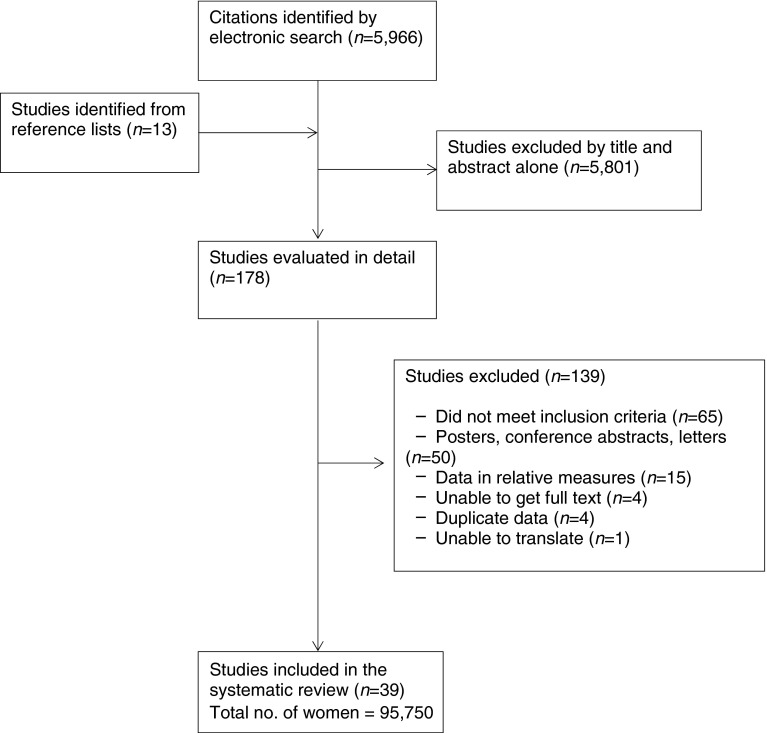
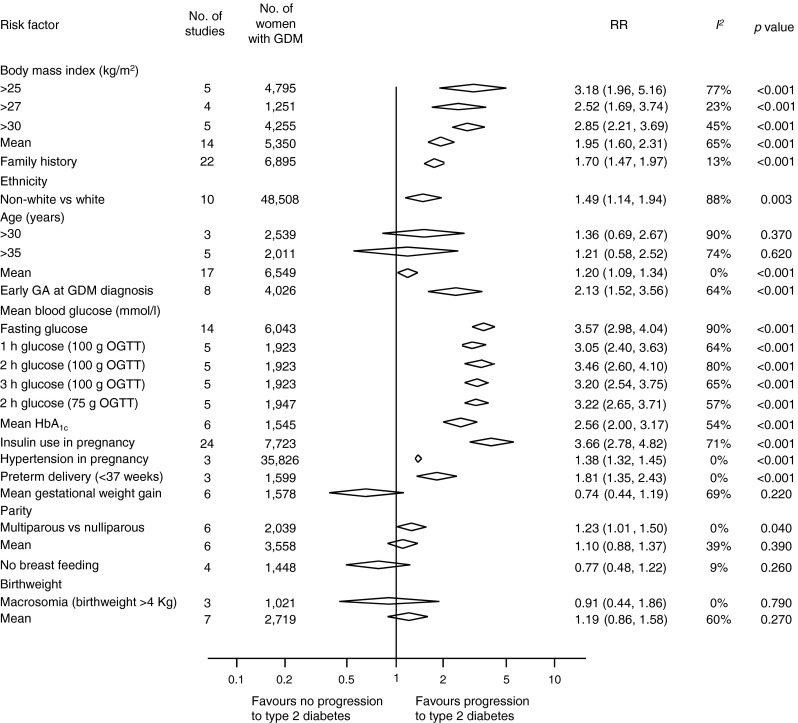
AIMS/HYPOTHESIS: Women with gestational diabetes mellitus (GDM) are at risk of developing type 2 diabetes, but individualised risk estimates are unknown. We conducted a meta-analysis to quantify the risk of progression to type 2 diabetes for women with GDM. METHODS: We systematically searched the major electronic databases with no language restrictions. Two reviewers independently extracted 2 × 2 tables for dichotomous data and the means plus SEs for continuous data. Risk ratios were calculated and pooled using a random effects model. RESULTS: There were 39 relevant studies (including 95,750 women) BMI (RR 1.95 [95% CI 1.60, 2.31]), family history of diabetes (RR 1.70 [95% CI 1.47, 1.97]), non-white ethnicity (RR 1.49 [95% CI 1.14, 1.94]) and advanced maternal age (RR 1.20 [95% CI 1.09, 1.34]) were associated with future risk of type 2 diabetes. There was an increase in risk with early diagnosis of GDM (RR 2.13 [95% CI 1.52, 3.56]), raised fasting glucose (RR 3.57 [95% CI 2.98, 4.04]), increased HbA1c (RR 2.56 [95% CI 2.00, 3.17]) and use of insulin (RR 3.66 [95% CI 2.78, 4.82]). Multiparity (RR 1.23 [95% CI 1.01, 1.50]), hypertensive disorders in pregnancy (RR 1.38 [95% CI 1.32, 1.45]) and preterm delivery (RR 1.81 [95% CI 1.35, 2.43]) were associated with future diabetes. Gestational weight gain, macrosomia in the offspring or breastfeeding did not increase the risk. CONCLUSIONS/INTERPRETATION: Personalised risk of progression to type 2 diabetes should be communicated to mothers with GDM. SYSTEMATIC REVIEW REGISTRATION: www.crd.york.ac.uk/PROSPERO CRD42014013597.
Overview
The claims and statistics of this paper haven’t been checked yet.
Free: it reads the open-access text and checks the first 5 claims that cite a source we can check. Create a free account to check every claim.
Integrity signals
Registry
Cites
Statistics
Figures
Verification
Claims the paper makes
The claims and statistics of this paper haven’t been checked yet.
Free: it reads the open-access text and checks the first 5 claims that cite a source we can check. Create a free account to check every claim.
Claims other papers make about this one
Each is checked against this paper’s own text: does it say what the citing paper says it does?
The source backs part of the claim, not all of it — or backs it for a different population, condition or comparison.
In the citing paper
“Women with GDM have a much higher risk of developing impaired glucose tolerance and T2DM in later life than women with uncomplicated pregnancies7,195–201”
From A global view of hypertensive disorders and diabetes mellitus during pregnancy (2022) · cites this paper as [197]
Experimental — accuracy not yet measured
Self-check
Percentages, sums and reported differences re-computed from the paper’s own numbers.
The self-check needs the paper’s full text.
Citations
Cites
Preferred Reporting Items for Systematic Reviews and Meta-Analyses: the PRISMA statement
Moher, D., Liberati, A., Tetzlaff, J., Altman, D. G., & for the PRISMA Group (2009) · BMJ · doi:10.1136/bmj.b2535 · Cited by 83,823
Preferred reporting items for systematic reviews and meta-analyses: the PRISMA Statement.
(2009) · PubMed Central · Cited by 44,859
Reduction in the incidence of type 2 diabetes with lifestyle intervention or metformin
(2002) · New England Journal of Medicine · doi:10.1056/nejmoa012512 · Cited by 19,011 · cited 1×
“ment with drugs such as metformin, [8, 9], less than a fifth of mothers with GDM undergo postpartum glucose screening [10].”
Background(2014) · Medical Entomology and Zoology · Cited by 17,633
Type 2 diabetes mellitus after gestational diabetes: a systematic review and meta-analysis
Bellamy, L., Casas, J.-P., Hingorani, A. D., & Williams, D. (2009) · The Lancet · doi:10.1016/s0140-6736(09)60731-5 · Cited by 3,253 · cited 2×
“Previous reviews were limited in their findings by the small number of studies included and the absence of summary estimates [2, 16, 18, 59].”
BackgroundGestational Diabetes and the Incidence of Type 2 Diabetes
Kim, C., Newton, K. M., & Knopp, R. H. (2002) · Diabetes Care · doi:10.2337/diacare.25.10.1862 · Cited by 2,276 · cited 1×
“Previous reviews were limited in their findings by the small number of studies included and the absence of summary estimates [2, 16, 18, 59].”
Diabetes in Asia: Epidemiology, Risk Factors, and Pathophysiology
Chan, J. C. N., Malik, V., Jia, W., Kadowaki, T., Yajnik, C. S., Yoon, K.-H., & Hu, F. B. (2009) · JAMA · doi:10.1001/jama.2009.726 · Cited by 1,997
Ratner, R. E., Christophi, C. A., Metzger, B. E., Dabelea, D., Bennett, P. H., Pi-Sunyer, X., Fowler, S., Kahn, S. E., & The Diabetes Prevention Program Research Group (2008) · The Journal of Clinical Endocrinology & Metabolism · doi:10.1210/jc.2008-0772 · Cited by 867 · cited 1×
“ment with drugs such as metformin, [8, 9], less than a fifth of mothers with GDM undergo postpartum glucose screening [10].”
BackgroundHex, N., Bartlett, C., Wright, D., Taylor, M., & Varley, D. (2012) · Diabetic Medicine · doi:10.1111/j.1464-5491.2012.03698.x · Cited by 819 · cited 1×
“Increasing numbers of women are presenting with previously undiagnosed diabetes and related complications, leading to substantial healthcare costs [3].”
BackgroundDiagnostic Criteria and Classification of Hyperglycaemia First Detected in Pregnancy
Agarwal, M., Boulvain, M., Coetzee, E. J., Colagiuri, S., Falavigna, M., Hod, M., Meltzer, S. J., Metzger, B. E., Omori, Y., Rasa, I., et al. (2013) · Cited by 769
Research works printed but not linked: 3
- Cochrane (2012) Review Manager (RevMan) version 5.2. The Nordic Cochrane Centre, Copenhagen
- Carvalho Ribeiro AM Nogueira-Silva C Melo-Rocha G Pereira ML Rocha A Gestational diabetes: determination of risk factors to diabetes mellitus Rev Port Endocrinol Diabetes Metab 2015 10 8 13
- Zonenberg A Telejko B Topolska J Factors predisposing to disturbed carbohydrate tolerance in patients with previous gestational diabetes mellitus Diabetol Dosw Klin 2006 6 143 150
Cited by
Items 301–308 of 308
Tamir, T. T., Zegeye, A. F., Tekeba, B., Mekonen, E. G., Endalew, H. L., Bazezew, A. M., Zeleke, G. A., Wassie, M., & Kassie, A. T. (2026) · Diabetology & Metabolic Syndrome · doi:10.1186/s13098-026-02205-0
“HbA1c levels were among the strongest predictors, with ORs up to 6.62 and an RR of 2.56 [6, 9, 10].”
InfluentialHasbullah, F. Y. (2024) · Universiti Putra Malaysia Institutional Repository (Universiti Putra Malaysia)
Kennedy, S. (2026) · NATIONS UNIVERSITY INTERNATIONAL JOURNAL OF MULTI-DISCIPLINARY STUDIES · doi:10.59607/nijms.v1i2.22
“Without structured monitoring systems and clear clinical pathways connecting obstetric and chronic disease services, the postpartum period, identified by Rayanagoudar et al. (2016) as the period of highest leverage for intervention, is routinely missed as a preventive opportunity.”
InfluentialEng, P. C., Tan, R. J., Luo, R., Al-Amri, A., Tan, L. L.-Y., Izzi‐Engbeaya, C. N., & Khoo, C. M. (2026) · Frontiers in Endocrinology · doi:10.3389/fendo.2026.1913417
Ethnic Differences in Pregnancy Complications Among Women with Gestational Diabetes
Filardi, T., Galoppi, P., Gorini, S., Mappa, I., Rizzo, G., & Morano, S. (2026) · Medical Sciences · doi:10.3390/medsci14040482
Bomba-Opon, D. A., Cypryk, K., Czajkowski, K., Wender-Ożegowska, E., & Zozulińska‐Ziółkiewicz, D. (2026) · Diabetes Therapy · doi:10.1007/s13300-026-01906-z
“The risk of developing T2D is 3 to 14‑fold higher than in women who do not have GDM in pregnancy, depending on the popula‑ tion studied [62–64].”
Kahingi, J. K., Dibomba, O. K., Munanga, P. K., Ngila, R. M., Muyisa, R. M., & Mata, J. M. (2026) · Diabetes Epidemiology and Management · doi:10.1016/j.deman.2026.100336
Metadata
- Authors
- Rayanagoudar, G., Hashi, A. A., Zamora, J., Khan, K. S., Hitman, G. A., & Thangaratinam, S.
- Affiliations
- Queen Mary University of London (GB)
- Corresponding author
- Thangaratinam, Shakila
- Venue
- Diabetologia
- Published
- 2016-04-13
- Volume
- 59
- Issue
- 7
- Pages
- 1403-1411
- ISSN
- 0012-186X (ISSN-L)
- 1432-0428
- PMC
- PMC4901120
- OpenAlex
- W2342252659
- Cited by
- 292
- References
- 69
- Citations by year
- 2026: 17 · 2025: 26 · 2024: 28 · 2023: 28 · 2022: 38 · 2021: 40 · 2020: 34 · 2019: 21 · 2018: 32 · 2017: 20 · 2016: 8
- FWCI
- 4.77
- Type
- journal article
- Language
- en
- Open access
- hybrid
- doi.org
- Locations
- Diabetologia (publishedVersion, cc-by)
- Europe PMC (PubMed Central) (publishedVersion, cc-by)
- PubMed Central (publishedVersion, cc-by)
- PubMed (publishedVersion)
- LA Referencia (Red Federada de Repositorios Institucionales de Publicaciones Científicas) (submittedVersion, other-oa)
- University of Birmingham Research Portal (University of Birmingham) (submittedVersion, other-oa)
- Queen Mary Research Online (Queen Mary University of London) (submittedVersion, cc-by)
- Funders
- European Union's Seventh Framework Programme (EC-GA No. 278917 (GIFTS))
- Topics
- Health Sciences › Medicine › Obstetrics and Gynecology › Gestational Diabetes Research and Management
- Health Sciences › Medicine › Endocrinology, Diabetes and Metabolism › Diabetes, Cardiovascular Risks, and Lipoproteins
- Health Sciences › Medicine › Endocrinology, Diabetes and Metabolism › Diabetes Management and Research
- Keywords
- gestational diabetes mellitus, type 2 diabetes risk, risk factors, body mass index, family history of diabetes, ethnicity, advanced maternal age, HbA1c, fasting blood glucose, insulin use, multiparity, hypertensive disorders of pregnancy, preterm birth, women's health, pregnancy outcomes, breastfeeding
- MeSH terms
- Diabetes Mellitus, Type 2, Female, Humans, Pregnancy, Pregnancy Complications, Risk Factors, Databases, Factual, Diabetes, Gestational
About these checks
Registry, retraction, Cites and statistics results are computed, not judged, with one exception: a printed reference that no index lists is read once by a model before it counts as a citation error. Claims are extracted by a model and kept only when their quote appears verbatim in the text; each cited source is then checked, with a model’s help, for whether it says what the claim relies on. Those verdicts can be wrong — read the claim’s quote and the cited source before relying on one.
Statistics and arithmetic are recomputed, not judged.
Confidence bands are shown only for fields calibrated on our annotated test set. None is calibrated yet, so no band is shown.
What counts as a claim ›How we measure confidence ›How we check this ›
Are you an author, or do you see a problem with this page? Request a review
Data sources
Bibliographic data: Semantic Scholar, OpenAlex, Crossref.
Contains information from the Semantic Scholar Academic Graph Datasets, made available under the ODC Attribution License (ODC-BY 1.0).
Semantic Scholar’s data is described in: Kinney, R., et al. (2023). The Semantic Scholar Open Data Platform. arXiv:2301.10140.
