

Quantification of the type 2 diabetes risk in women with gestational diabetes: a systematic review and meta-analysis of 95,750 women
Open accessThe DOI matches its Crossref record; 67 of the 69 references it cites were found in a registry or an index.
Abstract
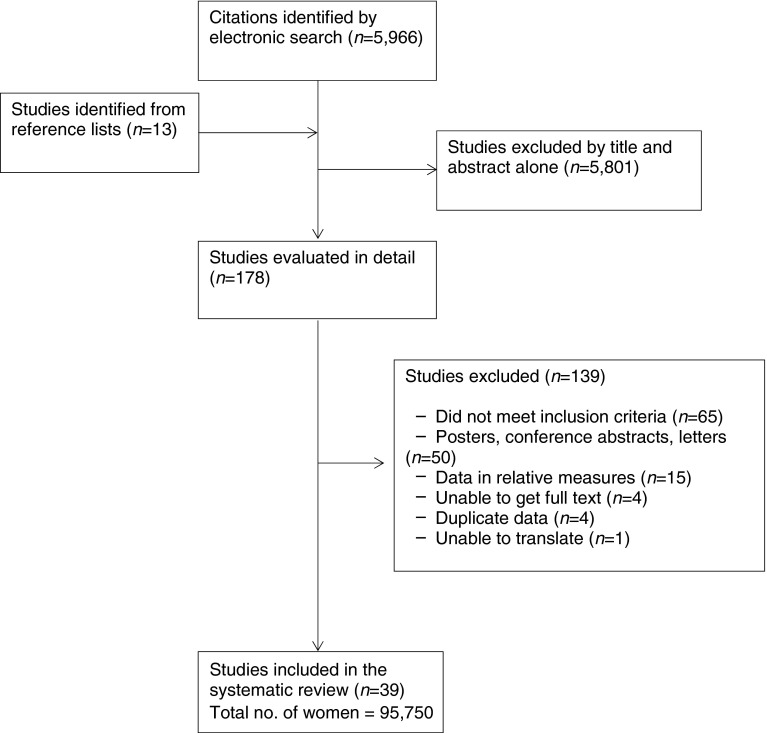
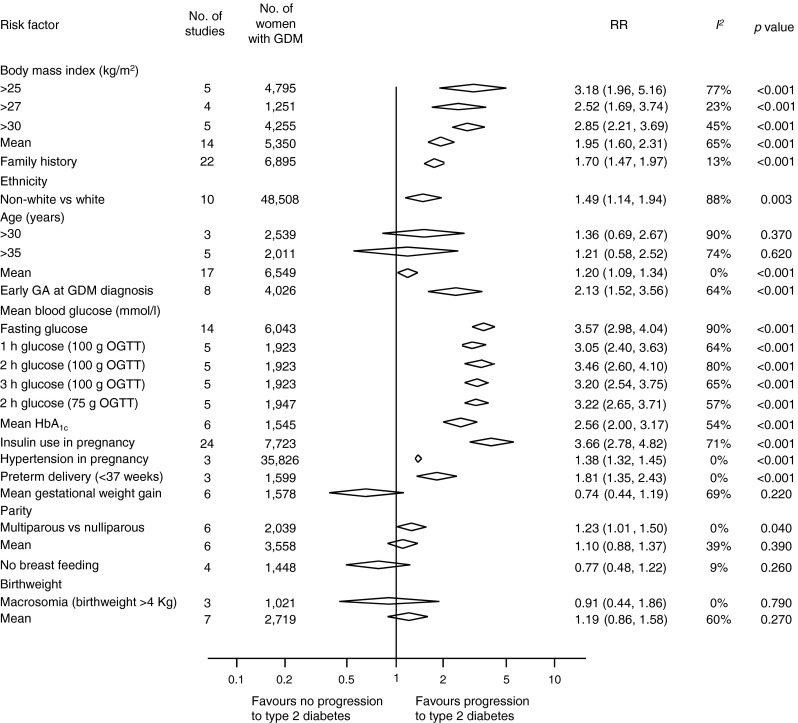
AIMS/HYPOTHESIS: Women with gestational diabetes mellitus (GDM) are at risk of developing type 2 diabetes, but individualised risk estimates are unknown. We conducted a meta-analysis to quantify the risk of progression to type 2 diabetes for women with GDM. METHODS: We systematically searched the major electronic databases with no language restrictions. Two reviewers independently extracted 2 × 2 tables for dichotomous data and the means plus SEs for continuous data. Risk ratios were calculated and pooled using a random effects model. RESULTS: There were 39 relevant studies (including 95,750 women) BMI (RR 1.95 [95% CI 1.60, 2.31]), family history of diabetes (RR 1.70 [95% CI 1.47, 1.97]), non-white ethnicity (RR 1.49 [95% CI 1.14, 1.94]) and advanced maternal age (RR 1.20 [95% CI 1.09, 1.34]) were associated with future risk of type 2 diabetes. There was an increase in risk with early diagnosis of GDM (RR 2.13 [95% CI 1.52, 3.56]), raised fasting glucose (RR 3.57 [95% CI 2.98, 4.04]), increased HbA1c (RR 2.56 [95% CI 2.00, 3.17]) and use of insulin (RR 3.66 [95% CI 2.78, 4.82]). Multiparity (RR 1.23 [95% CI 1.01, 1.50]), hypertensive disorders in pregnancy (RR 1.38 [95% CI 1.32, 1.45]) and preterm delivery (RR 1.81 [95% CI 1.35, 2.43]) were associated with future diabetes. Gestational weight gain, macrosomia in the offspring or breastfeeding did not increase the risk. CONCLUSIONS/INTERPRETATION: Personalised risk of progression to type 2 diabetes should be communicated to mothers with GDM. SYSTEMATIC REVIEW REGISTRATION: www.crd.york.ac.uk/PROSPERO CRD42014013597.
Overview
The claims and statistics of this paper haven’t been checked yet.
Free: it reads the open-access text and checks the first 5 claims that cite a source we can check. Create a free account to check every claim.
Integrity signals
Registry
Cites
Statistics
Figures
Verification
Claims the paper makes
The claims and statistics of this paper haven’t been checked yet.
Free: it reads the open-access text and checks the first 5 claims that cite a source we can check. Create a free account to check every claim.
Claims other papers make about this one
Each is checked against this paper’s own text: does it say what the citing paper says it does?
The source backs part of the claim, not all of it — or backs it for a different population, condition or comparison.
In the citing paper
“Women with GDM have a much higher risk of developing impaired glucose tolerance and T2DM in later life than women with uncomplicated pregnancies7,195–201”
From A global view of hypertensive disorders and diabetes mellitus during pregnancy (2022) · cites this paper as [197]
Experimental — accuracy not yet measured
Self-check
Percentages, sums and reported differences re-computed from the paper’s own numbers.
The self-check needs the paper’s full text.
Citations
Cites
Preferred Reporting Items for Systematic Reviews and Meta-Analyses: the PRISMA statement
Moher, D., Liberati, A., Tetzlaff, J., Altman, D. G., & for the PRISMA Group (2009) · BMJ · doi:10.1136/bmj.b2535 · Cited by 83,823
Preferred reporting items for systematic reviews and meta-analyses: the PRISMA Statement.
(2009) · PubMed Central · Cited by 44,859
Reduction in the incidence of type 2 diabetes with lifestyle intervention or metformin
(2002) · New England Journal of Medicine · doi:10.1056/nejmoa012512 · Cited by 19,011 · cited 1×
“ment with drugs such as metformin, [8, 9], less than a fifth of mothers with GDM undergo postpartum glucose screening [10].”
Background(2014) · Medical Entomology and Zoology · Cited by 17,633
Type 2 diabetes mellitus after gestational diabetes: a systematic review and meta-analysis
Bellamy, L., Casas, J.-P., Hingorani, A. D., & Williams, D. (2009) · The Lancet · doi:10.1016/s0140-6736(09)60731-5 · Cited by 3,253 · cited 2×
“Previous reviews were limited in their findings by the small number of studies included and the absence of summary estimates [2, 16, 18, 59].”
BackgroundGestational Diabetes and the Incidence of Type 2 Diabetes
Kim, C., Newton, K. M., & Knopp, R. H. (2002) · Diabetes Care · doi:10.2337/diacare.25.10.1862 · Cited by 2,276 · cited 1×
“Previous reviews were limited in their findings by the small number of studies included and the absence of summary estimates [2, 16, 18, 59].”
Diabetes in Asia: Epidemiology, Risk Factors, and Pathophysiology
Chan, J. C. N., Malik, V., Jia, W., Kadowaki, T., Yajnik, C. S., Yoon, K.-H., & Hu, F. B. (2009) · JAMA · doi:10.1001/jama.2009.726 · Cited by 1,997
Ratner, R. E., Christophi, C. A., Metzger, B. E., Dabelea, D., Bennett, P. H., Pi-Sunyer, X., Fowler, S., Kahn, S. E., & The Diabetes Prevention Program Research Group (2008) · The Journal of Clinical Endocrinology & Metabolism · doi:10.1210/jc.2008-0772 · Cited by 867 · cited 1×
“ment with drugs such as metformin, [8, 9], less than a fifth of mothers with GDM undergo postpartum glucose screening [10].”
BackgroundHex, N., Bartlett, C., Wright, D., Taylor, M., & Varley, D. (2012) · Diabetic Medicine · doi:10.1111/j.1464-5491.2012.03698.x · Cited by 819 · cited 1×
“Increasing numbers of women are presenting with previously undiagnosed diabetes and related complications, leading to substantial healthcare costs [3].”
BackgroundDiagnostic Criteria and Classification of Hyperglycaemia First Detected in Pregnancy
Agarwal, M., Boulvain, M., Coetzee, E. J., Colagiuri, S., Falavigna, M., Hod, M., Meltzer, S. J., Metzger, B. E., Omori, Y., Rasa, I., et al. (2013) · Cited by 769
Research works printed but not linked: 3
- Cochrane (2012) Review Manager (RevMan) version 5.2. The Nordic Cochrane Centre, Copenhagen
- Carvalho Ribeiro AM Nogueira-Silva C Melo-Rocha G Pereira ML Rocha A Gestational diabetes: determination of risk factors to diabetes mellitus Rev Port Endocrinol Diabetes Metab 2015 10 8 13
- Zonenberg A Telejko B Topolska J Factors predisposing to disturbed carbohydrate tolerance in patients with previous gestational diabetes mellitus Diabetol Dosw Klin 2006 6 143 150
Cited by
Items 101–200 of 308
Pamidi, S., Meltzer, S. J., Garfield, N., Lavigne, L., Olha, A., Khalyfa, A. A., Benedetti, A., Tremblay, G., Gagnon, R. J., Rey, É., et al. (2018) · Frontiers in Endocrinology · doi:10.3389/fendo.2018.00659 · Cited by 16
Exposure to bisphenol a and risk of developing type 2 diabetes: A mini review
Siddique, S., Zhang, G., & Kubwabo, C. (2020) · Emerging contaminants · doi:10.1016/j.emcon.2020.07.005 · Cited by 16
Moore, L. E., Voaklander, B., Savu, A., Yeung, R. O., Ryan, E. A., Chojecki, D., Kaul, P., & Ospina, M. B. (2020) · Journal of Diabetes and its Complications · doi:10.1016/j.jdiacomp.2020.107804 · Cited by 15
Houri, O., Gil, Y., Chen, R., Wiznitzer, A., Hochberg, A., Hadar, E., & Berezowsky, A. (2022) · Journal of Medical and Biological Engineering · doi:10.1007/s40846-022-00685-9 · Cited by 16
The risk of developing type 2 diabetes after gestational diabetes: A registry study from Finland
Perämäki, R., Gissler, M., Ollila, M., Hukkanen, J., Vääräsmäki, M., Uotila, J. T., Metso, S., Hakkarainen, H., Rintamäki, R. M., Kaaja, R., et al. (2022) · Diabetes Epidemiology and Management · doi:10.1016/j.deman.2022.100124 · Cited by 19
Kek, H.-P., Su, Y., Tey, S.-J., Yang, M., Chang, L.-C., Hung, Y.-H., & Tsai, C. (2023) · BMC Pregnancy and Childbirth · doi:10.1186/s12884-023-05829-6 · Cited by 16
Weight retention and glucose intolerance in early postpartum after gestational diabetes
Minschart, C., Myngheer, N., Maes, T., Block, C. E. M. D., Pottelbergh, I. V., Abrams, P. J., Vinck, W. J., Leuridan, L., Driessens, S., Mathieu, C., et al. (2023) · European Journal of Endocrinology · doi:10.1093/ejendo/lvad053 · Cited by 15
Wahabi, H., Fayed, A. A., Tunkar, S. M. S., Bakhsh, H., Al-Hazmi, A., Esmaeil, S. A., & Siddiqui, A. (2019) · PLoS ONE · doi:10.1371/journal.pone.0210024 · Cited by 14
Shin, D., & Lee, K. W. (2021) · PLoS ONE · doi:10.1371/journal.pone.0252442 · Cited by 15
Fatin, A., & Alina, T. I. (2019) · Europe PMC (PubMed Central) · Cited by 19
Beyond the infant in your arms: effects of climate change last for generations
Mendola, P., & Ha, S. (2022) · Fertility and Sterility · doi:10.1016/j.fertnstert.2022.06.007 · Cited by 12
Chatzakis, C., Koletsos, N., Tirta, M., Dinas, K. D., Gkaliagkousi, Ε., & Sotiriadis, A. (2022) · Diabetes/Metabolism Research and Reviews · doi:10.1002/dmrr.3600 · Cited by 13
“We searched the literature (last search October 2022) for cohort and observational reports of FMD in pregnant women with GDM or premenopausal women with a history of GDM. MED- LINE, Scopus, Cochrane Library, Google Scholar, and grey literature sources were searched.”
BackgroundInfluentialBond, R., Pace, R., Rahme, E., & Dasgupta, K. (2017) · Diabetic Medicine · doi:10.1111/dme.13444 · Cited by 13
It's Time to Eliminate Racism and Fragmentation in Women's Health Care
McCloskey, L., Bernstein, J., Blount, L. G., Greiner, A. C., Norton, A., Jones, E. J., & Bird, C. E. (2021) · Women s Health Issues · doi:10.1016/j.whi.2020.12.007 · Cited by 14
“There is robust evidence that pregnancy complications, including gestational diabetes, hypertensive disorders of pregnancy, depression, and substance use disorder, are all associated with future chronic illness (Allalou et al., 2016; Kramer, Campbell, & Retnakaran, 2019; Rayanagoudar et al., 2016).”
BackgroundReyes-Muñoz, E., Sandoval-Osuna, N. L., Reyes-Mayoral, C., Ortega-González, C., Martínez-Cruz, N., Ramírez-Torres, M. A., Arce-Sánchez, L., Lira-Plascencia, J., Estrada‐Gutiérrez, G., & Montoya-Estrada, A. (2018) · BMJ Open · doi:10.1136/bmjopen-2018-021617 · Cited by 15
Rehder, P. M., Borovac‐Pinheiro, A., de Araujo, R. O. M. B., Diniz, J. A. P. M., Ferreira, N. L. C., Branco, A. C. R., Dias, A. D. F., & Pereira, B. G. (2021) · Revista Brasileira Ginecologia e Obstetrícia · doi:10.1055/s-0040-1721356 · Cited by 17
Wang, T., Zheng, W., Huang, W., Zhang, L., Tian, Z., Zhang, T., Qi, Y., & Li, G. (2019) · Journal of obstetrics and gynaecology research · doi:10.1111/jog.14009 · Cited by 12
“A systematic review and meta-analysis also found advanced maternal age was associated with future risk of type 2 diabetes.(7) In our study, maternal age was higher in the AGT group than the NGT group.”
BackgroundBianchi, C., Gennaro, G., Brocchi, A., Minaldi, E., Prato, S. D., & Bertolotto, A. (2021) · Journal of Diabetes and its Complications · doi:10.1016/j.jdiacomp.2021.107854 · Cited by 13
Prediction Method of Gestational Diabetes Based on Electronic Medical Record Data
Liu, Y., Yu, Z., & Sun, H. (2021) · Journal of Healthcare Engineering · doi:10.1155/2021/6672072 · Cited by 14
“Although his research has certain theoretical value, the research method lacks precision [3].”
MethodRetractedDuo, Y., Song, S., Qiao, X., Zhang, Y., Xu, J., Zhang, J., Peng, Z., Chen, Y., Nie, X., Sun, Q., et al. (2023) · Diabetes Therapy · doi:10.1007/s13300-023-01480-8 · Cited by 13
“Race is one of the risk factors for GDM [9].”
BackgroundResultPreventing progression from gestational diabetes mellitus to diabetes: A thought‐filled review
Meron, M. K., & Grajower, M. M. (2017) · Diabetes/Metabolism Research and Reviews · doi:10.1002/dmrr.2909 · Cited by 15
“Most of the women with prior GDM share the same clinical and biochemical phenotype of patients withT2DM: advanced maternal age, obesity, strong family background, insulin resistance, and relative beta‐cell failure.(12) Both baseline BMI and post‐partum weight gain are significantly and positively associated with the r…”
Lee, K. W., Loh, H. C., Chong, S. C., Ching, S. M., Devaraj, N. K., Tusimin, M., Hamid, H. A., & Hoo, F. K. (2020) · World Journal of Meta-Analysis · doi:10.13105/wjma.v8.i3.275 · Cited by 13
Selecting and defining indicators for diabetes surveillance in Germany
Koch-Institut, R. (2018) · PubMed Central · doi:10.17886/rki-gbe-2018-063 · Cited by 16
“Although in most cases women recover from this form of diabetes after pregnancy, the disease is related to a greater risk of complications during pregnancy as well as an increased risk for both the mother and the baby to develop type 2 diabetes at a later stage in life [16-18].”
BackgroundCosma, V., Imbernon, J., Zagdoun, L., Boulot, P., Renard, É., Brunet, C., Marès, P., Rodier, M., Kabani, S., Dematteï, C., et al. (2021) · Scientific Reports · doi:10.1038/s41598-021-89679-2 · Cited by 11
Screening Accuracy of the 50 g-Glucose Challenge Test in Twin Compared With Singleton Pregnancies
Hiersch, L., Shah, B. R., Berger, H. M., Geary, M. P., McDonald, S. D., Murray‐Davis, B., Guan, J., Halperin, I. J., Retnakaran, R. R., Barrett, J. F. R., et al. (2022) · The Journal of Clinical Endocrinology & Metabolism · doi:10.1210/clinem/dgac472 · Cited by 11
O'Hara, H., Taylor, J., & Woodside, J. V. (2023) · Nutrients · doi:10.3390/nu15071613 · Cited by 12
“In the post-partum period, a BMI of over 25 kg/m2 is associated with a 2–3-fold increased risk of developing T2DM in those with a history of GDM [15].”
BackgroundTong, J.-N., Chen, Y.-X., Guan, X.-N., Liu, K., Yin, A.-Q., Zhang, H.-F., Wu, L.-L., & Niu, J.-M. (2022) · BMC Pregnancy and Childbirth · doi:10.1186/s12884-022-04874-x · Cited by 11
Is Breastfeeding an Effective Approach to Reduce Metabolic Risk After GDM in Mothers and Infants?
Filardi, T., Bleve, E., Gorini, S., Caprio, M., & Morano, S. (2025) · Journal of Clinical Medicine · doi:10.3390/jcm14093065 · Cited by 12
“…of predictors, involving both maternal risk factors, including advanced age, obesity, family history of T2D, non-Caucasian ethnicity, and pregnancy-specific factors, such as high levels of glycemia at OGTT, increased HbA1c, insulin use, multiparity, hypertensive disease, and preterm delivery [7].”
Chaves, C., Cunha, F. M., Martinho, M., Garrido, S., Silva-Vieira, M., Estevinho, C., Melo, A., Figueiredo, O., Morgado, A., Nogueira, C., et al. (2021) · Archives of Gynecology and Obstetrics · doi:10.1007/s00404-021-06107-6 · Cited by 10
Sun, B. H., Reynolds, K., Garland, M. A., McMahon, M. M., Saha, S. K., & Zhou, C. J. (2023) · Birth Defects Research · doi:10.1002/bdr2.2226 · Cited by 11
“GDM is associated with an increased rate of gestational complications (e.g., pre-eclampsia and C-section) and women with GDM showed significantly higher risks of developing type 2 diabetes in the years after the first diagnosis (Bellamy et al., 2009; Rayanagoudar et al., 2016).”
BackgroundVince, K., Poljičanin, T., Brkić, M., Rodin, U., & Matijević, R. (2018) · Primary care diabetes · doi:10.1016/j.pcd.2018.02.003 · Cited by 10
Gunn, C. M., Bernstein, J., Bokhour, B. G., & McCloskey, L. (2020) · Journal of Midwifery & Women s Health · doi:10.1111/jmwh.13122 · Cited by 12
Fritsche, L., Sarief, M., Wagner, R. J., Stefan, N., Lehmann, R., Häring, H., Grallert, H., Fritsche, A., & Lechner, A. (2018) · Diabetes Research and Clinical Practice · doi:10.1016/j.diabres.2018.11.003 · Cited by 10
Prashanthan, J., & Prashanthan, A. (2025) · Primary care diabetes · doi:10.1016/j.pcd.2025.09.006 · Cited by 9
Reitzle, L., Heidemann, C., Krause, L., & Hoebel, J. (2024) · PubMed Central · doi:10.25646/12086 · Cited by 16
“Although GDM usually disappears after pregnancy, the mother’s risk of developing type 2 diabetes later in life is significantly increased [ 10 ].”
BackgroundPrevalence and Risk Factors for Glucose Intolerance among Saudi Women with Gestational Diabetes
Wahabi, H. (2018) · Journal of Diabetes Research · doi:10.1155/2018/4282347 · Cited by 9
Mahzari, M. M., Alwadi, F. A., Alhussain, B., Alenzi, T. M., Omair, A. A., & Dera, H. S. A. (2018) · Journal of Taibah University Medical Sciences · doi:10.1016/j.jtumed.2018.11.004 · Cited by 9
“A BMI higher than the normal range is a known risk factor of T2DM particularly if associated with GDM.”
BackgroundInfluentialMorettini, M., Castriota, C., Göbl, C. S., Kautzky‐Willer, A., Pacini, G., Burattini, L., & Tura, A. (2020) · Diabetes & Metabolism Journal · doi:10.4093/dmj.2019.0016 · Cited by 9
Dai, F., Mani, H., Razali, N. S., & Tan, K. H. (2022) · BMJ Open · doi:10.1136/bmjopen-2021-055458 · Cited by 10
Königbauer, J. T., Fangmann, L., Rostin, P., Balke, S., Weid, P., Henrich, W., Weichert, A., & Christian, G. Z. (2023) · Journal of Perinatal Medicine · doi:10.1515/jpm-2023-0170 · Cited by 9
Francaitė-Daugėlienė, M., Lesauskaitė, V., Tamošiūnas, A., Jasukaitienė, A., & Veličkienė, D. (2020) · Diabetes Research and Clinical Practice · doi:10.1016/j.diabres.2020.108636 · Cited by 9
Classification and identification of risk factors for type 2 diabetes
Tang, S., Zhao, X., An, X., Sun, W., Kang, X., Sun, Y., Jiang, L., Gao, Q., Li, Z., Ji, H., et al. (2025) · World Journal of Diabetes · doi:10.4239/wjd.v16.i2.100371 · Cited by 10
Pregnancy Complications and Long-Term Atherosclerotic Cardiovascular Disease Risk
Rabadia, S. V., Heimberger, S., Cameron, N. A., & Shahandeh, N. (2025) · Current Atherosclerosis Reports · doi:10.1007/s11883-024-01273-9 · Cited by 9
“Additional factors that increase risk of future development of DM include higher BMI, family history of DM, multiparity, recurrent episodes of GDM, and advanced maternal age [69, 70 ].”
Fecal Short-Chain Fatty Acids Are Associated with Obesity in Gestational Diabetes
Molan, K., Avguštin, J. A., Likar, M., Barlovič, D. P., Barlovič, D. P., & Erjavec, M. S. (2025) · Biomedicines · doi:10.3390/biomedicines13020387 · Cited by 8
Astbury, N. M., Ripullone, K., Ramakrishnan, R., Woodward, M., & Hirst, J. E. (2025) · Diabetes Obesity and Metabolism · doi:10.1111/dom.70210 · Cited by 9
Whelan, A., Ayala, N. K., & Werner, E. F. (2021) · Current Diabetes Reports · doi:10.1007/s11892-021-01410-7 · Cited by 10
Benton, M., Sa’id, I. I. M., Goldsmith, K., Forbes, A., Ching, S. M., Nadal, I. P., Guess, N. D., Murphy, H. R., Yusof, B. N. M., Baharom, A., et al. (2022) · JMIR Research Protocols · doi:10.2196/37288 · Cited by 8
“Approximately 50% of mothers with GDM will develop diabetes within 10 years [8,10,11].”
Fernández, C. G., Golubić, R., Mitsigiorgi, R., Mansukhani, T., Car, J., & Nicolaides, K. H. (2025) · Nutrients · doi:10.3390/nu17030390 · Cited by 8
“…including 95,750 women diagnosed with GDM and duration of follow-up of between 6 weeks and 20 years postpartum, reported similar results to those of our cohort in terms of increased risk of dysglycaemia in women of non-white ethnicity, early diagnosis of GDM, and use of insulin therapy [25].”
Svensson, H. G., Wetterling, L., Andersson-Hall, U. K., Jennische, E., Edén, S., Holmäng, A. B., & Lönn, M. (2018) · Adipocyte · doi:10.1080/21623945.2018.1521230 · Cited by 9
“listed in a recent meta-analysis as maternal characteristics, and factors specific to pregnancy, associated with future onset of T2DM.(14) Although weight gain and a high BMI are strongly”
BackgroundInfluentialBayoumi, R. A. L., Khamis, A. H., Tahlak, M., Elgergawi, T., Harb, D. K., Hazari, K., Abdelkareem, W., Issa, A. O., Choudhury, R., Hassanein, M. M., et al. (2021) · World Journal of Diabetes · doi:10.4239/wjd.v12.i10.1778 · Cited by 8
Kosinski, C., Rossel, J., Gross, J., Helbling, C., Quansah, D. Y., Collet, T., & Puder, J. J. (2021) · BMJ Open Diabetes Research & Care · doi:10.1136/bmjdrc-2021-002382 · Cited by 9
Yefet, E., Schwartz, N., Sliman, B., & Nachum, Z. (2020) · Archives of Gynecology and Obstetrics · doi:10.1007/s00404-020-05827-5 · Cited by 8
“The risks for T2DM within the group of women with GDM are elevated BMI, family history of diabetes, nonwhite ethnicity, advanced maternal age, early diagnosis of GDM, raised fasting glucose, increased HbA1c, use of insulin, multiparity, hypertensive disorders in pregnancy, and preterm delivery [28].”
BackgroundThe Xi’an longitudinal mother–child cohort study: design, study population and methods
Ji, J., He, Z., Qu, P., Gao, J., Zhang, W., Wu, P., Wei, J., Zhang, T., Feei, Z., Luo, X., et al. (2021) · European Journal of Epidemiology · doi:10.1007/s10654-020-00704-6 · Cited by 9
“5 times more likely to have GDM than women who had a normal BMI, resulting in an increased risk of postpartum type 2 diabetes in these women 3–10 times [20, 21].”
BackgroundMcLennan, N.-M., Hazlehurst, J., Thangaratinam, S., & Reynolds, R. M. (2022) · European Journal of Endocrinology · doi:10.1530/eje-21-1046 · Cited by 13
Self-citationWeingarten, S. J., Levy, A. T., Al‐Kouatly, H. B., & McLaren, R. A. (2025) · Journal of Diabetes and its Complications · doi:10.1016/j.jdiacomp.2025.109038 · Cited by 7
Luo, Q., Zhou, J., Wu, H., Qiu, X., Xian, C., Zhan, X., & Liu, J. (2025) · Journal of Diabetes Investigation · doi:10.1111/jdi.70152 · Cited by 7
“For pregnant women diagnosed with GDM, we collected peripheral blood samples 4 – 12 weeks postpartum.”
Омариевна, У. Ф., Геннадьевна, Л. К., & Perekhodov, S. N. (2021) · Meditsinskiy sovet = Medical Council · doi:10.21518/2079-701x-2021-7-184-191 · Cited by 7
Hashmi, I. A., Yazidi, B. A., & Omari, O. A. (2022) · Journal of Healthcare Quality Research · doi:10.1016/j.jhqr.2021.12.004 · Cited by 7
Bhattacharjee, B., Chakrovorty, A., Biswas, M., Samadder, A., & Nandi, S. (2023) · Current Medicinal Chemistry · doi:10.2174/0929867330666230519112312 · Cited by 7
Smith‐Miller, C. A., Berry, D. C., & Miller, C. T. (2021) · Hispanic Health Care International · doi:10.1177/15404153211011727 · Cited by 8
“These accounts, and those in the literature, support current standards for ongoing glucose monitoring for women with a GDM history, illustrate the importance of taking the aforementioned risk factors into account in patient care, and provide a basis for extending regular glucose monitoring beyond 1-year postpartum (AD…”
ResultSharma, A., Nermoen, I., Qvigstad, E., Tran, A. T., Sommer, C., Sattar, N. A., Gill, J. M. R., Gulseth, H. L., Sollid, S. T., & Birkeland, K. I. (2022) · BMC Medicine · doi:10.1186/s12916-022-02515-w · Cited by 8
Diabetes Surveillance in Germany – Background, concept and prospects
Koch-Institut, R. (2017) · PubMed Central · doi:10.17886/rki-gbe-2017-022 · Cited by 14
“Gestational diabetes is a special form of diabetes mellitus caused by insulin resistance which generally recedes after pregnancy; however, women with this form of the disease have a significantly higher risk of developing type 2 diabetes mellitus in later life [5, 6].”
BackgroundFactores predictores de diabetes mellitus posparto en pacientes con diabetes gestacional
Civantos, S., Durán, M., Flández, B., Merino, M., Navea, C., Guijarro, G., Martell, N., & Monereo, S. (2018) · Endocrinología Diabetes y Nutrición · doi:10.1016/j.endinu.2018.08.013 · Cited by 7
Predictors of postpartum diabetes mellitus in patients with gestational diabetes
Civantos, S., Durán, M., Flández, B., Merino, M., Navea, C., Guijarro, G., Martell, N., & Monereo, S. (2019) · Endocrinología Diabetes y Nutrición (English ed ) · doi:10.1016/j.endien.2019.02.002 · Cited by 7
Amaefule, C. E., Bolou, A., Drymoussi, Z., Carreras, F. J. G., Pardo, M. D. C., Lanz, D., Dodds, J. P., Sweeney, L., Pizzo, E., D’Amico, M., et al. (2020) · BMJ Open · doi:10.1136/bmjopen-2019-036198 · Cited by 9
“The OMAhA study findings will inform the conduct of a full-scale definitive trial on the effects of metformin in reducing the risk of dysglycaemia including type 2 diabetes after delivery in women with a history of gestational diabetes.”
BackgroundSelf-citationIndications for the postpartum oral glucose tolerance test
Adamczewski, H., Weber, D., Klein, J., Behling, M., & Kaltheuner, M. (2024) · Deutsches Ärzteblatt international · doi:10.3238/arztebl.m2024.0034 · Cited by 8
Zhang, J., Xu, T., Cao, Q., Mao, C., Zhou, F., & Wang, X. (2024) · Maternal-Fetal Medicine · doi:10.1097/fm9.0000000000000252 · Cited by 7
Hallig, S. J., Aalders, J., Christensen, M. H., Andersen, M., Vinter, C. A., Dunne, F., Højlund, K., Jensen, D. M., & Overgaard, M. (2025) · Diabetes Obesity and Metabolism · doi:10.1111/dom.16148 · Cited by 6
Sari, Y. P., Herman, H., Fajria, L., Herien, Y., Susanti, E., & Lin, C. (2025) · Midwifery · doi:10.1016/j.midw.2025.104399 · Cited by 6
Sheng, Y., Cun, D., Chen, Y., Hu, X.-J., Zhang, X., Sun, X., & Song, S. (2025) · Diabetology & Metabolic Syndrome · doi:10.1186/s13098-025-01914-2 · Cited by 6
“All of these metabolic factors are strongly associated with the development of T2DM [30].”
Lesniara-Stachon, A., Cosson, E., Lacroix, A., Schenk, S., Quansah, D. Y., & Puder, J. J. (2024) · Frontiers in Endocrinology · doi:10.3389/fendo.2024.1381058 · Cited by 7
Schmidt, M. I., Bracco, P. A., Nunes, M. A., Cherubini, K. A., de Castilhos, C. D., Spagiari, J. Z., Galliano, L. M., Ladwig, R., Vecchio, F. B. D., Vecchio, A. H. M. D., et al. (2024) · BMJ Open · doi:10.1136/bmjopen-2023-082572 · Cited by 8
“9 The slight weight difference achieved with our telephone intervention is also comparable to previous DPPs offered onsite shortly after a pregnancy complicated by GDM. 25 26 Interpretation of the main study findings These intention- to-treat analyses failed to show a reduction in the incidence of diabetes, mainly bec…”
MethodInfluentialEteläinen, S., Keikkala, E., Lingaiah, S., Viljakainen, M., Männistö, T. I., Pouta, A. M., Kaaja, R., Eriksson, J. G., Laivuori, H. M., Gissler, M., et al. (2024) · Acta Obstetricia Et Gynecologica Scandinavica · doi:10.1111/aogs.14999 · Cited by 11
Reitzle, L. (2024) · Publication server of the Robert Koch Institute (Robert Kock Institute) · doi:10.25646/12009 · Cited by 8
Cao, S., Li, N., Zhang, C., Liu, J., Wang, H., Leng, J., Wang, L., Li, W., Yu, Z., Hu, G., et al. (2022) · Diabetes Research and Clinical Practice · doi:10.1016/j.diabres.2022.109817 · Cited by 7
Liew, S. J., Soon, C. S., Chooi, Y. C., Tint, M. T., & Eriksson, J. G. (2023) · Frontiers in Clinical Diabetes and Healthcare · doi:10.3389/fcdhc.2023.1251411 · Cited by 8
“family history of T2D, ethnicity, advanced age and overweight or obesity) (9).”
BackgroundMao, P., Jiang, S., Guo, J., Jiang, Y., Long, Q., Tang, Y., Luo, J., Wiley, J. A., & Vorderstrasse, A. A. (2020) · Diabetes Metabolic Syndrome and Obesity · doi:10.2147/dmso.s252542 · Cited by 6
Feleke, B. E., Feleke, T. E., Kassahun, M. B., Adane, W. G., Achenefe, D., Genetu, A., Nigussie, A. A., & Engedaw, H. A. (2020) · Primary care diabetes · doi:10.1016/j.pcd.2020.11.016 · Cited by 6
Chen, N., Zeng, R., Xu, C., Lai, F., Chen, L., Wang, C., Pei, L., Li, Z., Li, Y., Xiao, H., et al. (2023) · Nutrients · doi:10.3390/nu15092193 · Cited by 7
Long-term Outcomes Associated With Post–kidney Donation Pregnancy Complications
Palzer, E. F., Helgeson, E. S., Evans, M. D., Vock, D. M., & Matas, A. J. (2023) · Transplantation · doi:10.1097/tp.0000000000004540 · Cited by 5
“Of the 6 women who had ≥2 postdonation pregnancies with gHTN, none of them developed HTN during a median postdonation follow-up time of 22 y, whereas 56.5% of women with 1 gHTN pregnancy developed HTN during a median postdonation follow-up time of 21 y. Similarly, none of the 6 women with ≥2 gDM pregnancies developed…”
BackgroundResultInfluentialOverview of Gestational Diabetes Mellitus (GDM) in Ghana; a Call for Action
Quansah, D. Y. (2018) · Current Research in Diabetes & Obesity Journal · doi:10.19080/crdoj.2018.06.555694 · Cited by 6
Breastfeeding: A standard or an intervention? Review of systematic reviews
Dimnjaković, J., Poljičanin, T., & Švajda, M. (2020) · Medical Hypotheses · doi:10.1016/j.mehy.2020.109737 · Cited by 5
Versace, V. L., Beks, H., Hannah, W., Namara, K. M., Hague, W. M., Anjana, R. M., Mohan, V., Khunti, K., & Dunbar, J. (2020) · Seminars in Reproductive Medicine · doi:10.1055/s-0041-1727203 · Cited by 6
Pre–kidney Donation Pregnancy Complications and Long-term Outcomes
Helgeson, E. S., Palzer, E. F., Vock, D. M., Porrett, P. M., Sawinski, D. L., & Matas, A. J. (2022) · Transplantation · doi:10.1097/tp.0000000000004146 · Cited by 6
“More recent studies report that between 20% and 30% of women with GDM develop type 2 DM.(35-37) Overall, studies report a 3- to 5-fold increased risk.”
BackgroundInfluentialPukkila, J., Mustaniemi, S., Lingaiah, S., Lappalainen, O.-P., Kajantie, E., Pouta, A. M., Kaaja, R., Eriksson, J. G., Laivuori, H. M., Gissler, M., et al. (2022) · International Journal of Environmental Research and Public Health · doi:10.3390/ijerph191710711 · Cited by 6
“Women with recurrent GDM or requiring pharmacological treatment for GDM are at especially high risk of later developing type 2 diabetes [5,6].”
BackgroundFujishima, A., Onodera, Y., Miura, H., & Terada, Y. (2023) · The Tohoku Journal of Experimental Medicine · doi:10.1620/tjem.2023.j013 · Cited by 6
Mievis, V., Minschart, C., Myngheer, N., Maes, T., Block, C. E. M. D., Bochanen, N., Pottelbergh, I. V., Abrams, P. J., Vinck, W. J., Leuridan, L., et al. (2024) · Diabetic Medicine · doi:10.1111/dme.15400 · Cited by 4
“31 To our knowledge, delivery by caesarean section has not yet been identified as an independent predictor to develop glucose intolerance.”
An Oral Glucose Tolerance Test in Pregnancy Can Serve as a Valuable Predictor for Future Diabetes
Schiller, T., Gabay, L., Barak, O., Kirzhner, A., Khadija, H. A., Chodick, G., Vaisbuch, E., & Barer, Y. (2025) · The Journal of Clinical Endocrinology & Metabolism · doi:10.1210/clinem/dgaf534 · Cited by 4
Liu, J., Liu, L., Pang, X., & Liu, W. (2025) · Endocrine · doi:10.1007/s12020-025-04271-2 · Cited by 4
Kapaya, H., May, L. S., Jacques, R., & Madhuvrata, P. (2017) · Obstetric Medicine · doi:10.1177/1753495x17702786 · Cited by 5
“This is in agreement with the results of previous studies.8,13 In contrast to other studies, we did not find an association between: maternal-age, BMI, multiparity, increased levels of either fasting or 2-h blood glucose during pregnancy, birth weight or fetal macrosomia and the development of IGT.8,9,13 The significa…”
BackgroundResultInfluentialWilson, C. A., Santorelli, G., Reynolds, R. M., Simonoff, E. A., Howard, L. M., & Ismail, K. (2022) · BMJ Open · doi:10.1136/bmjopen-2021-051498 · Cited by 5
Bengtson, A. M., Dice, A. L. E., Clark, M. A., Gutman, R., Rouse, D. J., & Werner, E. F. (2022) · American Journal of Perinatology · doi:10.1055/a-1877-9587 · Cited by 4
“…family history of type 2 diabetes, and insulin treatment in pregnancy are all correlated with the risk of progressing to prediabetes and type 2 diabetes postpartum, 1,19,20 but have not been integrated into a clinically useful prediction model to identify high-risk individuals at delivery.”
BackgroundManaging diabetes across female reproductive stages
Mauricio, D., Gratacòs, M., & Franch‐Nadal, J. (2025) · Trends in Endocrinology and Metabolism · doi:10.1016/j.tem.2025.02.003 · Cited by 4
Schweinhart, A. M., & Clayton, J. A. (2018) · International Journal of Environmental Research and Public Health · doi:10.3390/ijerph15091796 · Cited by 4
“Another pregnancy-related condition, gestational diabetes mellitus, increases the risk of developing type 2 diabetes [51,52].”
BackgroundThe obstetrician's role in preventing cardiometabolic disease
Hirst, J. E., Nagraj, S., Henry, A., Mackillop, L. H., Norton, R., & Kennedy, S. (2019) · The Obstetrician & Gynaecologist · doi:10.1111/tog.12600 · Cited by 4
Bülent, C. A. N., Doğanşen, S. Ç., Yalın, G. Y., & Dınççağ, N. (2021) · TURKISH JOURNAL OF MEDICAL SCIENCES · doi:10.3906/sag-2002-65 · Cited by 5
“report in their systematic review that gestational glycemic status is the main determinant of T2DM risk in the future, and that gestational weight gain or macrosomic infant do not increase the risk [24].”
BackgroundBolou, A., Lanz, D., Drymoussi, Z., Carreras, F. J. G., Austin, F., Dodds, J. P., Mehay, A., Pizzo, E., Thomas, A. S., Heighway, J., et al. (2021) · BMJ Open · doi:10.1136/bmjopen-2021-050099 · Cited by 4
Self-citationMalhotra, S., Kant, S., Kumar, R., Ahamed, F., Mandal, S., Arjun, M. C., Misra, P., & Gupta, Y. (2022) · Cureus · doi:10.7759/cureus.25452 · Cited by 6
“In the long run, both mother and child have higher chances of developing type 2 diabetes mellitus, and babies are more likely to become obese later in life [4,5].”
BackgroundPosition statement of Italian Society of Obesity (SIO): Gestational Obesity
Barrea, L., Camastra, S., Garelli, S., Guglielmi, V., Manco, M., Velluzzi, F., Barazzoni, R., Verde, L., & Muscogiuri, G. (2024) · Eating and Weight Disorders - Studies on Anorexia Bulimia and Obesity · doi:10.1007/s40519-024-01688-y · Cited by 5
“…but also for developing type 2 diabetes after delivery, with a sevenfold higher incidence of type 2 diabetes in the first decade compared with non-complicated pregnancies [96], as well as BMI ≥ 25 kg/m 2 , family history of diabetes, non-white ethnicity, multiparity, and older maternal age [94].”
BackgroundDiabète gestationnel : devenir des mères après la grossesse et de leurs enfants
Cosson, E. (2017) · Médecine des Maladies Métaboliques · doi:10.1016/s1957-2557(17)30121-9 · Cited by 6
Metadata
- Authors
- Rayanagoudar, G., Hashi, A. A., Zamora, J., Khan, K. S., Hitman, G. A., & Thangaratinam, S.
- Affiliations
- Queen Mary University of London (GB)
- Corresponding author
- Thangaratinam, Shakila
- Venue
- Diabetologia
- Published
- 2016-04-13
- Volume
- 59
- Issue
- 7
- Pages
- 1403-1411
- ISSN
- 0012-186X (ISSN-L)
- 1432-0428
- PMC
- PMC4901120
- OpenAlex
- W2342252659
- Cited by
- 292
- References
- 69
- Citations by year
- 2026: 17 · 2025: 26 · 2024: 28 · 2023: 28 · 2022: 38 · 2021: 40 · 2020: 34 · 2019: 21 · 2018: 32 · 2017: 20 · 2016: 8
- FWCI
- 4.77
- Type
- journal article
- Language
- en
- Open access
- hybrid
- doi.org
- Locations
- Diabetologia (publishedVersion, cc-by)
- Europe PMC (PubMed Central) (publishedVersion, cc-by)
- PubMed Central (publishedVersion, cc-by)
- PubMed (publishedVersion)
- LA Referencia (Red Federada de Repositorios Institucionales de Publicaciones Científicas) (submittedVersion, other-oa)
- University of Birmingham Research Portal (University of Birmingham) (submittedVersion, other-oa)
- Queen Mary Research Online (Queen Mary University of London) (submittedVersion, cc-by)
- Funders
- European Union's Seventh Framework Programme (EC-GA No. 278917 (GIFTS))
- Topics
- Health Sciences › Medicine › Obstetrics and Gynecology › Gestational Diabetes Research and Management
- Health Sciences › Medicine › Endocrinology, Diabetes and Metabolism › Diabetes, Cardiovascular Risks, and Lipoproteins
- Health Sciences › Medicine › Endocrinology, Diabetes and Metabolism › Diabetes Management and Research
- Keywords
- gestational diabetes mellitus, type 2 diabetes risk, risk factors, body mass index, family history of diabetes, ethnicity, advanced maternal age, HbA1c, fasting blood glucose, insulin use, multiparity, hypertensive disorders of pregnancy, preterm birth, women's health, pregnancy outcomes, breastfeeding
- MeSH terms
- Diabetes Mellitus, Type 2, Female, Humans, Pregnancy, Pregnancy Complications, Risk Factors, Databases, Factual, Diabetes, Gestational
About these checks
Registry, retraction, Cites and statistics results are computed, not judged, with one exception: a printed reference that no index lists is read once by a model before it counts as a citation error. Claims are extracted by a model and kept only when their quote appears verbatim in the text; each cited source is then checked, with a model’s help, for whether it says what the claim relies on. Those verdicts can be wrong — read the claim’s quote and the cited source before relying on one.
Statistics and arithmetic are recomputed, not judged.
Confidence bands are shown only for fields calibrated on our annotated test set. None is calibrated yet, so no band is shown.
What counts as a claim ›How we measure confidence ›How we check this ›
Are you an author, or do you see a problem with this page? Request a review
Data sources
Bibliographic data: Semantic Scholar, OpenAlex, Crossref.
Contains information from the Semantic Scholar Academic Graph Datasets, made available under the ODC Attribution License (ODC-BY 1.0).
Semantic Scholar’s data is described in: Kinney, R., et al. (2023). The Semantic Scholar Open Data Platform. arXiv:2301.10140.
