

The DOI matches its Crossref record; 137 of the 138 references it cites were found in a registry or an index.
Sex differences in type 2 diabetes
Open accessAbstract
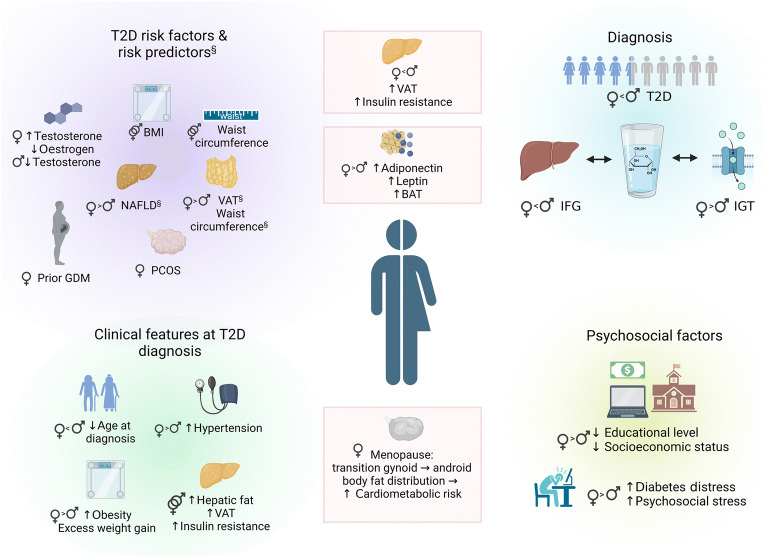
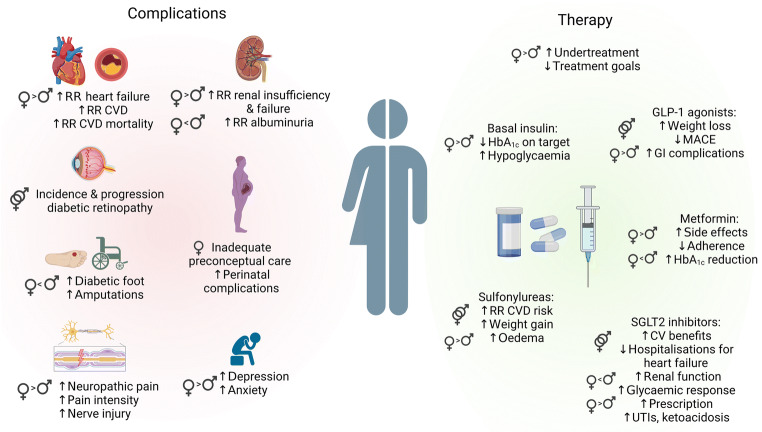
The prevalence of type 2 diabetes mellitus is increasing in both sexes, but men are usually diagnosed at a younger age and lower body fat mass than women. Worldwide, an estimated 17.7 million more men than women have diabetes mellitus. Women appear to bear a greater risk factor burden at the time of their type 2 diabetes diagnosis, especially obesity. Moreover, psychosocial stress might play a more prominent role in diabetes risk in women. Across their lifespan, women experience greater hormone fluctuations and body changes due to reproductive factors than men. Pregnancies can unmask pre-existing metabolic abnormalities, resulting in the diagnosis of gestational diabetes, which appears to be the most prominent risk factor for progression to type 2 diabetes in women. Additionally, menopause increases women’s cardiometabolic risk profile. Due to the progressive rise in obesity, there is a global increase in women with pregestational type 2 diabetes, often with inadequate preconceptual care. There are differences between men and women regarding type 2 diabetes and other cardiovascular risk factors with respect to comorbidities, the manifestation of complications and the initiation of and adherence to therapy. Women with type 2 diabetes show greater relative risk of CVD and mortality than men. Moreover, young women with type 2 diabetes are currently less likely than men to receive the treatment and CVD risk reduction recommended by guidelines. Current medical recommendations do not provide information on sex-specific or gender-sensitive prevention strategies and management. Thus, more research on sex differences, including the underlying mechanisms, is necessary to increase the evidence in the future. Nonetheless, intensified efforts to screen for glucose metabolism disorders and other cardiovascular risk factors, as well as the early establishment of prophylactic measures and aggressive risk management strategies, are still required for both men and women at increased risk of type 2 diabetes. In this narrative review we aim to summarise sex-specific clinical features and differences between women and men with type 2 diabetes into risk factors, screening, diagnosis, complications and treatment. Graphical abstract
Overview
The claims and statistics of this paper haven’t been checked yet.
Run the check — free, no account needed. It reads the open-access text and checks the sources it cites.
Integrity signals
Registry
Cites
Statistics
Figures
Verification
Claims the paper makes
The claims and statistics of this paper haven’t been checked yet.
Run the check — free, no account needed. It reads the open-access text and checks the sources it cites.
Claims other papers make about this one
Each is checked against this paper’s own text: does it say what the citing paper says it does?
The source backs part of the claim, not all of it — or backs it for a different population, condition or comparison.
In the citing paper
“women treated with GLP-1 RAs may experience greater glycaemic control and weight-reduction benefits, as well as a higher incidence of gastrointestinal adverse events, compared with men [59]”
From Subcutaneously administered tirzepatide vs semaglutide for adults with type 2 diabetes: a systematic review and network meta-analysis of randomised controlled trials (2024) · cites this paper as [59]
Experimental — accuracy not yet measuredThe cited source says what the claim attributes to it.
In the citing paper
“evidence suggests that sex differences may influence the efficacy and safety profiles of GLP-1 RAs [59]”
Self-check
Percentages, sums and reported differences re-computed from the paper’s own numbers.
The self-check needs the paper’s full text.
Citations
Cites
Dapagliflozin in Heart Failure with Mildly Reduced or Preserved Ejection Fraction
Solomon, S. D., McMurray, J. J. V., Claggett, B., de Boer, R. A., DeMets, D., Hernandez, A. F., Inzucchi, S. E., Kosiborod, M. N., Lam, C. S. P., Martinez, F., et al. (2022) · New England Journal of Medicine · doi:10.1056/nejmoa2206286 · Cited by 2,884
Angiotensin–Neprilysin Inhibition in Heart Failure with Preserved Ejection Fraction
Solomon, S. D., McMurray, J. J. V., Anand, I. S., Ge, J., Lam, C. S. P., Maggioni, A. P., Martinez, F., Packer, M., Pfeffer, M. A., Pieske, B., et al. (2019) · New England Journal of Medicine · doi:10.1056/nejmoa1908655 · Cited by 2,430
The progression from hypertension to congestive heart failure
Levy, D. (1996) · JAMA: The Journal of the American Medical Association · doi:10.1001/jama.1996.03530440037034 · Cited by 2,155 · cited 1×
“Hypertension is a main driver of heart failure progression, especially in women with hypertension compared with women without hypertension (threefold increase in risk in for women vs twofold for men) [75].”
BackgroundPolycystic Ovary Syndrome: Definition, Aetiology, Diagnosis and Treatment
Escobar-Morreale, H. F. (2018) · Nature Reviews Endocrinology · doi:10.1038/nrendo.2018.24 · Cited by 2,083
Sex and Gender Differences in Risk, Pathophysiology and Complications of Type 2 Diabetes Mellitus
Kautzky-Willer, A., Harreiter, J., & Pacini, G. (2016) · Endocrine Reviews · doi:10.1210/er.2015-1137 · Cited by 2,043
Self-citationSex and gender: modifiers of health, disease, and medicine
Mauvais-Jarvis, F., Bairey Merz, N., Barnes, P. J., Brinton, R. D., Carrero, J.-J., DeMeo, D. L., De Vries, G. J., Epperson, C. N., Govindan, R., Klein, S. L., et al. (2020) · The Lancet · doi:10.1016/s0140-6736(20)31561-0 · Cited by 2,001
A Randomized Trial of Low-Dose Aspirin in the Primary Prevention of Cardiovascular Disease in Women
Ridker, P. M., Cook, N. R., Lee, I.-M., Gordon, D., Gaziano, J. M., Manson, J. E., Hennekens, C. H., & Buring, J. E. (2005) · New England Journal of Medicine · doi:10.1056/nejmoa050613 · Cited by 1,945
McIntyre, H. D., Catalano, P., Zhang, C., Desoye, G., Mathiesen, E. R., & Damm, P. (2019) · Nature Reviews Disease Primers · doi:10.1038/s41572-019-0098-8 · Cited by 1,850
Huxley, R., Barzi, F., & Woodward, M. (2005) · BMJ · doi:10.1136/bmj.38678.389583.7c · Cited by 1,531
Research works printed but not linked: 1
- International Diabetes Federation (2021) IDF Diabetes Atlas, 10th edn. International Diabetes Federation, Brussels
Cited by
Sorted by citations
Oral Semaglutide and Cardiovascular Outcomes in High-Risk Type 2 Diabetes
McGuire, D. K., Marx, N., Mulvagh, S. L., Deanfield, J. E., Inzucchi, S. E., Pop-Busui, R., Mann, J. F. E., Emerson, S. S., Poulter, N. R., Engelmann, M. D. M., et al. (2025) · New England Journal of Medicine · doi:10.1056/nejmoa2501006 · Cited by 416
Diabetes in China part 1: epidemiology and risk factors
Xu, Y., Lu, J., Li, M., Wang, T., Wang, K., Cao, Q., Ding, Y., Xiang, Y., Wang, S., Yang, Q., et al. (2024) · The Lancet Public Health · doi:10.1016/s2468-2667(24)00250-0 · Cited by 247
Insights and implications of sexual dimorphism in osteoporosis
Zhang, Y., Xie, N., Sun, X., Nice, E. C., Liou, Y., Huang, C., Zhu, H., & Shen, Z. (2024) · Bone Research · doi:10.1038/s41413-023-00306-4 · Cited by 164
Siam, N. H., Snigdha, N. N., Tabasumma, N., & Parvin, I. (2024) · Reviews in Cardiovascular Medicine · doi:10.31083/j.rcm2512436 · Cited by 171
Sex-based differences in insulin resistance
Gado, M., Tsaousidou, E., Bornstein, S. R., & Perakakis, N. (2024) · Journal of Endocrinology · doi:10.1530/joe-23-0245 · Cited by 126
Metadata
- Authors
- Kautzky-Willer, A., Leutner, M., & Harreiter, J.
- Affiliations
- Medical University of Vienna (AT)
- Venue
- Diabetologia
- Published
- 2023-03-10
- Volume
- 66
- Issue
- 6
- Pages
- 986-1002
- ISSN
- 0012-186X (ISSN-L)
- 1432-0428
- PMC
- PMC10163139
- OpenAlex
- W4323804403
- Cited by
- 624
- References
- 138
- Citations by year
- 2026: 181 · 2025: 237 · 2024: 172 · 2023: 34
- FWCI
- 30.72
- Type
- journal article
- Language
- en
- Update notices
- correction (2023-04-12)
- Open access
- hybrid
- doi.org
- Locations
- Diabetologia (publishedVersion, cc-by)
- PubMed Central (publishedVersion, cc-by)
- PubMed (publishedVersion)
- Funders
- GENDER-NET Plus ERA-NET Initiative (GOING-FWD funded by the GENDER-NET Plus ERA-NET In)
- Topics
- Health Sciences › Medicine › Public Health, Environmental and Occupational Health › Sex and Gender in Healthcare
- Health Sciences › Medicine › Endocrinology, Diabetes and Metabolism › Diabetes, Cardiovascular Risks, and Lipoproteins
- Health Sciences › Medicine › Obstetrics and Gynecology › Gestational Diabetes Research and Management
- Keywords
- type 2 diabetes, sex differences, women, gestational diabetes mellitus, menopause, obesity, psychosocial stress, cardiovascular risk, diabetes complications, diabetes screening, diabetes diagnosis, medication adherence, reproductive factors
- MeSH terms
- Cardiovascular Diseases, Diabetes Mellitus, Type 2, Female, Humans, Male, Obesity, Risk Factors, Sex Characteristics, Sex Factors, Prevalence
About these checks
Registry, retraction, Cites and statistics results are computed, not judged, with one exception: a printed reference that no index lists is read once by a model before it counts as a citation error. Claims are extracted by a model and kept only when their quote appears verbatim in the text; each cited source is then checked, with a model’s help, for whether it says what the claim relies on. Those verdicts can be wrong — read the claim’s quote and the cited source before relying on one.
Statistics and arithmetic are recomputed, not judged.
Confidence bands are shown only for fields calibrated on our annotated test set. None is calibrated yet, so no band is shown.
What counts as a claim ›How we measure confidence ›How we check this ›
Are you an author, or do you see a problem with this page? Request a review
