

Bone health assessment in older people with or without muscle health impairment
Open accessThe DOI matches its Crossref record; 46 of the 46 references it cites were found in a registry or an index.
Abstract
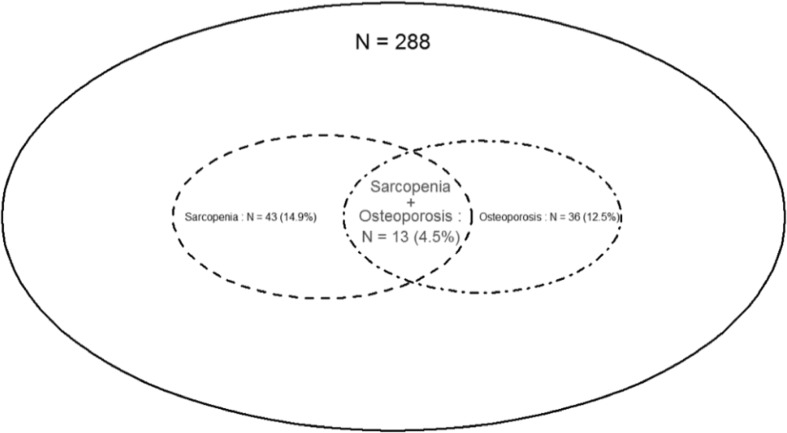
This study investigated the relationship between muscle and bone status in elderly individuals. Our results suggested links between sarcopenia and osteoporosis; impairment in muscle status (i.e., muscle mass, muscle strength, and physical performance) is associated with deterioration in bone mass and texture subsequently leading to an increased risk of fracture. Accumulating evidence has shown associations between sarcopenia and osteoporosis, but existing studies face inconsistencies in the clinical definition of both conditions. Thus, we sought to investigate bone health among older individuals with or without muscle health impairment. We conducted an analysis of cross-sectional data available from the Sarcopenia and Physical Impairment with Advancing Age (SarcoPhAge) study. Sarcopenia was diagnosed according to the European Working Group on Sarcopenia in Older People (EWGSOP) (i.e., a low muscle mass plus either low muscle strength or low physical performance). Muscle mass and areal bone mineral density (aBMD) were determined using dual-energy X-ray absorptiometry (DEXA). Muscle strength was assessed using a hand dynamometer, and physical performance was assessed with the Short Physical Performance Battery test. Using the cutoff limits proposed by the EWGSOP, we have classified women in the “low SMI group” when its value was < 5.50 kg/m 2 , in the “low muscle strength group” when strength was < 20 kg, and in the “low physical performance group” when SPPB < 8 points. The thresholds of < 7.26 kg/m 2 (for SMI), < 30 kg (for muscle strength), and SPPB < 8 points were used for men. The 10-year fracture risk was obtained using the FRAX® tool. Moreover, bone texture was determined using the trabecular bone score (TBS) method. The study sample consisted of 288 older subjects aged 74.7 ± 5.7 years, and 59.0% of the subjects were women. Sarcopenia was diagnosed in 43 individuals (14.9%), and osteoporosis was diagnosed in 36 subjects (12.5%). Moreover, aBMD values were, most of the time, lower in older men and women with muscle impairment (i.e., low muscle mass, low muscle strength, and low physical performance). For these subjects, we also noted a higher probability of fracture. When comparing bone quality, there were no significant differences in the TBS values between sarcopenic and non-sarcopenic older men and women or between those with low and high muscle mass. However, when controlling for confounders (i.e., age, BMI, number of co-morbidities, smoking status, and nutritional status), TBS values were lower in older women with low muscle strength ( p = 0.04) and in older men with low physical performance ( p = 0.01). Our study showed interrelationships between components of sarcopenia and osteoporosis, with older subjects with muscle impairment having poorer bone health.
Overview
The claims and statistics of this paper haven’t been checked yet.
Free: it reads the open-access text and checks the first 5 claims that cite a source we can check. Create a free account to check every claim.
Integrity signals
Registry
Cites
Statistics
Figures
Verification
Claims the paper makes
The claims and statistics of this paper haven’t been checked yet.
Free: it reads the open-access text and checks the first 5 claims that cite a source we can check. Create a free account to check every claim.
Claims other papers make about this one
Each is checked against this paper’s own text: does it say what the citing paper says it does?
In the citing paper
“Sarcopenia is a major risk factor and a major component of aging-related illnesses [3,168].”
From Bone diseases in patients with chronic liver disease (2019) · cites this paper as [168]
Self-check
Percentages, sums and reported differences re-computed from the paper’s own numbers.
The self-check needs the paper’s full text.
Citations
Cites
Sarcopenia: European consensus on definition and diagnosis
Cruz-Jentoft, A. J., Baeyens, J. P., Bauer, J. M., Boirie, Y., Cederholm, T., Landi, F., Martin, F. C., Michel, J.-P., Rolland, Y., Schneider, S. M., et al. (2010) · Age and Ageing · doi:10.1093/ageing/afq034 · Cited by 11,601
Roberts, H. C., Denison, H. J., Martin, H. J., Patel, H. P., Syddall, H., Cooper, C., & Sayer, A. A. (2011) · Age and Ageing · doi:10.1093/ageing/afr051 · Cited by 3,001
Guralnik, J. M., Ferrucci, L., Pieper, C. F., Leveille, S. G., Markides, K. S., Ostir, G. V., Studenski, S., Berkman, L. F., & Wallace, R. B. (2000) · The Journals of Gerontology Series A: Biological Sciences and Medical Sciences · doi:10.1093/gerona/55.4.m221 · Cited by 2,898
Studenski, S. A., Peters, K. W., Alley, D. E., Cawthon, P. M., McLean, R. R., Harris, T. B., Ferrucci, L., Guralnik, J. M., Fragala, M. S., Kenny, A. M., et al. (2014) · The Journals of Gerontology: Series A · doi:10.1093/gerona/glu010 · Cited by 2,545 · cited 1×
“In the case of sarcopenia, some studies defined the disease based on low musclemass alone [8–12], but a growing consensus advocates for sarcopenia to be defined additionally on the basis of decreased muscle strength and/or impaired physical function [13, 14].”
BackgroundFRAX™ and the assessment of fracture probability in men and women from the UK
Kanis, J. A., Johnell, O., Oden, A., Johansson, H., & McCloskey, E. (2008) · Osteoporosis International · doi:10.1007/s00198-007-0543-5 · Cited by 2,467
Self-citationGuigoz, Y., Vellas, B., & Garry, P. J. (2009) · Nutrition Reviews · doi:10.1111/j.1753-4887.1996.tb03793.x · Cited by 1,564
A reference standard for the description of osteoporosis
Kanis, J. A., McCloskey, E. V., Johansson, H., Oden, A., Melton, L. J., & Khaltaev, N. (2008) · Bone · doi:10.1016/j.bone.2007.11.001 · Cited by 1,234
Self-citationOsteoporosis: A still increasing prevalence
Reginster, J.-Y., & Burlet, N. (2006) · Bone · doi:10.1016/j.bone.2005.11.024 · Cited by 1,013
Self-citationWelcome to the ICD‐10 code for sarcopenia
Anker, S. D., Morley, J. E., & von Haehling, S. (2016) · Journal of Cachexia, Sarcopenia and Muscle · doi:10.1002/jcsm.12147 · Cited by 983
Hans, D., Goertzen, A. L., Krieg, M.-A., & Leslie, W. D. (2011) · Journal of Bone and Mineral Research · doi:10.1002/jbmr.499 · Cited by 643
Cited by
Yeung, S. S. Y., Reijnierse, E. M., Pham, V. K., Trappenburg, M. C., Lim, W. K., Meskers, C. G. M., & Maier, A. B. (2019) · Journal of Cachexia Sarcopenia and Muscle · doi:10.1002/jcsm.12411 · Cited by 1,115
“Five studies for fractures were rated as low quality.(38,39,42,46,47) Association of sarcopenia with falls Twenty-two studies investigated the association of sarcopenia and falls, of which 10 studies (45%) reported higher risks of falls among sarcopenic individuals compared with non-sarcopenic individuals.”
BackgroundOsteosarcopenia: where osteoporosis and sarcopenia collide
Clynes, M. A., Gregson, C. L., Bruyère, O., Cooper, C., & Dennison, E. M. (2021) · Rheumatology · doi:10.1093/rheumatology/keaa755 · Cited by 268
Self-citationSarcopenia and osteoporosis in older people: a systematic review and meta-analysis
Nielsen, B. R., Abdulla, J., Andersen, H. E., Schwarz, P., & Suetta, C. (2018) · European Geriatric Medicine · doi:10.1007/s41999-018-0079-6 · Cited by 166
Chen, S., Xu, X., Gong, H., Chen, R., Guan, L., Yan, X., Zhou, L., Yang, Y., Wang, J., Zhou, J., et al. (2023) · Journal of Cachexia Sarcopenia and Muscle · doi:10.1002/jcsm.13392 · Cited by 148
Bone diseases in patients with chronic liver disease
Jeong, H., & Kim, D. (2019) · International Journal of Molecular Sciences · doi:10.3390/ijms20174270 · Cited by 113
“Sarcopenia is a major risk factor and a major component of aging-related illnesses [3,168].”
BackgroundWirnitzer, K. (2020) · International Journal of Sports and Exercise Medicine · doi:10.23937/2469-5718/1510165 · Cited by 70
Strength and multimorbidity among community-dwelling elderly from southern Brazil
Montes, M. C., Bortolotto, C. C., Tomasi, E., González, M. C., Barbosa-Silva, T. G., Domingues, M. R., & Bielemann, R. M. (2019) · Nutrition · doi:10.1016/j.nut.2019.110636 · Cited by 56
Nielsen, B. R., Andersen, H. E., Haddock, B., Hovind, P. H., Schwarz, P., & Suetta, C. (2020) · Experimental Gerontology · doi:10.1016/j.exger.2020.110974 · Cited by 55
Locquet, M., Beaudart, C., Reginster, J., & Bruyère, O. (2018) · Calcified Tissue International · doi:10.1007/s00223-018-0503-4 · Cited by 53
Self-citationFracture Risk Assessment: An Update
Cozadd, A. J., Schroder, L. K., & Switzer, J. A. (2021) · Journal of Bone and Joint Surgery · doi:10.2106/jbjs.20.01071 · Cited by 42
Geerinck, A., Bruyère, O., Locquet, M., Reginster, J., & Beaudart, C. (2018) · Advances in Therapy · doi:10.1007/s12325-018-0820-z · Cited by 42
Self-citationBone mineral density and trabecular bone score in Chinese subjects with sarcopenia
Qi, H., Sheng, Y., Chen, S., Wang, S., Zhang, A., Cai, J., Lai, B., & Ding, G. (2019) · Aging Clinical and Experimental Research · doi:10.1007/s40520-019-01266-8 · Cited by 41
Kajiki, Y., Tsuji, H., Misawa, H., Nakahara, R., Tetsunaga, T., Yamane, K., Oda, Y., Takao, S., & Ozaki, T. (2021) · Nutrition · doi:10.1016/j.nut.2021.111428 · Cited by 39
Xiu, S., Chhetri, J. K., Sun, L., Mu, Z., & Wang, L. (2019) · Therapeutic Advances in Chronic Disease · doi:10.1177/2040622319857361 · Cited by 38
Research progress on sarcopenia in the musculoskeletal system
Mao, X., Lv, K., Qi, W., Cheng, W., Li, T., Sun, Y., Jin, H., Pan, H., & Wang, D. (2025) · Bone Research · doi:10.1038/s41413-025-00455-8 · Cited by 37
Yun, H. J., Ryoo, S. R., Kim, J., Choi, Y. J., Park, I., Shin, G., Kim, H., & Jeong, J. C. (2020) · BMC Nephrology · doi:10.1186/s12882-020-01944-0 · Cited by 31
A pas de deux of osteoporosis and sarcopenia: osteosarcopenia
Laskou, F., Patel, H. P., Cooper, C. C., & Dennison, E. M. (2021) · Climacteric · doi:10.1080/13697137.2021.1951204 · Cited by 30
Wagner, P. P., Whittier, D. E., Foesser, D., Boyd, S. K., Chapurlat, R. D., & Szulc, P. (2021) · The Journal of Clinical Endocrinology & Metabolism · doi:10.1210/clinem/dgab506 · Cited by 29
Igarashi-Migitaka, J., Seki, A., Ikegame, M., Honda, M., Sekiguchi, T., Mishima, H., Shimizu, N., Matsubara, H., Srivastav, A. K., Hirayama, J., et al. (2020) · Acta Histochemica · doi:10.1016/j.acthis.2020.151596 · Cited by 22
Helicobacter pylori Related Diseases and Osteoporotic Fractures (Narrative Review)
Fisher, L., Fisher, A., & Smith, P. N. (2020) · Journal of Clinical Medicine · doi:10.3390/jcm9103253 · Cited by 21
Testa, G., Vescio, A., Zuccalà, D., Petrantoni, V., Amico, M., Russo, G. I., Sessa, G., & Pavone, V. (2020) · Journal of Clinical Medicine · doi:10.3390/jcm9092997 · Cited by 21
Hernández-Martínez, P., Olmos, J. M., Llorca, J., Hernández, J. L., & González-Macías, J. (2022) · Archives of Osteoporosis · doi:10.1007/s11657-022-01146-1 · Cited by 20
Osteosarcopenia, an Asymmetrical Overlap of Two Connected Syndromes: Data from the OsteoSys Study
Pourhassan, M., Buehring, B., Stervbo, U., Rahmann, S., Mölder, F., Rütten, S., Trampisch, U. S., Babel, N., Westhoff, T. H., & Wirth, R. (2021) · Nutrients · doi:10.3390/nu13113786 · Cited by 19
The Triple Burden of Osteoporosis, Sarcopenia, and Aging in Geriatrics (review)
Kurmaev, D. P., Bulgakova, S. V., Treneva, E. V., Kosareva, O. V., Sharonova, L. A., & Dolgikh, Y. A. (2024) · Russian Journal of Geriatric Medicine · doi:10.37586/2686-8636-3-2024-225-239 · Cited by 15
Juesas, Á., Gargallo, P., Gené‐Morales, J., Babiloni-López, C., Saez-Berlanga, Á., Jiménez‐Martínez, P., Casaña, J., Benítez-Martínez, J. C., Ramírez‐Campillo, R., Chulvi‐Medrano, I., et al. (2023) · International Journal of Environmental Research and Public Health · doi:10.3390/ijerph20064700 · Cited by 15
Du, Y., Tao, S., Oh, C., & No, J.-K. (2023) · Journal of Obesity & Metabolic Syndrome · doi:10.7570/jomes22057 · Cited by 14
Sarcopenia and self-reported markers of physical frailty in patients with osteoporosis
Nielsen, B. R., Andersen, H. E., Hovind, P. H., Jørgensen, N. R., Schwarz, P., Kristensen, S. H., & Suetta, C. (2024) · Archives of Osteoporosis · doi:10.1007/s11657-024-01437-9 · Cited by 14
Jin, S., Zheng, F., Liu, H., Liu, L., & Yu, J. (2025) · Frontiers in Medicine · doi:10.3389/fmed.2025.1603879 · Cited by 14
What Is ‘Muscle Health’? A Narrative Review and Conceptual Framework
Boncella, K. L., Oranchuk, D. J., Gonzalez-Rivera, D., Sawyer, E. E., Magnusson, D., & Harris‐Love, M. O. (2025) · Journal of Functional Morphology and Kinesiology · doi:10.3390/jfmk10040367 · Cited by 13
Ge, H., Yang, S., Su, W., Guan, W., Dong, S., Chang, W., Jia, H., Jiang, S., Qin, D., & Ma, G. (2025) · BMC Geriatrics · doi:10.1186/s12877-025-05723-0 · Cited by 12
Co‐morbid sarcopenia and low bone mineral density in young paediatric cancer survivors
Mármol-Pérez, A., Ubago‐Guisado, E., Gil-Cosano, J. J., Llorente‐Cantarero, F. J., Pascual-Gázquez, J. F., Muñoz‐Torres, M., Martínez‐Vizcaíno, V., Ness, K. K., Ruiz, J. R., & Gracia‐Marco, L. (2024) · Journal of Cachexia Sarcopenia and Muscle · doi:10.1002/jcsm.13563 · Cited by 11
Martel, D., Honig, S., Monga, A., & Chang, G. A. (2020) · Bone Reports · doi:10.1016/j.bonr.2020.100259 · Cited by 11
Fragilidad, sarcopenia y osteoporosis
Olmos, J. M., Martínez, P. H., & Macías, J. G. (2024) · Medicina Clínica · doi:10.1016/j.medcli.2024.03.004 · Cited by 9
Frailty, sarcopenia and osteoporosis
Olmos, J. M., Martínez, P. H., & Macías, J. G. (2024) · Medicina Clínica (English Edition) · doi:10.1016/j.medcle.2024.03.004 · Cited by 8
Wang, W., Gu, X., Cao, Z., Wang, X., Lei, Y., Xu, X., Wang, S., Wu, T., & Bao, Z. (2023) · Lipids in Health and Disease · doi:10.1186/s12944-023-01879-z · Cited by 7
Telli, H., & Özdemir, Ç. (2024) · Turkish Journal of Osteoporosis · doi:10.4274/tod.galenos.2023.60437 · Cited by 6
The Local and Systemic Interactions Between Muscle and Bone in Postmenopausal Korean Women
Kwak, M. K., Kim, B., Kim, J. S., Lee, S. H., & Koh, J. (2019) · Calcified Tissue International · doi:10.1007/s00223-019-00585-2 · Cited by 6
Katsurasako, T., Murata, S., Goda, A., Nakano, H., Shiraiwa, K., Horie, J., & Nonaka, K. (2022) · Geriatrics · doi:10.3390/geriatrics7050098 · Cited by 6
Bekele, B. M., Moritz, I., Reißberg, S., & Ryang, Y. (2025) · Archives of Osteoporosis · doi:10.1007/s11657-025-01633-1 · Cited by 6
Li, J., Long, X., Wang, L., Li, Q., Wang, L., & Song, Y. (2025) · Orthopaedic Surgery · doi:10.1111/os.70028 · Cited by 6
Osawa, R., Ikegami, S., Horiuchi, H., Tokida, R., Kato, H., & Takahashi, J. A. (2021) · Journal of Clinical Medicine · doi:10.3390/jcm10091896 · Cited by 6
Does Superior Bone Health Promote a Longer Lifespan?
Dayer, S. R., Mears, S. C., Pangle, A. K., Mendiratta, P., Wei, J. Y., & Azhar, G. (2021) · Geriatric Orthopaedic Surgery & Rehabilitation · doi:10.1177/21514593211036231 · Cited by 5
Ming-zhong, Y., Su, Y., Wang, P., & Pan, M. (2025) · Frontiers in Endocrinology · doi:10.3389/fendo.2025.1590247 · Cited by 5
Heo, J., Lee, S. C., Kim, J. H., Nam, C. H., Lee, D. N., & Baek, J. (2025) · Osteoporosis International · doi:10.1007/s00198-025-07731-7 · Cited by 4
Relationship between physical functional status indicators and bone mineral density in older women
Takahashi, I., Watanabe, K., Kawashima, H., Noguchi, H., Sato, J., & Ishii, Y. (2024) · Journal of Orthopaedics · doi:10.1016/j.jor.2024.06.014 · Cited by 4
Guidelines for Rehabilitation Interventions in Older Adults With Sarcopenia (2025 Edition)
Li, Y., Wang, S., Wang, X., Liu, Z., Wang, R., Liang, Y. T., Li, Y., Yu, Y., Zhang, L., Kirk, B., et al. (2026) · Journal of Evidence-Based Medicine · doi:10.1111/jebm.70131 · Cited by 3
Neto, L. S. S., Rezende, F. A. C., Nunes, D. P., Maciel, É. D. S., Travassos, A., & Osório, N. B. (2018) · Acta Fisiátrica · doi:10.11606/issn.2317-0190.v25i4a163868 · Cited by 3
Bone involvement in the early stages of Parkinson’s disease: a case–control study
Liguori, S., Moretti, A., Paoletta, M., Gargiulo, F., Barra, G., Gimigliano, F., & Iolascon, G. (2024) · Journal of International Medical Research · doi:10.1177/03000605241237880 · Cited by 3
Huang, L., Wang, X., Zhang, X., Li, S., Liu, X., Ma, Z., Qian, B., Zhou, C., & Luo, Z. (2025) · PLoS ONE · doi:10.1371/journal.pone.0329062 · Cited by 2
Association between sarcopenia, its components, and osteoporosis in the FRISBEE cohort
Tchang, S. L., de Filette, J. M. K., Iconaru, L., Bellanger, A., Sánchez‐Rodríguez, D., Charles, A., Baleanu, F., Mugisha, A., Surquin, M., Benoit, F., et al. (2025) · BMC Musculoskeletal Disorders · doi:10.1186/s12891-025-09146-1 · Cited by 2
Trastornos del metabolismo óseo en los pacientes frágiles
Hernández Martínez, P. (2023) · UCrea (University of Cantabria) · Cited by 2
Bellanger, A., Sánchez‐Rodríguez, D., Nzintcheu, F. K. Y., Iconaru, L., Mugisha, A., de Filette, J. M. K., Baleanu, F., Hambye, A., Lenghel, D. E., Benoit, F., et al. (2025) · Rehabilitación · doi:10.1016/j.rh.2025.100935 · Cited by 2
Advances in Geriatrics and Gerontology - Challenges of the New Millennium
Palermo, S. (2023) · IntechOpen eBooks · doi:10.5772/intechopen.111024 · Cited by 1
Impact of a Novel Training Approach on Body Composition in the Elderly
Scott Matthew, C., Allen Jason, D., Johannsen, N. M., Credeur, D. P., Earnest, C. P., Church, T. S., Ravussin, É., Kraus, W. E., & Welsch, M. A. (2020) · International Journal of Sports and Exercise Medicine · doi:10.23937/2469-5718/1510166 · Cited by 1
Integrative Analyses of Biomarkers and Pathways for OsteosarcopeniaPreprint
Li, Y., Sun, J., & Wang, G. (2021) · Research Square · doi:10.21203/rs.3.rs-283082/v1 · Cited by 1
Wagner, P. (2021) · theses.fr (ABES) · doi:10.70675/d071d07fzfa0cz4597za992z0df6a8c7b282 · Cited by 1
Đặc điểm Sarcopenia ở bệnh nhân loãng xương
Thoa, N. T., Trang, T. T. T., Hiền, P. T., Minh, Đ. Q., & Thu, P. H. (2026) · Tạp chí Nghiên cứu Y học · doi:10.52852/tcncyh.v199i2.4589 · Cited by 1
Mineral disorders in patients with chronic liver disease. Part 2: management
Spasskaya, O., Максимовна, Г. А., Евгеньевна, Б. Е., Tikhonov, I. N., Константиновна, Е. А., Khairieva, А. V., Litvinova, E. E., & Mokrysheva, N. G. (2026) · Obesity and metabolism · doi:10.14341/omet13290
Aggarwal, V., Kohli, S., Aggarwal, N., & Thakur, S. (2026) · The Egyptian Journal of Radiology and Nuclear Medicine · doi:10.1186/s43055-026-01774-4
Kirk, B., Zanker, J., Phu, S., & Duque, G. (2021) · Wiley eBooks · doi:10.1002/9781119597896.ch11
Özbek, İ. C., & Okutan, İ. (2026) · Egyptian Rheumatology and Rehabilitation · doi:10.1186/s43166-026-00440-x
Zarco, E. P., Gibbone, A., & Matatyaho, H. (2024) · IntechOpen eBooks · doi:10.5772/intechopen.113974
Associated Mechanisms and Interventions for Osteosarcopenia
袁, 良. (2025) · Advances in Clinical Medicine · doi:10.12677/acm.2025.1551584
Gu, J., Zhang, B., Long, X., Wang, X., Qin, W.-K., & Yongli, D. (2026) · PLoS ONE · doi:10.1371/journal.pone.0340693
Vidigal, C. V., Grili, P. P. D. F., da Cruz, G. F., Albergaria, B., Cardoso, L. D., Marques-Rocha, J. L., & Guandalini, V. R. (2025) · Journal of Nutrition and Metabolism · doi:10.1155/jnme/3170619
Körüklü, K. F., Demirulus, S., Tüfekçi, O., Karakaş, M., NARİN, G., Çağlayan, S., Yurdakul, T. N. Ç., Çetinkaya, B., Shahgaldiyev, M., Koç, M., et al. (2026) · Akademisyen Kitabevi eBooks · doi:10.37609/akya.4084
Palacios, P., Palacios, I. C. D., de Robles, P. A., Lorente, A., Mariscal, G., Benlloch, M., Gutiérrez, J. C., & Palacios, A. (2026) · Asian Spine Journal · doi:10.31616/asj.2025.0265
Zhang, Z., Guan, W., Xu, Y., Lin, Q., Song, X., Li, Y., Zhang, Y., Li, T., & Yu, W. (2023) · Research Square · doi:10.21203/rs.3.rs-3271631/v1
Lenci, F. (2024) · Electronic Theses and Dissertations Repository (University of Pisa)
Diagnostic de la sarcopénie par mesure échographique en population gériatrique
Sarrazy Garcia, V. (2023) · HAL
Gesar, B. (2018) · Lund University Publications (Lund University)
de Almeida, S. B. B. (2024) · LA Referencia (Red Federada de Repositorios Institucionales de Publicaciones Científicas)
Prevention and Treatment of Sarcopenia
Testa, G. (2021) · MDPI eBooks · doi:10.3390/books978-3-0365-1535-9
Current Advances in Spinal Diseases of Elderly Patients
Hirai, T., Nakashima, H., Miyagi, M., Takahashi, S., & Uehara, M. (2022) · MDPI eBooks · doi:10.3390/books978-3-0365-3900-3
Sarkopeniye Algoritmik Yaklaşım
Cenberoğlu, M. A. (2026) · Akademisyen Kitabevi eBooks · doi:10.37609/akya.4084.c6675
Reply to Letter to the Editor ‘Osteosarcopenia: Adjust for the BMI or Bare the Bias’
Paulin, T. K., Malmgren, L., McGuigan, F. E., & Åkesson, K. (2024) · Calcified Tissue International · doi:10.1007/s00223-024-01223-2
Piskórz, M., Miazek, W., Suski, P., Tokarczuk, O. D., & Różyło‐Kalinowska, I. (2025) · Medycyna Ogólna i Nauki o Zdrowiu · doi:10.26444/monz/200683
Kajiki, Y. (2022) · Institutional Repositories DataBase (IRDB) · doi:10.18926/63595
Yun, H. J., Ryoo, S. R., Kim, J.-E., Choi, Y. J., Park, I., Shin, G.-T., Kim, H., & Jeong, J. C. (2020) · Figshare · doi:10.6084/m9.figshare.12720065
Intrinsic capacity is associated with fracture risk in older women with osteoporosis
Oliveri, C. V., Surace, F., Morabito, N., Basile, G., Gaudio, A., Cesari, M., & Catalano, A. (2026) · Osteoporosis International · doi:10.1007/s00198-026-08323-9
Metadata
- Authors
- Locquet, M., Beaudart, C., Bruyère, O., Kanis, J. A., Delandsheere, L., & Reginster, J.-Y.
- Affiliations
- University of Liège (BE)
- Australian Catholic University (AU)
- Corresponding author
- Locquet, M.
- Venue
- Osteoporosis International
- Published
- 2018-02-14
- Volume
- 29
- Issue
- 5
- Pages
- 1057-1067
- ISSN
- 0937-941X (ISSN-L)
- 1433-2965
- PMC
- PMC5948285
- OpenAlex
- W2789545471
- Cited by
- 65
- References
- 46
- Citations by year
- 2026: 5 · 2025: 13 · 2024: 10 · 2023: 5 · 2022: 2 · 2021: 10 · 2020: 10 · 2019: 6 · 2018: 4
- FWCI
- 5.15
- Type
- journal article
- Language
- en
- Open access
- hybrid
- doi.org
- Licence
- cc-by-nc
- creativecommons.org/licenses/by-nc/4.0 (tdm)
- Locations
- Osteoporosis International (publishedVersion, cc-by-nc)
- Europe PMC (PubMed Central) (publishedVersion, cc-by-nc)
- PubMed Central (publishedVersion, cc-by-nc)
- PubMed (publishedVersion)
- Research Bank (Australian Catholic University) (submittedVersion)
- HAL (submittedVersion)
- Open Repository and Bibliography (University of Liège) (submittedVersion)
- Topics
- Health Sciences › Medicine › Physiology (medical) › Nutrition and Health in Aging
- Health Sciences › Medicine › Orthopedics and Sports Medicine › Bone health and osteoporosis research
- Health Sciences › Medicine › Geriatrics and Gerontology › Frailty in Older Adults
- Keywords
- sarcopenia, osteoporosis, bone health, older adults, muscle mass, muscle strength, physical performance, bone mineral density, bone quality, trabecular bone score, fracture risk, EWGSOP criteria, sarcopenic osteoporosis, sex differences, grip strength, physical activity
- MeSH terms
- Physical Functional Performance, Aged, Aged, 80 and over, Belgium, Cross-Sectional Studies, Female, Femur Neck, Hip Joint, Humans, Lumbar Vertebrae, Male, Osteoporosis, Absorptiometry, Photon, Bone Density, Geriatric Assessment, Muscle, Skeletal, Muscle Strength, Sarcopenia
About these checks
Registry, retraction, Cites and statistics results are computed, not judged, with one exception: a printed reference that no index lists is read once by a model before it counts as a citation error. Claims are extracted by a model and kept only when their quote appears verbatim in the text; each cited source is then checked, with a model’s help, for whether it says what the claim relies on. Those verdicts can be wrong — read the claim’s quote and the cited source before relying on one.
Statistics and arithmetic are recomputed, not judged.
Confidence bands are shown only for fields calibrated on our annotated test set. None is calibrated yet, so no band is shown.
What counts as a claim ›How we measure confidence ›How we check this ›
Are you an author, or do you see a problem with this page? Request a review
Data sources
Bibliographic data: Semantic Scholar, OpenAlex, Crossref.
Contains information from the Semantic Scholar Academic Graph Datasets, made available under the ODC Attribution License (ODC-BY 1.0).
Semantic Scholar’s data is described in: Kinney, R., et al. (2023). The Semantic Scholar Open Data Platform. arXiv:2301.10140.
