

Bone health assessment in older people with or without muscle health impairment
Open accessThe DOI matches its Crossref record; 46 of the 46 references it cites were found in a registry or an index.
Abstract
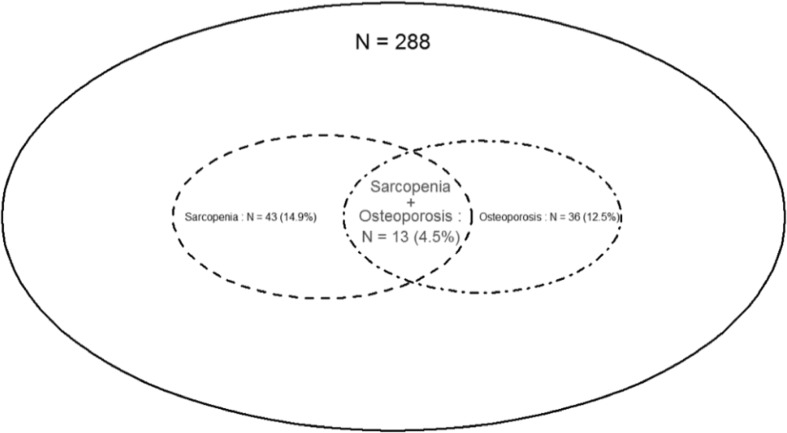
This study investigated the relationship between muscle and bone status in elderly individuals. Our results suggested links between sarcopenia and osteoporosis; impairment in muscle status (i.e., muscle mass, muscle strength, and physical performance) is associated with deterioration in bone mass and texture subsequently leading to an increased risk of fracture. Accumulating evidence has shown associations between sarcopenia and osteoporosis, but existing studies face inconsistencies in the clinical definition of both conditions. Thus, we sought to investigate bone health among older individuals with or without muscle health impairment. We conducted an analysis of cross-sectional data available from the Sarcopenia and Physical Impairment with Advancing Age (SarcoPhAge) study. Sarcopenia was diagnosed according to the European Working Group on Sarcopenia in Older People (EWGSOP) (i.e., a low muscle mass plus either low muscle strength or low physical performance). Muscle mass and areal bone mineral density (aBMD) were determined using dual-energy X-ray absorptiometry (DEXA). Muscle strength was assessed using a hand dynamometer, and physical performance was assessed with the Short Physical Performance Battery test. Using the cutoff limits proposed by the EWGSOP, we have classified women in the “low SMI group” when its value was < 5.50 kg/m 2 , in the “low muscle strength group” when strength was < 20 kg, and in the “low physical performance group” when SPPB < 8 points. The thresholds of < 7.26 kg/m 2 (for SMI), < 30 kg (for muscle strength), and SPPB < 8 points were used for men. The 10-year fracture risk was obtained using the FRAX® tool. Moreover, bone texture was determined using the trabecular bone score (TBS) method. The study sample consisted of 288 older subjects aged 74.7 ± 5.7 years, and 59.0% of the subjects were women. Sarcopenia was diagnosed in 43 individuals (14.9%), and osteoporosis was diagnosed in 36 subjects (12.5%). Moreover, aBMD values were, most of the time, lower in older men and women with muscle impairment (i.e., low muscle mass, low muscle strength, and low physical performance). For these subjects, we also noted a higher probability of fracture. When comparing bone quality, there were no significant differences in the TBS values between sarcopenic and non-sarcopenic older men and women or between those with low and high muscle mass. However, when controlling for confounders (i.e., age, BMI, number of co-morbidities, smoking status, and nutritional status), TBS values were lower in older women with low muscle strength ( p = 0.04) and in older men with low physical performance ( p = 0.01). Our study showed interrelationships between components of sarcopenia and osteoporosis, with older subjects with muscle impairment having poorer bone health.
Overview
The claims and statistics of this paper haven’t been checked yet.
Free: it reads the open-access text and checks the first 5 claims that cite a source we can check. Create a free account to check every claim.
Integrity signals
Registry
Cites
Statistics
Figures
Verification
Claims the paper makes
The claims and statistics of this paper haven’t been checked yet.
Free: it reads the open-access text and checks the first 5 claims that cite a source we can check. Create a free account to check every claim.
Claims other papers make about this one
Each is checked against this paper’s own text: does it say what the citing paper says it does?
In the citing paper
“Sarcopenia is a major risk factor and a major component of aging-related illnesses [3,168].”
From Bone diseases in patients with chronic liver disease (2019) · cites this paper as [168]
Self-check
Percentages, sums and reported differences re-computed from the paper’s own numbers.
The self-check needs the paper’s full text.
Citations
Cites
Sarcopenia: European consensus on definition and diagnosis
Cruz-Jentoft, A. J., Baeyens, J. P., Bauer, J. M., Boirie, Y., Cederholm, T., Landi, F., Martin, F. C., Michel, J.-P., Rolland, Y., Schneider, S. M., et al. (2010) · Age and Ageing · doi:10.1093/ageing/afq034 · Cited by 11,601
Roberts, H. C., Denison, H. J., Martin, H. J., Patel, H. P., Syddall, H., Cooper, C., & Sayer, A. A. (2011) · Age and Ageing · doi:10.1093/ageing/afr051 · Cited by 3,001
Guralnik, J. M., Ferrucci, L., Pieper, C. F., Leveille, S. G., Markides, K. S., Ostir, G. V., Studenski, S., Berkman, L. F., & Wallace, R. B. (2000) · The Journals of Gerontology Series A: Biological Sciences and Medical Sciences · doi:10.1093/gerona/55.4.m221 · Cited by 2,898 · cited 1×
“Physical performance was evaluated by the short physical performance battery (SPPB) test (12 points) [24].”
MethodStudenski, S. A., Peters, K. W., Alley, D. E., Cawthon, P. M., McLean, R. R., Harris, T. B., Ferrucci, L., Guralnik, J. M., Fragala, M. S., Kenny, A. M., et al. (2014) · The Journals of Gerontology: Series A · doi:10.1093/gerona/glu010 · Cited by 2,545 · cited 1×
“In the case of sarcopenia, some studies defined the disease based on low musclemass alone [8–12], but a growing consensus advocates for sarcopenia to be defined additionally on the basis of decreased muscle strength and/or impaired physical function [13, 14].”
BackgroundFRAX™ and the assessment of fracture probability in men and women from the UK
Kanis, J. A., Johnell, O., Oden, A., Johansson, H., & McCloskey, E. (2008) · Osteoporosis International · doi:10.1007/s00198-007-0543-5 · Cited by 2,467
Self-citationGuigoz, Y., Vellas, B., & Garry, P. J. (2009) · Nutrition Reviews · doi:10.1111/j.1753-4887.1996.tb03793.x · Cited by 1,564
A reference standard for the description of osteoporosis
Kanis, J. A., McCloskey, E. V., Johansson, H., Oden, A., Melton, L. J., & Khaltaev, N. (2008) · Bone · doi:10.1016/j.bone.2007.11.001 · Cited by 1,234
Self-citationOsteoporosis: A still increasing prevalence
Reginster, J.-Y., & Burlet, N. (2006) · Bone · doi:10.1016/j.bone.2005.11.024 · Cited by 1,013
Self-citationWelcome to the ICD‐10 code for sarcopenia
Anker, S. D., Morley, J. E., & von Haehling, S. (2016) · Journal of Cachexia, Sarcopenia and Muscle · doi:10.1002/jcsm.12147 · Cited by 983
Hans, D., Goertzen, A. L., Krieg, M.-A., & Leslie, W. D. (2011) · Journal of Bone and Mineral Research · doi:10.1002/jbmr.499 · Cited by 643
Cited by
Yeung, S. S. Y., Reijnierse, E. M., Pham, V. K., Trappenburg, M. C., Lim, W. K., Meskers, C. G. M., & Maier, A. B. (2019) · Journal of Cachexia Sarcopenia and Muscle · doi:10.1002/jcsm.12411 · Cited by 1,115
“Five studies for fractures were rated as low quality.(38,39,42,46,47) Association of sarcopenia with falls Twenty-two studies investigated the association of sarcopenia and falls, of which 10 studies (45%) reported higher risks of falls among sarcopenic individuals compared with non-sarcopenic individuals.”
BackgroundOsteosarcopenia: where osteoporosis and sarcopenia collide
Clynes, M. A., Gregson, C. L., Bruyère, O., Cooper, C., & Dennison, E. M. (2021) · Rheumatology · doi:10.1093/rheumatology/keaa755 · Cited by 268
Self-citationSarcopenia and osteoporosis in older people: a systematic review and meta-analysis
Nielsen, B. R., Abdulla, J., Andersen, H. E., Schwarz, P., & Suetta, C. (2018) · European Geriatric Medicine · doi:10.1007/s41999-018-0079-6 · Cited by 166
Chen, S., Xu, X., Gong, H., Chen, R., Guan, L., Yan, X., Zhou, L., Yang, Y., Wang, J., Zhou, J., et al. (2023) · Journal of Cachexia Sarcopenia and Muscle · doi:10.1002/jcsm.13392 · Cited by 148
Bone diseases in patients with chronic liver disease
Jeong, H., & Kim, D. (2019) · International Journal of Molecular Sciences · doi:10.3390/ijms20174270 · Cited by 113
“Sarcopenia is a major risk factor and a major component of aging-related illnesses [3,168].”
Background
Metadata
- Authors
- Locquet, M., Beaudart, C., Bruyère, O., Kanis, J. A., Delandsheere, L., & Reginster, J.-Y.
- Affiliations
- University of Liège (BE)
- Australian Catholic University (AU)
- Corresponding author
- Locquet, M.
- Venue
- Osteoporosis International
- Published
- 2018-02-14
- Volume
- 29
- Issue
- 5
- Pages
- 1057-1067
- ISSN
- 0937-941X (ISSN-L)
- 1433-2965
- PMC
- PMC5948285
- OpenAlex
- W2789545471
- Cited by
- 65
- References
- 46
- Citations by year
- 2026: 5 · 2025: 13 · 2024: 10 · 2023: 5 · 2022: 2 · 2021: 10 · 2020: 10 · 2019: 6 · 2018: 4
- FWCI
- 5.15
- Type
- journal article
- Language
- en
- Open access
- hybrid
- doi.org
- Licence
- cc-by-nc
- creativecommons.org/licenses/by-nc/4.0 (tdm)
- Locations
- Osteoporosis International (publishedVersion, cc-by-nc)
- Europe PMC (PubMed Central) (publishedVersion, cc-by-nc)
- PubMed Central (publishedVersion, cc-by-nc)
- PubMed (publishedVersion)
- Research Bank (Australian Catholic University) (submittedVersion)
- HAL (submittedVersion)
- Open Repository and Bibliography (University of Liège) (submittedVersion)
- Topics
- Health Sciences › Medicine › Physiology (medical) › Nutrition and Health in Aging
- Health Sciences › Medicine › Orthopedics and Sports Medicine › Bone health and osteoporosis research
- Health Sciences › Medicine › Geriatrics and Gerontology › Frailty in Older Adults
- Keywords
- sarcopenia, osteoporosis, bone health, older adults, muscle mass, muscle strength, physical performance, bone mineral density, bone quality, trabecular bone score, fracture risk, EWGSOP criteria, sarcopenic osteoporosis, sex differences, grip strength, physical activity
- MeSH terms
- Physical Functional Performance, Aged, Aged, 80 and over, Belgium, Cross-Sectional Studies, Female, Femur Neck, Hip Joint, Humans, Lumbar Vertebrae, Male, Osteoporosis, Absorptiometry, Photon, Bone Density, Geriatric Assessment, Muscle, Skeletal, Muscle Strength, Sarcopenia
About these checks
Registry, retraction, Cites and statistics results are computed, not judged, with one exception: a printed reference that no index lists is read once by a model before it counts as a citation error. Claims are extracted by a model and kept only when their quote appears verbatim in the text; each cited source is then checked, with a model’s help, for whether it says what the claim relies on. Those verdicts can be wrong — read the claim’s quote and the cited source before relying on one.
Statistics and arithmetic are recomputed, not judged.
Confidence bands are shown only for fields calibrated on our annotated test set. None is calibrated yet, so no band is shown.
What counts as a claim ›How we measure confidence ›How we check this ›
Are you an author, or do you see a problem with this page? Request a review
Data sources
Bibliographic data: Semantic Scholar, OpenAlex, Crossref.
Contains information from the Semantic Scholar Academic Graph Datasets, made available under the ODC Attribution License (ODC-BY 1.0).
Semantic Scholar’s data is described in: Kinney, R., et al. (2023). The Semantic Scholar Open Data Platform. arXiv:2301.10140.
