

Obesity is associated with early hip fracture risk in postmenopausal women: a 25-year follow-up
Open accessThe DOI matches its Crossref record; 39 of the 39 references it cites were found in a registry or an index.
Abstract
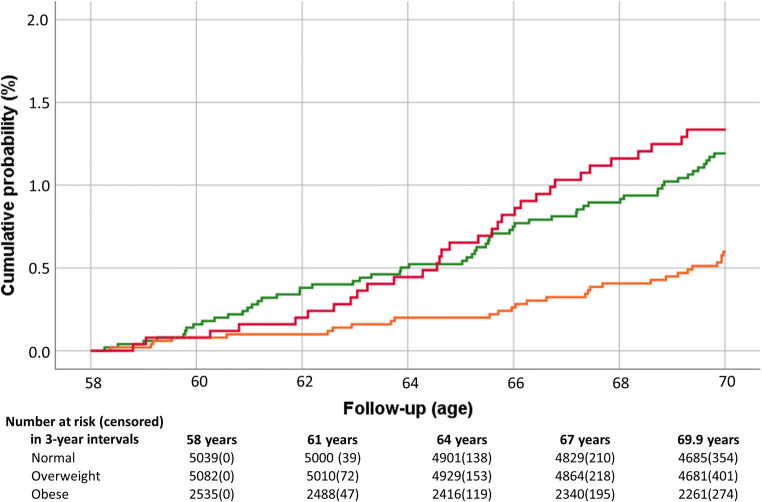
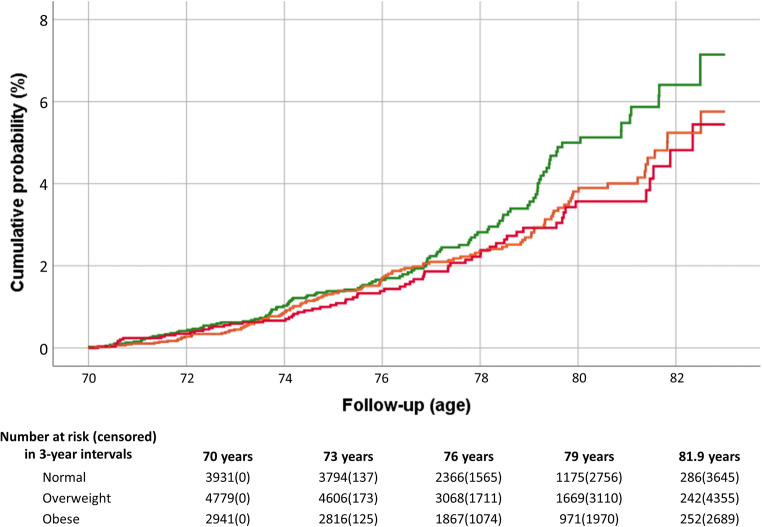
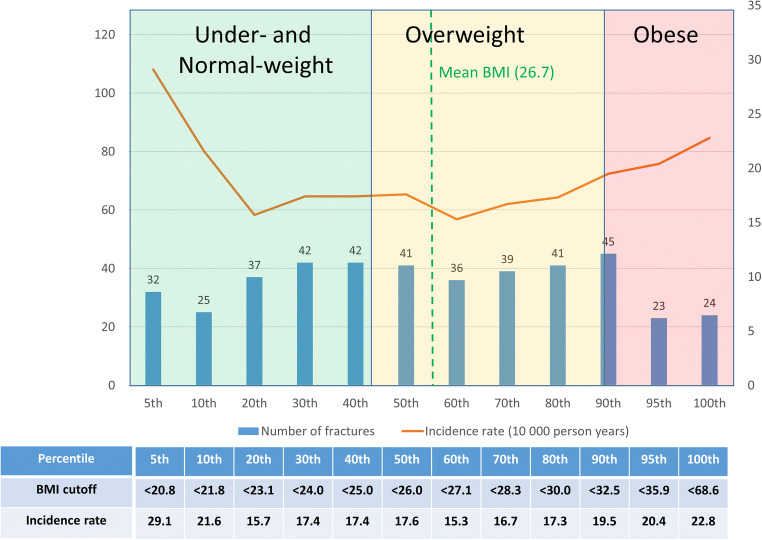
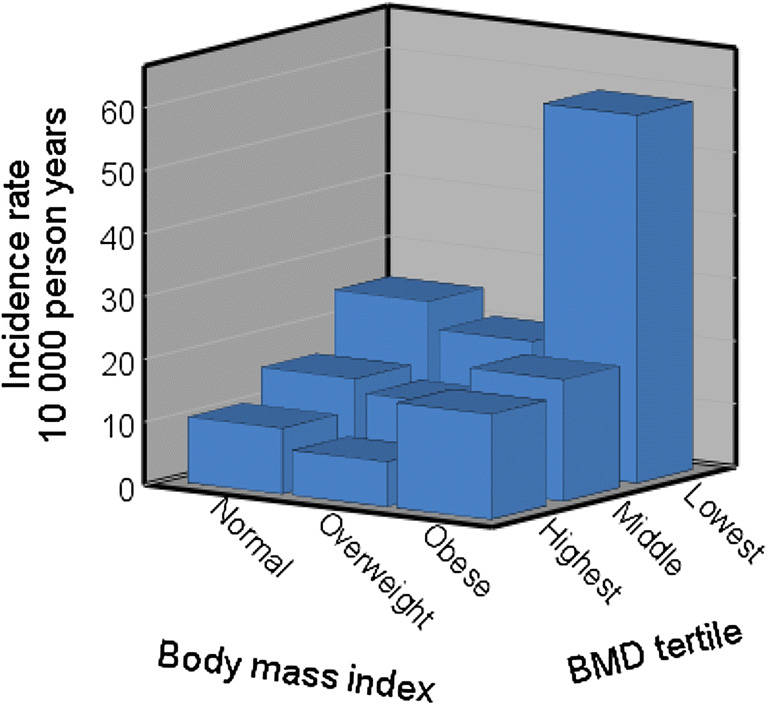
Association of body mass index and hip fracture has been controversial. In this study, women with lowest and highest body weight had the highest fracture incidence. A 25-year follow-up indicated that obesity associates with early hip fracture risk and suggested increasing trend in normal-weight women at a later stage. INTRODUCTION: Obesity is a pandemic health issue. Its association with hip fracture risk remains controversial. We studied the long-term relationship of body mass index and hip fracture incidence in postmenopausal women. METHODS: The cohort of 12,715 Finnish women born in 1932-1941 was followed for 25 years, covering ages from 58 up to 83. Fractures and deaths were obtained from national registries. Women were investigated in deciles of BMI as well as in WHO weight categories (normal, overweight, or obese). The follow-up analysis was carried out in two age strata as "early" (58-70 years) and "late" (> 70 years). Body weight information was updated accordingly. Femoral neck BMD was recorded for a subsample (n = 3163). Altogether, 427 hip fractures were observed. RESULTS: A higher risk of early hip fracture was observed in obese and normal-weight compared with overweight women with hazard ratios (HRs) of 2.3 ((95% CI) 1.4-3.7) and 2.0 (1.3-3.1) while no difference was observed in late hip fracture risk between the three WHO categories (log rank p = 0.14). All-cause mortality during the follow-up was 19.3%. Compared with normal weight women, the obese women had a higher risk of death with an HR of 1.6 (1.4-1.8) and higher baseline BMD (p < 0.001). Faster bone loss was observed in the obese compared with other women (p < 0.001). CONCLUSION: Obesity associates with earlier hip fracture and higher postfracture mortality. The obese women with low BMD have clearly the highest risk of hip fracture. This combination increases hip fracture risk more than either of the factors alone. After 75 years of age, risk appears to increase more in normal weight women, but this trend is in need of further confirmation.
Overview
The claims and statistics of this paper haven’t been checked yet.
Free: it reads the open-access text and checks the first 5 claims that cite a source we can check. Create a free account to check every claim.
Integrity signals
Registry
Cites
Statistics
Figures
Verification
Claims the paper makes
The claims and statistics of this paper haven’t been checked yet.
Free: it reads the open-access text and checks the first 5 claims that cite a source we can check. Create a free account to check every claim.
Claims other papers make about this one
Each is checked against this paper’s own text: does it say what the citing paper says it does?
In the citing paper
“Up to a point, heavier individuals tend to have a higher BMD, however, the correlation between the body mass index and bone mass appeared to be U-shaped [64].”
From Emerging role of liver-bone axis in osteoporosis (2024) · cites this paper as [64]
Self-check
Percentages, sums and reported differences re-computed from the paper’s own numbers.
The self-check needs the paper’s full text.
Citations
Cites
Overweight, obesity, and mortality from cancer in a prospectively studied cohort of U.S. Adults
Calle, E. E., Rodriguez, C., Walker-Thurmond, K., & Thun, M. J. (2003) · New England Journal of Medicine · doi:10.1056/nejmoa021423 · Cited by 7,696
Flegal, K. M., Kit, B. K., Orpana, H., & Graubard, B. I. (2013) · JAMA · doi:10.1001/jama.2012.113905 · Cited by 3,998 · cited 1×
“A similar reduction associatedwith overweight women has also been reported in all-cause mortality [33].”
BackgroundBody-Mass Index and Mortality in a Prospective Cohort of U.S. Adults
Calle, E. E., Thun, M. J., Petrelli, J. M., Rodriguez, C., & Heath, C. W. (1999) · New England Journal of Medicine · doi:10.1056/nejm199910073411501 · Cited by 3,643
Risk Factors for Hip Fracture in White Women
Cummings, S. R., Nevitt, M. C., Browner, W. S., Stone, K., Fox, K. M., Ensrud, K. E., Cauley, J., Black, D., & Vogt, T. M. (1995) · New England Journal of Medicine · doi:10.1056/nejm199503233321202 · Cited by 3,595
Body-mass index and mortality among 1.46 million white adults
Berrington de Gonzalez, A., Hartge, P., Cerhan, J. R., Flint, A. J., Hannan, L., MacInnis, R. J., Moore, S. C., Tobias, G. S., Anton-Culver, H., Freeman, L. B., et al. (2010) · New England Journal of Medicine · doi:10.1056/nejmoa1000367 · Cited by 2,317
Vestergaard, P. (2007) · Osteoporosis International · doi:10.1007/s00198-006-0253-4 · Cited by 1,808 · cited 1×
“Paradoxically, obesity and T2DM also have a positive association with BMD [13, 14].”
BackgroundBody mass index as a predictor of fracture risk: A meta-analysis
De Laet, C., Kanis, J. A., Odén, A., Johanson, H., Johnell, O., Delmas, P., Eisman, J. A., Kroger, H., Fujiwara, S., Garnero, P., et al. (2005) · Osteoporosis International · doi:10.1007/s00198-005-1863-y · Cited by 1,622
Self-citationPrevalence of low femoral bone density in older U.S. women from NHANES III
Looker, A. C., Johnston, C. C., Wahner, H. W., Dunn, W. L., Calvo, M. S., Harris, T. B., Heyse, S. P., & Lindsay, R. L. (1995) · Journal of Bone and Mineral Research · doi:10.1002/jbmr.5650100517 · Cited by 1,379
Bhaskaran, K., dos-Santos-Silva, I., Leon, D. A., Douglas, I. J., & Smeeth, L. (2018) · The Lancet Diabetes & Endocrinology · doi:10.1016/s2213-8587(18)30288-2 · Cited by 1,228
Quality of the Finnish Hospital Discharge Register: A systematic review
Sund, R. (2012) · Scandinavian Journal of Public Health · doi:10.1177/1403494812456637 · Cited by 1,185
Self-citation
Cited by
Turcotte, A.-F., O’Connor, S., Morin, S. N., Gibbs, J. C., Willie, B. M., Jean, S., & Gagnon, C. (2021) · PLOS ONE · doi:10.1371/journal.pone.0252487 · Cited by 166
Ali, D., Figeac, F., Caci, A., Ditzel, N., Schmal, C., Kerckhofs, G., Havelund, J. F., Færgeman, N. J., Rauch, A., Tencerová, M., et al. (2022) · Aging Cell · doi:10.1111/acel.13726 · Cited by 68
Tang, G. H., Feng, L., Pei, Y., Gu, Z., Chen, T., & Feng, Z. (2023) · Frontiers in Endocrinology · doi:10.3389/fendo.2023.1154927 · Cited by 57
“Another study reported an inverted U-shaped relationship between BMI and lumbar BMD in women and neonates.”
BackgroundInfluentialPrevalence and Risk Factors of Osteoporosis: A Cross-Sectional Study in a Tertiary Center
Özmen, S., Kurt, S., Timur, H. T., Yavuz, O., Kula, H., Demir, A. Y., & Balcı, A. (2024) · Medicina · doi:10.3390/medicina60122109 · Cited by 70
“It has also been shown that BMD is lower in underweight individuals [23,32,33].”
Obesity and risk of fracture in postmenopausal women: a meta-analysis of cohort studies
Liu, H.-F., Meng, D., Yu, P., De, J.-C., & Li, H. (2023) · Annals of Medicine · doi:10.1080/07853890.2023.2203515 · Cited by 42
“In particular, obese women had a 25%–30% lower risk of hip fracture, but our meta-analysis, which included three high-quality cohort studies [21,25,27], found no statistical difference in the risk of hip fracture in obese postmenopausal women compared with normal-weight women.”
Result
Metadata
- Authors
- Rikkonen, T., Sund, R., Sirola, J., Honkanen, R., Poole, K. E. S., & Kröger, H.
- Affiliations
- University of Eastern Finland (FI)
- University of Cambridge (GB)
- Corresponding author
- Rikkonen, T.
- Venue
- Osteoporosis International
- Published
- 2020-10-23
- Volume
- 32
- Issue
- 4
- Pages
- 769-777
- ISSN
- 0937-941X (ISSN-L)
- 1433-2965
- PMC
- PMC8026440
- OpenAlex
- W3094437112
- Cited by
- 52
- References
- 39
- Citations by year
- 2026: 4 · 2025: 10 · 2024: 11 · 2023: 10 · 2022: 12 · 2021: 4 · 2020: 1
- FWCI
- 6.75
- Type
- journal article
- Language
- en
- Open access
- hybrid
- doi.org
- Licence
- cc-by-nc
- creativecommons.org/licenses/by-nc/4.0 (tdm)
- creativecommons.org/licenses/by-nc/4.0 (vor)
- Locations
- Osteoporosis International (publishedVersion, cc-by-nc)
- PubMed Central (publishedVersion, cc-by-nc)
- PubMed (publishedVersion)
- Apollo (University of Cambridge) (submittedVersion, cc-by-nc)
- Apollo
- Funders
- Juho Vainion Säätiö
- Suomalainen Tiedeakatemia (310831/2017)
- Pohjois-Savon Rahasto
- Sigrid Juséliuksen Säätiö
- Topics
- Health Sciences › Medicine › Orthopedics and Sports Medicine › Bone health and osteoporosis research
- Health Sciences › Medicine › Surgery › Hip and Femur Fractures
- Health Sciences › Medicine › Endocrinology, Diabetes and Metabolism › Menopause: Health Impacts and Treatments
- Keywords
- obesity, hip fracture, postmenopausal women, body mass index, fracture risk, bone mineral density, bone loss, all-cause mortality, normal-weight women, long-term follow-up
- MeSH terms
- Aged, Aged, 80 and over, Female, Finland, Follow-Up Studies, Hip Fractures, Humans, Middle Aged, Obesity, Risk Factors, Bone Density, Body Mass Index, Postmenopause
About these checks
Registry, retraction, Cites and statistics results are computed, not judged, with one exception: a printed reference that no index lists is read once by a model before it counts as a citation error. Claims are extracted by a model and kept only when their quote appears verbatim in the text; each cited source is then checked, with a model’s help, for whether it says what the claim relies on. Those verdicts can be wrong — read the claim’s quote and the cited source before relying on one.
Statistics and arithmetic are recomputed, not judged.
Confidence bands are shown only for fields calibrated on our annotated test set. None is calibrated yet, so no band is shown.
What counts as a claim ›How we measure confidence ›How we check this ›
Are you an author, or do you see a problem with this page? Request a review
How to cite
Cite CoChat for the checks on this page, and the paper for its own findings.
- This page
- CoChat. (2026). Citation check: Obesity is associated with early hip fracture risk in postmenopausal women: a 25-year follow-up. https://app.cochat.ai/papers/10.1007/s00198-020-05665-w
- The paper
- Rikkonen, T., Sund, R., Sirola, J., Honkanen, R., Poole, K. E. S., & Kröger, H. (2021). Obesity is associated with early hip fracture risk in postmenopausal women: a 25-year follow-up. Osteoporosis International. https://doi.org/10.1007/s00198-020-05665-w
Data sources
Bibliographic data: Semantic Scholar, OpenAlex, Crossref.
Contains information from the Semantic Scholar Academic Graph Datasets, made available under the ODC Attribution License (ODC-BY 1.0).
Semantic Scholar’s data is described in: Kinney, R., et al. (2023). The Semantic Scholar Open Data Platform. arXiv:2301.10140.
