

A primer on systematic reviews in toxicology
Open accessThe DOI matches its Crossref record; 64 of the 65 references it cites were found in a registry or an index.
Abstract
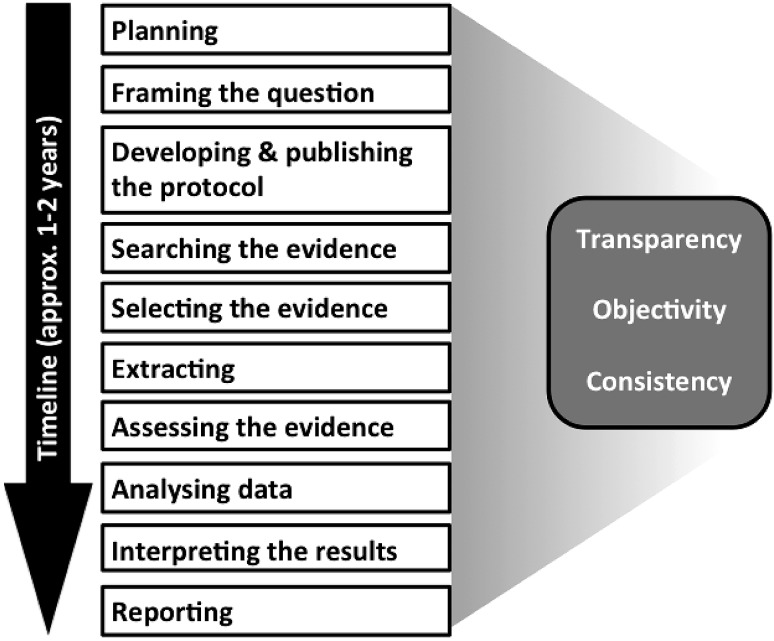
Systematic reviews, pioneered in the clinical field, provide a transparent, methodologically rigorous and reproducible means of summarizing the available evidence on a precisely framed research question. Having matured to a well-established approach in many research fields, systematic reviews are receiving increasing attention as a potential tool for answering toxicological questions. In the larger framework of evidence-based toxicology, the advantages and obstacles of, as well as the approaches for, adapting and adopting systematic reviews to toxicology are still being explored. To provide the toxicology community with a starting point for conducting or understanding systematic reviews, we herein summarized available guidance documents from various fields of application. We have elaborated on the systematic review process by breaking it down into ten steps, starting with planning the project, framing the question, and writing and publishing the protocol, and concluding with interpretation and reporting. In addition, we have identified the specific methodological challenges of toxicological questions and have summarized how these can be addressed. Ultimately, this primer is intended to stimulate scientific discussions of the identified issues to fuel the development of toxicology-specific methodology and to encourage the application of systematic review methodology to toxicological issues.
Overview
The claims and statistics of this paper haven’t been checked yet.
Free: it reads the open-access text and checks the first 5 claims that cite a source we can check. Create a free account to check every claim.
Integrity signals
Registry
Cites
Statistics
Figures
Verification
Claims the paper makes
The claims and statistics of this paper haven’t been checked yet.
Free: it reads the open-access text and checks the first 5 claims that cite a source we can check. Create a free account to check every claim.
Claims other papers make about this one
Each is checked against this paper’s own text: does it say what the citing paper says it does?
The source backs part of the claim, not all of it — or backs it for a different population, condition or comparison.
In the citing paper
“Over the last years, however, the number of systematic reviews in these latter fields has been steadily increasing (Hoffmann et al., 2017;Whaley et al., 2016); where we have a rudimentary count of them, they are showing exponential growth (Whaley et al., 2016).”
From Toward good in vitro reporting standards (2019) · cites this paper as Hoffmann et al., 2017
Experimental — accuracy not yet measuredIn the citing paper
“Despite similarities in the general structure of the review, the ‘roadmap’ of systematic reviews of observational studies is less standardised [17]”
From COSMOS-E: Guidance on conducting systematic reviews and meta-analyses of observational studies of etiology (2019) · cites this paper as [17]
In the citing paper
“Especially in the field of toxicology, mechanistic evidence plays an important role in causal inference”
From COSMOS-E: Guidance on conducting systematic reviews and meta-analyses of observational studies of etiology (2019) · cites this paper as [17]
In the citing paper
“Clearly, understanding pathways requires more than quickly searching for a few articles that support the hypothesis ('cherry picking') [17].”
From COSMOS-E: Guidance on conducting systematic reviews and meta-analyses of observational studies of etiology (2019) · cites this paper as [17]
Self-check
Percentages, sums and reported differences re-computed from the paper’s own numbers.
The self-check needs the paper’s full text.
Citations
Cites
Preferred Reporting Items for Systematic Reviews and Meta-Analyses: the PRISMA statement
Moher, D., Liberati, A., Tetzlaff, J., Altman, D. G., & for the PRISMA Group (2009) · BMJ · doi:10.1136/bmj.b2535 · Cited by 83,823
Preferred Reporting Items for Systematic Reviews and Meta-Analyses: The PRISMA Statement
Moher, D., Liberati, A., Tetzlaff, J., Altman, D. G., & The PRISMA Group (2009) · PLoS Medicine · doi:10.1371/journal.pmed.1000097 · Cited by 64,042 · cited 2×
“2 (Moher et al. 2009).”
MethodPreferred reporting items for systematic reviews and meta-analyses: the PRISMA Statement.
(2009) · PubMed Central · Cited by 44,859
PRISMA-P Group, Moher, D., Shamseer, L., Clarke, M., Ghersi, D., Liberati, A., Petticrew, M., Shekelle, P., & Stewart, L. A. (2015) · Systematic Reviews · doi:10.1186/2046-4053-4-1 · Cited by 26,223
Wang, G., Ma, R., Qiao, G., Wada, K., Aizawa, Y., & Satoh, T. (2015) · Integrative Medicine International · doi:10.1159/000368408 · Cited by 18,657
Scoping studies: advancing the methodology
Levac, D., Colquhoun, H., & O'Brien, K. K. (2010) · Implementation Science · doi:10.1186/1748-5908-5-69 · Cited by 15,268 · cited 1×
“Scoping may range from a simple nonsystematic search in one or two databases to a more formalized, resource intensive scoping review (described in Levac et al. 2010 and in Peters et al. 2015).”
BackgroundGRADE guidelines: 3. Rating the quality of evidence
Balshem, H., Helfand, M., Schünemann, H. J., Oxman, A. D., Kunz, R., Brozek, J., Vist, G. E., Falck-Ytter, Y., Meerpohl, J., & Norris, S. (2011) · Journal of Clinical Epidemiology · doi:10.1016/j.jclinepi.2010.07.015 · Cited by 8,285
Guidance for conducting systematic scoping reviews
Peters, M. D. J., Godfrey, C. M., Khalil, H., McInerney, P., Parker, D., & Soares, C. B. (2015) · International Journal of Evidence-Based Healthcare · doi:10.1097/xeb.0000000000000050 · Cited by 7,472 · cited 1×
“Scoping may range from a simple nonsystematic search in one or two databases to a more formalized, resource intensive scoping review (described in Levac et al. 2010 and in Peters et al. 2015).”
BackgroundCochrane Handbook for Systematic Reviews of Interventions Version 5.0.1. The Cochrane Collaboration
Higgins, J. P. T., Green, S. R., & Higgins, J. P. T. (2008) · Cited by 7,259
Improving bioscience research reporting: The ARRIVE guidelines for reporting animal research
Kilkenny, C., Browne, W. J., Cuthill, I. C., Emerson, M., & Altman, D. G. (2010) · Journal of Pharmacology and Pharmacotherapeutics · doi:10.4103/0976-500x.72351 · Cited by 6,277
Research works printed but not linked: 5
- AHRQ (2014) Methods guide for effectiveness and comparative effectiveness reviews. https://effectivehealthcare.ahrq.gov/ehc/products/60/318/CER-Methods-Guide-140109.pdf. Accessed 13 Feb 2017 21433403
- CEE (2013) Guidelines for systematic reviews in environmental management. Version 4.2, http://www.environmentalevidence.org/wp-content/uploads/2017/01/Review-guidelines-version-4.2-final-update.pdf. Accessed 13 Feb 2017
- IOM (2011) Finding what works in health care: Standards for systematic reviews. Free download at https://www.nap.edu/catalog/13059/finding-what-works-in-health-care-standards-for-systematic-reviews. Accessed 13 Feb 2017 24983062
- National Toxicology Program (2016) Systematic review of the effects of fluoride on learning and memory in animal studies. NTP Research Report 1. https://ntp.niehs.nih.gov/ntp/ohat/pubs/ntp_rr/01fluoride_508.pdf. Accessed 20 Feb 2017 31944639
- TCEQ (Texas Commission on Environmental Quality) (2014) TCEQ recommendations for systematic review and evidence integration. http://www.tceq.com/assets/public/implementation/tox/dsd/proposed/nov14/systematic_review.pdf. Accessed 13 Feb 2017
Cited by
Overview of known plastic packaging-associated chemicals and their hazards
Groh, K. J., Backhaus, T., Carney-Almroth, B., Geueke, B., Inostroza, P. A., Lennquist, A., Leslie, H. A., Maffini, M., Slunge, D., Trasande, L., et al. (2019) · Science of The Total Environment · doi:10.1016/j.scitotenv.2018.10.015 · Cited by 913
Dekkers, O. M., Vandenbroucke, J. P., Cevallos, M., Renehan, A. G., Altman, D. G., & Egger, M. (2019) · PLOS Medicine · doi:10.1371/journal.pmed.1002742 · Cited by 525
Adverse outcome pathways: opportunities, limitations and open questions
Leist, M., Ghallab, A., Graepel, R., Marchan, R., Hassan, R., Bennekou, S. H., Limonciel, A., Vinken, M., Schildknecht, S., Waldmann, T., et al. (2017) · Archives of Toxicology · doi:10.1007/s00204-017-2045-3 · Cited by 394
Toxicity testing in the 21st century: progress in the past decade and future perspectives
Krewski, D., Andersen, M. E., Tyshenko, M. G., Krishnan, K., Hartung, T., Boekelheide, K., Wambaugh, J. F., Jones, D., Whelan, M., Thomas, R., et al. (2020) · Archives of Toxicology · doi:10.1007/s00204-019-02613-4 · Cited by 383
Olker, J. H., Elonen, C. M., Pilli, A., Anderson, A., Kinziger, B., Erickson, S., Skopinski, M., Pomplun, A., LaLone, C. A., Russom, C. L., et al. (2022) · Environmental Toxicology and Chemistry · doi:10.1002/etc.5324 · Cited by 301
Noyes, P. D., Friedman, K. P., Browne, P., Haselman, J. T., Gilbert, M. E., Hornung, M. W., Barone, S., Crofton, K. M., Laws, S. C., Stoker, T. E., et al. (2019) · Environmental Health Perspectives · doi:10.1289/ehp5297 · Cited by 205
“…review and evidence integration provide approaches to identify and evaluate peerreviewed studies for relevance, performance, and reliability to support their inclusion in chemical assessment (Hoffmann et al. 2017; Rooney et al. 2014; National Academies of Sciences, Engineering, and Medicine 2018).”
BackgroundArtificial intelligence (AI)—it’s the end of the tox as we know it (and I feel fine)*
Kleinstreuer, N., & Härtung, T. (2024) · Archives of Toxicology · doi:10.1007/s00204-023-03666-2 · Cited by 179
O’Connor, A. M., Tsafnat, G., Thomas, J., Glasziou, P., Gilbert, S. B., & Hutton, B. (2019) · Systematic Reviews · doi:10.1186/s13643-019-1062-0 · Cited by 167
Avoiding Regrettable Substitutions: Green Toxicology for Sustainable Chemistry
Maertens, A., Golden, E., & Härtung, T. (2021) · ACS Sustainable Chemistry & Engineering · doi:10.1021/acssuschemeng.0c09435 · Cited by 165
Wolffe, T. A. M., Whaley, P., Halsall, C., Rooney, A. A., & Walker, V. R. (2019) · Environment International · doi:10.1016/j.envint.2019.05.065 · Cited by 119
Self-citationProbabilistic risk assessment – the keystone for the future of toxicology
Maertens, A., Golden, E., Luechtefeld, T. H., Hoffmann, S., Tsaioun, K., & Hartung, T. (2022) · ALTEX · doi:10.14573/altex.2201081 · Cited by 126
Self-citationPerspectives on In Vitro to In Vivo Extrapolations
Härtung, T. (2017) · Applied In Vitro Toxicology · doi:10.1089/aivt.2016.0026 · Cited by 100
Big-data and machine learning to revamp computational toxicology and its use in risk assessment
Luechtefeld, T., Rowlands, C., & Härtung, T. (2018) · Toxicology Research · doi:10.1039/c8tx00051d · Cited by 98
3S - Systematic, systemic, and systems biology and toxicology
Smirnova, L. (2018) · ALTEX · doi:10.14573/altex.1804051 · Cited by 72
Self-citationDirven, H. A. A. M., Vist, G. E., Bandhakavi, S., Mehta, J., Fitch, S., Pound, P., Ram, R., Kincaid, B., Leenaars, C. H. C., Chen, M., et al. (2021) · Scientific Reports · doi:10.1038/s41598-021-85708-2 · Cited by 80
Self-citationRoth, N., Zilliacus, J., & Beronius, A. (2021) · Frontiers in Toxicology · doi:10.3389/ftox.2021.746430 · Cited by 79
Toward good in vitro reporting standards
Hartung, T. (2019) · ALTEX · doi:10.14573/altex.1812191 · Cited by 65
“The development of evidence-based toxicology (Hoffmann and Hartung, 2006; Griesinger et al., 2009; Hartung, 2009; Stephens et al., 2013, 2016; Hoffmann et al., 2016, 2017), as promoted by the Evidence-based Toxicology Collaboration3, includes the determination of quality, e.g., by quality…”
BackgroundSelf-citationCronin, M., Enoch, S. J., Madden, J. C., Rathman, J. F., Richarz, A.-N., & Yang, C. (2022) · Computational Toxicology · doi:10.1016/j.comtox.2022.100213 · Cited by 63
A systematic review on the effects of nanomaterials on gut microbiota
Utembe, W., Tlotleng, N., & Kamng’ona, A. W. (2022) · Current Research in Microbial Sciences · doi:10.1016/j.crmicr.2022.100118 · Cited by 58
(PPR), E. P. O. P. P. P. A. T. R., Ockleford, C., Adriaanse, P., Berny, P. J., Brock, T. C. M., Duquesne, S., Grilli, S., Bennekou, S. H., Klein, M., Kühl, T., et al. (2017) · EFSA Journal · doi:10.2903/j.efsa.2017.5007 · Cited by 51
Wolffe, T. A. M., Vidler, J. E., Halsall, C. J., Hunt, N., & Whaley, P. (2020) · Toxicological Sciences · doi:10.1093/toxsci/kfaa025 · Cited by 45
Self-citationDoes paraquat cause Parkinson’s disease? A review of reviews
Weed, D. L. (2021) · NeuroToxicology · doi:10.1016/j.neuro.2021.08.006 · Cited by 45
The methodological rigour of systematic reviews in environmental health
Menon, J. M. L., Struijs, F., & Whaley, P. (2022) · Critical Reviews in Toxicology · doi:10.1080/10408444.2022.2082917 · Cited by 45
Self-citationA call for a Human Exposome Project
Härtung, T. (2023) · ALTEX · doi:10.14573/altex.2301061 · Cited by 45
Henschenmacher, B., Bitsch, A., Gala, T. D. L. H., Forman, H. J., Fragoulis, A., Ghezzi, P., Kellner, R. L. L., Koch, W., Kühne, J., Sachno, D., et al. (2021) · Environment International · doi:10.1016/j.envint.2021.106932 · Cited by 41
Self-citationApplication of evidence-based methods to construct mechanism-driven chemical assessment frameworks
Hoffmann, S., Aiassa, E., Angrish, M. M., Beausoleil, C., Bois, F. Y., Ciccolallo, L., Craig, P. S., de Vries, R. B. M., Dorne, J. L. C. M., Druwe, I. L., et al. (2022) · ALTEX · doi:10.14573/altex.2202141 · Cited by 39
Self-citationLeenaars, C. H. C., Tsaioun, K., Stafleu, F. R., Rooney, K. B., Meijboom, F. L. B., Ritskes-Hoitinga, M. J., & Bleich, A. (2020) · Laboratory Animals · doi:10.1177/0023677220968599 · Cited by 39
Self-citationRebooting the generally recognized as safe (GRAS) approach for food additive safety in the US
Härtung, T. (2018) · ALTEX · doi:10.14573/altex.1712181 · Cited by 37
The validation of regulatory test methods – Conceptual, ethical, and philosophical foundations
Härtung, T. (2024) · ALTEX · doi:10.14573/altex.2409271 · Cited by 36
Assessing risk of bias in toxicological studies in the era of artificial intelligence
Härtung, T., Hoffmann, S., & Whaley, P. (2025) · Archives of Toxicology · doi:10.1007/s00204-025-03978-5 · Cited by 33
Self-citationKnowledge Organization Systems for Systematic Chemical Assessments
Whaley, P., Edwards, S. W., Kraft, A. D., Nyhan, K., Shapiro, A. J., Watford, S., Wattam, S., Wolffe, T. A. M., & Angrish, M. M. (2020) · Environmental Health Perspectives · doi:10.1289/ehp6994 · Cited by 33
Self-citationApplying evidence-based methods to the development and use of adverse outcome pathways
de Vries, R. B. M. (2021) · ALTEX · doi:10.14573/altex.2101211 · Cited by 32
Wikoff, D. S., Lewis, R. J., Erraguntla, N. K., Franzen, A., & Foreman, J. E. (2020) · Regulatory Toxicology and Pharmacology · doi:10.1016/j.yrtph.2020.104790 · Cited by 28
Self-citationSystematic review in evidence-based risk assessment
Farhat, N., Tsaioun, K., Saunders-Hastings, P., Morgan, R. L., Ramoju, S., Hartung, T., & Krewski, D. (2021) · ALTEX · doi:10.14573/altex.2004111 · Cited by 29
Self-citationMapping Chemical Respiratory Sensitization: How Useful Are Our Current Computational Tools?
Golden, E., Maertens, M., Härtung, T., & Maertens, A. (2020) · Chemical Research in Toxicology · doi:10.1021/acs.chemrestox.0c00320 · Cited by 25
Evidence-based approaches in toxicology: their origins, challenges, and future directions
Härtung, T., & Tsaioun, K. (2024) · Evidence-Based Toxicology · doi:10.1080/2833373x.2024.2421187 · Cited by 24
Self-citationAbdulai, P. M., Sam, K., Onyena, A. P., Ezejiofor, A. N., Frazzoli, C., Ekhator, O. C., Udom, G. J., Frimpong, C. K., Nriagu, J. O., & Orisakwe, O. E. (2024) · Environmental Monitoring and Assessment · doi:10.1007/s10661-024-12500-w · Cited by 24
Borghoff, S. J., Cohen, S. S., Jiang, X., Lea, I. A., Klaren, W. D., Chappell, G. A., Britt, J. K., Rivera, B. N., Choski, N. Y., & Wikoff, D. S. (2022) · Food and Chemical Toxicology · doi:10.1016/j.fct.2022.113549 · Cited by 24
Self-citationReview of refractory ceramic fiber (RCF) toxicity, epidemiology and occupational exposure
Maxim, L. D., & Utell, M. J. (2018) · Inhalation Toxicology · doi:10.1080/08958378.2018.1448019 · Cited by 24
Mohapatra, R., Leist, M., von Aulock, S., & Härtung, T. (2025) · ALTEX · doi:10.14573/altex.2507041 · Cited by 25
Schreier, V. N., Appenzeller‐Herzog, C., Brüschweiler, B. J., Geueke, B., Wilks, M. F., Simat, T. J., Schilter, B., Smieško, M., Muncke, J., Odermatt, A., et al. (2022) · Environment International · doi:10.1016/j.envint.2022.107387 · Cited by 23
Biological plausibility in environmental health systematic reviews: a GRADE concept paper
Whaley, P., Piggott, T., Morgan, R. L., Hoffmann, S., Tsaioun, K., Schwingshackl, L., Ansari, M., Thayer, K. A., & Schünemann, H. J. (2022) · Environment International · doi:10.1016/j.envint.2022.107109 · Cited by 23
Self-citationIngre‐Khans, E., Ågerstrand, M., Rudén, C., & Beronius, A. (2019) · Human and Ecological Risk Assessment An International Journal · doi:10.1080/10807039.2018.1504275 · Cited by 24
Authority, E. F. S. (2018) · EFSA Supporting Publications · doi:10.2903/sp.efsa.2018.en-1396 · Cited by 22
Whaley, P., Blaauboer, B. J., Brozek, J., Hubal, E. A. C., Hair, K., Kacew, S., Knudsen, T. B., Kwiatkowski, C. F., Mellor, D. T., Olshan, A. F., et al. (2021) · ALTEX · doi:10.14573/altex.2106111 · Cited by 20
Self-citationWhat Are the Net Benefits of Reducing the Ozone Standard to 65 ppb? An Alternative Analysis
Lange, S. S., Mulholland, S. E., & Honeycutt, M. (2018) · International Journal of Environmental Research and Public Health · doi:10.3390/ijerph15081586 · Cited by 18
Hoffmann, S., Marigliani, B., Akgün-Ölmez, S. G., Ireland, D., Cruz, R., Busquet, F., Flick, B., Lalu, M. M., Ghandakly, E., de Vries, R. B. M., et al. (2021) · Toxicological Sciences · doi:10.1093/toxsci/kfab072 · Cited by 17
Self-citationA systematic review on fluoride-induced epigenetic toxicity in mammals
Balasubramanian, S., & Perumal, E. (2022) · Critical Reviews in Toxicology · doi:10.1080/10408444.2022.2122771 · Cited by 17
Developing a database of systematic reviews of animal studies
Langendam, M. W., Magnuson, K., Williams, A. R., Walker, V. R., Howdeshell, K. L., Rooney, A. A., & Hooijmans, C. R. (2021) · Regulatory Toxicology and Pharmacology · doi:10.1016/j.yrtph.2021.104940 · Cited by 16
Alternative Approaches for Carcinogenicity and Reproductive Toxicity
Corvi, R., Spielmann, H., & Härtung, T. (2018) · Elsevier eBooks · doi:10.1016/b978-0-12-813697-3.00024-x · Cited by 13
Stephens, M. L., Akgün-Ölmez, S. G., Hoffmann, S., de Vries, R. B. M., Flick, B., Härtung, T., Lalu, M. M., Maertens, A., Witters, H. E., Wright, R. A., et al. (2019) · Toxicological Sciences · doi:10.1093/toxsci/kfz128 · Cited by 13
Self-citationJarabek, A. M., & Hines, D. E. (2019) · Current Opinion in Toxicology · doi:10.1016/j.cotox.2019.09.001 · Cited by 13
Urban, J. D., Wikoff, D. S., Chappell, G. A., Harris, C., & Haws, L. C. (2020) · Toxicology · doi:10.1016/j.tox.2020.152427 · Cited by 13
Self-citationSharma, B. M., Kalina, J., Whaley, P., & Scheringer, M. (2021) · Environment International · doi:10.1016/j.envint.2021.106437 · Cited by 14
Self-citationVandenberg, L. N., & Pelch, K. E. (2021) · Endocrine Metabolic & Immune Disorders - Drug Targets · doi:10.2174/1871530321666211005163614 · Cited by 13
Biological plausibility in environmental health systematic reviews: a GRADE concept paper
Whaley, P., Piggott, T., Morgan, R. L., Hoffmann, S., Tsaioun, K., Schwingshackl, L., Ansari, M., Thayer, K. A., & Schünemann, H. J. (2022) · Journal of Clinical Epidemiology · doi:10.1016/j.jclinepi.2022.02.011 · Cited by 13
Self-citationImiuwa, M. E., Baynes, A., & Routledge, E. J. (2023) · PLoS ONE · doi:10.1371/journal.pone.0287582 · Cited by 12
Muñoz, J. A. (2021) · PLoS ONE · doi:10.1371/journal.pone.0252533 · Cited by 12
From cellular perturbation to probabilistic risk assessments
Maertens, A., Kincaid, B., Bridgeford, E., Brochot, C., Silva, A. D. C. E., Dorne, J. L. C. M., Geris, L., Husøy, T., Kleinstreuer, N., Ladeira, L., et al. (2025) · ALTEX · doi:10.14573/altex.2501291 · Cited by 11
Self-citationSystems-level understanding of toxicology and cardiovascular system
(2024) · Global Journal of Basic Science · doi:10.63454/jbs20000005 · Cited by 10
Safi, Z., Miyittah, M. K., Offei, B. K., & Amenorpe, G. (2025) · Environmental Science Atmospheres · doi:10.1039/d5ea00018a · Cited by 9
Korchevskiy, A. A. (2020) · Journal of Applied Toxicology · doi:10.1002/jat.4063 · Cited by 9
Management of bias and conflict of interest among occupational exposure limit expert groups
Schenk, L., & Johanson, G. (2021) · Regulatory Toxicology and Pharmacology · doi:10.1016/j.yrtph.2021.104929 · Cited by 9
Roth, N., Sandström, J., & Wilks, M. F. (2020) · Environment International · doi:10.1016/j.envint.2020.105768 · Cited by 8
Härtung, T., Kopańska, K., Maertens, A., Whaley, P., & Hoffmann, S. (2026) · Archives of Toxicology · doi:10.1007/s00204-026-04386-z · Cited by 6
Self-citationAn interdisciplinary framework for derivation of occupational exposure limits
Maurer, L. L., Alexander, M. S., Bachman, A. N., Grimm, F. A., Lewis, R. J., North, C. M., Wojcik, N. C., & Goyak, K. O. (2022) · Frontiers in Public Health · doi:10.3389/fpubh.2022.1038305 · Cited by 6
Custom GPTs to aid in compliance checking for reporting standards in academic publishing
Mohapatra, R., & Härtung, T. (2026) · ALTEX · doi:10.14573/altex.2601011 · Cited by 5
Evidence-based AI: from trailblazer to trustblazer?
Luechtefeld, T., & Hartung, T. (2026) · Frontiers in Artificial Intelligence · doi:10.3389/frai.2026.1818128 · Cited by 5
Self-citationSvendsen, C., Mathisen, G. H., Vist, G. E., Husøy, T., Ames, H. M., Beronius, A., Consiglio, E. D., Druwe, I. L., Härtung, T., Hoffmann, S., et al. (2024) · Evidence-Based Toxicology · doi:10.1080/2833373x.2024.2371285 · Cited by 4
Self-citationAlpi, K. M., Vo, T. A., & Dorman, D. C. (2019) · International Journal of Toxicology · doi:10.1177/1091581819827232 · Cited by 4
Hermansson, A. L., Nylund, A. T., Hassellöv, I., Abrantes, N., Ré, A., Chen, C. Y., Granberg, M., Magnusson, K., Picone, M., Giubilato, E., et al. (2025) · Integrated Environmental Assessment and Management · doi:10.1093/inteam/vjaf192 · Cited by 3
Kolesnyk, S., Souza, J. D. P., Bearth, A., Aicher, L., Wilks, M., Mosig, A., & Fritsche, E. (2026) · Toxicology · doi:10.1016/j.tox.2026.154439 · Cited by 3
Applying the adverse outcome pathway concept to questions in anaesthetic neurotoxicity
Waspe, J., Chico, T., & Hansen, T. G. (2021) · British Journal of Anaesthesia · doi:10.1016/j.bja.2021.03.009 · Cited by 3
The Center for Alternatives to Animal Testing in the USA and Europe
Goldberg, A. M., Leist, M., & Härtung, T. (2018) · Elsevier eBooks · doi:10.1016/b978-0-12-813697-3.00014-7 · Cited by 3
Scott, A. M., Barbrook, J., Riccardi, M., Zaccaria, K. J., Pavlovic, M., Thayer, K. A., Tsaioun, K., Lagisz, M., Wright, R. A., Hoffmann, S., et al. (2025) · Evidence-Based Toxicology · doi:10.1080/2833373x.2025.2548563 · Cited by 2
Self-citationImiuwa, M. E., Baynes, A., & Routledge, E. J. (2025) · Toxics · doi:10.3390/toxics13121043 · Cited by 2
Jahan, Z., Ishita, I. J., Sultan, M. T., Talukdar, S., & Hasan, M. (2025) · Barind Medical College Journal · doi:10.70818/bmcj.v011i2.0240 · Cited by 2
Berninger, J. P., & Tillitt, D. E. (2021) · Environmental Toxicology and Chemistry · doi:10.1002/etc.5074 · Cited by 2
Härtung, T. (2023) · Elsevier eBooks · doi:10.1016/b978-0-12-824315-2.00973-8 · Cited by 2
Thompson, C. (2023) · Liverpool John Moores University · doi:10.24377/ljmu.t.00018629 · Cited by 2
Pavlovic, M. D., Lagisz, M., Videira, N. B., Menon, J. M. L., Vist, G. E., Omeragić, E., Morgan, R. L., Hoffmann, S., & Evidence-Based Toxicology Collaboration (2025) · Evidence-Based Toxicology · doi:10.1080/2833373x.2025.2480543 · Cited by 1
Self-citationAdvances in pharmacokinetic-pharmacodynamic modeling for anesthesia, 1987–2024: a review
Tulbah, Y., & Aljamaan, I. A. (2026) · Frontiers in Pharmacology · doi:10.3389/fphar.2026.1741851 · Cited by 1
Evidence-to-decision: From exposome data to evidence to action through agentic AI
Hartung, T. (2026) · ALTEX · doi:10.14573/altex.2606281 · Cited by 1
Self-citationCheng, F., & Zhang, J. (2020) · Springer eBooks · doi:10.1007/978-981-15-5975-4_8 · Cited by 1
Integration of epidemiology with other lines of scientific evidence into pesticide risk assessment
Hernández, A. F. (2020) · Elsevier eBooks · doi:10.1016/b978-0-12-812466-6.00009-9 · Cited by 1
Spezielle zellbiologische Methoden in der Zellkultur
Gstraunthaler, G. J. A., & Lindl, T. (2021) · Springer eBooks · doi:10.1007/978-3-662-62606-1_19 · Cited by 1
Rodgers, J. B., & Ritskes-Hoitinga, M. J. (2021) · Laboratory animal science and medicine · doi:10.1007/978-3-030-66147-2_10 · Cited by 1
Wang, X., Bao, L., Jiang, M., Li, D., Xu, L., & Bai, M. (2022) · Toxicology Research · doi:10.1093/toxres/tfac081 · Cited by 1
A systematic scoping review of the neurological effects of COVID-19
Högberg, H. T., Tsaioun, K., Breidenbach, J. D., Elmore, B., Filipovska, J., García‐Reyero, N., Hargreaves, A. J., Joshi, O., Omeragić, E., Plant, S., et al. (2024) · NeuroToxicology · doi:10.1016/j.neuro.2024.05.003 · Cited by 1
Self-citationSystematic review of ecotoxicological studies investigating the effects of scrubber water
Abrantes, N., Chen, C. Y., Giubilato, E., Granberg, M., Hassellöv, I.-M., Lunde Hermansson, A., Magnusson, K., Nylund, A. T., Picone, M., Ré, A., et al. (2024) · Chalmers Research (Chalmers University of Technology) · Cited by 1
Advancing assessments of endocrine disruptors using adverse outcome pathways and novel methodologies
Wiklund, L. (2025) · doi:10.69622/29197022 · Cited by 1
Systematic review: methodological aspects of its role in drug safety assessment
Penedones, A. (2020) · Portuguese National Funding Agency for Science, Research and Technology (RCAAP Project by FCT)
Whaley, P. (2021) · ALTEX · doi:10.14573/altex.2106111s
Self-citationUso de nalbufina para intoxicación grave por heroína en el servicio de urgencias: reporte de caso
Reyes-Monge, R. A., Fernández-Andrew, J. A., & Ibarra-Ocegueda, T. S. (2023) · Revista de Educaci�n e Investigaci�n en Emergencias · doi:10.24875/reie.21000131
Chemical Toxicity Information Sources
Holmgren, S. D. (2023) · Wiley eBooks · doi:10.1002/0471125474.tox009.pub3
Pavlovic, M. D., Lagisz, M., Videira, N. B., Menon, J. M. L., Vist, G. E., Omeragić, E., Morgan, R. L., Hoffmann, S., & Evidence-Based Toxicology Collaboration (2026) · Evidence-Based Toxicology · doi:10.1080/2833373x.2026.2752667
Self-citationMurithi, R. G., & Tang, D. P. M. M. B. M. K. (2025) · Journal of Anesthesia & Pain Medicine · doi:10.33140/japm.10.03.05
Βιοηθικές παράμετροι της τοξικολογίας
Βακαλοπούλου, Σ. Α. (2024) · University of Thessaly Institutional Repository (University of Thessaly) · doi:10.26253/heal.uth.40058
Hlabisa, M. (2024) · ResearchSpace (University of KwaZulu-Natal)
Jack Fowle: Combining Values, Experience, and Teamwork to Improve Risk Analysis
Greenberg, M., & Lowrie, K. W. (2026) · Risk Analysis · doi:10.1111/risa.70303
Metadata
- Authors
- Hoffmann, S., de Vries, R. B. M., Stephens, M. L., Beck, N. B., Dirven, H. A. A. M., Fowle, J. R., Goodman, J. E., Hartung, T., Kimber, I., Lalu, M. M., Thayer, K., Whaley, P., Wikoff, D., & Tsaioun, K.
- Affiliations
- Johns Hopkins University (US)
- American Chemistry Council (US)
- Norwegian Institute of Public Health (NO)
- University of Pittsburgh at Titusville (US)
- Gradient (United States) (US)
- University of Manchester (GB)
- University of Ottawa (CA)
- Environmental Protection Agency (US)
- Lancaster University (GB)
- ToxStrategies LLC (United States) (US)
- Corresponding author
- Tsaioun, Katya
- ORCID
- Venue
- Archives of Toxicology
- Published
- 2017-05-13
- Volume
- 91
- Issue
- 7
- Pages
- 2551-2575
- ISSN
- 0340-5761 (ISSN-L)
- 1432-0738
- PMC
- PMC5489636
- OpenAlex
- W2612847450
- Cited by
- 85
- References
- 65
- Citations by year
- 2026: 5 · 2025: 7 · 2024: 5 · 2023: 5 · 2022: 13 · 2021: 18 · 2020: 10 · 2019: 10 · 2018: 9 · 2017: 3
- FWCI
- 2.16
- Type
- journal article
- Language
- en
- Open access
- hybrid
- doi.org
- Licence
- cc-by
- creativecommons.org/licenses/by/4.0 (tdm)
- Locations
- Archives of Toxicology (publishedVersion, cc-by)
- Europe PMC (PubMed Central) (publishedVersion, cc-by)
- PubMed Central (publishedVersion, cc-by)
- PubMed (publishedVersion)
- BIBSYS Brage (BIBSYS (Norway)) (submittedVersion)
- Lancaster EPrints (Lancaster University) (submittedVersion)
- NORA - Norwegian Open Research Archives (submittedVersion, other-oa)
- Research Explorer (The University of Manchester) (submittedVersion, cc-by)
- Radboud Repository (Radboud University) (submittedVersion)
- Radboud Repository (Radboud University) (submittedVersion, other-oa)
- Funders
- U.S. Environmental Protection Agency
- Topics
- Social Sciences › Decision Sciences › Statistics, Probability and Uncertainty › Meta-analysis and systematic reviews
- Health Sciences › Nursing › Research and Theory › Methodologies in Health Research and Practice
- Physical Sciences › Mathematics › Statistics and Probability › Statistical Methods in Epidemiology
- Keywords
- systematic reviews, evidence-based toxicology, research question formulation
- MeSH terms
- Toxicology, Meta-Analysis as Topic
About these checks
Registry, retraction, Cites and statistics results are computed, not judged, with one exception: a printed reference that no index lists is read once by a model before it counts as a citation error. Claims are extracted by a model and kept only when their quote appears verbatim in the text; each cited source is then checked, with a model’s help, for whether it says what the claim relies on. Those verdicts can be wrong — read the claim’s quote and the cited source before relying on one.
Statistics and arithmetic are recomputed, not judged.
Confidence bands are shown only for fields calibrated on our annotated test set. None is calibrated yet, so no band is shown.
What counts as a claim ›How we measure confidence ›How we check this ›
Are you an author, or do you see a problem with this page? Request a review
Data sources
Bibliographic data: Semantic Scholar, OpenAlex, Crossref.
Contains information from the Semantic Scholar Academic Graph Datasets, made available under the ODC Attribution License (ODC-BY 1.0).
Semantic Scholar’s data is described in: Kinney, R., et al. (2023). The Semantic Scholar Open Data Platform. arXiv:2301.10140.
