

The DOI matches its Crossref record; 51 of the 52 references it cites were found in a registry or an index.
Effects of high-dose B vitamin complex with vitamin C and minerals on subjective mood and performance in healthy males
Open accessAbstract
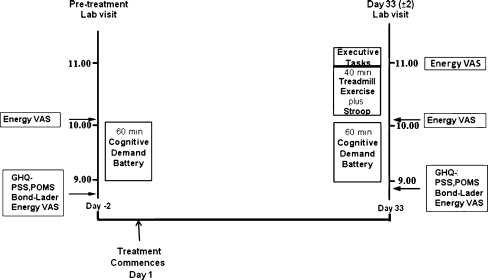
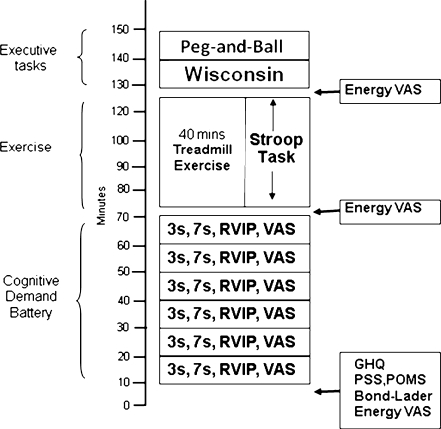
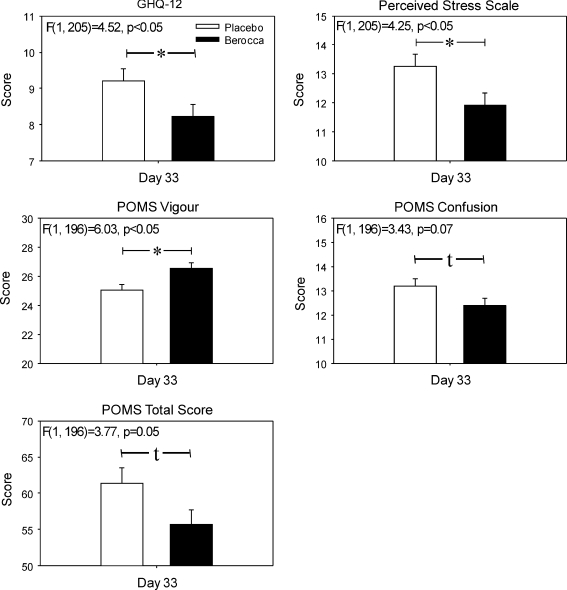
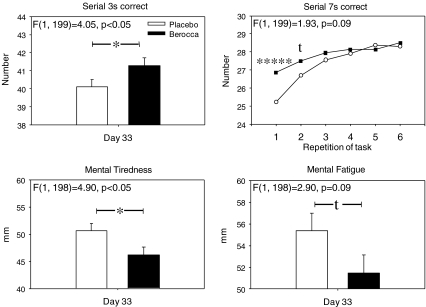
RATIONALE: A significant proportion of the general population report supplementing their diet with one or more vitamins or minerals, with common reasons for doing so being to combat stress and fatigue and to improve mental functioning. Few studies have assessed the relationship between supplementation with vitamins/minerals and psychological functioning in healthy cohorts of non-elderly adults. OBJECTIVES: The present randomised, placebo-controlled, double-blind, parallel groups trial assessed the cognitive and mood effects of a high-dose B-complex vitamin and mineral supplement (Berocca(R)) in 215 males aged 30 to 55 years, who were in full-time employment. METHODS: Participants attended the laboratory prior to and on the last day of a 33-day treatment period where they completed the Profile of Mood States (POMS), Perceived Stress Scale (PSS) and General Health Questionnaire (GHQ-12). Cognitive performance and task-related modulation of mood/fatigue were assessed with the 60 min cognitive demand battery. On the final day, participants also completed the Stroop task for 40 min whilst engaged in inclined treadmill walking and subsequent executive function was assessed. RESULTS: Vitamin/mineral supplementation led to significant improvements in ratings on the PSS, GHQ-12 and the 'vigour' subscale of the POMS. The vitamin/mineral group also performed better on the Serial 3s subtractions task and rated themselves as less 'mentally tired' both pre- and post-completion of the cognitive demand battery. CONCLUSIONS: Healthy members of the general population may benefit from augmented levels of vitamins/minerals via direct dietary supplementation. Specifically, supplementation led to improved ratings of stress, mental health and vigour and improved cognitive performance during intense mental processing.
Overview
The claims and statistics of this paper haven’t been checked yet.
Run the check — free, no account needed. It reads the open-access text and checks the sources it cites.
Integrity signals
Registry
Cites
Statistics
Figures
Verification
Claims the paper makes
The claims and statistics of this paper haven’t been checked yet.
Run the check — free, no account needed. It reads the open-access text and checks the sources it cites.
Claims other papers make about this one
Each is checked against this paper’s own text: does it say what the citing paper says it does?
The cited source says what the claim attributes to it.
In the citing paper
“This assessment system has previously been shown to be sensitive to nutritional interventions (Kennedy et al. 2010a; Stonehouse et al. 2013) including caffeine (Kennedy and Haskell 2011).”
From A Double-Blind, Placebo-Controlled Study Evaluating the Effects of Caffeine and L-Theanine Both Alone and in Combination on Cerebral Blood Flow, Cognition and Mood (2015) · cites this paper as Kennedy et al. 2010a
Self-check
Percentages, sums and reported differences re-computed from the paper’s own numbers.
The self-check needs the paper’s full text.
Citations
Cites
A Global Measure of Perceived Stress
Cohen, S., Kamarck, T., & Mermelstein, R. (1983) · Journal of Health and Social Behavior · doi:10.2307/2136404 · Cited by 32,807
The Validity of Two Versions of the GHQ in the WHO Study of Mental Illness in General Health Care
GOLDBERG, D. P., GATER, R., SARTORIUS, N., USTUN, T. B., PICCINELLI, M., GUREJE, O., & RUTTER, C. (1997) · Psychological Medicine · doi:10.1017/s0033291796004242 · Cited by 3,657
A simple objective technique for measuring flexibility in thinking
Berg, E. A. (1948) · The Journal of General Psychology · doi:10.1080/00221309.1948.9918159 · Cited by 2,255
The use of analogue scales in rating subjective feelings
BOND, A., & LADER, M. (1974) · British Journal of Medical Psychology · doi:10.1111/j.2044-8341.1974.tb02285.x · Cited by 1,972
Dietary Intake of Antioxidants and Risk of Alzheimer Disease
Engelhart, M. J. (2002) · JAMA · doi:10.1001/jama.287.24.3223 · Cited by 1,080
Importance of Zinc in the Central Nervous System: The Zinc-Containing Neuron
Frederickson, C. J., Suh, S. W., Silva, D., Frederickson, C. J., & Thompson Richard, B. (2000) · Journal of Nutrition · doi:10.1093/jn/130.5.1471s · Cited by 866
Folate and homocysteine metabolism in neural plasticity and neurodegenerative disorders
Mattson, M. P., & Shea, T. B. (2003) · Trends in Neurosciences · doi:10.1016/s0166-2236(03)00032-8 · Cited by 847
Durga, J., van Boxtel, M. P., Schouten, E. G., Kok, F. J., Jolles, J., Katan, M. B., & Verhoef, P. (2007) · The Lancet · doi:10.1016/s0140-6736(07)60109-3 · Cited by 758
Epstein, F. H., Epstein, F. H., & Rasmussen, H. (1986) · New England Journal of Medicine · doi:10.1056/nejm198604243141707 · Cited by 663
Vitamin C function in the brain: Vital role of the ascorbate transporter SVCT2
Harrison, F. E., & May, J. M. (2009) · Free Radical Biology and Medicine · doi:10.1016/j.freeradbiomed.2008.12.018 · Cited by 661
Research works printed but not linked: 2
- Cohen J (1988) Statistical Power Analysis for the Behavioral Sciences (second ed.). Lawrence Erlbaum Associates
- Nelson M, Erens B, Bates B, Church S, Boshier T (2007) Low Income Diet and Nutrition Survey. TSO, London
Cited by
Sorted by citations
Oxidative & nitrosative stress in depression: Why so much stress?
Moylan, S., Berk, M., Dean, O. M., Samuni, Y., Williams, L. J., O'Neil, A. E., Hayley, A. C., Pasco, J. A., Anderson, G., Jacka, F. N., et al. (2014) · Neuroscience & Biobehavioral Reviews · doi:10.1016/j.neubiorev.2014.05.007 · Cited by 412
Cox, K. H., Pipingas, A., & Scholey, A. B. (2015) · Journal of Psychopharmacology · doi:10.1177/0269881114552744 · Cited by 368
Stonehouse, W., Conlon, C. A., Podd, J., Hill, S. R., Minihane, A. M., Haskell, C., & Kennedy, D. (2013) · The American Journal of Clinical Nutrition · doi:10.3945/ajcn.112.053371 · Cited by 252
Self-citationGeiker, N. R. W., Astrup, A. V., Hjorth, M. F., Sjödin, A. M., Pijls, L. G. M., & Markus, C. R. (2017) · Obesity Reviews · doi:10.1111/obr.12603 · Cited by 246
Astrup, A., & Bügel, S. (2019) · International Journal of Obesity · doi:10.1038/s41366-018-0143-9 · Cited by 179
Metadata
- Authors
- Kennedy, D. O., Veasey, R., Watson, A., Dodd, F., Jones, E., Maggini, S., & Haskell, C. F.
- Affiliations
- Northumbria University (GB)
- Bayer (Switzerland) (CH)
- Venue
- Psychopharmacology
- Published
- 2010-05-08
- Volume
- 211
- Issue
- 1
- Pages
- 55-68
- ISSN
- 0033-3158 (ISSN-L)
- 1432-2072
- PMC
- PMC2885294
- OpenAlex
- W2082890731
- Cited by
- 159
- References
- 52
- Citations by year
- 2026: 2 · 2025: 7 · 2024: 4 · 2023: 8 · 2022: 3 · 2021: 9 · 2020: 8 · 2019: 7 · 2018: 12 · 2017: 10 · 2016: 8 · 2015: 16 · 2014: 19 · 2013: 14 · 2012: 13
- FWCI
- 14.63
- Type
- journal article
- Language
- en
- Open access
- hybrid
- doi.org
- Licence
- cc-by-nc
- Locations
- Psychopharmacology (publishedVersion, cc-by-nc)
- PubMed Central (publishedVersion, cc-by-nc)
- PubMed (publishedVersion)
- Northumbria Research Link (Northumbria University) (submittedVersion)
- Topics
- Health Sciences › Medicine › Public Health, Environmental and Occupational Health › Nutrition and Health Studies
- Health Sciences › Nursing › Nutrition and Dietetics › Folate and B Vitamins Research
- Health Sciences › Medicine › Biochemistry (medical) › Antioxidant Activity and Oxidative Stress
- Keywords
- B vitamins, vitamin C, mineral supplementation, mood, stress, mental health, cognitive performance, fatigue, vigor, executive function, Stroop task, treadmill walking, healthy men
- MeSH terms
- Adult, Affect, Analysis of Variance, Ascorbic Acid, Cognition, Double-Blind Method, Fatigue, Humans, Male, Mathematics, Middle Aged, Minerals, Neuropsychological Tests, Placebos, Surveys and Questionnaires, Vitamin B Complex, Dietary Supplements, Executive Function
About these checks
Registry, retraction, Cites and statistics results are computed, not judged, with one exception: a printed reference that no index lists is read once by a model before it counts as a citation error. Claims are extracted by a model and kept only when their quote appears verbatim in the text; each cited source is then checked, with a model’s help, for whether it says what the claim relies on. Those verdicts can be wrong — read the claim’s quote and the cited source before relying on one.
Statistics and arithmetic are recomputed, not judged.
Confidence bands are shown only for fields calibrated on our annotated test set. None is calibrated yet, so no band is shown.
What counts as a claim ›How we measure confidence ›How we check this ›
Are you an author, or do you see a problem with this page? Request a review
