

Tryptophan depletion disinhibits punishment but not reward prediction: implications for resilience
Open accessThe DOI matches its Crossref record; 33 of the 33 references it cites were found in a registry or an index.
Abstract
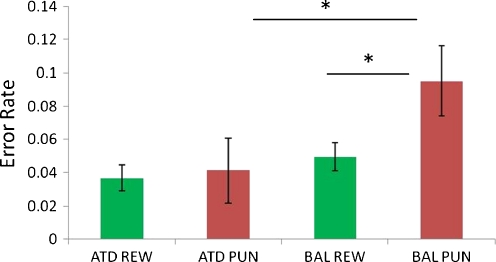
RATIONALE: We have previously shown that tryptophan depletion enhances punishment but not reward prediction (Cools et al. in Neuropsychopharmacology 33:2291-2299, 2008b). This provided evidence for a valence-specific role of serotonin (which declines under depleted tryptophan) in aversive processing. Recent theoretical (Dayan and Huys in PLoS Comput Biol 4:e4, 2008) and experimental (Crockett et al. in J Neurosci 29:11993-11999, 2009) approaches have, however, further specified this role by showing that serotonin is critical for punishment-induced inhibition. OBJECTIVES: We sought to examine the role of serotonin in punishment-induced inhibition. We also examined the impact of induced mood on this effect to assess whether effects of tryptophan depletion on affective inhibition are moderated by mood. METHODS: Healthy females consumed a balanced amino acid mixture with (N = 20) or without (N = 21) the serotonin precursor tryptophan. Each subject completed either negative or neutral mood induction. All subjects completed the reward and punishment reversal learning task adopted in the previous study. RESULTS: We demonstrate a punishment prediction impairment in individuals who consumed tryptophan which was absent in individuals who were depleted of tryptophan. This effect was impervious to mood state. CONCLUSIONS: Our results suggest that serotonin promotes the inhibition of responses to punishing outcomes. This may lead to reduced punishment prediction accuracy in the presence of tryptophan and may contribute to resilience to affective disorders. Reduction of serotonin via tryptophan depletion then removes this inhibition. As such, we highlight a mechanism by which reduced serotonin can contribute to disorders of impulsivity and compulsivity as well as disorders of emotion.
Overview
The claims and statistics of this paper haven’t been checked yet.
Free: it reads the open-access text and checks the first 5 claims that cite a source we can check. Create a free account to check every claim.
Integrity signals
Registry
Cites
Statistics
Figures
Verification
Claims the paper makes
The claims and statistics of this paper haven’t been checked yet.
Free: it reads the open-access text and checks the first 5 claims that cite a source we can check. Create a free account to check every claim.
Claims other papers make about this one
Each is checked against this paper’s own text: does it say what the citing paper says it does?
In the citing paper
“Robinson et al. (2012), Cools et al. (2008) and Crockett et al. (2009) have all emphasised the effects of serotonin on learning from punishment, but also its impact on reward and resilience.”
From The role of habit in compulsivity (2016) · cites this paper as Robinson et al. (2012)
Self-check
Percentages, sums and reported differences re-computed from the paper’s own numbers.
The self-check needs the paper’s full text.
Citations
Cites
An inventory for measuring depression
BECK, A. T. (1961) · Archives of General Psychiatry · doi:10.1001/archpsyc.1961.01710120031004 · Cited by 38,032
Scoville, W. B. (1949) · Journal of neurosurgery · doi:10.3171/jns.1949.6.1.0065 · Cited by 7,381
Carver, C. S., & White, T. L. (1994) · Journal of Personality and Social Psychology · doi:10.1037/0022-3514.67.2.319 · Cited by 7,306
Judgment of contingency in depressed and nondepressed students: Sadder but wiser?
Alloy, L. B., & Abramson, L. Y. (1979) · Journal of Experimental Psychology: General · doi:10.1037/0096-3445.108.4.441 · Cited by 1,692
5-HT and mechanisms of defence
Deakin, J. F. W., & Graeff, F. G. (1991) · Journal of Psychopharmacology · doi:10.1177/026988119100500414 · Cited by 1,010
Reconciling the role of central serotonin neurons in human and animal behavior
Soubrié, P. (1986) · Behavioral and Brain Sciences · doi:10.1017/s0140525x00022871 · Cited by 996
Impulsiveness and Venturesomeness: Their Position in a Dimensional System of Personality Description
Eysenck, S. B. G., & Eysenck, H. J. (1978) · Psychological Reports · doi:10.2466/pr0.1978.43.3f.1247 · Cited by 945
Opponent interactions between serotonin and dopamine
Daw, N. D., Kakade, S., & Dayan, P. (2002) · Neural Networks · doi:10.1016/s0893-6080(02)00052-7 · Cited by 844
Serotoninergic regulation of emotional and behavioural control processes
Cools, R., Roberts, A. C., & Robbins, T. W. (2008) · Trends in Cognitive Sciences · doi:10.1016/j.tics.2007.10.011 · Cited by 656 · cited 17×
“Treatment effects are assessed prior to the MIP, and MIP effects are collapsed across treatment sessions aversive temporal-difference prediction error signals, brought about by lowering tonic 5-HT levels and increasing the signal-to-noise ratio of phasic 5-HT bursts (Cools et al. 2008b).”
BackgroundMethodResultInfluentialSelf-citationBeddington, J., Cooper, C. L., Field, J., Goswami, U., Huppert, F. A., Jenkins, R., Jones, H. S., Kirkwood, T. B. L., Sahakian, B. J., & Thomas, S. M. (2008) · Nature · doi:10.1038/4551057a · Cited by 554 · cited 1×
“Increasing our understanding of how it might be possible to cushion against such disorders, potentially by enhancing behavioural inhibition to aversive stimuli, would go a long way towards improving the ‘mental wealth of nations’ (Beddington et al. 2008).”
BackgroundSelf-citation
Cited by
Dopamine, serotonin and impulsivity
Dalley, J. W., & Roiser, J. P. (2012) · Neuroscience · doi:10.1016/j.neuroscience.2012.03.065 · Cited by 501
“…including: premature responses (LeMarquand et al., 1998, 1999; Walderhaug et al., 2002, 2007; Booij et al., 2006; Dougherty et al., 2007); impaired conditioned suppression (Crockett et al., 2009; Robinson et al., 2012); and delay discounting (Crean et al., 2002; Schweighofer et al., 2008).”
Huys, Q. J. M., Eshel, N., O'Nions, E., Sheridan, L., Dayan, P., & Roiser, J. P. (2012) · PLoS Computational Biology · doi:10.1371/journal.pcbi.1002410 · Cited by 439
The role of habit in compulsivity
Gillan, C. M., Robbins, T. W., Sahakian, B. J., van den Heuvel, O. A., & van Wingen, G. (2016) · European Neuropsychopharmacology · doi:10.1016/j.euroneuro.2015.12.033 · Cited by 292
Self-citationOverlapping neural systems represent cognitive effort and reward anticipation
Vassena, E., Silvetti, M., Boehler, C. N., Achten, E., Fias, W., & Verguts, T. (2014) · PLoS ONE · doi:10.1371/journal.pone.0091008 · Cited by 200
Dimensional psychiatry: reward dysfunction and depressive mood across psychiatric disorders
Hägele, C., Schlagenhauf, F., Rapp, M., Sterzer, P., Beck, A., Bermpohl, F., Stoy, M., Ströhle, A., Wittchen, H.-U., Dolan, R. J., et al. (2015) · Psychopharmacology · doi:10.1007/s00213-014-3662-7 · Cited by 191
“Further studies will have to explore the association between anxiety, learning from punishment, and serotonin dysfunction (Daw et al. 2002; Reimold et al. 2008; Robinson et al. 2012).”
BackgroundAn Update on the Role of Serotonin and its Interplay with Dopamine for Reward
Fischer, A. G., & Ullsperger, M. (2017) · Frontiers in Human Neuroscience · doi:10.3389/fnhum.2017.00484 · Cited by 176
“However, ATD increased participants’ ability to predict negative outcomes of observed choices (Cools et al., 2008b; Robinson et al., 2012) and increased the BOLD response to errors in fMRI in the pre-frontal cortex (Evers et al., 2005).”
BackgroundSego, C., Gonçalves, L., Lima, L., Furigo, I. C., Donato, J., & Metzger, M. (2014) · Journal of Comparative Neurology · doi:10.1002/cne.23533 · Cited by 127
Zeeb, F. D., Wong, A. C., & Winstanley, C. A. (2012) · Psychopharmacology · doi:10.1007/s00213-012-2822-x · Cited by 101
Stress increases aversive prediction error signal in the ventral striatum
Robinson, O. J., Overstreet, C., Charney, D. R., Vytal, K., & Grillon, C. (2013) · Proceedings of the National Academy of Sciences · doi:10.1073/pnas.1213923110 · Cited by 91
Self-citationFaulkner, P., & Deakin, J. F. W. (2014) · Neuroscience & Biobehavioral Reviews · doi:10.1016/j.neubiorev.2014.07.024 · Cited by 90
The Neural Mechanism Underlying Cognitive and Emotional Processes in Creativity
Gu, S., Gao, M., Yan, Y., Wang, F., Tang, Y., & Huang, J. H. (2018) · Frontiers in Psychology · doi:10.3389/fpsyg.2018.01924 · Cited by 83
Herzallah, M. M., Moustafa, A. A., Natsheh, J. Y., Abdellatif, S. M., Taha, M. B., Tayem, Y. I., Sehwail, M. A., Amleh, I., Petrides, G., Myers, C. E., et al. (2013) · Frontiers in Integrative Neuroscience · doi:10.3389/fnint.2013.00067 · Cited by 77
“…abnormally negative attitudes and thoughts (Bower, 1981), while being unable to modulate their behavioral responses when presented with positive reinforcement, which results in misconception of environmental information to confirm these biases (Gotlib and Joormann, 2010; Roiser and Sahakian, 2013).”
BackgroundSerotonin and Aversive Pavlovian Control of Instrumental Behavior in Humans
Geurts, D. E. M., Huys, Q. J. M., den Ouden, H. E. M., & Cools, R. (2013) · The Journal of Neuroscience · doi:10.1523/jneurosci.2749-13.2013 · Cited by 77
Self-citationvon Borries, A. K. L., Verkes, R. J., Bulten, B. H., Cools, R., & de Bruijn, E. R. A. (2013) · Cognitive Affective & Behavioral Neuroscience · doi:10.3758/s13415-013-0150-1 · Cited by 68
Self-citationRobinson, O. J., Overstreet, C., Allen, P. S., Letkiewicz, A., Vytal, K., Pine, D. S., & Grillon, C. (2013) · NeuroImage · doi:10.1016/j.neuroimage.2013.03.075 · Cited by 64
Self-citation5-HT modulation of pain perception in humans
Martin, S. L., Power, A., Boyle, Y., Anderson, I. M., Silverdale, M., & Jones, A. K. P. (2017) · Psychopharmacology · doi:10.1007/s00213-017-4686-6 · Cited by 59
Scholl, J., Kolling, N., Nelissen, N., Browning, M., Rushworth, M. F. S., & Harmer, C. J. (2017) · PLOS Biology · doi:10.1371/journal.pbio.2000756 · Cited by 58
Banlaki, Z., Elek, Z., Nanasi, T., Szekely, A., Nemoda, Z., Sasvari-Szekely, M., & Ronai, Z. (2015) · PLOS ONE · doi:10.1371/journal.pone.0117792 · Cited by 55
Balasubramani, P. P., Chakravarthy, V. S., Ravindran, B., & Moustafa, A. A. (2015) · Frontiers in Computational Neuroscience · doi:10.3389/fncom.2015.00076 · Cited by 50
The Role of Tryptophan and Tyrosine in Executive Function and Reward Processing
Aquili, L. (2020) · International Journal of Tryptophan Research · doi:10.1177/1178646920964825 · Cited by 48
Lipids, aggression, suicidality and impulsivity in drug-naïve/drug-free patients of schizophrenia
Kavoor, A. R., Mitra, S., Kumar, S., Sisodia, A., & Jain, R. K. (2017) · Asian Journal of Psychiatry · doi:10.1016/j.ajp.2017.03.002 · Cited by 45
Balasubramani, P. P., Chakravarthy, V. S., Ravindran, B., & Moustafa, A. A. (2014) · Frontiers in Computational Neuroscience · doi:10.3389/fncom.2014.00047 · Cited by 44
Role of dopamine and clinical heterogeneity in cognitive dysfunction in Parkinson's disease
Cools, R., Tichelaar, J. G., Helmich, R. C. G., Bloem, B. R., Esselink, R. A. J., Smulders, K., & Timmer, M. H. M. (2022) · Progress in brain research · doi:10.1016/bs.pbr.2022.01.012 · Cited by 44
Self-citationRobinson, O. J., Grillon, C., & Sahakian, B. J. (2012) · Protocol Exchange · doi:10.1038/protex.2012.007 · Cited by 44
Self-citationSerotonin and aversive processing in affective and social decision-making
Crockett, M. J., & Cools, R. (2015) · Current Opinion in Behavioral Sciences · doi:10.1016/j.cobeha.2015.08.005 · Cited by 43
Self-citationNeural systems for choice and valuation with counterfactual learning signals
Tobia, M. J., Guo, R., Schwarze, U., Böhmer, W., Gläscher, J. P., Finckh, B., Marschner, A., Büchel, C., Obermayer, K., & Sommer, T. (2013) · NeuroImage · doi:10.1016/j.neuroimage.2013.11.051 · Cited by 43
The Influence of Serotonin on Fear Learning
Hindi Attar, C., Finckh, B., & Büchel, C. (2012) · PLoS ONE · doi:10.1371/journal.pone.0042397 · Cited by 42
Carlisi, C. O., & Robinson, O. J. (2018) · Brain and Neuroscience Advances · doi:10.1177/2398212818774223 · Cited by 41
Self-citationNeuromolecular Underpinnings of Negative Cognitive Bias in Depression
Noworyta, K., Cieslik-Starkiewicz, A., & Ryguła, R. (2021) · Cells · doi:10.3390/cells10113157 · Cited by 40
van Eijndhoven, P., Collard, R. M., Vrijsen, J. N., Geurts, D. E. M., Vásquez, A. A., Schellekens, A., van den Munckhof, E., Brolsma, S. C. A., Duyser, F. A., Bergman, M. A., et al. (2022) · JMIRx Med · doi:10.2196/31269 · Cited by 39
Affective Biases in Humans and Animals
Robinson, E. S. J., & Roiser, J. P. (2015) · Current Topics in Behavioral Neurosciences · doi:10.1007/7854_2015_5011 · Cited by 37
Robinson, O. J., Overstreet, C., Allen, P. S., Pine, D. S., & Grillon, C. (2012) · Neuropsychopharmacology · doi:10.1038/npp.2012.43 · Cited by 35
Self-citationSerotonin depletion impairs both Pavlovian and instrumental reversal learning in healthy humans
Kanen, J. W., Apergis-Schoute, A. M., Yellowlees, R., Arntz, F. E., van der Flier, F. E., Price, A., Cardinal, R. N., Christmas, D. M., Clark, L., Sahakian, B. J., et al. (2021) · Molecular Psychiatry · doi:10.1038/s41380-021-01240-9 · Cited by 34
Self-citationThe effects of acute fluoxetine administration on temporal discounting in youth with ADHD
Carlisi, C. O., Chantiluke, K. C., Norman, L. J., Christakou, A., Barrett, N., Giampietro, V., Brammer, M. J., Simmons, A., & Rubia, K. (2015) · Psychological Medicine · doi:10.1017/s0033291715002731 · Cited by 32
Macoveanu, J., Knorr, U., Skimminge, A., Søndergaard, M. G., Jørgensen, A., Fauerholdt-Jepsen, M., Paulson, O. B., Knudsen, G. M., Siebner, H. R., & Kessing, L. V. (2014) · Psychological Medicine · doi:10.1017/s0033291713001815 · Cited by 30
Jepma, M., Roy, M., Ramlakhan, K., van Velzen, M., & Dahan, A. (2022) · eLife · doi:10.7554/elife.74149 · Cited by 30
Fischer, A. G., Endrass, T., Reuter, M., Kubisch, C., & Ullsperger, M. (2015) · The Journal of Neuroscience · doi:10.1523/jneurosci.5124-14.2015 · Cited by 29
Cortico‐limbic connectivity in MAOA‐L carriers is vulnerable to acute tryptophan depletion
Eisner, P. D., Klasen, M., Wolf, D., Zerres, K., Eggermann, T., Eisert, A., Zvyagintsev, M., Sarkheil, P., Mathiak, K. A., Zepf, F. D., et al. (2016) · Human Brain Mapping · doi:10.1002/hbm.23475 · Cited by 28
Reward learning deficits in Parkinson's disease depend on depression
Timmer, M. H. M., Sescousse, G., van der Schaaf, M. E., Esselink, R. A. J., & Cools, R. (2017) · Psychological Medicine · doi:10.1017/s0033291717000769 · Cited by 28
Self-citationDirect serotonin release in humans shapes aversive learning and inhibition
Colwell, M., Tagomori, H., Shang, F., Cheng, H. I., Wigg, C., Browning, M. D., Cowen, P. J., Murphy, S. E., & Harmer, C. J. (2024) · Nature Communications · doi:10.1038/s41467-024-50394-x · Cited by 28
Using rodents to model abnormal sensitivity to feedback in depression
Ryguła, R., Noworyta, K., Drozd, R., & Kozub, A. (2018) · Neuroscience & Biobehavioral Reviews · doi:10.1016/j.neubiorev.2018.10.008 · Cited by 27
Mavrogiorgou, P., Enzi, B., Klimm, A., Köhler, E., Roser, P., Norra, C., & Juckel, G. (2016) · Human Brain Mapping · doi:10.1002/hbm.23468 · Cited by 25
Enge, S., Mothes, H., Fleischhauer, M., Reif, A., & Strobel, A. (2017) · Scientific Reports · doi:10.1038/s41598-017-02594-3 · Cited by 25
Schroeder, K. B., McElreath, R. L., & Nettle, D. (2013) · Proceedings of the National Academy of Sciences · doi:10.1073/pnas.1216841110 · Cited by 24
Effects of serotonin and dopamine depletion on neural prediction computations during social learning
Frey, A.-L., & McCabe, C. (2020) · Neuropsychopharmacology · doi:10.1038/s41386-020-0678-z · Cited by 23
Zhang, L., Yu, F., Hu, Q., Qiao, Y., Xuan, R., Ji, G., Zhu, C., Cai, C., & Wang, K. (2020) · Psychiatry Investigation · doi:10.30773/pi.2019.0345 · Cited by 22
Mkrtchian, A., Qiu, Z., Abir, Y., Erdmann, T., Dercon, Q., Sedlinská, T., Browning, M. D., Costello, H., & Huys, Q. J. M. (2025) · JAMA Psychiatry · doi:10.1001/jamapsychiatry.2025.0839 · Cited by 19
Amino acid challenge and depletion techniques in human functional neuroimaging studies: an overview
Biskup, C. S., Gaber, T. J., Helmbold, K., Bubenzer‐Busch, S., & Zepf, F. D. (2015) · Amino Acids · doi:10.1007/s00726-015-1919-z · Cited by 19
Toward a multiscale modeling framework for understanding serotonergic function
Wong‐Lin, K., Wang, D., Moustafa, A. A., Cohen, J. Y., & Nakamura, K. (2017) · Journal of Psychopharmacology · doi:10.1177/0269881117699612 · Cited by 17
Thirkettle, M., Barker, L.-M., Gallagher, T. F., Nayeb, N., & Aquili, L. (2019) · Frontiers in Behavioral Neuroscience · doi:10.3389/fnbeh.2019.00127 · Cited by 12
Carvalheiro, J., & Philiastides, M. G. (2023) · Cell Reports · doi:10.1016/j.celrep.2023.113589 · Cited by 11
Gaber, T. J., Dingerkus, V. L. S., Crockett, M. J., Bubenzer‐Busch, S., Helmbold, K., Sánchez, C. L., Dahmen, B., Herpertz‐Dahlmann, B., & Zepf, F. D. (2015) · Food & Nutrition Research · doi:10.3402/fnr.v59.28443 · Cited by 10
Noworyta, K., & Ryguła, R. (2021) · European Neuropsychopharmacology · doi:10.1016/j.euroneuro.2020.12.004 · Cited by 9
Understanding the Role of Serotonin in Basal Ganglia through a Unified Model
Priyadharsini, B. P., Ravindran, B., & Chakravarthy, V. S. (2012) · Lecture notes in computer science · doi:10.1007/978-3-642-33269-2_59 · Cited by 9
Brain serotonin transporter is associated with cognitive‐affective biases in healthy individuals
Armand, S., Ozenne, B., Svart, N., Frøkjær, V. G., Knudsen, G. M., Fisher, P. M., & Stenbæk, D. S. (2022) · Human Brain Mapping · doi:10.1002/hbm.25946 · Cited by 9
Faulkner, P., Mancinelli, F., Lockwood, P. L., Matarín, M., Dolan, R. J., Wood, N. W., Dayan, P., & Roiser, J. P. (2016) · The International Journal of Neuropsychopharmacology · doi:10.1093/ijnp/pyw075 · Cited by 9
Hot and cold cognition in major depressive disorder
Robinson, O. J., Roiser, J. P., & Sahakian, B. J. (2015) · Cambridge University Press eBooks · doi:10.1017/cbo9781139860567.007 · Cited by 7
Self-citationPhillips, B. U., & Robbins, T. W. (2020) · Handbook of behavioral neuroscience · doi:10.1016/b978-0-444-64125-0.00031-1 · Cited by 6
The Role of Serotonin in Aversive Inhibition: Behavioural, Cognitive and Neural Perspectives
Robinson, O. J., & Roiser, J. P. (2015) · Psychopathology Review · doi:10.5127/pr.034013 · Cited by 6
Self-citationModeling Serotonin’s Contributions to Basal Ganglia Dynamics
Balasubramani, P. P., Chakravarthy, V. S., Ravindran, B., & Moustafa, A. A. (2018) · Cognitive science and technology · doi:10.1007/978-981-10-8494-2_12 · Cited by 5
The role of serotonin in performance monitoring and cognitive control
Fischer, A. G., & Jocham, G. (2020) · Handbook of behavioral neuroscience · doi:10.1016/b978-0-444-64125-0.00033-5 · Cited by 5
Cognitive Biomarkers in Depression
Robinson, O. J., & Sahakian, B. J. (2013) · Oxford University Press eBooks · doi:10.1093/med/9780199796816.003.0035 · Cited by 4
Self-citationClinical relevance of cognitive dysfunction in major depressive disorder
Cha, D. S. (2015) · Cambridge University Press eBooks · doi:10.1017/cbo9781139860567.002 · Cited by 2
The Role of Monoamine System in Core Affects and Basic Emotions
Wang, F. (2019) · Archives in Neurology & Neuroscience · doi:10.33552/ann.2019.03.000553 · Cited by 2
Out of Balance. Neurocognitive mechanisms underlying depression in Parkinson’s disease
Timmer, M. H. M. (2019) · Radboud Repository (Radboud University) · Cited by 2
Reward learning deficits in Parkinson’s disease depend on depressionPreprint
Timmer, M. H. M., Sescousse, G., van der Schaaf, M. E., Esselink, R. A. J., & Cools, R. (2016) · bioRxiv (Cold Spring Harbor Laboratory) · doi:10.1101/069062 · Cited by 1
Self-citationInvestigating the neurobiological basis of decision-making using a novel rat gambling task
Zeeb, F. D. (2012) · cIRcle (University of British Columbia) · doi:10.14288/1.0072647 · Cited by 1
The motivational brain: neural encoding of reward and effort in goal-directed behavior
Vassena, E. (2014) · Ghent University Academic Bibliography (Ghent University) · Cited by 1
Cognitive Flexibility in the Context of Stress and Depressive Disorders
Gabrys, R. L. (2017) · Carleton University's Institutional Repository (MacOdrum Library, Carleton University) · doi:10.22215/etd/2017-11965
The effects of dietary probiotic administration on anxiety and cognition
O’Hagan, C. (2015) · ORCA Online Research @Cardiff (Cardiff University)
The effects of antidepressants (SSRIs) on cognitive function in major depressive disorder
Herzallah, M. M., Miezah, D., & Moustafa, A. A. (2020) · Elsevier eBooks · doi:10.1016/b978-0-12-817676-4.00003-1
Rahbarnia, A. (2019) · TSpace (University of Toronto)
Falck, J., Lindenberg, K., Schwarzer, G., Straube, B., & Shing, Y. L. (2024) · OSF Preprints (OSF Preprints) · doi:10.31219/osf.io/zu7pr
UNIVERSITE DE BREST - BRETAGNE OCCIDENTALE
de Médecine, F. (2013)
Smith, A. L. W., Hamilton, S., Murphy, S. E., Cowen, P. J., & Harmer, C. J. (2026) · Journal of Psychopharmacology · doi:10.1177/02698811261430527
Translational Psychiatry: When affect motivates effect
Geurts, D. E. M. (2017) · Radboud Repository (Radboud University)
Kanen, J. W. (2020) · Apollo (University of Cambridge) · doi:10.17863/cam.56767
Hägele, C., Schlagenhauf, F., Rapp, M. A., Sterzer, P., Beck, A., Bermpohl, F., Stoy, M., Ströhle, A., Wittchen, H.-U., Dolan, R. J., et al. (2020) · publish.UP (University of Potsdam) · doi:10.25932/publishup-43106
The effects of serotonergic manipulation on behavioural and neural correlates of reward processing
Smith, A. (2025) · Oxford University Research Archive (ORA) (University of Oxford) · doi:10.5287/ora-kemadxp98
Videojuegos y regulación emocional en estudiantes universitarios
Valdivia Verde, G. A. (2022) · Communities in DSpace (Pontifical Catholic University of Peru)
Falck, J., Lindenberg, K., Kührt, J., Straube, B., Schwarzer, G., & Shing, Y. L. (2025) · OSF Preprints (OSF Preprints) · doi:10.31219/osf.io/zu7pr_v2
Metadata
- Authors
- Robinson, O. J., Cools, R., & Sahakian, B. J.
- Affiliations
- University of Cambridge (GB)
- Radboud University Nijmegen (NL)
- Corresponding author
- Robinson, Oliver J.
- Venue
- Psychopharmacology
- Published
- 2011-07-19
- Volume
- 219
- Issue
- 2
- Pages
- 599-605
- ISSN
- 0033-3158 (ISSN-L)
- 1432-2072
- PMC
- PMC3249152
- OpenAlex
- W2074069500
- Semantic Scholar
- f95799f569db2db270a4f46a5ed0226ce20b0344
- Cited by
- 73
- References
- 33
- Citations by year
- 2026: 1 · 2025: 2 · 2024: 2 · 2023: 1 · 2022: 3 · 2021: 4 · 2020: 6 · 2019: 3 · 2018: 4 · 2017: 8 · 2016: 4 · 2015: 13 · 2014: 4 · 2013: 11 · 2012: 7
- FWCI
- 2.91
- Type
- journal article
- Language
- en
- Open access
- hybrid
- doi.org
- Licence
- cc-by-nc
- Locations
- Psychopharmacology (publishedVersion, cc-by-nc)
- Europe PMC (PubMed Central) (publishedVersion, cc-by-nc)
- PubMed Central (publishedVersion, cc-by-nc)
- PubMed (publishedVersion)
- UCL Discovery (University College London) (submittedVersion)
- Radboud Repository (Radboud University) (submittedVersion)
- Funders
- Wellcome Trust (093875)
- Topics
- Life Sciences › Neuroscience › Cellular and Molecular Neuroscience › Neurotransmitter Receptor Influence on Behavior
- Life Sciences › Neuroscience › Cognitive Neuroscience › Neural and Behavioral Psychology Studies
- Life Sciences › Neuroscience › Biological Psychiatry › Tryptophan and brain disorders
- Keywords
- tryptophan depletion, serotonin, reward prediction, mood induction, resilience, reversal learning, impulsivity, compulsivity, emotional disorders
- MeSH terms
- Adult, Affect, Amino Acids, Female, Humans, Inhibition, Psychological, Neuropsychological Tests, Punishment, Reversal Learning, Reward, Tryptophan, Resilience, Psychological
About these checks
Registry, retraction, Cites and statistics results are computed, not judged, with one exception: a printed reference that no index lists is read once by a model before it counts as a citation error. Claims are extracted by a model and kept only when their quote appears verbatim in the text; each cited source is then checked, with a model’s help, for whether it says what the claim relies on. Those verdicts can be wrong — read the claim’s quote and the cited source before relying on one.
Statistics and arithmetic are recomputed, not judged.
Confidence bands are shown only for fields calibrated on our annotated test set. None is calibrated yet, so no band is shown.
What counts as a claim ›How we measure confidence ›How we check this ›
Are you an author, or do you see a problem with this page? Request a review
Data sources
Bibliographic data: Semantic Scholar, OpenAlex, Crossref.
Contains information from the Semantic Scholar Academic Graph Datasets, made available under the ODC Attribution License (ODC-BY 1.0).
Semantic Scholar’s data is described in: Kinney, R., et al. (2023). The Semantic Scholar Open Data Platform. arXiv:2301.10140.
