

Chronic psychosocial stress and citalopram modulate the expression of the glial proteins GFAP and NDRG2 in the hippocampus
Open accessThe DOI matches its Crossref record; 89 of the 89 references it cites were found in a registry or an index.
Abstract
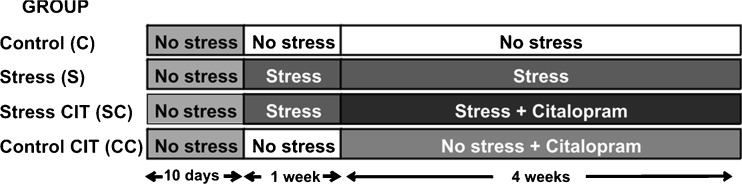
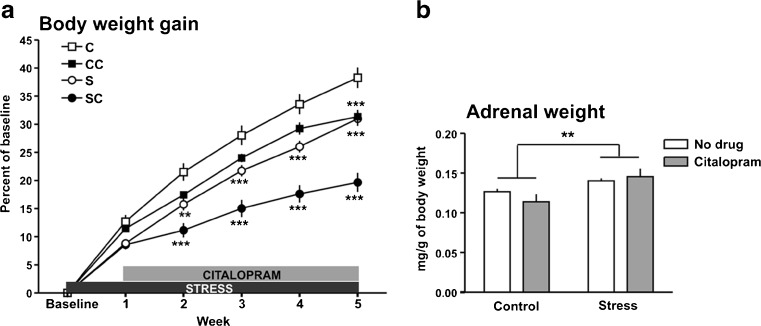
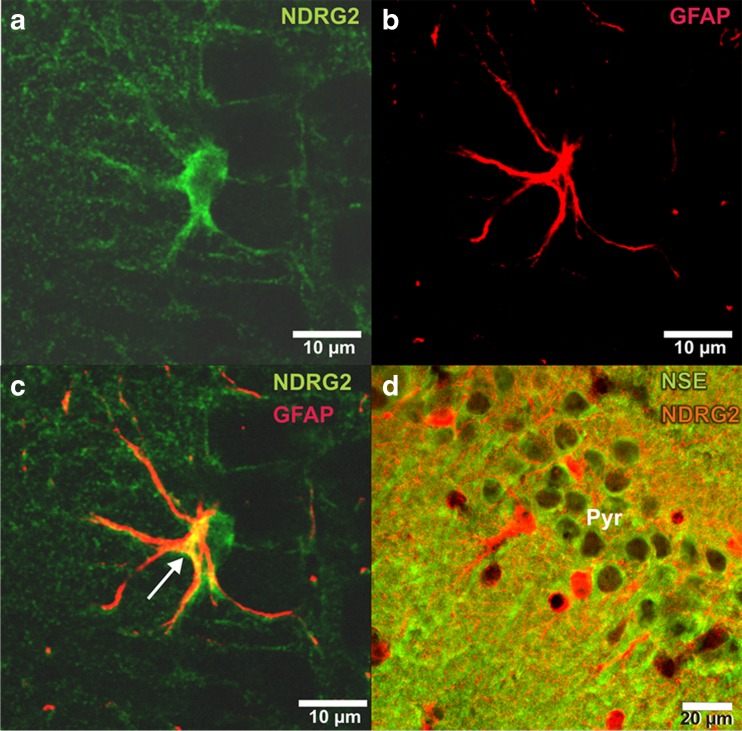
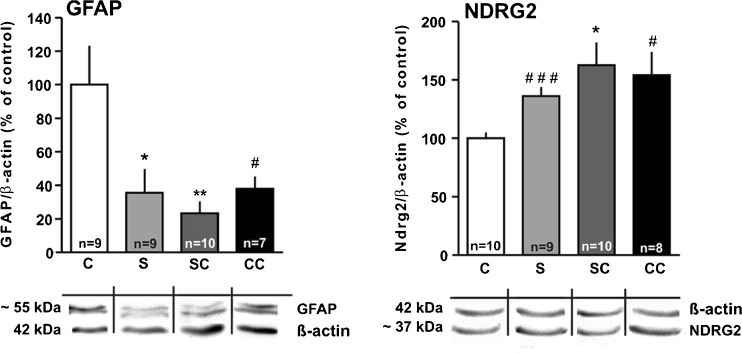
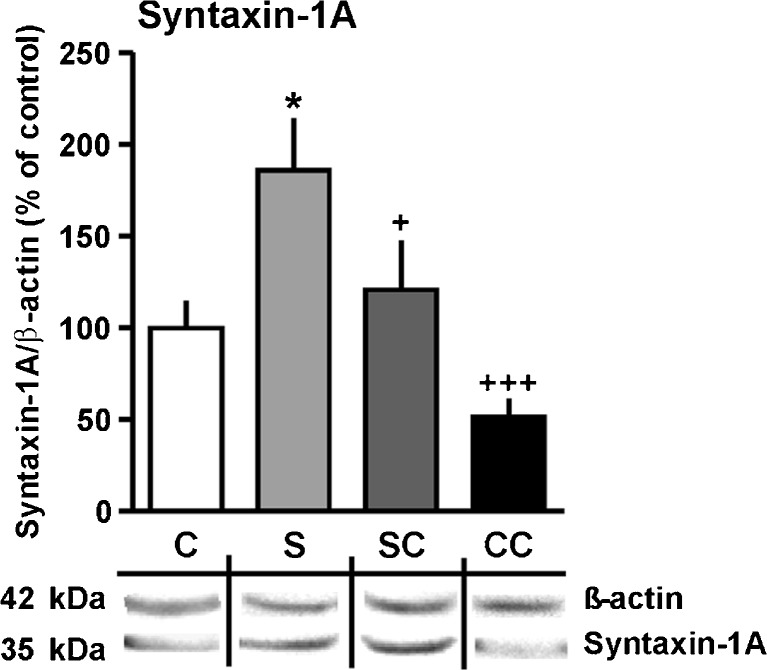
RATIONALE: It has been suggested that there are causal relationships between alterations in brain glia and major depression. OBJECTIVES: To investigate whether a depressive-like state induces changes in brain astrocytes, we used chronic social stress in male rats, an established preclinical model of depression. Expression of two astrocytic proteins, the intermediate filament component glial fibrillary acidic protein (GFAP) and the cytoplasmic protein N-myc downregulated gene 2 (NDRG2), was analyzed in the hippocampus. For comparison, expression of the neuronal protein syntaxin-1A was also determined. METHODS: Adult male rats were subjected to daily social defeat for 5 weeks and were concomitantly treated with citalopram (30 mg/kg/day, via the drinking water) for 4 weeks. RESULTS: Western blot analysis showed that the chronic stress downregulated GFAP but upregulated NDRG2 protein. Citalopram did not prevent these stress effects, but the antidepressant per se downregulated GFAP and upregulated NDRG2 in nonstressed rats. In contrast, citalopram prevented the stress-induced upregulation of the neuronal protein syntaxin-1A. CONCLUSIONS: These data suggest that chronic stress and citalopram differentially affect expression of astrocytic genes while the antidepressant drug does not prevent the stress effects. The inverse regulation of the cytoskeletal protein GFAP and the cytoplasmic protein NDRG2 indicates that the cells undergo profound metabolic changes during stress and citalopram treatment. Furthermore, the present findings indicate that a 4-week treatment with citalopram does not restore normal glial function in the hippocampus, although the behavior of the animals was normalized within this treatment period, as reported previously.
Overview
The claims and statistics of this paper haven’t been checked yet.
Free: it reads the open-access text and checks the first 5 claims that cite a source we can check. Create a free account to check every claim.
Integrity signals
Registry
Cites
Statistics
Figures
Verification
Claims the paper makes
The claims and statistics of this paper haven’t been checked yet.
Free: it reads the open-access text and checks the first 5 claims that cite a source we can check. Create a free account to check every claim.
Claims other papers make about this one
Each is checked against this paper’s own text: does it say what the citing paper says it does?
The source backs part of the claim, not all of it — or backs it for a different population, condition or comparison.
In the citing paper
“Mice exposed to chronic daily social defeat expressed reduced GFAP in stress-related brain regions associated with depressive-like behaviors (95).”
From Chronic stress, neuroinflammation, and depression: an overview of pathophysiological mechanisms and emerging anti-inflammatories (2023) · cites this paper as [95]
Experimental — accuracy not yet measured
Self-check
Percentages, sums and reported differences re-computed from the paper’s own numbers.
The self-check needs the paper’s full text.
Citations
Cites
The Rat Brain in Stereotaxic Coordinates
(1982) · Elsevier eBooks · doi:10.1016/c2009-0-63235-9 · Cited by 51,963
The rat brain in stereotaxic coordinates
Palkovits, M. (1983) · Neuropeptides · doi:10.1016/0143-4179(83)90049-5 · Cited by 28,831
Molecular Mechanisms of Depression: Perspectives on New Treatment Strategies
Lang, U. E., & Borgwardt, S. (2013) · Cellular Physiology and Biochemistry · doi:10.1159/000350094 · Cited by 8,475
AChE-stained horizontal sections of the rat brain in stereotaxic coordinates
Paxinos, G., Watson, C. R. R., & Emson, P. C. (1980) · Journal of Neuroscience Methods · doi:10.1016/0165-0270(80)90021-7 · Cited by 4,497
Tripartite synapses: glia, the unacknowledged partner
Araque, A., Parpura, V., Sanzgiri, R. P., & Haydon, P. G. (1999) · Trends in Neurosciences · doi:10.1016/s0166-2236(98)01349-6 · Cited by 2,529 · cited 2×
“As astrocytes are dynamic regulators of synaptogenesis and synaptic strength, and control neurogenesis in the adult dentate gyrus, the stress effects observed here may negatively influence neuronal functioning, possibly because of alterations in the capacity of supplying neurotrophic factors to the neuropil (Araque et…”
A molecular and cellular theory of depression
Duman, R. S. (1997) · Archives of General Psychiatry · doi:10.1001/archpsyc.1997.01830190015002 · Cited by 2,129 · cited 4×
“Some studies have analyzed SSRI effects on the expression of neuronal genes that are directly involved either in serotonergic transmission or in cell survival and neuroplasticity (Duman et al. 1997; Manji et al. 2003; Alfonso et al. 2004; Abumaria et al. 2007; Sairanen et al. 2007; Boer et al. 2010; Bethea et al. 2011…”
InfluentialThe rat brain in stereotaxic coordinates (2nd edn)
Herman, J. P., & Watson, S. J. (1987) · Trends in Neurosciences · doi:10.1016/0166-2236(87)90017-8 · Cited by 1,753
Stress revisited: a critical evaluation of the stress concept
Koolhaas, J. M., Bartolomucci, A., Buwalda, B., de Boer, S. F., Flügge, G., Korte, S. M., Meerlo, P., Murison, R., Olivier, B., Palanza, P., et al. (2011) · Neuroscience & Biobehavioral Reviews · doi:10.1016/j.neubiorev.2011.02.003 · Cited by 1,626
Protoplasmic Astrocytes in CA1 Stratum Radiatum Occupy Separate Anatomical Domains
Bushong, E. A., Martone, M. E., Jones, Y. Z., & Ellisman, M. H. (2002) · The Journal of Neuroscience · doi:10.1523/jneurosci.22-01-00183.2002 · Cited by 1,578 · cited 1×
“In addition, since GFAP-immunoreactive structures constitute only ~15 % of the total astrocytic volume, the reduction in the protein should not be taken as a measure of cell numbers (Bushong et al. 2002; Lavialle et al. 2011).”
Glial reduction in the subgenual prefrontal cortex in mood disorders
Öngür, D., Drevets, W. C., & Price, J. L. (1998) · Proceedings of the National Academy of Sciences · doi:10.1073/pnas.95.22.13290 · Cited by 1,525 · cited 2×
“was reduced in the orbitofrontal cortex of patients with major depression (Ongur et al. 1998; Miguel-Hidalgo et al. 2010).”
Cited by
Items 101–119 of 119
N-Myc Downstream-Regulated Gene 2 (NDRG2) as a Novel Tumor Suppressor in Multiple Human Cancers
Zhang, J., Li, X., Shen, L., Li, Y., & Yao, L. (2019) · IntechOpen eBooks · doi:10.5772/intechopen.86798 · Cited by 1
Rani, B. (2021) · Florence Research (University of Florence) · Cited by 1
Kiselycznyk, C., & Sanacora, G. (2014) · Springer eBooks · doi:10.1007/978-1-4939-1056-4_17
“In contrast, it should be noted that some studies have failed to find an ability of antidepressants to reverse stress-induced GFAP loss in the hippocampus (Araya-Callís et al. 2012) or cortex (Fatemi et al.”
ResultGill, T. (2019) · TSpace (University of Toronto)
Han, L., Xiong, X., Fan, M., Zhang, L., Liu, L., Guo, C., Gao, S., Wang, X., Zhao, L., Xiao, X., et al. (2021) · Research Square · doi:10.21203/rs.3.rs-1007353/v1
Research on Mechanism of Immediate Analgesic of Nf-Κb/Glu Mediated by Tuina in Minor Cci Model RatsPreprint
Sa, C., Yang, Z., Yu, T., Chen, J., Zhang, R., Zhang, Y., Sun, J., Liu, J., & Zhang, H. (2024) · SSRN Electronic Journal · doi:10.2139/ssrn.4882290
Sciatic Nerve Stimulation Mitigates Depression‐Like Behaviors and Memory Deficits in Stressed Mice
Tien, C., Chen, P., Hsiao, Y., Wong, C., Wu, M., Chen, Y., Huang, K., Lee, P., Chang, K., Hsu, H., et al. (2025) · The Kaohsiung Journal of Medical Sciences · doi:10.1002/kjm2.70091
“Consistent with our re-sults, previous studies show that chronic stress reduces GFAP mRNA expression in the prefrontal cortex [29] and GFAP protein levels in the hippocampus [30].”
Palleis, C. (2018) · Elektronische Hochschulschriften der LMU München (Ludwig-Maximilians-Universität München) · doi:10.5282/edoc.24315
Lopes, I. S. (2023) · LA Referencia (Red Federada de Repositorios Institucionales de Publicaciones Científicas)
Carreira, J. (2022) · Portuguese National Funding Agency for Science, Research and Technology (RCAAP Project by FCT)
Silva, L. D. S. D. (2024) · LA Referencia (Red Federada de Repositorios Institucionales de Publicaciones Científicas)
de Souza, R. A. C. (2023) · LA Referencia (Red Federada de Repositorios Institucionales de Publicaciones Científicas)
Öcalan, R. T. B. (2017) · Dspace Repository (Marmara Üniversitesi)
Simard, S. F. (2025) · Carleton University's Institutional Repository (MacOdrum Library, Carleton University) · doi:10.22215/etd/2025-16757
Kim, J., Ko, G., Kim, J.-H., & Chang, K. (2026) · Translational Psychiatry · doi:10.1038/s41398-026-04149-5
Taghavi, E., Eslami, M., Yekta, B. G., Gholami, M., & Vaseghi, S. (2026) · Physiology & Behavior · doi:10.1016/j.physbeh.2026.115430
Zhang, Q., Wu, W., Zhou, Y., Yu, L.-K., Zhang, X.-Y., Wu, J., Song, S., Yao, Z., & Initiative, A. D. N. (2026) · Journal of Alzheimer s Disease · doi:10.1177/13872877261477113
“27 NDRG2 participates in diverse physiological and pathological processes, including the modulation of neurological stress and depressive states, 28,29 the regulation of neurite outgrowth, 30 and cellular responses to a range of stressors.”
Neuropeptide W ameliorates brain damage induced by chronic unpredictable stress in rats
Köroğlu, A. K. (2025) · Marmara University Open Access System
Metadata
- Authors
- Araya-Callís, C., Hiemke, C., Abumaria, N., & Flugge, G.
- Affiliations
- German Primate Center (DE)
- University Medical Center of the Johannes Gutenberg University Mainz (DE)
- Center for Life Sciences (CN)
- Venue
- Psychopharmacology
- Published
- 2012-05-18
- Volume
- 224
- Issue
- 1
- Pages
- 209-222
- ISSN
- 0033-3158 (ISSN-L)
- 1432-2072
- PMC
- PMC3465647
- OpenAlex
- W1981874044
- Cited by
- 109
- References
- 89
- Citations by year
- 2026: 6 · 2025: 5 · 2024: 6 · 2023: 9 · 2022: 6 · 2021: 5 · 2020: 10 · 2019: 11 · 2018: 8 · 2017: 7 · 2016: 4 · 2015: 10 · 2014: 13 · 2013: 8 · 2012: 1
- FWCI
- 7.51
- Type
- journal article
- Language
- en
- Open access
- hybrid
- doi.org
- Licence
- cc-by
- Locations
- Psychopharmacology (publishedVersion, cc-by)
- Europe PMC (PubMed Central) (publishedVersion, cc-by)
- PubMed Central (publishedVersion, cc-by)
- PubMed (publishedVersion)
- Funders
- Deutsche Forschungsgemeinschaft
- H. Lundbeck A/S
- Topics
- Health Sciences › Medicine › Pharmacology (medical) › Treatment of Major Depression
- Life Sciences › Neuroscience › Behavioral Neuroscience › Stress Responses and Cortisol
- Life Sciences › Neuroscience › Biological Psychiatry › Tryptophan and brain disorders
- Keywords
- chronic psychosocial stress, social defeat, citalopram, glial fibrillary acidic protein, NDRG2, astrocytes, hippocampus, syntaxin 1A, major depressive disorder, antidepressant effects, glial function
- MeSH terms
- Animals, Astrocytes, Behavior, Animal, Chronic Disease, Depression, Disease Models, Animal, Dominance-Subordination, Glial Fibrillary Acidic Protein, Hippocampus, Male, Nerve Tissue Proteins, Stress, Psychological, Citalopram, Down-Regulation, Up-Regulation, Rats, Wistar, Antidepressive Agents, Second-Generation, Syntaxin 1, Rats
About these checks
Registry, retraction, Cites and statistics results are computed, not judged, with one exception: a printed reference that no index lists is read once by a model before it counts as a citation error. Claims are extracted by a model and kept only when their quote appears verbatim in the text; each cited source is then checked, with a model’s help, for whether it says what the claim relies on. Those verdicts can be wrong — read the claim’s quote and the cited source before relying on one.
Statistics and arithmetic are recomputed, not judged.
Confidence bands are shown only for fields calibrated on our annotated test set. None is calibrated yet, so no band is shown.
What counts as a claim ›How we measure confidence ›How we check this ›
Are you an author, or do you see a problem with this page? Request a review
Data sources
Bibliographic data: Semantic Scholar, OpenAlex, Crossref.
Contains information from the Semantic Scholar Academic Graph Datasets, made available under the ODC Attribution License (ODC-BY 1.0).
Semantic Scholar’s data is described in: Kinney, R., et al. (2023). The Semantic Scholar Open Data Platform. arXiv:2301.10140.
