

Estimating the optimal dose of flupentixol decanoate in the maintenance treatment of schizophrenia—a systematic review of the literature
Open accessThe DOI matches its Crossref record; 50 of the 50 references it cites were found in a registry or an index.
Abstract
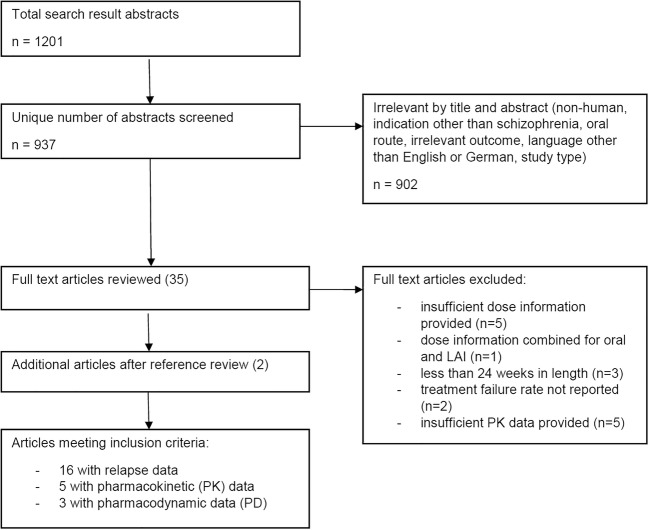
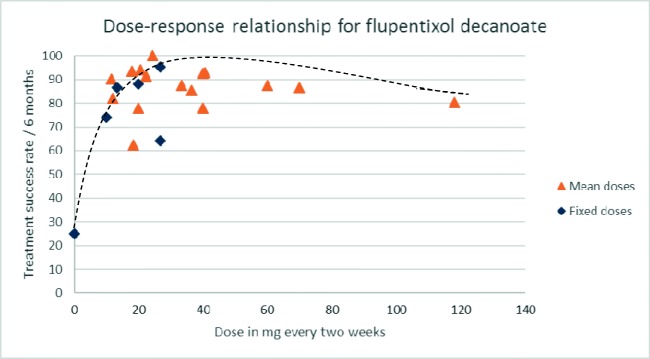
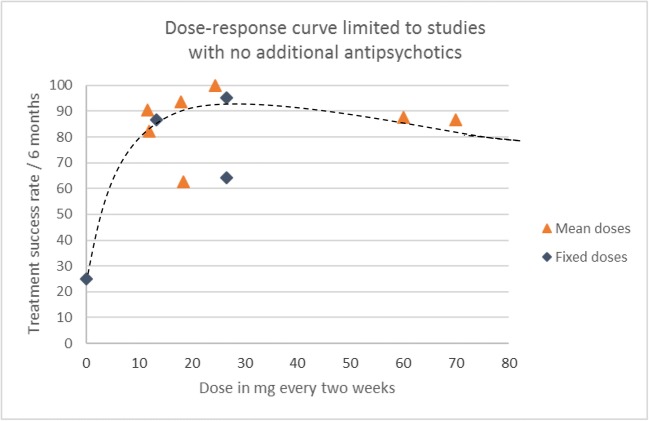
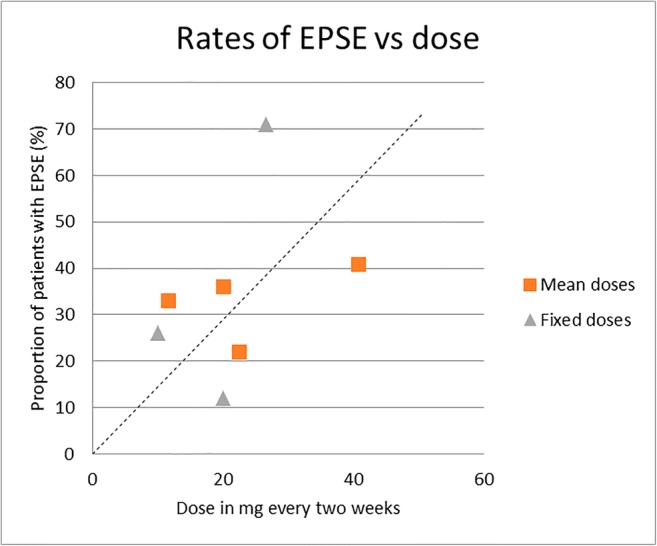
RATIONALE: The licensed dose range for the long-acting injectable antipsychotic flupentixol decanoate (Depixol®) in the treatment of schizophrenia is very broad. This provides little useful direction to prescribers and may ultimately result in patients receiving unnecessarily high doses. OBJECTIVES: We aimed to estimate the effect of dose of flupentixol decanoate on relapse rates in schizophrenia and on tolerability by expanding on an earlier review and including non-RCT and German-language studies, as well as using pharmacokinetic and pharmacodynamic data to offer guidance on dosing. METHODS: A literature review using EMBASE, Medline, PsycINFO and PubMed was conducted. Treatment success rates at 6 months were extracted or extrapolated from the studies and plotted against dose to estimate a dose-response curve. RESULTS: Data from 16 studies (n = 514) allowed estimation of a dose-response curve which rises steeply between the chosen placebo anchor (25% success rate) and 10 mg every 2 weeks before reaching a maximum between 20 and 40 mg every 2 weeks (80-95% success rates). Extrapyramidal side effects (EPSEs) were frequently seen (12-71% of participants) in that dose range. Two -weekly injections seem to provide the highest trough plasma concentration per dose administered and the lowest peak-to-trough concentration ratio. Plasma concentration varied up to 5-fold among individuals receiving the same dose. CONCLUSIONS: The optimal dose of flupentixol decanoate is likely to be between 20 mg and 40 mg every 2 weeks although higher doses may be required in some individuals owing to variation in drug handling. Doses of flupentixol should be individually established in the range of 10 to 40 mg every 2 weeks according to response and tolerability.
Overview
The claims and statistics of this paper haven’t been checked yet.
Free: it reads the open-access text and checks the first 5 claims that cite a source we can check. Create a free account to check every claim.
Integrity signals
Registry
Cites
Statistics
Figures
Verification
Claims the paper makes
The claims and statistics of this paper haven’t been checked yet.
Free: it reads the open-access text and checks the first 5 claims that cite a source we can check. Create a free account to check every claim.
Claims other papers make about this one
Each is checked against this paper’s own text: does it say what the citing paper says it does?
The cited source says what the claim attributes to it.
In the citing paper
“recent evidence suggests that doses close to or below the minimum recommended dose (as low as 10 mg every 2 weeks) are effective [47]”
From Pharmacokinetic Characteristics of Long-Acting Injectable Antipsychotics for Schizophrenia: An Overview (2021) · cites this paper as [47]
Self-check
Percentages, sums and reported differences re-computed from the paper’s own numbers.
The self-check needs the paper’s full text.
Citations
Cites
Effectiveness of Antipsychotic Drugs in Patients with Chronic Schizophrenia
Lieberman, J. A., Stroup, T. S., McEvoy, J. P., Swartz, M. S., Rosenheck, R. A., Perkins, D. O., Keefe, R. S. E., Davis, S. M., Davis, C. E., Lebowitz, B. D., et al. (2005) · New England Journal of Medicine · doi:10.1056/nejmoa051688 · Cited by 5,892
The Maudsley Prescribing Guidelines in Psychiatry
Taylor, D. M., Barnes, T. R. E., & Young, A. H. (2021) · Wiley eBooks · doi:10.1002/9781119870203 · Cited by 988 · cited 1×
“The pharmacokinetic properties of the different formulations are summarised in Box 1 (Lundbeck Limited 2017b; Taylor et al. 2018), but offer no explanation for the wider dose range of flupentixol decanoate.”
BackgroundSelf-citationLeucht, S., Tardy, M., Komossa, K., Heres, S., Kissling, W., Salanti, G., & Davis, J. M. (2012) · The Lancet · doi:10.1016/s0140-6736(12)60239-6 · Cited by 931
Arvanitis, L. A., & Miller, B. G. (1997) · Biological Psychiatry · doi:10.1016/s0006-3223(97)00190-x · Cited by 803
Kane, J. M., Eerdekens, M., Lindenmayer, J.-P., Keith, S. J., Lesem, M., & Karcher, K. (2003) · American Journal of Psychiatry · doi:10.1176/appi.ajp.160.6.1125 · Cited by 489
Kane, J. M., Sanchez, R., Perry, P. P., Jin, N., Johnson, B. R., Forbes, R. A., McQuade, R. D., Carson, W. H., & Fleischhacker, W. W. (2012) · The Journal of Clinical Psychiatry · doi:10.4088/jcp.11m07530 · Cited by 361
Dose Response and Dose Equivalence of Antipsychotics
Davis, J. M., & Chen, N. (2004) · Journal of Clinical Psychopharmacology · doi:10.1097/01.jcp.0000117422.05703.ae · Cited by 358
D1- and D2-dopamine receptor occupancy during treatment with conventional and atypical neuroleptics
Farde, L., Wiesel, F. A., Nordstr�m, A. L., & Sedvall, G. (1989) · Psychopharmacology · doi:10.1007/bf00442555 · Cited by 325
High levels of dopamine D2 receptor occupancy with low-dose haloperidol treatment: a PET study
(1996) · American Journal of Psychiatry · doi:10.1176/ajp.153.7.948 · Cited by 252
Low- and Conventional-Dose Maintenance Therapy With Fluphenazine Decanoate: Two-Year Outcome
Marder, S. R. (1987) · Archives of General Psychiatry · doi:10.1001/archpsyc.1987.01800180028005 · Cited by 245
A simple and sensitive radioreceptor assay for antischizophrenic drugs in blood
CREESE, I., & SNYDER, S. H. (1977) · Nature · doi:10.1038/270180a0 · Cited by 239
Neuroleptic-induced supersensitivity psychosis
(1978) · American Journal of Psychiatry · doi:10.1176/ajp.135.11.1409 · Cited by 224
Pandina, G. J., Lindenmayer, J.-P., Lull, J., Lim, P., Gopal, S., Herben, V., Kusumakar, V., Yuen, E., & Palumbo, J. (2010) · Journal of Clinical Psychopharmacology · doi:10.1097/jcp.0b013e3181dd3103 · Cited by 214
McEvoy, J. P., Byerly, M., Hamer, R. M., Dominik, R., Swartz, M. S., Rosenheck, R. A., Ray, N., Lamberti, J. S., Buckley, P. F., Wilkins, T. M., et al. (2014) · JAMA · doi:10.1001/jama.2014.4310 · Cited by 151
A depot neuroleptic withdrawal study
Wistedt, B., J�rgensen, A., & Wiles, D. (1982) · Psychopharmacology · doi:10.1007/bf00433729 · Cited by 134
Wistedt, B. (1981) · Acta Psychiatrica Scandinavica · doi:10.1111/j.1600-0447.1981.tb00761.x · Cited by 113 · cited 1×
“…al. 2016; Cookson 1987; Gottfries and Green 1974; Johnson et al. 1987; Kelly et al. 1977; Knights et al. 1979; Laux et al. 2010; Pach et al. 1998; Wistedt 1981), deterioration according to global rating in one study (Agrup-Andersson Box 1 Pharmacokinetic data oral vs injection Oral flupentixol…”
BackgroundJohnson, D. A. W., Ludlow, J. M., Street, K., & Taylor, R. D. W. (1987) · British Journal of Psychiatry · doi:10.1192/bjp.151.5.634 · Cited by 110
The Maudsley Prescribing Guidelines in Psychiatry, 12th ed
Jenkins, J. A., & Kontos, N. (2016) · The Journal of Clinical Psychiatry · doi:10.4088/jcp.16bk10716 · Cited by 107 · cited 1×
“The pharmacokinetic properties of the different formulations are summarised in Box 1 (Lundbeck Limited 2017b; Taylor et al. 2018), but offer no explanation for the wider dose range of flupentixol decanoate.”
BackgroundBauer, M., & Priebe, S. (1997) · Springer eBooks · doi:10.1007/978-3-662-10473-6_7 · Cited by 102
Low Dose vs Standard Dose of Antipsychotics for Relapse Prevention in Schizophrenia: Meta-analysis
Uchida, H., Suzuki, T., Takeuchi, H., Arenovich, T., & Mamo, D. C. (2011) · Schizophrenia Bulletin · doi:10.1093/schbul/sbp149 · Cited by 100
Bishara, D., Olofinjana, O., Sparshatt, A., Kapur, S., Taylor, D. M., & Patel, M. X. (2013) · Journal of Clinical Psychopharmacology · doi:10.1097/jcp.0b013e31828b28d5 · Cited by 81
Self-citationKnights, A., Okasha, M. S., Salih, M. A., & Hirsch, S. R. (1979) · British Journal of Psychiatry · doi:10.1192/bjp.135.6.515 · Cited by 79
Reimold, M., Solbach, C., Noda, S., Schaefer, J.-E., Bartels, M., Beneke, M., Machulla, H. ‐., Bares, R., Gläser, T., & Wormstall, H. (2006) · Psychopharmacology · doi:10.1007/s00213-006-0611-0 · Cited by 72
McCreadie, R. G., Wiles, D. H., Grant, S. M., Moore, J. W., Crocket, G. T., Mahmood, Z., Livingston, M. G., Watt, J. A. G., Greene, J. G., Kershaw, P. W., et al. (1988) · British Journal of Psychiatry · doi:10.1192/bjp.152.4.470 · Cited by 52
Taylor, D. M., Young, C., & Patel, M. X. (2005) · The International Journal of Neuropsychopharmacology · doi:10.1017/s1461145705006309 · Cited by 50 · cited 1×
“The curve of the doseresponse plot not only stops rising beyond this dose, it actually appears to decline, suggesting that higher doses may be somewhat detrimental to therapeutic effect (as seen with oral quetiapine (Arvanitis and Miller 1997) and oral risperidone (Ezewuzie and Taylor 2006)).”
BackgroundSelf-citationAaes‐Jørgensen, T. (1980) · Journal of Chromatography B Biomedical Sciences and Applications · doi:10.1016/s0378-4347(00)81700-4 · Cited by 48
Clopenthixol and flupenthixol depot preparations in outpatient schizophrenics: III. SERUM LEVELS
Jørgensen, A., & Overø, K. F. (1980) · Acta Psychiatrica Scandinavica · doi:10.1111/j.1600-0447.1980.tb07082.x · Cited by 43
A sensitive and specific radioimmunoassay for CIS (Z)- flupenthixol in human serum
Jørgensen, A. (1978) · Life Sciences · doi:10.1016/0024-3205(78)90580-5 · Cited by 40
FLUPENTHIXOL DECANOATE ‐IN TREATMENT OF OUT‐PATIENTS
Cg, G., & Green, L. (1974) · Acta Psychiatrica Scandinavica · doi:10.1111/j.1600-0447.1974.tb08890.x · Cited by 39
Pharmacological differentation of classical and novel antipsychotics
Arnt, J. (1998) · International Clinical Psychopharmacology · doi:10.1097/00004850-199803003-00002 · Cited by 37 · cited 1×
“Flupentixol has occasionally been described as a partial atypical antipsychotic due to its action on serotonin 5-HT2A and 5-HT2C receptors (Arnt 1998; Glaser et al. 1998), and it has long been suggested that typical drugs can be made essentially atypical by careful dosing (Kapur et al. 1996).”
BackgroundKistrup, K. R., Gerlach, J., Aaes‐Jørgensen, T., & Larsen, N. (1991) · Psychopharmacology · doi:10.1007/bf02316862 · Cited by 36
COOKSON, I. B. (1987) · International Clinical Psychopharmacology · doi:10.1097/00004850-198704000-00008 · Cited by 36 · cited 5×
“The study that used the highest doses of flupentixol decanoate (Cookson 1987) did so for a subset of patients who responded only to dose increases beyond 100 mg every 2 weeks, when lower doses had been ineffective.”
BackgroundMethodInfluentialDencker, S. J., Lepp, M., & Malm, U. (1980) · Acta Psychiatrica Scandinavica · doi:10.1111/j.1600-0447.1980.tb07080.x · Cited by 35 · cited 2×
“1974), discontinuation due to poor response in two studies (Dencker et al. 1980; Shajahan et al. 2010), hospitalisation for psychiatric reasons in two studies (Knights et al.”
BackgroundMethodLarsen, N., Hansen, L. B., & Knudsen, P. (1985) · Journal of Chromatography B Biomedical Sciences and Applications · doi:10.1016/s0378-4347(00)84037-2 · Cited by 35
Pinto, R., Bannerjee, A., & Ghosh, N. (1979) · Acta Psychiatrica Scandinavica · doi:10.1111/j.1600-0447.1979.tb00281.x · Cited by 34
Establishing a dose-response relationship for oral risperidone in relapsed schizophrenia
Ezewuzie, N., & Taylor, D. M. (2005) · Journal of Psychopharmacology · doi:10.1177/0269881105057001 · Cited by 33
Self-citationChiliza, B., Ojagbemi, A., Esan, O., Asmal, L., Oosthuizen, P. P., Kidd, M., Gureje, O., & Emsley, R. A. (2014) · Early Intervention in Psychiatry · doi:10.1111/eip.12141 · Cited by 31
Kelly, H. B., Freeman, H. L., Banning, B., & Schiff, A. A. (2017) · International Pharmacopsychiatry · doi:10.1159/000468286 · Cited by 30
Flupenthixol decanoate (depot) for schizophrenia or other similar psychotic disorders
Mahapatra, J., Quraishi, S. N., David, A. S., Sampson, S. J., & Adams, C. E. (2014) · Cochrane Database of Systematic Reviews · doi:10.1002/14651858.cd001470.pub2 · Cited by 29
Wistedt, B., & Ranta, J. (1983) · Acta Psychiatrica Scandinavica · doi:10.1111/j.1600-0447.1983.tb09718.x · Cited by 29
Establishing a dose–response relationship for haloperidol decanoate
Taylor, D. M. (2005) · Psychiatric Bulletin · doi:10.1192/pb.29.3.104 · Cited by 18 · cited 1×
“For long-acting injectable antipsychotics, this dose-response pattern has been demonstrated for haloperidol decanoate (Taylor 2005) with the dose of maximal effect estimated to be, at most, 100 mg every 4 weeks.”
BackgroundSelf-citationPlasma Flupentixol Concentrations and Clinical Response in Acute Schizophrenia
Balant-Gorgia, A. E., Eisele, R., Aeschlimann, J., Balant, L. P., & Garrone, G. (1985) · Therapeutic Drug Monitoring · doi:10.1097/00007691-198512000-00008 · Cited by 18
Comparison of the effectiveness of depot antipsychotics in routine clinical practice
Shajahan, P. M., Spence, E., Taylor, M., Daniel, D., & Pelosi, A. J. (2010) · The Psychiatrist · doi:10.1192/pb.bp.109.026849 · Cited by 13
FLUPENTHIXOL DECANOATE ‐CONTROLLED INVESTIGATION CONCERNING DOSAGE
Andersson, L. A., Bengtsson, A., Erlandsson, K., Gottfries, C. G., & Witzell‐Östlund, G. (1974) · Acta Psychiatrica Scandinavica · doi:10.1111/j.1600-0447.1974.tb08889.x · Cited by 12
Steady-state serum concentrations after cis (Z)-flupentixol decanoate in viscoleo
Saikia, J. K., & J�rgensen, A. (1983) · Psychopharmacology · doi:10.1007/bf00432123 · Cited by 12
Turbott, J., Villiger, J. W., & Hunter, L. (1985) · The British Journal of Psychiatry · doi:10.1192/bjp.146.4.439 · Cited by 9
A Comparative Trial of Depot Pipothiazine
Steinert, J., Neder, A., Erba, E., Pugh, C. R., Robinson, C. G., & Priest, R. G. (1986) · Journal of International Medical Research · doi:10.1177/030006058601400204 · Cited by 9
The effects of dose of flupentixol decanoate on relapse rates in schizophrenia
Reed, P., & Fanshawe, T. (2011) · The Psychiatrist · doi:10.1192/pb.bp.110.030916 · Cited by 7
Rentrop, M., Brakebusch, M., & Müller, R. (2009) · Elsevier eBooks · doi:10.1016/b978-343723146-9.10017-1 · Cited by 6
Gläser, T. (1998) · Steinkopff eBooks · doi:10.1007/978-3-642-93700-2 · Cited by 6
Research works printed but not linked: 1
- Pach J Bertling R Finkbeiner T Haug HJ Knoche M Osterheider M Reinertshofer T Tegeler J Rezidive bei schizophrenen erkrankungen unter depot-neuroleptika—Ergebnisse einer einjahrigen doppelblindstudie mit flupentixol-decanoat—relapse in schizophrenia under maintenance depot neuroleptic therapy—results of a 1-year double-blind study with flupenthixol decanoate Psychopharmakotherapie 1998 5 4 161 165
Cited by
Correll, C. U., Kim, E., Sliwa, J. K., Hamm, W., Gopal, S., Mathews, M., Venkatasubramanian, R., & Saklad, S. R. (2021) · CNS Drugs · doi:10.1007/s40263-020-00779-5 · Cited by 205
Therapeutic Drug Monitoring of Long-Acting Injectable Antipsychotic Drugs
Schoretsanitis, G., Baumann, P., Conca, A., Dietmaier, O., Giupponi, G., Gründer, G., Hahn, M., Hart, X. M., Havemann‐Reinecke, U., Hefner, G., et al. (2020) · Therapeutic Drug Monitoring · doi:10.1097/ftd.0000000000000830 · Cited by 54
Long-Acting Injectable Antipsychotics—A Review on Formulation and In Vitro Dissolution
Markowicz-Piasecka, M., Kubisiak, M., Asendrych-Wicik, K., Kołodziejczyk, M. K., Grzelińska, J., Fabijańska, M., & Pietrzak, T. M. (2023) · Pharmaceutics · doi:10.3390/pharmaceutics16010028 · Cited by 51
Current and emerging long-acting antipsychotics for the treatment of schizophrenia
de Filippis, R., Fazio, P. D., Gaetano, R., Steardo, L., Cedro, C., Bruno, A., Zoccali, R. A., & Muscatello, M. R. A. (2021) · Expert Opinion on Drug Safety · doi:10.1080/14740338.2021.1910674 · Cited by 47
Hart, X. M., Gründer, G., Ansermot, N., Conca, A., Corruble, E., Crettol, S., Cumming, P. D., Frajerman, A., Hefner, G., Howes, O. D., et al. (2024) · The World Journal of Biological Psychiatry · doi:10.1080/15622975.2024.2366235 · Cited by 43
Metadata
- Authors
- Bailey, L., & Taylor, D.
- Affiliations
- South London and Maudsley NHS Foundation Trust (GB)
- King's College London (GB)
- Corresponding author
- Taylor, David
- Venue
- Psychopharmacology
- Published
- 2019-07-12
- Volume
- 236
- Issue
- 11
- Pages
- 3081-3092
- ISSN
- 0033-3158 (ISSN-L)
- 1432-2072
- PMC
- PMC6828621
- OpenAlex
- W2956813035
- Semantic Scholar
- 68d0c6d19d89f5e35eceab352f95510ee2ecb1c4
- Cited by
- 21
- References
- 50
- Citations by year
- 2026: 2 · 2025: 3 · 2024: 4 · 2023: 1 · 2022: 3 · 2021: 6 · 2020: 2
- FWCI
- 0.46
- Type
- journal article
- Language
- en
- Update notices
- correction (2019-08-06)
- Open access
- hybrid
- doi.org
- Licence
- cc-by
- creativecommons.org/licenses/by/4.0 (tdm)
- creativecommons.org/licenses/by/4.0 (vor)
- Locations
- Psychopharmacology (publishedVersion, cc-by)
- Europe PMC (PubMed Central) (publishedVersion)
- PubMed Central (publishedVersion, cc-by)
- PubMed (publishedVersion)
- Funders
- King's College London
- Topics
- Health Sciences › Medicine › Psychiatry and Mental health › Schizophrenia research and treatment
- Health Sciences › Medicine › Pharmacology (medical) › Treatment of Major Depression
- Social Sciences › Psychology › Clinical Psychology › Family Caregiving in Mental Illness
- Keywords
- long-acting injectable antipsychotics, schizophrenia, maintenance therapy, dose-response relationship, relapse rate, extrapyramidal symptoms, plasma concentration variability, individualized dosing, pharmacokinetics, pharmacodynamics
- MeSH terms
- Adult, Delayed-Action Preparations, Dose-Response Relationship, Drug, Female, Flupenthixol, Humans, Male, Middle Aged, Schizophrenia, Schizophrenic Psychology, Antipsychotic Agents, Treatment Outcome, Dopamine Antagonists
About these checks
Registry, retraction, Cites and statistics results are computed, not judged, with one exception: a printed reference that no index lists is read once by a model before it counts as a citation error. Claims are extracted by a model and kept only when their quote appears verbatim in the text; each cited source is then checked, with a model’s help, for whether it says what the claim relies on. Those verdicts can be wrong — read the claim’s quote and the cited source before relying on one.
Statistics and arithmetic are recomputed, not judged.
Confidence bands are shown only for fields calibrated on our annotated test set. None is calibrated yet, so no band is shown.
What counts as a claim ›How we measure confidence ›How we check this ›
Are you an author, or do you see a problem with this page? Request a review
Data sources
Bibliographic data: Semantic Scholar, OpenAlex, Crossref.
Contains information from the Semantic Scholar Academic Graph Datasets, made available under the ODC Attribution License (ODC-BY 1.0).
Semantic Scholar’s data is described in: Kinney, R., et al. (2023). The Semantic Scholar Open Data Platform. arXiv:2301.10140.
