

The DOI matches its Crossref record; 117 of the 118 references it cites were found in a registry or an index.
Analysis of microplastics in drinking water and other clean water samples with micro-Raman and micro-infrared spectroscopy: minimum requirements and best practice guidelines
Open accessAbstract
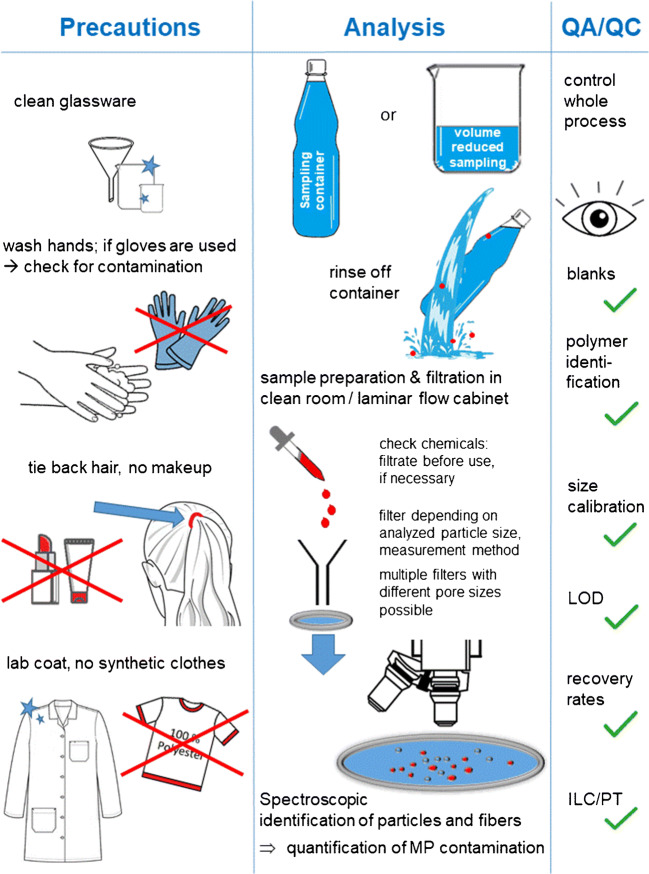
Microplastics are a widespread contaminant found not only in various natural habitats but also in drinking waters. With spectroscopic methods, the polymer type, number, size, and size distribution as well as the shape of microplastic particles in waters can be determined, which is of great relevance to toxicological studies. Methods used in studies so far show a huge diversity regarding experimental setups and often a lack of certain quality assurance aspects. To overcome these problems, this critical review and consensus paper of 12 European analytical laboratories and institutions, dealing with microplastic particle identification and quantification with spectroscopic methods, gives guidance toward harmonized microplastic particle analysis in clean waters. The aims of this paper are to (i) improve the reliability of microplastic analysis, (ii) facilitate and improve the planning of sample preparation and microplastic detection, and (iii) provide a better understanding regarding the evaluation of already existing studies. With these aims, we hope to make an important step toward harmonization of microplastic particle analysis in clean water samples and, thus, allow the comparability of results obtained in different studies by using similar or harmonized methods. Clean water samples, for the purpose of this paper, are considered to comprise all water samples with low matrix content, in particular drinking, tap, and bottled water, but also other water types such as clean freshwater. Graphical abstract
Overview
The claims and statistics of this paper haven’t been checked yet.
Run the check — free, no account needed. It reads the open-access text and checks the sources it cites.
Integrity signals
Registry
Cites
Statistics
Figures
Verification
Claims the paper makes
The claims and statistics of this paper haven’t been checked yet.
Run the check — free, no account needed. It reads the open-access text and checks the sources it cites.
Self-check
Percentages, sums and reported differences re-computed from the paper’s own numbers.
The self-check needs the paper’s full text.
Citations
Cites
Microplastics in the marine environment
Andrady, A. L. (2011) · Marine Pollution Bulletin · doi:10.1016/j.marpolbul.2011.05.030 · Cited by 8,105
Lost at sea: where is all the plastic?
Thompson, R. C., Olsen, Y., Mitchell, R. P., Davis, A., Rowland, S. J., John, A. W. G., McGonigle, D., & Russell, A. E. (2004) · Science · doi:10.1126/science.1094559 · Cited by 7,765
Hidalgo-Ruz, V., Gutow, L., Thompson, R. C., & Thiel, M. (2012) · Environmental Science & Technology · doi:10.1021/es2031505 · Cited by 5,440
International Organization for Standardization (ISO)
Nahler, G. (2009) · Dictionary of Pharmaceutical Medicine · doi:10.1007/978-3-211-89836-9_723 · Cited by 3,673
Hartmann, N. B., Hüffer, T., Thompson, R. C., Hassellöv, M., Verschoor, A., Daugaard, A. E., Rist, S., Karlsson, T., Brennholt, N., Cole, M., et al. (2019) · Environmental Science & Technology · doi:10.1021/acs.est.8b05297 · Cited by 2,881
Self-citationMicroplastics in Freshwaters and Drinking Water: Critical Review and Assessment of Data Quality
Koelmans, A. A., Mohamed Nor, N. H., Hermsen, E., Kooi, M., Mintenig, S. M., & De France, J. (2019) · Water Research · doi:10.1016/j.watres.2019.02.054 · Cited by 2,535
Microplastics in bivalves cultured for human consumption
Cauwenberghe, L. V., & Janssen, C. (2014) · Environmental Pollution · doi:10.1016/j.envpol.2014.06.010 · Cited by 2,105
The deep sea is a major sink for microplastic debris
Woodall, L. C., Sanchez-Vidal, A., Canals, M., Paterson, G. L. J., Coppock, R., Sleight, V., Calafat, A., Rogers, A. D., Narayanaswamy, B. E., & Thompson, R. C. (2014) · Royal Society Open Science · doi:10.1098/rsos.140317 · Cited by 1,946 · cited 1×
“Using a HQI of 70% as a threshold for accepting a result as correct has been suggested [68, 108].”
BackgroundFundamentals of Fourier Transform Infrared Spectroscopy
Smith, B. C. (2011) · CRC Press eBooks · doi:10.1201/b10777 · Cited by 1,669
Schymanski, D., Goldbeck, C., Humpf, H., & Fürst, P. (2017) · Water Research · doi:10.1016/j.watres.2017.11.011 · Cited by 1,420
Self-citation
Research works printed but not linked: 2
- European Pharmacopoeia. Particulate contamination: sub-visible particles; 1/ Ph. Eur. 2.9.19: reference 01/2005:20919. 5th Edition (official on January 2005).
- European Parliament and of the Council on the quality of water intended for human consumption. Proposal for a Directive of the European Parliament and of the Council on the quality of water intended for human consumption (recast) - Political agreement ST 6060 2020 REV 1, vol. 2020.
Cited by
Sorted by citations
Discovery and quantification of plastic particle pollution in human blood
Leslie, H. A., van Velzen, M. J. M., Brandsma, S. H., Vethaak, A. D., Garcia-Vallejo, J. J., & Lamoree, M. H. (2022) · Environment International · doi:10.1016/j.envint.2022.107199 · Cited by 3,906
Chemical Analysis of Microplastics and Nanoplastics: Challenges, Advanced Methods, and Perspectives
Ivleva, N. P. (2021) · Chemical Reviews · doi:10.1021/acs.chemrev.1c00178 · Cited by 1,172
Self-citationRapid single-particle chemical imaging of nanoplastics by SRS microscopy
Qian, N., Gao, X., Lang, X., Deng, H., Bratu, T. M., Chen, Q., Stapleton, P., Yan, B., & Min, W. (2024) · Proceedings of the National Academy of Sciences · doi:10.1073/pnas.2300582121 · Cited by 467
Microplastics: Human exposure assessment through air, water, and food
Zuri, G., Karanasiou, A., & Lacorte, S. (2023) · Environment International · doi:10.1016/j.envint.2023.108150 · Cited by 260
Self-citationWater Analysis: Emerging Contaminants and Current Issues
Richardson, S. D., & Ternes, T. A. (2021) · Analytical Chemistry · doi:10.1021/acs.analchem.1c04640 · Cited by 239
Metadata
- Authors
- Schymanski, D., Oßmann, B. E., Benismail, N., Boukerma, K., Dallmann, G., von der Esch, E., Fischer, D., Fischer, F., Gilliland, D., Glas, K., Hofmann, T., Käppler, A., Lacorte, S., Marco, J., Rakwe, M. E., Weisser, J., Witzig, C., Zumbülte, N., & Ivleva, N. P.
- Affiliations
- University of Münster (DE)
- Bayerisches Landesamt für Gesundheit und Lebensmittelsicherheit (DE)
- Nestlé (France) (FR)
- Ifremer (FR)
- Leibniz Institute of Polymer Research (DE)
- European Commission (BE)
- Technical University of Munich (DE)
- DVGW - Technologiezentrum Wasser (DE)
- Corresponding author
- Ivleva, Natalia P.
- ORCID
- Venue
- Analytical and Bioanalytical Chemistry
- Published
- 2021-07-20
- Volume
- 413
- Issue
- 24
- Pages
- 5969-5994
- ISSN
- 1618-2642 (ISSN-L)
- 1618-2650
- PMC
- PMC8440246
- OpenAlex
- W3183588047
- Cited by
- 280
- References
- 118
- Citations by year
- 2026: 68 · 2025: 58 · 2024: 71 · 2023: 48 · 2022: 32 · 2021: 3
- FWCI
- 1.87
- Type
- journal article
- Language
- en
- Open access
- hybrid
- doi.org
- Locations
- Analytical and Bioanalytical Chemistry (publishedVersion, cc-by)
- Europe PMC (PubMed Central) (publishedVersion, other-oa)
- PubMed Central (publishedVersion, cc-by)
- PubMed (publishedVersion)
- DIGITAL.CSIC (Spanish National Research Council (CSIC)) (submittedVersion, other-oa)
- HAL (submittedVersion)
- Institutional Archive of Ifremer (French Research Institute for Exploitation of the Sea) (submittedVersion, other-oa)
- mediaTUM – the media and publications repository of the Technical University Munich (Technical University Munich) (submittedVersion)
- mediaTUM – the media and publications repository of the Technical University Munich (Technical University Munich) (submittedVersion, other-oa)
- RENATE (submittedVersion, cc-by-nc-nd)
- RENATE (cc-by)
- Funders
- Ministry of Science and Innovation of Spain (PID2019-105732GB-C21)
- Bayerische Forschungsstiftung (AZ-1258-16 (“MiPAq“))
- Bundesministerium für Bildung und Forschung (02WPL1443A “SubµTrack”; 03F0851B “HOTMIC”)
- Bavarian State Ministry of the Environment and Consumer Protection
- Topics
- Physical Sciences › Environmental Science › Pollution › Microplastics and Plastic Pollution
- Physical Sciences › Chemistry › Analytical Chemistry › Analytical chemistry methods development
- Physical Sciences › Environmental Science › Water Science and Technology › Environmental and Analytical Chemistry Studies
- Keywords
- microplastics, drinking water, clean water, micro-Raman spectroscopy, micro-infrared spectroscopy, microplastic quantification, method harmonization, quality assurance, sample preparation, bottled water, tap water, freshwater, polymer types, particle size distribution
- MeSH terms
- Microplastics, Spectrophotometry, Infrared, Spectrum Analysis, Raman, Water Pollutants, Chemical, Guidelines as Topic, Practice Guidelines as Topic, Drinking Water
About these checks
Registry, retraction, Cites and statistics results are computed, not judged, with one exception: a printed reference that no index lists is read once by a model before it counts as a citation error. Claims are extracted by a model and kept only when their quote appears verbatim in the text; each cited source is then checked, with a model’s help, for whether it says what the claim relies on. Those verdicts can be wrong — read the claim’s quote and the cited source before relying on one.
Statistics and arithmetic are recomputed, not judged.
Confidence bands are shown only for fields calibrated on our annotated test set. None is calibrated yet, so no band is shown.
What counts as a claim ›How we measure confidence ›How we check this ›
Are you an author, or do you see a problem with this page? Request a review
