

Dividing Quantum Channels
Open accessThe DOI matches its Crossref record; 35 of the 36 references it cites were found in a registry or an index.
Abstract
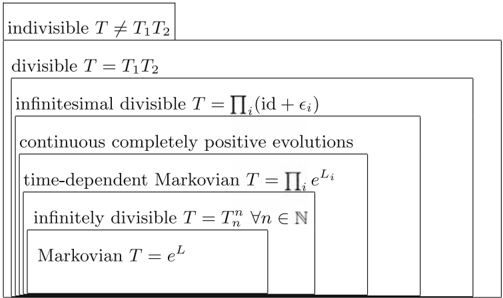
We investigate the possibility of dividing quantum channels into concatenations of other channels, thereby studying the semigroup structure of the set of completely-positive trace-preserving maps. We show the existence of ‘ indivisible ’ channels which can not be written as non-trivial products of other channels and study the set of ‘ infinitesimal divisible ’ channels which are elements of continuous completely positive evolutions. For qubit channels we obtain a complete characterization of the sets of indivisible and infinitesimal divisible channels. Moreover, we identify those channels which are solutions of time-dependent master equations for both positive and completely positive evolutions. For arbitrary finite dimension we prove a representation theorem for elements of continuous completely positive evolutions based on new results on determinants of quantum channels and Markovian approximations.
Overview
The claims and statistics of this paper haven’t been checked yet.
Free: it reads the open-access text and checks the first 5 claims that cite a source we can check. Create a free account to check every claim.
Integrity signals
Registry
Cites
Statistics
Figures
Verification
Claims the paper makes
The claims and statistics of this paper haven’t been checked yet.
Free: it reads the open-access text and checks the first 5 claims that cite a source we can check. Create a free account to check every claim.
Claims other papers make about this one
Each is checked against this paper’s own text: does it say what the citing paper says it does?
The cited source says what the claim attributes to it.
In the citing paper
“It can be proven that, since E (t,t 0 ) is a composition of completely positive maps, the absolute value of the determinant of M (t,t 0 ) decreases monotonically with time [27].”
From Quantum non-Markovianity: characterization, quantification and detection (2014) · cites this paper as [27]
In the citing paper
“Moreover, it is easy to show with the help of Eq. (78) that the maximum in Eq. (76) is attained for a = 0 and | b | = 1 [38]. This means that the optimal pairs of initial states correspond to antipodal points on the equator of the Bloch sphere representing the qubit.”
From Foundations and measures of quantum non-Markovianity (2012) · cites this paper as [38]
Self-check
Percentages, sums and reported differences re-computed from the paper’s own numbers.
The self-check needs the paper’s full text.
Citations
Cites
Quantum Computation and Quantum Information
Nielsen, M. A., Chuang, I., & Grover, L. K. (2002) · American Journal of Physics · doi:10.1119/1.1463744 · Cited by 21,895
Quantum computation and quantum information
Law, J. (2001) · ACM SIGSOFT Software Engineering Notes · doi:10.1145/505482.505499 · Cited by 18,842
On the generators of quantum dynamical semigroups
Lindblad, G. (1976) · Communications in Mathematical Physics · doi:10.1007/bf01608499 · Cited by 7,548
Completely positive dynamical semigroups of N -level systems
Gorini, V., Kossakowski, A., & Sudarshan, E. C. G. (1976) · Journal of Mathematical Physics · doi:10.1063/1.522979 · Cited by 3,998
Bhatia, R. (1996) · Cited by 2,847
Completely positive linear maps on complex matrices
Choi, M.-D. (1975) · Linear Algebra and its Applications · doi:10.1016/0024-3795(75)90075-0 · Cited by 2,659
Scott, W. R. (1964) · Cited by 2,606
Bhatia, R. (1997) · Graduate Texts in Mathematics · doi:10.1007/978-1-4612-0653-8 · Cited by 2,336
The ‘transition probability’ in the state space of a—algebra
Uhlmann, A. (1976) · Reports on Mathematical Physics · doi:10.1016/0034-4877(76)90060-4 · Cited by 1,649
Linear transformations which preserve trace and positive semidefiniteness of operators
Jamiołkowski, A. (1972) · Reports on Mathematical Physics · doi:10.1016/0034-4877(72)90011-0 · Cited by 1,512
Research works printed but not linked: 4
- 3. Holevo, A.S.: Theor. Probab. Appl. 32, 560 (1986)
- 7. Kraus, K.: States, Effects, and Operations. Berlin-Heidelberg-New York: Springer, 1983
- 27. Verstraete, F., Verschelde, H.: http://arxiv.org/list/quant-ph/0202124, 2002;
- 33. Wolf, M.M., Eisert, J., Cubitt, T.S., Cirac, J.I.: arXiv: 0711.3172 (2007) · arXiv
Cited by
Items 101–200 of 288
Completely Positive Approximate Solutions of Driven Open Quantum Systems
Haddadfarshi, F., Cui, J., & Mintert, F. (2015) · Physical Review Letters · doi:10.1103/physrevlett.114.130402 · Cited by 34
Hou, S. C., Yi, X. X., Yu, S., & Oh, C. H. (2012) · Physical Review A · doi:10.1103/physreva.86.012101 · Cited by 32
How Quantum Evolution with Memory is Generated in a Time-Local Way
Nestmann, K., Bruch, V., & Wegewijs, M. R. (2021) · RWTH Publications (RWTH Aachen) · Cited by 25
Composition of quantum states and dynamical subadditivity
Roga, W., Fannes, M., & Życzkowski, K. (2008) · Journal of Physics A Mathematical and Theoretical · doi:10.1088/1751-8113/41/3/035305 · Cited by 26
“Recently [ 17 ], the concatenation of quantum maps has been investigated from the point of view of divisibility.”
BackgroundSoares-Pinto, D. O., Moussa, M. H. Y., Maziero, J., DeAzevedo, E. R., Bonagamba, T. J., Serra, R. M., & Céleri, L. C. (2011) · Physical Review A · doi:10.1103/physreva.83.062336 · Cited by 24
Universal Constraint for Relaxation Rates for Quantum Dynamical Semigroup
Chruściński, D., Kimura, G., Kossakowski, A., & Shishido, Y. (2021) · Physical Review Letters · doi:10.1103/physrevlett.127.050401 · Cited by 37
Witnessing non-Markovianity of quantum evolution
Chruściński, D., & Kossakowski, A. (2014) · The European Physical Journal D · doi:10.1140/epjd/e2013-40171-9 · Cited by 26
A steady state quantum classifier
Türkpençe, D., Akıncı, T. Ç., & Şeker, S. (2019) · Physics Letters A · doi:10.1016/j.physleta.2019.01.063 · Cited by 28
“If a map satisfying Φt+s = Φt ◦ Φs is CP for all t and s ≥ 0 then it is a CP divisible map [17].”
BackgroundThermodynamic description of non-Markovian information flux of nonequilibrium open quantum systems
Chen, H., Chen, G.-Y., & Chen, Y.-N. (2017) · Physical Review A · doi:10.1103/physreva.96.062114 · Cited by 21
State retrieval beyond Bayes' retrodiction
Surace, J., & Scandi, M. (2023) · Quantum · doi:10.22331/q-2023-04-27-990 · Cited by 34
“It should be noticed that the spectrum of a CP-map is the same as the one of the corresponding vectorised version [34].”
BackgroundMaximally non-Markovian quantum dynamics without environment-to-system backflow of information
Budini, A. A. (2018) · Physical Review A · doi:10.1103/physreva.97.052133 · Cited by 27
High-frequency expansions for time-periodic Lindblad generators
Schnell, A., Denisov, S., & Eckardt, A. (2021) · Physical review. B./Physical review. B · doi:10.1103/physrevb.104.165414 · Cited by 33
Hierarchy of non-Markovianity and k -divisibility phase diagram of quantum processes in open systems
Chen, H., Lien, J., Chen, G.-Y., & Chen, Y.-N. (2015) · Physical Review A · doi:10.1103/physreva.92.042105 · Cited by 23
How Quantum Evolution with Memory is Generated in a Time-Local Way
Nestmann, K., Bruch, V., & Wegewijs, M. R. (2021) · Physical Review X · doi:10.1103/physrevx.11.021041 · Cited by 39
“It also features in quantum coding [57,58] and tomography [59], key distribution [60], teleportation [61], and work extraction by erasure [62]; see Sec.”
BackgroundLindbladians with multiple steady states: theory and applicationsPreprint
Albert, V. V. (2018) · arXiv (Cornell University) · doi:10.48550/arxiv.1802.00010 · Cited by 86
“It is impossible to simulate a more general channel that maps all of Op(H) to itself using only a Lindbladian [307].”
BackgroundThe Stochastic-Quantum Correspondence
Barandes, J. A. (2025) · Philosophy of Physics · doi:10.31389/pop.186 · Cited by 66
Illustrating the Geometry of Coherently Controlled Unital Open Quantum Systems
O'Meara, C., Dirr, G., & Schulte‐Herbrüggen, T. (2012) · IEEE Transactions on Automatic Control · doi:10.1109/tac.2012.2195849 · Cited by 27
An optimal dissipative encoder for the toric code
Dengis, J., König, R., & Pastawski, F. (2014) · New Journal of Physics · doi:10.1088/1367-2630/16/1/013023 · Cited by 33
“By the correspondence discussed in [20], each local CPTPM Tj defines a local Liouvillian Lj = Tj − id.”
BackgroundQuantum Darwinism and non-Markovianity in a model of quantum harmonic oscillators
de Oliveira, S. M., de Paula, A. L., & Drumond, R. C. (2019) · Physical Review A · doi:10.1103/physreva.100.052110 · Cited by 23
“Otherwise, the evolution is classified as nonMarkovian [26, 27].”
BackgroundCirillo, G. I., & Ticozzi, F. (2015) · Journal of Physics A Mathematical and Theoretical · doi:10.1088/1751-8113/48/8/085302 · Cited by 22
Brownian motion on Lie groups and open quantum systems
Aniello, P., Kossakowski, A., Marmo, G., & Ventriglia, F. (2010) · Journal of Physics A Mathematical and Theoretical · doi:10.1088/1751-8113/43/26/265301 · Cited by 21
“amical semigroup {St}t∈R+ is covariant with respect to the representation U˘. Another issue that is worth discussing is the characterization of the twirling superoperators that are Markovian channels [47, 48] (we would prefer the term embeddable channels); i.e. that are members of quantum dynamical semigroups. Precise…”
BackgroundQuantum-memory-enhanced dissipative entanglement creation in nonequilibrium steady states
Heineken, D., Beyer, K., Luoma, K., & Strunz, W. T. (2021) · Physical Review A · doi:10.1103/physreva.104.052426 · Cited by 22
“[75] that the absolute value of the determinant of a positive map F (s) can only decrease under composition with another positive map F (t, s):”
BackgroundGauge invariant information concerning quantum channels
Rudnicki, Ł., Puchała, Z., & Zyczkowski, K. (2018) · Quantum · doi:10.22331/q-2018-04-11-60 · Cited by 29
“The structure of the peripheral spectrum, which contains all eigenvalues of Φ with modulus one, was studied by Groh in the eighties [19] and also more recently in context of quantum information [20, 21, 22].”
BackgroundPauli semigroups and unistochastic quantum channels
Puchała, Z., Rudnicki, Ł., & Życzkowski, K. (2019) · Physics Letters A · doi:10.1016/j.physleta.2019.04.057 · Cited by 21
“[28] B. Kraus and J. I. Cirac, Phys.”
BackgroundInfluentialThe inverse eigenvalue problem for quantum channelsPreprint
Wolf, M. M., & García, D. P. (2010) · LA Referencia (Red Federada de Repositorios Institucionales de Publicaciones Científicas) · doi:10.48550/arxiv.1005.4545 · Cited by 54
Self-citationLong-lived quantum coherence and non-Markovianity of photosynthetic complexes
Chen, H., Lien, J., Hwang, C.-C., & Chen, Y.-N. (2014) · Physical Review E · doi:10.1103/physreve.89.042147 · Cited by 22
Quantum and classical resources for unitary design of open-system evolutions
Ticozzi, F., & Viola, L. (2017) · Quantum Science and Technology · doi:10.1088/2058-9565/aa722a · Cited by 23
Asymptotics of quantum channels
Amato, D., Facchi, P., & Konderak, A. (2023) · Journal of Physics A Mathematical and Theoretical · doi:10.1088/1751-8121/acd828 · Cited by 25
Fitting quantum noise models to tomography data
Onorati, E., Kohler, T., & Cubitt, T. S. (2023) · Quantum · doi:10.22331/q-2023-12-05-1197 · Cited by 38
Designing High-Fidelity Zeno Gates for Dissipative Cat Qubits
Gautier, R., Mirrahimi, M., & Sarlette, A. (2023) · PRX Quantum · doi:10.1103/prxquantum.4.040316 · Cited by 37
Lami, L., & Giovannetti, V. (2016) · Journal of Mathematical Physics · doi:10.1063/1.4942495 · Cited by 19
Progress towards a unified approach to entanglement distribution
Streltsov, A., Augusiak, R., Demianowicz, M., & Lewenstein, M. (2015) · Physical Review A · doi:10.1103/physreva.92.012335 · Cited by 19
Exact stabilization of entangled states in finite time by dissipative quantum circuits
Johnson, P. D., Ticozzi, F., & Viola, L. (2017) · Physical Review A · doi:10.1103/physreva.96.012308 · Cited by 18
Haikka, P., & Maniscalco, S. (2014) · Open Systems & Information Dynamics · doi:10.1142/s1230161214400058 · Cited by 23
Quantum Foundations of Classical Reversible Computing
Frank, M., & Shukla, K. (2021) · Entropy · doi:10.3390/e23060701 · Cited by 20
“However, note that not every CPTP map satsifies the GKSL equation [53,54]; it just so happens that we’re only concerned with the ones that do.”
BackgroundSystem-environment correlations for dephasing two-qubit states coupled to thermal baths
Costa, A. C. S., Beims, M. W., & Strunz, W. T. (2016) · Physical Review A · doi:10.1103/physreva.93.052316 · Cited by 18
“Note that this rate may turn negative at times for nontrivial spectral densities and therefore the CP map ρ(0) → ρ(t) may lose its divisibility, which is used as an indication for nonMarkovian quantum dynamics [9,33,34].”
BackgroundQuantum dynamics in a tiered non-Markovian environment
Fruchtman, A., Lovett, B. W., Benjamin, S. C., & Gauger, E. M. (2015) · New Journal of Physics · doi:10.1088/1367-2630/17/2/023063 · Cited by 16
Quantum process estimation via generic two-body correlations
Mohseni, M., Rezakhani, A. T., Barreiro, J. T., Kwiat, P. G., & Aspuru‐Guzik, A. (2010) · Physical Review A · doi:10.1103/physreva.81.032102 · Cited by 17
Markovian exchange phenomena in magnetic resonance and the Lindblad equation
Bengs, C. (2020) · Journal of Magnetic Resonance · doi:10.1016/j.jmr.2020.106868 · Cited by 15
Activating information backflow with the assistance of quantum SWITCH
Maity, A. G., & Bhattacharya, S. (2024) · Journal of Physics A Mathematical and Theoretical · doi:10.1088/1751-8121/ad41a7 · Cited by 22
“) and Λ( σ i ) = λ i σ i where σ i s represent Pauli matrices, then the map is CP divisible if there is only one k ∈ { 1 , 2 , 3 } , for which λ k ̸ = 0 [59, 60].”
BackgroundQuantum Chaos and Coherence: Random Parametric Quantum Channels
Matsoukas-Roubeas, A. S., Prosen, T., & del Campo, A. (2024) · Quantum · doi:10.22331/q-2024-08-27-1446 · Cited by 27
“Nevertheless, whenever the channel Λτ,ε is infinitesimally divisible [95, 96], the evolution described by Eq.”
BackgroundQuantum Subdivision Capacities and Continuous-Time Quantum Coding
Müller‐Hermes, A., Reeb, D., & Wolf, M. M. (2014) · IEEE Transactions on Information Theory · doi:10.1109/tit.2014.2366456 · Cited by 18
Self-citationQuantum Systems Theory Viewed from Kossakowski-Lindblad Lie Semigroups — andVice Versa
Schulte‐Herbrüggen, T., Dirr, G., & Zeier, R. (2017) · Open Systems & Information Dynamics · doi:10.1142/s1230161217400194 · Cited by 16
Constraints for the spectra of generators of quantum dynamical semigroups
Chruściński, D., Fujii, R., Kimura, G., & Ohno, H. (2021) · Linear Algebra and its Applications · doi:10.1016/j.laa.2021.08.012 · Cited by 14
Geometry of Pauli maps and Pauli channels
Siudzińska, K. (2019) · Physical Review A · doi:10.1103/physreva.100.062331 · Cited by 13
Classifying the non-time-local and entangling dynamics of an open qubit system
Prudhoe, S., & Shandera, S. E. (2023) · Journal of High Energy Physics · doi:10.1007/jhep02(2023)007 · Cited by 16
“Note that unitary reduced dynamics is the only kind of Markovian dynamics possible, since the environment Hilbert space is of finite dimension, so necessarily has a free Hamiltonian that is bounded from below [42].”
BackgroundExploring the Limits of Controlled Markovian Quantum Dynamics with Thermal Resources
Ende, F. V., Malvetti, E., Dirr, G., & Schulte‐Herbrüggen, T. (2023) · Open Systems & Information Dynamics · doi:10.1142/s1230161223500051 · Cited by 14
Non-Markovian discrete qubit dynamics
Sun, J. Y., Sun, Y.-N., Li, C., Guo, G., Luoma, K., & Piilo, J. (2016) · 中国科学通报:英文版 · doi:10.1007/s11434-016-1089-8 · Cited by 11
“In general, the dynamical map is less structured, meaning the dynamical map may not necessarily be divisible, not even with positive maps [7], relistic quantum systems interact and exchange information with the environment and thus lead to open quantum non-Markovian dynamics.”
BackgroundContinuum limits of matrix product states
Cuevas, G. D. L., Schuch, N., Pérez-García, D., & Cirac, J. I. (2018) · Physical review. B./Physical review. B · doi:10.1103/physrevb.98.174303 · Cited by 12
Self-citationStrict positivity and D -majorization
Ende, F. V. (2020) · Linear and Multilinear Algebra · doi:10.1080/03081087.2020.1860887 · Cited by 14
“sses which are not Markovian but as these do not interact as nicely with strict positivity we will sweep them under the rug here. For those more general notions of divisibility we refer the reader to [33]. 9 (iv) P n j=1 (x j td j) + P n j=1 (y j td j) + for all t2f x i d i ;y i ji= 1;:::;ng. (v) kx tdk 1 ky tdk 1 for…”
BackgroundThe complexity of divisibility
Bausch, J., & Cubitt, T. S. (2016) · Linear Algebra and its Applications · doi:10.1016/j.laa.2016.03.041 · Cited by 17
“view can be found in [24]. Following this long history of classical results, quantum channel divisibility recently gained attention in the quantum information literature. The foundations were laid in [33], where the authors first introduced the notion of channel divisibility. A divisible quantum channel is a cptp map t…”
BackgroundNon-Markovianity quantifier of an arbitrary quantum process
Debarba, T., & Fanchini, F. F. (2017) · Physical Review A · doi:10.1103/physreva.96.062118 · Cited by 13
Quantum informational properties of the Landau–Streater channel
Filippov, S. N., & Kuzhamuratova, K. V. (2019) · Journal of Mathematical Physics · doi:10.1063/1.5037700 · Cited by 12
Transitions in Computational Complexity of Continuous-Time Local Open Quantum Dynamics
Trivedi, R., & Cirac, J. I. (2022) · Physical Review Letters · doi:10.1103/physrevlett.129.260405 · Cited by 23
Self-citationSwitching quantum dynamics for fast stabilization
Scaramuzza, P., & Ticozzi, F. (2015) · Physical Review A · doi:10.1103/physreva.91.062314 · Cited by 13
“A dynamical system for which Et2,t0 = Et2,t1 ◦ Et1,t0 , for any intermediate time t1, with both the factor maps being CPTP, is said to be a two-parameter semigroup [1, 48].”
BackgroundSuperoperator structures and no-go theorems for dissipative quantum phase transitions
Barthel, T., & Zhang, Y. (2022) · Physical Review A · doi:10.1103/physreva.105.052224 · Cited by 13
Unitary dilations of discrete-time quantum-dynamical semigroups
Ende, F. V., & Dirr, G. (2019) · Journal of Mathematical Physics · doi:10.1063/1.5095868 · Cited by 13
Ende, F. V., Dirr, G., Keyl, M., & Schulte-Herbrüggen, T. (2019) · Open Systems & Information Dynamics · doi:10.1142/s1230161219500148 · Cited by 10
Transfer of quantum information via a dissipative protocol for data classification
Korkmaz, U., & Türkpençe, D. (2021) · Physics Letters A · doi:10.1016/j.physleta.2021.127887 · Cited by 12
Log-convex set of Lindblad semigroups acting on N-level system
Shahbeigi, F., Amaro-Alcalá, D., Puchała, Z., & Życzkowski, K. (2021) · Journal of Mathematical Physics · doi:10.1063/5.0009745 · Cited by 12
“A necessary condition is the divisibility property [12–14], so that the map Φ can be represented as a composition of two other quantum maps, Φ = Ψ2Ψ1, which are completely positive and trace preserving such that one of them is not unitary.”
BackgroundConstruction of propagators for divisible dynamical maps
Chakraborty, U., & Chruściński, D. (2020) · New Journal of Physics · doi:10.1088/1367-2630/abd43b · Cited by 13
Quantum Subdivision Capacities and Continuous-time Quantum CodingPreprint
Müller‐Hermes, A., Reeb, D., & Wolf, M. M. (2016) · Cited by 13
Self-citationQuantum algorithms for cooling: A simple case study
Molpeceres, D., Lu, S., Cirac, J. I., & Kraus, B. (2025) · Physical Review Research · doi:10.1103/4hx7-xnhw · Cited by 17
Self-citationRecovering Complete Positivity of Non-Markovian Quantum Dynamics with Choi-Proximity Regularization
D’Abbruzzo, A., Farina, D., & Giovannetti, V. (2024) · Physical Review X · doi:10.1103/physrevx.14.031010 · Cited by 11
“An important property that dynamical maps Φ t might have that we will need later is completely positive divisi-bility , often abbreviated as CP-divisibility [26].”
BackgroundMarkovianity of an emitter coupled to a structured spin-chain bath
Roos, J., Cirac, J. I., & Bañuls, M. C. (2020) · Physical Review A · doi:10.1103/physreva.101.042114 · Cited by 9
Self-citationTransfer-tensor description of memory effects in open-system dynamics and multi-time statistics
Gherardini, S., Smirne, A., Huelga, S. F., & Caruso, F. (2022) · Quantum Science and Technology · doi:10.1088/2058-9565/ac4422 · Cited by 14
Non-Markovianity criteria for mixtures of noninvertible Pauli dynamical maps
Siudzińska, K. (2022) · Journal of Physics A Mathematical and Theoretical · doi:10.1088/1751-8121/ac65c0 · Cited by 11
Measure of positive and not completely positive single-qubit Pauli maps
Jagadish, V., Srikanth, R., & Petruccione, F. (2019) · Physical Review A · doi:10.1103/physreva.99.022321 · Cited by 8
Universal bound on the relaxation rates for quantum Markovian dynamics
Muratore-Ginanneschi, P., Kimura, G., & Chruściński, D. (2025) · Journal of Physics A Mathematical and Theoretical · doi:10.1088/1751-8121/adaa3f · Cited by 15
Symmetry classes of dissipative topological insulators with edge dark states
Yang, F., Wei, Z., Tong, X., Cao, K., & Kou, S.-P. (2023) · Physical review. B./Physical review. B · doi:10.1103/physrevb.107.165139 · Cited by 12
Noisy Werner-Holevo channel and its properties
Roofeh, S., & Karimipour, V. (2024) · Physical Review A · doi:10.1103/physreva.109.052620 · Cited by 9
“…Counting the degeneracies of the eigenvalues, this shows that the determinant of the channel is equal to This shows that the determinant of the channel is negative in a certain range, namely In this range, the channel is not infinitely divisible and does not represent a Markovian evolution [48].”
BackgroundMachine learning of reduced quantum channels on noisy intermediate-scale quantum devices
Cemin, G., Cech, M., Weiss, E., Sołtan, S., Braun, D., Lesanovsky, I., & Carollo, F. (2024) · Physical Review A · doi:10.1103/physreva.110.052418 · Cited by 17
“(1)-(2) due to physical constraints, permits the analysis of whether the dynamics is time dependent and of whether or not it is divisible in terms of completely positive channels [18, 26, 48–50].”
BackgroundExploring non-Markovianity in ergodic channels: Measuring memory retention through ergotropy
Basu, R., Chakraborty, A., Badhani, H., Alimuddin, M., & Bhattacharya, S. (2025) · Physical Review A · doi:10.1103/physreva.111.032416 · Cited by 12
Quasi-Entropies and Non-Markovianity
Benatti, F., & Brancati, L. (2019) · Entropy · doi:10.3390/e21101020 · Cited by 6
Tensor Products of Quantum Mappings
Filippov, S. N. (2020) · Journal of Mathematical Sciences · doi:10.1007/s10958-020-05146-9 · Cited by 6
“The properties of positivity and complete positivity of intermediate mappings (see [54]) Θt,t+s = Φt+s ◦ Φ−1 t , s > 0, are often used for characterizing the Markov property of the dynamic process Φt (see [5, 10, 43]).”
MethodQuantum and classical dynamical semigroups of superchannels and semicausal channels
Hasenöhrl, M., & Caro, M. C. (2022) · Journal of Mathematical Physics · doi:10.1063/5.0070635 · Cited by 8
Dynamical signatures of non-Markovianity in a dissipative-driven qubit
Amati, G. (2024) · Physical Review A · doi:10.1103/physreva.109.052433 · Cited by 6
“94,95 This applies in particular to the BM limit discussed in Section II.”
BackgroundHow Markovian is exciton dynamics in purple bacteria?
Vaughan, F. M. W. C., Linden, N., & Manby, F. R. (2017) · The Journal of Chemical Physics · doi:10.1063/1.4978568 · Cited by 6
Modeling Quantum Devices and the Reconstruction of Physics in Practical Systems
Ren, H., & Li, Y. (2019) · Physical Review Letters · doi:10.1103/physrevlett.123.140405 · Cited by 7
“[21], it is proved that a physical map is unitary if and only if its determinant is 1.”
BackgroundApplication of Shemesh theorem to quantum channels
Białończyk, M., Jamiołkowski, A., & Życzkowski, K. (2018) · Journal of Mathematical Physics · doi:10.1063/1.5027616 · Cited by 8
Positivity and complete positivity of differentiable quantum processes
Cabrera, G. M., Davalos, D., & Gorin, T. (2019) · Physics Letters A · doi:10.1016/j.physleta.2019.05.049 · Cited by 6
“[7, 8].”
Divisibility of Dynamical Maps with Time Independent Invariant State
Chruściński, D., & Kossakowski, A. (2019) · Open Systems & Information Dynamics · doi:10.1142/s1230161219500197 · Cited by 5
Böttcher-Wenzel inequality for weighted Frobenius norms and its application to quantum physics
Mayumi, A., Kimura, G., Ohno, H., & Chruściński, D. (2024) · Linear Algebra and its Applications · doi:10.1016/j.laa.2024.07.013 · Cited by 9
“On the other hand, as we have [15, 16], we obtain the following constraints on relaxation rates for GKLS master equation: Note that relaxation rates are observable in experiments, the above constraint can be directly tested in experimental setups.”
BackgroundNoisy Landau-Streater and Werner-Holevo channels in arbitrary dimensions
Karimipour, V. (2024) · Physical Review A · doi:10.1103/physreva.110.022424 · Cited by 6
Non-Markovianity of photon dynamics in a birefringent crystal
Wang, K.-H., Chen, S.-H., Lin, Y., & Li, C. (2018) · Physical Review A · doi:10.1103/physreva.98.043850 · Cited by 5
Nearly Markovian maps and entanglement-based bound on corresponding non-Markovianity
Das, S., Roy, S. S., Bhattacharya, S., & Sen, U. (2021) · Journal of Physics A Mathematical and Theoretical · doi:10.1088/1751-8121/ac1d8b · Cited by 7
Enhancing non-Markovianity by quantum feedback control
Zong, X.-L., Song, W., Yang, M., & Cao, Z. (2020) · Quantum Information Processing · doi:10.1007/s11128-020-02629-1 · Cited by 5
“The CP-divisibility approach defines non-Markovian quantum dynamics as those which cannot be decomposed into a sequence of completely positive maps [23,24].”
BackgroundQuantum-embeddable stochastic matrices
Shahbeigi, F., Chubb, C. T., Kukulski, R., Pawela, Ł., & Korzekwa, K. (2024) · Quantum · doi:10.22331/q-2024-07-10-1404 · Cited by 6
“To see that, we note that a concatenation of Markovian quantum channels is Markovian with a time-dependent Lindbladian [15].”
BackgroundTruncated moment sequences and a solution to the channel separability problem
Milazzo, N., Braun, D., & Giraud, O. (2020) · Physical Review A · doi:10.1103/physreva.102.052406 · Cited by 6
Mimicking an Information Reservoir by Superconducting Quantum Circuits
Korkmaz, U., Sanga, C., & Türkpençe, D. (2021) · International Symposium on Multidisciplinary Studies and Innovative Technologies (ISMSIT) · doi:10.1109/ismsit52890.2021.9604610 · Cited by 5
Geometry of symmetric and noninvertible Pauli channels
Siudzińska, K. (2020) · Physical Review A · doi:10.1103/physreva.102.062615 · Cited by 4
Universal constraint for relaxation rates of semigroups of qubit Schwarz maps
Chruściński, D., Kimura, G., & Mukhamedov, F. M. (2024) · Journal of Physics A Mathematical and Theoretical · doi:10.1088/1751-8121/ad3c82 · Cited by 6
“Given a unital α -positive map Φ : M 2 → M 2 one may ask is it possible to find L such that Φ = e L (following [42, 43] one calls such map Markovian).”
BackgroundQuantum simulation of Pauli channels and dynamical maps: Algorithm and implementation
Basile, T., & Pineda, C. (2024) · PLoS ONE · doi:10.1371/journal.pone.0297210 · Cited by 7
“Quantum channels are the most general linear operations that a quantum system can undergo independently of its past [23, 24].”
BackgroundBerberich, J., Kosut, R. L., & Schulte‐Herbrüggen, T. (2024) · IEEE Conference on Decision and Control (CDC) · doi:10.1109/cdc56724.2024.10886787 · Cited by 8
“Open Markovian [55, 56] quantum bilinear control systems can be treated similarly by scenarios (3, 3’) and (4, 4’) in Tab.”
Non-Markovianity of subsystem dynamics in isolated quantum many-body systems
Banerjee, A. (2025) · Physical review. B./Physical review. B · doi:10.1103/q8h3-mkzr · Cited by 7
“…if one has, where Λ 𝑡,𝑠 is also a CPTP map evolving the system from time 𝑠 to 𝑡 , otherwise if Λ 𝑡,𝑠 is not CPTP, the evolution is termed (CP-)indivisible (note that it is not to be taken for granted nor is it obvious or generic that the intermediate map Λ 𝑡,𝑠 has to be CPTP) [25].”
Binegativity of two qubits under noise
Sazim, S., & Awasthi, N. (2018) · Physics Letters A · doi:10.1016/j.physleta.2018.04.056 · Cited by 5
Quantum-Dynamical Semigroups and the Church of the Larger Hilbert Space
Ende, F. V. (2023) · Open Systems & Information Dynamics · doi:10.1142/s1230161223500038 · Cited by 8
Preparations and weak-field phase control can witness initial correlations
Nahar, S., & Vinjanampathy, S. (2019) · Physical Review A · doi:10.1103/physreva.100.062120 · Cited by 4
Finite-Dimensional Stinespring Curves Can Approximate Any Dynamics
Ende, F. V. (2024) · Open Systems & Information Dynamics · doi:10.1142/s1230161224500045 · Cited by 8
Roots of completely positive maps
Bhat, B. V. R., Hillier, R., Mallick, N., & Vijaya Kumar, U. (2019) · Linear Algebra and its Applications · doi:10.1016/j.laa.2019.10.027 · Cited by 5
Metadata
- Authors
- Wolf, M. M., & Cirac, J. I.
- Affiliations
- Max Planck Society (DE)
- Corresponding author
- Wolf, Michael M.
- Venue
- Communications in Mathematical Physics
- Published
- 2008-02-01
- Volume
- 279
- Issue
- 1
- Pages
- 147-168
- ISSN
- 0010-3616 (ISSN-L)
- 1432-0916
- OpenAlex
- W2052344514
- Semantic Scholar
- 0bd4e105fb4e18ab74c88a52b58bdad786127a30
- Cited by
- 288
- References
- 36
- Citations by year
- 2026: 11 · 2025: 14 · 2024: 25 · 2023: 17 · 2022: 24 · 2021: 21 · 2020: 22 · 2019: 23 · 2018: 19 · 2017: 15 · 2016: 11 · 2015: 19 · 2014: 14 · 2013: 12 · 2012: 13
- FWCI
- 14.80
- Type
- journal article
- Language
- en
- Open access
- hybrid
- doi.org
- Licence
- cc-by-nc
- creativecommons.org/licenses/by-nc/2.0 (tdm)
- creativecommons.org/licenses/by-nc/2.0 (vor)
- Locations
- Communications in Mathematical Physics (publishedVersion, cc-by-nc)
- arXiv (Cornell University) (submittedVersion)
- Max Planck Institute for Plasma Physics (submittedVersion)
- MPG.PuRe (Max Planck Society) (submittedVersion)
- arXiv (Cornell University)
- Topics
- Physical Sciences › Physics and Astronomy › Atomic and Molecular Physics, and Optics › Quantum Information and Cryptography
- Physical Sciences › Physics and Astronomy › Atomic and Molecular Physics, and Optics › Quantum Mechanics and Applications
- Physical Sciences › Mathematics › Mathematical Physics › Advanced Operator Algebra Research
- Keywords
- quantum channels, completely positive trace-preserving maps, semigroup structure, qubit channels, Markov approximation, quantum dynamical systems
About these checks
Registry, retraction, Cites and statistics results are computed, not judged, with one exception: a printed reference that no index lists is read once by a model before it counts as a citation error. Claims are extracted by a model and kept only when their quote appears verbatim in the text; each cited source is then checked, with a model’s help, for whether it says what the claim relies on. Those verdicts can be wrong — read the claim’s quote and the cited source before relying on one.
Statistics and arithmetic are recomputed, not judged.
Confidence bands are shown only for fields calibrated on our annotated test set. None is calibrated yet, so no band is shown.
What counts as a claim ›How we measure confidence ›How we check this ›
Are you an author, or do you see a problem with this page? Request a review
Data sources
Bibliographic data: Semantic Scholar, OpenAlex, Crossref.
Contains information from the Semantic Scholar Academic Graph Datasets, made available under the ODC Attribution License (ODC-BY 1.0).
Semantic Scholar’s data is described in: Kinney, R., et al. (2023). The Semantic Scholar Open Data Platform. arXiv:2301.10140.
