

Dividing Quantum Channels
Open accessThe DOI matches its Crossref record; 35 of the 36 references it cites were found in a registry or an index.
Abstract
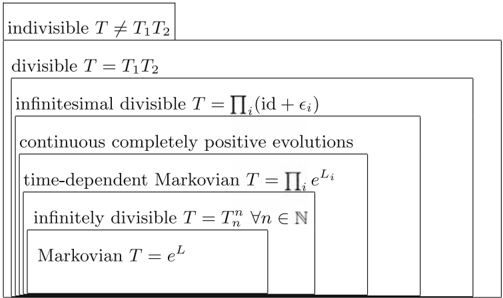
We investigate the possibility of dividing quantum channels into concatenations of other channels, thereby studying the semigroup structure of the set of completely-positive trace-preserving maps. We show the existence of ‘ indivisible ’ channels which can not be written as non-trivial products of other channels and study the set of ‘ infinitesimal divisible ’ channels which are elements of continuous completely positive evolutions. For qubit channels we obtain a complete characterization of the sets of indivisible and infinitesimal divisible channels. Moreover, we identify those channels which are solutions of time-dependent master equations for both positive and completely positive evolutions. For arbitrary finite dimension we prove a representation theorem for elements of continuous completely positive evolutions based on new results on determinants of quantum channels and Markovian approximations.
Overview
The claims and statistics of this paper haven’t been checked yet.
Free: it reads the open-access text and checks the first 5 claims that cite a source we can check. Create a free account to check every claim.
Integrity signals
Registry
Cites
Statistics
Figures
Verification
Claims the paper makes
The claims and statistics of this paper haven’t been checked yet.
Free: it reads the open-access text and checks the first 5 claims that cite a source we can check. Create a free account to check every claim.
Claims other papers make about this one
Each is checked against this paper’s own text: does it say what the citing paper says it does?
The cited source says what the claim attributes to it.
In the citing paper
“It can be proven that, since E (t,t 0 ) is a composition of completely positive maps, the absolute value of the determinant of M (t,t 0 ) decreases monotonically with time [27].”
From Quantum non-Markovianity: characterization, quantification and detection (2014) · cites this paper as [27]
In the citing paper
“Moreover, it is easy to show with the help of Eq. (78) that the maximum in Eq. (76) is attained for a = 0 and | b | = 1 [38]. This means that the optimal pairs of initial states correspond to antipodal points on the equator of the Bloch sphere representing the qubit.”
From Foundations and measures of quantum non-Markovianity (2012) · cites this paper as [38]
Self-check
Percentages, sums and reported differences re-computed from the paper’s own numbers.
The self-check needs the paper’s full text.
Citations
Cites
Quantum Computation and Quantum Information
Nielsen, M. A., Chuang, I., & Grover, L. K. (2002) · American Journal of Physics · doi:10.1119/1.1463744 · Cited by 21,895
Quantum computation and quantum information
Law, J. (2001) · ACM SIGSOFT Software Engineering Notes · doi:10.1145/505482.505499 · Cited by 18,842
On the generators of quantum dynamical semigroups
Lindblad, G. (1976) · Communications in Mathematical Physics · doi:10.1007/bf01608499 · Cited by 7,548
Completely positive dynamical semigroups of N -level systems
Gorini, V., Kossakowski, A., & Sudarshan, E. C. G. (1976) · Journal of Mathematical Physics · doi:10.1063/1.522979 · Cited by 3,998
Bhatia, R. (1996) · Cited by 2,847
Completely positive linear maps on complex matrices
Choi, M.-D. (1975) · Linear Algebra and its Applications · doi:10.1016/0024-3795(75)90075-0 · Cited by 2,659
Scott, W. R. (1964) · Cited by 2,606
Bhatia, R. (1997) · Graduate Texts in Mathematics · doi:10.1007/978-1-4612-0653-8 · Cited by 2,336
The ‘transition probability’ in the state space of a—algebra
Uhlmann, A. (1976) · Reports on Mathematical Physics · doi:10.1016/0034-4877(76)90060-4 · Cited by 1,649
Linear transformations which preserve trace and positive semidefiniteness of operators
Jamiołkowski, A. (1972) · Reports on Mathematical Physics · doi:10.1016/0034-4877(72)90011-0 · Cited by 1,512
Research works printed but not linked: 4
- 3. Holevo, A.S.: Theor. Probab. Appl. 32, 560 (1986)
- 7. Kraus, K.: States, Effects, and Operations. Berlin-Heidelberg-New York: Springer, 1983
- 27. Verstraete, F., Verschelde, H.: http://arxiv.org/list/quant-ph/0202124, 2002;
- 33. Wolf, M.M., Eisert, J., Cubitt, T.S., Cirac, J.I.: arXiv: 0711.3172 (2007) · arXiv
Cited by
Items 201–288 of 288
Quantum dynamical semigroups involving separable and entangled statesPreprint
Singh, A. I. (2012) · arXiv (Cornell University) · Cited by 4
Quantum Dynamics is Not Strictly Bidivisible
Davalos, D., & Ziman, M. (2023) · Physical Review Letters · doi:10.1103/physrevlett.130.080801 · Cited by 7
On divisible quantum dynamical mappings
Gumerov, R. N., & Khazhin, R. L. (2022) · Ufimskii Matematicheskii Zhurnal · doi:10.13108/2022-14-2-22 · Cited by 3
Non-Markovian Quantum Evolution: Time-Local Generators and Memory Kernels
Chruściński, D., & Należyty, P. (2016) · Reports on Mathematical Physics · doi:10.1016/s0034-4877(16)30036-2 · Cited by 6
Non-Markovian dynamics of few emitters in a laser-driven cavity
Pagel, D., & Fehske, H. (2017) · Physical Review A · doi:10.1103/physreva.96.041802 · Cited by 3
Two-time correlation functions of a two-level system influenced by a composite environment
Ban, M. (2018) · Quantum Information Processing · doi:10.1007/s11128-018-2093-5 · Cited by 2
Dynamical Semigroups in the Birkhoff Polytope of Order 3 as a Tool for Analysis of Quantum Channels
Snamina, M., & Zak, E. J. (2020) · Open Systems & Information Dynamics · doi:10.1142/s1230161220500018 · Cited by 4
Pauli component erasing quantum channels
de Leon, J. A., Fonseca, A., Leyvraz, F., Davalos, D., & Pineda, C. (2022) · Physical Review A · doi:10.1103/physreva.106.042604 · Cited by 5
Training an open quantum classifier
Korkmaz, U., Topal, M. C., Aygül, E. E., & Türkpençe, D. (2022) · International Symposium on Multidisciplinary Studies and Innovative Technologies (ISMSIT) · doi:10.1109/ismsit56059.2022.9932705 · Cited by 3
“Furthermore, validation of this additivity applies in terms of collisional models only when the CP divisibility condition is satisfied [39], [40].”
MethodAlmost All Quantum Channels Are Diagonalizable
Ende, F. V. (2024) · Open Systems & Information Dynamics · doi:10.1142/s1230161224500124 · Cited by 7
Qubit entanglement generation by Gaussian non-Markovian dynamics
Benatti, F., Ferialdi, L., & Marcantoni, S. (2018) · Journal of Physics A Mathematical and Theoretical · doi:10.1088/1751-8121/aaea13 · Cited by 3
Necessary criteria for Markovian divisibility of linear maps
Caro, M. C., & Graswald, B. R. (2021) · Journal of Mathematical Physics · doi:10.1063/5.0031760 · Cited by 3
Bounds for the divisibility-based and distinguishability-based non-Markovianity measures
Mäkelä, H. (2015) · Physical Review A · doi:10.1103/physreva.91.012108 · Cited by 4
Vatasescu, M. (2018) · Physical Review A · doi:10.1103/physreva.98.053426 · Cited by 3
Evolution of entanglement in quantum neural network
Korkmaz, U., Türkpençe, D., Akıncı, T. Ç., & Şeker, S. (2019) · IOP Conference Series Materials Science and Engineering · doi:10.1088/1757-899x/618/1/012006 · Cited by 3
Dequantization Via Quantum Channels
Andersson, A. (2016) · Letters in Mathematical Physics · doi:10.1007/s11005-016-0874-2 · Cited by 3
“, there may be no maps τ−t , t such that τ−t ◦ t = [41].”
Ghosh, S., Varma, A. V., & Das, S. (2023) · Journal of Physics A Mathematical and Theoretical · doi:10.1088/1751-8121/acc912 · Cited by 6
Korkmaz, U., Sanga, C., & Türkpençe, D. (2022) · Lecture notes of the Institute for Computer Sciences, Social Informatics and Telecommunications Engineering · doi:10.1007/978-3-031-01984-5_13 · Cited by 4
Bipartite Quantum Interactions: Entangling and Information Processing Abilities
Das, S. (2018) · Louisiana State University · doi:10.31390/gradschool_dissertations.4717 · Cited by 7
A Brief on Quantum Systems Theory and Control Engineering
Schulte‐Herbrüggen, T., Zeier, R., Keyl, M., & Dirr, G. (2016) · Wiley eBooks · doi:10.1002/9783527805785.ch27 · Cited by 5
Reachability in Controlled Markovian Quantum Systems
Ende, F. V. (2020) · arXiv (Cornell University) · doi:10.14459/2020md1559809 · Cited by 7
“Although not directly relevant to the setting in this work, some notions which generalize Markovianity are infinitesimal divisibility of channels [247] as well as P-divisibility of dynamical processes [56].”
BackgroundInfluentialOne-dimensional continuous-time quantum Markov chains: qubit probabilities and measures
de la Iglesia, M. D., & Lardizabal, C. F. (2024) · Journal of Physics A Mathematical and Theoretical · doi:10.1088/1751-8121/ad5bcb · Cited by 2
“As P acts on the vectorized expressions for the densities, we apply vec − 1 and take the trace in order to obtain (see (2.3)): where [10, 26, 30, 34]).”
InfluentialBhuiyan, A., Pan, H., & Jian, C. (2026) · Physical Review Research · doi:10.1103/nk38-ygyq · Cited by 8
Bottlenecks in Quantum Channels and Finite Temperature Phases of Matter
Rakovszky, T., Placke, B., Breuckmann, N. P., & Khemani, V. (2026) · Physical Review Letters · doi:10.1103/y9z2-52rl · Cited by 32
“We will be interested in Markovian (memoryless) evolutions [19–23], where the state at time t depends only on the state at the previous step, as where we allow the channel M t itself to also depend on t , which could correspond, e.g., to discretizing the evolution with time-dependent Lindbladian.”
Generalized ansatz for continuous matrix product states
Balanzó-Juandó, M., & Cuevas, G. D. L. (2020) · Physical Review A · doi:10.1103/physreva.101.052312 · Cited by 2
Quantitative Nonclassicality of Mediated Interactions
Ganardi, R., Panwar, E., Pandit, M., Wołoncewicz, B., & Paterek, T. (2024) · PRX Quantum · doi:10.1103/prxquantum.5.010318 · Cited by 8
“So-called divisibility asks whether map Λ can be written as Λ 1 Λ 2 where both Λ 1 and Λ 2 are not unitaries [37].”
BackgroundGenerating quantum channels from functions on discrete sets
Quillen, A. C., & Skerrett, N. (2024) · Quantum Information Processing · doi:10.1007/s11128-023-04254-0 · Cited by 2
“:3) j | : i , j ∈ 0 , 1 , 2 , . . . , N } (following [25]).”
Driven-dissipative Bose-Einstein condensation and the upper critical dimension
Zhang, Y., & Barthel, T. (2024) · Physical Review A · doi:10.1103/physreva.109.l021301 · Cited by 4
Distillation of quantum non-Markovianity
Azevedo, T. M. D., Duarte, C., & Bernardes, N. K. (2024) · Physics Letters A · doi:10.1016/j.physleta.2024.129582 · Cited by 3
Analog simulation of noisy quantum circuits
Granet, E., Hémery, K., & Dreyer, H. (2025) · Physical Review Research · doi:10.1103/physrevresearch.7.013213 · Cited by 5
HOW LONG CAN IT TAKE FOR A QUANTUM CHANNEL TO FORGET EVERYTHING?
Ahlbrecht, A., RICHTER, F., & Werner, R. F. (2012) · International Journal of Quantum Information · doi:10.1142/s0219749912500578 · Cited by 5
“The divisibility of quantum channels, that is, the property of a channel T to be decomposable into two non-trivial channels S1 and S2 has been investigated in reference [WC08].”
BackgroundKorkmaz, U., Türkpençe, D., Akıncı, T. Ç., Akinci, C., & Seker, S. (2020) · Quantum Information and Computation · doi:10.26421/qic20.11-12-4 · Cited by 7
“The main idea of the study relies on the complete positivity (CP), divisibility and additivity of the quantum dynamical maps [35]–[37].”
BackgroundNo-go theorem and a universal decomposition strategy for quantum channel compilation
Gong, W., Jiang, S., & Deng, D.-L. (2023) · Physical Review Research · doi:10.1103/physrevresearch.5.013060 · Cited by 5
Isotropy and control of dissipative quantum dynamics
Dive, B., Burgarth, D. K., & Mintert, F. (2016) · Physical Review A · doi:10.1103/physreva.94.012119 · Cited by 7
Macroscopic instructions vs microscopic operations in quantum circuits
Veitia, A., Silva, M. P. D., Blume-Kohout, R., & van Enk, S. J. (2019) · Physics Letters A · doi:10.1016/j.physleta.2019.126131 · Cited by 6
Deciding whether a Quantum Channel is Markovian is NP-hard
Cubitt, T. S., Eisert, J., & Wolf, M. M. (2009) · Cited by 2
Self-citationThe Complexity of Relating Quantum Channels to Master EquationsPreprint
Cubitt, T. S., Eisert, J., & Wolf, M. M. (2009) · arXiv (Cornell University) · doi:10.17169/refubium-21279 · Cited by 2
Self-citationNon-Markovianity and entanglement detection
Chanduka, S., Bhattacharya, B., Mundra, R., Bhattacharya, S., & Chakrabarty, I. (2023) · International Journal of Quantum Information · doi:10.1142/s0219749923500259 · Cited by 1
Generating quantum dynamical mappings
Gumerov, R. N., & Khazhin, R. L. (2024) · Theoretical and Mathematical Physics · doi:10.1134/s0040577924120122 · Cited by 1
“This fact and Theorem 4.1 in [14] allow constructing continuous completely positive evolution using a nonsingular continuous CP -divisible quantum dynamical mapping [17].”
InfluentialInformation back-flow in quantum non-Markovian dynamics and its connection to teleportation
Tserkis, S., Head-Marsden, K., & Narang, P. (2025) · Physics Letters A · doi:10.1016/j.physleta.2025.130649 · Cited by 5
“Markovianity in quantum systems admits various definitions [2–9].”
Open-systems tools for nonthermalizing closed quantum systems
Akhouri, U., Shandera, S. E., & Henry, J. (2025) · Physical review. E · doi:10.1103/zt7h-fj8w · Cited by 3
Non-Markovian exceptional points by interpolating quantum channels
Wong, W. C., Zeng, B., & Li, J. (2026) · npj Quantum Information · doi:10.1038/s41534-026-01205-2 · Cited by 9
“(cid:4) This is due to the smallest singular value s min of the distortion matrix E a 1 ; a 2 ; a 3 (cid:5) at the EP satisfying s < det E a necessityandsuf fi ciencyconditiongivenbyref.49.”
Switching quantum dynamics for fast preparation of pure states
Scaramuzza, P., & Ticozzi, F. (2015) · IEEE Conference on Decision and Control (CDC) · doi:10.1109/cdc.2015.7403233 · Cited by 1
“A quantum dynamical system for which the propagator satisfies Et2,t0 = Et2,t1◦Et1,t0 , for any intermediate time t1, with both the factor maps being Completely=Positive Trace-Preserving (CPTP) linear maps, is said to be Quantum Dynamical Semigroup (QDS) [27], [28].”
BackgroundQuantum-to-classical transition in a spin star network
Korkmaz, U. (2022) · Pramana · doi:10.1007/s12043-022-02439-3 · Cited by 1
Santis, D. D. (2023) · Quantum · doi:10.22331/q-2023-09-26-1124 · Cited by 1
“It follows that vol(Λ0)=vol(Λt) <vol(Λs), the intermediate map Vt,s cannot be positive [38].”
BackgroundSuperoperator Master Equations for Depolarizing Dynamics
Teretenkov, A. E. (2024) · Lobachevskii Journal of Mathematics · doi:10.1134/s1995080224602832 · Cited by 1
“We have derived the superoperator master equations for the twirling hyperprojector with respect to the whole unitary group.”
CP Conditions for GKSL-Like Master Equations
Watanabe, A., Unoki, M., Nakazato, H., & Suzuki, T. (2024) · Open Systems & Information Dynamics · doi:10.1142/s1230161224500173 · Cited by 1
“This supports the well-known condition for the QDM to be CP-divisible [42–44 Consider the first-order, linear integro-differential equation Integration of Eq.”
Chruściński, D., Ende, F. V., Kimura, G., & Muratore-Ginanneschi, P. (2025) · Reports on Progress in Physics · doi:10.1088/1361-6633/ae075f · Cited by 9
Characterizing Non-Markovian Dynamics
Chruściński, D., & Kossakowski, A. (2012) · Springer eBooks · doi:10.1007/978-3-0348-0448-6_23 · Cited by 1
Quantum Non-Markovianity via the Covariance Matrix
Fan, Y., Chen, L., Cao, H., & Meng, H. (2018) · International Journal of Theoretical Physics · doi:10.1007/s10773-018-3793-4 · Cited by 1
“approaches to the problem of (non)Markovian evolution are based on divisibility [5, 6], distinguishability of states [7], quantum Fisher information flow [8], fidelity [9], mutual information [10], channel capacity [11] and geometry of the set of accessible states [12].”
BackgroundFate of Entanglement for Initial Separable States in Quantum Neural Network
Korkmaz, U. (2019) · Balkan Journal of Electrical and Computer Engineering · doi:10.17694/bajece.541444 · Cited by 1
“types of interactions have been shown to be dynamic maps equivalent to the Markovian principal equation approach, using the divisibility of quantum channels [34].”
MethodQuantifying quantum non-Markovianity via one-shot generalised mutual information
Luo, Y., Li, Y., Shao, L.-H., & Xi, Z. (2020) · Laser Physics Letters · doi:10.1088/1612-202x/ab6991 · Cited by 1
Singh, A. I. (2015) · WyoScholar · Cited by 1
Upper bounds on the leakage of private data and an operational approach to Markovianity
Horodecki, K., Studziński, M., Kostecki, R. P., Sakarya, O., & Yang, D. (2021) · Physical Review A · doi:10.1103/physreva.104.052422 · Cited by 3
Entropic Continuity Bounds & Eventually Entanglement-Breaking Channels
Hanson, E. P. (2020) · arXiv (Cornell University) · doi:10.17863/cam.58687 · Cited by 4
Non-Markovianity boosts the efficiency of thermal bio-molecular switches.Preprint
Spaventa, G., Huelga, S. F., & Plenio, M. B. (2021) · arXiv (Cornell University) · Cited by 1
Heisenberg's Limit Phase Sensitivity in The Presence of Decoherence ChannelsPreprint
Nosraty, F. (2015) · arXiv (Cornell University) · doi:10.48550/arxiv.1506.06249
“e often described as memoryless and memory effect of environment. In particular, several so-called non-Markovianity measures were proposed which are based on divisibility distinguishability of states [27, 28, 29, 30, 31], quantum entanglement [28], quantum Fisher information (QFI) flow [32], fidelity [33], mutual info…”
BackgroundMathematical aspects of local in time master equations
Chruściński, D. (2013) · Physica Scripta · doi:10.1088/0031-8949/87/03/038102
Locality and complexity in simulations of complex quantum systems
Kliesch, M. (2015) · Universitätsbibliothek der FU Berlin Hochschulschriftenstelle u. Dokumentenserver · doi:10.17169/refubium-11923
A Lie Theoretic Framework for Controlling Open Quantum SystemsPreprint
O’Meara, C. (2025) · arXiv (Cornell University) · doi:10.48550/arxiv.2510.04719 · Cited by 3
Quantum Markov processes on graphs, monitoring and hitting timesPreprint
Lardizabal, C. F. (2018) · arXiv (Cornell University) · doi:10.48550/arxiv.1801.09578 · Cited by 1
“A special case of valid generators which are of interest to us are the ones given by L = Φ− I, for any quantum channel Φ [36], this being analogous to the classical theory of Markov chains: given a stochastic matrix P we have that Q = P − I is a valid (classical) generator so e is stochastic for every t ≥ 0.”
BackgroundDefining and generating current in open quantum systemsPreprint
Hovhannisyan, K. V., & Imparato, A. (2018) · arXiv (Cornell University)
No-cloning theorem for a single POVMPreprint
Rastegin, A. E. (2009) · arXiv (Cornell University) · doi:10.48550/arxiv.0907.4598
“positive linear maps [1, 2]. In the realm of quantum information these maps are referred to as quantum channels. In the certain cases, a channel can be decomposed into concatenation of other channels [30]. So, two input qudits are processed via quantum channel E acting as a map on the set of density operators. To desc…”
BackgroundHeisenberg Limit Phase Sensitivity in the Presence of Decoherence Channels
Nosraty, F. (2016) · Communications in Theoretical Physics · doi:10.1088/0253-6102/65/2/225
“e often described as memoryless and memory effect of environment. In particular, several so-called non-Markovianity measures were proposed which are based on divisibility distinguishability of states [27, 28, 29, 30, 31], quantum entanglement [28], quantum Fisher information (QFI) flow [32], fidelity [33], mutual info…”
BackgroundControle da não Markovianidade em sistemas quânticas abertos
Lima, R. B. B. (2020) · Digital Library of Theses and Dissertations (Universidade de São Paulo) · doi:10.11606/t.76.2020.tde-05062020-151346 · Cited by 1
Divisibility classes of qubit maps and singular Gaussian channelsPreprint
Davalos, D. (2020) · arXiv (Cornell University) · doi:10.48550/arxiv.2009.00159
“This is a rank-three qubit unital channel, thus, it is indivisible [WC08].”
BackgroundMethodInfluentialExperimental observation of transition between strong and weak non-Markovianity
Bernardes, N. K., Cuevas, Á., Orieux, A., Monken, C. H., Mataloni, P., Sciarrino, F., & Santos, M. F. (2015) · Proceedings of SPIE, the International Society for Optical Engineering/Proceedings of SPIE · doi:10.1117/12.2194881
Quantum Reservoir Parameter Estimation via Fisher Information
Korkmaz, U., & Türkpençe, D. (2022) · Sakarya University Journal of Science · doi:10.16984/saufenbilder.1018716
Information retrieval and criticality in high-dimensional parity-time-symmetric systems
Qu, D., Yi, F., & Xue, P. (2022) · Acta Physica Sinica · doi:10.7498/aps.71.20220511 · Cited by 3
Measured Composite Collision Models: Quantum Trajectory Purities and Channel Divisibility
Beyer, K., Luoma, K., Lenz, T., & Strunz, W. T. (2022) · Entropy · doi:10.3390/e24050715
Accessible Maps in a Group of Classical or Quantum Channels
Sadri, K., Shahbeigi, F., Puchała, Z., & Życzkowski, K. (2022) · Open Systems & Information Dynamics · doi:10.1142/s1230161222500020
“Moreover, complete positivity of Φ imposes conditional complete positivity on LΦ resulting in a valid Lindblad generator assigned to any quantum channel [18].”
BackgroundStabilization and Dissipative Information Transfer of a Superconducting Kerr-Cat Qubit
Korkmaz, U., & Türkpençe, D. (2023) · Balkan Journal of Electrical and Computer Engineering · doi:10.17694/bajece.1211876
“(12) and is only valid if it satisfies the addition and divisibility conditions of quantum dynamic maps [27], [29], [38] .”
BackgroundWitnessing non-Markovian evolutions
Santis, D. D. (2021) · UPCommons institutional repository (Universitat Politècnica de Catalunya) · doi:10.5821/dissertation-2117-363074
Порождающие квантовые динамические отображения
Gumerov, R. N., & Khazhin, R. L. (2024) · Теоретическая и математическая физика · doi:10.4213/tmf10802
A sufficient criterion for divisibility of quantum channels
Ende, F. V. (2025) · Journal of Mathematical Physics · doi:10.1063/5.0231812 · Cited by 4
Geometric Signature of Non-Markovian Dynamics
Luo, D.-W., & Yu, T. (2025) · Annals of Physics · doi:10.1016/j.aop.2025.170243 · Cited by 2
“Since non-negative rate coefficient can be a necessary and sufficient condition for Markov or divisible processes [18, 26, 52], for the model under consideration the divisible criteria and the trace distance measure agrees: the trace distance measure would be non-monotonic when the rate coefficient…”
Universal bound on the eigenvalues of 2-positive trace-preserving maps
Ende, F. V., Chruściński, D., Kimura, G., & Muratore-Ginanneschi, P. (2025) · Linear Algebra and its Applications · doi:10.1016/j.laa.2025.10.022 · Cited by 5
“…for quantum processes with time-dependent generators (i.e., as there, the intermediate maps V ( t, s ) which satisfy Φ( t ) = V ( t, s ) ◦ Φ( s ) may not be completely positive anymore, but often satisfy weaker notions of positivity (which have different physical implications) [18], [19, Sec.”
Approach to equilibrium in open quantum statistical mechanics under detailed balance condition
Yang, D. H. O. (2025) · Journal of Mathematical Physics · doi:10.1063/5.0276850
Information Storage and Transmission under Markovian Noise
Singh, S., & Datta, N. (2026) · PRX Quantum · doi:10.1103/8rnj-667b · Cited by 12
Edge dark states of dissipative dynamics in topological insulators
Sun, J., Fei, Y., 何, J. 敬. H., & Wu, Y.-J. (2025) · Chinese Physics B · doi:10.1088/1674-1056/ae2675
Corralling spectra of generators of time-continuous Markov evolution (both classical and quantum)
Chruściński, D., Denisov, S., Tarnowski, W., & Życzkowski, K. (2026) · Journal of Physics A Mathematical and Theoretical · doi:10.1088/1751-8121/ae58d2 · Cited by 2
“The authors of [46] proved the following with Tr L α = 0 , and It is, therefore, clear that the spectrum of 1 ν q , 1 L is confined to D ( 0 , 2 ) .”
Constructing Fermionic Dynamics with Closed Moment Hierarchies
Teretenkov, A. E. (2026) · Lobachevskii Journal of Mathematics · doi:10.1134/s1995080226618485
“Namely, starting from any completely positive map, one can [40, Lemma 1] construct a GKSL generator by the formula because the Kraus representation for Φ defines a Lindblad representation for L .”
Optimal measurement strategies for quantum states and quantum channels estimation
Milazzo, N. (2021) · theses.fr (ABES) · doi:10.70675/ab5e9c11z573dz4938za409z4aae63958c83
Quantum Theory: Ideals, Infinities, and Pluralities
Coves, G. D. L. (2026) · doi:10.1093/9780198929277.003.0017
Realization of trapped ion dynamics in the strong-field regime and non-Markovianity
Anonymous, Tu, H., Tassis, T., Zou, M., Yin, Z., Zhang, J.-N., Semião, F. L., & Kim, K. (2026) · Physical Review Research · doi:10.1103/r8dp-52s2
Non-normality and dissipation in Markovian quantum dynamics: Implications for quantum simulation
Daryanoosh, S. (2026) · Physical Review A · doi:10.1103/5yrr-26rs
How to Break Symmetries for Tomographying Coherently Controlled Bilinear Quantum Systems*
Schulte‐Herbrüggen, T., Dirr, G., & Malvetti, E. (2026) · IEEE International Conference on Quantum Control, Computing and Learning (qCCL) · doi:10.1109/qccl70331.2026.11668576
“We call a quantum map time-dependent Markovian iff it is infinitessimally divisible and time-independent Markovian iff it is infinitely divisible in the sense of Wolf and Cirac [30].”
Unique determination and generation of rank-two single-qubit quantum channels
Kuklina, N. E., Vasilenko, V. I., Volkov, B. O., & Pechen, A. N. (2026) · Journal of Physics A Mathematical and Theoretical · doi:10.1088/1751-8121/ae9b4f
“A complete characterization of the sets of indivisible and infinitesimal divisible channels for qubit channels was obtained using a general approach of dividing quantum channels into concatenations of other channels [31].”
Metadata
- Authors
- Wolf, M. M., & Cirac, J. I.
- Affiliations
- Max Planck Society (DE)
- Corresponding author
- Wolf, Michael M.
- Venue
- Communications in Mathematical Physics
- Published
- 2008-02-01
- Volume
- 279
- Issue
- 1
- Pages
- 147-168
- ISSN
- 0010-3616 (ISSN-L)
- 1432-0916
- OpenAlex
- W2052344514
- Semantic Scholar
- 0bd4e105fb4e18ab74c88a52b58bdad786127a30
- Cited by
- 288
- References
- 36
- Citations by year
- 2026: 11 · 2025: 14 · 2024: 25 · 2023: 17 · 2022: 24 · 2021: 21 · 2020: 22 · 2019: 23 · 2018: 19 · 2017: 15 · 2016: 11 · 2015: 19 · 2014: 14 · 2013: 12 · 2012: 13
- FWCI
- 14.80
- Type
- journal article
- Language
- en
- Open access
- hybrid
- doi.org
- Licence
- cc-by-nc
- creativecommons.org/licenses/by-nc/2.0 (tdm)
- creativecommons.org/licenses/by-nc/2.0 (vor)
- Locations
- Communications in Mathematical Physics (publishedVersion, cc-by-nc)
- arXiv (Cornell University) (submittedVersion)
- Max Planck Institute for Plasma Physics (submittedVersion)
- MPG.PuRe (Max Planck Society) (submittedVersion)
- arXiv (Cornell University)
- Topics
- Physical Sciences › Physics and Astronomy › Atomic and Molecular Physics, and Optics › Quantum Information and Cryptography
- Physical Sciences › Physics and Astronomy › Atomic and Molecular Physics, and Optics › Quantum Mechanics and Applications
- Physical Sciences › Mathematics › Mathematical Physics › Advanced Operator Algebra Research
- Keywords
- quantum channels, completely positive trace-preserving maps, semigroup structure, qubit channels, Markov approximation, quantum dynamical systems
About these checks
Registry, retraction, Cites and statistics results are computed, not judged, with one exception: a printed reference that no index lists is read once by a model before it counts as a citation error. Claims are extracted by a model and kept only when their quote appears verbatim in the text; each cited source is then checked, with a model’s help, for whether it says what the claim relies on. Those verdicts can be wrong — read the claim’s quote and the cited source before relying on one.
Statistics and arithmetic are recomputed, not judged.
Confidence bands are shown only for fields calibrated on our annotated test set. None is calibrated yet, so no band is shown.
What counts as a claim ›How we measure confidence ›How we check this ›
Are you an author, or do you see a problem with this page? Request a review
Data sources
Bibliographic data: Semantic Scholar, OpenAlex, Crossref.
Contains information from the Semantic Scholar Academic Graph Datasets, made available under the ODC Attribution License (ODC-BY 1.0).
Semantic Scholar’s data is described in: Kinney, R., et al. (2023). The Semantic Scholar Open Data Platform. arXiv:2301.10140.
