

The DOI matches its Crossref record; 30 of the 30 references it cites were found in a registry or an index.
Simply longer is not better: reversal of theta burst after-effect with prolonged stimulation
Open accessAbstract
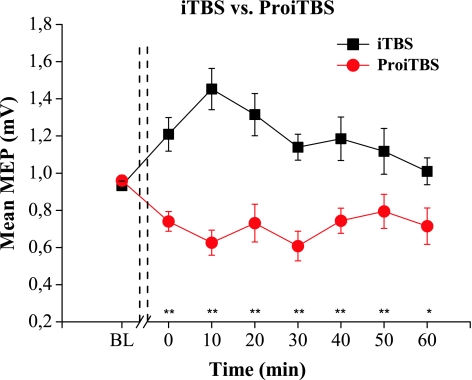
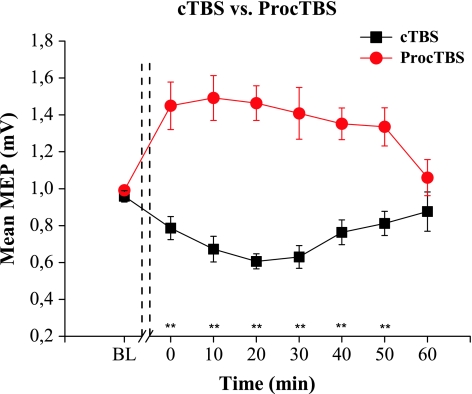
From all rTMS protocols at present, the theta burst stimulation (TBS) is considered the most efficient in terms of number of impulses and intensity required during a given stimulation. The aim of this study was to investigate the effects of inhibitory and excitatory TBS protocols on motor cortex excitability when the duration of stimulation was doubled. Fourteen healthy volunteers were tested under four conditions: intermittent theta bust stimulation (iTBS), continuous theta burst stimulation (cTBS), prolonged intermittent theta bust stimulation (ProiTBS) and prolonged continuous theta burst stimulation (ProcTBS). The prolonged paradigms were twice as long as the conventional TBS protocols. Conventional facilitatory iTBS converted into inhibitory when it was applied for twice as long, while the normally inhibitory cTBS became facilitatory when the stimulation duration was doubled. Our results show that TBS-induced plasticity cannot be deliberately enhanced simply by prolonging TBS protocols. Instead, when stimulating too long, after-effects will be reversed. This finding supplements findings at the short end of the stimulation duration range, where it was shown that conventional cTBS is excitatory in the first half and switches to inhibition only after the full length protocol. It is relevant for clinical applications for which an ongoing need for further protocol improvement is imminent.
Overview
The claims and statistics of this paper haven’t been checked yet.
Run the check — free, no account needed. It reads the open-access text and checks the sources it cites.
Integrity signals
Registry
Cites
Statistics
Figures
Verification
Claims the paper makes
The claims and statistics of this paper haven’t been checked yet.
Run the check — free, no account needed. It reads the open-access text and checks the sources it cites.
Claims other papers make about this one
Each is checked against this paper’s own text: does it say what the citing paper says it does?
The source backs part of the claim, not all of it — or backs it for a different population, condition or comparison.
In the citing paper
“Studies demonstrate that this number of pulses results in an optimal “window” of cortical excitability, and additional pulses may have an inhibitory effect [59-61].”
From Frontal Pole Neuromodulation for Impulsivity and Suicidality in Veterans With Mild Traumatic Brain Injury and Common Co-Occurring Mental Health Conditions: Protocol for a Pilot Randomized Controlled Trial (2024) · cites this paper as [60]
Experimental — accuracy not yet measured
Self-check
Percentages, sums and reported differences re-computed from the paper’s own numbers.
The self-check needs the paper’s full text.
Citations
Cites
The assessment and analysis of handedness: The Edinburgh inventory
Oldfield, R. C. (1971) · Neuropsychologia · doi:10.1016/0028-3932(71)90067-4 · Cited by 35,900
Theta Burst Stimulation of the Human Motor Cortex
Huang, Y.-Z., Edwards, M. J., Rounis, E., Bhatia, K. P., & Rothwell, J. C. (2005) · Neuron · doi:10.1016/j.neuron.2004.12.033 · Cited by 4,158
Bienenstock, E., Cooper, L., & Munro, P. (1982) · The Journal of Neuroscience · doi:10.1523/jneurosci.02-01-00032.1982 · Cited by 2,896
Cheeran, B., Talelli, P., Mori, F., Koch, G., Suppa, A., Edwards, M. J., Houlden, H., Bhatia, K. P., Greenwood, R., & Rothwell, J. C. (2008) · The Journal of Physiology · doi:10.1113/jphysiol.2008.159905 · Cited by 746
Consensus: Motor cortex plasticity protocols
Ziemann, U., Paulus, W., Nitsche, M. A., Pascual-Leone, A., Byblow, W. D., Berardelli, A., Siebner, H. R., Classen, J., Cohen, L. G., & Rothwell, J. C. (2008) · Brain Stimulation · doi:10.1016/j.brs.2008.06.006 · Cited by 639
Self-citationZiemann, U., Ilic, T. V., Pauli, C., Meintzschel, F., & Ruge, D. (2004) · Journal of Neuroscience · doi:10.1523/jneurosci.5016-03.2004 · Cited by 590
(1999) · PubMed · Cited by 558
Self-citationLazzaro, V. D., Pilato, F., Saturno, E., Oliviero, A., Dileone, M., Mazzone, P., Insola, A., Tonali, P., Ranieri, F., Huang, Y., et al. (2005) · The Journal of Physiology · doi:10.1113/jphysiol.2005.087288 · Cited by 424
Lazzaro, V. D., Pilato, F., Dileone, M., Profice, P., Oliviero, A., Mazzone, P., Insola, A., Ranieri, F., Meglio, M., Tonali, P., et al. (2008) · The Journal of Physiology · doi:10.1113/jphysiol.2008.152736 · Cited by 354
Gentner, R., Wankerl, K., Reinsberger, C., Zeller, D., & Claßen, J. (2007) · Cerebral Cortex · doi:10.1093/cercor/bhm239 · Cited by 350
Cited by
Sorted by citations
Rossini, P., Burke, D. F., Chen, R., Cohen, L., Daskalakis, Z., Iorio, R. D., di Lazzaro, V., Ferreri, F., Fitzgerald, P., George, M., et al. (2015) · Clinical Neurophysiology · doi:10.1016/j.clinph.2015.02.001 · Cited by 2,729
Self-citationLefaucheur, J.-P., André-Obadia, N., Antal, A., Ayache, S. S., Baeken, C., Benninger, D. H., Cantello, R. M., Cincotta, M., de Carvalho, M., De Ridder, D., et al. (2014) · Clinical Neurophysiology · doi:10.1016/j.clinph.2014.05.021 · Cited by 2,119
Self-citationBlumberger, D. M., Vila-Rodriguez, F., Thorpe, K. E., Feffer, K., Noda, Y., Giacobbe, P., Knyahnytska, Y., Kennedy, S. H., Lam, R. W., Daskalakis, Z. J., et al. (2018) · The Lancet · doi:10.1016/s0140-6736(18)30295-2 · Cited by 1,363
Batsikadze, G., Moliadze, V., Paulus, W., Kuo, M. ‐., & Nitsche, M. A. (2013) · The Journal of Physiology · doi:10.1113/jphysiol.2012.249730 · Cited by 1,017
Self-citationStudying and modifying brain function with non-invasive brain stimulation
Polanía, R., Nitsche, M. A., & Ruff, C. C. (2018) · Nature Neuroscience · doi:10.1038/s41593-017-0054-4 · Cited by 1,090
Metadata
- Authors
- Gamboa, O. L., Antal, A., Moliadze, V., & Paulus, W.
- Affiliations
- University of Göttingen (DE)
- Corresponding author
- Gamboa, Olga Lucía
- Venue
- Experimental Brain Research
- Published
- 2010-06-22
- Volume
- 204
- Issue
- 2
- Pages
- 181-187
- ISSN
- 0014-4819 (ISSN-L)
- 1432-1106
- PMC
- PMC2892066
- OpenAlex
- W2073595961
- Cited by
- 318
- References
- 30
- Citations by year
- 2026: 17 · 2025: 27 · 2024: 25 · 2023: 18 · 2022: 37 · 2021: 17 · 2020: 19 · 2019: 16 · 2018: 23 · 2017: 18 · 2016: 15 · 2015: 20 · 2014: 21 · 2013: 16 · 2012: 12
- FWCI
- 8.73
- Type
- journal article
- Language
- en
- Open access
- hybrid
- doi.org
- Licence
- cc-by-nc
- Locations
- Experimental Brain Research (publishedVersion, cc-by-nc)
- PubMed Central (publishedVersion, cc-by-nc)
- PubMed (publishedVersion)
- GoeScholar The Publication Server of the Georg-August-Universität Göttingen (Georg-August-Universität Göttingen) (submittedVersion, cc-by)
- GRO (submittedVersion, cc-by)
- Funders
- Rose Foundation for Communities and the Environment (T298/14376/2004, T298/14375/2004)
- Bundesministerium für Bildung und Forschung (01GQ0782, 01GQ0810)
- Topics
- Life Sciences › Neuroscience › Neurology › Transcranial Magnetic Stimulation Studies
- Life Sciences › Neuroscience › Cellular and Molecular Neuroscience › Neuroscience and Neuropharmacology Research
- Health Sciences › Medicine › Clinical Neurology › Deep Brain Stimulation and Movement Disorders
- Keywords
- theta burst stimulation, repetitive transcranial magnetic stimulation, stimulation duration, motor cortex excitability, long-term potentiation, long-term depression, intermittent theta burst stimulation, continuous theta burst stimulation
- MeSH terms
- Adult, Electric Stimulation, Electromyography, Female, Humans, Male, Motor Cortex, Neuronal Plasticity, Reaction Time, Theta Rhythm, Long-Term Potentiation, Evoked Potentials, Motor, Transcranial Magnetic Stimulation
About these checks
Registry, retraction, Cites and statistics results are computed, not judged, with one exception: a printed reference that no index lists is read once by a model before it counts as a citation error. Claims are extracted by a model and kept only when their quote appears verbatim in the text; each cited source is then checked, with a model’s help, for whether it says what the claim relies on. Those verdicts can be wrong — read the claim’s quote and the cited source before relying on one.
Statistics and arithmetic are recomputed, not judged.
Confidence bands are shown only for fields calibrated on our annotated test set. None is calibrated yet, so no band is shown.
What counts as a claim ›How we measure confidence ›How we check this ›
Are you an author, or do you see a problem with this page? Request a review
