

The DOI matches its Crossref record; 96 of the 96 references it cites were found in a registry or an index.
Properties, production, and applications of camelid single-domain antibody fragments
Open accessAbstract
Camelids produce functional antibodies devoid of light chains of which the single N-terminal domain is fully capable of antigen binding. These single-domain antibody fragments (VHHs or Nanobodies®) have several advantages for biotechnological applications. They are well expressed in microorganisms and have a high stability and solubility. Furthermore, they are well suited for construction of larger molecules and selection systems such as phage, yeast, or ribosome display. This minireview offers an overview of (1) their properties as compared to conventional antibodies, (2) their production in microorganisms, with a focus on yeasts, and (3) their therapeutic applications.
Overview
The claims and statistics of this paper haven’t been checked yet.
Run the check — free, no account needed. It reads the open-access text and checks the sources it cites.
Integrity signals
Registry
Cites
Statistics
Figures
Verification
Claims the paper makes
The claims and statistics of this paper haven’t been checked yet.
Run the check — free, no account needed. It reads the open-access text and checks the sources it cites.
Claims other papers make about this one
Each is checked against this paper’s own text: does it say what the citing paper says it does?
The cited source says what the claim attributes to it.
In the citing paper
“Given their high-affinity, solubility and stability also in absence of the partner VL domain, the camelid VH domains (VHH) [4] and the shark VH domains called V-NAR (New Antigen Receptor) [5], are currently used as templates to generate highly efficient and stable new antibody fragments collectively termed nanobodies [6,7,8].”
From Evolution of Escherichia coli Expression System in Producing Antibody Recombinant Fragments (2020) · cites this paper as [4]
Self-check
Percentages, sums and reported differences re-computed from the paper’s own numbers.
The self-check needs the paper’s full text.
Citations
Cites
Naturally occurring antibodies devoid of light chains
Hamers-Casterman, C., Atarhouch, T., Muyldermans, S., Robinson, G., Hammers, C., Songa, E. B., Bendahman, N., & Hammers, R. (1993) · Nature · doi:10.1038/363446a0 · Cited by 3,241 · cited 4×
“Sequence analysis (Hamers-Casterman et al. 1993; Muyldermans et al. 1994; Vu et al. 1997; Harmsen et al. 2000) and elucidation of the crystal structure (Desmyter et al.”
BackgroundInfluentialRapid generation of functional human IgG antibodies derived from Fab-on-phage display libraries
Jostock, T., Vanhove, M., Brepoels, E., van Gool, R., Daukandt, M., Wehnert, A., van Hegelsom, R., Dransfield, D., Sexton, D., Devlin, M., et al. (2004) · Journal of Immunological Methods · doi:10.1016/j.jim.2004.03.014 · Cited by 2,572
Engineered antibody fragments and the rise of single domains
Holliger, P., & Hudson, P. J. (2005) · Nature Biotechnology · doi:10.1038/nbt1142 · Cited by 1,928 · cited 1×
“As compared to human VH domains, the VHH FRs show a high sequence homology of more than 80%, and their 3D structures can be superimposed (Muyldermans et al. 2001; Holliger and Hudson 2005).”
BackgroundWard, E. S., Güssow, D., Griffiths, A. D., Jones, P., & Winter, G. P. (1989) · Nature · doi:10.1038/341544a0 · Cited by 1,010 · cited 2×
“Although isolated antibody heavy (Utsumi and Karush 1964) and light chains (Yoo et al. 1967) can retain antigenbinding specificity, their affinity and solubility is often reduced (Ward et al. 1989).”
BackgroundGreenberg, A. S., Avila, D. W., Hughes, M. K., Hughes, A. L., McKinney, E. C., & Flajnik, M. F. (1995) · Nature · doi:10.1038/374168a0 · Cited by 783 · cited 2×
“Although single-domain antibodies later were also identified in particular cartilaginous fish (Greenberg et al. 1995), most research on the biotechnological application of singledomain antibodies was done using camelids because of Appl Microbiol Biotechnol (2007) 77:13–22”
BackgroundSelection and identification of single domain antibody fragments from camel heavy‐chain antibodies
Ghahroudi, M. A., Desmyter, A., Wyns, L., HAMERS, R., & Muyldermans, S. (1997) · FEBS Letters · doi:10.1016/s0014-5793(97)01062-4 · Cited by 775 · cited 1×
“Methods to isolate antigen-specific VHHs from immune ( Arbabi-Ghahroudi et al. 1997; Van der Linden et al. 2000a), nonimmune (Tanha et al. 2002; Yau et al. 2003; Verheesen et al. 2006), or semisynthetic (Goldman et al. 2006) libraries using phage, yeast, or ribosome display are now well established.”
BackgroundTargeting and tracing antigens in live cells with fluorescent nanobodies
Rothbauer, U., Zolghadr, K., Tillib, S. V., Nowak, D., Schermelleh, L., Gahl, A., Backmann, N., Conrath, K., Muyldermans, S., Cardoso, M. C., et al. (2006) · Nature Methods · doi:10.1038/nmeth953 · Cited by 715 · cited 1×
“Because of their stability, VHHs are especially suited for intrabody production because this requires expression in the reducing environment of the cytoplasm (Gueorguieva et al. 2006; Rothbauer et al. 2006).”
BackgroundMolecular basis for the preferential cleft recognition by dromedary heavy-chain antibodies
Genst, E. D., Silence, K., Decanniere, K., Conrath, K., Loris, R., Kinne, J., Muyldermans, S., & Wyns, L. (2006) · Proceedings of the National Academy of Sciences · doi:10.1073/pnas.0505379103 · Cited by 681 · cited 4×
“Occasionally, VHHs with affinity constants (KD) as low as 100 pM are isolated (Saerens et al. 2004; De Genst et al. 2006; Harmsen et al. 2006), which equals the affinity ceiling proposed for natural antibodies (Sundberg and Mariuzza 2002).”
BackgroundInfluentialSingle‐domain antibody fragments with high conformational stability
Dumoulin, M., Conrath, K., Meirhaeghe, A. V., Meersman, F., Heremans, K., Frenken, L. G. J., Muyldermans, S., Wyns, L., & Matagne, A. (2002) · Protein Science · doi:10.1110/ps.34602 · Cited by 641 · cited 4×
“VHHs are especially suited for oral immunotherapy because of their resistance against extremes of pH and the capacity to bind to the target at high concentrations of chaotropic agents (Dumoulin et al. 2002, 2003).”
BackgroundInfluentialStructure-Immunogenicity Relationships of Therapeutic Proteins
Hermeling, S., Crommelin, D. J. A., Schellekens, H., & Jiskoot, W. (2004) · Pharmaceutical Research · doi:10.1023/b:pham.0000029275.41323.a6 · Cited by 617 · cited 1×
“This could rely on their high sequence homology to conventional VH domains and on their high stability because aggregation of proteins is known to increase immunogenicity (Hermeling et al. 2004).”
BackgroundSingle domain camel antibodies: current status
Muyldermans, S. (2001) · Reviews in Molecular Biotechnology · doi:10.1016/s1389-0352(01)00021-6 · Cited by 553 · cited 1×
“For further reading on these topics, we refer to recently published reviews (Muyldermans 2001; Dufner et al. 2006).”
MethodCrystal structure of a camel single-domain VH antibody fragment in complex with lysozyme
Desmyter, A., Transue, T. R., Ghahroudi, M. A., Thi, M. H. D., Poortmans, F., HAMERS, R., Muyldermans, S., & Wyns, L. (1996) · Nature Structural & Molecular Biology · doi:10.1038/nsb0996-803 · Cited by 541 · cited 4×
“Sequence analysis (Hamers-Casterman et al. 1993; Muyldermans et al. 1994; Vu et al. 1997; Harmsen et al. 2000) and elucidation of the crystal structure (Desmyter et al. 1996, 2001; Spinelli et al. 1996) has revealed several structural features of VHH domains.”
BackgroundInfluentialHumanization of yeast to produce complex terminally sialylated glycoproteins
Hamilton, S. R., Davidson, R. C., Sethuraman, N., Nett, J. H., Jiang, Y., Rios, S., Bobrowicz, P., Stadheim, T. A., Li, H., Choi, B.-K., et al. (2006) · Science · doi:10.1126/science.1130256 · Cited by 511 · cited 2×
“However, this may now be feasible using P. pastoris strains with an engineered glycosylation machinery that are able to produce proteins with a specific human glycoform ( Hamilton et al. 2006 ).”
BackgroundMuyldermans, S., Atarhouch, T., Saldanha, J. W., Barbosa, J. A. R. G., & HAMERS, R. (1994) · Protein Engineering Design and Selection · doi:10.1093/protein/7.9.1129 · Cited by 495 · cited 7×
“Sequence analysis (Hamers-Casterman et al. 1993; Muyldermans et al. 1994; Vu et al. 1997; Harmsen et al. 2000) and elucidation of the crystal structure (Desmyter et al. 1996, 2001; Spinelli et al. 1996) has revealed several structural features of VHH domains.”
BackgroundInfluentialPotent enzyme inhibitors derived from dromedary heavy‐chain antibodies
Lauwereys, M., Ghahroudi, M. A., Desmyter, A., Kinne, J., Hölzer, W., Genst, E. D., Wyns, L., & Muyldermans, S. (1998) · The EMBO Journal · doi:10.1093/emboj/17.13.3512 · Cited by 492 · cited 2×
“VHHs can also recognize antigenic sites that are normally not recognized by conventional antibodies such as enzyme active sites (Lauwereys et al. 1998; De Genst et al. 2006) and conserved cryptic epitopes (Stijlemans et al. 2004).”
BackgroundA comparison of strategies to stabilize immunoglobulin Fv-fragments
Glockshuber, R., Malia, M., Pfitzinger, I., & Plückthun, A. (1990) · Biochemistry · doi:10.1021/bi00458a002 · Cited by 473 · cited 2×
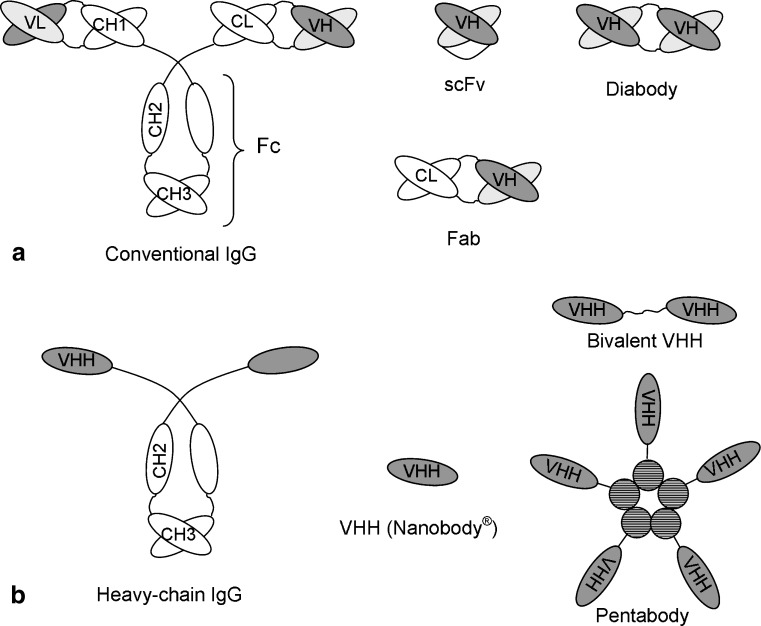
“Such molecules (diabodies, Fig. 1a) can be produced using conventional recombinant antibodies using linkers between the VH and VL domains of a specific length, although this often results in aggregation and reduced affinity because of mispairing of VH and VL domains ( Glockshuber et al. 1990; Whitlow et al. 1993).”
Backgroundvan der Linden, R. H. J., Frenken, L. G. J., de Geus, B., Harmsen, M. M., Ruuls, R. C., Stok, W., de Ron, L., Wilson, S., Davis, P., & Verrips, C. T. (1999) · Biochimica et Biophysica Acta (BBA) - Protein Structure and Molecular Enzymology · doi:10.1016/s0167-4838(99)00030-8 · Cited by 471 · cited 3×
“Contrary to conventional antibodies, VHHs have been shown to remain functional at 90°C (Van der Linden et al. 1999) or after incubation at high temperatures (Van der Linden et al. 1999; Perez et al. 2001).”
BackgroundSelf-citationAdvances in the production of human therapeutic proteins in yeasts and filamentous fungi
Gerngross, T. U. (2004) · Nature Biotechnology · doi:10.1038/nbt1028 · Cited by 409
Development trends for monoclonal antibody cancer therapeutics
Reichert, J. M., & Valge-Archer, V. (2007) · Nature Reviews Drug Discovery · doi:10.1038/nrd2241 · Cited by 399 · cited 3×
“They contain an N-linked oligosaccharide attached to the second heavy-chain constant domain (CH2) that is essential for antibody effector functions such as antibody-dependent cellular cytotoxicity (ADCC), complement-dependent cytolysis (CDC), and for retaining a long serum half-life.”
BackgroundInfluentialEfficient Cancer Therapy with a Nanobody-Based Conjugate
Cortez‐Retamozo, V., Backmann, N., Senter, P. D., Wernery, U., BAETSELIER, P. D., Muyldermans, S., & Revets, H. (2004) · Cancer Research · doi:10.1158/0008-5472.can-03-3935 · Cited by 383 · cited 3×
“…FMD virus VP1 Monovalent PEG Harmsen et al. 2007 Sepsis N. meningitidis LPS Monovalent None El Khattabi et al. 2006 Cancer – CEA Monovalent β-Lactamase Cortez-Retamozo et al. 2004 Cancer – EGF receptor Bivalent Anti-albumin VHH Roovers et al. 2007 Rheumatoid arthritis – TNFα Bivalent…”
Backgroundβ-Lactamase Inhibitors Derived from Single-Domain Antibody Fragments Elicited in the Camelidae
Conrath, K., Lauwereys, M., Galleni, M., Matagne, A., Frère, J., Kinne, J., Wyns, L., & Muyldermans, S. (2001) · Antimicrobial Agents and Chemotherapy · doi:10.1128/aac.45.10.2807-2812.2001 · Cited by 348 · cited 3×
“However, antigen binding by the C-terminal VHH in such fusions can be compromised (Conrath et al. 2001b) presumably because of steric hindrance by the N-terminal VHH.”
BackgroundEfficient inhibition of EGFR signalling and of tumour growth by antagonistic anti-EGFR Nanobodies
Roovers, R. C., Laeremans, T., Huang, L., Taeye, S. D., Verkleij, A. J., Revets, H., de Haard, H., & Henegouwen, P. M. P. V. B. E. (2006) · Cancer Immunology Immunotherapy · doi:10.1007/s00262-006-0180-4 · Cited by 348 · cited 7×
“Therefore, VHHs have been targeted to normally long-lived serum proteins such as albumin (Coppieters et al. 2006; Roovers et al. 2007) or immunoglobulin (Harmsen et al. 2005a) using bispecific VHHs recognizing these serum proteins in addition to the therapeutic target, resulting in half-lives that…”
BackgroundInfluentialComparison of llama VH sequences from conventional and heavy chain antibodies
Bang, V. K., Ghahroudi, M. A., Wyns, L., & Muyldermans, S. (1997) · Molecular Immunology · doi:10.1016/s0161-5890(97)00146-6 · Cited by 344 · cited 3×
“Sequence analysis (Hamers-Casterman et al. 1993; Muyldermans et al. 1994; Vu et al. 1997; Harmsen et al. 2000) and elucidation of the crystal structure (Desmyter et al.”
BackgroundPotent neutralization of botulinum neurotoxin by recombinant oligoclonal antibody
Nowakowski, A., Wang, C., Powers, D. B., Amersdorfer, P., Smith, T. J., Montgomery, V. A., Sheridan, R., Blake, R., Smith, L. A., & Marks, J. D. (2002) · Proceedings of the National Academy of Sciences · doi:10.1073/pnas.172229899 · Cited by 331 · cited 1×
“The use of mixtures of a limited number of monoclonal antibodies (oligoclonal antibodies) is advantageous over single monoclonal antibodies for particular applications, such as toxin neutralization (Nowakowski et al. 2002).”
BackgroundMuyldermans, S., Cambillau, C., & Wyns, L. (2001) · Trends in Biochemical Sciences · doi:10.1016/s0968-0004(01)01790-x · Cited by 322 · cited 2×
“As compared to human VH domains, the VHH FRs show a high sequence homology of more than 80%, and their 3D structures can be superimposed (Muyldermans et al. 2001; Holliger and Hudson 2005).”
BackgroundAn improved linker for single-chain Fv with reduced aggregation and enhanced proteolytic stability
Whitlow, M., Bell, B. A., Feng, S.-L. Y., Filpula, D. R., Hardman, K. D., Hubert, S. L., Rollence, M. L., Wood, J. F., Schott, M. E., Milenic, D. E., et al. (1993) · Protein Engineering Design and Selection · doi:10.1093/protein/6.8.989 · Cited by 318 · cited 1×
“1a) can be produced using conventional recombinant antibodies using linkers between the VH and VL domains of a specific length, although this often results in aggregation and reduced affinity because of mispairing of VH and VL domains (Glockshuber et al. 1990; Whitlow et al. 1993).”
BackgroundCoppieters, K. T., Dreier, T., Silence, K., de Haard, H., Lauwereys, M., Casteels, P., Beirnaert, E., Jonckheere, H., de Wiele, C. V., Staelens, L., et al. (2006) · Arthritis & Rheumatism · doi:10.1002/art.21827 · Cited by 303
Conrath, K., Lauwereys, M., Wyns, L., & Muyldermans, S. (2001) · Journal of Biological Chemistry · doi:10.1074/jbc.m007734200 · Cited by 301 · cited 3×
“However, antigen binding by the C-terminal VHH in such fusions can be compromised (Conrath et al. 2001b) presumably because of steric hindrance by the N-terminal VHH.”
BackgroundNguyen, V. K., HAMERS, R., Wyns, L., & Muyldermans, S. (2000) · The EMBO Journal · doi:10.1093/emboj/19.5.921 · Cited by 301 · cited 1×
“Firstly, the N-terminal part of CDR1 is more variable (Vu et al. 1997; Harmsen et al. 2000; Nguyen et al. 2000).”
BackgroundFrenken, L. G. J., van der Linden, R. H. J., Hermans, P., Bos, J. W., Ruuls, R. C., de Geus, B., & Verrips, C. T. (2000) · Journal of Biotechnology · doi:10.1016/s0168-1656(99)00228-x · Cited by 287 · cited 6×
“As a result, high-affinity antigenbinding VHHs can be isolated by directly screening a limited number of clones from immune libraries without prior selection using display technologies (Frenken et al. 2000; Harmsen et al. 2005b).”
BackgroundInfluentialEfficient Targeting of Conserved Cryptic Epitopes of Infectious Agents by Single Domain Antibodies
Stijlemans, B., Conrath, K., Cortez‐Retamozo, V., Xong, H. V., Wyns, L., Senter, P. D., Revets, H., BAETSELIER, P. D., Muyldermans, S., & Magez, S. (2004) · Journal of Biological Chemistry · doi:10.1074/jbc.m307341200 · Cited by 277 · cited 2×
“VHHs can also recognize antigenic sites that are normally not recognized by conventional antibodies such as enzyme active sites (Lauwereys et al. 1998; De Genst et al. 2006) and conserved cryptic epitopes ( Stijlemans et al. 2004 ).”
BackgroundAggregation-resistant domain antibodies selected on phage by heat denaturation
Jespers, L. S., Schön, O., Famm, K., & Winter, G. P. (2004) · Nature Biotechnology · doi:10.1038/nbt1000 · Cited by 266 · cited 2×
“For further reading on these topics, we refer to recently published reviews (Muyldermans 2001; Dufner et al. 2006).”
BackgroundMethodMuruganandam, A., Tanha, J., Narang, S. A., & Stanimirovic, D. B. (2001) · The FASEB Journal · doi:10.1096/fj.01-0343fje · Cited by 261 · cited 2×
“For their use in targeting drugs across the blood–brain barrier (BBB) into the brain, VHHs were selected that transmigrate the human BBB in an in vitro model and accumulate in the brain after intravenous injection into mice (Muruganandam et al. 2002).”
BackgroundEfficient tumor targeting by single‐domain antibody fragments of camels
Cortez‐Retamozo, V., Lauwereys, M., Gh., G. H., Gobert, M., Conrath, K., Muyldermans, S., BAETSELIER, P. D., & Revets, H. (2002) · International Journal of Cancer · doi:10.1002/ijc.10212 · Cited by 260 · cited 2×
“Until now, multiple injections of VHHs have not shown any immunogenicity in mice, as assessed by the presence of specific antibodies, T cell proliferation, or cytokine levels (Cortez-Retamozo et al. 2002; Coppieters et al. 2006).”
BackgroundMolecular recognition in antibody-antigen complexes
Sundberg, E. J., & Mariuzza, R. A. (2002) · Advances in protein chemistry · doi:10.1016/s0065-3233(02)61004-6 · Cited by 255 · cited 6×
“However, the paired N-terminal variable domains of heavy (VH) and light (VL) chains are sufficient for antigen binding (Sundberg and Mariuzza 2002).”
BackgroundInfluentialNanobodies as novel agents for cancer therapy
Revets, H., BAETSELIER, P. D., & Muyldermans, S. (2005) · Expert Opinion on Biological Therapy · doi:10.1517/14712598.5.1.111 · Cited by 254 · cited 2×
“Similar to conventional VH domains, VHHs contain four framework regions (FRs) that form the core structure of the immunoglobulin domain and three complementarity-determining regions (CDRs) that are involved in antigen binding.”
BackgroundEngineering of therapeutic antibodies to minimize immunogenicity and optimize function
Presta, L. G. (2006) · Advanced Drug Delivery Reviews · doi:10.1016/j.addr.2006.01.026 · Cited by 253 · cited 2×
“If necessary, technologies developed to decrease immunogenicity of mouse monoclonal antibodies (Presta 2006) could also be applied to VHHs.”
BackgroundChallenges in therapeutic glycoprotein production
Sethuraman, N., & Stadheim, T. A. (2006) · Current Opinion in Biotechnology · doi:10.1016/j.copbio.2006.06.010 · Cited by 252 · cited 2×
“Furthermore, it could complicate their therapeutic use because the addition of yeast-specific high-mannose oligosaccharides results in a high immunogenicity and decreased serum half-life because of binding to specific mannose receptors on cells of the reticulo-endothelial system (Sethuraman and Stadheim 2006).”
BackgroundNieba, L., Honegger, A., Krebber, C., & Plückthun, A. (1997) · Protein Engineering Design and Selection · doi:10.1093/protein/10.4.435 · Cited by 248 · cited 2×
“Fourth, replacement of hydrophobic residues of conventional VH domains normally interacting with CH1 increased scFv production in E. coli (Nieba et al. 1997), suggesting that the hydrophilic mutations that naturally occur at these positions in VHHs also contributes to their high expression level.”
BackgroundMethodA camelid antibody fragment inhibits the formation of amyloid fibrils by human lysozyme
Dumoulin, M., Last, A. M., Desmyter, A., Decanniere, K., Canet, D., Larsson, G., Spencer, A. G., Archer, D. B., Sasse, J., Muyldermans, S., et al. (2003) · Nature · doi:10.1038/nature01870 · Cited by 243 · cited 2×
“VHHs are especially suited for oral immunotherapy because of their resistance against extremes of pH and the capacity to bind to the target at high concentrations of chaotropic agents (Dumoulin et al. 2002, 2003).”
BackgroundHarmsen, M. M., Ruuls, R. C., Nijman, I. J., Niewold, T., Frenken, L. G. J., & de Geus, B. (2000) · Molecular Immunology · doi:10.1016/s0161-5890(00)00081-x · Cited by 218 · cited 5×
“Sequence analysis (Hamers-Casterman et al. 1993; Muyldermans et al. 1994; Vu et al. 1997; Harmsen et al. 2000) and elucidation of the crystal structure (Desmyter et al. 1996, 2001; Spinelli et al. 1996) has revealed several structural features of VHH domains.”
BackgroundInfluentialSelf-citationThermal Unfolding of a Llama Antibody Fragment: A Two-State Reversible Process
Pérez, J. M. J., Renisio, J., Prompers, J. J., van Platerink, C. J., Cambillau, C., Darbon, H., & Frenken, L. G. J. (2000) · Biochemistry · doi:10.1021/bi0009082 · Cited by 200 · cited 3×
“Contrary to conventional antibodies, VHHs have been shown to remain functional at 90°C (Van der Linden et al. 1999) or after incubation at high temperatures (Van der Linden et al. 1999; Perez et al. 2001).”
BackgroundProkaryotic expression of antibodies
Arbabi‐Ghahroudi, M., Tanha, J., & MacKenzie, R. (2005) · Cancer and Metastasis Reviews · doi:10.1007/s10555-005-6193-1 · Cited by 191 · cited 2×
“However, antibody fragments that lack the Fc with its N-linked oligosaccharide are preferably produced in microbial systems (Arbabi-Ghahroudi et al. 2005).”
BackgroundBiophysical Properties of Camelid VHH Domains Compared to Those of Human VH3 Domains
Ewert, S., Cambillau, C., Conrath, K., & Plückthun, A. (2002) · Biochemistry · doi:10.1021/bi011239a · Cited by 184 · cited 2×
“This high apparent stability is mainly attributed to their efficient refolding after chemical or thermal denaturation and to a lesser extent because of an increased resistance against denaturation (Perez et al. 2001; Dumoulin et al. 2002; Ewert et al. 2002).”
BackgroundGoldman, E. R., Anderson, G. P., Liu, J. L., Delehanty, J. B., Sherwood, L. J., Osborn, L. E., Cummins, L. B., & Hayhurst, A. (2006) · Analytical Chemistry · doi:10.1021/ac0610053 · Cited by 183 · cited 2×
“Methods to isolate antigen-specific VHHs from immune (ArbabiGhahroudi et al. 1997; Van der Linden et al. 2000a), nonimmune (Tanha et al. 2002; Yau et al. 2003; Verheesen et al. 2006), or semisynthetic (Goldman et al. 2006) libraries using phage, yeast, or ribosome display are now well established.”
BackgroundZhang, J., Tanha, J., Hirama, T., Khieu, N. H., To, R., Tong-Sevinc, H., Stone, E., Brisson, J., & MacKenzie, C. R. (2003) · Journal of Molecular Biology · doi:10.1016/j.jmb.2003.09.034 · Cited by 171 · cited 2×
“The avidity of VHHs has also been strongly increased using genetic fusions to the B-subunits of an E. coli toxin that selfassembles into a homopentamer (Zhang et al. 2004), resulting in pentameric recombinant antibodies (“pentabodies,” Fig.”
BackgroundDesmyter, A., Decanniere, K., Muyldermans, S., & Wyns, L. (2001) · Journal of Biological Chemistry · doi:10.1074/jbc.m102107200 · Cited by 168 · cited 3×
“Sequence analysis (Hamers-Casterman et al. 1993; Muyldermans et al. 1994; Vu et al. 1997; Harmsen et al. 2000) and elucidation of the crystal structure (Desmyter et al. 1996, 2001; Spinelli et al. 1996) has revealed several structural features of VHH domains.”
BackgroundExperimental therapy of African trypanosomiasis with a nanobody-conjugated human trypanolytic factor
Baral, T. N., Magez, S., Stijlemans, B., Conrath, K., Vanhollebeke, B., Pays, É., Muyldermans, S., & BAETSELIER, P. D. (2006) · Nature Medicine · doi:10.1038/nm1395 · Cited by 166 · cited 3×
“For example, sleeping sickness was successfully treated with VHHs that bind to a trypanosome coat protein and were fused to the apolipoprotein L-1 enzyme, resulting in trypanosome lysis (Baral et al. 2006).”
BackgroundInfluentialCamelid Heavy-Chain Variable Domains Provide Efficient Combining Sites to Haptens
Spinelli, S., Frenken, L. G. J., Hermans, P., Verrips, T. C., Brown, K., Tegoni, M., & Cambillau, C. (2000) · Biochemistry · doi:10.1021/bi991830w · Cited by 163
The Subunits of Purified Rabbit Antibody*
Utsumi, S., & Karush, F. (1964) · Biochemistry · doi:10.1021/bi00897a024 · Cited by 158 · cited 2×
“Although isolated antibody heavy (Utsumi and Karush 1964) and light chains (Yoo et al.”
BackgroundDavies, J., & Riechmann, L. (1996) · Protein Engineering Design and Selection · doi:10.1093/protein/9.6.531 · Cited by 155 · cited 1×
“…human VH fragment that contains several of the hallmark hydrophilic amino acid residues of VHHs was more stable than the original VH fragment (Davies and Riechmann 1995, 1996), whereas “decamelization” of a VHH to mimic a VH domain reduces its thermodynamic stability (Conrath et al. 2005).”
BackgroundElbow motion in the immunoglobulins involves a molecular ball-and-socket joint
Lesk, A. M., & Chothia, C. (1988) · Nature · doi:10.1038/335188a0 · Cited by 152 · cited 7×
“Fourth, replacement of hydrophobic residues of conventional VH domains normally interacting with CH1 increased scFv production in E. coli (Nieba et al. 1997), suggesting that the hydrophilic mutations that naturally occur at these positions in VHHs also contributes to their high expression level.”
BackgroundInfluentialPant, N., Hultberg, A., Zhao, Y., Svensson, L., Pan‐Hammarström, Q., Johansen, K., Pouwels, P. H., Ruggeri, F. M., Hermans, P., Frenken, L. G. J., et al. (2006) · The Journal of Infectious Diseases · doi:10.1086/508747 · Cited by 152 · cited 3×
“Thus, diarrhea could also be prevented by lactobacilli that produce rotavirus-neutralizing VHHs fused to a cell surface anchor (Pant et al. 2006).”
BackgroundInfluentialThe crystal structure of a llama heavy chain variable domain
Spinelli, S., Frenken, L. A. M., Bourgeois, D., de Ron, L., Bos, W., Verrips, T. C., Anguille, C., Cambillau, C., & TEGONI, M. (1996) · Nature Structural & Molecular Biology · doi:10.1038/nsb0996-752 · Cited by 148 · cited 2×
“Sequence analysis (Hamers-Casterman et al. 1993; Muyldermans et al. 1994; Vu et al. 1997; Harmsen et al. 2000) and elucidation of the crystal structure (Desmyter et al. 1996, 2001; Spinelli et al. 1996) has revealed several structural features of VHH domains.”
BackgroundSaerens, D., Kinne, J., Bosmans, E., Wernery, U., Muyldermans, S., & Conrath, K. (2004) · Journal of Biological Chemistry · doi:10.1074/jbc.m409292200 · Cited by 148 · cited 4×
“Occasionally, VHHs with affinity constants (KD) as low as 100 pM are isolated (Saerens et al. 2004; De Genst et al. 2006; Harmsen et al. 2006), which equals the affinity ceiling proposed for natural antibodies (Sundberg and Mariuzza 2002).”
BackgroundInfluentialStreltsov, V. A., Varghese, J. N., Carmichael, J. A., Irving, R. A., Hudson, P. J., & Nuttall, S. D. (2004) · Proceedings of the National Academy of Sciences · doi:10.1073/pnas.0403509101 · Cited by 141 · cited 2×
“This contrasts with shark single-domain antibodies that have a vestigial CDR2 that does not contribute to antigen binding (Streltsov et al. 2004).”
BackgroundAntibody VH Domains as Small Recognition Units
Davies, J., & Riechmann, L. (1995) · Nature Biotechnology · doi:10.1038/nbt0595-475 · Cited by 141 · cited 2×
“…human VH fragment that contains several of the hallmark hydrophilic amino acid residues of VHHs was more stable than the original VH fragment (Davies and Riechmann 1995, 1996), whereas “decamelization” of a VHH to mimic a VH domain reduces its thermodynamic stability (Conrath et al. 2005).”
BackgroundResultvan der Linden, R. H. J., de Geus, B., Stok, W., Bos, W., van Wassenaar, D., Verrips, T. C., & Frenken, L. A. M. (2000) · Journal of Immunological Methods · doi:10.1016/s0022-1759(00)00188-5 · Cited by 140 · cited 3×
“Methods to isolate antigen-specific VHHs from immune (ArbabiGhahroudi et al. 1997; Van der Linden et al. 2000a), nonimmune (Tanha et al. 2002; Yau et al. 2003; Verheesen et al. 2006), or semisynthetic (Goldman et al. 2006) libraries using phage, yeast, or ribosome display are now well established.”
BackgroundIsolation of Llama Antibody Fragments for Prevention of Dandruff by Phage Display in Shampoo
Dolk, E., van der Vaart, M., Hulsik, D. L., Vriend, G., de Haard, H., Spinelli, S., Cambillau, C., Frenken, L. G. J., & Verrips, T. C. (2005) · Applied and Environmental Microbiology · doi:10.1128/aem.71.1.442-450.2005 · Cited by 130 · cited 2×
“Although VHHs are highly suited for applications that require a high stability, such as use in shampoo for the prevention of dandruff (Dolk et al. 2005), as capturing reagents in immunoaffinity purification (Verheesen et al. 2003), or use in biosensors (Pleschberger et al. 2004), we would like to…”
BackgroundHarmsen, M. M., van Solt, C. B., Bemmel, A. M. V. Z.-V., Niewold, T., & van Zijderveld, F. G. (2006) · Applied Microbiology and Biotechnology · doi:10.1007/s00253-005-0300-7 · Cited by 123 · cited 5×
“However, by selection for proteolytic stability, a VHH could be isolated from the original library that was not degraded in vivo (Harmsen et al. 2006).”
BackgroundInfluentialSelf-citationTanha, J., Dubuc, G., Hirama, T., Narang, S. A., & MacKenzie, C. R. (2002) · Journal of Immunological Methods · doi:10.1016/s0022-1759(02)00027-3 · Cited by 123 · cited 8×
“Methods to isolate antigen-specific VHHs from immune (Arbabi-Ghahroudi et al. 1997; Van der Linden et al. 2000a), nonimmune ( Tanha et al. 2002; Yau et al. 2003; Verheesen et al. 2006), or semisynthetic (Goldman et al. 2006) libraries using phage, yeast, or ribosome display are now well established.”
BackgroundResultInfluentialYau, K. Y. F., Groves, M. A. T., Li, S., Sheedy, C., Lee, H., Tanha, J., MacKenzie, C. R., Jermutus, L., & Hall, J. C. (2003) · Journal of Immunological Methods · doi:10.1016/j.jim.2003.07.011 · Cited by 119 · cited 3×
“Methods to isolate antigen-specific VHHs from immune (ArbabiGhahroudi et al. 1997; Van der Linden et al. 2000a), nonimmune (Tanha et al. 2002; Yau et al. 2003; Verheesen et al. 2006), or semisynthetic (Goldman et al. 2006) libraries using phage, yeast, or ribosome display are now well established.”
BackgroundConrath, K., Vincke, C., Stijlemans, B., Schymkowitz, J. W. H., Decanniere, K., Wyns, L., Muyldermans, S., & Loris, R. (2005) · Journal of Molecular Biology · doi:10.1016/j.jmb.2005.04.050 · Cited by 117 · cited 2×
“…human VH fragment that contains several of the hallmark hydrophilic amino acid residues of VHHs was more stable than the original VH fragment (Davies and Riechmann 1995, 1996), whereas “decamelization” of a VHH to mimic a VH domain reduces its thermodynamic stability (Conrath et al. 2005).”
BackgroundVandervaart, J. P., Pant, N., Wolvers, D. A. W., Bezemer, S., Hermans, P., Bellamy, K., Sarker, S. A., VANDERLOGT, C., Svensson, L., & Verrips, C. T. (2006) · Vaccine · doi:10.1016/j.vaccine.2006.02.045 · Cited by 112 · cited 5×
“VHHs that successfully prevented diarrhea caused by rotavirus in a mouse model were similarly selected for resistance against the acidic environment of the stomach ( Van der Vaart et al. 2006 ).”
BackgroundInfluentialZwick, M. B., Parren, P. W. H. I., Saphire, E. O., Church, S., Wang, M., Scott, J. K., Dawson, P. E., Wilson, I. A., & Burton, D. R. (2003) · Journal of Virology · doi:10.1128/jvi.77.10.5863-5876.2003 · Cited by 108
Pleschberger, M., Saerens, D., Weigert, S., Sleytr, U. B., Muyldermans, S., Sára, M., & Egelseer, E. M. (2004) · Bioconjugate Chemistry · doi:10.1021/bc049964w · Cited by 105 · cited 2×
“…stability, such as use in shampoo for the prevention of dandruff (Dolk et al. 2005), as capturing reagents in immunoaffinity purification (Verheesen et al. 2003), or use in biosensors (Pleschberger et al. 2004), we would like to focus on their therapeutic applications, which are more challenging.”
BackgroundBond, C. J., Marsters, J. C., & Sidhu, S. S. (2003) · Journal of Molecular Biology · doi:10.1016/s0022-2836(03)00967-7 · Cited by 101 · cited 1×
“In addition to these specific mutations, the packing of extended CDR3 loops against this former VL interface contributes to domain stability (Bond et al. 2003).”
BackgroundGeneration of llama single-domain antibodies against methotrexate, a prototypical hapten
Alvarez-Rueda, N., Béhar, G., Ferré, V., Pugnière, M., Roquet, F., Gastinel, L. N., Jacquot, C., Aubry, J., Baty, D., Barbet, J., et al. (2006) · Molecular Immunology · doi:10.1016/j.molimm.2006.08.007 · Cited by 99 · cited 1×
“However, hapten- and peptide-binding VHHs have been successfully isolated using strong selection systems (Spinelli et al. 2000; Yau et al. 2003; Alvarez-Rueda et al. 2007; Harmsen et al. 2007).”
BackgroundIntroduction of an N-Glycosylation Site Increases Secretion of Heterologous Proteins in Yeasts
Sagt, C. M. J., Kleizen, B., Verwaal, R., de Jong, M. D. M., Müller, W. H., Smits, A., Visser, C. J., Boonstra, J., Verkleij, A. J., & Verrips, C. T. (2000) · Applied and Environmental Microbiology · doi:10.1128/aem.66.11.4940-4944.2000 · Cited by 94 · cited 2×
“First, the presence of a potential N-linked glycosylation site often increases production levels in yeast (Sagt et al. 2000).”
BackgroundOver expression of anti-MUC1 single-domain antibody fragments in the yeast Pichia pastoris
Rahbarizadeh, F., Rasaee, M. J., Forouzandeh, M., & Allameh, A. (2005) · Molecular Immunology · doi:10.1016/j.molimm.2005.03.003 · Cited by 90 · cited 2×
“VHH production by the favored yeast expression host Pichia pastoris was only recently described (Rahbarizadeh et al. 2006).”
BackgroundGeneration of heavy-chain-only antibodies in mice
Janssens, R., Dekker, S., Hendriks, R. W., Panayotou, G., van Remoortere, A., San, J. K. A., Grosveld, F. G., & Drabek, D. (2006) · Proceedings of the National Academy of Sciences · doi:10.1073/pnas.0601108103 · Cited by 88 · cited 2×
“Furthermore, transgenic mice containing hybrid llama/ human antibody loci that contain llama V regions and human D, J, and C regions have recently been used to generate human heavy-chain antibodies in mice (Janssens et al. 2006).”
Harmsen, M. M., van Solt, C. B., Fijten, H., & Setten, M. C. V. (2005) · Vaccine · doi:10.1016/j.vaccine.2005.05.017 · Cited by 85 · cited 9×
“As a result, high-affinity antigenbinding VHHs can be isolated by directly screening a limited number of clones from immune libraries without prior selection using display technologies (Frenken et al. 2000; Harmsen et al. 2005b).”
BackgroundInfluentialSelf-citationHarmsen, M. M., van Solt, C. B., Fijten, H., van Keulen, L. J. M., Rosalia, R. A., Weerdmeester, K., Cornelissen, A. H. M., de Bruin, M. G. M., Eblé, P. L., & Dekker, A. (2006) · Veterinary Microbiology · doi:10.1016/j.vetmic.2006.10.029 · Cited by 85 · cited 5×
“However, in contrast to the full protection afforded by the hyperimmune serum, these VHHs poorly protected guinea pigs from FMD viral challenge infection, suggesting that Fc-mediated effector functions are required for efficient in vivo protection (Harmsen et al. 2007).”
BackgroundInfluentialSelf-citationHarnessing phage and ribosome display for antibody optimisation
Dufner, P., Jermutus, L., & Minter, R. (2006) · Trends in biotechnology · doi:10.1016/j.tibtech.2006.09.004 · Cited by 81 · cited 3×
“2000b), as has often been done for conventional antibody fragments (Dufner et al. 2006).”
BackgroundMethodOlichon, A., Schweizer, D., Muyldermans, S., & de Marco, A. (2007) · BMC Biotechnology · doi:10.1186/1472-6750-7-7 · Cited by 81
Retargeting serum immunoglobulin with bispecific diabodies
Holliger, P., Wing, M. G., Pound, J. D., Bohlen, H., & Winter, G. P. (1997) · Nature Biotechnology · doi:10.1038/nbt0797-632 · Cited by 79 · cited 1×
“Although such effector functions can be indirectly recruited using bispecific (conventional) antibody fragments binding to host immunoglobulin (Holliger et al. 1997), it may be more efficient to recruit these functions by fusing VHHs to host Fc domains.”
BackgroundVerheesen, P., ten Haaft, M. R., Lindner, N. M., Verrips, C. T., & de Haard, J. J. W. (2003) · Biochimica et Biophysica Acta (BBA) - General Subjects · doi:10.1016/j.bbagen.2003.09.006 · Cited by 76 · cited 1×
“…a high stability, such as use in shampoo for the prevention of dandruff (Dolk et al. 2005), as capturing reagents in immunoaffinity purification (Verheesen et al. 2003), or use in biosensors (Pleschberger et al. 2004), we would like to focus on their therapeutic applications, which are more…”
BackgroundVerheesen, P., Roussis, A., de Haard, H., Groot, A. J., Stam, J. C., den Dunnen, J. T., Frants, R. R., Verkleij, A. J., Verrips, C. T., & van der Maarel, S. M. (2006) · Biochimica et Biophysica Acta (BBA) - Proteins and Proteomics · doi:10.1016/j.bbapap.2006.05.011 · Cited by 69 · cited 2×
“Methods to isolate antigen-specific VHHs from immune (ArbabiGhahroudi et al. 1997; Van der Linden et al. 2000a), nonimmune (Tanha et al. 2002; Yau et al. 2003; Verheesen et al. 2006), or semisynthetic (Goldman et al. 2006) libraries using phage, yeast, or ribosome display are now well established.”
BackgroundHarmsen, M. M., van Solt, C. B., Hoogendoorn, A., van Zijderveld, F., Niewold, T., & van der Meulen, J. (2005) · Veterinary Microbiology · doi:10.1016/j.vetmic.2005.09.005 · Cited by 62 · cited 13×
“As a result, high-affinity antigenbinding VHHs can be isolated by directly screening a limited number of clones from immune libraries without prior selection using display technologies (Frenken et al. 2000; Harmsen et al. 2005b).”
BackgroundInfluentialSelf-citationHarrison, R. A., Hasson, S. S., Harmsen, M. M., Laing, G. D., Conrath, K., & Theakston, R. D. G. (2005) · Toxicon · doi:10.1016/j.toxicon.2005.10.017 · Cited by 60 · cited 2×
“2004), in vivo diagnosis using imaging, and treatment of snake bites (Harrison et al. 2006).”
BackgroundSelf-citationAntibody phage display : methods and protocols
Aitken, R. (2002) · Cited by 58
Large-scale production of VHH antibody fragments by Saccharomyces cerevisiae
Thomassen, Y. E., Meijer, W., Sierkstra, L. N., & Verrips, C. T. (2002) · Enzyme and Microbial Technology · doi:10.1016/s0141-0229(01)00497-5 · Cited by 55 · cited 1×
“VHHs have also often been produced in the yeast Saccharomyces cerevisiae (Frenken et al. 2000; Thomassen et al. 2002; Van der Vaart 2002).”
BackgroundGueorguieva, D., Li, S., Walsh, N., Mukerji, A., Tanha, J., & Pandey, S. (2006) · The FASEB Journal · doi:10.1096/fj.06-6306fje · Cited by 53 · cited 5×
“Finally, Bax-specific VHHs have been expressed in the cytoplasm, resulting in so-called intrabodies, to prevent oxidative-stress-induced apoptosis that is implicated in several neurodegenerative diseases (Gueorguieva et al. 2006).”
BackgroundInfluentialSpecific Binding Activity of Isolated Light Chains of Antibodies
Yoo, T. J., Roholt, O. A., & Pressman, D. (1967) · Science · doi:10.1126/science.157.3789.707 · Cited by 52 · cited 2×
“Although isolated antibody heavy (Utsumi and Karush 1964) and light chains (Yoo et al. 1967) can retain antigenbinding specificity, their affinity and solubility is often reduced (Ward et al. 1989).”
BackgroundDimerisation strategies for shark IgNAR single domain antibody fragments
Simmons, D. P., Abregu, F. A., Krishnan, U. V., Proll, D. F., Streltsov, V. A., Doughty, L., Hattarki, M. K., & Nuttall, S. D. (2006) · Journal of Immunological Methods · doi:10.1016/j.jim.2006.07.019 · Cited by 52 · cited 1×
“Third, the presence of unpaired C-terminal cysteines reduces expression levels (Simmons et al. 2006).”
BackgroundImproved production and function of llama heavy chain antibody fragments by molecular evolution
van der Linden, R. H. J., de Geus, B., Frenken, L. G. J., Peters, H., & Verrips, C. T. (2000) · Journal of Biotechnology · doi:10.1016/s0168-1656(00)00274-1 · Cited by 52 · cited 3×
“Methods to isolate antigen-specific VHHs from immune (ArbabiGhahroudi et al. 1997; Van der Linden et al. 2000a), nonimmune (Tanha et al. 2002; Yau et al. 2003; Verheesen et al. 2006), or semisynthetic (Goldman et al. 2006) libraries using phage, yeast, or ribosome display are now well established.”
Backgroundvan de Laar, T., Visser, C., Holster, M., López, C. G., Kreuning, D., Sierkstra, L. N., Lindner, N. M., & Verrips, T. C. (2006) · Biotechnology and Bioengineering · doi:10.1002/bit.21150 · Cited by 40
Rahbarizadeh, F., Rasaee, M. J., Forouzandeh‐Moghadam, M., & Allameh, A. (2005) · Protein Expression and Purification · doi:10.1016/j.pep.2005.04.008 · Cited by 38 · cited 2×
“VHHs have often been produced in E. coli (ArbabiGhahroudi et al. 1997; Rahbarizadeh et al. 2005).”
BackgroundKrüger, C., Hultberg, A., Marcotte, H., Hermans, P., Bezemer, S., Frenken, L. G. J., & Hammarström, L. L. G. (2006) · Applied Microbiology and Biotechnology · doi:10.1007/s00253-006-0347-0 · Cited by 37 · cited 4×
“…Pant et al. 2006 Piglet diarrhea E. coli F4 fimbriae Monovalent None Harmsen et al. 2006 Caries S. mutans I/II adhesion Monovalent None Kruger et al. 2006 FMD FMD virus VP1 Monovalent PEG Harmsen et al. 2007 Sepsis N. meningitidis LPS Monovalent None El Khattabi et al. 2006 Cancer –…”
BackgroundInfluentialKhattabi, M. E., Adams, H., Heezius, E. C. J. M., Hermans, P., Detmers, F. J. M., Maassen, B., van der Ley, P., Tommassen, J., Verrips, T. C., & Stam, J. C. (2006) · Clinical and Vaccine Immunology · doi:10.1128/cvi.00107-06 · Cited by 35 · cited 4×
“Piglet diarrhea E. coli F4 fimbriae Monovalent None Harmsen et al. 2006 Caries S. mutans I/II adhesion Monovalent None Kruger et al. 2006 FMD FMD virus VP1 Monovalent PEG Harmsen et al. 2007 Sepsis N. meningitidis LPS Monovalent None El Khattabi et al. 2006”
BackgroundInfluentialHeavy‐chain only antibodies derived from dromedary are secreted and displayed by mouse B cells
Nguyen, V. K., Zou, X., Lauwereys, M., Brys, L., Brüggemann, M., & Muyldermans, S. (2003) · Immunology · doi:10.1046/j.1365-2567.2003.01633.x · Cited by 33 · cited 1×
“Production of such functional antibodies requires the correct glycosylation of the CH2 domain, which until recently could only be accomplished using higher eukaryotic cells (Nguyen et al. 2003) but not by microbial production.”
BackgroundThomassen, Y. E., Verkleij, A. J., Boonstra, J., & Verrips, C. T. (2005) · Journal of Biotechnology · doi:10.1016/j.jbiotec.2005.05.010 · Cited by 28 · cited 2×
“In baker’s yeast, the specific VHH production rate is correlated with growth rate (Thomassen et al. 2005) and can be up to fivefold increased by growing on ethanol as the carbon source (Van de Laar et al.”
BackgroundJoosten, V., Roelofs, M. S., van den Dries, N., Goosen, T., Verrips, C. T., van den Hondel, C. A. M. J. J., & Lokman, B. C. (2005) · Journal of Biotechnology · doi:10.1016/j.jbiotec.2005.06.034 · Cited by 25 · cited 1×
“There is only one example of VHH production in filamentous fungi, which resulted in limited proteolytic degradation of the secreted product (Joosten et al. 2005) because of the high levels of proteases secreted by filamentous fungi (Gerngross 2004).”
Background“Baculophage:” A new tool for protein display
Davies, A. H. (1995) · Nature Biotechnology · doi:10.1038/nbt1095-1046 · Cited by 24
Lange, I. G., Daxenberger, A., & MEYER, H. H. D. (2001) · Veterinary Immunology and Immunopathology · doi:10.1016/s0165-2427(01)00376-2 · Cited by 22 · cited 1×
“Indeed, llamas immunized with clenbuterol developed conventional but not heavychain antibodies against this hapten (Lange et al. 2001).”
BackgroundExpression of VHH Antibody Fragments in Saccharomyces cerevisiae
van der Vaart, J. M. (2003) · Humana Press eBooks · doi:10.1385/1-59259-240-6:359 · Cited by 18
Research works printed but not linked: 1
- Estell D (2006) Adapting industry practices for the rapid, large-scale manufacture of pharmaceutical proteins. Bridge 36:39–44
Cited by
Sorted by citations
Nanobodies: natural single-domain antibodies
Muyldermans, S. (2013) · Annual Review of Biochemistry · doi:10.1146/annurev-biochem-063011-092449 · Cited by 2,304
Single-Cell Phenotyping within Transparent Intact Tissue through Whole-Body Clearing
Yang, B., Treweek, J. B., Kulkarni, R. P., Deverman, B. E., Chen, C., Lubeck, E., Shah, S., Cai, L., & Gradinaru, V. (2014) · Cell · doi:10.1016/j.cell.2014.07.017 · Cited by 937
The therapeutic potential of nanobodies
Jovčevska, I., & Muyldermans, S. (2020) · BioDrugs · doi:10.1007/s40259-019-00392-z · Cited by 749
Overcoming the Blood–Brain Barrier: The Role of Nanomaterials in Treating Neurological Diseases
Furtado, D., Björnmalm, M., Ayton, S., Bush, A. I., Kempe, K., & Caruso, F. (2018) · Advanced Materials · doi:10.1002/adma.201801362 · Cited by 708
PEGylation of therapeutic proteins
Jevševar, S., Kunstelj, M., & Porekar, V. G. (2010) · Biotechnology Journal · doi:10.1002/biot.200900218 · Cited by 681
“An example of a successful application of PEGylation to nanobodies is the PEGylated nanobody neutralizing foot and mouth disease (FMD) virus [15].”
Background
Metadata
- Authors
- Harmsen, M. M., & De Haard, H. J.
- Affiliations
- Wageningen University & Research (NL)
- Ablynx (Belgium) (BE)
- Corresponding author
- Harmsen, M. M.
- Venue
- Applied Microbiology and Biotechnology
- Published
- 2007-08-18
- Volume
- 77
- Issue
- 1
- Pages
- 13-22
- ISSN
- 0175-7598 (ISSN-L)
- 1432-0614
- PMC
- PMC2039825
- OpenAlex
- W2147451568
- Cited by
- 809
- References
- 96
- Citations by year
- 2026: 31 · 2025: 43 · 2024: 48 · 2023: 41 · 2022: 41 · 2021: 65 · 2020: 57 · 2019: 49 · 2018: 53 · 2017: 42 · 2016: 46 · 2015: 48 · 2014: 53 · 2013: 40 · 2012: 52
- FWCI
- 2.67
- Type
- journal article
- Language
- en
- Open access
- hybrid
- doi.org
- Locations
- Applied Microbiology and Biotechnology (publishedVersion, cc-by)
- PubMed Central (publishedVersion, cc-by)
- PubMed (publishedVersion)
- Socio-Environmental Systems Modeling (acceptedVersion)
- Data Archiving and Networked Services (DANS) (submittedVersion, other-oa)
- Topics
- Life Sciences › Immunology and Microbiology › Immunology › Monoclonal and Polyclonal Antibodies Research
- Life Sciences › Biochemistry, Genetics and Molecular Biology › Molecular Biology › Protein purification and stability
- Life Sciences › Agricultural and Biological Sciences › Food Science › Animal Diversity and Health Studies
- Keywords
- single-domain antibody fragments, VHH, nanobodies, camelid antibodies, recombinant antibody production, yeast expression system, phage display, ribosome display, yeast surface display, therapeutic applications
- MeSH terms
- Animals, Camelids, New World, Immunoglobulin Fragments, Immunoglobulin Heavy Chains, Models, Biological
About these checks
Registry, retraction, Cites and statistics results are computed, not judged, with one exception: a printed reference that no index lists is read once by a model before it counts as a citation error. Claims are extracted by a model and kept only when their quote appears verbatim in the text; each cited source is then checked, with a model’s help, for whether it says what the claim relies on. Those verdicts can be wrong — read the claim’s quote and the cited source before relying on one.
Statistics and arithmetic are recomputed, not judged.
Confidence bands are shown only for fields calibrated on our annotated test set. None is calibrated yet, so no band is shown.
What counts as a claim ›How we measure confidence ›How we check this ›
Are you an author, or do you see a problem with this page? Request a review
