

Mdivi-1 and mitochondrial fission: recent insights from fungal pathogens
Open accessThe DOI matches its Crossref record; 71 of the 71 references it cites were found in a registry or an index.
Abstract
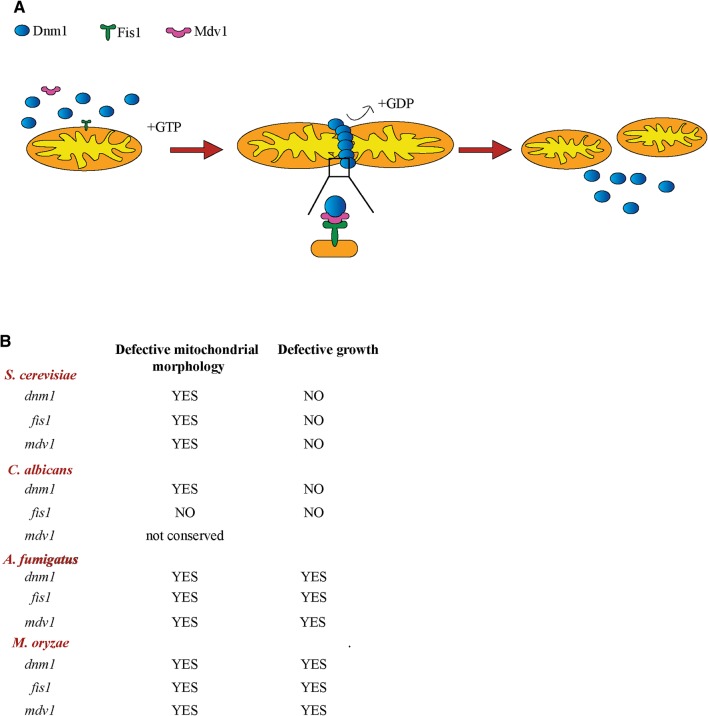
Mitochondrial fission shows potential as a therapeutic target in non-infectious human diseases. The compound mdivi-1 was identified as a mitochondrial fission inhibitor that acts against the evolutionarily conserved mitochondrial fission GTPase Dnm1/Drp1, and shows promising data in pre-clinical models of human pathologies. Two recent studies, however, found no evidence that mdivi-1 acts as a mitochondrial fission inhibitor and proposed other mechanisms. In mammalian cells, Bordt et al. showed that mdivi-1 inhibits complex I in mitochondria (Dev Cell 40:583, 2017). In a second study, we have recently demonstrated that mdivi-1 does not trigger a mitochondrial morphology change in the human yeast pathogen Candida albicans, but impacts on endogenous nitric oxide (NO) levels and inhibits the key virulence property of hyphal formation (Koch et al., Cell Rep 25:2244, 2018). Here we discuss recent insights into mdivi-1's action in pathogenic fungi and the potential and challenges for repurposing it as an anti-infective. We also outline recent findings on the roles of mitochondrial fission in human and plant fungal pathogens, with the goal of starting the conversation on whether the research field of fungal pathogenesis can benefit from efforts in other disease areas aimed at developing therapeutic inhibitors of mitochondrial division.
Overview
The claims and statistics of this paper haven’t been checked yet.
Free: it reads the open-access text and checks the first 5 claims that cite a source we can check. Create a free account to check every claim.
Integrity signals
Registry
Cites
Statistics
Figures
Verification
Claims the paper makes
The claims and statistics of this paper haven’t been checked yet.
Free: it reads the open-access text and checks the first 5 claims that cite a source we can check. Create a free account to check every claim.
Claims other papers make about this one
Each is checked against this paper’s own text: does it say what the citing paper says it does?
The cited source says what the claim attributes to it.
In the citing paper
“The putative mitochondrial fission inhibitor mdivi-1, which has been shown to inhibit mammalian Complex I as a secondary target, prevents hyphal growth in C. albicans (Koch and Traven 2019).”
From The potential of respiration inhibition as a new approach to combat human fungal pathogens (2019) · cites this paper as Koch and Traven 2019
Self-check
Percentages, sums and reported differences re-computed from the paper’s own numbers.
The self-check needs the paper’s full text.
Citations
Cites
Hidden Killers: Human Fungal Infections
Brown, G. D., Denning, D. W., Gow, N. A. R., Levitz, S. M., Netea, M. G., & White, T. C. (2012) · Science Translational Medicine · doi:10.1126/scitranslmed.3004404 · Cited by 4,284
Mitochondria: In Sickness and in Health
Nunnari, J., & Suomalainen, A. (2012) · Cell · doi:10.1016/j.cell.2012.02.035 · Cited by 3,479
Mitochondrial form and function
Friedman, J. R., & Nunnari, J. (2014) · Nature · doi:10.1038/nature12985 · Cited by 1,803
The Role of Dynamin-Related Protein 1, a Mediator of Mitochondrial Fission, in Apoptosis
Frank, S., Gaume, B., Bergmann-Leitner, E. S., Leitner, W. W., Robert, E. G., Catez, F., Smith, C. L., & Youle, R. J. (2001) · Developmental Cell · doi:10.1016/s1534-5807(01)00055-7 · Cited by 1,755
During autophagy mitochondria elongate, are spared from degradation and sustain cell viability
Gomes, L. C., Benedetto, G. D., & Scorrano, L. (2011) · Nature Cell Biology · doi:10.1038/ncb2220 · Cited by 1,735
Mitochondrial Dynamics Controls T Cell Fate through Metabolic Programming
Buck, M. D., O’Sullivan, D., Klein Geltink, R. I., Curtis, J. D., Chang, C.-H., Sanin, D. E., Qiu, J., Kretz, O., Braas, D., van der Windt, G. J. W., et al. (2016) · Cell · doi:10.1016/j.cell.2016.05.035 · Cited by 1,443
Cassidy-Stone, A., Chipuk, J. E., Ingerman, E., Song, C., Yoo, C., Kuwana, T., Kurth, M. J., Shaw, J. T., Hinshaw, J. E., Green, D. R., et al. (2008) · Developmental Cell · doi:10.1016/j.devcel.2007.11.019 · Cited by 1,200
Rambold, A. S., Kostelecky, B., Elia, N., & Lippincott-Schwartz, J. (2011) · Proceedings of the National Academy of Sciences · doi:10.1073/pnas.1107402108 · Cited by 1,156
Growth of Candida albicans hyphae
Sudbery, P. E. (2011) · Nature Reviews Microbiology · doi:10.1038/nrmicro2636 · Cited by 1,110 · cited 1×
“This process of morphology change is linked to pathogenicity (Sudbery 2011).”
BackgroundInhibiting Mitochondrial Fission Protects the Heart Against Ischemia/Reperfusion Injury
Ong, S.-B., Subrayan, S., Lim, S. Y., Yellon, D. M., Davidson, S. M., & Hausenloy, D. J. (2010) · Circulation · doi:10.1161/circulationaha.109.906610 · Cited by 986
Cited by
Mitochondrial division inhibitor (mdivi-1) decreases oxidative metabolism in cancer
Dai, W., Wang, G., Chwa, J. S., Oh, M. E., Abeywardana, T., Yang, Y., Wang, Q. A., & Jiang, L. (2020) · British Journal of Cancer · doi:10.1038/s41416-020-0778-x · Cited by 113
Batista, A. F., Rody, T., Forny-Germano, L., Cerdeiro, S., Bellio, M., Ferreira, S. T., Munoz, D. P., & De Felice, F. G. (2021) · Journal of Neuroinflammation · doi:10.1186/s12974-021-02099-x · Cited by 91
Mitochondrial Mechanisms of Apoptosis and Necroptosis in Liver Diseases
Chu, Q., Gu, X., Zheng, Q., Wang, J., & Zhu, H. (2021) · Analytical Cellular Pathology · doi:10.1155/2021/8900122 · Cited by 70
Chen, Z., Ma, Y., Yang, Q., Hu, J., Feng, J., Liang, W., & Ding, G. (2019) · Journal of Cellular Physiology · doi:10.1002/jcp.29646 · Cited by 68
Jian, Y., Yang, Y., Cheng, L., Yang, X., Liu, H., Li, W., Wan, Y., & Yang, D. (2022) · Cell Proliferation · doi:10.1111/cpr.13362 · Cited by 64
Metadata
- Authors
- Koch, B., & Traven, A.
- Affiliations
- Callaghan Innovation (NZ)
- Monash University (AU)
- Corresponding author
- Traven, Ana
- ORCID
- Traven, Ana
- Venue
- Current Genetics
- Published
- 2019-02-19
- Volume
- 65
- Issue
- 4
- Pages
- 837-845
- ISSN
- 0172-8083 (ISSN-L)
- 1432-0983
- PMC
- PMC6620241
- OpenAlex
- W2917284256
- Cited by
- 26
- References
- 71
- Citations by year
- 2026: 1 · 2025: 6 · 2024: 3 · 2023: 6 · 2022: 2 · 2021: 4 · 2020: 2 · 2019: 2
- FWCI
- 0.22
- Type
- journal article
- Language
- en
- Open access
- hybrid
- doi.org
- Licence
- cc-by
- creativecommons.org/licenses/by/4.0 (tdm)
- Locations
- Current Genetics (publishedVersion, cc-by)
- Europe PMC (PubMed Central) (publishedVersion, cc-by)
- PubMed Central (publishedVersion, cc-by)
- PubMed (publishedVersion)
- Monash University Research Portal (Monash University) (acceptedVersion, other-oa)
- Funders
- National Health and Medical Research Council of Australia (APP1101562)
- Austrian Science Fund (J-3743)
- Topics
- Life Sciences › Biochemistry, Genetics and Molecular Biology › Molecular Biology › Mitochondrial Function and Pathology
- Life Sciences › Biochemistry, Genetics and Molecular Biology › Molecular Biology › Fungal and yeast genetics research
- Health Sciences › Medicine › Infectious Diseases › Antifungal resistance and susceptibility
- Keywords
- Mdivi-1, mitochondrial fission, Candida albicans, fungal pathogens, drug repurposing, nitric oxide, hyphal development, mitochondrial complex I inhibition, plant pathogenic fungi
- MeSH terms
- Fungi, Humans, Mitochondria, Nitric Oxide, Apoptosis, GTP Phosphohydrolases, Hyphae, Electron Transport Complex I, Quinazolinones, Mitochondrial Dynamics
About these checks
Registry, retraction, Cites and statistics results are computed, not judged, with one exception: a printed reference that no index lists is read once by a model before it counts as a citation error. Claims are extracted by a model and kept only when their quote appears verbatim in the text; each cited source is then checked, with a model’s help, for whether it says what the claim relies on. Those verdicts can be wrong — read the claim’s quote and the cited source before relying on one.
Statistics and arithmetic are recomputed, not judged.
Confidence bands are shown only for fields calibrated on our annotated test set. None is calibrated yet, so no band is shown.
What counts as a claim ›How we measure confidence ›How we check this ›
Are you an author, or do you see a problem with this page? Request a review
How to cite
Cite CoChat for the checks on this page, and the paper for its own findings.
- This page
- CoChat. (2026). Citation check: Mdivi-1 and mitochondrial fission: recent insights from fungal pathogens. https://app.cochat.ai/papers/10.1007/s00294-019-00942-6
- The paper
- Koch, B., & Traven, A. (2019). Mdivi-1 and mitochondrial fission: recent insights from fungal pathogens. Current Genetics. https://doi.org/10.1007/s00294-019-00942-6
Data sources
Bibliographic data: Semantic Scholar, OpenAlex, Crossref.
Contains information from the Semantic Scholar Academic Graph Datasets, made available under the ODC Attribution License (ODC-BY 1.0).
Semantic Scholar’s data is described in: Kinney, R., et al. (2023). The Semantic Scholar Open Data Platform. arXiv:2301.10140.
