

The DOI matches its Crossref record; 19 of the 19 references it cites were found in a registry or an index.
Can incorrect artificial intelligence (AI) results impact radiologists, and if so, what can we do about it? A multi-reader pilot study of lung cancer detection with chest radiography
Open accessAbstract
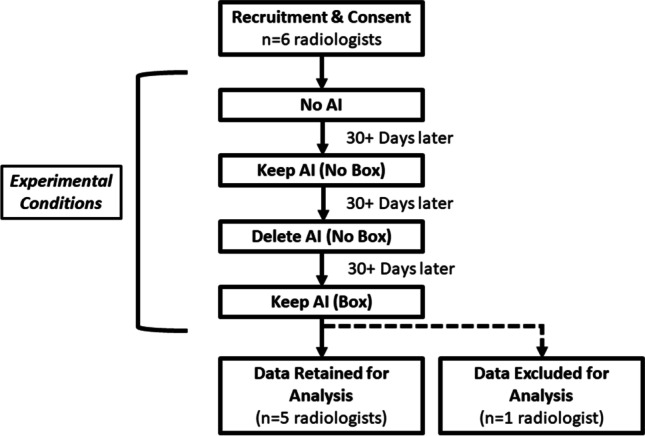
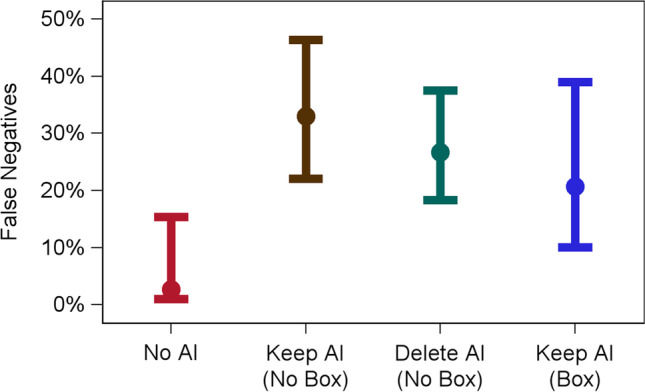
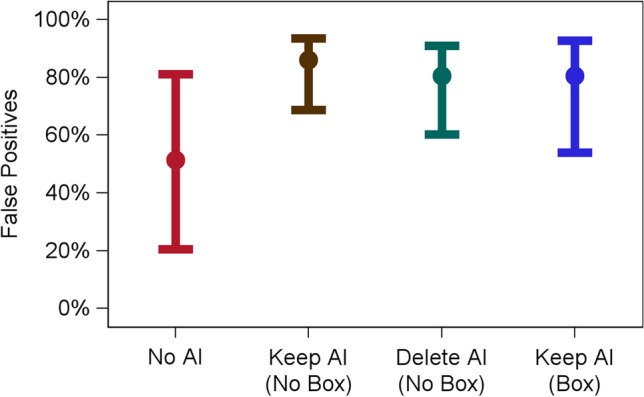
Objective: To examine whether incorrect AI results impact radiologist performance, and if so, whether human factors can be optimized to reduce error. Methods: Multi-reader design, 6 radiologists interpreted 90 identical chest radiographs (follow-up CT needed: yes/no) on four occasions (09/20–01/22). No AI result was provided for session 1. Sham AI results were provided for sessions 2–4, and AI for 12 cases were manipulated to be incorrect (8 false positives (FP), 4 false negatives (FN)) (0.87 ROC-AUC). In the Delete AI (No Box) condition, radiologists were told AI results would not be saved for the evaluation. In Keep AI (No Box) and Keep AI (Box), radiologists were told results would be saved. In Keep AI (Box), the ostensible AI program visually outlined the region of suspicion. AI results were constant between conditions. Results: Relative to the No AI condition (FN = 2.7%, FP = 51.4%), FN and FPs were higher in the Keep AI (No Box) (FN = 33.0%, FP = 86.0%), Delete AI (No Box) (FN = 26.7%, FP = 80.5%), and Keep AI (Box) (FN = to 20.7%, FP = 80.5%) conditions (all p s < 0.05). FNs were higher in the Keep AI (No Box) condition (33.0%) than in the Keep AI (Box) condition (20.7%) (p = 0.04). FPs were higher in the Keep AI (No Box) (86.0%) condition than in the Delete AI (No Box) condition (80.5%) (p = 0.03). Conclusion: Incorrect AI causes radiologists to make incorrect follow-up decisions when they were correct without AI. This effect is mitigated when radiologists believe AI will be deleted from the patient’s file or a box is provided around the region of interest. Clinical relevance statement: When AI is wrong, radiologists make more errors than they would have without AI. Based on human factors psychology, our manuscript provides evidence for two AI implementation strategies that reduce the deleterious effects of incorrect AI. Key Points: • When AI provided incorrect results, false negative and false positive rates among the radiologists increased. • False positives decreased when AI results were deleted, versus kept, in the patient’s record. • False negatives and false positives decreased when AI visually outlined the region of suspicion.
Overview
The claims and statistics of this paper haven’t been checked yet.
Run the check — free, no account needed. It reads the open-access text and checks the sources it cites.
Integrity signals
Registry
Cites
Statistics
Figures

Verification
Claims the paper makes
The claims and statistics of this paper haven’t been checked yet.
Run the check — free, no account needed. It reads the open-access text and checks the sources it cites.
Claims other papers make about this one
Each is checked against this paper’s own text: does it say what the citing paper says it does?
The check wasn’t confident either way, so it gives no verdict — never disputed.
In the citing paper
“Such references can be removed to reduce hallucinations when prior studies are not available, 9,14,18 or used in conjunction with prior images to enable descriptions of change.17,19,20”
From MAIRA-2: Grounded Radiology Report Generation (2024) · cites this paper as [18]
Experimental — accuracy not yet measuredThe check wasn’t confident either way, so it gives no verdict — never disputed.
In the citing paper
“This bidirectional approach differs from traditional factual verification approaches such as FActScore that assume a 'single' source of truth (e.g., Wikipedia), but has precedents in medical summarisation where both completeness and conciseness are important.45”
From MAIRA-2: Grounded Radiology Report Generation (2024) · cites this paper as [45]
Experimental — accuracy not yet measured
Self-check
Percentages, sums and reported differences re-computed from the paper’s own numbers.
The self-check needs the paper’s full text.
Citations
Cites
The practical implementation of artificial intelligence technologies in medicine
He, J., Baxter, S. L., Xu, J., Xu, J., Zhou, X., & Zhang, K. (2019) · Nature Medicine · doi:10.1038/s41591-018-0307-0 · Cited by 2,246
Diagnostic accuracy of deep learning in medical imaging: a systematic review and meta-analysis
Aggarwal, R., Sounderajah, V., Martin, G., Ting, D. S. W., Karthikesalingam, A., King, D., Ashrafian, H., & Darzi, A. (2021) · npj Digital Medicine · doi:10.1038/s41746-021-00438-z · Cited by 946
Detection of Breast Cancer with Mammography: Effect of an Artificial Intelligence Support System
Rodríguez-Ruiz, A., Krupinski, E., Mordang, J.-J., Schilling, K., Heywang-Köbrunner, S. H., Sechopoulos, I., & Mann, R. M. (2019) · Radiology · doi:10.1148/radiol.2018181371 · Cited by 602
Strohm, L., Hehakaya, C., Ranschaert, E. R., Boon, W. P. C., & Moors, E. H. M. (2020) · European Radiology · doi:10.1007/s00330-020-06946-y · Cited by 329
Seah, J. C. Y., Tang, C. H. M., Buchlak, Q. D., Holt, X., Wardman, J. B., Aimoldin, A., Esmaili, N., Ahmad, H. K., Pham, H. N., Lambert, J. F., et al. (2021) · The Lancet Digital Health · doi:10.1016/s2589-7500(21)00106-0 · Cited by 245
Egglin, T. K. (1996) · JAMA · doi:10.1001/jama.1996.03540210060035 · Cited by 192
2020 ACR Data Science Institute Artificial Intelligence Survey
Allen, B., Agarwal, S., Coombs, L. P., Wald, C., & Dreyer, K. J. (2021) · Journal of the American College of Radiology · doi:10.1016/j.jacr.2021.04.002 · Cited by 154
Self-citationA Systematic Review of Fatigue in Radiology: Is It a Problem?
Stec, N., Arje, D., Moody, A. R., Krupinski, E. A., & Tyrrell, P. N. (2018) · American Journal of Roentgenology · doi:10.2214/ajr.17.18613 · Cited by 133
Effects of incorrect computer-aided detection (CAD) output on human decision-making in mammography
Alberdi, E., Povyakalo, A., Strigini, L., & Ayton, P. (2004) · Academic Radiology · doi:10.1016/j.acra.2004.05.012 · Cited by 124
Homayounieh, F., Digumarthy, S., Ebrahimian, S., Rueckel, J., Hoppe, B. F., Sabel, B. O., Conjeti, S., Ridder, K., Sistermanns, M., Wang, L., et al. (2021) · JAMA Network Open · doi:10.1001/jamanetworkopen.2021.41096 · Cited by 113
Research works printed but not linked: 2
- Hundall C (2021) Thinking about AI? Available via https://www.acr.org/Practice-Management-Quality-Informatics/ACR-Bulletin/Articles/June-2021/Thinking-About-AI. Accessed 30 Mar 2022
- Walton D (2010) Appeal to expert opinion: arguments from authority. Penn State Press
Cited by
Sorted by citations
Items 101–141 of 141
Lee, C. I., & Milch, H. S. (2025) · Radiology · doi:10.1148/radiol.251860 · Cited by 1
Letter to the Editor: Radiologist burnout—AI’s true black box
Baird, G. L., Bernstein, M. H., Sheppard, B., Song, E. C., & Bruno, M. A. (2026) · European Radiology · doi:10.1007/s00330-026-12420-y · Cited by 1
Self-citationThe Impact of AI Accuracy Is Probably Overstated
Bernstein, M. H., Baird, G. L., & Atalay, M. K. (2023) · Radiology · doi:10.1148/radiol.231858
Self-citationYang, X., Song, B., Sun, J., & Wei, R. (2024) · SSRN Electronic Journal · doi:10.2139/ssrn.4779026
Limitations of using artificial intelligence services to analyze chest x-ray imaging
Vasilev, Y. A., Vladzymyrskyy, A. V., Arzamasov, K. M., Михайлович, Ш. И., Astapenko, E. V., & Дмитриевич, П. Л. (2024) · Digital Diagnostics · doi:10.17816/dd626310
A Radiology (with AI) christmas carol: Past, present and Yet to come
Chew, C., & Brady, A. P. (2024) · Clinical Radiology · doi:10.1016/j.crad.2024.106757
Fransen, S. J. (2024) · Journal of Magnetic Resonance Imaging · doi:10.1002/jmri.29684
Tugwell-Allsup, J., England, A., & Owen, B. W. (2025) · BJR|Artificial Intelligence · doi:10.1093/bjrai/ubaf002
Role of Artificial Intelligence in Emergency Radiology
Jani, K., Mattay, G. S., & Mintz, A. J. (2025) · Springer eBooks · doi:10.1007/978-3-030-44092-3_2-2
Role of Artificial Intelligence in Emergency Radiology
Jani, K., Mattay, G. S., & Mintz, A. J. (2025) · Springer eBooks · doi:10.1007/978-3-031-78916-8_2
“You’ll Never Look Alone”: Embedding Second-Look AI into the Radiologist’s Workflow
Levi, R., & Laghi, A. (2025) · Radiology Artificial Intelligence · doi:10.1148/ryai.250575
Nechaev, V. A., Kashtanova, N. Y., Kopeykin, E. V., Magomedova, U. M., Gribkova, M. S., Hardin, A. K., Sekacheva, M. I., Sanikovich, V. D., Chernina, V., & Gombolevskiy, V. А. (2025) · Diagnostics · doi:10.3390/diagnostics15212778
Díaz-Angulo, C., Martín‐Noguerol, T., Paulano‐Godino, F., García, L. A. D. C., & Luna, A. (2025) · Journal of Imaging Informatics in Medicine · doi:10.1007/s10278-025-01731-z
Reply to “Minimizing Medical Malpractice Risk for Radiologists Using Artificial Intelligence”
Sagreiya, H. (2025) · American Journal of Roentgenology · doi:10.2214/ajr.25.34161
Minimizing Medical Malpractice Risk for Radiologists Using Artificial Intelligence
Berstein, M. H., Sheppard, B., Bruno, M. A., & Baird, G. L. (2025) · American Journal of Roentgenology · doi:10.2214/ajr.25.34048
Self-citationRole of Artificial Intelligence and Machine Learning in the Diagnosis and Treatment of NSCLC
Singh, N., Sharma, V., Thakur, A., Bhalla, S., Verma, N., & Srivastava, R. (2025) · IGI Global eBooks · doi:10.4018/979-8-3373-2096-0.ch009
Blum, A., Py, B., Guillot-Triller, V., Douis, N., Renard, I., Noltet, M., & Gorincour, G. (2026) · Journal d imagerie diagnostique et interventionnelle · doi:10.1016/j.jidi.2025.12.001
Ahmed, F., Haider, F., Ali, R., Arham, M., Junaid, Y., Dad, A., Bakht, K., Abbasi, M., Malik, B. T., Mateen, A., et al. (2026) · Frontiers in Artificial Intelligence · doi:10.3389/frai.2025.1709489
Waite, S., Brady, A., Graber, M. L., Banja, J. D., Sheppard, B., & Bruno, M. A. (2026) · Cureus · doi:10.7759/cureus.103537 · Cited by 2
Gassier, M., Bellahsen‐Harrar, Y., Bani, M. A., & Badoual, C. (2026) · Annales de Pathologie · doi:10.1016/j.annpat.2026.01.017
Kızıltoprak, N., Özkan, Ö. F., Cengız, F., Kamer, E., & Sücüllü, İ. (2026) · Digital Health · doi:10.1177/20552076261425149
Keys, R., O’Kane, A. A., Marshall, P., & Stuart, G. (2026) · CHI Conference on Human Factors in Computing Systems · doi:10.1145/3772318.3790692
The negative sigmoid loss for controlling false positive rate in osteolytic lesion segmentation
van Leeuwen, M. P., van Oudheusden, T. R., Oei, S. P., Steunenberg, B. E., Kint, J. F., Ranschaert, E. R., Bosma, G. P. T., Heres, H. M., Postma, E. O., Haak, K. V., et al. (2026) · Computers in Biology and Medicine · doi:10.1016/j.compbiomed.2026.111713
Diagnostic Errors in Pediatric Neuroradiology: Illustrative Examples and Improvement Considerations
Goldman-Yassen, A. E., Lall, N., Dekmar, B. F., & Kadom, N. (2026) · AJNR Clinical Practice · doi:10.3174/cp.a0001
Toward trustworthy healthcare AI: designing academic research for translation readiness
Hekler, A., & Buettner, F. (2026) · Molecular Systems Biology · doi:10.1038/s44320-026-00219-4
Long, K. J., Balassone, M., Sathyamurthy, S., CHALLA, V., Adarsh, D., & Silvestri, G. A. (2026) · European Journal of Radiology Open · doi:10.1016/j.ejro.2026.100765 · Cited by 2
Rivera, E. N. A., Maiques, J. M., Alcantara, R., Román, M., Burón, A., Sala, M., & Busto, M. (2026) · Radiología (English Edition) · doi:10.1016/j.rxeng.2026.501741
Seeing beyond the algorithm: artificial intelligence and the enduring role of the radiologist
Weiner, J., Raja, M., Azam, Z., & Shah, S. (2026) · Current Problems in Diagnostic Radiology · doi:10.1067/j.cpradiol.2026.06.010
Transforming Diagnostics Through Generative Models
ElSayary, A. (2026) · Advances in computational intelligence and robotics book series · doi:10.4018/979-8-3373-7082-8.ch004
AI for Radiology: A Primer Part II. Interacting with AI Results
Tejani, A. S., Kohli, M. D., Rauschecker, A. M., Andriole, K. P., Cook, T. S., Hussain, M., Hutson, K., Kitamura, F., Magudia, K. A., O'Donnell, K., et al. (2026) · Radiology · doi:10.1148/radiol.252702
Dietrich, N., & Stubbert, B. (2026) · Clinical Imaging · doi:10.1016/j.clinimag.2026.110895
Rainer, Q. C., Sun, Y., Vyas, M., Kopach, P., Gondim, D. D., Muthukumarana, V., Thaker, H. M., & Deshpande, V. (2026) · Journal of Clinical Pathology · doi:10.1136/jcp-2026-210643
Integrating AI Into Emergency Radiology: Promises, Pitfalls, and Practical Approaches
Miller, Z. D., King, W. E., Cross, N. M., Singh, S., Linnau, K. F., Medverd, J. R., Sahani, D., & Mastrodicasa, D. (2026) · Seminars in Roentgenology · doi:10.1016/j.ro.2026.151009
Tomiyama, M., Yanagawa, M., Yoshida, T., Ohara, K., Masuda, C., Ninomiya, K., Doi, S., Nakamoto, A., Hori, M., Hashimoto, M., et al. (2026) · Japanese Journal of Radiology · doi:10.1007/s11604-026-02053-y
The Scaling Paradox in Human-AI CollaborationPreprint
Qi, A., & Wang, M. (2026) · SSRN Electronic Journal · doi:10.2139/ssrn.7207559
Patterson, E. S., Baird, G. L., Bates, D. W., Brady, J., Catchpole, K. C., Gangai, L., Graber, M. L., Gürses, A. P., Kahn, C. E., Krupinski, E. A., et al. (2026) · Diagnosis · doi:10.1515/dx-2026-0082
Self-citationAI for Accessible and Inclusive Education
Mulia, M. V. (2026) · Advances in computational intelligence and robotics book series · doi:10.4018/979-8-3373-7225-9.ch012
Schaffernak, I., Cecil, J., Kokje, E., Kleine, A., Saad, A., Zemo, F., & Lermer, E. (2026) · Journal of Medical Internet Research · doi:10.2196/93172
A Detection, Diagnostic, and Triage AI Buyer’s Guide: Questions that Matter
Baird, G. L., Bernstein, M. H., Chambers, A. B., Prater, A. B., Wald, C., & Bruno, M. A. (2026) · Journal of Imaging Informatics in Medicine · doi:10.1007/s10278-026-02239-w
Self-citationReddy, V. U., Susmitha, N., & Botchu, R. (2026) · Academic Radiology · doi:10.1016/j.acra.2026.08.082
Metadata
- Authors
- Bernstein, M. H., Atalay, M. K., Dibble, E. H., Maxwell, A. W. P., Karam, A. R., Agarwal, S., Ward, R. C., Healey, T. T., & Baird, G. L.
- Affiliations
- Brown University (US)
- Corresponding author
- Bernstein, Michael H.
- ORCID
- Venue
- European Radiology
- Published
- 2023-06-02
- Volume
- 33
- Issue
- 11
- Pages
- 8263-8269
- ISSN
- 0938-7994 (ISSN-L)
- 1432-1084
- PMC
- PMC10235827
- OpenAlex
- W4379095447
- Cited by
- 140
- References
- 19
- Citations by year
- 2026: 42 · 2025: 59 · 2024: 35 · 2023: 4
- FWCI
- 5.59
- Type
- journal article
- Language
- en
- Open access
- hybrid
- doi.org
- Locations
- European Radiology (publishedVersion, cc-by)
- PubMed Central (publishedVersion, cc-by)
- PubMed (publishedVersion)
- Topics
- Health Sciences › Medicine › Health Informatics › Artificial Intelligence in Healthcare and Education
- Health Sciences › Medicine › Radiology, Nuclear Medicine and Imaging › Radiology practices and education
- Physical Sciences › Computer Science › Artificial Intelligence › AI in cancer detection
- Keywords
- lung cancer detection, chest radiography, radiologist performance, false positives, false-negative results, AI implementation strategy, human factors, trustworthy AI
- MeSH terms
- Radiologists, Artificial Intelligence, Humans, Lung Neoplasms, Pilot Projects, Radiography, Retrospective Studies
About these checks
Registry, retraction, Cites and statistics results are computed, not judged, with one exception: a printed reference that no index lists is read once by a model before it counts as a citation error. Claims are extracted by a model and kept only when their quote appears verbatim in the text; each cited source is then checked, with a model’s help, for whether it says what the claim relies on. Those verdicts can be wrong — read the claim’s quote and the cited source before relying on one.
Statistics and arithmetic are recomputed, not judged.
Confidence bands are shown only for fields calibrated on our annotated test set. None is calibrated yet, so no band is shown.
What counts as a claim ›How we measure confidence ›How we check this ›
Are you an author, or do you see a problem with this page? Request a review
