

The DOI matches its Crossref record; 5 of the 5 references it cites were found in a registry or an index.
Energy intake during hospital stay predicts all-cause mortality after discharge independently of nutritional status in elderly heart failure patients
Open accessAbstract
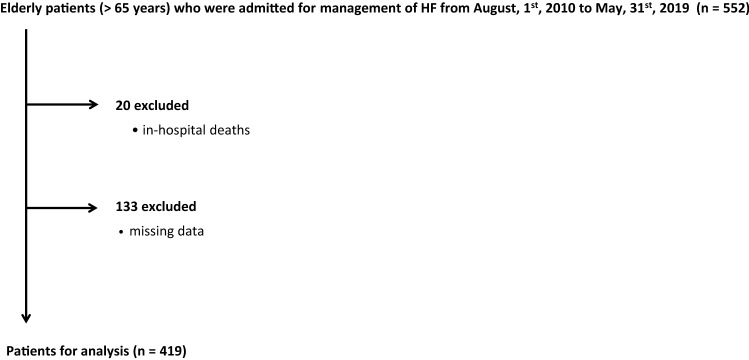
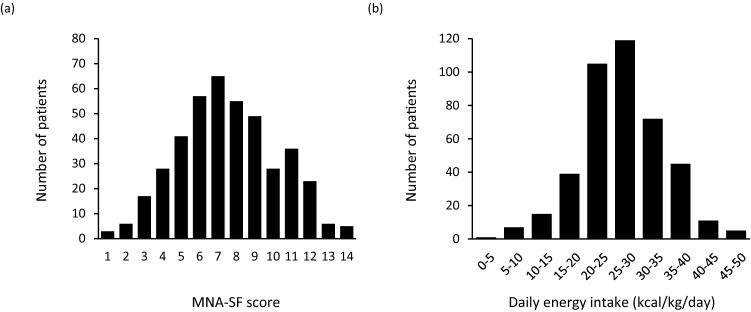
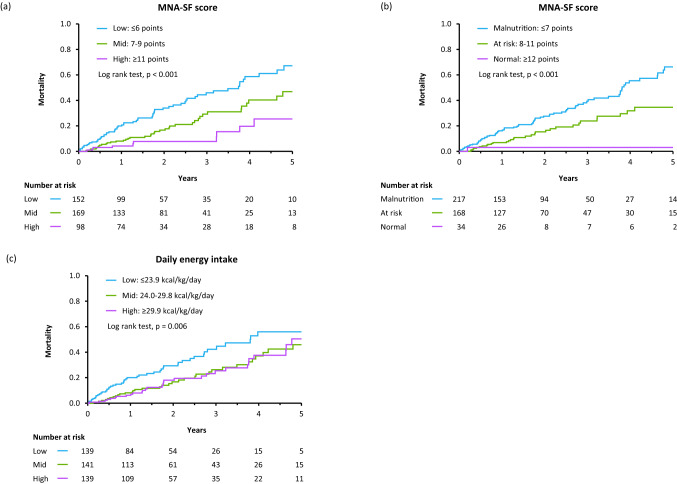
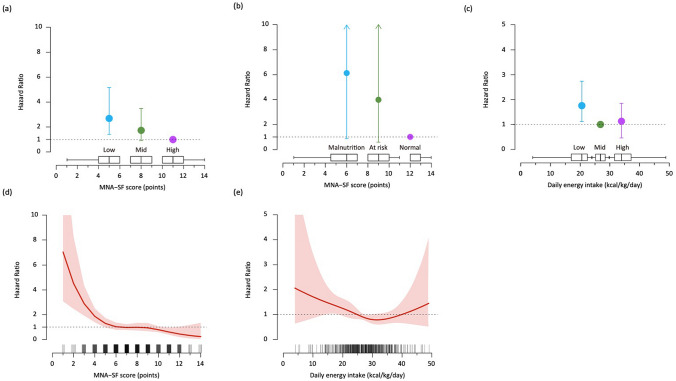
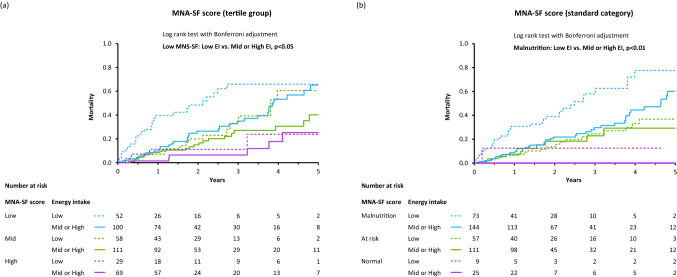
Objective: Malnutrition is associated with an increased risk of mortality in heart failure (HF) patients. Here, we examined the hypothesis that assessment of energy intake in addition to nutritional status improves the stratification of mortality risk in elderly HF patients. Methods: We retrospectively examined 419 HF patients aged ≥ 65 years (median 78 years, 49% female). Nutritional status was assessed by the Mini Nutritional Assessment Short Form (MNA-SF), and daily energy intake was calculated from intake during 3 consecutive days before discharge. Results: During a median 1.52-year period (IQR 0.96–2.94 years), 110 patients (26%) died. Kaplan–Meier survival curves showed that patients with low tertile of daily energy intake had a higher mortality rate than did patients with high or middle tertile of daily energy intake. In multivariate Cox regression analyses, low daily energy intake was independently associated with higher mortality after adjustment for the model including age, sex, BNP, Charlson Comorbidity Index, history of HF hospitalization, and cachexia in addition to MNA-SF. Inclusion of both MNA-SF and energy intake into the adjustment model improved the accuracy of prediction of the mortality after discharge (continuous net reclassification improvement, 0.355, p = 0.003; integrated discrimination improvement, 0.029, p = 0.003). Results of a fully adjusted dose-dependent association analysis showed that risk of all-cause mortality was lowest among HF patients who consumed 31.5 kcal/kg/day of energy. Conclusions: Energy intake during hospital stay is an independent predictor of the mortality in elderly HF patients, and its assessment together with established predictors improves the mortality risk stratification. Graphic abstract:
Overview
The claims and statistics of this paper haven’t been checked yet.
Run the check — free, no account needed. It reads the open-access text and checks the sources it cites.
Integrity signals
Registry
Cites
Statistics
Figures
Verification
Claims the paper makes
The claims and statistics of this paper haven’t been checked yet.
Run the check — free, no account needed. It reads the open-access text and checks the sources it cites.
Claims other papers make about this one
Each is checked against this paper’s own text: does it say what the citing paper says it does?
The source backs part of the claim, not all of it — or backs it for a different population, condition or comparison.
In the citing paper
“Dietary protein is generally considered a major determinant of muscle mass,118 but it is controversial whether enhanced dietary macronutrient intake can overcome the inflammatory catabolic metabolism of advanced cardiac conditions and achieve net gains in fat-free mass.119,120”
From Malnutrition and Cachexia in Inpatients With Acute Cardiac Conditions: A Scientific Statement From the American Heart Association (2026) · cites this paper as [120]
Experimental — accuracy not yet measured
Self-check
Percentages, sums and reported differences re-computed from the paper’s own numbers.
The self-check needs the paper’s full text.
Citations
Cites
The natural history of congestive heart failure: the Framingham study
McKee, P. A., Castelli, W. P., McNamara, P. M., & Kannel, W. B. (1971) · New England Journal of Medicine · doi:10.1056/nejm197112232852601 · Cited by 3,448
Roger, V. L. (2013) · Circulation Research · doi:10.1161/circresaha.113.300268 · Cited by 1,728
Sarcopenic obesity in older adults: aetiology, epidemiology and treatment strategies
Batsis, J. A., & Villareal, D. T. (2018) · Nature Reviews Endocrinology · doi:10.1038/s41574-018-0062-9 · Cited by 1,382
Schuetz, P., Fehr, R., Baechli, V., Geiser, M., Deiss, M., Gomes, F., Kutz, A., Tribolet, P., Bregenzer, T., Braun, N., et al. (2019) · The Lancet · doi:10.1016/s0140-6736(18)32776-4 · Cited by 910
Zhang, X., Xie, X., Dou, Q., Liu, C., Zhang, W., Yang, Y., Deng, R., & Cheng, A. S. K. (2019) · BMC Geriatrics · doi:10.1186/s12877-019-1195-y · Cited by 209
Research works printed but not linked: 37
- Savarese G, Lund LH (2017) Global public health burden of heart failure. Card Fail Rev 3(1):7–11 · DOI
- Mentz RJ, Kelly JP, von Lueder TG, Voors AA, Lam CS, Cowie MR et al (2014) Noncardiac comorbidities in heart failure with reduced versus preserved ejection fraction. J Am Coll Cardiol 64(21):2281–2293 · DOI · Paper page
- Lawson CA, Solis-Trapala I, Dahlstrom U, Mamas M, Jaarsma T, Kadam UT et al (2018) Comorbidity health pathways in heart failure patients: a sequences-of-regressions analysis using cross-sectional data from 10,575 patients in the Swedish heart failure registry. PLoS Med 15(3):e1002540 · DOI
- Lin H, Zhang H, Lin Z, Li X, Kong X, Sun G (2016) Review of nutritional screening and assessment tools and clinical outcomes in heart failure. Heart Fail Rev 21(5):549–565 · DOI
- Wawrzeńczyk A, Anaszewicz M, Wawrzeńczyk A, Budzyński J (2019) Clinical significance of nutritional status in patients with chronic heart failure-a systematic review. Heart Fail Rev 24(5):671–700 · DOI
- Joaquín C, Alonso N, Lupón J, de Antonio M, Domingo M, Moliner P et al (2020) Mini nutritional assessment short form is a morbi-mortality predictor in outpatients with heart failure and mid-range left ventricular ejection fraction. Clin Nutr. pii:S0261-5614(20):30095-9 · DOI
- Cederholm T, Barazzoni R, Austin P, Ballmer P, Biolo G, Bischoff SC et al (2017) ESPEN guidelines on definitions and terminology of clinical nutrition. Clin Nutr 36(1):49–64 · DOI · Paper page
- Kaiser MJ, Bauer JM, Ramsch C, Uter W, Guigoz Y, Cederholm T et al (2009) Validation of the mini nutritional assessment short-form (MNA-SF): a practical tool for identification of nutritional status. J Nutr Health Aging 13(9):782–788 · DOI
- Wleklik M, Uchmanowicz I, Jankowska-Polańska B, Andreae C, Regulska-Ilow B (2018) The role of nutritional status in elderly patients with heart failure. J Nutr Health Aging 22(5):581–588 · DOI
- Saitoh M, Dos Santos MR, Emami A, Ishida J, Ebner N, Valentova M et al (2017) Anorexia, functional capacity, and clinical outcome in patients with chronic heart failure: results from the Studies Investigating Co-morbidities Aggravating Heart Failure (SICA-HF). ESC Heart Fail 4(4):448–457 · DOI
- von Haehling S, Ebner N, Dos Santos MR, Springer J, Anker SD (2017) Muscle wasting and cachexia in heart failure: mechanisms and therapies. Nat Rev Cardiol 14(6):323–341 · DOI
- Gomes F, Baumgartner A, Bounoure L, Bally M, Deutz NE, Greenwald JL et al (2019) Association of nutritional support with clinical outcomes among medical inpatients who are malnourished or at nutritional risk: an updated systematic review and meta-analysis. JAMA Netw Open 2(11):e1915138 · DOI · Paper page
- Katano S, Hashimoto A, Ohori K, Watanabe A, Honma R, Yanase R et al (2018) Nutritional status and energy intake as predictors of functional status after cardiac rehabilitation in elderly inpatients with heart failure—a retrospective cohort study. Circ J 82(6):1584–1591 · DOI
- Kawasaki Y, Sakai M, Nishimura K, Fujiwara K, Fujisaki K, Shimpo M et al (2016) Criterion validity of the visual estimation method for determining patients’ meal intake in a community hospital. Clin Nutr 35(6):1543–1549 · DOI
- Yang Y, Qin X, Li Y, Lei Z, Li Y, Yang S et al (2020) The association between dietary energy intake and the risk of mortality in maintenance haemodialysis patients: a multi-centre prospective cohort study. Br J Nutr 123(4):437–445 · DOI
- Ikizler TA, Cano NJ, Franch H, Fouque D, Himmelfarb J, Kalantar-Zadeh K et al (2013) Prevention and treatment of protein energy wasting in chronic kidney disease patients: a consensus statement by the International Society of Renal Nutrition and Metabolism. Kidney Int 84(6):1096–1107 · DOI
- Nagai M, Ohkubo T, Miura K, Fujiyoshi A, Okuda N, Hayakawa T et al (2016) Association of total energy intake with 29-year mortality in the Japanese: NIPPON DATA80. J Atheroscler Thromb 23(3):339–354 · DOI
- Charlson ME, Pompei P, Ales KL, MacKenzie CR (1987) A new method of classifying prognostic comorbidity in longitudinal studies: development and validation. J Chronic Dis 40(5):373–383 · DOI · Paper page
- Fearon K, Strasser F, Anker SD, Bosaeus I, Bruera E, Fainsinger RL et al (2011) Definition and classification of cancer cachexia: an international consensus. Lancet Oncol 12(5):489–495 · DOI
- DeLong ER, DeLong DM, Clarke-Pearson DL (1988) Comparing the areas under two or more correlated receiver operating characteristic curves: a nonparametric approach. Biometrics 44(3):837–845 · DOI · Paper page
- Pencina MJ, D’Agostino RB Sr, D’Agostino RB Jr, Vasan RS (2008) Evaluating the added predictive ability of a new marker: from area under the ROC curve to reclassification and beyond. Stat Med 27(2):157–172 · DOI · Paper page
- Rozentryt P, von Haehling S, Lainscak M, Nowak JU, Kalantar-Zadeh K, Polonski L et al (2010) The effects of a high-caloric protein-rich oral nutritional supplement in patients with chronic heart failure and cachexia on quality of life, body composition, and inflammation markers: a randomized, double-blind pilot study. J Cachexia Sarcopenia Muscle 1(1):35–42 · DOI
- Aquilani R, Viglio S, Iadarola P, Opasich C, Testa A, Dioguardi FS et al (2008) Oral amino acid supplements improve exercise capacities in elderly patients with chronic heart failure. Am J Cardiol 101(11A):104E–110E · DOI · Paper page
- Bonilla-Palomas JL, Gámez-López AL, Castillo-Domínguez JC, Moreno-Conde M, López Ibáñez MC, Alhambra Expósito R et al (2016) Nutritional intervention in malnourished hospitalized patients with heart failure. Arch Med Res 47(7):535–540 · DOI · Paper page
- Vest AR, Chan M, Deswal A, Givertz MM, Lekavich C, Lennie T et al (2019) Nutrition, obesity, and cachexia in patients with heart failure: a consensus statement from the Heart Failure Society of America Scientific Statements Committee. J Card Fail 25(5):380–400 · DOI
- Anker SD, Ponikowski P, Varney S, Chua TP, Clark AL, Webb-Peploe KM et al (1997) Wasting as independent risk factor for mortality in chronic heart failure. Lancet 349(9058):1050–1053 · DOI
- Simone CB (2019) Cancer cachexia: definitions, outcomes, and treatments. Ann Palliat Med 8(1):E1–E3 · DOI
- Omura T, Tamura Y, Yamaoka T, Yoshimura Y, Sakurai T, Umegaki H et al (2020) Assessing the association between optimal energy intake and all-cause mortality in older patients with diabetes mellitus using the Japanese elderly diabetes intervention trial. Geriatr Gerontol Int 20(1):59–65 · DOI
- Compher C, Chittams J, Sammarco T, Higashibeppu N, Higashiguchi T, Heyland DK (2019) Greater nutrient intake is associated with lower mortality in western and eastern critically ill patients with low BMI: a multicenter, multinational observational study. JPEN J Parenter Enteral Nutr 43(1):63–69 · DOI
- Shirado K, Wakabayashi H, Maeda K, Nishiyama A, Asada M, Isse H et al (2020) Impact of energy intake at one week after hospitalization on prognosis for older adults with pneumonia. J Nutr Health Aging 24(1):119–124 · DOI
- Willcox BJ, Yano K, Chen R, Willcox DC, Rodriguez BL, Masaki KH et al (2004) How much should we eat? The association between energy intake and mortality in a 36-year follow-up study of Japanese-American men. J Gerontol A Biol Sci Med Sci 59(8):789–795 · DOI
- Leosdottir M, Nilsson P, Nilsson JA, Månsson H, Berglund G (2004) The association between total energy intake and early mortality: data from the Malmö Diet and Cancer Study. J Intern Med 256(6):499–509 · DOI
- Kuehneman T, Gregory M, de Waal D, Davidson P, Frickel R, King C et al (2018) Academy of nutrition and dietetics evidence-based practice guideline for the management of heart failure in adults. J Acad Nutr Diet 118(12):2331–2345 · DOI
- Volkert D, Beck AM, Cederholm T, Cruz-Jentoft A, Goisser S, Hooper L et al (2019) ESPEN guideline on clinical nutrition and hydration in geriatrics. Clin Nutr 38(1):10–47 · DOI · Paper page
- Doehner W, Clark A, Anker SD (2010) The obesity paradox: weighing the benefit. Eur Heart J 31(2):146–148 · DOI
- Nagarajan V, Kohan L, Holland E, Keeley EC, Mazimba S (2016) Obesity paradox in heart failure: a heavy matter. ESC Heart Fail 3(4):227–234 · DOI
- Evans WJ, Morley JE, Argilés J, Bales C, Baracos V, Guttridge D et al (2008) Cachexia: a new definition. Clin Nutr 27(6):793–799 · DOI
Cited by
Sorted by citations
Vest, A. R., DiDomenico, R. J., Lichtenstein, L., Slater, T., Ekpo, E., Damluji, A. A., Bohula, E., Alviar, C. L., on behalf of the American Heart Association Acute Cardiac Care and General Cardiology Committee of the Council on Clinical Cardiology, & Council on Cardiovascular and Stroke Nursing (2026) · Circulation · doi:10.1161/cir.0000000000001405 · Cited by 15
Metadata
- Authors
- Katano, S., Yano, T., Kouzu, H., Ohori, K., Shimomura, K., Honma, S., Nagaoka, R., Inoue, T., Takamura, Y., Ishigo, T., Watanabe, A., Koyama, M., Nagano, N., Fujito, T., Nishikawa, R., Ohwada, W., Hashimoto, A., Katayose, M., & Miura, T.
- Affiliations
- Sapporo Medical University Hospital (JP)
- Sapporo Medical University (JP)
- Hakodate Goryoukaku Hospital (JP)
- Hokuto Hospital (JP)
- Corresponding author
- Yano, Toshiyuki
- ORCID
- Venue
- Clinical Research in Cardiology
- Published
- 2021-01-05
- Volume
- 110
- Issue
- 8
- Pages
- 1202-1220
- ISSN
- 1861-0684 (ISSN-L)
- 1861-0692
- PMC
- PMC8318973
- OpenAlex
- W3120876513
- Cited by
- 37
- References
- 5
- Citations by year
- 2026: 1 · 2025: 5 · 2024: 6 · 2023: 13 · 2022: 8 · 2021: 4
- FWCI
- 5.20
- Type
- journal article
- Language
- en
- Open access
- hybrid
- doi.org
- Locations
- Clinical Research in Cardiology (publishedVersion, cc-by)
- PubMed Central (publishedVersion, cc-by)
- PubMed (publishedVersion)
- Funders
- the Japan Society for the Promotion of Science (JP18K17677)
- Topics
- Health Sciences › Medicine › Cardiology and Cardiovascular Medicine › Heart Failure Treatment and Management
- Health Sciences › Medicine › Physiology (medical) › Nutrition and Health in Aging
- Health Sciences › Nursing › Nutrition and Dietetics › Clinical Nutrition and Gastroenterology
- Keywords
- heart failure, elderly patients, energy intake, malnutrition, nutritional status, all-cause mortality, mortality risk stratification, Mini Nutritional Assessment Short Form, cachexia, length of hospital stay, mortality prediction
- MeSH terms
- Aged, Animals, Energy Intake, Cause of Death, Dogs, Female, Heart Failure, Hospitalization, Humans, Male, Nutritional Status, Patient Discharge, Retrospective Studies, Risk Factors
About these checks
Registry, retraction, Cites and statistics results are computed, not judged, with one exception: a printed reference that no index lists is read once by a model before it counts as a citation error. Claims are extracted by a model and kept only when their quote appears verbatim in the text; each cited source is then checked, with a model’s help, for whether it says what the claim relies on. Those verdicts can be wrong — read the claim’s quote and the cited source before relying on one.
Statistics and arithmetic are recomputed, not judged.
Confidence bands are shown only for fields calibrated on our annotated test set. None is calibrated yet, so no band is shown.
What counts as a claim ›How we measure confidence ›How we check this ›
Are you an author, or do you see a problem with this page? Request a review
How to cite
Cite CoChat for the checks on this page, and the paper for its own findings.
- This page
- CoChat. (2026). Citation check: Energy intake during hospital stay predicts all-cause mortality after discharge independently of nutritional status in elderly heart failure patients. https://app.cochat.ai/papers/10.1007/s00392-020-01774-y
- The paper
- Katano, S., Yano, T., Kouzu, H., Ohori, K., Shimomura, K., Honma, S., Nagaoka, R., Inoue, T., Takamura, Y., Ishigo, T., Watanabe, A., Koyama, M., Nagano, N., Fujito, T., Nishikawa, R., Ohwada, W., Hashimoto, A., Katayose, M., & Miura, T. (2021). Energy intake during hospital stay predicts all-cause mortality after discharge independently of nutritional status in elderly heart failure patients. Clinical Research in Cardiology. https://doi.org/10.1007/s00392-020-01774-y
