

Effects of low-dose milk protein supplementation following low-to-moderate intensity exercise training on muscle mass in healthy older adults: a randomized placebo-controlled trial
Open accessThe DOI matches its Crossref record; 57 of the 57 references it cites were found in a registry or an index.
Abstract
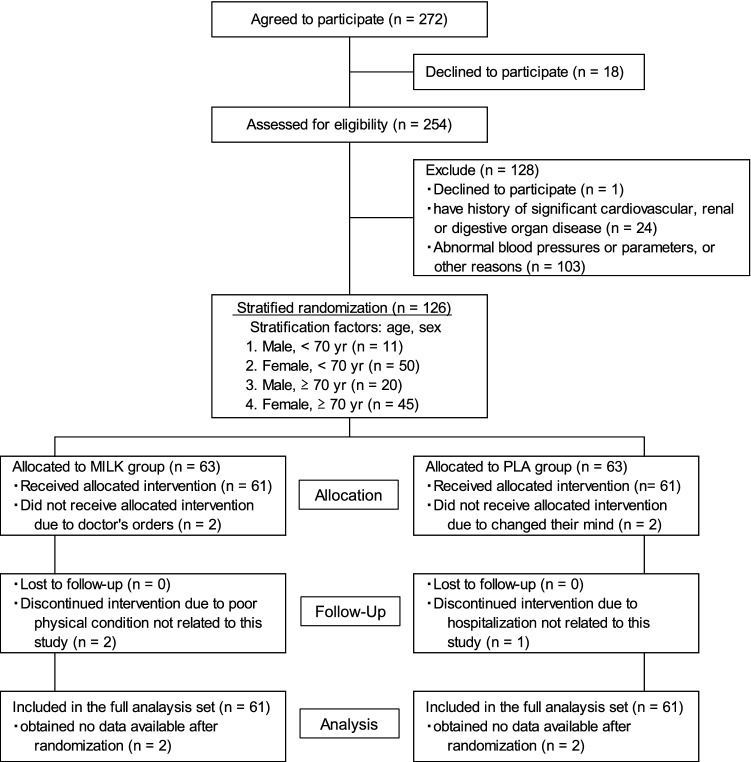
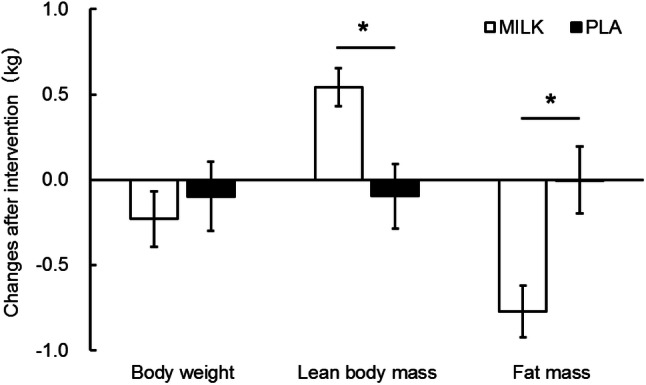
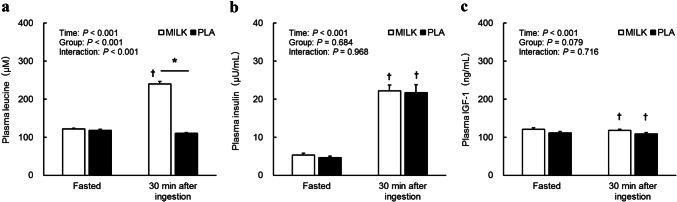
Purpose: The purpose of this study was to examine whether long-term ingestion of low-dose milk protein supplementation causes a greater increase in muscle mass and strength of older adults during low-to-moderate intensity exercise training intervention than isocaloric carbohydrate. Methods: In a randomized, double-blind, and placebo-controlled design, 122 healthy older adults (60–84 year) received either an acidified milk protein drink containing 10 g of milk protein (MILK; n = 61) or an isocaloric placebo drink (PLA; n = 61) daily throughout 6 months of body weight and medicine ball exercise training. Measurements before and after the intervention included body composition, physical performance and blood biochemistry. Results: Lean body mass significantly increased in the MILK group (+ 0.54 kg, p < 0.001), but did not change in the PLA group (− 0.10 kg, p = 0.534). The increases in the MILK group were significantly greater than in the PLA group (p = 0.004). Fat mass (− 0.77 kg) and plasma uric acid levels (− 0.3 mg/dL) significantly decreased only in the MILK group (p < 0.001), with a significant group difference (p = 0.002 and p < 0.001, respectively). Most of the physical performance tests significantly improved in both groups, but no group differences were found. Conclusion: We conclude that low-dose milk protein supplementation (10 g of protein/day) combined with low-to-moderate intensity exercise training is associated with increased muscle mass, but not improved physical performance compared to carbohydrate combined with exercise in healthy older adults. This study was registered in the UMIN Clinical Trials Registry (UMIN000032189).
Overview
The claims and statistics of this paper haven’t been checked yet.
Free: it reads the open-access text and checks the first 5 claims that cite a source we can check. Create a free account to check every claim.
Integrity signals
Registry
Cites
Statistics
Figures
Verification
Claims the paper makes
The claims and statistics of this paper haven’t been checked yet.
Free: it reads the open-access text and checks the first 5 claims that cite a source we can check. Create a free account to check every claim.
Claims other papers make about this one
Each is checked against this paper’s own text: does it say what the citing paper says it does?
The cited source says what the claim attributes to it.
In the citing paper
“However, it is relevant to highlight that the study of Nakayama et al., 76 was the main contributor to this result according to our sensitivity analysis.”
From Systematic review and meta-analysis of protein intake to support muscle mass and function in healthy adults (2022) · cites this paper as [76]
The cited source says what the claim attributes to it.
In the citing paper
“A post hoc sensitivity analysis revealed that excluding Nakayama et al. 76 from the subgroup of studies testing older subjects at 1.2–1.59 g/kg/day changed the main effect to a non‐significant value (SMD = 0.12, 95% CI −0.08:0.32, Table S6).”
From Systematic review and meta-analysis of protein intake to support muscle mass and function in healthy adults (2022) · cites this paper as [76]
The cited source says what the claim attributes to it.
In the citing paper
“Therefore, because the effect of protein supplementation is significant only when Nakayama et al. 76 data are included in the analysis, it is possible that resistance exercise per se is the main contributor to lean body mass gains in studies with older participants.”
From Systematic review and meta-analysis of protein intake to support muscle mass and function in healthy adults (2022) · cites this paper as [76]
Self-check
Percentages, sums and reported differences re-computed from the paper’s own numbers.
The self-check needs the paper’s full text.
Citations
Cites
The Timed “Up & Go”: A Test of Basic Functional Mobility for Frail Elderly Persons
Podsiadlo, D., & Richardson, S. (1991) · Journal of the American Geriatrics Society · doi:10.1111/j.1532-5415.1991.tb01616.x · Cited by 14,418
Garber, C. E., Blissmer, B., Deschenes, M. R., Franklin, B. A., Lamonte, M. J., Lee, I.-M., Nieman, D. C., & Swain, D. P. (2011) · Medicine & Science in Sports & Exercise · doi:10.1249/mss.0b013e318213fefb · Cited by 9,319 · cited 1×
“The criteria for using low-to-moderate intensity exercise training [23] was that the participants were able to repeat the exercises at least 12 times (< 70% of 1-repetition maximum [24]).”
BackgroundMorton, R. W., Murphy, K. T., McKellar, S. R., Schoenfeld, B. J., Henselmans, M., Helms, E., Aragon, A. A., Devries, M. C., Banfield, L., Krieger, J. W., et al. (2018) · British Journal of Sports Medicine · doi:10.1136/bjsports-2017-097608 · Cited by 1,269
Anabolic signaling deficits underlie amino acid resistance of wasting, aging muscle
Cuthbertson, D., Smith, K., Babraj, J., Leese, G., Waddell, T., Atherton, P., Wackerhage, H., Taylor, P. M., & Rennie, M. J. (2005) · The FASEB Journal · doi:10.1096/fj.04-2640fje · Cited by 1,211
Essentials of Strength Training and Conditioning
Phillips, N. (1997) · Physiotherapy · doi:10.1016/s0031-9406(05)66120-2 · Cited by 1,077
Katsanos, C. S., Kobayashi, H., Sheffield-Moore, M., Aarsland, A., & Wolfe, R. R. (2006) · American Journal of Physiology-Endocrinology and Metabolism · doi:10.1152/ajpendo.00488.2005 · Cited by 923 · cited 1×
“Aging would increase the threshold [47, 48], so a large increase in plasma leucine levels is required to stimulate muscle protein synthesis in older adults.”
BackgroundCermak, N. M., Res, P. T., de Groot, L. C., Saris, W. H., & van Loon, L. J. (2012) · The American Journal of Clinical Nutrition · doi:10.3945/ajcn.112.037556 · Cited by 827 · cited 1×
“5 kg in the lean body mass change [6], assuming a standard deviation of 1.”
BackgroundDeveloping Maximal Neuromuscular Power: Part 1 – Biological Basis of Maximal Power Production
Cormie, P., McGuigan, M. R., & Newton, R. U. (2011) · Sports Medicine · doi:10.2165/11537690-000000000-00000 · Cited by 774 · cited 1×
“Not only muscle mass but also neuromuscular activity influences muscle strength [51].”
BackgroundKumar, V., Selby, A., Rankin, D., Patel, R., Atherton, P., Hildebrandt, W., Williams, J., Smith, K., Seynnes, O., Hiscock, N., et al. (2009) · The Journal of Physiology · doi:10.1113/jphysiol.2008.164483 · Cited by 740 · cited 1×
“It is well-known that high-intensity resistance training induces greater muscle protein synthesis [39] and muscle mass gain [40–42] compared with low-intensity resistance training.”
BackgroundChoi, H. K., Liu, S., & Curhan, G. (2005) · Arthritis & Rheumatism · doi:10.1002/art.20761 · Cited by 595 · cited 1×
“A cross-sectional study also shows dairy consumption is associated with lower serum uric acid levels, but meat and seafood consumption are associated with higher serum uric acid levels [56].”
Background
Cited by
Nunes, E. A., Colenso‐Semple, L., McKellar, S. R., Yau, T., Ali, M. U., Fitzpatrick‐Lewis, D., Sherifali, D., Gaudichon, C., Tomé, D., Atherton, P. J., et al. (2022) · Journal of Cachexia, Sarcopenia and Muscle · doi:10.1002/jcsm.12922 · Cited by 280
Choi, M., Kim, H., & Bae, J. (2021) · BMC Geriatrics · doi:10.1186/s12877-021-02491-5 · Cited by 61
Jang, Y. J. (2022) · Journal of Microbiology and Biotechnology · doi:10.4014/jmb.2210.10014 · Cited by 49
Dietary protein and amino acid intakes for mitigating sarcopenia in humans
He, W., Connolly, E. D., Cross, H. R., & Wu, G. (2024) · Critical Reviews in Food Science and Nutrition · doi:10.1080/10408398.2024.2348549 · Cited by 42
Effects of Icelandic yogurt consumption and resistance training in healthy untrained older males
Bagheri, R., Moghadam, B. H., Candow, D. G., Elliott, B., Wong, A., Ashtary‐Larky, D., Forbes, S. C., & Rashidlamir, A. (2021) · British Journal Of Nutrition · doi:10.1017/s0007114521002166 · Cited by 28
Park, S., & Roh, Y. (2022) · Mechanisms of Ageing and Development · doi:10.1016/j.mad.2022.111773 · Cited by 27
Spoelder, M., Koopmans, L., Hartman, Y., Bongers, C. C. W. G., Schoofs, M. C. A., Eijsvogels, T. M. H., & Hopman, M. T. E. (2023) · Nutrients · doi:10.3390/nu15020342 · Cited by 13
Khanal, P., He, L., Degens, H., Stebbings, G. K., Onambélé-Pearson, G. L., Williams, A. G., Thomis, M. A., & Morse, C. I. (2021) · Nutrients · doi:10.3390/nu13093076 · Cited by 13
“It is possible that food types may underlie the lower nutrient intake, where the high SMM r group had a diet richer in fish, milk, nuts and seeds, considered a high diet quality [55–62].”
BackgroundKang, M., Rho, H., Kim, M., Lee, M., Lim, Y., Chon, J., & Lim, H. (2025) · The Journal of nutrition, health and aging · doi:10.1016/j.jnha.2025.100508 · Cited by 10
Mahmoodi, M., Shateri, Z., Nouri, M., Vali, M., Nasimi, N., Sohrabi, Z., Dabbaghmanesh, M. H., & Makhtoomi, M. (2024) · BMC Geriatrics · doi:10.1186/s12877-024-04790-z · Cited by 8
“It has also been demonstrated that beverages like milk, green tea, and coffee can positively increase lean body mass [17–19].”
BackgroundAl‐Rawhani, A. H., Adznam, S. N., Zaid, Z. A., Yusop, N. B. M., Sallehuddin, H. M., & Alshawsh, M. A. (2025) · Journal of Parenteral and Enteral Nutrition · doi:10.1002/jpen.2749 · Cited by 7
Tian, H., Qiao, W., & Wen, X. (2025) · Journal of Nutrition · doi:10.1016/j.tjnut.2025.01.017 · Cited by 8
Nouchi, R., Butler, L. T., Lamport, D. J., Nouchi, H., & Kawashima, R. (2023) · Nutrients · doi:10.3390/nu15020431 · Cited by 8
“a high proportion of amino acids [52], and the acidified milk drink also contains amino acids [17].”
BackgroundInfluentialMa, Y., Yan, R., Li, Y., Li, D., Sun, X., Chen, T., & Liu, X. (2025) · Frontiers in Nutrition · doi:10.3389/fnut.2025.1640858 · Cited by 5
Mohammadi, S., Ashtary‐Larky, D., Alaghemand, N., Alnsour, A. F., Shokouhifar, S., Borzabadi, A., Mehrbod, M., Candow, D. G., Forbes, S. C., António, J., et al. (2025) · Nutrients · doi:10.3390/nu17243877 · Cited by 7
“The RCTs were carried out in multiple countries, including Finland [73,138,150], the Netherlands [42,83,89, 172,182,190], Australia [43,67,103,119,142], Japan [45,72,93,94,121,123,132], Iran [61,65, 109,115,117,126,128–130, 135, 144,”
Verdijk, L. B. (2021) · Current Opinion in Clinical Nutrition & Metabolic Care · doi:10.1097/mco.0000000000000792 · Cited by 5
Gholambareshi, P., Arabpour, Z., Gholizadeh, E., Aliakbari, M., Kamrani, F., Senobari, M. A., Saadati, A., Razaghi, M., & Khosravi, M. (2026) · Geriatric Nursing · doi:10.1016/j.gerinurse.2026.103886 · Cited by 3
Lin, C.-L., Huang, S.-W., Chen, H., Huang, M.-H., Liou, T., & Liao, C. (2026) · Nutrients · doi:10.3390/nu18091409 · Cited by 4
de Camargo, J. B. B., & de Oliveira, A. F. (2022) · Journal of Aging and Physical Activity · doi:10.1123/japa.2022-0015 · Cited by 3
A INFLUÊNCIA DO CONSUMO DE PROTEÍNA NA PREVENÇÃO DE SARCOPENIA NO IDOSO
Melo, L. A., dos Santos, M. V., & Silva, V. (2023) · RECIMA21 - Revista Científica Multidisciplinar · doi:10.47820/recima21.v4i12.4611 · Cited by 2
Drummond, M. D. M., da Silva, R. Â. D., Carvas, N., de Melo, M. S., & Ferreira, M. H. L. (2026) · Translational Sports Medicine · doi:10.1155/tsm2/5557511 · Cited by 4
de Camargo, J. B. B. (2023) · Journal of Aging and Physical Activity · doi:10.1123/japa.2022-0275 · Cited by 2
Wang, J., Zhang, Y., Kang, H., Zhang, S., Yang, H., Wang, Y., Yue, X., Liu, Z., & Li, M. (2026) · Food Bioscience · doi:10.1016/j.fbio.2026.109005 · Cited by 1
Li, J., Wang, Y., Liu, F., & Miao, Y. (2024) · Journal of Aging and Physical Activity · doi:10.1123/japa.2023-0285 · Cited by 2
Inca‐Barriga, O., Alberti‐Nuñez, P., & López‐Moreno, M. (2025) · Journal of Cachexia Sarcopenia and Muscle · doi:10.1002/jcsm.70036 · Cited by 1
“A similar pattern is observed in other included studies, such as Nakayama et al. [6].”
Nunes, E. A., Tomé, D., Naranjo‐Modad, S., Sherifali, D., Gaudichon, C., Phillips, S. M., & authors, T. (2025) · Journal of Cachexia Sarcopenia and Muscle · doi:10.1002/jcsm.70108
Lee, S., Kang, M. K., Lee, S., Kim, J., & Oh, S. (2026) · Journal of Dairy Science and Biotechnology · doi:10.22424/jdsb.2026.44.1.1
Al-Rawhani, A. H. N. (2024) · Universiti Putra Malaysia Institutional Repository (Universiti Putra Malaysia)
He, J.-J., Chen, X.-L., Ning, C., & Wei, Q.-J. (2026) · Frontiers in Nutrition · doi:10.3389/fnut.2026.1782327
“Specifically, supplementation with 10 g of protein per day combined with low-to moderate-intensity exercise training has been shown to increase muscle mass in healthy older adults (54).”
Rin, T., Natsume, M., Iwasawa, K., Iwasaka, C., Haseda, A., Kagami‐Katsuyama, H., Honma, N., & Nishihira, J. (2026) · BMC Nutrition · doi:10.1186/s40795-026-01445-7
“Milk protein was selected as the supplemental protein source because a randomized placebo-controlled trial in healthy older adults reported that low-dose milk-protein supplementation combined with low-to-moderate-intensity exercise increased muscle mass [12].”
Influential
Metadata
- Authors
- Nakayama, K., Saito, Y., Sanbongi, C., Murata, K., & Urashima, T.
- Affiliations
- Meiji (Japan) (JP)
- Obihiro University of Agriculture and Veterinary Medicine (JP)
- Corresponding author
- Nakayama, Kyosuke
- Venue
- European Journal of Nutrition
- Published
- 2020-06-10
- Volume
- 60
- Issue
- 2
- Pages
- 917-928
- ISSN
- 1436-6207 (ISSN-L)
- 1436-6215
- PMC
- PMC7900046
- OpenAlex
- W3033526836
- Cited by
- 27
- References
- 57
- Citations by year
- 2026: 7 · 2025: 6 · 2024: 3 · 2023: 4 · 2022: 4 · 2021: 3
- FWCI
- 1.37
- Type
- journal article
- Language
- en
- Open access
- hybrid
- doi.org
- Licence
- cc-by
- creativecommons.org/licenses/by/4.0 (tdm)
- creativecommons.org/licenses/by/4.0 (vor)
- Locations
- European Journal of Nutrition (publishedVersion, cc-by)
- PubMed Central (publishedVersion, cc-by)
- PubMed (publishedVersion)
- Topics
- Health Sciences › Nursing › Nutrition and Dietetics › Muscle metabolism and nutrition
- Health Sciences › Medicine › Physiology (medical) › Nutrition and Health in Aging
- Life Sciences › Biochemistry, Genetics and Molecular Biology › Molecular Biology › Muscle Physiology and Disorders
- Keywords
- older adults, muscle mass, lean body mass, exercise training, body composition, fat mass, uric acid, physical performance
- MeSH terms
- Body Composition, Double-Blind Method, Humans, Milk Proteins, Exercise, Muscle, Skeletal, Dietary Supplements, Muscle Strength, Resistance Training
About these checks
Registry, retraction, Cites and statistics results are computed, not judged, with one exception: a printed reference that no index lists is read once by a model before it counts as a citation error. Claims are extracted by a model and kept only when their quote appears verbatim in the text; each cited source is then checked, with a model’s help, for whether it says what the claim relies on. Those verdicts can be wrong — read the claim’s quote and the cited source before relying on one.
Statistics and arithmetic are recomputed, not judged.
Confidence bands are shown only for fields calibrated on our annotated test set. None is calibrated yet, so no band is shown.
What counts as a claim ›How we measure confidence ›How we check this ›
Are you an author, or do you see a problem with this page? Request a review
Data sources
Bibliographic data: Semantic Scholar, OpenAlex, Crossref.
Contains information from the Semantic Scholar Academic Graph Datasets, made available under the ODC Attribution License (ODC-BY 1.0).
Semantic Scholar’s data is described in: Kinney, R., et al. (2023). The Semantic Scholar Open Data Platform. arXiv:2301.10140.
