

Intermittent fasting and continuous energy restriction result in similar changes in body composition and muscle strength when combined with a 12 week resistance training program
Open accessThe DOI matches its Crossref record; 55 of the 55 references it cites were found in a registry or an index.
Abstract
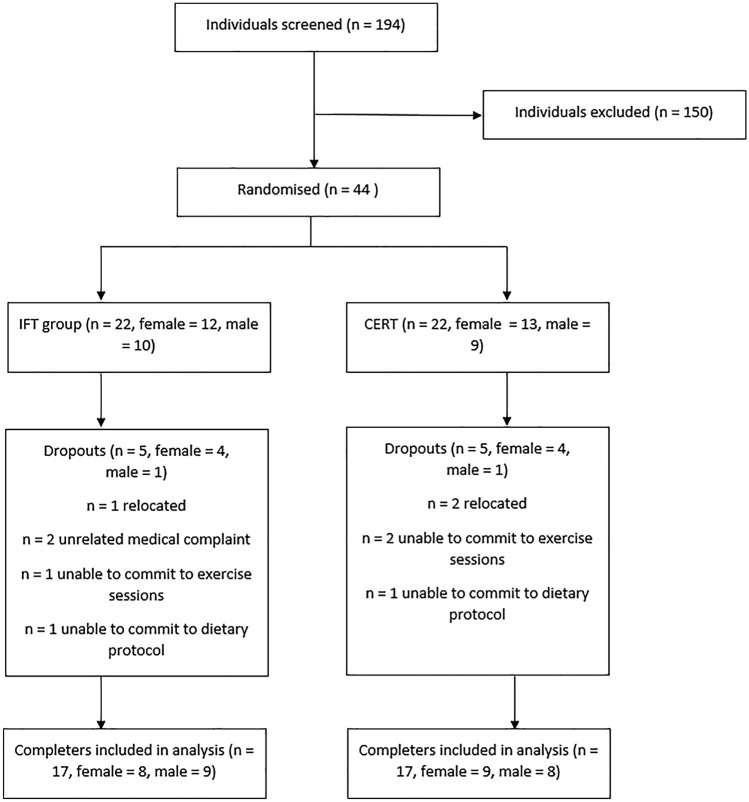
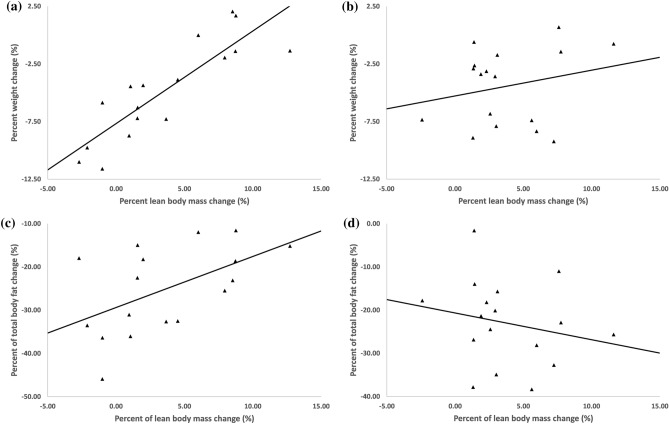
PURPOSE: The objective of this study was to compare the effects of 12 weeks of resistance training combined with either 5:2 intermittent fasting or continuous energy restriction on body composition, muscle size and quality, and upper and lower body strength. METHODS: Untrained individuals undertook 12 weeks of resistance training plus either continuous energy restriction [20% daily energy restriction (CERT)] or 5:2 intermittent fasting [~ 70% energy restriction 2 days/week, euenergetic consumption 5 days/week (IFT)], with both groups prescribed a mean of ≥ 1.4 g of protein per kilogram of body weight per day. Participants completed 2 supervised resistance and 1 unsupervised aerobic/resistance training combination session per week. Changes in lean body mass (LBM), thigh muscle size and quality, strength and dietary intake were assessed. RESULTS: Thirty-four participants completed the study (CERT = 17, IFT = 17). LBM was significantly increased (+ 3.7%, p < 0.001) and body weight (- 4.6%, p < 0.001) and fat (- 24.1%, p < 0.001) were significantly reduced with no significant difference between groups, though results differed by sex. Both groups showed improvements in thigh muscle size and quality, and reduced intramuscular and subcutaneous fat assessed by ultrasonography and peripheral quantitative computed tomography (pQCT), respectively. The CERT group demonstrated a significant increase in muscle surface area assessed by pQCT compared to the IFT group. Similar gains in upper and lower body strength and muscular endurance were observed between groups. CONCLUSION: When combined with resistance training and moderate protein intake, continuous energy restriction and 5:2 intermittent fasting resulted in similar improvements in body composition, muscle quality, and strength. ACTRN: ACTRN12620000920998, September 2020, retrospectively registered.
Overview
The claims and statistics of this paper haven’t been checked yet.
Free: it reads the open-access text and checks the first 5 claims that cite a source we can check. Create a free account to check every claim.
Integrity signals
Registry
Cites
Statistics
Figures
Verification
Claims the paper makes
The claims and statistics of this paper haven’t been checked yet.
Free: it reads the open-access text and checks the first 5 claims that cite a source we can check. Create a free account to check every claim.
Claims other papers make about this one
Each is checked against this paper’s own text: does it say what the citing paper says it does?
The source backs part of the claim, not all of it — or backs it for a different population, condition or comparison.
In the citing paper
“These effects can be mitigated through strength training, adequate protein and calories consumption, and a variety of minimally processed, nutrient‐rich foods (Table 6) [298].”
From Nutritional priorities to support GLP ‐1 therapy for obesity: A joint Advisory from the American College of Lifestyle Medicine, the American Society for Nutrition, the Obesity Medicine Association, and The Obesity Society (2025) · cites this paper as [298]
Experimental — accuracy not yet measuredIn the citing paper
“These effects can be mitigated through strength training, adequate protein and calories consumption, and a variety of minimally processed, nutrient-rich foods (Table 6) [292].”
Self-check
Percentages, sums and reported differences re-computed from the paper’s own numbers.
The self-check needs the paper’s full text.
Citations
Cites
Statistical power analyses using G∗Power 3.1: tests for correlation and regression analyses
Faul, F., Erdfelder, E., Buchner, A., & Lang, A.-G. (2009) · Behavior Research Methods · doi:10.3758/brm.41.4.1149 · Cited by 37,615 · cited 1×
“1 [37] based on previous research showing a 2.”
MethodEuropean Guidelines for Obesity Management in Adults
Yumuk, V., Tsigos, C., Fried, M., Schindler, K., Busetto, L., Micic, D., & Toplak, H. (2015) · Obesity Facts · doi:10.1159/000442721 · Cited by 3,432 · cited 1×
“This group represented a best practice ‘control’ group, as moderate energy restriction (15–30%) is most commonly recommended for weight loss [25, 26].”
BackgroundA new predictive equation for resting energy expenditure in healthy individuals
Mifflin, M., St Jeor, S., Hill, L., Scott, B., Daugherty, S., & Koh, Y. (1990) · The American Journal of Clinical Nutrition · doi:10.1093/ajcn/51.2.241 · Cited by 2,544 · cited 1×
“Jeor equation [21], with total energy requirements calculated by applying an activity factor of 1.”
MethodThe underappreciated role of muscle in health and disease
Wolfe, R. R. (2006) · The American Journal of Clinical Nutrition · doi:10.1093/ajcn/84.3.475 · Cited by 1,537 · cited 1×
“While fat loss is usually desirable, reductions in skeletal muscle mass (a major component of LBM) may lead to a number of deleterious short- and long-term consequences, such as hyperphagia and reduced basal metabolic rate, which may compromise long term weight loss success [2]; increased risk of strength loss and dis…”
BackgroundFolland, J. P., & Williams, A. G. (2007) · Sports Medicine · doi:10.2165/00007256-200737020-00004 · Cited by 1,347
Addressing Current Criticism Regarding the Value of Self-Report Dietary Data
Subar, A. F., Freedman, L. S., Tooze, J. A., Kirkpatrick, S. I., Boushey, C., Neuhouser, M. L., Thompson, F. E., Potischman, N., Guenther, P. M., Tarasuk, V., et al. (2015) · The Journal of Nutrition · doi:10.3945/jn.115.219634 · Cited by 1,047 · cited 1×
“Second, although we collected detailed dietary data, the limitations of selfreported dietary intake are well known [56], and our ability to make strong inferences based on dietary data were limited.”
BackgroundCurriculum, K. (2006) · Cited by 768
Moro, T., Tinsley, G., Bianco, A., Marcolin, G., Pacelli, Q. F., Battaglia, G., Palma, A., Gentil, P., Neri, M., & Paoli, A. (2016) · Journal of Translational Medicine · doi:10.1186/s12967-016-1044-0 · Cited by 732
Clinical definition of sarcopenia
Santilli, V (2014) · Clinical Cases in Mineral and Bone Metabolism · doi:10.11138/ccmbm/2014.11.3.177 · Cited by 710 · cited 1×
“While fat loss is usually desirable, reductions in skeletal muscle mass (a major component of LBM) may lead to a number of deleterious short- and long-term consequences, such as hyperphagia and reduced basal metabolic rate, which may compromise long term weight loss success [2]; increased risk of strength loss and dis…”
BackgroundEstrogen deficiency and the origin of obesity during menopause
Lizcano, F., & Guzmán, G. (2014) · BioMed Research International · doi:10.1155/2014/757461 · Cited by 586 · cited 1×
“When combined with the fact that females may require a greater absolute energy deficit per unit of weightloss [49], are more likely to under-report energy intake [50] and may be impacted by hormones that promote weight retention [51, 52], it is not surprising that males experienced greater weight and fat loss in the c…”
Background
Research works printed but not linked: 1
- Abràmoff MD Magalhaes P Ram S Image processing with ImageJ Biophotonics Int 2004 11 36 42
Cited by
Mozaffarian, D., Agarwal, M., Aggarwal, M., Alexander, L., Apovian, C. M., Bindlish, S., Bonnet, J., Butsch, W. S., Christensen, S., Gianos, E., et al. (2025) · The American Journal of Clinical Nutrition · doi:10.1016/j.ajcnut.2025.04.023 · Cited by 154
“These effects can be mitigated through strength training, adequate protein and calories consumption, and a variety of minimally processed, nutrient-rich foods (Table 6) [292].”
Mozaffarian, D., Agarwal, M., Aggarwal, M., Alexander, L., Apovian, C. M., Bindlish, S., Bonnet, J., Butsch, W. S., Christensen, S., Gianos, E., et al. (2025) · Obesity · doi:10.1002/oby.24336 · Cited by 143
“These effects can be mitigated through strength training, adequate protein and calories consumption, and a variety of minimally processed, nutrient-rich foods (Table 6) [298].”
Fasting: From Physiology to Pathology
Tang, D., Tang, Q., Huang, W., Zhang, Y., Tian, Y., & Fu, X. (2023) · Advanced Science · doi:10.1002/advs.202204487 · Cited by 87
Keenan, S. J., Cooke, M. B., Chen, W. S., Wu, S. S. X., & Belski, R. (2022) · Nutrients · doi:10.3390/nu14153071 · Cited by 69
“Detailed intervention methods have been previously described [21].”
BackgroundMethodSelf-citationThe cyclic metabolic switching theory of intermittent fasting
Mattson, M. P. (2025) · Nature Metabolism · doi:10.1038/s42255-025-01254-5 · Cited by 55
The Effect of Intermittent Fasting on Appetite: A Systematic Review and Meta-Analysis
Elsworth, R. L., Monge, A. M., Perry, R. E., Hinton, E. C., Flynn, A. N., Whitmarsh, A., Hamilton-Shield, J. P., Lawrence, N., & Brunstrom, J. M. (2023) · Nutrients · doi:10.3390/nu15112604 · Cited by 36
“Keenan (2020) [42] Hunger, fullness * Daily, from week 1 until week 12 Assessed daily on a mobile phone with a Likert scale (0–10) adapted from VAS”
BackgroundMethodInfluentialMozaffarian, D., Agarwal, M., Aggarwal, M., Alexander, L., Apovian, C. M., Bindlish, S., Bonnet, J., Butsch, W. S., Christensen, S., Gianos, E., et al. (2025) · Obesity Pillars · doi:10.1016/j.obpill.2025.100181 · Cited by 28
Mozaffarian, D., Agarwal, M., Aggarwal, M., Alexander, L., Apovian, C. M., Bindlish, S., Bonnet, J. P., Butsch, W. S., Christensen, S. M., Gianos, E., et al. (2025) · Obesity Pillars · doi:10.1016/j.obpill.2026.100269 · Cited by 41
Kim, J., & Song, Y. (2022) · Obesity Facts · doi:10.1159/000527838 · Cited by 30
“A 12-week intervention of intermittent fasting, resistance training, and a prescribed daily protein intake of more than 1.4 g per kg body weight has been shown to significantly reduce body weight and fat mass while also increasing lean body mass [24].”
InfluentialKazeminasab, F., Baharlooie, M., Karimi, B., Mokhtari, K., Rosenkranz, S. K., & Santos, H. O. (2023) · Nutrition Reviews · doi:10.1093/nutrit/nuad155 · Cited by 23
Fasting diets: what are the impacts on eating behaviors, sleep, mood, and well-being?
Hosseini, E., Ammar, A., Josephson, J. K., Gibson, D. L., Askari, G., Bragazzi, N. L., Trabelsi, K., Schöllhorn, W. I., & Mokhtari, Z. (2024) · Frontiers in Nutrition · doi:10.3389/fnut.2023.1256101 · Cited by 20
Compliance of participants undergoing a ‘5-2’ intermittent fasting diet and impact on body weight
Cook, F., Langdon-Daly, J., & Serpell, L. (2022) · Clinical Nutrition ESPEN · doi:10.1016/j.clnesp.2022.08.012 · Cited by 17
Hamsho, M., Shkorfu, W., Ranneh, Y., & Fadel, A. (2024) · Nutrition Metabolism and Cardiovascular Diseases · doi:10.1016/j.numecd.2024.103805 · Cited by 15
A Narrative Review of Intermittent Fasting With Exercise
Gabel, K., Hamm, A., Czyzewski, O., Perez, J. S., Fought-Boudaia, A., Motl, R. W., & Hibbing, P. R. (2024) · Journal of the Academy of Nutrition and Dietetics · doi:10.1016/j.jand.2024.05.015 · Cited by 19
Belamjahad, A., Tourny, C., Hackney, A. C., Laziri, F., Saeidi, A., Hachimi, O. E., Laher, I., Granacher, U., & Zouhal, H. (2025) · Sports Medicine - Open · doi:10.1186/s40798-025-00831-y · Cited by 13
Cozma, D. C., Văcărescu, C., & Stoicescu, C. I. (2025) · Biomedicines · doi:10.3390/biomedicines13123079 · Cited by 6
“Concurrent resistance exercise further supports anabolic signaling, while adequate carbohydrate and healthy fat intake timed around physical activity and refeeding phases ensures energy availability and adherence [60].”
Cesanelli, L., Ylaitė, B., Brazaitis, M., Eimantas, N., Ratkevičius, A., Satkunskienė, D., & Minderis, P. (2025) · Biology Open · doi:10.1242/bio.062245 · Cited by 5
“Despite the lack of clear evidence supporting these practices (Zouhal et al., 2020; Keenan et al., 2022), in the context of exercise and physical performance, examples include endurance athletes who occasionally train in a fasted state to improve lipid metabolism and optimize performance, and…”
Jiao, M., Yan, H., Zhang, B., Zhao, X., Li, J., & Harun, M. T. (2026) · Frontiers in Nutrition · doi:10.3389/fnut.2026.1772836 · Cited by 1
Alternate Day Fasting and the 5:2 Diet: Effects on Body Weight and Metabolic Disease Risk Factors
Gabel, K., & Varady, K. A. (2024) · Springer eBooks · doi:10.1007/978-3-031-49622-6_6 · Cited by 1
Li, G., Wang, Q., Xie, R., Wang, X., Zhong, L., & Wang, L. (2023) · Research Square · doi:10.21203/rs.3.rs-2792151/v1
Wojtczak, M., Pniak, M., Miklis, P., Mawlichanów, M., Ciesielska, A., Sieradzka, A., Szerej, K., Kot, A., Myśliwiec, N., & Różycki, A. (2025) · Quality in Sport · doi:10.12775/qs.2025.37.57195 · Cited by 3
Noda, T., Shimamoto, T., Kiyohara, K., Imanaka, M., Nishioka, N., Tateyama, Y., & Iwami, T. (2026) · JMIR mhealth and uhealth · doi:10.2196/58930
“Furthermore, other studies have shown that incorporating exercise during IF can increase muscle mass and exercise performance [44,45].”
Deller, M., Weiershaus, J., Held, S., & Brinkmann, C. K. (2026) · Diabetes Obesity and Metabolism · doi:10.1111/dom.70873
Common questions and misconceptions about diets: what does the scientific evidence really show?
António, J., Antonio, B. B., Aragon, A. A., Arent, S. M., Campbell, B. I., Candow, D. G., Eberhardt, H. K., Escalante, G., Evans, C., Forbes, S. C., et al. (2026) · Journal of the International Society of Sports Nutrition · doi:10.1080/15502783.2026.2707252
Metadata
- Authors
- Keenan, S. J., Cooke, M. B., Hassan, E. B., Chen, W. S., Sullivan, J., Wu, S. X., El-Ansary, D., Imani, M., & Belski, R.
- Affiliations
- Swinburne University of Technology (AU)
- The University of Melbourne (AU)
- Corresponding author
- Keenan, Stephen J.
- ORCID
- Venue
- European Journal of Nutrition
- Published
- 2022-01-27
- Volume
- 61
- Issue
- 4
- Pages
- 2183-2199
- ISSN
- 1436-6207 (ISSN-L)
- 1436-6215
- PMC
- PMC9106626
- OpenAlex
- W4210730927
- Cited by
- 24
- References
- 55
- Citations by year
- 2026: 3 · 2025: 10 · 2024: 4 · 2023: 4 · 2022: 3
- FWCI
- 3.25
- Type
- journal article
- Language
- en
- Open access
- hybrid
- doi.org
- Licence
- cc-by
- creativecommons.org/licenses/by/4.0 (tdm)
- creativecommons.org/licenses/by/4.0 (vor)
- Locations
- European Journal of Nutrition (publishedVersion, cc-by)
- PubMed Central (publishedVersion, cc-by)
- PubMed (publishedVersion)
- Figshare (submittedVersion, cc-by)
- Minerva Access (University of Melbourne) (submittedVersion, cc-by)
- Funders
- Swinburne University of Technology (Student Scholarship)
- Topics
- Health Sciences › Medicine › Physiology (medical) › Dietary Effects on Health
- Health Sciences › Nursing › Nutrition and Dietetics › Muscle metabolism and nutrition
- Health Sciences › Medicine › Orthopedics and Sports Medicine › Sports Performance and Training
- Keywords
- intermittent fasting, 5:2 diet, continuous energy restriction, resistance training, body composition, lean body mass, muscle strength, muscle quality, thigh muscle, intramuscular fat, subcutaneous adipose tissue, protein intake, dietary fat restriction, untrained individuals
- MeSH terms
- Body Composition, Body Weight, Fasting, Humans, Muscle Strength, Resistance Training
About these checks
Registry, retraction, Cites and statistics results are computed, not judged, with one exception: a printed reference that no index lists is read once by a model before it counts as a citation error. Claims are extracted by a model and kept only when their quote appears verbatim in the text; each cited source is then checked, with a model’s help, for whether it says what the claim relies on. Those verdicts can be wrong — read the claim’s quote and the cited source before relying on one.
Statistics and arithmetic are recomputed, not judged.
Confidence bands are shown only for fields calibrated on our annotated test set. None is calibrated yet, so no band is shown.
What counts as a claim ›How we measure confidence ›How we check this ›
Are you an author, or do you see a problem with this page? Request a review
Data sources
Bibliographic data: Semantic Scholar, OpenAlex, Crossref.
Contains information from the Semantic Scholar Academic Graph Datasets, made available under the ODC Attribution License (ODC-BY 1.0).
Semantic Scholar’s data is described in: Kinney, R., et al. (2023). The Semantic Scholar Open Data Platform. arXiv:2301.10140.
