

Peroxisomal alterations in Alzheimer’s disease
Open accessThe DOI matches its Crossref record; 42 of the 42 references it cites were found in a registry or an index.
Abstract
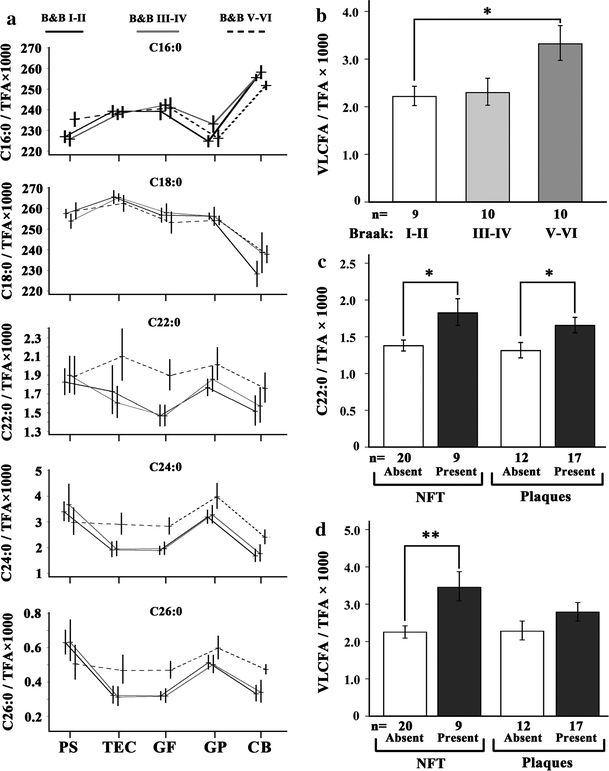
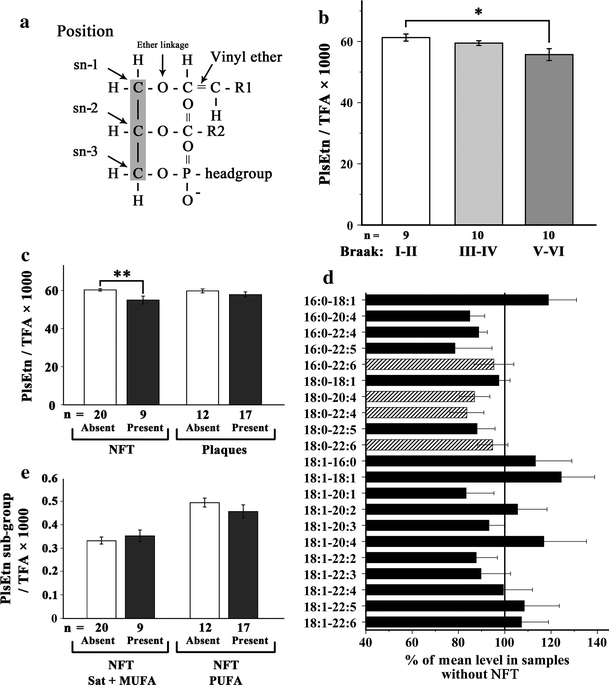
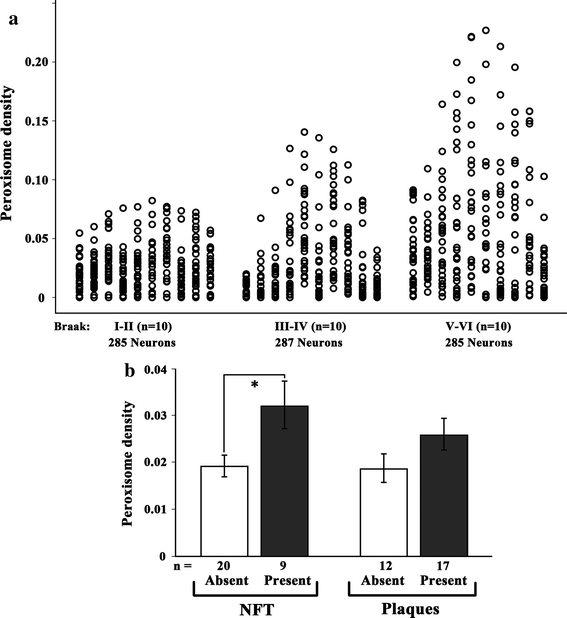
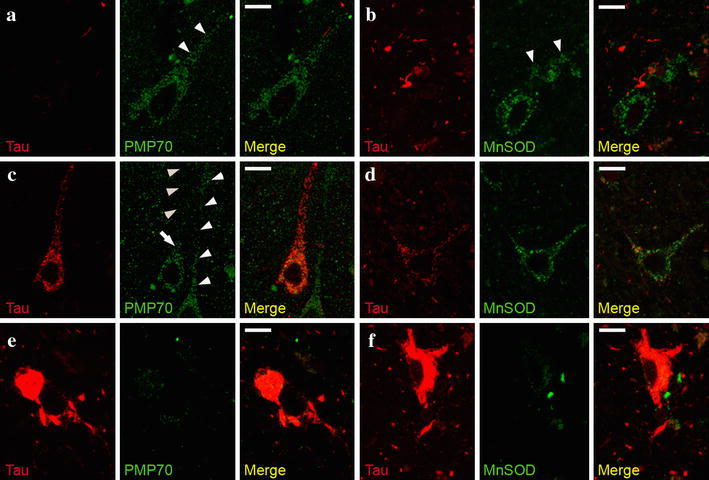
In Alzheimer's disease (AD), lipid alterations are present early during disease progression. As some of these alterations point towards a peroxisomal dysfunction, we investigated peroxisomes in human postmortem brains obtained from the cohort-based, longitudinal Vienna-Transdanube Aging (VITA) study. Based on the neuropathological Braak staging for AD on one hemisphere, the patients were grouped into three cohorts of increasing severity (stages I-II, III-IV, and V-VI, respectively). Lipid analyses of cortical regions from the other hemisphere revealed accumulation of C22:0 and very long-chain fatty acids (VLCFA, C24:0 and C26:0), all substrates for peroxisomal β-oxidation, in cases with stages V-VI pathology compared with those modestly affected (stages I-II). Conversely, the level of plasmalogens, which need intact peroxisomes for their biosynthesis, was decreased in severely affected tissues, in agreement with a peroxisomal dysfunction. In addition, the peroxisomal volume density was increased in the soma of neurons in gyrus frontalis at advanced AD stages. Confocal laser microscopy demonstrated a loss of peroxisomes in neuronal processes with abnormally phosphorylated tau protein, implicating impaired trafficking as the cause of altered peroxisomal distribution. Besides the original Braak staging, the study design allowed a direct correlation between the biochemical findings and the amount of neurofibrillary tangles (NFT) and neuritic plaques, quantified in adjacent tissue sections. Interestingly, the decrease in plasmalogens and the increase in VLCFA and peroxisomal volume density in neuronal somata all showed a stronger association with NFT than with neuritic plaques. These results indicate substantial peroxisome-related alterations in AD, which may contribute to the progression of AD pathology.
Overview
The claims and statistics of this paper haven’t been checked yet.
Free: it reads the open-access text and checks the first 5 claims that cite a source we can check. Create a free account to check every claim.
Integrity signals
Registry
Cites
Statistics
Figures
Verification
Claims the paper makes
The claims and statistics of this paper haven’t been checked yet.
Free: it reads the open-access text and checks the first 5 claims that cite a source we can check. Create a free account to check every claim.
Claims other papers make about this one
Each is checked against this paper’s own text: does it say what the citing paper says it does?
The source backs part of the claim, not all of it — or backs it for a different population, condition or comparison.
In the citing paper
“PEX7 regulates peroxisomal protein import, and peroxisomes are abundant in dendrites (Kou et al., 2011).”
From Using Whole-Exome Sequencing to Identify Inherited Causes of Autism (2013) · cites this paper as Kou et al., 2011
Experimental — accuracy not yet measuredThe source backs part of the claim, not all of it — or backs it for a different population, condition or comparison.
In the citing paper
“Kou et al. [127] evidenced heterogeneity in the peroxisomal distribution in neurons of patients with AD, which was concentrated in the soma and absent in the dendrites”
From Multi-Target Mechanisms of Phytochemicals in Alzheimer’s Disease: Effects on Oxidative Stress, Neuroinflammation and Protein Aggregation (2022) · cites this paper as [127]
Experimental — accuracy not yet measuredIn the citing paper
“implying that Tau does not allow the correct transit of these organelles, being an abnormally phosphorylated cytoskeleton protein, the possible cause of the increase in the oxidizing environment.”
From Multi-Target Mechanisms of Phytochemicals in Alzheimer’s Disease: Effects on Oxidative Stress, Neuroinflammation and Protein Aggregation (2022) · cites this paper as [127]
Self-check
Percentages, sums and reported differences re-computed from the paper’s own numbers.
The self-check needs the paper’s full text.
Citations
Cites
Cleavage of Structural Proteins during the Assembly of the Head of Bacteriophage T4
LAEMMLI, U. K. (1970) · Nature · doi:10.1038/227680a0 · Cited by 249,961
A RAPID METHOD OF TOTAL LIPID EXTRACTION AND PURIFICATION
Bligh, E. G., & Dyer, W. J. (1959) · Canadian Journal of Biochemistry and Physiology · doi:10.1139/o59-099 · Cited by 54,751 · cited 1×
“For improved method for analysis of plasmalogen subspecies, lipid standards dissolved in chloroform/methanol (1:2, vol/vol) were added to the extraction solvent before neutral lipid extraction, which was performed according to the method of Bligh and Dyer [5].”
MethodNeuropathological stageing of Alzheimer-related changes.
Braak, H., & Braak, E. (1991) · Acta Neuropathologica · doi:10.1007/bf00308809 · Cited by 16,123 · cited 3×
“The staging of AD-related neuropathology was done on the left brain hemisphere according to Braak and Braak [7, 8].”
BackgroundMethodMitochondrial Dysfunction and Oxidative Stress in Neurodegenerative Diseases
Lin, M. T., & Beal, M. F. (2006) · Nature · doi:10.1038/nature05292 · Cited by 6,455 · cited 2×
“Agebased metabolic changes may lead to an imbalance of metabolites and/or second messengers promoting mitochondrial, endosomal–lysosomal and peroxisomal dysfunctions, which might be involved in the initiation of neuropathological events in AD [26, 32].”
BackgroundStrittmatter, W. J., Saunders, A. M., Schmechel, D., Pericak-Vance, M., Enghild, J., Salvesen, G. S., & Roses, A. D. (1993) · Proceedings of the National Academy of Sciences · doi:10.1073/pnas.90.5.1977 · Cited by 4,268
Braak, H., Alafuzoff, I., Arzberger, T., Kretzschmar, H., & Del Tredici, K. (2006) · Acta Neuropathologica · doi:10.1007/s00401-006-0127-z · Cited by 3,172 · cited 3×
“The staging of AD-related neuropathology was done on the left brain hemisphere according to Braak and Braak [7, 8].”
MethodNeurofibrillary tangles but not senile plaques parallel duration and severity of Alzheimer's disease
Arriagada, P. V., Growdon, J. H., Hedley-Whyte, E. T., & Hyman, B. T. (1992) · Neurology · doi:10.1212/wnl.42.3.631 · Cited by 2,668 · cited 1×
“Although amyloid b plaques represent a hallmark of AD, NFT pathology is widely considered to correlate better with disease progression [2, 8].”
BackgroundSystematic meta-analyses of Alzheimer disease genetic association studies: the AlzGene database
Bertram, L., McQueen, M. B., Mullin, K., Blacker, D., & Tanzi, R. E. (2007) · Nature Genetics · doi:10.1038/ng1934 · Cited by 1,857 · cited 1×
“So far, the e4 allele of apolipoprotein E (APOE) is the best established genetic risk factor for sporadic AD [4, 39].”
BackgroundExtension of murine life span by overexpression of catalase targeted to mitochondria
Schriner, S. E., Linford, N. J., Martin, G. M., Treuting, P., Ogburn, C. E., Emond, M., Coskun, P. E., Ladiges, W., Wolf, N., Van Remmen, H., et al. (2005) · Science · doi:10.1126/science.1106653 · Cited by 1,724 · cited 1×
“The observation that the life span of mice is extended when catalase, normally localized to the cytosol and to peroxisomes, is transgenically targeted to mitochondria supports the theory of organellar contribution to aging [37].”
BackgroundConsumption of Fish and n-3 Fatty Acids and Risk of Incident Alzheimer Disease
Morris, M. C., Evans, D. A., Bienias, J. L., Tangney, C. C., Bennett, D. A., Wilson, R. S., Aggarwal, N., & Schneider, J. (2003) · Archives of Neurology · doi:10.1001/archneur.60.7.940 · Cited by 1,135 · cited 1×
“DHA incorporated into phospholipids and cholesterol esters were found to be reduced in brain [29] and plasma [12] of AD patients and several studies indicate a decreased risk for AD after an x3 (in particular DHA) rich diet [3, 20, 31].”
Background
Cited by
Items 201–229 of 229
Hepatic peroxisome and its implications on cardiac function, inflammation and aging
Huang, K. (2020) · Iowa State University Digital Repository (Iowa State University) · doi:10.31274/etd-20210114-64
Apoptosis-Related Diseases and Peroxisomes
Wang, M., Liu, Y., Chen, N., Wang, J., & Zhao, Y. (2022) · Physiology · doi:10.5772/intechopen.105052
Lazarow, P. B. (2022) · Elsevier eBooks · doi:10.1016/b978-0-12-821618-7.00127-9 · Cited by 1
Generation of Reporter Cell Lines for Endogenous Expression Analysis of Peroxisomal Proteins
Silva, B. S. C., Schrader, T. A., Schrader, M., & Carmichael, R. E. (2023) · Methods in molecular biology · doi:10.1007/978-1-0716-3048-8_18
The potential of extracellular vesicle lipid profiling in Alzheimer's disease.Preprint
Su, H., Masters, C. L., Bush, A. I., Barnham, K. J., Reid, G. E., & Vella, L. J. (2023) · Authorea · doi:10.22541/au.168388562.25020996/v1
Cerebrospinal fluid neutral lipids are associated with Alzheimer’s disease progressionPreprint
Dakterzada, F., Jové, M., Huerto, R. P., Carnes, A., Sol, J., Pamplona, R., & Piñol‐Ripoll, G. (2023) · Research Square · doi:10.21203/rs.3.rs-2981663/v1
Graneri, L., Mamo, J. C. L., Takechi, R., & Lam, V. (2023) · Elsevier eBooks · doi:10.1016/b978-0-323-89834-8.00018-0 · Cited by 2
Böhlig, K., Iglesias‐Artola, J. M., Asaro, A., Lennartz, H. M., Link, A. C., Drobot, B., & Nadler, A. (2025) · Angewandte Chemie · doi:10.1002/ange.202513360
Du, E. Y., & Tian, J. (2025) · Journal of Alzheimer s Disease · doi:10.1177/13872877251400775
“…very long chain fatty acid metabolism has been previously linked to neurotransmission defects and pathological characteristics of AD including brain amyloidosis and tauopa-thy, 78,79 further supporting impaired homeostasis of very long chain fatty acid metabolism in potentiating neuronal damages.”
Semikasev, E., Ahlemeyer, B., Acker, T., Schänzer, A., & Baumgart‐Vogt, E. (2024) · Figshare · doi:10.6084/m9.figshare.26588847
Semikasev, E., Ahlemeyer, B., Acker, T., Schänzer, A., & Baumgart‐Vogt, E. (2024) · Figshare · doi:10.6084/m9.figshare.26588850
Semikasev, E., Ahlemeyer, B., Acker, T., Schänzer, A., & Baumgart‐Vogt, E. (2024) · Figshare · doi:10.6084/m9.figshare.26588841
Whitfield-Cargile, C. M., Chung, H. C., Coleman, M. C., Cohen, N. D., Chamoun-Emanuelli, A. M., Ivanov, I. V., Goldsby, J. S., Davidson, L. A., Gaynanova, I., Ni, Y., et al. (2024) · Figshare · doi:10.6084/m9.figshare.26706492
Semikasev, E., Ahlemeyer, B., Acker, T., Schänzer, A., & Baumgart‐Vogt, E. (2024) · Figshare · doi:10.6084/m9.figshare.26588829
Semikasev, E., Ahlemeyer, B., Acker, T., Schänzer, A., & Baumgart‐Vogt, E. (2024) · Figshare · doi:10.6084/m9.figshare.26588853
Semikasev, E., Ahlemeyer, B., Acker, T., Schänzer, A., & Baumgart‐Vogt, E. (2024) · Figshare · doi:10.6084/m9.figshare.26588844
Semikasev, E., Ahlemeyer, B., Acker, T., Schänzer, A., & Baumgart‐Vogt, E. (2024) · Figshare · doi:10.6084/m9.figshare.26588832
Whitfield-Cargile, C. M., Chung, H. C., Coleman, M. C., Cohen, N. D., Chamoun-Emanuelli, A. M., Ivanov, I. V., Goldsby, J. S., Davidson, L. A., Gaynanova, I., Ni, Y., et al. (2024) · Figshare · doi:10.6084/m9.figshare.26706495
Song, Y., Lin, F., Cao, H., Song, W., Liao, F., Deng, Y., Wu, N., Hong, W., Sze, F. T. A., & Chen, X. (2026) · BMC Geriatrics · doi:10.1186/s12877-026-07102-9
“The potential involvement of peroxisomes in Alzheimer’s disease (AD) has garnered increased attention due to findings indicating elevated levels of very long-chain fatty acids (VLCFAs), namely C22:0, C24:0, and C26:0, within brain lesions of AD patients [55, 56].”
Balsliemke, A.-L., Ahlemeyer, B., Schmidl, E., Acker, T., Schänzer, A., & Baumgart‐Vogt, E. (2026) · Journal of Alzheimer s Disease · doi:10.1177/13872877261418994 · Cited by 2
“With regard to AD, increased levels of very long chain fatty acids 46 and reduced levels of plasmalogens and docosa-hexaenoic acid 46 – 51 were measured in postmortem neocorti-ces of patients with high ADNC compared to control patients.”
The complex lipidome as a driver of tissue-specific pathology in adrenoleukodystrophy
Kemp, S., Engelen, M., & Jaspers, Y. R. J. (2026) · Molecular Neurodegeneration · doi:10.1186/s13024-026-00975-9 · Cited by 1
Rotenone-induced oxidative stress triggers peroxisomal alterations in BV-2 microglial cells
Valenza, A., Muzzi, M., Rendina, F., Montali, I., Pensabene, D., Fracassi, A., Segatto, M., & Moreno, S. (2026) · Frontiers in Cellular Neuroscience · doi:10.3389/fncel.2026.1941513
“Comparable alterations in peroxisomal trafficking have been reported in conditions such as AD, in which micro-tubule disruption contributes to peroxisomal dysfunction (Kou et al., 2011).”
Peroxisomes in Alzheimer’s disease: emerging mechanistic insights and therapeutic opportunities
Liu, T., Liu, Y., Zhang, Y., Wang, J., Ren, Y., Fu, S., Han, L., 蒋鹏成, Chen, J., Li, Y., et al. (2026) · Frontiers in Aging Neuroscience · doi:10.3389/fnagi.2026.1960320
“Kou et al. (2011) identified peroxisomal and lipid abnormalities in AD brain tissue.”
Matta, C., Cheon, Y.-H., Vágó, J., Mészár, Z., Kim, E. H., Jiang, S., Balogh, A., Zana, M., Dinnyés, A., & Jin, E. (2026) · Materials Today Bio · doi:10.1016/j.mtbio.2026.103752
“Kou et al. reported altered VLCFA and plasmalogen profiles, increased somatic peroxisomal volume density, and loss of peroxisomes from tau-affected neuronal processes in vulnerable cortical regions [72].”
Influential
Metadata
- Authors
- Kou, J., Kovacs, G. G., Höftberger, R., Kulik, W., Brodde, A., Forss-Petter, S., Hönigschnabl, S., Gleiss, A., Brügger, B., Wanders, R., Just, W., Budka, H., Jungwirth, S., Fischer, P., & Berger, J.
- Affiliations
- Medical University of Vienna (AT)
- Amsterdam UMC Location University of Amsterdam (NL)
- Heidelberg University (DE)
- Ludwig Boltzmann Institute for Age Research (AT)
- Corresponding author
- Berger, Johannes
- ORCID
- Venue
- Acta Neuropathologica
- Published
- 2011-05-19
- Volume
- 122
- Issue
- 3
- Pages
- 271-283
- ISSN
- 0001-6322 (ISSN-L)
- 1432-0533
- PMC
- PMC3168371
- OpenAlex
- W2124956869
- Cited by
- 227
- References
- 42
- Citations by year
- 2026: 7 · 2025: 21 · 2024: 12 · 2023: 20 · 2022: 22 · 2021: 17 · 2020: 25 · 2019: 13 · 2018: 9 · 2017: 12 · 2016: 10 · 2015: 17 · 2014: 19 · 2013: 10 · 2012: 12
- FWCI
- 9.16
- Type
- journal article
- Language
- en
- Open access
- hybrid
- doi.org
- Licence
- cc-by-nc
- Locations
- Acta Neuropathologica (publishedVersion, cc-by-nc)
- Europe PMC (PubMed Central) (publishedVersion, cc-by-nc)
- PubMed Central (publishedVersion, cc-by-nc)
- PubMed (publishedVersion)
- UvA-DARE (University of Amsterdam) (submittedVersion, other-oa)
- Data Archiving and Networked Services (DANS) (submittedVersion, other-oa)
- Data Archiving and Networked Services (DANS) (submittedVersion)
- Pure Amsterdam UMC (submittedVersion)
- Funders
- European Commission (LSHG-CT-2004-512018)
- Austrian Science Fund (P 21950)
- Topics
- Life Sciences › Neuroscience › Cellular and Molecular Neuroscience › Alzheimer's disease research and treatments
- Health Sciences › Medicine › Psychiatry and Mental health › Dementia and Cognitive Impairment Research
- Life Sciences › Biochemistry, Genetics and Molecular Biology › Biochemistry › Lipid metabolism and biosynthesis
- Keywords
- Alzheimer's disease, peroxisomes, peroxisomal dysfunction, very long chain fatty acids, plasmalogens, peroxisomal beta-oxidation, neurofibrillary tangles, neuritic plaques, Braak staging, tau phosphorylation, neuronal soma
- MeSH terms
- Aged, 80 and over, Alzheimer Disease, Brain, Double-Blind Method, Fatty Acids, Female, Humans, Male, Myelin Sheath, Plasmalogens, Postmortem Changes, Cohort Studies, Neurofibrillary Tangles, Plaque, Amyloid
About these checks
Registry, retraction, Cites and statistics results are computed, not judged, with one exception: a printed reference that no index lists is read once by a model before it counts as a citation error. Claims are extracted by a model and kept only when their quote appears verbatim in the text; each cited source is then checked, with a model’s help, for whether it says what the claim relies on. Those verdicts can be wrong — read the claim’s quote and the cited source before relying on one.
Statistics and arithmetic are recomputed, not judged.
Confidence bands are shown only for fields calibrated on our annotated test set. None is calibrated yet, so no band is shown.
What counts as a claim ›How we measure confidence ›How we check this ›
Are you an author, or do you see a problem with this page? Request a review
Data sources
Bibliographic data: Semantic Scholar, OpenAlex, Crossref.
Contains information from the Semantic Scholar Academic Graph Datasets, made available under the ODC Attribution License (ODC-BY 1.0).
Semantic Scholar’s data is described in: Kinney, R., et al. (2023). The Semantic Scholar Open Data Platform. arXiv:2301.10140.
