

The DOI matches its Crossref record; 55 of the 55 references it cites were found in a registry or an index.
Genetics of skin color variation in Europeans: genome-wide association studies with functional follow-up
Open accessAbstract
In the International Visible Trait Genetics (VisiGen) Consortium, we investigated the genetics of human skin color by combining a series of genome-wide association studies (GWAS) in a total of 17,262 Europeans with functional follow-up of discovered loci. Our GWAS provide the first genome-wide significant evidence for chromosome 20q11.22 harboring the ASIP gene being explicitly associated with skin color in Europeans. In addition, genomic loci at 5p13.2 (SLC45A2), 6p25.3 (IRF4), 15q13.1 (HERC2/OCA2), and 16q24.3 (MC1R) were confirmed to be involved in skin coloration in Europeans. In follow-up gene expression and regulation studies of 22 genes in 20q11.22, we highlighted two novel genes EIF2S2 and GSS, serving as competing functional candidates in this region and providing future research lines. A genetically inferred skin color score obtained from the 9 top-associated SNPs from 9 genes in 940 worldwide samples (HGDP-CEPH) showed a clear gradual pattern in Western Eurasians similar to the distribution of physical skin color, suggesting the used 9 SNPs as suitable markers for DNA prediction of skin color in Europeans and neighboring populations, relevant in future forensic and anthropological investigations.
Overview
The claims and statistics of this paper haven’t been checked yet.
Run the check — free, no account needed. It reads the open-access text and checks the sources it cites.
Integrity signals
Registry
Cites
Statistics
Figures
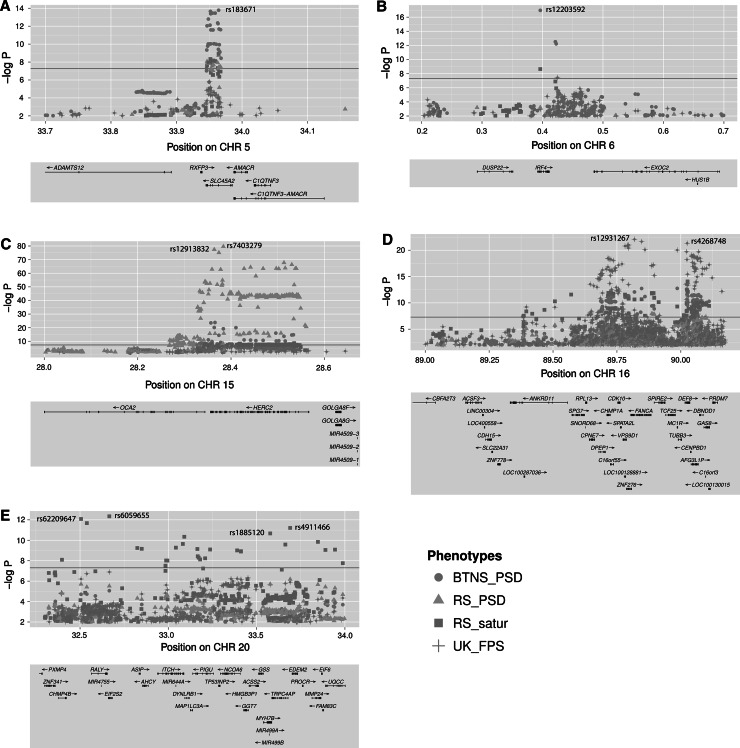
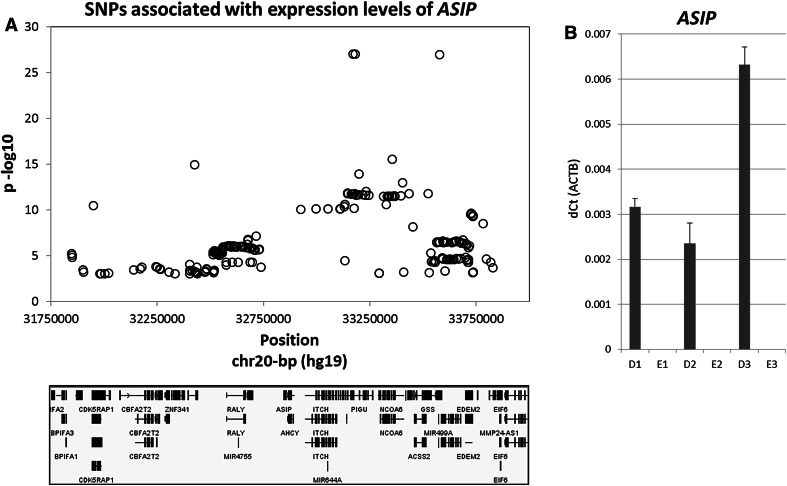
Verification
Claims the paper makes
The claims and statistics of this paper haven’t been checked yet.
Run the check — free, no account needed. It reads the open-access text and checks the sources it cites.
Claims other papers make about this one
Each is checked against this paper’s own text: does it say what the citing paper says it does?
In the citing paper
“In European populations, predictive models based on only 9 SNPs capture up to 16% of the variance in skin pigmentation (Liu et al., 2015), highlighting its relative simplicity.”
From An Unexpectedly Complex Architecture for Skin Pigmentation in Africans (2017) · cites this paper as Liu et al., 2015
Self-check
Percentages, sums and reported differences re-computed from the paper’s own numbers.
The self-check needs the paper’s full text.
Citations
Cites
The validity and practicality of sun-reactive skin types I through VI
Fitzpatrick, T. B. (1988) · Archives of Dermatology · doi:10.1001/archderm.1988.01670060015008 · Cited by 4,339
Histone H3K27ac separates active from poised enhancers and predicts developmental state
Creyghton, M. P., Cheng, A. W., Welstead, G. G., Kooistra, T., Carey, B. W., Steine, E. J., Hanna, J., Lodato, M. A., Frampton, G. M., Sharp, P. A., et al. (2010) · Proceedings of the National Academy of Sciences · doi:10.1073/pnas.1016071107 · Cited by 4,302
Evolutionarily conserved elements in vertebrate, insect, worm, and yeast genomes
Siepel, A., Bejerano, G., Pedersen, J. S., Hinrichs, A. S., Hou, M., Rosenbloom, K., Clawson, H., Spieth, J., Hillier, L. W., Richards, S., et al. (2005) · Genome Research · doi:10.1101/gr.3715005 · Cited by 3,971
Merlin—rapid analysis of dense genetic maps using sparse gene flow trees
Abecasis, G. R., Cherny, S. S., Cookson, W., & Cardon, L. R. (2001) · Nature Genetics · doi:10.1038/ng786 · Cited by 3,323
LocusZoom: regional visualization of genome-wide association scan results
Pruim, R. J., Welch, R. P., Sanna, S., Teslovich, T. M., Chines, P. S., Gliedt, T. P., Boehnke, M., Abecasis, G. R., & Willer, C. J. (2010) · Bioinformatics · doi:10.1093/bioinformatics/btq419 · Cited by 2,707
The Electronic Medical Records and Genomics (eMERGE) Consortium, Wood, A. R., The MIGen Consortium, The PAGE Consortium, Study, T. L. C., Esko, T., Yang, J., Vedantam, S., Pers, T. H., Gustafsson, S., et al. (2014) · Nature Genetics · doi:10.1038/ng.3097 · Cited by 1,853
The Rotterdam Study: objectives and design update
Albert Hofman, D., Breteler, M. M. B., van Duijn, C. M., Krestin, G. P., Pols, H. A. P., Stricker, B. H. C., Tiemeier, H. W., Uitterlinden, A. G., Vingerling, J. R., & Witteman, J. C. M. (2007) · European Journal of Epidemiology · doi:10.1007/s10654-007-9199-x · Cited by 1,408
MITF: master regulator of melanocyte development and melanoma oncogene
Levy, C., Khaled, M., & Fisher, D. E. (2006) · Trends in Molecular Medicine · doi:10.1016/j.molmed.2006.07.008 · Cited by 1,169
Wada, K., Tanaka, K., & Nakashima, K. (2011) · PubMed · Cited by 1,132
SLC24A5, a putative cation exchanger, affects pigmentation in zebrafish and humans
Lamason, R. L., Mohideen, M.-A. P. K., Mest, J. R., Wong, A. C., Norton, H. L., Aros, M. C., Jurynec, M. J., Mao, X., Humphreville, V. R., Humbert, J. E., et al. (2005) · Science · doi:10.1126/science.1116238 · Cited by 1,043
Cited by
Sorted by citations
The Rotterdam Study: 2018 update on objectives, design and main results
Ikram, M. A., Brusselle, G., Murad, S. D., van Duijn, C. M., Franco, O. H., Goedegebure, A., Klaver, C. C. W., Nijsten, T. E. C., Peeters, R. P., Stricker, B. H. C., et al. (2017) · European Journal of Epidemiology · doi:10.1007/s10654-017-0321-4 · Cited by 447
The Rotterdam Study: 2016 objectives and design update
Albert Hofman, D., Brusselle, G., Murad, S. D., van Duijn, C. M., Franco, O. H., Goedegebure, A., Ikram, M. A., Klaver, C. C. W., Nijsten, T. E. C., Peeters, R. P., et al. (2015) · European Journal of Epidemiology · doi:10.1007/s10654-015-0082-x · Cited by 385
Jin, Y., Andersen, G. H. L., Yorgov, D., Ferrara, T. M., Ben, S., Brownson, K. M., Holland, P. J., Birlea, S. A., Siebert, J., Hartmann, A., et al. (2016) · Nature Genetics · doi:10.1038/ng.3680 · Cited by 354
Loci associated with skin pigmentation identified in African populations
Crawford, N. G., Kelly, D. E., Hansen, M. E. B., Beltrame, M. H., Fan, S., Bowman, S. L., Jewett, E., Ranciaro, A., Thompson, S., Lo, Y., et al. (2017) · Science · doi:10.1126/science.aan8433 · Cited by 321
Chaitanya, L., Breslin, K., Zuñiga, S., Wirken, L., Pośpiech, E., Kukla-Bartoszek, M., Sijen, T., Knijff, P. D., Liu, F., Branicki, W., et al. (2018) · Forensic Science International: Genetics · doi:10.1016/j.fsigen.2018.04.004 · Cited by 335
Self-citation
Metadata
- Authors
- Liu, F., Visser, M., Duffy, D. L., Hysi, P. G., Jacobs, L. C., Lao, O., Zhong, K., Walsh, S., Chaitanya, L., Wollstein, A., Zhu, G., Montgomery, G. W., Henders, A. K., Mangino, M., Glass, D., Bataille, V., Sturm, R. A., Rivadeneira, F., Hofman, A., van IJcken, W. F. J., Uitterlinden, A. G., Palstra, R.-J. T. S., Spector, T. D., Martin, N. G., Nijsten, T. E. C., & Kayser, M.
- Affiliations
- Erasmus MC (NL)
- QIMR Berghofer Medical Research Institute (AU)
- King's College London (GB)
- Translational Research Institute (AU)
- Corresponding author
- Liu, Fan
- Kayser, Manfred
- ORCID
- Liu, Fan
- Visser, Mijke
- Duffy, David L.
- Hysi, Pirro G.
- Jacobs, Leonie C.
- Zhong, Kaiyin
- Walsh, Susan
- Chaitanya, Lakshmi
- Zhu, Gu
- Montgomery, Grant W.
- Henders, Anjali K.
- Mangino, Massimo
- Glass, Daniel
- Bataille, Veronique
- Sturm, Richard A.
- Rivadeneira, Fernando
- Uitterlinden, André G.
- Palstra, Robert-Jan T. S.
- Martin, Nicholas G.
- Nijsten, Tamar E. C.
- Kayser, Manfred
- Venue
- Human Genetics
- Published
- 2015-05-12
- Volume
- 134
- Issue
- 8
- Pages
- 823-835
- ISSN
- 0018-7348 (ISSN-L)
- 0340-6717
- 1432-1203
- PMC
- PMC4495261
- OpenAlex
- W1750145230
- Cited by
- 172
- References
- 54
- Citations by year
- 2026: 9 · 2025: 10 · 2024: 15 · 2023: 12 · 2022: 16 · 2021: 18 · 2020: 21 · 2019: 18 · 2018: 17 · 2017: 22 · 2016: 10 · 2015: 4
- FWCI
- 9.34
- Type
- journal article
- Language
- en
- Open access
- hybrid
- doi.org
- Locations
- Human Genetics (publishedVersion, cc-by)
- Europe PMC (PubMed Central) (publishedVersion, cc-by)
- PubMed Central (publishedVersion, cc-by)
- PubMed (publishedVersion)
- EUR Research Repository (Erasmus University Rotterdam) (publishedVersion, other-oa)
- EUR Research Repository (Erasmus University Rotterdam) (submittedVersion, other-oa)
- RePub (Erasmus University Rotterdam) (submittedVersion, other-oa)
- UCL Discovery (University College London) (submittedVersion)
- Research Portal (King's College London) (submittedVersion, cc-by)
- RePub (Erasmus University Rotterdam) (submittedVersion)
- IUScholarWorks (Indiana University) (submittedVersion, cc-by-nc-nd)
- PMC
- Funders
- Wellcome Trust
- National Institute for Health and Care Research (NF-SI-0514-10027)
- Nederlandse Organisatie voor Wetenschappelijk Onderzoek (911-03-012, 175.010.200)
- Medical Research Council (MR/N01104X/1)
- Biotechnology and Biological Sciences Research Council (G20234)
- National Eye Institute (R01EY018246)
- Eunice Kennedy Shriver National Institute of Child Health and Human Development (R01HD050735, HD50735)
- Topics
- Life Sciences › Biochemistry, Genetics and Molecular Biology › Cell Biology › melanin and skin pigmentation
- Life Sciences › Biochemistry, Genetics and Molecular Biology › Genetics › Genetic Associations and Epidemiology
- Life Sciences › Biochemistry, Genetics and Molecular Biology › Genetics › Forensic and Genetic Research
- Keywords
- skin color, pigmentation genetics, ASIP, SLC45A2, IRF4, MC1R, gene expression regulation, General Social Survey, forensic anthropology, European populations
- MeSH terms
- Interferon Regulatory Factor-4, Antigens, Neoplasm, Chromosomes, Human, Female, Follow-Up Studies, United Kingdom, Humans, Male, Middle Aged, Skin Pigmentation, Polymorphism, Single Nucleotide, Guanine Nucleotide Exchange Factors, Membrane Transport Proteins, White People, Ubiquitin-Protein Ligases, Interferon Regulatory Factors, Agouti Signaling Protein, Genome-Wide Association Study, Genetic Loci
About these checks
Registry, retraction, Cites and statistics results are computed, not judged, with one exception: a printed reference that no index lists is read once by a model before it counts as a citation error. Claims are extracted by a model and kept only when their quote appears verbatim in the text; each cited source is then checked, with a model’s help, for whether it says what the claim relies on. Those verdicts can be wrong — read the claim’s quote and the cited source before relying on one.
Statistics and arithmetic are recomputed, not judged.
Confidence bands are shown only for fields calibrated on our annotated test set. None is calibrated yet, so no band is shown.
What counts as a claim ›How we measure confidence ›How we check this ›
Are you an author, or do you see a problem with this page? Request a review
