

Does near-infrared (NIR) fluorescence angiography modify operative strategy during emergency procedures?
Open accessThe DOI matches its Crossref record; 21 of the 21 references it cites were found in a registry or an index.
Abstract
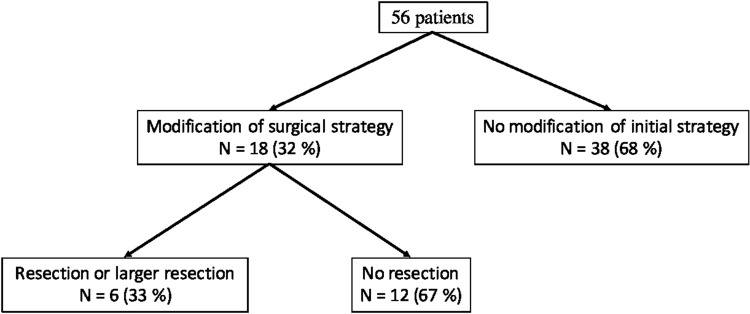
INTRODUCTION: Bowel viability can be difficult to evaluate during emergency surgery. Near-infrared (NIR) fluorescence angiography allows an intraoperative assessment of organ perfusion during elective surgery and might help to evaluate intestinal perfusion during emergency procedures. The aim of this study was to assess if NIR modified operative strategy during emergency surgery. MATERIALS AND METHODS: From July 2014 to December 2015, we prospectively evaluated all consecutive patients, who had NIR assessment during emergency surgery. Primary endpoint was the modification of operative strategy after the assessment with NIR. Secondary endpoints were general post-operative outcomes, including reoperation rate. RESULTS: Fifty-six patients were included in the study. Mean age was 64 ± 17 years. An exploratory laparoscopy was performed in 39% (n = 22) and an open surgery in 61% of cases (n = 34). Conversion rate to open surgery was 41% (n = 9). 32 patients had a bowel resection. In 32% of the cases (n = 18), the result of the NIR test led to a modification of the operative strategy. Among them, 33% (n = 6) had a larger resection or a resection, which was initially not planned. The other 12 patients (67%) had finally no resection, which was initially thought to be performed. Importantly, none of those patients needed a reoperation for ischemia. Mean time for performing NIR test was 167 s (± 121). Overall reoperation rate was 16.1% (n = 9). Two patients had an anastomotic leak. Eight patients (14.3%) died within the first 30 post-operative days; however, none of them presented a bowel ischemia or an anastomotic leak. CONCLUSION: NIR is an easy and short procedure, which can be performed during emergency surgery to assess bowel perfusion. It may help the surgeon to preserve intestinal length or to define the exact limits of resection. Overall, we report a modification of operative strategy in up to one-third of evaluated patients.
Overview
The claims and statistics of this paper haven’t been checked yet.
Free: it reads the open-access text and checks the first 5 claims that cite a source we can check. Create a free account to check every claim.
Integrity signals
Registry
Cites
Statistics
Figures
Verification
Claims the paper makes
The claims and statistics of this paper haven’t been checked yet.
Free: it reads the open-access text and checks the first 5 claims that cite a source we can check. Create a free account to check every claim.
Claims other papers make about this one
Each is checked against this paper’s own text: does it say what the citing paper says it does?
The cited source says what the claim attributes to it.
In the citing paper
“ICG utilization in the emergent setting, particularly in AMI, has not been well investigated to date, although early animal models, isolated cases, and cohort studies show promise.”
From Acute mesenteric ischemia: updated guidelines of the World Society of Emergency Surgery. (2022) · cites this paper as [91]
Self-check
Percentages, sums and reported differences re-computed from the paper’s own numbers.
The self-check needs the paper’s full text.
Citations
Cites
Dindo, D., Demartines, N., & Clavien, P.-A. (2004) · Annals of Surgery · doi:10.1097/01.sla.0000133083.54934.ae · Cited by 31,378
Clinical applications of indocyanine green (ICG) enhanced fluorescence in laparoscopic surgery
Boni, L., David, G., Mangano, A., Dionigi, G., Rausei, S., Spampatti, S., Cassinotti, E., & Fingerhut, A. (2015) · Surgical Endoscopy · doi:10.1007/s00464-014-3895-x · Cited by 548 · cited 1×
“This technology requires a special endoscope emitting a signal at a wavelength of 805 nm to visualize the blood flow in vessels and organs [4, 5].”
Boni, L., David, G., Dionigi, G., Rausei, S., Cassinotti, E., & Fingerhut, A. (2016) · Surgical Endoscopy · doi:10.1007/s00464-015-4540-z · Cited by 240
How to assess intestinal viability during surgery: A review of techniques
Urbanavičius, L. (2011) · World Journal of Gastrointestinal Surgery · doi:10.4240/wjgs.v3.i5.59 · Cited by 235 · cited 1×
“[1] published a review of those techniques.”
BULKLEY, G. B., ZUIDEMA, G. D., HAMILTON, S. R., OʼMARA, C. S., KLACSMANN, P. G., & HORN, S. D. (1981) · Annals of Surgery · doi:10.1097/00000658-198105000-00014 · Cited by 203
Disclosure between patients with gastrointestinal cancer and their spouses
Porter, L. S., Keefe, F. J., Hurwitz, H., & Faber, M. (2005) · Psycho-Oncology · doi:10.1002/pon.915 · Cited by 182
Enhanced-Reality Video Fluorescence: A Real-Time Assessment of Intestinal Viability
Diana, M., Noll, E., Diemunsch, P., Dallemagne, B., Benahmed, M. A., Agnus, V., Soler, L., Barry, B., Namer, I. J., Demartines, N., et al. (2014) · Annals of Surgery · doi:10.1097/sla.0b013e31828d4ab3 · Cited by 168 · cited 1×
“The studies were often done on animal models [8, 9].”
BackgroundIndocyanine green for intraoperative localization of ureter
Siddighi, S., Yune, J. J., & Hardesty, J. S. (2014) · American Journal of Obstetrics and Gynecology · doi:10.1016/j.ajog.2014.05.017 · Cited by 155 · cited 1×
“Actually, this technique offers much more applications to the general surgeon, including help during liver resection, ureteral localization [6], or abdominal wall reconstructive surgery as summarized by Gossedge et al.”
Near‐infrared laparoscopy for real‐time intra‐operative arterial and lymphatic perfusion imaging
Cahill, R. A., Ris, F., & Mortensen, N. J. M. C. (2011) · Colorectal Disease · doi:10.1111/j.1463-1318.2011.02772.x · Cited by 84 · cited 1×
“This technology requires a special endoscope emitting a signal at a wavelength of 805 nm to visualize the blood flow in vessels and organs [4, 5].”
Self-citationvan den Bos, J., Al‐Taher, M., Schols, R. M., van Kuijk, S. M. J., Bouvy, N. D., & Stassen, L. P. S. (2017) · Journal of Laparoendoscopic & Advanced Surgical Techniques · doi:10.1089/lap.2017.0231 · Cited by 80
Cited by
Acute mesenteric ischemia: updated guidelines of the World Society of Emergency Surgery.
Bala, M., Catena, F., Kashuk, J., De Simone, B., Gomes, C. A., Weber, D., Sartelli, M., Coccolini, F., Kluger, Y., Abu-Zidan, F. M., et al. (2022) · World Journal of Emergency Surgery · doi:10.1186/s13017-022-00443-x · Cited by 380
“It has been used in the same way as fluorescein, but primarily in the elective surgical setting [91].”
Robotic surgery in emergency setting: 2021 WSES position paper
de’Angelis, N., Khan, J. S., Marchegiani, F., Bianchi, G., Aisoni, F., Alberti, D., Ansaloni, L., Biffl, W. L., Chiara, O., Ceccarelli, G., et al. (2022) · World Journal of Emergency Surgery · doi:10.1186/s13017-022-00410-6 · Cited by 151
Self-citationCassinotti, E., Al‐Taher, M., Antoniou, S. A., Arezzo, A., Baldari, L., Boni, L., Bonino, M. A., Bouvy, N. D., Brodie, R., Carus, T., et al. (2023) · Surgical Endoscopy · doi:10.1007/s00464-023-09928-5 · Cited by 146
Sermonesi, G., Tian, B. W. C. A., Vallicelli, C., Abu‐Zidan, F. M., Damaskos, D., Kelly, M. D., Leppäniemi, A. K., Galante, J. M., Tan, E. C. T. H., Kirkpatrick, A. W., et al. (2023) · World Journal of Emergency Surgery · doi:10.1186/s13017-023-00520-9 · Cited by 161
“Flowmetry with fluorescein dye is currently considered the first-line adjunctive tool for intraoperative assessment of bowel perfusion, using a Woods Lamp in open laparotomies or laparoscopically using an endoscope with appropriate filters [170, 171].”
MethodKoelemay, M. J., Geelkerken, R. H., Kärkkäinen, J., Leone, N., Antoniou, G. A., de Bruin, J. L., Gombert, A., Gottsätter, A., Iborra, E., Ronchey, S., et al. (2025) · European Journal of Vascular and Endovascular Surgery · doi:10.1016/j.ejvs.2025.06.010 · Cited by 123
de Simone, B. D., Abu‐Zidan, F. M., Boni, L., González-Castillo, A. M., Cassinotti, E., Corradi, F., Maggio, F. D., Ashraf, H., Baiocchi, G. L., Tarasconi, A., et al. (2025) · World Journal of Emergency Surgery · doi:10.1186/s13017-025-00575-w · Cited by 74
“Otherwise, these case series continue to show that ICG angiography is a quick and safe technique without increased risk of major complications in patients with ASA scores of at least 3, even in the hands of less experienced surgeons [187].”
InfluentialTechniques for intraoperative evaluation of bowel viability in mesenteric ischemia: A review
Bryski, M. G., Sulyok, L. G. F., Kaplan, L. J., Singhal, S. K., & Keating, J. J. (2020) · The American Journal of Surgery · doi:10.1016/j.amjsurg.2020.01.042 · Cited by 56
Joosten, J. J., Longchamp, G., Khan, M. F., Lameris, W., van Berge Henegouwen, M. I., Bemelman, W. A., Cahill, R. A., Hompes, R., & Ris, F. (2022) · Surgical Endoscopy · doi:10.1007/s00464-022-09136-7 · Cited by 36
Self-citationde Simone, B. D., Abu‐Zidan, F. M., Saeidi, S., Deeken, G., Biffl, W. L., Moore, E. E., Sartelli, M., Coccolini, F., Ansaloni, L., Saverio, S. D., et al. (2024) · Updates in Surgery · doi:10.1007/s13304-024-01853-z · Cited by 38
“In 32% of the cases (18/56), fluorescence angiography led to modification of the operative strategy and 67% (12/18) of these patients had no resection, which was initially thought to have been performed [26].”
Application of Fluorescent Dyes in Visceral Surgery: State of the Art and Future Perspectives
Nowak, K., Karampinis, I., & Gerken, A. L. H. (2020) · Visceral Medicine · doi:10.1159/000506910 · Cited by 32
Lendzion, R. J., Frahm‐Jensen, G., & Keck, J. O. (2022) · Clinics in Colon and Rectal Surgery · doi:10.1055/s-0042-1743283 · Cited by 44
Mullen, K. M., Regier, P. J., Ellison, G. W., & Londoño, L. A. (2020) · Topics in companion animal medicine · doi:10.1016/j.tcam.2020.100438 · Cited by 42
Quero, G., Lapergola, A., Barberio, M., Seeliger, B., Saccomandi, P., Guerriero, L., Mutter, D., Saadi, A., Worreth, M. D., Marescaux, J., et al. (2018) · Surgical Endoscopy · doi:10.1007/s00464-018-6512-6 · Cited by 32
Clinical features of patients with hepatic portal venous gas
Fujii, M., Yamashita, S., Tanaka, M., Tashiro, J., Takenaka, Y., Yamasaki, K., & Masaki, Y. (2020) · BMC Surgery · doi:10.1186/s12893-020-00973-8 · Cited by 24
Laparoscopy in major abdominal emergency surgery seems to be a safe procedure.
Nielsen, L. B. J., Tengberg, L. T., & Bay‐Nielsen, M. (2017) · PubMed · Cited by 20
Application of fluorescence-guided surgery in the acute care setting: a systematic literature review
Fransvea, P., Fico, V., Puccioni, C., D’Agostino, L., Costa, G., Biondi, A., Brisinda, G., & Sganga, G. (2023) · Langenbeck s Archives of Surgery · doi:10.1007/s00423-023-03109-7 · Cited by 19
“In the majority of the articles included in this review, it used a fixed dose of ICG (median value 7.5 mg) [15, 19–24, 30, 34]; on the other hand, in three studies, the dose of ICG to use was calculated with the weight of the patient (median value 0.2 mg/kg) [18, 25, 26].”
BackgroundMethodInfluentialEmergency robotic surgery: the experience of a single center and review of the literature
Ceccarelli, G., Catena, F., Avella, P., Tian, B. W., Rondelli, F., Guerra, G., Rosa, M. D., & Rocca, A. (2024) · World Journal of Emergency Surgery · doi:10.1186/s13017-024-00555-6 · Cited by 20
“This feature is not routinely available in laparoscopic surgery [66, 67].”
BackgroundProspects of Intraoperative Multimodal OCT Application in Patients with Acute Mesenteric Ischemia
Kiseleva, E. B., Ryabkov, M. G., Baleev, M. S., Львовна, Б. Е., Shilyagin, P. A., Moiseev, A. A., Beschastnov, V. V., Romanov, I., Gelikonov, G. V., & Gladkova, N. D. (2021) · Diagnostics · doi:10.3390/diagnostics11040705 · Cited by 22
“it is advisable to use techniques that have proven efficacy: LSCI [41,70] or fluorescence angiography [19,20].”
BackgroundMethodResultNamikawa, T., Iwabu, J., Hashiba, M., Munekage, M., Uemura, S., Yamada, T., Kitagawa, H., Mizuta, H., Okamoto, K., Uchida, K., et al. (2020) · Langenbeck s Archives of Surgery · doi:10.1007/s00423-020-01902-2 · Cited by 16
Role of near-infrared fluorescence in colorectal surgery
Zocola, E., Meyer, J., Christou, N., Liot, É., Toso, C., Buchs, N. C., & Ris, F. (2021) · World Journal of Gastroenterology · doi:10.3748/wjg.v27.i31.5189 · Cited by 14
Self-citationOsterkamp, J. T. F., Patel, M. Q., Steyn, E., Svendsen, L. B., Forgan, T., & Achiam, M. P. (2021) · International Journal of Surgery Open · doi:10.1016/j.ijso.2021.02.001 · Cited by 12
Verhaar, N., & Geburek, F. (2025) · Veterinary Surgery · doi:10.1111/vsu.14248 · Cited by 11
Bowel viability assessment during surgery (review of the literature)
Zacharenko, A., Беляев, М. А., Трушин, А. А., Zaytcev, D. A., & Курсенко, Р. В. (2020) · Grekov s Bulletin of Surgery · doi:10.24884/0042-4625-2020-179-1-82-88 · Cited by 12
Current Concepts in Small Animal Gastrointestinal Surgery
Regier, P. J. (2022) · Veterinary Clinics of North America Small Animal Practice · doi:10.1016/j.cvsm.2021.11.002 · Cited by 8
Rizzo, R., Vallicelli, C., Ansaloni, L., Coccolini, F., Fugazzola, P., Sartelli, M., Agnoletti, V., Baiocchi, G. L., & Catena, F. (2024) · International Journal of Surgery · doi:10.1097/js9.0000000000001529 · Cited by 9
“Karampinis et al. [26] University of Heidelberg 2018 Retrospective no PSM 7 9 Reoperation/mortality 11 Liot et al. [27] University of Geneva 2018 Retrospective no PSM 15 25 Reoperation/mortality 13 Guerra et al. [23] Pesaro Hospital Italy 2020 Retrospective no PSM 27 66 Reoperation…”
Zhang, X., Wu, L., Li, Y., Tao, Z., Li, N., Zhang, H., Ren, M., & Wang, K. (2024) · Environmental Health and Preventive Medicine · doi:10.1265/ehpm.24-00206 · Cited by 6
“Additionally, diagnostic advances, such as portable ultrasound for early emergency diagnosis and near-infrared fl uorescence imaging for dynamic blood fl ow perfusion observation have been made [36].”
Ryabkov, M. G., Kiseleva, E. B., Baleev, M. S., Львовна, Б. Е., Sizov, M. A., Vorobyov, A. N., Moiseev, A. A., Karabut, M. M., Plekhanova, M. A., & Gladkova, N. D. (2020) · Современные технологии в медицине · doi:10.17691/stm2020.12.2.07 · Cited by 6
Christofi, A., Traska, T., & Dimitroulis, D. (2024) · Innovative Surgical Sciences · doi:10.1515/iss-2024-0013 · Cited by 7
Zorzetti, N., Lauro, A., Cuoghi, M., Gatta, M. L., Marino, I. R., Sorrenti, S., D’Andrea, V., Mingoli, A., & Navarra, G. G. (2023) · Journal of Clinical Medicine · doi:10.3390/jcm12165173 · Cited by 5
“Combined in real-time WL images with fluorescence NIR, ICG provides intraoperative information on blood perfusion and tissue vitality, guiding the successive surgical strategy [8,9].”
MethodMullen, K. M., Regier, P. J., Perez‐Rodriguez, V., Fox‐Alvarez, W. A., Bertran, J., & Colee, J. (2023) · Veterinary Surgery · doi:10.1111/vsu.14067 · Cited by 4
Evidenz der Indocyaningrünfluoreszenz in der robotisch assistierten Kolorektalchirurgie
Vilz, T. O., Kalff, J. C., & Stoffels, B. (2021) · Der Chirurg · doi:10.1007/s00104-020-01340-2 · Cited by 4
Perini, D., & Martellucci, J. (2024) · World Journal of Gastrointestinal Surgery · doi:10.4240/wjgs.v16.i2.270 · Cited by 5
Advancement in the diagnosis and treatment of hepatic portal venous gas
Zhou, Q., Zheng, Z., Lv, X., Guo, J.-Q., Zhang, K., & Xu, H. (2025) · World Journal of Gastrointestinal Surgery · doi:10.4240/wjgs.v17.i10.109062 · Cited by 2
“Recent studies have suggested the use of near-infrared fluorescence angiography to assess bowel perfusion, which has potentially reduced the rate of postoperative intestinal fistula, although its effectiveness warrants further investigation[34].”
Kulkarni, A., Sheth, C., & Pawa, N. (2026) · Updates in Surgery · doi:10.1007/s13304-025-02469-7 · Cited by 2
“The perceived accuracy of ICG depends heavily on the surgeon’s own experience, the intraoperative context, and the urgency of the case [ 2, 3 , 5, 7, 8 ].”
InfluentialFluorescence-Guided Surgery With Indocyanine Green in Acute Bowel Ischemia: A Systematic Review
Nicolae, S. E., Snitkjær, C., Schucany, A., Nerup, N. A., Burcharth, J., & Achiam, M. P. (2026) · Journal of Surgical Research · doi:10.1016/j.jss.2026.02.024 · Cited by 3
Aggarwal, V., Ravi, V., Puri, G., & Ranjan, P. (2021) · BMJ Case Reports · doi:10.1136/bcr-2021-242497 · Cited by 2
Clough, E., Nightingale, K., Smith, S. R., & Burke, J. (2026) · ANZ Journal of Surgery · doi:10.1111/ans.70433 · Cited by 2
ICG Image-Guided Surgery with the Assessment for Anastomotic Safety
Ramamoorthy, S. L., & Matson, J. S. (2021) · Springer eBooks · doi:10.1007/978-3-030-78217-7_34 · Cited by 1
Modern methods of assessing the viability of the intestinal wall (review)
Valiev, A. A., Hasanov, R. S., Galimova, L., & Гатауллин, И. Г. (2023) · Koloproktologia · doi:10.33878/2073-7556-2023-22-3-140-148 · Cited by 1
Laparoscopic surgery for acute small bowel obstruction: How best to determine bowel viability
Guerra, F., & Coletta, D. (2021) · Colorectal Disease · doi:10.1111/codi.15953
ICG-Fluoreszenz und Enhanced Imaging
Nowak, K. (2024) · Springer eBooks · doi:10.1007/978-3-662-67852-7_6
GUIA DE ORIENTAÇÕES PARA A ASSISTÊNCIA PRÉ-NATAL A HOMENS TRANS E PESSOAS TRANS MASCULINAS
dos Santos, J. A. B., de Almeida, L. C. G., Santos, J. S., Oliveira, D. M., dos Santos, S. C., Franceschini, P. K. M., Mascarenhas, R. N. D. S., de Jesus, J. E. O., Vieira, I. R. P., Sousa, M. D. O., et al. (2025) · doi:10.22533/at.ed.4042522012
Bala, M., Catena, F., Kashuk, J., De Simone, B., Gomes, C. A., Weber, D., Sartelli, M., Coccolini, F., Kluger, Y., Abu-Zidan, F. M., et al. (2022) · Figshare · doi:10.6084/m9.figshare.21368764
Improved Quantification of ICG Perfusion Through Motion Compensation in Fluorescence-Guided Surgery
Nicolae, S. E., Piper, T. B., Nerup, N. A., Achiam, M. P., & Svendsen, M. B. S. (2026) · Diagnostics · doi:10.3390/diagnostics16020176 · Cited by 2
Indocyanine Green Fluorescence-Guided Emergency Surgery: Principles for an Evidence-Based Practice
de Simone, B. D., & Catena, F. (2026) · Hot topics in acute care surgery and trauma · doi:10.1007/978-3-032-09357-8_14
Seeliger, B. (2019) · theses.fr (ABES) · doi:10.70675/4e77927fzf930z4451z9deazf89581812487
Ceccato, F., Marinello, P., Patauner, S., & Frena, A. (2026) · Surgical Endoscopy · doi:10.1007/s00464-026-13094-9
“Several studies allowed repeat ICG administration in case of uncertainty or for additional assessment following bowel resection, including evaluation of anastomotic perfusion [19, 21].”
InfluentialKourgiali, C. G., Gotti, K.-K. E., Velikoudi, M. D., & Chatzelas, D. A. (2026) · Cureus · doi:10.7759/cureus.114102
Metadata
- Authors
- Liot, E., Assalino, M., Buchs, N. C., Schiltz, B., Douissard, J., Morel, P., & Ris, F.
- Affiliations
- University of Geneva (CH)
- ORCID
- Venue
- Surgical Endoscopy
- Published
- 2018-05-16
- Volume
- 32
- Issue
- 10
- Pages
- 4351-4356
- ISSN
- 0930-2794 (ISSN-L)
- 1432-2218
- PMC
- PMC6132899
- OpenAlex
- W2804048005
- Cited by
- 48
- References
- 21
- Citations by year
- 2026: 7 · 2025: 4 · 2024: 7 · 2023: 6 · 2022: 6 · 2021: 7 · 2020: 7 · 2019: 2 · 2018: 1
- FWCI
- 2.94
- Type
- journal article
- Language
- en
- Open access
- hybrid
- doi.org
- Licence
- cc-by
- creativecommons.org/licenses/by/4.0 (tdm)
- Locations
- Surgical Endoscopy (publishedVersion, cc-by)
- Europe PMC (PubMed Central) (publishedVersion, other-oa)
- PubMed Central (publishedVersion, cc-by)
- PubMed (publishedVersion)
- Archive ouverte UNIGE (University of Geneva) (publishedVersion, other-oa)
- Archive ouverte UNIGE (University of Geneva) (submittedVersion, cc-by)
- Topics
- Health Sciences › Medicine › Radiology, Nuclear Medicine and Imaging › Optical Imaging and Spectroscopy Techniques
- Health Sciences › Medicine › Surgery › Abdominal vascular conditions and treatments
- Health Sciences › Medicine › Oncology › Colorectal Cancer Surgical Treatments
- Keywords
- bowel viability, intestinal perfusion, emergency surgery, bowel resection, intestinal ischemia, reoperation rate, anastomotic leakage, diagnostic laparoscopy
- MeSH terms
- Adult, Aged, Aged, 80 and over, Emergencies, Female, Fluorescein Angiography, Humans, Indocyanine Green, Intestines, Intraoperative Period, Male, Middle Aged, Laparoscopy, Reoperation, Retrospective Studies, Digestive System Surgical Procedures, Anastomotic Leak, Conversion to Open Surgery
About these checks
Registry, retraction, Cites and statistics results are computed, not judged, with one exception: a printed reference that no index lists is read once by a model before it counts as a citation error. Claims are extracted by a model and kept only when their quote appears verbatim in the text; each cited source is then checked, with a model’s help, for whether it says what the claim relies on. Those verdicts can be wrong — read the claim’s quote and the cited source before relying on one.
Statistics and arithmetic are recomputed, not judged.
Confidence bands are shown only for fields calibrated on our annotated test set. None is calibrated yet, so no band is shown.
What counts as a claim ›How we measure confidence ›How we check this ›
Are you an author, or do you see a problem with this page? Request a review
Data sources
Bibliographic data: Semantic Scholar, OpenAlex, Crossref.
Contains information from the Semantic Scholar Academic Graph Datasets, made available under the ODC Attribution License (ODC-BY 1.0).
Semantic Scholar’s data is described in: Kinney, R., et al. (2023). The Semantic Scholar Open Data Platform. arXiv:2301.10140.
