

Randomized controlled trial of standardized education and telemonitoring for pain in outpatients with advanced solid tumors
Open accessThe DOI matches its Crossref record; 31 of the 31 references it cites were found in a registry or an index.
Abstract
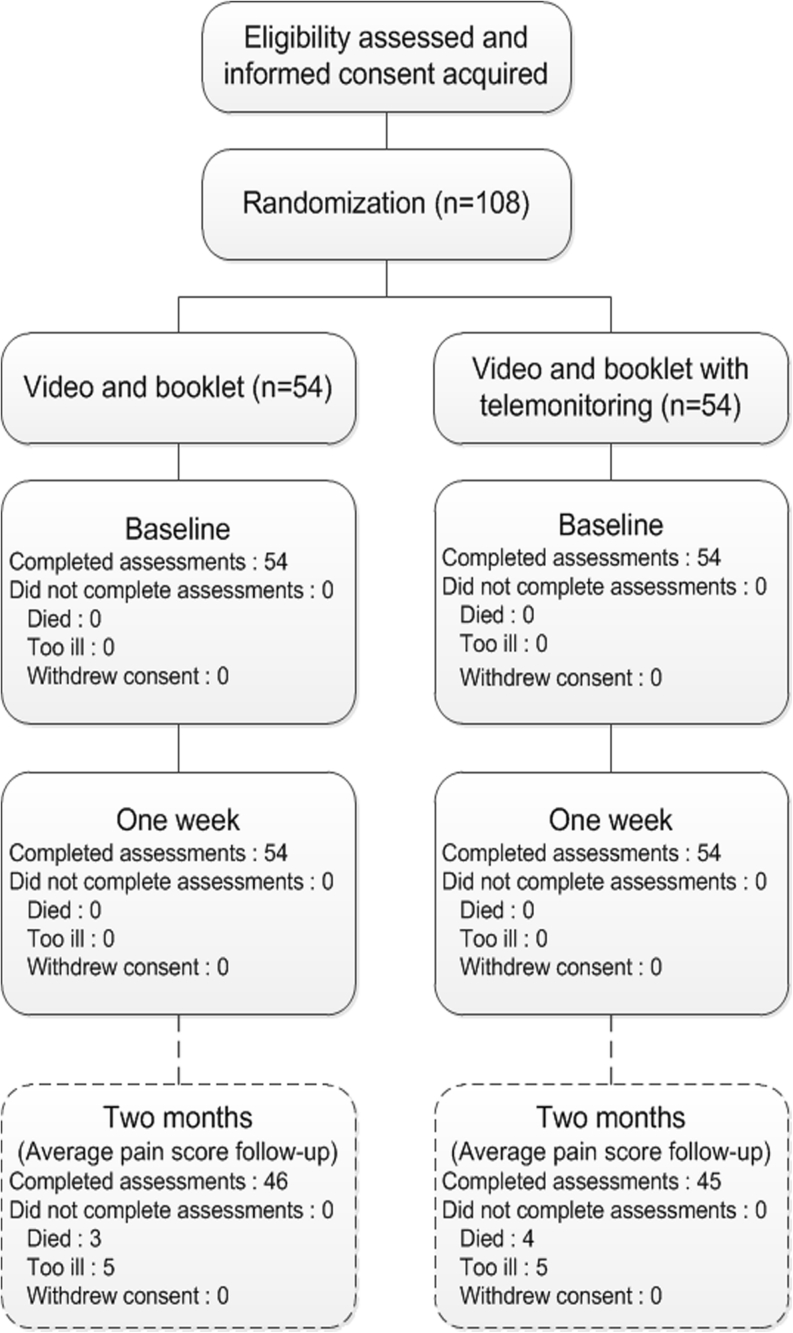
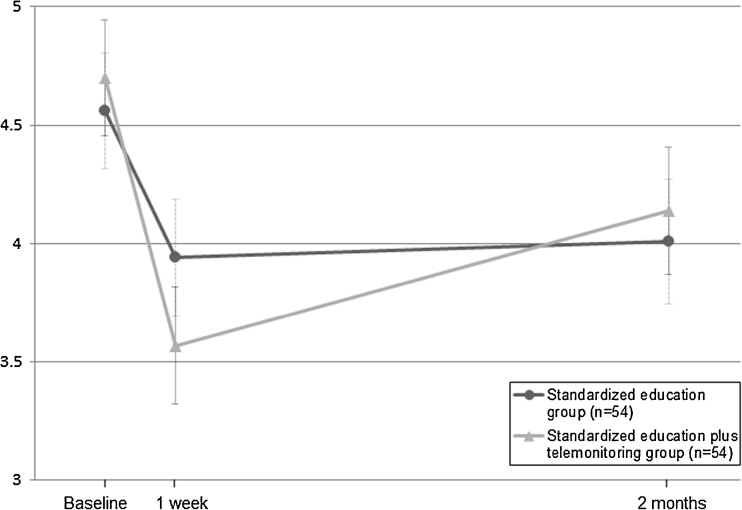
PURPOSE: Previous studies have not defined the role of telemonitoring with educational tools in outpatients with advanced cancers. We tested the effectiveness of standardized education and telemonitoring for improving pain, distress, anxiety, depression, quality of life (QoL), and performance in outpatients with advanced cancers. METHODS: A total of 108 patients were randomly assigned to receive pain education alone (control arm) or pain education plus telemonitoring (experimental arm). Nursing specialists provided video-assisted educational material in both arms and daily telemonitoring for the first week in the experimental arm. Assessment was performed at baseline and 1 week and included evaluations of pain (Brief Pain Inventory, BPI), distress (Distress Thermometer, DT), anxiety, and depression (Hospital Anxiety and Depression Scale, HADS), QoL (QLQ-C30), and a Karnofsky score. RESULTS: Overall (n = 108), pain intensity was significantly improved at 1 week, including worst pain (7.3 to 5.7, P < 0.01) and average pain (4.6 to 3.8, P < 0.01). Additionally, anxiety (HADS score ≥ 11, 75% to 56%, P < 0.01), depression (HADS score ≥ 11, 73% to 51%, P < 0.01), QoL (fatigue and insomnia), and the Karnofsky score (32 to 66, P < 0.01) were also significantly improved at 1 week. However, the level of distress did not improve. The telemonitoring plus standardized education group showed more significant improvement in portion of pain >4 on VAS scale (35% vs. 19%, P = 0.02). CONCLUSIONS: Standardized pain education using nursing specialists is an efficient way to improve not only pain itself but also anxiety, depression, performance, and QoL. The addition of telemonitoring helps to improve pain management in the outpatient setting.
Overview
The claims and statistics of this paper haven’t been checked yet.
Free: it reads the open-access text and checks the first 5 claims that cite a source we can check. Create a free account to check every claim.
Integrity signals
Registry
Cites
Statistics
Figures
Verification
Claims the paper makes
The claims and statistics of this paper haven’t been checked yet.
Free: it reads the open-access text and checks the first 5 claims that cite a source we can check. Create a free account to check every claim.
Claims other papers make about this one
Each is checked against this paper’s own text: does it say what the citing paper says it does?
The source backs part of the claim, not all of it — or backs it for a different population, condition or comparison.
In the citing paper
“Even so, some trials with positive effects on other dimensions (ie, where anxiety or depression were not among the primary outcomes) were also found to effectively treat adults with depression.137,138”
From Management of Anxiety and Depression in Adult Survivors of Cancer: ASCO Guideline Update (2023) · cites this paper as [138]
Experimental — accuracy not yet measured
Self-check
Percentages, sums and reported differences re-computed from the paper’s own numbers.
The self-check needs the paper’s full text.
Citations
Cites
The Hospital Anxiety and Depression Scale
Zigmond, A. S., & Snaith, R. P. (1983) · Acta Psychiatrica Scandinavica · doi:10.1111/j.1600-0447.1983.tb09716.x · Cited by 47,139
Aaronson, N. K., Ahmedzai, S., Bergman, B., Bullinger, M., Cull, A., Duez, N. J., Filiberti, A., Flechtner, H., Fleishman, S. B., Haes, J. C. J. M. D., et al. (1993) · JNCI Journal of the National Cancer Institute · doi:10.1093/jnci/85.5.365 · Cited by 16,005 · cited 1×
“The European Organization for Research and Treatment of Cancer Quality of Life Questionnaire (EORTC QLQC30) is a well-defined instrument containing 30 items for cancer patients [25].”
MethodPain and Its Treatment in Outpatients with Metastatic Cancer
Cleeland, C. S., Gonin, R., Hatfield, A. K., Edmonson, J. H., Blum, R. H., Stewart, J. A., & Pandya, K. J. (1994) · New England Journal of Medicine · doi:10.1056/nejm199403033300902 · Cited by 2,019 · cited 2×
“7 in Table 2), which was comparable to a previous report [27].”
BackgroundResultPrevalence of pain in patients with cancer: a systematic review of the past 40 years
van den Beuken-van Everdingen, M. H. J., de Rijke, J. M., Kessels, A. G., Schouten, H. C., van Kleef, M., & Patijn, J. (2007) · Annals of Oncology · doi:10.1093/annonc/mdm056 · Cited by 1,923 · cited 1×
“Pain is one of the most common symptoms in patients with advanced cancer, and more than one-third of patients with pain rate it as moderate or severe [1].”
BackgroundBreast Cancer, Version 4.2017, NCCN Clinical Practice Guidelines in Oncology
Gradishar, W. J., Anderson, B. O., Balassanian, R., Blair, S. L., Burstein, H. J., Cyr, A., Elias, A. D., Farrar, W. B., Forero, A., Giordano, S. H., et al. (2018) · Journal of the National Comprehensive Cancer Network · doi:10.6004/jnccn.2018.0012 · Cited by 1,609
Development of the Wisconsin Brief Pain Questionnaire to assess pain in cancer and other diseases
Daut, R. L., Cleeland, C. S., & Flanery, R. C. (1983) · Pain · doi:10.1016/0304-3959(83)90143-4 · Cited by 1,562 · cited 1×
“It rates the severity of pain, including worst, least, and average pain in the last 24 h, on a 0–10 scale along with the degree of interference [22].”
BackgroundPortenoy, R. K., & Lesage, P. (1999) · The Lancet · doi:10.1016/s0140-6736(99)01310-0 · Cited by 1,017
Prevalence of undertreatment in cancer pain. A review of published literature
Deandrea, S., Montanari, M., Moja, L., & Apolone, G. (2008) · Annals of Oncology · doi:10.1093/annonc/mdn419 · Cited by 870 · cited 1×
“Despite the existence of well-documented guidelines for cancer pain [2-4], nearly 50 % of patients are undertreated [5].”
BackgroundMarkou, K. D., Nikolaou, A. C., & Themelis, C. (2011) · Cited by 757
Management of cancer pain: ESMO Clinical Practice Guidelines
Ripamonti, C. I., Bandieri, E., & Roila, F. (2011) · Annals of Oncology · doi:10.1093/annonc/mdr390 · Cited by 447
Cited by
Interactive telemedicine: effects on professional practice and health care outcomes
Flodgren, G., Rachas, A., Farmer, A. J., Inzitari, M., & Shepperd, S. (2015) · Cochrane Database of Systematic Reviews · doi:10.1002/14651858.cd002098.pub2 · Cited by 806
Management of Anxiety and Depression in Adult Survivors of Cancer: ASCO Guideline Update
Andersen, B. L., Lacchetti, C., Ashing, K., Berek, J. S., Berman, B. S., Bolte, S., Dizon, D. S., Given, B., Nekhlyudov, L., Pirl, W., et al. (2023) · Journal of Clinical Oncology · doi:10.1200/jco.23.00293 · Cited by 318
Psychosocial interventions for advanced cancer patients: a systematic review
Teo, I., Krishnan, A., & Lee, G. L. (2019) · Psycho-Oncology · doi:10.1002/pon.5103 · Cited by 205
“A number of studies, especially those that focus on education, skills training, and symptom management are beginning to test the use of telehealth for delivery of interventions to increase reach and adherence as well as reduce long‐term costs.(23,68,78,79) A vast majority of the studies reviewed did not report cost or…”
BackgroundAgboola, S. O., Ju, W., Elfiky, A., Kvedar, J. C., & Jethwani, K. (2015) · Journal of Medical Internet Research · doi:10.2196/jmir.4009 · Cited by 132
“Thirteen (65%) of the 20 trials, were conducted among patients with breast cancer [12,16-18,21,22,25-31], followed by four trials in patients with any solid cancer [13-15,23], and one trial each with focus on cervical [24], colorectal [19], and colorectal/prostate cancers [20].”
InfluentialLi, J., Liu, Y., Jiang, J., Peng, X., & Hu, X. (2021) · International Journal of Nursing Studies · doi:10.1016/j.ijnurstu.2021.103970 · Cited by 98
Models of Integration of Specialized Palliative Care with Oncology
Mathews, J. J., Hannon, B. L., & Zimmermann, C. (2021) · Current Treatment Options in Oncology · doi:10.1007/s11864-021-00836-1 · Cited by 99
Pain prevalence in cancer patients: status quo or opportunities for improvement?
Haumann, J., Joosten, E. A. J., & Everdingen, M. H. J. V. D. B.-V. (2017) · Current Opinion in Supportive and Palliative Care · doi:10.1097/spc.0000000000000261 · Cited by 77
Living with Metastatic Cancer: A Roadmap for Future Research
Tometich, D. B., Hyland, K. A., Soliman, H. H., Jim, H., & Oswald, L. B. (2020) · Cancers · doi:10.3390/cancers12123684 · Cited by 54
“Existing studies have sought to improve patient education and communication with medical providers at the point of metastatic diagnosis and during treatment using decision aids [150–157], communication aids [153,154], question prompt lists [150–152], and educational videos and handouts [155,157].”
BackgroundLee, C. E., Kim, S., Kim, S., Joo, H. M., & Lee, S. (2017) · Holistic Nursing Practice · doi:10.1097/hnp.0000000000000220 · Cited by 47
Self-citationKoh, S., Keam, B., Hyun, M. K., Seo, J. J., Park, K. U., Oh, S. Y., Ahn, J., Lee, J. Y., & Kim, J. (2018) · Pain Medicine · doi:10.1093/pm/pny039 · Cited by 39
Self-citationHochstenbach, L. M. J., Courtens, A. M., Zwakhalen, S. M. G., Vermeulen, J., van Kleef, M., & de Witte, L. P. (2017) · Applied Nursing Research · doi:10.1016/j.apnr.2017.03.004 · Cited by 36
Eaton, L. H., Brant, J. M., McLeod, K., & Yeh, C. H. (2017) · Clinical journal of oncology nursing · doi:10.1188/17.cjon.s3.54-70 · Cited by 35
“(CONTINUED) PUTTING EVIDENCE INTO PRACTICE: RECOMMENDED FOR PRACTICE FOR PROCEDURAL INTERVENTIONS STUDY INTERVENTION SAMPLE AND DESIGN FINDINGS LIMITATIONS Celiac plexus block (continued) Yamaguchi et al., 2013 (Japan) Celiac plexus block Japanese Society for Palliative Medicine guidelines Celiac plexus block recommen…”
InfluentialRural Palliative Care Telemedicine for Advanced Cancer Patients: A Systematic Review
Sánchez-Cárdenas, M. A., Iriarte‐Aristizábal, M. F., León, M., Rodríguez-Campos, L. F., Correa‐Morales, J. E., Piñeros, Á. M. C., & Parra, S. L. (2022) · American Journal of Hospice and Palliative Medicine® · doi:10.1177/10499091221130329 · Cited by 32
“The prognosis was established from cut off points in functionality scores that predicted a life expectancy of less than 24 months.(15,18,19,21,22,24,28) The treatment status criteria found in the articles stated candidates for telemedicine care should not be receiving oncologic treatment.”
BackgroundMethodInfluentialFamily caregivers of advanced cancer patients: self-perceived competency and meaning-making
Teo, I., Baid, D., Ozdemir, S., Malhotra, C., Singh, R., Harding, R., Malhotra, R., Yang, M. G., Neo, S. H.-S., Cheung, Y. B., et al. (2020) · BMJ Supportive & Palliative Care · doi:10.1136/bmjspcare-2019-001979 · Cited by 29
Zweers, D., de Graaf, E., & Teunissen, S. C. C. M. (2015) · International Journal of Nursing Studies · doi:10.1016/j.ijnurstu.2015.10.022 · Cited by 29
“e study described blinding procedures for physicians d nurse practitioners who were not informed about the ndomization process (Kim et al., 2013).”
BackgroundMethodInfluentialHome Telemonitoring Improved Pain Registration in Patients With Cancer
Knegtmans, M. F., Wauben, L. S. G. L., Wagemans, M. F. M., & Oldenmenger, W. H. (2019) · Pain Practice · doi:10.1111/papr.12830 · Cited by 28
“Although Kim et al. used telemonitoring to measure pain for only 1 week without continuation, their findings were consistent with our results.”
BackgroundInfluentialThe discordance of information needs between cancer patients and their families in China
Yi, T., Deng, Y., Chen, H., Zhang, J., Liu, J., Huang, B., Wang, Y., & Jiang, Y. (2015) · Patient Education and Counseling · doi:10.1016/j.pec.2015.12.022 · Cited by 27
Zhang, L., McLeod, H. L., Liu, K.-K., Liu, W., Huang, H., Huang, Y.-M., Sun, S., Chen, X., Chen, Y., Liu, F.-Z., et al. (2021) · JMIR mhealth and uhealth · doi:10.2196/24555 · Cited by 27
“However, the portion of average pain rated ≥4 did not improve significantly because of the short study period [20].”
BackgroundPain, fatigue, anxiety and depression in older home‐dwelling people with cancer
Solvik, E., Ytrehus, S., Utne, I., & Grov, E. K. (2019) · Nursing Open · doi:10.1002/nop2.406 · Cited by 26
“It is possible that well-adjusted pain treatment may reduce fatigue, anxiety and depression (Kim et al., 2013) and individual follow-up programmes may have a positive effect on symptoms like fatigue, anxiety (Paiva et al., 2012), pain and depression (Shi et al., 2015).”
BackgroundPark, Y., & Lee, M. K. (2021) · Journal of Nursing Scholarship · doi:10.1111/jnu.12750 · Cited by 24
Duan, L., Zhang, S., Yan, Q., Chen, Y., Su, Y., & Hu, X. (2026) · Worldviews on Evidence-Based Nursing · doi:10.1111/wvn.70103 · Cited by 21
Bektaş, H., Çoşkun, H. Ş., Arıkan, F., Özcan, K., Tekeli, A., Kondak, Y., Sezgin, M. G., Yangec, E., & Kalav, S. (2022) · Supportive Care in Cancer · doi:10.1007/s00520-022-07039-w · Cited by 21
“In a study examining the effects of standard education and telemonitoring on patient outcomes, it was stated that standard education was effective in symptoms such as pain, anxiety, and depression only in the first week and that education and telemonitoring provided more and long-term improvement in patient outcomes […”
BackgroundGonzález-Martín, A. M., Aguilera-García, I., Castellote‐Caballero, Y., Rivas-Campo, Y., SUÁREZ, A. B., & Aibar‐Almazán, A. (2023) · Cancers · doi:10.3390/cancers15164123 · Cited by 19
“[43] found a significant decrease in pain intensity at week, including the worst pain (p < 0.”
BackgroundTelehealth as a Panacea Amidst Global Pandemic (COVID-19) in Africa
Alhassan, G. N., Öztürk, İ., Adedoyin, F. F., & Bekun, F. V. (2021) · Düzce Tıp Fakültesi Dergisi · doi:10.18678/dtfd.898373 · Cited by 19
“(17) analyzed the key role of telemonitoring in QoL, distress, and anxiety randomly in advance cancer outpatient.”
BackgroundTelehealth in patient care by advanced practice nurses: a systematic review
Costa, I. C. P., Costa, A. S., Garbuio, D. C., Zamarioli, C. M., Eduardo, A. H. A., de Carvalho, E. C., & Chaves, É. D. C. L. (2025) · Acta Paulista de Enfermagem · doi:10.37689/acta-ape/2025ar0003141 · Cited by 18
Haveman, M. E., Jonker, L. T., Hermens, H. J., Tabak, M., & de Vries, J. P. P. M. (2021) · Journal of Telemedicine and Telecare · doi:10.1177/1357633x211047710 · Cited by 17
Associated factors of distress in patients with advanced cancer: A retrospective study
Huertas, L. A., Allende‐Pérez, S., & Pastrana, T. (2020) · Palliative & Supportive Care · doi:10.1017/s1478951520001066 · Cited by 16
Chen, W., Huang, J., Cui, Z., Wang, L., Dong, L., Ying, W., & Zhang, Y. (2023) · Therapeutic Advances in Chronic Disease · doi:10.1177/20406223231153097 · Cited by 16
Update on Research-Based Interventions for Anxiety in Patients With Cancer
Smith, P. R., Cope, D. G., Sherner, T. L., & Walker, D. (2014) · Clinical journal of oncology nursing · doi:10.1188/14.cjon.s3.5-16 · Cited by 15
“…because significant reductions in anxiety were reported in several studies (Chan et al., 2011; Galway et al., 2012; Katz, Irish, & Devins, 2004; Kim et al., 2013; Liu et al., 2008; Targ & Levine, 2002; Williams & Schreier, 2004) and others reported no significant effects (Goerling, Foerg,…”
Zhao, B., Zhang, S., Zhang, T., Chen, Y., & Zhang, C. (2024) · Supportive Care in Cancer · doi:10.1007/s00520-024-08866-9 · Cited by 13
“Four studies reported pain intensity [30, 31, 35, 39], three using the Brief Pain Inventory (BPI) [30, 35, 39], and one using the 3-item Patient-Reported Outcomes Measurement Information System (PROMIS) [31], with higher scores on all measurement tools indicating higher levels of pain.”
InfluentialKumar, B., Htaa, M. T., Kerin‐Ayres, K., Smith, A. L., Lacey, J., Browne, S. B., & Grant, S. (2024) · Journal of Cancer Survivorship · doi:10.1007/s11764-024-01714-z · Cited by 11
“Furthermore, a nurse practitioner–led trial focused on telemonitoring pain [90].”
Nursing Support for Pain in Patients With Cancer: A Scoping Review
Morikawa, M., Kajiwara, K., Kobayashi, M., Kanno, Y., Nakano, K., Matsuda, Y., Shimizu, Y., Shimazu, T., & Kako, J. (2023) · Cureus · doi:10.7759/cureus.49692 · Cited by 11
Hernández, S. H., Ciuró, A. H., Núñez, J. M., Mateo, A. C., Navas‐Otero, A., López‐López, L., & Valenza, M. C. (2024) · Cancers · doi:10.3390/cancers16132468 · Cited by 10
You, E. (2020) · Holistic Nursing Practice · doi:10.1097/hnp.0000000000000380 · Cited by 9
Bossi, P., Antonuzzo, A., Armento, G., Consoli, F., Giuliani, J., Giusti, R., Lucchesi, M., Mirabile, A., Palermo, L., & Scagliarini, S. (2021) · Cancer Management and Research · doi:10.2147/cmar.s310651 · Cited by 9
“A randomized controlled trial of out-patients with stage IV advanced solid tumors demonstrated that standardized pain education and telemonitoring used by nurse practitioners was an efficient way to improve out-patient pain management in the outpatient clinic.(28) In another study, telemonitoring improved pain reporti…”
MethodIntervenção telefônica para manejo da ansiedade de pacientes oncológicos: ensaio clínico randomizado
Stamm, B., Girardon-Perlini, N. M. O., Pasqualoto, A. S., Beuter, M., & Magnago, T. S. B. D. S. (2018) · Acta Paulista de Enfermagem · doi:10.1590/1982-0194201800021 · Cited by 9
Pengaruh Intervensi Psikoedukasi Berbasis Audio Visual Terhadap Internet Addiction
Estria, S. R., & Nurjanah, S. (2020) · Jurnal Keperawatan Muhammadiyah · Cited by 8
Phetlerthirunkul, P., Tsianakas, V., Ayis, S. A., & Harris, R. G. (2025) · International Journal of Nursing Studies · doi:10.1016/j.ijnurstu.2025.105303 · Cited by 8
Obaid, A. T., Bader, M., Shroof, B. H., Hroub, A. A., & Khudair, H. A. (2022) · Pain Management Nursing · doi:10.1016/j.pmn.2022.04.004 · Cited by 7
Kaplan, M., & Çelik, H. (2025) · Supportive Care in Cancer · doi:10.1007/s00520-025-09814-x · Cited by 5
Banda, J. C., Chagomerana, M., Udedi, M. M., & Muula, A. S. (2022) · African Health Sciences · doi:10.4314/ahs.v22i3.24 · Cited by 4
Li, X., Zhu, J., Li, P., Zhu, G., Wu, X., Chen, H., Zhao, H., Wang, W., Zhang, Y., Xiao, W., et al. (2014) · Chinese Journal of Cancer Research · doi:10.3978/j.issn.1000-9604.2014.04.02 · Cited by 4
“The baseline assessment results of ”worst” and “average” pain intensity using BPI-C in this study were very close to the data reported by scholars from Taipei, China and South Korea in 2013 (23,24), suggesting that inadequate treatment of cancer pain is still a common issue to be addressed urgently.”
ResultRomdhane, K., Sekma, A., Sassi, S. B., Yaakoubi, H., Youssef, R., Msolli, M. A., Beltaïef, K., Grissa, M. H., Boubaker, H., Soltane, H. B., et al. (2023) · Clinical Journal of Pain · doi:10.1097/ajp.0000000000001145 · Cited by 3
Dehpour, T., Wakefield, D., Luckett, T., Hussain, J. A., & Koffman, J. (2026) · Palliative Care and Social Practice · doi:10.1177/26323524261421936 · Cited by 2
Patient Education and Communication in Palliative Radiotherapy: A Narrative Review
Galietta, E., Donati, C. M., Mammini, F., Zamfir, A. A., Bazzocchi, A., Sassi, R., Hovenier, R., Bos, C., Buwenge, M., Cammelli, S., et al. (2025) · Cancers · doi:10.3390/cancers17193109 · Cited by 2
Paice, J. A. (2016) · Oxford University Press eBooks · doi:10.1093/med/9780190204747.003.0023 · Cited by 2
Hochstenbach (2017) · Research Publications (Maastricht University) · doi:10.26481/dis.20170630lh · Cited by 2
Gunturi, A., Pertierra, M., Espinoza, I. E. H., Ramachandran, M. K., Ratshikana-Moloko, M., & Lorenz, K. (2025) · Journal of Palliative Medicine · doi:10.1089/jpm.2024.0382 · Cited by 1
“Fourteen interventions recruited patients from a hospital or medical center setting, 16,18,20,21,23,24,27,28,30,33,34,38,39,45 nine recruited patients from a clinic or outpatient setting, 17,19,25,26,29,37,40,42,43 six recruited patients from both hospital and clinic settings, 15,22,35,36,41,44 and…”
Mycek, E. (2019) · Theseus (Ammattikorkeakoulujen) · Cited by 1
Tremblay, L. J. (2017) · University Library - University of Saskatchewan (University of Saskatchewan) · Cited by 1
A Method for Evaluation of the Management of Chronic Non-cancer Pain in Global Cities
Lakha, S. F. (2016) · TSpace (University of Toronto) · Cited by 1
Effects of telemonitoring in cancer patients
Vittatoe, D. S., & Glenn, L. L. (2013) · Supportive Care in Cancer · doi:10.1007/s00520-013-1980-7
“[1] tested standardized education with and without telemonitoring for pain in outpatients with advanced cancer and concluded that “The addition of telemonitoring helps to improve pain management in the outpatient setting.”
BackgroundZhang, L., McLeod, H. L., Liu, K.-K., Liu, W., Huang, H., Huang, Y.-M., Sun, S., Chen, X., Chen, Y., Liu, F.-Z., et al. (2021) · JMIR mhealth and uhealth · doi:10.2196/33223
Rahmadiyanti, I. A., & Allenidekania, A. (2024) · Jurnal Penelitian Kesehatan "SUARA FORIKES" (Journal of Health Research "Forikes Voice") · doi:10.33846/sf15236
Yoshida, S., Takahashi, S., Tagami, K., Harada, N., Ouchi, K., & Sato, F. (2026) · Asia-Pacific Journal of Oncology Nursing · doi:10.1016/j.apjon.2026.100968
Review of educational interventions for patients requiring palliative care: A scoping review
Bourgninaud, M., Loizeau, V., Andrade, V. D., Murali, K. P., & Margat, A. (2026) · Nursing Outlook · doi:10.1016/j.outlook.2026.102917
Metadata
- Authors
- Kim, H. S., Shin, S. J., Kim, S. C., An, S., Rha, S. Y., Ahn, J. B., Cho, B. C., Choi, H. J., Sohn, J. H., Kim, H. S., Chung, H. C., Kim, J. H., Roh, J. K., & Lee, S.
- Affiliations
- Yonsei University (KR)
- Korea Bioinformation Center (KR)
- ORCID
- Venue
- Supportive Care in Cancer
- Published
- 2013-01-23
- Volume
- 21
- Issue
- 6
- Pages
- 1751-1759
- ISSN
- 0941-4355 (ISSN-L)
- 1433-7339
- PMC
- PMC3641298
- OpenAlex
- W2013998871
- Cited by
- 47
- References
- 31
- Citations by year
- 2026: 2 · 2025: 3 · 2024: 5 · 2023: 5 · 2022: 4 · 2021: 7 · 2020: 2 · 2019: 5 · 2018: 2 · 2017: 4 · 2016: 1 · 2015: 4 · 2014: 2 · 2013: 1
- FWCI
- 3.39
- Type
- journal article
- Language
- en
- Open access
- hybrid
- doi.org
- Licence
- Locations
- Supportive Care in Cancer (publishedVersion, cc-by-nc)
- Europe PMC (PubMed Central) (publishedVersion)
- PubMed Central (publishedVersion, cc-by-nc)
- PubMed (publishedVersion)
- YUHSpace (Yonsei University Medical Library) (submittedVersion, cc-by-nc-nd)
- KRIBB Repository (submittedVersion)
- Funders
- Janssen Pharmaceuticals
- Topics
- Health Sciences › Medicine › Anesthesiology and Pain Medicine › Pain Management and Opioid Use
- Health Sciences › Medicine › Oncology › Cancer survivorship and care
- Health Sciences › Medicine › Public Health, Environmental and Occupational Health › Palliative and Oncologic Care
- Keywords
- cancer pain, remote patient monitoring, pain education, advanced solid tumors, outpatients, specialist nurses, anxiety, depression, quality of life, Karnofsky performance status, distress, pain management
- MeSH terms
- Adult, Aged, Aged, 80 and over, Anxiety, Depression, Fatigue, Female, Humans, Male, Middle Aged, Neoplasms, Nurse Practitioners, Outpatients, Pain, Patient Education as Topic, Psychiatric Status Rating Scales, Quality of Life, Telephone, Young Adult, Pain Management
About these checks
Registry, retraction, Cites and statistics results are computed, not judged, with one exception: a printed reference that no index lists is read once by a model before it counts as a citation error. Claims are extracted by a model and kept only when their quote appears verbatim in the text; each cited source is then checked, with a model’s help, for whether it says what the claim relies on. Those verdicts can be wrong — read the claim’s quote and the cited source before relying on one.
Statistics and arithmetic are recomputed, not judged.
Confidence bands are shown only for fields calibrated on our annotated test set. None is calibrated yet, so no band is shown.
What counts as a claim ›How we measure confidence ›How we check this ›
Are you an author, or do you see a problem with this page? Request a review
Data sources
Bibliographic data: Semantic Scholar, OpenAlex, Crossref.
Contains information from the Semantic Scholar Academic Graph Datasets, made available under the ODC Attribution License (ODC-BY 1.0).
Semantic Scholar’s data is described in: Kinney, R., et al. (2023). The Semantic Scholar Open Data Platform. arXiv:2301.10140.
