

Exploring the role of gut microbiota in intervertebral disc degeneration: insights from bidirectional Mendelian randomization analysis
Open accessThe DOI matches its Crossref record; 58 of the 58 references it cites were found in a registry or an index.
Abstract
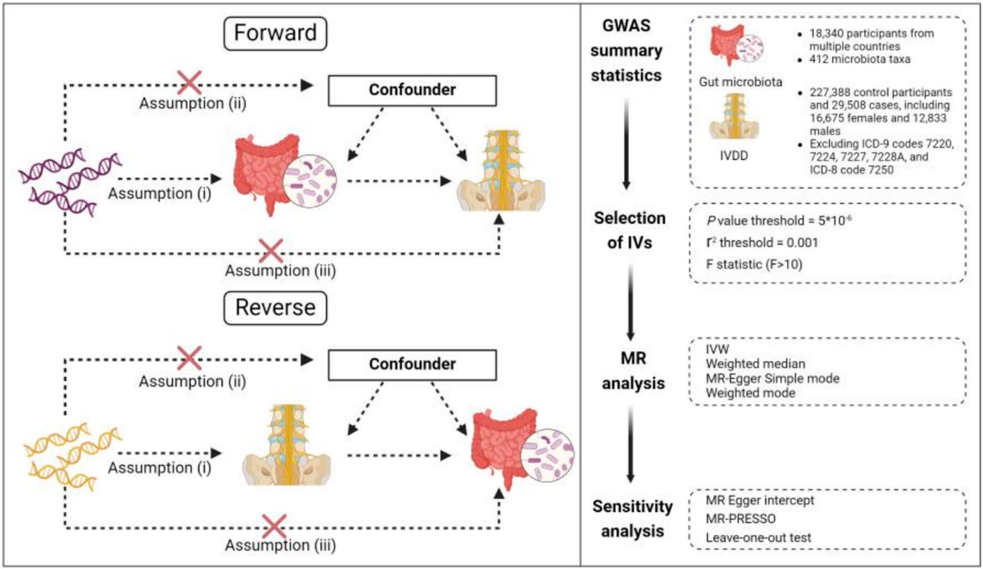
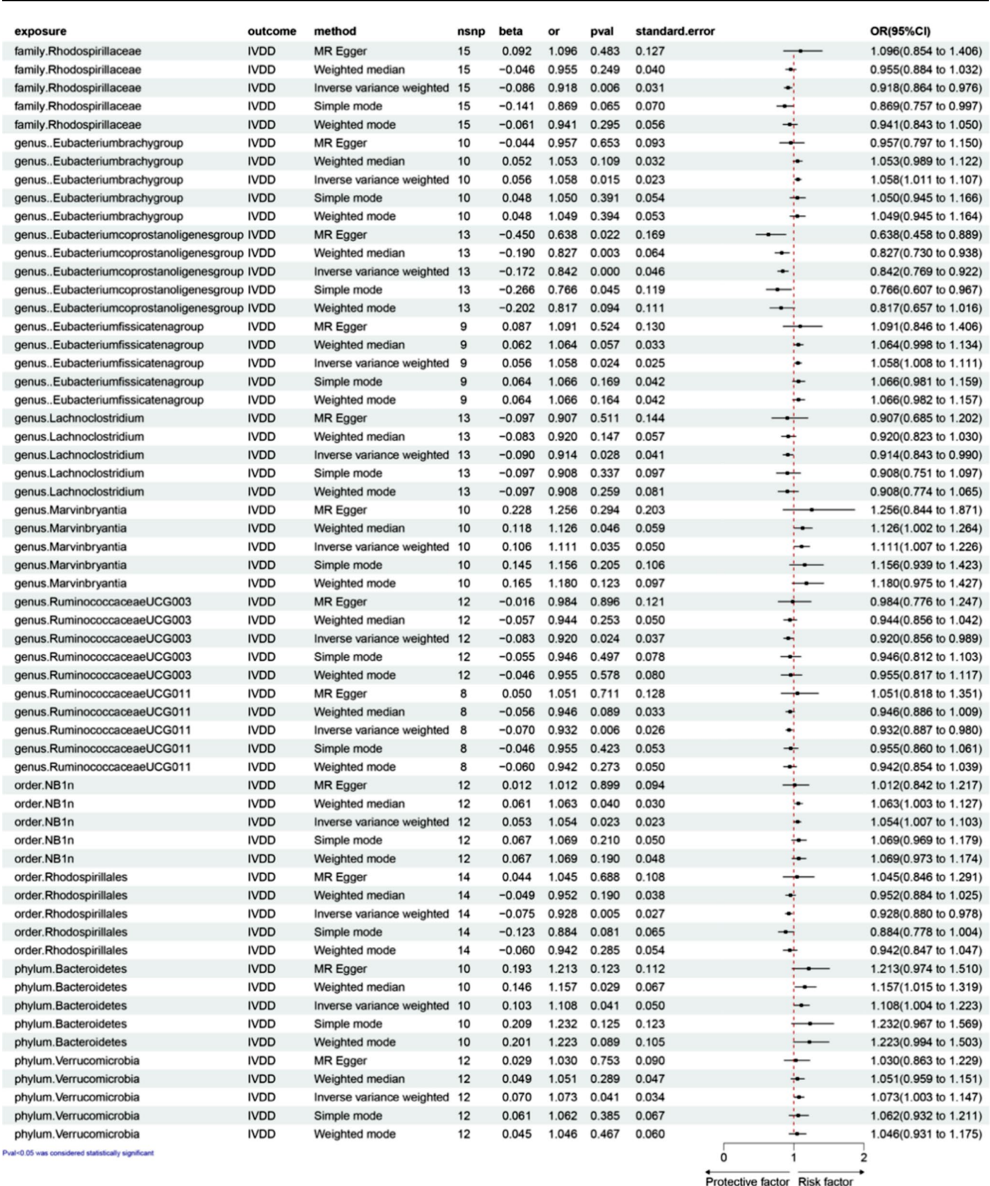
OBJECTIVE: Although previous studies have indicated a potential association between the gut microbiota and intervertebral disc degeneration (IVDD), the precise nature of this relationship remains unclear. The objective of this study is to further explore the potential causal relationship between gut microbiota and IVDD using a bidirectional Mendelian randomization approach, with the aim of identifying potential microbial characteristics associated with IVDD. METHODS: Using the data from genome-wide association studies (GWAS) involving 412 gut microbiota species and 227,388 controls and 29,508 cases of IVDD. Inverse variance weighted (IVW) was used as the primary Mendelian randomization (MR) analysis, complemented by weighted median, MR-Egger regression, weighted mode and simple mode methods. Extensive sensitivity analyses were performed to confirm the robustness of the results and to assess heterogeneity and horizontal pleiotropy. RESULTS: This study revealed a positive genetic predisposition between 6 types of gut microbiota and IVDD through the IVW method, indicating that increased levels of these microbiota may lead to a higher risk of IVDD. Conversely, 6 types of gut microbiota were found to have negative effects on IVDD, suggesting that increased levels of these microbiota may have a protective effect against IVDD. Reverse MR analysis results revealed such possibilities as 1 positive and 5 negative causal relationships between IVDD and gut microbiota. The results of Cochran's Q test, MR-Egger regression, and MR-PRESSO analysis from the bidirectional Mendelian randomization all yielded p-values greater than 0.05, indicating that there is no significant heterogeneity or pleiotropy in the genetic effect analysis between gut microbiota and IVDD. CONCLUSION: We used a bidirectional Mendelian randomization approach to identify various gut microbiota associated with IVDD. Our findings lay the foundation for further exploration of the pathogenesis and treatment strategies of gut microbiota and IVDD, and provide new possibilities for research on biomarkers of IVDD-related metabolic microbiota.
Overview
The claims and statistics of this paper haven’t been checked yet.
Free: it reads the open-access text and checks the first 5 claims that cite a source we can check. Create a free account to check every claim.
Integrity signals
Registry
Cites
Statistics
Figures

Verification
Claims the paper makes
The claims and statistics of this paper haven’t been checked yet.
Free: it reads the open-access text and checks the first 5 claims that cite a source we can check. Create a free account to check every claim.
Claims other papers make about this one
Each is checked against this paper’s own text: does it say what the citing paper says it does?
The cited source says what the claim attributes to it.
In the citing paper
“Furthermore, emerging evidence links microbiome shifts to IVDD, suggesting that modifying gut microbiota balance might offer novel systemic avenues to treat spinal degeneration [137].”
From Interorgan Communications in Skeletal Pathophysiology: From Molecular Pathways to Multidisciplinary Therapies (2026) · cites this paper as [137]
Self-check
Percentages, sums and reported differences re-computed from the paper’s own numbers.
The self-check needs the paper’s full text.
Citations
Cites
Verbanck, M., Chen, C.-Y., Neale, B., & Do, R. (2018) · Nature Genetics · doi:10.1038/s41588-018-0099-7 · Cited by 8,591 · cited 1×
“Among the employed methods, inverse variance weighted (IVW) was the primary approach, with MR-Egger, weighted median (WM), weighted mode, and simple mode serving as supplementary methods [ 23 ].”
Interpreting findings from Mendelian randomization using the MR-Egger method.
Burgess, S., & Thompson, S. G. (2017) · European Journal of Epidemiology · doi:10.1007/s10654-017-0255-x · Cited by 4,571 · cited 1×
“Robustness of the findings was evaluated using several diagnostic plots, including leave-one-out plots, funnel plots, and scatter plots [26].”
FinnGen provides genetic insights from a well-phenotyped isolated population
Kurki, M. I., Karjalainen, J., Palta, P., Sipilä, T. P., Kristiansson, K., Donner, K. M., Reeve, M. P., Laivuori, H., Aavikko, M., Kaunisto, M. A., et al. (2023) · Nature · doi:10.1038/s41586-022-05473-8 · Cited by 4,233 · cited 1×
“This GWAS includes 29,508 cases and 227,388 controls, including 16,675 females and 12,833 males [ 20 ].”
Skrivankova, V. W., Richmond, R. C., Woolf, B. A. R., Yarmolinsky, J., Davies, N. M., Swanson, S. A., VanderWeele, T. J., Higgins, J. P. T., Timpson, N. J., Dimou, N., et al. (2021) · JAMA · doi:10.1001/jama.2021.18236 · Cited by 3,994 · cited 1×
“This study adhered to the Strengthening the Reporting of Observational Studies in Epidemiology Using Mendelian Randomization guidelines (STROBE-MR) [18].”
A systematic review of the global prevalence of low back pain
Hoy, D., Bain, C., Williams, G., March, L., Brooks, P., Blyth, F., Woolf, A., Vos, T., & Buchbinder, R. (2012) · Arthritis & Rheumatism · doi:10.1002/art.34347 · Cited by 3,005 · cited 1×
“A systematic review of 54 countries indicates that the average prevalence of low back pain among adults is approximately 12%, with a lifetime prevalence of up to 40% [ 2 ].”
Mendelian Randomization as an Approach to Assess Causality Using Observational Data
Sekula, P., Del Greco M, F., Pattaro, C., & Köttgen, A. (2016) · Journal of the American Society of Nephrology · doi:10.1681/asn.2016010098 · Cited by 2,351 · cited 1×
“…(MR) is a novel approach that leverages genome-wide association study (GWAS) data to use single nucleotide polymorphisms (SNPs) as instrumental variables (IVs), enabling precise and rigorous assessment and inference of genetic associations between exposure factors and disease outcomes [16].”
Stojanov, S., Berlec, A., & Štrukelj, B. (2020) · Microorganisms · doi:10.3390/microorganisms8111715 · Cited by 1,885
Role of cytokines in intervertebral disc degeneration: pain and disc content
Risbud, M. V., & Shapiro, I. M. (2014) · Nature Reviews Rheumatology · doi:10.1038/nrrheum.2013.160 · Cited by 1,767 · cited 1×
“IL-6 is an important cytokine, with serum levels significantly higher in IVDD patients than in healthy groups, and it accelerates the progression of IVDD through multiple signaling pathways [ 41, 42 ].”
The Firmicutes/Bacteroidetes ratio of the human microbiota changes with age
Mariat, D., Firmesse, O., Levenez, F., Guimarăes, V., Sokol, H., Doré, J., Corthier, G., & Furet, J.-P. (2009) · BMC Microbiology · doi:10.1186/1471-2180-9-123 · Cited by 1,755 · cited 1×
“The composition of the human gut microbiota changes with age, particularly the Firmicutes/Bacteroidetes(F/B) ratio, which may be associated with obesity, type 2 diabetes, and inflammatory diseases when imbalanced [51– 53].”
An insight into gut microbiota and its functionalities
Adak, A., & Khan, M. R. (2019) · Cellular and Molecular Life Sciences · doi:10.1007/s00018-018-2943-4 · Cited by 1,485 · cited 1×
“These microbes are involved in numerous processes, including nutrient absorption, metabolic regulation, immune system development, and maintenance of neural function [ 9 ].”
Research works printed but not linked: 1
- Ds SB, S., Sg T (2017) A review of instrumental variable estima- tors for Mendelian randomization. Stat Methods Med Res 26
Cited by
Gan, D., Qin, L., & Xiao, G. (2026) · Research · doi:10.34133/research.1319 · Cited by 1
“Furthermore, emerging evidence links microbiome shifts to IVDD, suggesting that modifying gut microbiota balance might offer novel systemic avenues to treat spinal degeneration [ 137 ].”
The Roles of Bacteria in the Microbiome–Intervertebral Disc Axis
Melrose, J., Smith, M. M., & Diwan, A. D. (2025) · Advanced Gut & Microbiome Research · doi:10.1155/agm3/5515716
Zhang, H., Tian, J., Lu, Y., Yu, D., Wu, H., Lu, Y., Yu, L., & Luo, Z. (2026) · BMC Musculoskeletal Disorders · doi:10.1186/s12891-026-10040-7
“1 [16–35].”
Cui, X., & Du, W. (2026) · Journal of Cellular Physiology · doi:10.1002/jcp.70222
“…general descriptions of “microbiota imbalance associated with inflammation” to clarifying specific evidence chains—that is, how microbiome changes affect endplate nutrient transport, disc cell fate, ECM homeostasis, and pain phenotypes through measurable immune–metabolic signals (Xiao et al. 2025).”
Chen, R., Xu, D., Li, Y., & Yang, J. (2026) · Frontiers in Immunology · doi:10.3389/fimmu.2026.1938023
Shen, L., Qin, C., Deng, Z.-L., Yu, Q., Deng, R., Chen, M., Hu, T., Wang, X., Lei, B., Chen, Y., et al. (2026) · Mediators of Inflammation · doi:10.1155/mi/5998779
Metadata
- Authors
- Xiao, J., Zhou, X., Xia, T., Zhang, W., Xing, X., Zhang, Y., & Xiong, L.
- Affiliations
- Third Hospital of Hebei Medical University (CN)
- Wuhan Union Hospital (CN)
- Nankai University (CN)
- Corresponding author
- Zhang, Yingze
- Xiong, Liming
- Venue
- European Spine Journal
- Published
- 2025-04-21
- Volume
- 34
- Issue
- 6
- Pages
- 2092-2105
- ISSN
- 0940-6719 (ISSN-L)
- 1432-0932
- OpenAlex
- W4409617600
- Cited by
- 6
- References
- 58
- Citations by year
- 2026: 5 · 2025: 1
- FWCI
- 1.81
- Type
- journal article
- Language
- en
- Open access
- hybrid
- doi.org
- Licence
- cc-by-nc-nd
- creativecommons.org/licenses/by-nc-nd/4.0 (tdm)
- creativecommons.org/licenses/by-nc-nd/4.0 (vor)
- Locations
- European Spine Journal (publishedVersion, cc-by-nc-nd)
- PubMed (publishedVersion)
- Funders
- the Integration Project of NSFC Joint Fund for Regional Innovation and Development (U23A6008)
- the Key Projects of the National Natural Science Foundation of China (32130052)
- the Hygiene and Health Innovation Project of Major project assignment for research and development in Hebei province (21377731D)
- Huazhong University of Science and Technology 19th Batch of Graduate Student Innovation Fund Project (2021yjsCXCY119)
- Topics
- Life Sciences › Biochemistry, Genetics and Molecular Biology › Molecular Biology › Gut microbiota and health
- Health Sciences › Medicine › Orthopedics and Sports Medicine › Spine and Intervertebral Disc Pathology
- Life Sciences › Biochemistry, Genetics and Molecular Biology › Genetics › Genetic Associations and Epidemiology
- Keywords
- gut microbiota, intervertebral disc degeneration, bidirectional Mendelian randomization, causal inference, genetic susceptibility, horizontal pleiotropy, degenerative spine disease
- MeSH terms
- Gastrointestinal Microbiome, Humans, Genetic Predisposition to Disease, Genome-Wide Association Study, Intervertebral Disc Degeneration, Mendelian Randomization Analysis
About these checks
Registry, retraction, Cites and statistics results are computed, not judged, with one exception: a printed reference that no index lists is read once by a model before it counts as a citation error. Claims are extracted by a model and kept only when their quote appears verbatim in the text; each cited source is then checked, with a model’s help, for whether it says what the claim relies on. Those verdicts can be wrong — read the claim’s quote and the cited source before relying on one.
Statistics and arithmetic are recomputed, not judged.
Confidence bands are shown only for fields calibrated on our annotated test set. None is calibrated yet, so no band is shown.
What counts as a claim ›How we measure confidence ›How we check this ›
Are you an author, or do you see a problem with this page? Request a review
Data sources
Bibliographic data: Semantic Scholar, OpenAlex, Crossref.
Contains information from the Semantic Scholar Academic Graph Datasets, made available under the ODC Attribution License (ODC-BY 1.0).
Semantic Scholar’s data is described in: Kinney, R., et al. (2023). The Semantic Scholar Open Data Platform. arXiv:2301.10140.
