

Exploring the role of gut microbiota in intervertebral disc degeneration: insights from bidirectional Mendelian randomization analysis
Open accessThe DOI matches its Crossref record; 58 of the 58 references it cites were found in a registry or an index.
Abstract
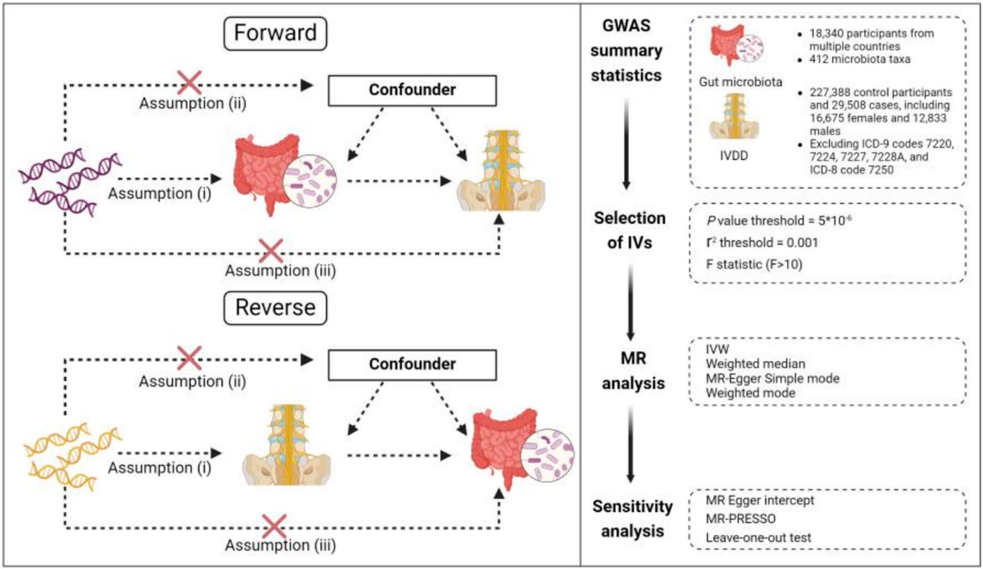
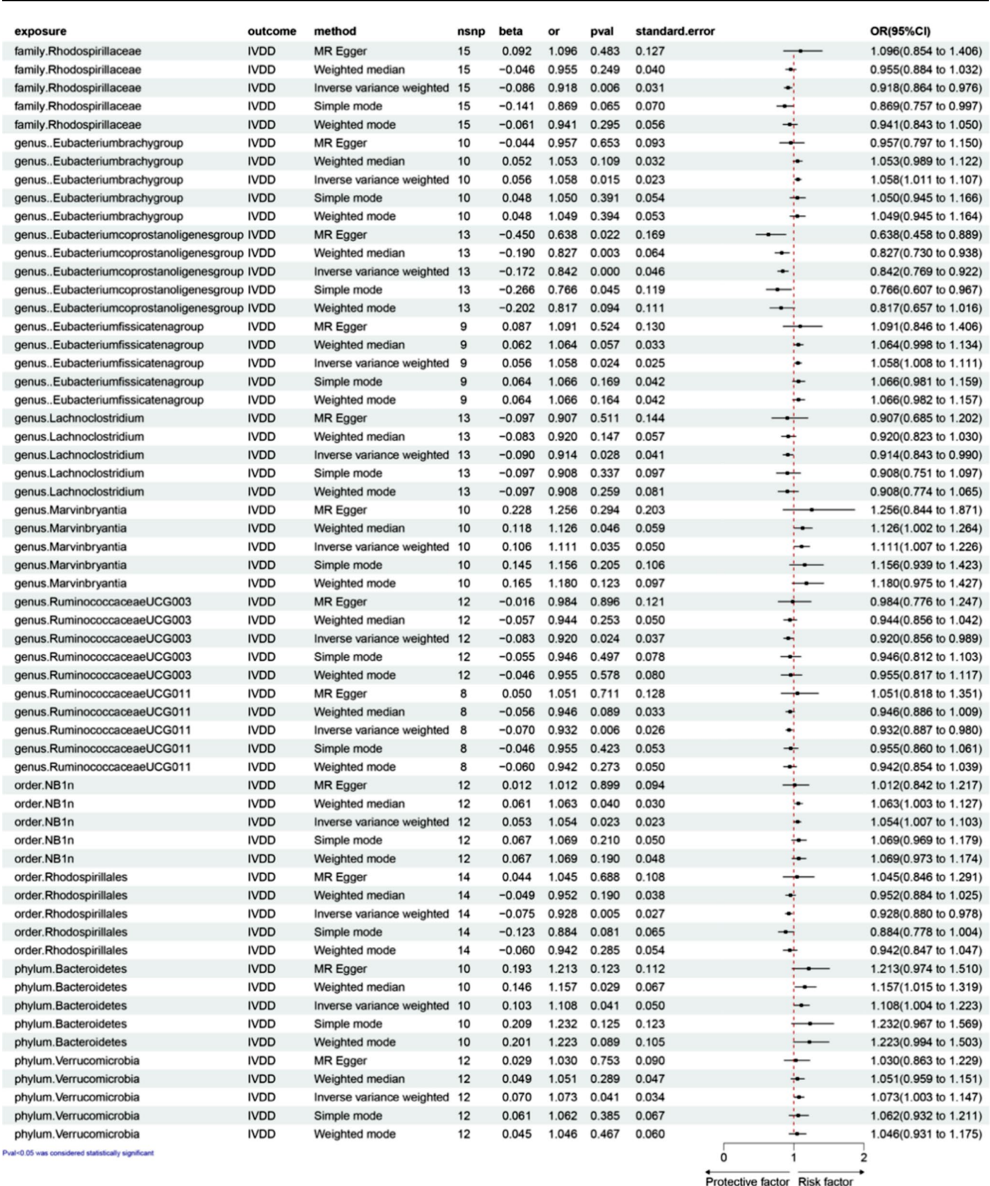
OBJECTIVE: Although previous studies have indicated a potential association between the gut microbiota and intervertebral disc degeneration (IVDD), the precise nature of this relationship remains unclear. The objective of this study is to further explore the potential causal relationship between gut microbiota and IVDD using a bidirectional Mendelian randomization approach, with the aim of identifying potential microbial characteristics associated with IVDD. METHODS: Using the data from genome-wide association studies (GWAS) involving 412 gut microbiota species and 227,388 controls and 29,508 cases of IVDD. Inverse variance weighted (IVW) was used as the primary Mendelian randomization (MR) analysis, complemented by weighted median, MR-Egger regression, weighted mode and simple mode methods. Extensive sensitivity analyses were performed to confirm the robustness of the results and to assess heterogeneity and horizontal pleiotropy. RESULTS: This study revealed a positive genetic predisposition between 6 types of gut microbiota and IVDD through the IVW method, indicating that increased levels of these microbiota may lead to a higher risk of IVDD. Conversely, 6 types of gut microbiota were found to have negative effects on IVDD, suggesting that increased levels of these microbiota may have a protective effect against IVDD. Reverse MR analysis results revealed such possibilities as 1 positive and 5 negative causal relationships between IVDD and gut microbiota. The results of Cochran's Q test, MR-Egger regression, and MR-PRESSO analysis from the bidirectional Mendelian randomization all yielded p-values greater than 0.05, indicating that there is no significant heterogeneity or pleiotropy in the genetic effect analysis between gut microbiota and IVDD. CONCLUSION: We used a bidirectional Mendelian randomization approach to identify various gut microbiota associated with IVDD. Our findings lay the foundation for further exploration of the pathogenesis and treatment strategies of gut microbiota and IVDD, and provide new possibilities for research on biomarkers of IVDD-related metabolic microbiota.
Overview
The claims and statistics of this paper haven’t been checked yet.
Free: it reads the open-access text and checks the first 5 claims that cite a source we can check. Create a free account to check every claim.
Integrity signals
Registry
Cites
Statistics
Figures

Verification
Claims the paper makes
The claims and statistics of this paper haven’t been checked yet.
Free: it reads the open-access text and checks the first 5 claims that cite a source we can check. Create a free account to check every claim.
Claims other papers make about this one
Each is checked against this paper’s own text: does it say what the citing paper says it does?
The cited source says what the claim attributes to it.
In the citing paper
“Furthermore, emerging evidence links microbiome shifts to IVDD, suggesting that modifying gut microbiota balance might offer novel systemic avenues to treat spinal degeneration [137].”
From Interorgan Communications in Skeletal Pathophysiology: From Molecular Pathways to Multidisciplinary Therapies (2026) · cites this paper as [137]
Self-check
Percentages, sums and reported differences re-computed from the paper’s own numbers.
The self-check needs the paper’s full text.
Citations
Cites
Verbanck, M., Chen, C.-Y., Neale, B., & Do, R. (2018) · Nature Genetics · doi:10.1038/s41588-018-0099-7 · Cited by 8,591 · cited 1×
“Among the employed methods, inverse variance weighted (IVW) was the primary approach, with MR-Egger, weighted median (WM), weighted mode, and simple mode serving as supplementary methods [ 23 ].”
Interpreting findings from Mendelian randomization using the MR-Egger method.
Burgess, S., & Thompson, S. G. (2017) · European Journal of Epidemiology · doi:10.1007/s10654-017-0255-x · Cited by 4,571 · cited 1×
“Robustness of the findings was evaluated using several diagnostic plots, including leave-one-out plots, funnel plots, and scatter plots [26].”
FinnGen provides genetic insights from a well-phenotyped isolated population
Kurki, M. I., Karjalainen, J., Palta, P., Sipilä, T. P., Kristiansson, K., Donner, K. M., Reeve, M. P., Laivuori, H., Aavikko, M., Kaunisto, M. A., et al. (2023) · Nature · doi:10.1038/s41586-022-05473-8 · Cited by 4,233 · cited 1×
“This GWAS includes 29,508 cases and 227,388 controls, including 16,675 females and 12,833 males [ 20 ].”
Skrivankova, V. W., Richmond, R. C., Woolf, B. A. R., Yarmolinsky, J., Davies, N. M., Swanson, S. A., VanderWeele, T. J., Higgins, J. P. T., Timpson, N. J., Dimou, N., et al. (2021) · JAMA · doi:10.1001/jama.2021.18236 · Cited by 3,994 · cited 1×
“This study adhered to the Strengthening the Reporting of Observational Studies in Epidemiology Using Mendelian Randomization guidelines (STROBE-MR) [18].”
A systematic review of the global prevalence of low back pain
Hoy, D., Bain, C., Williams, G., March, L., Brooks, P., Blyth, F., Woolf, A., Vos, T., & Buchbinder, R. (2012) · Arthritis & Rheumatism · doi:10.1002/art.34347 · Cited by 3,005 · cited 1×
“A systematic review of 54 countries indicates that the average prevalence of low back pain among adults is approximately 12%, with a lifetime prevalence of up to 40% [ 2 ].”
Mendelian Randomization as an Approach to Assess Causality Using Observational Data
Sekula, P., Del Greco M, F., Pattaro, C., & Köttgen, A. (2016) · Journal of the American Society of Nephrology · doi:10.1681/asn.2016010098 · Cited by 2,351 · cited 1×
“…(MR) is a novel approach that leverages genome-wide association study (GWAS) data to use single nucleotide polymorphisms (SNPs) as instrumental variables (IVs), enabling precise and rigorous assessment and inference of genetic associations between exposure factors and disease outcomes [16].”
Stojanov, S., Berlec, A., & Štrukelj, B. (2020) · Microorganisms · doi:10.3390/microorganisms8111715 · Cited by 1,885
Role of cytokines in intervertebral disc degeneration: pain and disc content
Risbud, M. V., & Shapiro, I. M. (2014) · Nature Reviews Rheumatology · doi:10.1038/nrrheum.2013.160 · Cited by 1,767 · cited 1×
“IL-6 is an important cytokine, with serum levels significantly higher in IVDD patients than in healthy groups, and it accelerates the progression of IVDD through multiple signaling pathways [ 41, 42 ].”
The Firmicutes/Bacteroidetes ratio of the human microbiota changes with age
Mariat, D., Firmesse, O., Levenez, F., Guimarăes, V., Sokol, H., Doré, J., Corthier, G., & Furet, J.-P. (2009) · BMC Microbiology · doi:10.1186/1471-2180-9-123 · Cited by 1,755 · cited 1×
“The composition of the human gut microbiota changes with age, particularly the Firmicutes/Bacteroidetes(F/B) ratio, which may be associated with obesity, type 2 diabetes, and inflammatory diseases when imbalanced [51– 53].”
An insight into gut microbiota and its functionalities
Adak, A., & Khan, M. R. (2019) · Cellular and Molecular Life Sciences · doi:10.1007/s00018-018-2943-4 · Cited by 1,485 · cited 1×
“These microbes are involved in numerous processes, including nutrient absorption, metabolic regulation, immune system development, and maintenance of neural function [ 9 ].”
Knezevic, N. N., Candido, K. D., Vlaeyen, J. W. S., Van Zundert, J., & Cohen, S. P. (2021) · The Lancet · doi:10.1016/s0140-6736(21)00733-9 · Cited by 1,345
Wang, L., Tang, L., Feng, Y., Zhao, S., Han, M., Zhang, C., Yuan, G., Zhu, J., Cao, S., Wu, Q., et al. (2020) · Gut · doi:10.1136/gutjnl-2019-320105 · Cited by 630 · cited 1×
“The research evidence has confirmed its role and related mechanisms in improving inflammatory bowel disease, metabolic disorders, and tumor development, thus making it a promising “next-generation probiotic” [56–58].”
Effect of host genetics on the gut microbiome in 7,738 participants of the Dutch Microbiome Project
Lopera-Maya, E. A., Kurilshikov, A., van der Graaf, A., Hu, S., Andreu-Sánchez, S., Chen, L., Vila, A. V., Gacesa, R., Sinha, T., Collij, V., et al. (2022) · Nature Genetics · doi:10.1038/s41588-021-00992-y · Cited by 553
Intervertebral Disk Degeneration and Repair
Dowdell, J., Erwin, M., Choma, T., Vaccaro, A., Iatridis, J., & Cho, S. K. (2017) · Neurosurgery · doi:10.1093/neuros/nyw078 · Cited by 472 · cited 1×
“IVDD is a complex process involving various morphological, functional, and biochemical changes [ 4 ].”
Dissecting the in Vivo Metabolic Potential of Two Human Gut Acetogens
Rey, F. E., Faith, J. J., Bain, J., Muehlbauer, M. J., Stevens, R. D., Newgard, C. B., & Gordon, J. I. (2010) · Journal of Biological Chemistry · doi:10.1074/jbc.m110.117713 · Cited by 421 · cited 1×
“Among these factors, genetic predispositions and inflammation are often At present, only one species within this genus is known: Marvinbryantia formatexigens, which has been identified in human faeces [35].”
Akkermansia muciniphila phospholipid induces homeostatic immune responses
Bae, M., Cassilly, C. D., Liu, X., Park, S.-M., Tusi, B. K., Chen, X., Kwon, J., Filipčík, P., Bolze, A. S., Liu, Z., et al. (2022) · Nature · doi:10.1038/s41586-022-04985-7 · Cited by 413
Mohd Isa, I. L., Teoh, S. L., Mohd Nor, N. H., & Mokhtar, S. A. (2022) · International Journal of Molecular Sciences · doi:10.3390/ijms24010208 · Cited by 365
Intervertebral disc regeneration: do nutrients lead the way?
Huang, Y.-C., Urban, J. P. G., & Luk, K. D. K. (2014) · Nature Reviews Rheumatology · doi:10.1038/nrrheum.2014.91 · Cited by 329 · cited 1×
“The IVD is generally considered the largest avascular structure in the human body, with its nutrients and oxygen supply mainly relying on diffusion from the outer one-third of the annulus fibrosus and cartilage endplate [ 29 ].”
Association between sciatica and Propionibacterium acnes
Stirling, A., Worthington, T., Rafiq, M., Lambert, P. A., & Elliott, T. S. (2001) · The Lancet · doi:10.1016/s0140-6736(00)05109-6 · Cited by 318 · cited 1×
“The association between the microbiota and intervertebral disc disease can be traced back to 2001, when reports suggested that Propionibacterium acnes infection might be associated with sciatica [ 31 ].”
Albert, H. B., Lambert, P., Rollason, J., Sorensen, J. S., Worthington, T., Pedersen, M. B., Nørgaard, H. S., Vernallis, A., Busch, F., Manniche, C., et al. (2013) · European Spine Journal · doi:10.1007/s00586-013-2674-z · Cited by 311 · cited 1×
“Subsequently, Albert et al. [ 32 ] Propionibacterium acnes, a resident bacterium of the skin and oral cavity, could enter the blood-stream through daily activities such as tooth brushing.”
Wu, P. H., Kim, H. S., & Jang, I.-T. (2020) · International Journal of Molecular Sciences · doi:10.3390/ijms21062135 · Cited by 266
The gut microbiota: A treasure for human health
Li, D., Wang, P., Wang, P., Hu, X., & Chen, F. (2016) · Biotechnology Advances · doi:10.1016/j.biotechadv.2016.08.003 · Cited by 261 · cited 1×
“In the field of human health research, the trillions of symbiotic gut microbiota in the gastrointestinal tract have increasingly become a subject of study [8].”
Jia, B., Zou, Y., Han, X., Bae, J.-W., & Jeon, C. O. (2023) · Trends in Microbiology · doi:10.1016/j.tim.2022.08.003 · Cited by 212 · cited 1×
“The genus Eubacterium coprostanoligenes group (OR: 0.842) is a significant gut bacterium with the capacity to reduce cholesterol levels [ 43 ].”
InfluentialUsing Mendelian randomisation to assess causality in observational studies
Pagoni, P., Dimou, N. L., Murphy, N., & Stergiakouli, E. (2019) · Evidence-Based Mental Health · doi:10.1136/ebmental-2019-300085 · Cited by 176 · cited 1×
“In FinnGen’s phenotype library, diseases have been categorized according to the ICD-10, ICD-9, and ICD-8 coding system, thus ensuring the reliability of studies using FinnGen [ 22 ].”
Weber, K. T., Alipui, D. O., Sison, C. P., Bloom, O., Quraishi, S., Overby, M. C., Levine, M. E., & Chahine, N. O. (2016) · Arthritis Research & Therapy · doi:10.1186/s13075-015-0887-8 · Cited by 169 · cited 1×
“IL-6 is an important cytokine, with serum levels significantly higher in IVDD patients than in healthy groups, and it accelerates the progression of IVDD through multiple signaling pathways [ 41, 42 ].”
Zhang, Y., Wu, Y. Q., Liu, X.-F., Chen, X., & Su, J. (2024) · Ageing Research Reviews · doi:10.1016/j.arr.2024.102196 · Cited by 165 · cited 1×
“Recently, a growing body of evidence has indicated a close relationship between gut microbiota and musculoskeletal degenerative diseases [ 10 ].”
Self-citationVascularization of the human intervertebral disc: A scoping review
Fournier, D. E., Kiser, P. K., Shoemaker, J. K., Battié, M. C., & Séguin, C. A. (2020) · JOR Spine · doi:10.1002/jsp2.1123 · Cited by 157 · cited 1×
“Nevertheless, a recent study has indicated that the vascularisation of the IVD can vary with age and the degree of degeneration or injury [ 30 ].”
An accurate test for homogeneity of odds ratios based on Cochran’s Q-statistic
Kulinskaya, E., & Dollinger, M. B. (2015) · BMC Medical Research Methodology · doi:10.1186/s12874-015-0034-x · Cited by 155 · cited 1×
“In cases where heterogeneity was detected, the random-effects inverse-variance weighted (IVW) method was employed as the primary analytical approach [25].”
Akkermansia muciniphila : is it the Holy Grail for ameliorating metabolic diseases?
Yan, J., Sheng, L., & Li, H. (2021) · Gut Microbes · doi:10.1080/19490976.2021.1984104 · Cited by 154
Zhou, J., Mi, J., Peng, Y., Han, H., & Liu, Z. (2021) · Frontiers in Endocrinology · doi:10.3389/fendo.2021.740200 · Cited by 145 · cited 1×
“We defined the disease phenotype of IVDD according to the International Classification of Diseases, Tenth, Ninth, and Eighth Editions (ICD-10, ICD-9 and ICD-8), which has been widely used in previous studies [ 21 ].”
Intervertebral disc degeneration: A focus on obesity and type 2 diabetes
Cannata, F., Vadalà, G., Ambrosio, L., Fallucca, S., Napoli, N., Papalia, R., Pozzilli, P., & Denaro, V. (2020) · Diabetes/Metabolism Research and Reviews · doi:10.1002/dmrr.3224 · Cited by 144 · cited 1×
“Although various risk factors have been identified, including genetics, aging, abnormal mechanical stress, obesity, diabetes, and infection, the pathogenesis related to these factors remains poorly understood [5 , 6].”
Ma, J., Liu, Z., Gao, X., Bao, Y., Hong, Y., He, X., Zhu, W., Li, Y., Huang, W., Zheng, N., et al. (2023) · Pharmacological Research · doi:10.1016/j.phrs.2023.106687 · Cited by 141 · cited 1×
“The research evidence has confirmed its role and related mechanisms in improving inflammatory bowel disease, metabolic disorders, and tumor development, thus making it a promising “next-generation probiotic” [56–58].”
Wang, L., Liao, Y., Yang, R., Zhu, Z., Zhang, L., Wu, Z., & Sun, X. (2021) · Bioengineering & Translational Medicine · doi:10.1002/btm2.10219 · Cited by 122 · cited 1×
“Wang et al. [ 47 ] demonstrated that the promotion of Rumi-nococcaceae bacteria growth can significantly enhance butyrate production.”
Human intervertebral discs harbour a unique microbiome and dysbiosis determines health and disease
Rajasekaran, S., Soundararajan, D. C. R., Tangavel, C., Raveendran, M., Anand, K. S. S. V., Matchado, M. S., Nayagam, S. M., Shetty, A. P., Kanna, R. M., & Dharmalingam, K. (2020) · European Spine Journal · doi:10.1007/s00586-020-06446-z · Cited by 119 · cited 3×
“Rajasekaran et al. [ 13 ] conducted 16 S rRNA sequencing on the genomic DNA of 24 IVDs, revealing that the composition of gut microbiota may play a crucial role in IVDD.”
InfluentialDifferences in the gut microbiome and reduced fecal butyrate in elders with low skeletal muscle mass
Han, D., Wu, W., Liu, P., Yang, Y.-T., Hsu, H., Kuo, C., Wu, M., & Wang, T. (2022) · Clinical Nutrition · doi:10.1016/j.clnu.2022.05.008 · Cited by 115 · cited 1×
“Studies have demonstrated that the genus Marvinbryantia is associated with low skeletal muscle mass in the elderly [36].”
Gut-disc axis: A cause of intervertebral disc degeneration and low back pain?
Li, W., Lai, K., Chopra, N., Zheng, Z., Das, A., & Diwan, A. D. (2022) · European Spine Journal · doi:10.1007/s00586-022-07152-8 · Cited by 93
Zhou, M., Theologis, A. A., & O’Connell, G. D. (2023) · JOR Spine · doi:10.1002/jsp2.1289 · Cited by 86 · cited 1×
“Although various risk factors have been identified, including genetics, aging, abnormal mechanical stress, obesity, diabetes, and infection, the pathogenesis related to these factors remains poorly understood [5 , 6].”
The F/B ratio as a biomarker for inflammation in COVID-19 and T2D: Impact of metformin
Petakh, P., Oksenych, V., & Kamyshnyi, O. (2023) · Biomedicine & Pharmacotherapy · doi:10.1016/j.biopha.2023.114892 · Cited by 81 · cited 1×
“The composition of the human gut microbiota changes with age, particularly the Firmicutes/Bacteroidetes(F/B) ratio, which may be associated with obesity, type 2 diabetes, and inflammatory diseases when imbalanced [51– 53].”
Wolin, M. J., Miller, T. L., Collins, M. D., & Lawson, P. A. (2003) · Applied and Environmental Microbiology · doi:10.1128/aem.69.10.6321-6326.2003 · Cited by 70 · cited 1×
“The genus Marvinbryantia is a genus of microorganisms in the Lachnospiraceae family that is capable of degrading cellulose and methylcellulose [ 34 ].”
Jia, J., Nie, L., & Liu, Y. (2019) · International Immunopharmacology · doi:10.1016/j.intimp.2019.106004 · Cited by 50 · cited 1×
“In studies on IVDD, butyrate has been found to exert anti-inflammatory effects by inhibiting the activation of NF-κB signaling [48].”
Nkosi, B. V. Z., Padayachee, T., Gront, D., Nelson, D. R., & Syed, K. (2022) · International Journal of Molecular Sciences · doi:10.3390/ijms23095057 · Cited by 47 · cited 1×
“The phylum Bacteroidetes (OR: 1.108) represent the second most abundant bacterial group after Firmicutes and play a critical role in the human gut ecosystem [50].”
InfluentialDai, Z., Li, S., Meng, Y., Zhao, Q., Zhang, Y., Suonan, Z., Sun, Y., Shen, Q., Liao, X., & Xue, Y. (2022) · Nutrients · doi:10.3390/nu14204334 · Cited by 47 · cited 1×
“Moreover, a Sperman correlation analysis indicated that the abundance of the genus Marvin-bryantia was significantly positively correlated with serum Interleukin-6 (IL-6) [ 40 ].”
Self-citationThe gut microbiome-joint axis in osteoarthritis
Wei, J., Zhang, Y., Hunter, D. J., Zeng, C., & Lei, G. (2023) · 中国科学通报:英文版 · doi:10.1016/j.scib.2023.03.024 · Cited by 42
Self-citationZhao, J., Liang, R., Song, Q., Song, S., Yue, J., & Wu, C. (2023) · Precision Clinical Medicine · doi:10.1093/pcmedi/pbad010 · Cited by 41 · cited 1×
“A recent MR-based study also demonstrated a significant causal relationship between the genus Eubacterium fissicatena and sarcopenia [ 37 ].”
Geng, Z., Wang, J., Chen, G., Liu, J., Lan, J., Zhang, Z., & Miao, J. (2023) · Journal of Orthopaedic Surgery and Research · doi:10.1186/s13018-023-04081-0 · Cited by 40
Chen, W., Deng, Z., Zhu, J., Yuan, L., Li, S., Zhang, Y., Wu, J., Huang, Z., Qin, T., & Ye, W. (2023) · Acta Biochimica et Biophysica Sinica · doi:10.3724/abbs.2023026 · Cited by 37
Self-citationLiu, X., Jiang, C., Liu, G., Wang, P., Shi, M., Yang, M., Zhong, Z., Ding, S., Li, Y., Liu, B., et al. (2020) · International Immunopharmacology · doi:10.1016/j.intimp.2020.106657 · Cited by 34 · cited 1×
“Furthermore, sodium butyrate has been demonstrated to facilitate the progression of IVDD by enhancing the expression of PPARγ-regulated Klotho, thereby counteracting oxidative stress in NPCs [ 49 ].”
The Effect of Gut Microbiota on the Progression of Intervertebral Disc Degeneration
Yao, B., Cai, Y., Wang, W., Deng, J., Zhao, L., Han, Z., & Wan, L. (2023) · Orthopaedic Surgery · doi:10.1111/os.13626 · Cited by 28 · cited 1×
“Yao et al. [ 33 ] observed that in an IVDD rat model, the fecal microbiota transplantation (FMT) group exhibited reduced levels of TNF-α, IL-1β, IL-6, MMP-3, MMP-13, NLRP3, and Caspase-1, along with increased collagen II and aggrecan expression, when compared to the control group.”
Rajasekaran, S., Vasudevan, G., Tangavel, C., Ramachandran, K., Nayagam, S. M., Muthurajan, R., Gopalakrishnan, C., Anand, K. S. S. V., Shetty, A. P., & Kanna, R. M. (2024) · The Spine Journal · doi:10.1016/j.spinee.2024.06.020 · Cited by 26 · cited 1×
“Rajasekaran et al. [54] reported that the F/B ratio in the healthy population was 0.7, in contrast, patients with IVDD exhibited a significantly lower F/B ratio.”
InfluentialAboushaala, K. A., Chee, A., Adnan, D., Toro, S. J., Singh, H., Savoia, A., Dhillon, E. S., Yuh, C., Dourdourekas, J., Patel, I. K., et al. (2024) · JOR Spine · doi:10.1002/jsp2.70005 · Cited by 26 · cited 1×
“Nice surprisingly, Khaled Aboushaala et al. [55 ] conducted a study characterizing fecal microbiomes through 16 S rRNA gene amplification sequencing in 21 patients with lumbar degenerative spondylolisthesis (LDS) and 12 controls without LDS, aiming to evaluate differences in fecal microbial…”
Wang, N., Chen, S., Xie, Y., Liu, X., Xi, Z., Li, J., Xue, C., Deng, R., Min, W., Kang, R., et al. (2024) · Phytomedicine · doi:10.1016/j.phymed.2024.155480 · Cited by 25
Beierfuß, A., Hunjadi, M., Ritsch, A., Kremser, C., Thomé, C., & Mern, D. S. (2019) · PLoS ONE · doi:10.1371/journal.pone.0225527 · Cited by 19 · cited 1×
“The genus Eubacterium coprostanoligenes group is a significant gut bacterium with the capacity to reduce cholesterol levels [ 44 ].”
Qi, W., Mei, Z., Mao, X., Zhu, L., Shao, Y., Ge, G., Zhang, W., Pan, H., & Wang, D. (2024) · European Spine Journal · doi:10.1007/s00586-024-08291-w · Cited by 19 · cited 1×
“Sarco-penia may result in spinal sagittal alignment abnormalities and low back pain, and may also contribute to the development of IVDD [38 , 39 ].”
Self-citationTanaka, Y., Miyagi, M., Inoue, G., Hori, Y., Inage, K., Murata, K., Fujimaki, H., Kuroda, A., Yokozeki, Y., Inoue, S., et al. (2023) · Scientific Reports · doi:10.1038/s41598-023-37125-w · Cited by 16
Shan, S., Zhang, Z., Nie, J., Wen, Y., Wu, W., Liu, Y., & Zhao, C. C. (2024) · Pharmacological Research · doi:10.1016/j.phrs.2024.107257 · Cited by 16
Cheng, S., Yu, J., Cui, M., Su, H., & Cao, Y. (2024) · Journal of Orthopaedic Surgery and Research · doi:10.1186/s13018-023-04486-x · Cited by 14 · cited 1×
“Cheng et al. [ 27] demonstrated that IVDD altered the gut microbiota and fecal metabolites in a rabbit model through 16 S rRNA sequencing and liquid chromatography-mass spectrometry (LC/MS) metab-olomics.”
Li, S., Chen, T., Zhou, Y., & Li, X. (2023) · Biochimica et Biophysica Acta (BBA) - Molecular Basis of Disease · doi:10.1016/j.bbadis.2023.166972 · Cited by 13
Ni, S., Huang, X., Li, X., Shi, C., Fan, M., Zhao, L., Rong, Z., & Zhang, H. (2024) · The Journals of Gerontology Series A · doi:10.1093/gerona/glae150 · Cited by 12
Research works printed but not linked: 1
- Ds SB, S., Sg T (2017) A review of instrumental variable estima- tors for Mendelian randomization. Stat Methods Med Res 26
Cited by
Gan, D., Qin, L., & Xiao, G. (2026) · Research · doi:10.34133/research.1319 · Cited by 1
“Furthermore, emerging evidence links microbiome shifts to IVDD, suggesting that modifying gut microbiota balance might offer novel systemic avenues to treat spinal degeneration [ 137 ].”
The Roles of Bacteria in the Microbiome–Intervertebral Disc Axis
Melrose, J., Smith, M. M., & Diwan, A. D. (2025) · Advanced Gut & Microbiome Research · doi:10.1155/agm3/5515716
Zhang, H., Tian, J., Lu, Y., Yu, D., Wu, H., Lu, Y., Yu, L., & Luo, Z. (2026) · BMC Musculoskeletal Disorders · doi:10.1186/s12891-026-10040-7
“1 [16–35].”
Cui, X., & Du, W. (2026) · Journal of Cellular Physiology · doi:10.1002/jcp.70222
“…general descriptions of “microbiota imbalance associated with inflammation” to clarifying specific evidence chains—that is, how microbiome changes affect endplate nutrient transport, disc cell fate, ECM homeostasis, and pain phenotypes through measurable immune–metabolic signals (Xiao et al. 2025).”
Chen, R., Xu, D., Li, Y., & Yang, J. (2026) · Frontiers in Immunology · doi:10.3389/fimmu.2026.1938023
Metadata
- Authors
- Xiao, J., Zhou, X., Xia, T., Zhang, W., Xing, X., Zhang, Y., & Xiong, L.
- Affiliations
- Third Hospital of Hebei Medical University (CN)
- Wuhan Union Hospital (CN)
- Nankai University (CN)
- Corresponding author
- Zhang, Yingze
- Xiong, Liming
- Venue
- European Spine Journal
- Published
- 2025-04-21
- Volume
- 34
- Issue
- 6
- Pages
- 2092-2105
- ISSN
- 0940-6719 (ISSN-L)
- 1432-0932
- OpenAlex
- W4409617600
- Cited by
- 6
- References
- 58
- Citations by year
- 2026: 5 · 2025: 1
- FWCI
- 1.81
- Type
- journal article
- Language
- en
- Open access
- hybrid
- doi.org
- Licence
- cc-by-nc-nd
- creativecommons.org/licenses/by-nc-nd/4.0 (tdm)
- creativecommons.org/licenses/by-nc-nd/4.0 (vor)
- Locations
- European Spine Journal (publishedVersion, cc-by-nc-nd)
- PubMed (publishedVersion)
- Funders
- the Integration Project of NSFC Joint Fund for Regional Innovation and Development (U23A6008)
- the Key Projects of the National Natural Science Foundation of China (32130052)
- the Hygiene and Health Innovation Project of Major project assignment for research and development in Hebei province (21377731D)
- Huazhong University of Science and Technology 19th Batch of Graduate Student Innovation Fund Project (2021yjsCXCY119)
- Topics
- Life Sciences › Biochemistry, Genetics and Molecular Biology › Molecular Biology › Gut microbiota and health
- Health Sciences › Medicine › Orthopedics and Sports Medicine › Spine and Intervertebral Disc Pathology
- Life Sciences › Biochemistry, Genetics and Molecular Biology › Genetics › Genetic Associations and Epidemiology
- Keywords
- gut microbiota, intervertebral disc degeneration, bidirectional Mendelian randomization, causal inference, genetic susceptibility, horizontal pleiotropy, degenerative spine disease
- MeSH terms
- Gastrointestinal Microbiome, Humans, Genetic Predisposition to Disease, Genome-Wide Association Study, Intervertebral Disc Degeneration, Mendelian Randomization Analysis
About these checks
Registry, retraction, Cites and statistics results are computed, not judged, with one exception: a printed reference that no index lists is read once by a model before it counts as a citation error. Claims are extracted by a model and kept only when their quote appears verbatim in the text; each cited source is then checked, with a model’s help, for whether it says what the claim relies on. Those verdicts can be wrong — read the claim’s quote and the cited source before relying on one.
Statistics and arithmetic are recomputed, not judged.
Confidence bands are shown only for fields calibrated on our annotated test set. None is calibrated yet, so no band is shown.
What counts as a claim ›How we measure confidence ›How we check this ›
Are you an author, or do you see a problem with this page? Request a review
Data sources
Bibliographic data: Semantic Scholar, OpenAlex, Crossref.
Contains information from the Semantic Scholar Academic Graph Datasets, made available under the ODC Attribution License (ODC-BY 1.0).
Semantic Scholar’s data is described in: Kinney, R., et al. (2023). The Semantic Scholar Open Data Platform. arXiv:2301.10140.
