

Prevalence and risk of mental disorders in the perinatal period among migrant women: a systematic review and meta-analysis
Open accessThe DOI matches its Crossref record; 83 of the 83 references it cites were found in a registry or an index.
Abstract
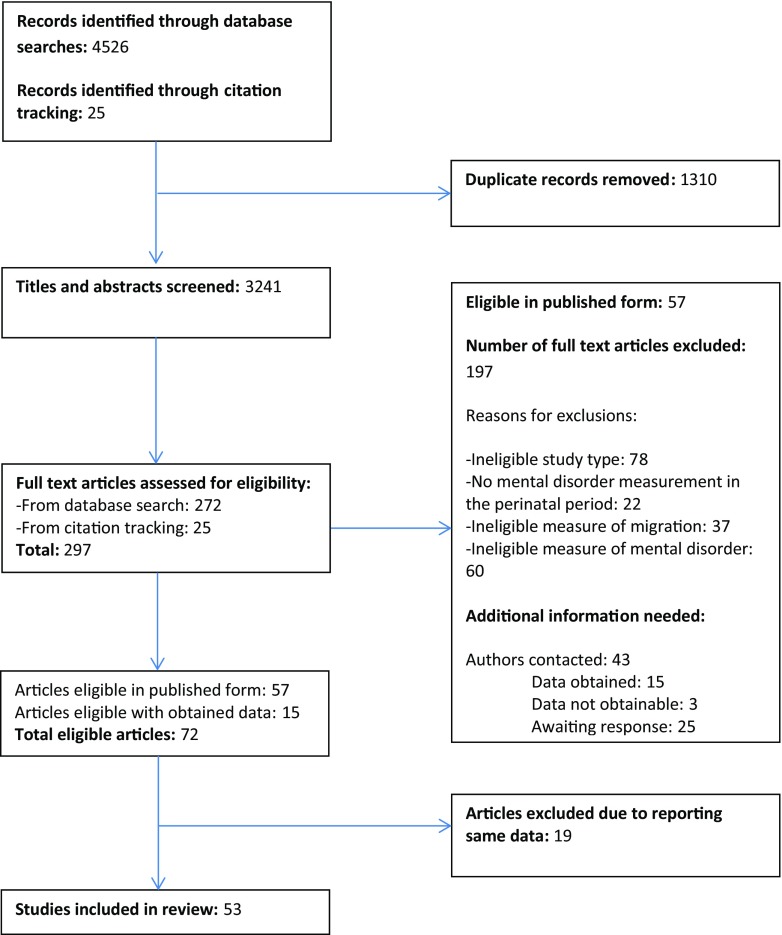
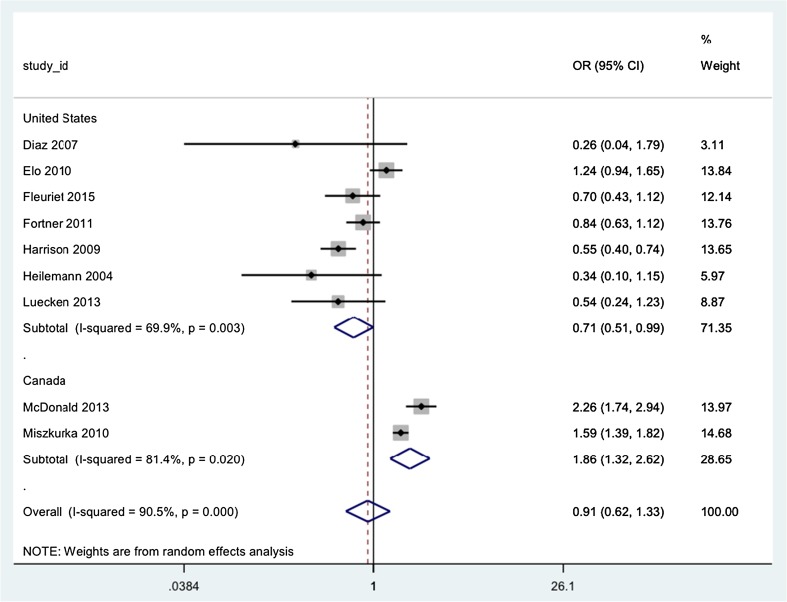
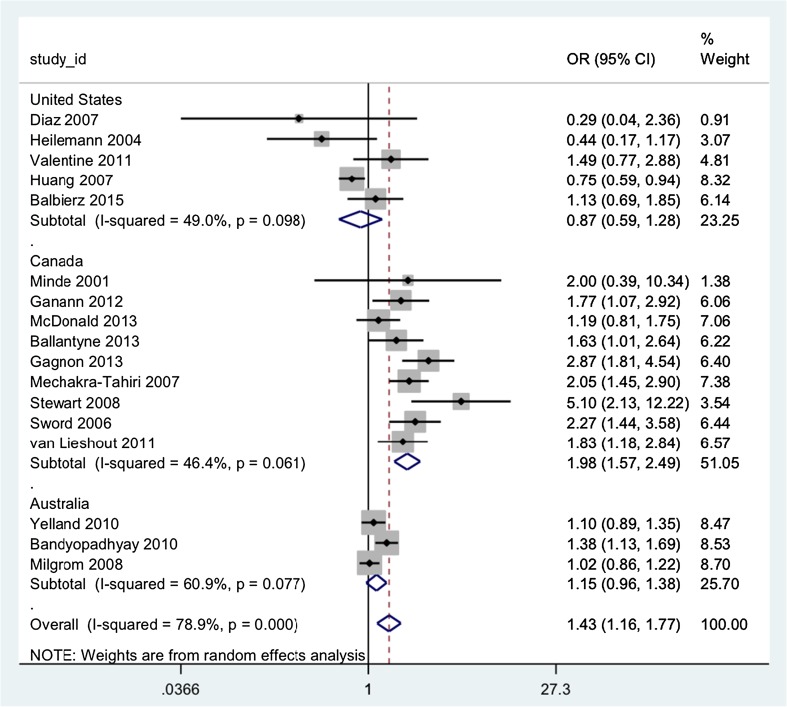
This study was conducted in order to evaluate the prevalence and risk of mental disorders in the perinatal period among migrant women. Six databases (including MEDLINE) were searched from inception to October 19th, 2015, in addition to citation tracking. Studies were eligible if mental disorders were assessed with validated tools during pregnancy and up to 1 year postpartum among women born outside of the study country. Of 3241 abstracts screened, 53 met the inclusion criteria for the review. Only three studies investigated a mental disorder other than depression. Unadjusted odds ratios were pooled using random effects meta-analysis for elevated depression symptoms during pregnancy (n = 12) and the postpartum (n = 24), stratified by study country due to heterogeneity. Studies from Canada found an increased risk for antenatal (OR = 1.86, 95% CIs 1.32-2.62) and postnatal elevated depression symptoms (OR = 1.98, 95% CIs 1.57-2.49) associated with migrant status. Studies from the USA found a decreased risk of antenatal elevated depression symptoms (OR = 0.71, 95% CIs 0.51-0.99), and studies from the USA and Australia found no association between migrant status and postnatal elevated depression symptoms. Low social support, minority ethnicity, low socioeconomic status, lack of proficiency in host country language and refugee or asylum-seeking status all put migrant populations at increased risk of perinatal mental disorders.
Overview
The claims and statistics of this paper haven’t been checked yet.
Free: it reads the open-access text and checks the first 5 claims that cite a source we can check. Create a free account to check every claim.
Integrity signals
Registry
Cites
Statistics
Figures
Verification
Claims the paper makes
The claims and statistics of this paper haven’t been checked yet.
Free: it reads the open-access text and checks the first 5 claims that cite a source we can check. Create a free account to check every claim.
Claims other papers make about this one
Each is checked against this paper’s own text: does it say what the citing paper says it does?
The cited source says what the claim attributes to it.
In the citing paper
“The factors and experiences contributing to migrant women's isolation and feelings of loneliness, including a lack of social support, language barriers, economic difficulties, life and childcare stresses, and having an ethnic minority and/or refugee/asylum seeking status, are also known to be associated with maternal mental health disorders in this population (43).”
From Social Isolation, Loneliness and Health: A Descriptive Study of the Experiences of Migrant Mothers With Young Children (0–5 Years Old) at La Maison Bleue (2022) · cites this paper as [43]
Self-check
Percentages, sums and reported differences re-computed from the paper’s own numbers.
The self-check needs the paper’s full text.
Citations
Cites
The CES-D Scale: A Self-Report Depression Scale for Research in the General Population
Radloff, L. S. (1977) · Applied Psychological Measurement · doi:10.1177/014662167700100306 · Cited by 53,267
(2014) · Medical Entomology and Zoology · Cited by 17,633
Detection of Postnatal Depression: Development of the 10-item Edinburgh Postnatal Depression Scale
Cox, J. L., Holden, J. M., & Sagovsky, R. (1987) · British Journal of Psychiatry · doi:10.1192/bjp.150.6.782 · Cited by 14,183
Downs, S. H., & Black, N. (1998) · Journal of Epidemiology and Community Health · doi:10.1136/jech.52.6.377 · Cited by 8,252
Beck, A. T., Steer, R. A., & Brown, G. (2011) · PsycTESTS Dataset · doi:10.1037/t00742-000 · Cited by 7,535
Perinatal Depression: A Systematic Review of Prevalence and Incidence
Gavin, N. I., Gaynes, B. N., Lohr, K. N., Meltzer-Brody, S., Gartlehner, G., & Swinson, T. (2005) · Obstetrics & Gynecology · doi:10.1097/01.aog.0000183597.31630.db · Cited by 3,282
Kessler, R. C., Mickelson, K. D., & Williams, D. R. (1999) · Journal of Health and Social Behavior · doi:10.2307/2676349 · Cited by 2,228
Effects of perinatal mental disorders on the fetus and child
Stein, A., Pearson, R. M., Goodman, S. H., Rapa, E., Rahman, A., McCallum, M., Howard, L. M., & Pariante, C. M. (2014) · The Lancet · doi:10.1016/s0140-6736(14)61277-0 · Cited by 2,166
Non-psychotic mental disorders in the perinatal period
Howard, L. M., Molyneaux, E., Dennis, C.-L., Rochat, T., Stein, A., & Milgrom, J. (2014) · The Lancet · doi:10.1016/s0140-6736(14)61276-9 · Cited by 1,328
Self-citationMore than culture: Structural racism, intersectionality theory, and immigrant health
Viruell-Fuentes, E. A., Miranda, P. Y., & Abdulrahim, S. (2012) · Social Science & Medicine · doi:10.1016/j.socscimed.2011.12.037 · Cited by 1,269
Research works printed but not linked: 5
- Collins CH Zimmerman C Howard LM Refugee, asylum seeker, immigrant women and postnatal depression: rates and risk factors Archives of Women’s Mental Health 2011 14 3 11 10.1007/s00737-010-0198-7 21153849 · DOI · Paper page
- Critical Appraisal Skills Programme (CASP) (2014) CASP checklists. (http://media.wix.com/ugd/dded87_63fb65dd4e0548e2bfd0a982295f839e.pdf; http://media.wix.com/ugd/dded87_e37a4ab637fe46a0869f9f977dacf134.pdf). CASP, Oxford
- Jayaweera H Health of migrants in the UK: what do we know? 2011 Oxford Migration Observatory, University of Oxford 1 9
- Miszkurka M Goulet L Zunzunegui MV Antenatal depressive symptoms among Canadian-born and immigrant women in Quebec: differential exposure and vulnerability to contextual risk factors Soc Psychiatry Psychiatr Epidemiol 2012 47 1639 1648 10.1007/s00127-011-0469-2 22237717 · DOI
- United Nations Trends in international migration stock 2013 New York United Nations
Cited by
Items 101–177 of 177
Vaillancourt, M., Deville-Stoetzel, J.-B., deMontigny, F., Dubeau, D., Gervais, C., Meunier, S., Pierce, T., Ditto, B., & Costa, D. D. (2024) · BMC Pregnancy and Childbirth · doi:10.1186/s12884-024-06768-6 · Cited by 10
“…psychological distress that are particularly relevant and distinct to first-generation immigrant parents, such as social support [6, 13, 15–19], gender role stress [14, 20], acculturative stress (i.e. stress from challenges or conflicts due to the adjustment to a host society’s culture)…”
BackgroundHeller, H. M., de Vries, A. V. R., Hoogendoorn, A. W., Scheele, F., Kop, W. J., de Groot, C. J. M., Honig, A., & Broekman, B. F. P. (2022) · Maternal and Child Health Journal · doi:10.1007/s10995-022-03451-0 · Cited by 6
Ashley-Norman, T., Fellmeth, G. L., Brummaier, T., Nosten, S., Oo, M., Phichitpadungtham, Y., Wai, K., Khirikoekkong, N., Plugge, E., & McGready, R. M. (2022) · Wellcome Open Research · doi:10.12688/wellcomeopenres.17744.1 · Cited by 2
“Previous research into migrant and refugee maternal mental health has largely focused on populations that have relocated to high-income countries (HICs), highlighting a need for further study of populations who have resettled within LMICs 10,11 .”
InfluentialHerreros, M. C. M., Muñoz, M. D. L. F. R., Méndez, N. I., & Crespo, M. E. O. (2022) · International Journal of Environmental Research and Public Health · doi:10.3390/ijerph191811782 · Cited by 5
“There is also a low level of social support due to the separation of social networks due to migration and social isolation in the host country [13].”
BackgroundSimhi, M., Schiff, M., & Pat‐Horenczyk, R. (2023) · Ethnicity and Health · doi:10.1080/13557858.2023.2279479 · Cited by 3
Breastfeeding Performance Among Potentially Depressed Nursing Mothers
Syam, A., Iskandar, I., & Kadrianti, E. (2019) · Global Journal of Health Science · doi:10.5539/gjhs.v11n13p59 · Cited by 5
Barnwell, J., Robert, C. H., Nguyen, T., Davis, K. P., Gratton, C., Elgbeili, G., Pham, H., Meaney, M. J., Montreuil, T. C., & O’Donnell, K. J. (2024) · JMIR Pediatrics and Parenting · doi:10.2196/53786 · Cited by 3
Mangindin, E. L., Gottfreðsdóttir, H., Stoll, K. H., Cadée, F., Zoëga, H., & Swift, E. M. (2026) · Sexual & Reproductive Healthcare · doi:10.1016/j.srhc.2026.101200 · Cited by 2
Rayment‐Jones, H., Burton, S. P., Backer, K. D., Vowles, Z., Baker, N., Stevenson, K., Barry, Z., Kitchen, K., Rankin, J. M., & Sandall, J. (2026) · Midwifery · doi:10.1016/j.midw.2026.104773 · Cited by 2
Prieto, M. D., Aracena, M., Verges, A. J., & Gómez‐Pérez, L. (2022) · Revista chilena de obstetricia y ginecología · doi:10.24875/rechog.22000063 · Cited by 2
Alzahrani, H., Alburaidi, F. S., Alharthi, A. M., Ghobran, A. M. A., Alhaboob, Z. A., Alibrahim, A. O., Alansari, A. B., Alanazi, D. M., Alshehri, W., Almekbel, A. I., et al. (2024) · Journal of Advanced Trends in Medical Research · doi:10.4103/atmr.atmr_184_24 · Cited by 3
Minas, H., Diocera, D., & Colucci, E. (2025) · Behavioral Sciences · doi:10.3390/bs15050604 · Cited by 4
“…that this generally better physical and mental health is not maintained in the long term, and that migrants overall are at increased risk of developing mental disorders and suicidal ideation (Anderson et al., 2017; Chen et al., 2019; Donath et al., 2019; Farooq et al., 2021; Hasan et al., 2021).”
Country of Birth, Race, Ethnicity, and Prenatal Depression
Kelly-Taylor, K., Aghaee, S., Nugent, J. R., Oberman, N. R., Kubo, A., Kurtovich, E. M., Quesenberry, C. P., Sujan, A. C., Ridout, K. K., Bhalala, M. M., et al. (2025) · JAMA Network Open · doi:10.1001/jamanetworkopen.2025.31844 · Cited by 3
Chen, H., Lai, J. C., Wang, K., & Chien, L. (2022) · Archives of Psychiatric Nursing · doi:10.1016/j.apnu.2022.08.001 · Cited by 5
Kanga‐Parabia, A., Biggs, L. J., McClaren, B., Lewis, S., Pangli, K. K., & Archibald, A. D. (2025) · International Journal of Qualitative Methods · doi:10.1177/16094069251316998 · Cited by 1
“People born outside the country in which they reside experience inequities across many different areas of health and healthcare (Anderson et al., 2017; Billett et al., 2022; Davies-Tuck et al., 2017; Gibson-Helm et al., 2015; Khatri & Assefa, 2022; Mengesha et al., 2016, 2017; Murray & Skull, 2005).”
Maternal Attachment and Perinatal Health in Refugee Women: A Systematic Review
Catalá, P., Gutiérrez, L., Écija, C., & Peñacoba, C. (2025) · Psychiatry International · doi:10.3390/psychiatryint6010020 · Cited by 1
“These types of experiences can predispose mothers to develop mental health problems, such as depression or post-traumatic stress disorder, which negatively influences the type of attachment the child forms with them [9].”
InfluentialA Systematic Review and Meta-Analysis of the Mental Health of Immigrant Parents
Han, Y., Luo, X., Xiong, Y., Peng, X., & Wang, L. (2025) · Clinical Child and Family Psychology Review · doi:10.1007/s10567-025-00542-6 · Cited by 1
“In addition, studies from Canada have found an increased risk of more prenatal symptoms and postnatal depressive symptoms associated with immigrant status (Anderson et al., 2017; Miszkurka et al., 2010).”
Romero, S., Dunlavy, A. C., Berg, L., & Juárez, S. (2025) · Scientific Reports · doi:10.1038/s41598-025-26172-0 · Cited by 2
Goldenberg, S. M., Saadeh, K., Ramage, K., Pitpitan, E. V., Strathdee, S. A., Aguilar, M. Á., Ramos, N. E., Rangel, G., & Bojórquez, I. (2025) · SSM - Mental Health · doi:10.1016/j.ssmmh.2025.100567 · Cited by 3
Barriers to accessing perinatal mental health services in ethnically diverse women in the UK
Makinde, E., Davey, A., Collins, G., Wong, G., Morgan‐Trimmer, S., McCree, C., Brook, J., Fisher, L., Sharp, H. M., Howard, L. M., et al. (2026) · BMC Psychiatry · doi:10.1186/s12888-025-07159-7 · Cited by 2
Rayment‐Jones, H., Burton, S. P., Dasgupta, T., Barry, Z., Backer, K. D., Baker, N., Wilson, C. A., Stevenson, K., Vowles, Z., Kitchen, K., et al. (2026) · Public Health · doi:10.1016/j.puhe.2026.106175 · Cited by 2
McCloskey, R. J., Gregory, K. A., Sposato, M. F., Trainor, K., & Renbarger, K. M. (2026) · Social Sciences · doi:10.3390/socsci15020113 · Cited by 1
“While some cultures may emphasize, “it takes a village,” others may experience social isolation as a result of migration, acculturation, or displacement thus experiencing more PMH (Anderson et al. 2017; Reupert et al. 2022).”
Disciplina Medicină de Familie, U. D. M. Ş. F. „. D., Irina Angela, R. A. D. U., Efrim, I. A., Cabinet individual de medicină de familie, Î.-D.-F., Matei, D. B., Disciplina Medicină de Familie, U. D. M. Ş. F. „. D., & INSMC „Alessandrescu-Rusescu“, B. (2021) · Romanian Journal of Medical Practice · doi:10.37897/rjmp.2021.1.11 · Cited by 1
Training on cultural competency for perinatal mental health peer supporters
Marvin‐Dowle, K., Oshaghi, G., Fair, F. J., Ratcliffe, J., & Soltani, H. (2022) · British Journal of Midwifery · doi:10.12968/bjom.2022.30.12.668 · Cited by 1
Onilude, Y., Ojo, O., Evans, D. T., Crowley, J., Chopra, P., Ade-Ojo, G. O., & Knightly-Jones, K. (2024) · Healthcare · doi:10.3390/healthcare12232329 · Cited by 1
Sandhu, A., Aquino, M. R. J., & Tang, M. Y. (2024) · Ethnicity and Health · doi:10.1080/13557858.2024.2442332 · Cited by 2
“Factors such as limited social support, low socioeconomic status, inadequate language proficiency, and being a refugee or seeking asylum also contributed to the heightened vulnerability of migrant populations to perinatal mental disorders (Anderson et al. 2017).”
Mahon, A. M., Feldman, M., Rousseau, C., & Moro, M. R. (2020) · Santé mentale au Québec · doi:10.7202/1075389ar · Cited by 5
Analysis factors affecting postpartum depression in postpartum mothers during the COVID-19 pandemic
Kusumastuti, K., Rahmadhani, W., & Chamroen, P. (2022) · International Journal of Health Sciences · doi:10.53730/ijhs.v6n3.12441
“Each woman looks forward to giving birth as the community perceives that a perfect woman is a woman who has given birth (Anderson et al., 2017).”
BackgroundThomas, R. (2018) · UA Campus Repository (The University of Arizona) · Cited by 1
Ikhilor, P. O., Brändle, T., Pulver, S., & Kurth, E. (2019) · International Journal of Health Professions · doi:10.2478/ijhp-2019-0006
Mixed-method evaluation of a community-based postpartum support program: a study protocol
Etowa, J. B., Johnston, A., Jama, Z., Eccles, K. M., & Ashton, A. (2020) · BMJ Open · doi:10.1136/bmjopen-2019-036749 · Cited by 1
Stirling-Cameron, E., DuPlessis, B. J., Aston, M. L., Ramos, H., & Jackson, L. A. (2020) · doi:10.21203/rs.3.rs-101217/v1
Driver, M. P. (2020) · ResearchWorks at the University of Washington (University of Washington)
Canfield, S. M. (2021) · MOspace Institutional Repository (University of Missouri) · doi:10.32469/10355/85766 · Cited by 1
Obstetric Care of Migrant Populations
Mamopoulos, A. M., Tsakiridis, I. G., & Athanasiadis, A. P. (2021) · Cambridge University Press eBooks · doi:10.1017/9781108863049.023
Due, C., Walsh, M., Aldam, I., Winter, A., Cooper, S. C., Sheriff, J., & Ziersch, A. M. (2022) · Research Square · doi:10.21203/rs.3.rs-1436244/v1
Prevention and Treatment of Perinatal Mental Disorders in Migrant Women
Bassi, M., Gnanapragasam, S., Malhotra, A. M., & Bhugra, D. (2022) · Springer eBooks · doi:10.1007/978-3-030-91832-3_19
Rahmadhani, W., Mutoharoh, S., & Kusumastuti, K. (2022) · Jurnal Aisyah : Jurnal Ilmu Kesehatan · doi:10.30604/jika.v7i1.774
Stevenson, K., Fellmeth, G. L., Edwards, S., Calvert, C., Bennett, P. R., Campbell, O. M. R., & Fuhr, D. C. (2022) · SSRN Electronic Journal · doi:10.2139/ssrn.4105599
Migrant women and mental health
Markey, K., Ogbuagu, A. C., & O’Brien, B. (2022) · British Journal of Midwifery · doi:10.12968/bjom.2022.30.10.592
Mental Health Conditions in the Postpartum Period: A Scoping StudyPreprint
Ojomo, O. A., Alesinloye-King, O., Erlandsson, K., Ängeby, K., & Envall, N. (2023) · Research Square · doi:10.21203/rs.3.rs-2623747/v1 · Cited by 1
Waqas, A., Zafar, S. W., Akhtar, P. S., et al. (2023) · Cambridge Prisms Global Mental Health · doi:10.1017/gmh.2023.8.pr10
Waqas, A., Zafar, S. W., Akhtar, P. S., et al. (2023) · Cambridge Prisms Global Mental Health · doi:10.1017/gmh.2023.8.pr8
Waqas, A., Zafar, S. W., Akhtar, P. S., et al. (2023) · Cambridge Prisms Global Mental Health · doi:10.1017/gmh.2023.8.pr6
Waqas, A., Zafar, S. W., Akhtar, P. S., et al. (2023) · Cambridge Prisms Global Mental Health · doi:10.1017/gmh.2023.8.pr9
Waqas, A. (2023) · Cambridge Prisms Global Mental Health · doi:10.1017/gmh.2023.8.pr7
Waqas, A., Zafar, S. W., Akhtar, P. S., et al. (2022) · Cambridge Prisms Global Mental Health · doi:10.1017/gmh.2023.8.pr4
Waqas, A., Zafar, S. W., Akhtar, P. S., et al. (2022) · Cambridge Prisms Global Mental Health · doi:10.1017/gmh.2023.8.pr3
Waqas, A., Zafar, S. W., Akhtar, P. S., et al. (2022) · Cambridge Prisms Global Mental Health · doi:10.1017/gmh.2023.8.pr5
Waqas, A., Zafar, S. W., Akhtar, P. S., et al. (2022) · Cambridge Prisms Global Mental Health · doi:10.1017/gmh.2023.8.pr2
Waqas, A. (2022) · Cambridge Prisms Global Mental Health · doi:10.1017/gmh.2023.8.pr1
Olakotan, O. O., Lim, J. N., Bhavsar, M., Siddiqui, F., Ayaz, R., Henry, G. O., Jonathan, C. K. W., & Pillay, T. (2023) · Research Square · doi:10.21203/rs.3.rs-3303108/v1
Dowlat, I. K. (2023) · Research Review · doi:10.52845/ijmhs/2023/13-09-1
Legse, L., Alemu, M. T., & Nigatu, D. T. (2024) · Science Journal of Public Health · doi:10.11648/j.sjph.20241203.14
Factors Affecting Diasporic Women’s Quality of Life: A Systematic Review
Pyo, Y., & Kwon, K. H. (2024) · Journal of Multidisciplinary Healthcare · doi:10.2147/jmdh.s467091
Rayment‐Jones, H., Burton, S. P., Dasgupta, T., Backer, K. D., Baker, N., Wilson, C. A., Stevenson, K., Barry, Z., Vowles, Z., Kitchen, K., et al. (2025) · SSRN Electronic Journal · doi:10.2139/ssrn.5398611
Philip, B., Kemp, L., Taylor, C. M., & Schmied, V. A. (2025) · Qualitative Health Research · doi:10.1177/10497323251382044
Davison, N., Behl, R., Baek, Y., Tran, T. D., & Fisher, J. (2025) · Current Psychiatry Reports · doi:10.1007/s11920-025-01649-x · Cited by 2
“These social and cultural factors can contribute to the risk of developing conditions such as perinatal depression which can have significant impacts on individuals and com - munities, and can interfere with optimal maternal and child health [3–6].”
Hukou status and perinatal depression: a longitudinal cohort study in China
Zhou, T., Sun, Y., Chen, F., Yang, X., Jiang, C. W., & Gu, X. (2025) · Frontiers in Public Health · doi:10.3389/fpubh.2025.1711901
Miah, J., Bee, P., Lunat, F., McPhillips, R., Taylor, A. K., Aseem, S., Sharma, D., Husain, N., & Chew-Graham, C. A. (2025) · BMJ Open · doi:10.1136/bmjopen-2024-096828 · Cited by 1
Pilav, S., Backer, K. D., Easter, A., Silverio, S. A., Sundaresh, S., Roberts, S., & Howard, L. M. (2022) · Figshare · doi:10.6084/m9.figshare.19793124
Rogers, H. J., AO, C. S. E. H., & Henry, A. (2024) · Figshare · doi:10.6084/m9.figshare.26638122
Rogers, H. J., AO, C. S. E. H., & Henry, A. (2024) · Figshare · doi:10.6084/m9.figshare.26638125
Rogers, H. J., AO, C. S. E. H., & Henry, A. (2024) · Figshare · doi:10.6084/m9.figshare.26638119
Echevarria, E., Branche, T. N., Miller, E. R., Novod, K., & Walker, V. P. (2026) · Journal of Perinatology · doi:10.1038/s41372-025-02493-w · Cited by 2
“Mentalhealth outcomes are in fl uenced by a family ’ s cultural background, religious/spiritual beliefs, lived experiences, and ability to access mental health services [3, 9, 13 – 18].”
The Perinatal Mental Health of Racial and Ethnic Minority Groups
Catalão, R., Codjoe, L., Das, P., Dyer, J., & Hatch, S. L. (2026) · Cambridge University Press eBooks · doi:10.1017/9781911623496.010
Ahimsadasan, N., Wu, W., Rahman, I., Sherifali, D., & Lipscombe, L. L. (2026) · Diabetic Medicine · doi:10.1111/dme.70339
“24 These inconsistencies likely reflect differences in sociocultural and healthcare contexts.”
InfluentialMental health in the perinatal period: bridging the gaps in care, evidence, and policy
Pramono, M. B. A., Andonotopo, W., Bachnas, M. A., Prabowo, W., Yuliantara, E. E., Dewantiningrum, J., Lukas, E., Sanjaya, I. N. H., Wiradnyana, A. A. G. P., Kusuma, A. A. N. J., et al. (2026) · Journal of Perinatal Medicine · doi:10.1515/jpm-2025-0301
“Migrant women, for example, carry a higher burden of perinatal mental disorders than host populations [10].”
InfluentialFirth, A., Haith‐Cooper, M., Hart, A., & Dickerson, J. (2026) · Midwifery · doi:10.1016/j.midw.2026.104898
Pinar, S., Johnson, J., Sulandari, S., & Joyal‐Desmarais, K. (2026) · Midwifery · doi:10.1016/j.midw.2026.104916
Kassam, S., Hirani, S. S., Miller, K. M., Sutanto, S., McGeer, J. P., Datoo, U., Nguyen, L. B. T., Chu, C., Surjani, P., & Awolesi, C. A. (2026) · Journal of Immigrant and Minority Health · doi:10.1007/s10903-026-01950-8
The Social Impact of Migration on Immigrant Women: Gendered Disruptions, Resilience, and Identity
Maleku, A., Kagotho, N., Hu, R., Mengo, C. W., & Karandikar, S. (2026) · Journal of International Migration and Integration / Revue de l integration et de la migration internationale · doi:10.1007/s12134-026-01437-3
del Castillo, R. P. (2025) · MEDICA REVIEW International Medical Humanities Review / Revista Internacional de Humanidades Médicas · doi:10.62701/revmedica.v13.5486
Hirani, S. S., Balachandran, S., Dev, R., Lee, K., & Carter, M. (2026) · PLoS ONE · doi:10.1371/journal.pone.0352132
Renzaho, A. M. N. (2026) · International Journal of Migration Health and Social Care · doi:10.1108/ijmhsc-04-2025-0048
Sokoto, K. C., Milord, J., Taknint, J. T., Gellatly, R., Montgomery, A., Amesekere, M., Louis, K. R., Mosawi, L. A., Muthiga, M., & Henderson, D. C. (2026) · Behavioral Sciences · doi:10.3390/bs16101951
“Migrant pregnant women, including forced migrants, are disproportionately affected by PMH conditions (Anderson et al., 2017; Laumonnier et al., 2026; Stevenson et al., 2023).”
Metadata
- Authors
- Anderson, F. M., Hatch, S. L., Comacchio, C., & Howard, L. M.
- Affiliations
- King's College London (GB)
- University of Verona (IT)
- Corresponding author
- Anderson, Fraser M
- Venue
- Archives of Women s Mental Health
- Published
- 2017-04-08
- Volume
- 20
- Issue
- 3
- Pages
- 449-462
- ISSN
- 1434-1816 (ISSN-L)
- 1435-1102
- PMC
- PMC5423996
- OpenAlex
- W2605243808
- Cited by
- 178
- References
- 83
- Citations by year
- 2026: 16 · 2025: 17 · 2024: 19 · 2023: 24 · 2022: 44 · 2021: 16 · 2020: 20 · 2019: 13 · 2018: 8 · 2017: 1
- FWCI
- 1.87
- Type
- journal article
- Language
- en
- Open access
- hybrid
- doi.org
- Locations
- Archives of Women s Mental Health (publishedVersion, cc-by)
- Europe PMC (PubMed Central) (publishedVersion, other-oa)
- PubMed Central (publishedVersion, cc-by)
- PubMed (publishedVersion)
- Research Portal (King's College London) (submittedVersion, cc-by)
- Funders
- National Institute for Health Research (PhD studentship, Salary support, Research Professorship)
- Topics
- Health Sciences › Medicine › Public Health, Environmental and Occupational Health › Maternal Mental Health During Pregnancy and Postpartum
- Social Sciences › Psychology › Clinical Psychology › Migration, Health and Trauma
- Health Sciences › Medicine › Pediatrics, Perinatology and Child Health › Maternal and Neonatal Healthcare
- Keywords
- perinatal mental disorders, migrant women, depression, antenatal depression, postpartum depression, prevalence, risk factors, social support, ethnic minorities, socioeconomic status, language proficiency, refugee status, Canada, Australia
- MeSH terms
- Adult, Australia, Canada, Depressive Disorder, Female, Humans, Mothers, Pregnancy, Refugees, Risk Factors, Transients and Migrants, United States, Prevalence, Odds Ratio, Pregnant People
About these checks
Registry, retraction, Cites and statistics results are computed, not judged, with one exception: a printed reference that no index lists is read once by a model before it counts as a citation error. Claims are extracted by a model and kept only when their quote appears verbatim in the text; each cited source is then checked, with a model’s help, for whether it says what the claim relies on. Those verdicts can be wrong — read the claim’s quote and the cited source before relying on one.
Statistics and arithmetic are recomputed, not judged.
Confidence bands are shown only for fields calibrated on our annotated test set. None is calibrated yet, so no band is shown.
What counts as a claim ›How we measure confidence ›How we check this ›
Are you an author, or do you see a problem with this page? Request a review
Data sources
Bibliographic data: Semantic Scholar, OpenAlex, Crossref.
Contains information from the Semantic Scholar Academic Graph Datasets, made available under the ODC Attribution License (ODC-BY 1.0).
Semantic Scholar’s data is described in: Kinney, R., et al. (2023). The Semantic Scholar Open Data Platform. arXiv:2301.10140.
